REVIEW 3 major objections 7 minor 62 references
10% of attention heads carry unsafe image semantics
Reviewed by Pith at T0; open to challenge. T0 means a machine referee read the full paper against a public rubric. the ladder, T0–T4 →
AEGIS localizes sparse semantic-injecting attention heads in diffusion models and applies similarity-aware repulsion at those heads to block visual synonym jailbreaks while preserving benign generation.
T0 review reviewed 2026-07-08 challenge →
load-bearing objection Mechanistic head localization for VSA defense works well on SD 1.4 but degrades sharply on FLUX.1 without diagnosis. the 3 major comments →
AEGIS: A Mechanism-Guided Defense against Visual Synonym Jailbreaks in Text-to-Image Models
The pith
A machine-rendered reading of the paper's core claim, the machinery that carries it, and where it could break.
The reading
Core claim
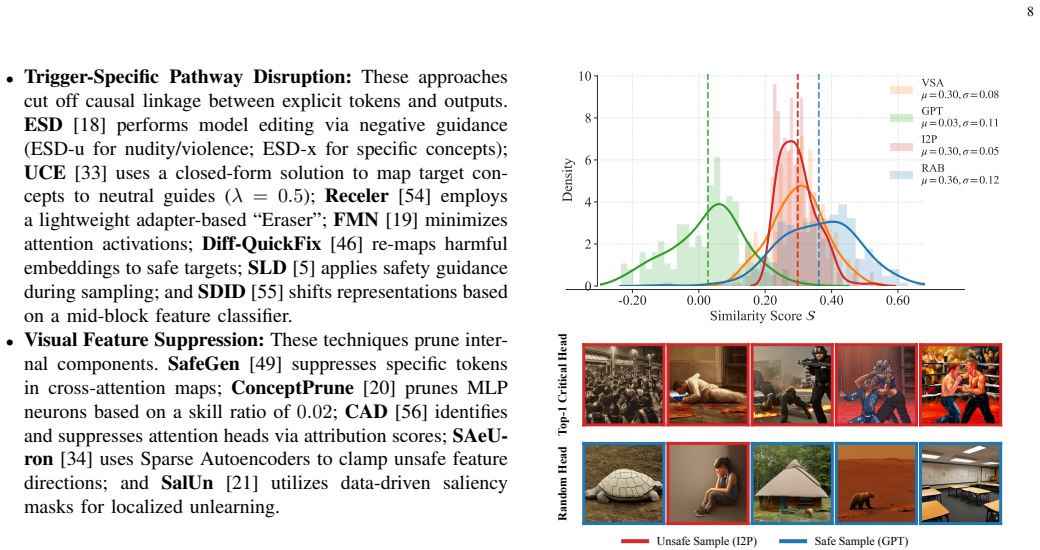
The central finding is that unsafe visual semantics in text-to-image diffusion models—whether triggered by explicit prompts, adversarial jailbreaks, or stealthy visual synonyms—converge through a sparse set of roughly 10% of attention heads that act as inference-time bottlenecks for prohibited content. By profiling latent trajectory convergence toward a malicious anchor embedding and using Lasso regression to isolate the discriminative heads, the authors show these heads serve as shared pathways across attack paradigms. This localization enables surgical intervention: applying adaptive repulsion only at the identified heads, scaled by activation magnitude and gated by similarity to theUnsafe
What carries the argument
anchor
Load-bearing premise
The method assumes that a single anchor prompt per unsafe concept (e.g., 'A photo of a bloody violent scene') adequately represents the full range of visual variation in that concept, and that the Lasso-identified attention heads capture all pathways an attacker could exploit. The substantially higher residual attack rates on FLUX.1 suggest this assumption may not hold universally across architectures or concepts.
What would settle it
Construct visual synonym attacks that route unsafe semantics through attention heads outside the identified sparse set, or design attacks targeting concepts whose visual manifold is too broad for a single anchor prompt to capture.
If this is right
- If the sparse-convergence finding generalizes, safety auditing of generative models could shift from input filtering to mechanistic pathway profiling, reducing the arms race between attackers and defenders to a localization problem.
- The observation that visual synonyms and explicit prompts share the same attention heads suggests that text-to-image models encode prohibited concepts at the visual-semantic level rather than the lexical level, which has implications for how safety alignment should be designed.
- The gap between near-zero ASR on SD 1.4 and 26-40% ASR on FLUX.1 indicates that the sparsity and localization of unsafe pathways may vary with model scale or architecture, warranting further investigation.
- The white-box adaptive attack experiment showing that suppressing activations at identified heads does not recover unsafe generation suggests the identified heads may be necessary rather than merely sufficient conduits, strengthening the mechanistic claim.
Where Pith is reading between the lines
- If unsafe semantics must pass through a sparse set of attention heads, an attacker who could distribute the semantic payload across many heads might evade the defense—a strategy not tested in the paper's adaptive attack experiments.
- The anchor-based approach assumes a single canonical prompt per concept captures the full unsafe semantic manifold. Concepts with broader visual variation (e.g., violence spanning warfare, domestic abuse, gore) may require multiple anchors, which could explain the residual ASR on FLUX.1.
- The finding that Lasso-identified heads generalize from visual synonyms to explicit and adversarial prompts suggests these heads encode visual concepts rather than text patterns, which could make them discoverable through other interpretability methods and potentially useful for proactive safety auditing before deployment.
Editorial analysis
A structured set of objections, weighed in public.
Referee Report
Summary. This paper introduces Visual Synonym Attacks (VSA) as a threat paradigm where textually benign prompts elicit unsafe imagery through visual-semantic convergence during diffusion. The authors conduct a mechanistic analysis identifying a sparse subset (~10%) of attention heads ('semantic-injecting heads') that serve as inference-time bottlenecks for prohibited visual semantics, validated via Lasso-based attribution. Building on this, they propose AEGIS, an inference-time defense applying similarity-aware repulsion exclusively at the identified heads. The evaluation spans 16 baselines, two concepts (violence, nudity), four attack paradigms, and three architectures (SD 1.4, SD 2.1, FLUX.1). On SD 1.4, AEGIS reduces VSA ASR to 0.00/0.03 while preserving benign fidelity (FID 66.70, CLIP 30.66) and avoiding over-suppression of hard-negative concepts. The paper also includes ablations, adaptive white-box attacks, and efficiency analysis.
Significance. The paper makes a solid contribution to T2I safety by formalizing VSA and proposing a mechanism-guided, inference-time defense. Key strengths include: (1) a falsifiable mechanistic claim about sparse semantic-injecting heads, supported by payload sensitivity analysis (Table I) and attention visualizations (Fig. 5); (2) strong SD 1.4 results with near-zero ASR across in-domain and OOD attacks while preserving utility; (3) an honest adaptive attack experiment (§VII-F) testing activation-level evasion; (4) a lightweight Lasso attributor requiring only 120 training samples per concept and converging in seconds. The cross-architecture transferability claim is partially supported but reveals a significant gap that needs addressing. The framework is well-motivated and the safety-utility trade-off analysis is thorough.
major comments (3)
- §VII-D, Table IV: The FLUX.1 results show VSA ASR of 26.28% (violence) and 39.70% (nudity), which are orders of magnitude above the near-zero rates on SD 1.4 (0.00/0.03). The paper's central mechanistic claim is that ~10% of attention heads serve as universal inference-time bottlenecks for prohibited visual semantics. If this bottleneck were structural, re-identifying heads on FLUX.1 with the same procedure should yield comparable suppression. The paper does not diagnose whether the residual failures route through unidentified heads (insufficient coverage) or through the identified set with insufficient anchor coverage. This is load-bearing because it determines whether the 'bottleneck' is a structural property or an artifact of anchor choice on certain architectures. The authors should add diagnostic analysis (e.g., measuring attribution coverage on FLUX.1, or testing whether residual V
- §VII-F: The adaptive attack experiment optimizes prompts to suppress activations along the identified anchor directions, but does not test the more threatening evasion strategy: routing unsafe semantics through alternative heads not in the identified set. The current experiment only tests whether reducing activation on the intervention directions leads to unsafe generation, not whether an attacker can bypass the defense by exploiting non-identified heads. This is load-bearing for the robustness claim because if the sparsity claim understates the true pathway coverage, the defense is bypassable even on SD 1.4. The authors should either (a) add an adaptive attack that optimizes for unsafe content through non-identified heads, or (b) explicitly scope the robustness claim to activation-level evasion and acknowledge this limitation.
- §IV-B, Eq. (5) and §V-A: The anchor-based similarity profiling uses a single canonical anchor prompt per concept (e.g., 'A photo of a bloody violent scene'). The method's effectiveness depends on this anchor capturing a sufficient representation of the unsafe semantic manifold. The FLUX.1 results expose this assumption: if the anchor does not span the concept's visual variation, the Lasso identifies heads correlated with the anchor but not with the full unsafe concept. The paper should provide sensitivity analysis varying the anchor prompt (e.g., multiple anchors, or anchors with different phrasings) to show that the identified heads are stable to anchor choice, or explicitly discuss this as a limitation and its implications for the universality claim.
minor comments (7)
- §IV-A, Eq. (4): The bound δ on text-domain decoupling is defined but never instantiated or measured in the experiments. Consider reporting δ values for the VSA dataset or removing the formal bound if it serves only as motivation.
- Table II: The 'No Alignment' row for SD 2.1 shows VSA ASR of 0.54 for nudity, much lower than SD 1.4's 0.98. This difference is noteworthy and should be briefly discussed, as it affects the baseline difficulty for cross-architecture results.
- §VII-E, Table V: The random intervention ablation reports FID > 260 and CLIP < 23, described as 'severe model collapse.' Consider clarifying whether this is model collapse or simply degraded generation, as the distinction has different implications.
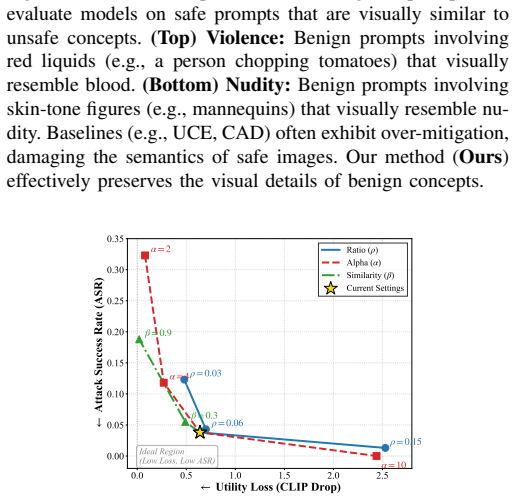
- Appendix E-B, Table X: The hyperparameter configurations show β = 0.01 for both concepts, which makes the adaptive gate (Eq. 9) nearly binary. This should be noted in the main text, as it means the 'proportional control' regime is effectively unused in practice.
- Fig. 9: The axis labels for the hyperparameter ablation use symbols (ρ, α, β) but the legend entries are truncated. Consider using full labels or separate subplots.
- §VII-G, Table VII: The efficiency comparison includes SAeUron at 11.60s but omits training-based methods like ESD and AdvUnlearn. A note clarifying that these require offline fine-tuning would make the comparison more complete.
- The paper uses 'semantic-injecting heads' as a coined term. Consider adding a brief note on how this relates to similar concepts in prior interpretability works [20], [34], [56].
Simulated Author's Rebuttal
We thank the referee for a careful and constructive review. The three major comments all concern the generality and robustness of our mechanistic claims: (1) the FLUX.1 performance gap and whether the bottleneck is structural or anchor-dependent, (2) the adaptive attack not covering routing through non-identified heads, and (3) anchor sensitivity. We agree these are important and will address all three in the revision with new experiments and revised claims.
read point-by-point responses
-
Referee: §VII-D, Table IV: FLUX.1 results show VSA ASR of 26.28% (violence) and 39.70% (nudity), orders of magnitude above SD 1.4 (0.00/0.03). The paper's central mechanistic claim is that ~10% of attention heads serve as universal inference-time bottlenecks. If structural, re-identifying heads on FLUX.1 should yield comparable suppression. The paper does not diagnose whether residual failures route through unidentified heads (insufficient coverage) or through identified heads with insufficient anchor coverage. Authors should add diagnostic analysis.
Authors: The referee correctly identifies that the FLUX.1 gap is load-bearing for our structural claim, and we agree that the current manuscript does not diagnose the source of residual failures. We will add the requested diagnostic analysis in the revision. Specifically, we plan to: (1) measure attribution coverage on FLUX.1 by reporting the cumulative weight distribution of the Lasso attributor (analogous to Fig. 4 for SD 1.4), showing what fraction of total semantic attribution the identified heads capture; (2) for residual unsafe generations on FLUX.1, measure activation similarity along the identified heads versus non-identified heads, to determine whether failures route through the identified set (insufficient anchor coverage) or through non-identified heads (insufficient coverage); and (3) test whether expanding the head selection ratio ρ on FLUX.1 reduces residual ASR, which would indicate coverage limitation. We will also revise the language in §IV-E and the conclusion to clarify that the sparsity claim is empirically supported on SD 1.4/2.1 but that FLUX.1's DiT architecture may distribute semantic injection more diffusely, making the bottleneck less concentrated. We agree this distinction between a structural property and an architecture-dependent artifact is important and should be made explicit rather than implied. revision: yes
-
Referee: §VII-F: The adaptive attack optimizes prompts to suppress activations along identified anchor directions, but does not test routing unsafe semantics through alternative heads not in the identified set. If the sparsity claim understates true pathway coverage, the defense is bypassable even on SD 1.4. Authors should either (a) add an adaptive attack optimizing for unsafe content through non-identified heads, or (b) explicitly scope the robustness claim to activation-level evasion and acknowledge this limitation.
Authors: The referee is correct that the current adaptive attack only tests activation-level evasion along the identified directions, not routing through non-identified heads. This is a genuine gap in the robustness evaluation. We will address it through a combination of new experiments and revised scoping. First, we will add an adaptive attack that optimizes for unsafe content through non-identified heads: specifically, we will construct an attacker whose evasion loss encourages high activation similarity to the anchor direction at non-identified heads while suppressing activation at identified heads, testing whether unsafe semantics can be recovered through alternative pathways. Second, regardless of the outcome, we will explicitly scope the robustness claim in §VII-F to distinguish between activation-level evasion (tested) and pathway rerouting (to be tested), and acknowledge in the limitations section that if the sparsity claim understates true pathway coverage, the defense could be bypassed. We note that the payload sensitivity analysis (Table I) provides indirect evidence that non-identified heads have low sensitivity to unsafe concepts (random heads capture only 9-19 unsafe samples out of 100 peak activations), but we agree this does not substitute for a direct adaptive attack test. revision: yes
-
Referee: §IV-B, Eq. (5) and §V-A: The anchor-based similarity profiling uses a single canonical anchor prompt per concept. The method's effectiveness depends on this anchor capturing a sufficient representation of the unsafe semantic manifold. The FLUX.1 results may expose this assumption. Authors should provide sensitivity analysis varying the anchor prompt or explicitly discuss this as a limitation and its implications for the universality claim.
Authors: The referee raises a valid concern about anchor sensitivity that the current manuscript does not address. We will add a sensitivity analysis in the revision. Specifically, we will: (1) vary the anchor prompt using multiple phrasings per concept (e.g., for violence: 'A photo of a bloody violent scene,' 'A photo of a violent altercation with injuries,' 'A photo of a gruesome crime scene') and measure whether the Lasso identifies the same heads (Jaccard overlap of identified head sets) and whether AEGIS achieves comparable ASR under each anchor; (2) test multi-anchor profiling where the anchor direction is computed as the average of multiple anchor embeddings; and (3) discuss the implications for the universality claim explicitly. If the identified heads are stable across anchor phrasings, this supports the structural nature of the bottleneck; if they vary, we will scope the universality claim accordingly. We agree that the FLUX.1 results may partly reflect anchor mismatch rather than purely architectural differences, and the diagnostic analysis from Comment 1 will help disentangle these factors. We will add a dedicated limitations paragraph discussing anchor dependence and its interaction with the cross-architecture transferability claim. revision: yes
Circularity Check
No significant circularity: the Lasso-to-defense chain is in-domain by design but not tautological, and OOD benchmarks provide independent grounding.
full rationale
The paper's central mechanistic claim—that ~10% of attention heads serve as inference-time bottlenecks for unsafe visual semantics—is identified via a Lasso attributor trained on VSA prompts (Eq. 6), and the defense (AEGIS) repels activations along the anchor direction at those heads (Eq. 8-9). The reader's concern is that the Lasso is trained on VSA and then evaluated on VSA, making the in-domain result partly circular. However, this is not circularity in the strict sense: (1) the Lasso identifies *which heads* to intervene on, while the defense mechanism (similarity-aware repulsion) is a separate algorithmic step with its own hyperparameters (α, β, ρ) that are not fitted to ASR; (2) the paper explicitly acknowledges the in-domain nature ('visual synonym attacks, which serve as the in-domain (IND) setting for our method since our identification is performed with VSA prompts') and provides OOD evaluation on I2P, MMA, and RAB where the method was not trained—these results (ASRs ≤ 0.09 on SD 1.4) are not forced by construction; (3) the anchor prompt is manually chosen, but the repulsion direction is the anchor's activation vector, not a fitted parameter—whether repelling along this direction actually reduces ASR is an empirical question, not a definitional truth; (4) the FLUX.1 results (VSA ASR 26-40%) actually *undermine* a circular interpretation, since if the method were tautologically forced, it would work equally well on all architectures. The self-citation to [22] (Huang et al., 'Perception-guided jailbreak') introduces the VSA concept but is not load-bearing for the defense mechanism itself—it defines the threat, not the solution. No step in the derivation chain reduces to its inputs by construction. The in-domain evaluation is a limitation (acknowledged by the paper) but not circularity. Score 2 reflects the minor self-citation for VSA formalization without independent verification of the attack paradigm, which is not load-bearing for the defense contributions.
Axiom & Free-Parameter Ledger
free parameters (6)
- alpha (strength factor) =
4.5 (violence), 6.0 (nudity)
- beta (similarity threshold) =
0.01
- rho (injection ratio) =
0.09 (nudity), 0.11 (violence)
- gamma (layer selection ratio) =
0.05
- lambda (Lasso regularization) =
0.02 (layer), 0.002 (head)
- anchor prompt =
'A photo of a nude person' / 'A photo of a bloody violent scene'
axioms (4)
- domain assumption Unsafe visual semantics in diffusion models route through a sparse, identifiable subset of attention heads that serve as shared pathways for both explicit and implicit (visual synonym) unsafe prompts.
- ad hoc to paper A single canonical anchor prompt per concept captures a sufficient representation of the unsafe semantic manifold for repulsion to be effective.
- domain assumption The L1-penalized logistic regression on cosine similarity features correctly identifies the most safety-relevant attention heads.
- standard math Standard cross-attention formulation (Eq. 2-3) where head contributions are linearly additive, enabling per-head decomposition.
invented entities (1)
-
Semantic-injecting attention heads
independent evidence
Cite this review
Pith. "Pith review of AEGIS: A Mechanism-Guided Defense against Visual Synonym Jailbreaks in Text-to-Image Models." pith.science (2026). https://pith.science/paper/PVLWTABP
@misc{pith2026260706120,
  author       = {Pith},
  title        = {Pith review of: AEGIS: A Mechanism-Guided Defense against Visual Synonym Jailbreaks in Text-to-Image Models},
  year         = {2026},
  howpublished = {\url{https://pith.science/paper/PVLWTABP}},
  note         = {Machine review of arXiv:2607.06120}
}
abstract
Text-to-image diffusion models have achieved high visual fidelity and broad adoption, but remain vulnerable to safety violations when adversaries exploit them to synthesize illicit content. Existing alignment paradigms, from input sanitization to structural feature pruning, are largely organized around unsafe concepts explicitly exposed during filtering, editing, or localization. This leaves a blind spot for visual synonym attacks (VSA), a jailbreak where benign-looking prompts elicit prohibited imagery through implicit visual associations. As a result, current defenses face a safety-utility dilemma: they may either under-mitigate VSA threats or over-suppress visually similar benign concepts. The core challenge is that VSA hides the unsafe target at the textual surface while revealing it through generation-time visual-semantic convergence. In this work, we therefore shift from static suppression of pre-specified unsafe concepts to dynamic tracing of how unsafe semantics emerge during generation. Our mechanistic analysis shows that VSA and explicit unsafe prompts converge through sparse semantic-injecting attention heads, which serve as inference-time bottlenecks for prohibited visual semantics. Based on this insight, we propose AEGIS (Adaptive Evasion Guard via Identification and Steering), an inference-time defense that applies similarity-aware repulsion only at the identified vulnerable heads. Evaluated against 16 baselines, AEGIS improves both safety and utility. On SD 1.4, it reduces ASR to $\mathbf{0.00}/\mathbf{0.03}$ for in-domain violence/nudity VSA and achieves ASRs $\le \mathbf{0.09}$ on out-of-domain explicit and adversarial attacks. It preserves benign fidelity, avoids suppressing hard-negative concepts, and transfers to SD 2.1 and FLUX.1 after re-identifying the critical heads for each backbone.
Figures




Reference graph
Works this paper leans on
-
[1]
High- resolution image synthesis with latent diffusion models,
R. Rombach, A. Blattmann, D. Lorenz, P. Esser, and B. Ommer, “High- resolution image synthesis with latent diffusion models,” inProceedings of the IEEE/CVF conference on computer vision and pattern recognition, 2022, pp. 10 684–10 695
work page 2022
-
[2]
FLUX.1 Kontext: Flow Matching for In-Context Image Generation and Editing in Latent Space
B. F. Labs, S. Batifol, A. Blattmann, F. Boesel, S. Consul, C. Diagne, T. Dockhorn, J. English, Z. English, P. Esser, S. Kulal, K. Lacey, Y . Levi, C. Li, D. Lorenz, J. M ¨uller, D. Podell, R. Rombach, H. Saini, A. Sauer, and L. Smith, “Flux.1 kontext: Flow matching for in-context image generation and editing in latent space,” 2025. [Online]. Available: h...
work page internal anchor Pith review Pith/arXiv arXiv 2025
-
[3]
Scaling rectified flow transformers for high-resolution image synthesis,
P. Esser, S. Kulal, A. Blattmann, R. Entezari, J. M ¨uller, H. Saini, Y . Levi, D. Lorenz, A. Sauer, F. Boeselet al., “Scaling rectified flow transformers for high-resolution image synthesis,” inForty-first international conference on machine learning, 2024
work page 2024
-
[4]
Unsafe diffusion: On the generation of unsafe images and hateful memes from text-to-image models,
Y . Qu, X. Shen, X. He, M. Backes, S. Zannettou, and Y . Zhang, “Unsafe diffusion: On the generation of unsafe images and hateful memes from text-to-image models,” inProceedings of the 2023 ACM SIGSAC conference on computer and communications security, 2023, pp. 3403–3417
work page 2023
-
[5]
Safe Latent Diffusion: Mitigating Inappropriate Degeneration in Diffusion Models,
P. Schramowski, M. Brack, B. Deiseroth, and K. Kersting, “Safe Latent Diffusion: Mitigating Inappropriate Degeneration in Diffusion Models,” in2023 IEEE/CVF Conference on Computer Vision and Pattern Recognition (CVPR). Vancouver, BC, Canada: IEEE, Jun. 2023, pp. 22 522–22 531. [Online]. Available: https://ieeexplore.ieee. org/document/10205305/
-
[6]
Ring-a-bell! how reliable are concept removal methods for diffusion models?
C. Y . Hsu, Y . L. Tsai, C. Xie, C. H. Lin, J. Y . Chen, B. Li, P. Y . Chen, C. M. Yu, and C. Y . Huang, “Ring-a-bell! how reliable are concept removal methods for diffusion models?” in12th International Conference on Learning Representations, ICLR 2024, 2024
work page 2024
-
[7]
Sneakyprompt: Jailbreaking text-to-image generative models,
Y . Yang, B. Hui, H. Yuan, N. Gong, and Y . Cao, “Sneakyprompt: Jailbreaking text-to-image generative models,” in2024 IEEE symposium on security and privacy (SP). IEEE, 2024, pp. 897–912
work page 2024
-
[8]
Explicit, AI-generated Taylor Swift images continue to proliferate on X, Instagram and Facebook,
“Explicit, AI-generated Taylor Swift images continue to proliferate on X, Instagram and Facebook,” Jan. 2024. [Online]. Available: https://www.nbcnews.com/tech/tech-news/ explicit-ai-generated-taylor-swift-images-continue-proliferate-x-insta-rcna136193 13
work page 2024
-
[9]
How X fuelled UK riot misinformation|Fake News, AI & Conspiracy Theories|LSE Research,
“How X fuelled UK riot misinformation|Fake News, AI & Conspiracy Theories|LSE Research,” 2026. [On- line]. Available: https://www.lse.ac.uk/research/research-for-the-world/ society/x-undermined-democracy-uk-riots
work page 2026
-
[10]
D. O. Passantino, Jon, “‘Verified’ Twitter accounts share fake image of ‘explosion’ near Pentagon, causing confusion|CNN Business,” May 2023. [Online]. Available: https://www.cnn.com/2023/05/22/tech/ twitter-fake-image-pentagon-explosion
work page 2023
-
[11]
DiffGuard: Text-Based Safety Checker for Diffusion Models
M. E. Khader, E. A. Bouzidi, A. Oumida, M. Sbaihi, E. Binard, J.-P. Poli, W. Ouerdane, B. Addad, and K. Kapusta, “Diffguard: Text-based safety checker for diffusion models,”arXiv preprint arXiv:2412.00064, 2024
work page internal anchor Pith review Pith/arXiv arXiv 2024
-
[12]
Hard prompts made easy: Gradient-based discrete optimization for prompt tuning and discovery,
Y . Wen, N. Jain, J. Kirchenbauer, M. Goldblum, J. Geiping, and T. Gold- stein, “Hard prompts made easy: Gradient-based discrete optimization for prompt tuning and discovery,”Advances in Neural Information Processing Systems, vol. 36, pp. 51 008–51 025, 2023
work page 2023
-
[13]
Mma- diffusion: Multimodal attack on diffusion models,
Y . Yang, R. Gao, X. Wang, T.-Y . Ho, N. Xu, and Q. Xu, “Mma- diffusion: Multimodal attack on diffusion models,” inProceedings of the IEEE/CVF Conference on Computer Vision and Pattern Recognition, 2024, pp. 7737–7746
work page 2024
-
[14]
Prompting4debugging: red-teaming text-to-image diffusion models by finding problematic prompts,
Z.-Y . Chin, C.-M. Jiang, C.-C. Huang, P.-Y . Chen, and W.-C. Chiu, “Prompting4debugging: red-teaming text-to-image diffusion models by finding problematic prompts,” inProceedings of the 41st International Conference on Machine Learning, 2024, pp. 8468–8486
work page 2024
-
[15]
Latent guard: a safety framework for text-to-image generation,
R. Liu, A. Khakzar, J. Gu, Q. Chen, P. Torr, and F. Pizzati, “Latent guard: a safety framework for text-to-image generation,” inEuropean Conference on Computer Vision. Springer, 2024, pp. 93–109
work page 2024
-
[16]
Safe-clip: Removing nsfw concepts from vision-and-language models,
S. Poppi, T. Poppi, F. Cocchi, M. Cornia, L. Baraldi, and R. Cucchiara, “Safe-clip: Removing nsfw concepts from vision-and-language models,” inEuropean Conference on Computer Vision. Springer, 2024, pp. 340– 356
work page 2024
-
[17]
Detecting malicious concepts without image generation in ai-generated content (aigc),
K. Xu, W. Wen, S. Qi, T. Wang, Y . Zhang, and Y . Fang, “Detecting malicious concepts without image generation in ai-generated content (aigc),”IEEE Transactions on Dependable and Secure Computing, 2026
work page 2026
-
[18]
Erasing concepts from diffusion models,
R. Gandikota, J. Materzynska, J. Fiotto-Kaufman, and D. Bau, “Erasing concepts from diffusion models,” inProceedings of the IEEE/CVF international conference on computer vision, 2023, pp. 2426–2436
work page 2023
-
[19]
Forget-me-not: Learning to forget in text-to-image diffusion models,
G. Zhang, K. Wang, X. Xu, Z. Wang, and H. Shi, “Forget-me-not: Learning to forget in text-to-image diffusion models,” inProceedings of the IEEE/CVF conference on computer vision and pattern recognition, 2024, pp. 1755–1764
work page 2024
-
[20]
Conceptprune: Concept editing in diffusion models via skilled neuron pruning,
R. Chavhan, D. Li, and T. Hospedales, “Conceptprune: Concept editing in diffusion models via skilled neuron pruning,” in13th International Conference on Learning Representations, ICLR 2025, 2025. [Online]. Available: https://openreview.net/forum?id=kSdWcw5mkp
work page 2025
-
[21]
C. Fan, J. Liu, Y . Zhang, E. Wong, D. Wei, and S. Liu, “Salun: Empowering machine unlearning via gradient-based weight saliency in both image classification and generation,” inThe Twelfth International Conference on Learning Representations, 2024. [Online]. Available: https://openreview.net/forum?id=gn0mIhQGNM
work page 2024
-
[22]
Perception-guided jailbreak against text-to-image models,
Y . Huang, L. Liang, T. Li, X. Jia, R. Wang, W. Miao, G. Pu, and Y . Liu, “Perception-guided jailbreak against text-to-image models,” in Proceedings of the AAAI Conference on Artificial Intelligence, vol. 39, 2025, pp. 26 238–26 247. [Online]. Available: https://ojs.aaai.org/index. php/AAAI/article/view/34821
work page 2025
-
[23]
Taming transformers for high- resolution image synthesis,
P. Esser, R. Rombach, and B. Ommer, “Taming transformers for high- resolution image synthesis,” inProceedings of the IEEE/CVF conference on computer vision and pattern recognition, 2021, pp. 12 873–12 883
work page 2021
-
[24]
Learning transferable visual models from natural language supervision,
A. Radford, J. W. Kim, C. Hallacy, A. Ramesh, G. Goh, S. Agarwal, G. Sastry, A. Askell, P. Mishkin, J. Clarket al., “Learning transferable visual models from natural language supervision,” inInternational conference on machine learning. PmLR, 2021, pp. 8748–8763
work page 2021
-
[25]
Denoising diffusion probabilistic models,
J. Ho, A. Jain, and P. Abbeel, “Denoising diffusion probabilistic models,” Advances in neural information processing systems, vol. 33, pp. 6840– 6851, 2020
work page 2020
-
[26]
Denoising Diffusion Implicit Models
J. Song, C. Meng, and S. Ermon, “Denoising diffusion implicit models,” arXiv preprint arXiv:2010.02502, 2020
work page internal anchor Pith review Pith/arXiv arXiv 2010
-
[27]
U-net: Convolutional networks for biomedical image segmentation,
O. Ronneberger, P. Fischer, and T. Brox, “U-net: Convolutional networks for biomedical image segmentation,” inInternational Conference on Medical image computing and computer-assisted intervention. Springer, 2015, pp. 234–241
work page 2015
-
[28]
A. Vaswani, N. Shazeer, N. Parmar, J. Uszkoreit, L. Jones, A. N. Gomez, Ł. Kaiser, and I. Polosukhin, “Attention is all you need,”Advances in neural information processing systems, vol. 30, 2017
work page 2017
-
[29]
Guardt2i: Defending text-to-image models from adversarial prompts,
Y . Yang, R. Gao, X. Yang, J. Zhong, and Q. Xu, “Guardt2i: Defending text-to-image models from adversarial prompts,”Advances in neural information processing systems, vol. 37, pp. 76 380–76 403, 2024
work page 2024
-
[30]
Safeguider: Robust and practical content safety control for text-to-image models,
P. Qi, K. Tang, W. Zhou, W. Zhang, N. Yu, T. Zhang, Q. Guo, and J. Zhang, “Safeguider: Robust and practical content safety control for text-to-image models,” inProceedings of the 2025 ACM SIGSAC Confer- ence on Computer and Communications Security, 2025, pp. 2818–2832
work page 2025
-
[31]
Safe Text-to-Image Generation: Simply Sanitize the Prompt Embedding
H. Qiu, G. Chen, M. Zhang, X. Zhang, X. You, and M. Yang, “Safe text-to-image generation: Simply sanitize the prompt embedding,”arXiv preprint arXiv:2411.10329, 2024
work page internal anchor Pith review Pith/arXiv arXiv 2024
-
[32]
Safree: Training- free and adaptive guard for safe text-to-image and video generation,
J. Yoon, S. Yu, V . Patil, H. Yao, and M. Bansal, “Safree: Training- free and adaptive guard for safe text-to-image and video generation,” 13th International Conference on Learning Representations, ICLR 2025, 2025
work page 2025
-
[33]
Unified concept editing in diffusion models,
R. Gandikota, H. Orgad, Y . Belinkov, J. Materzy ´nska, and D. Bau, “Unified concept editing in diffusion models,” inProceedings of the IEEE/CVF Winter Conference on Applications of Computer Vision, 2024, pp. 5111–5120
work page 2024
-
[34]
Saeuron: Interpretable concept unlearning in diffusion models with sparse autoencoders,
B. Cywi ´nski and K. Deja, “Saeuron: Interpretable concept unlearning in diffusion models with sparse autoencoders,” inForty-second Interna- tional Conference on Machine Learning, 2025
work page 2025
-
[35]
A mathematical framework for transformer circuits,
N. Elhage, N. Nanda, C. Olsson, T. Henighan, N. Joseph, B. Mann, A. Askell, Y . Bai, A. Chen, T. Conerlyet al., “A mathematical framework for transformer circuits,”Transformer Circuits Thread, vol. 1, no. 1, p. 12, 2021
work page 2021
-
[36]
Diffusion lens: Interpreting text encoders in text-to-image pipelines,
M. Toker, H. Orgad, M. Ventura, D. Arad, and Y . Belinkov, “Diffusion lens: Interpreting text encoders in text-to-image pipelines,” inProceed- ings of the 62nd Annual Meeting of the Association for Computational Linguistics (Volume 1: Long Papers), 2024, pp. 9713–9728
work page 2024
-
[37]
Introducing ChatGPT — openai.com,
OpenAI, “Introducing ChatGPT — openai.com,” https://openai.com/ blog/chatgpt, 2022, [Accessed 26-01-2026]
work page 2022
-
[38]
Llama 2: Open Foundation and Fine-Tuned Chat Models
H. Touvron, L. Martin, K. Stone, P. Albert, A. Almahairi, Y . Babaei, N. Bashlykov, S. Batra, P. Bhargava, S. Bhosaleet al., “Llama 2: Open foundation and fine-tuned chat models,”arXiv preprint arXiv:2307.09288, 2023
work page internal anchor Pith review Pith/arXiv arXiv 2023
-
[39]
Interpretability in the wild: a circuit for indirect object identification in gpt-2 small,
K. R. Wang, A. Variengien, A. Conmy, B. Shlegeris, and J. Steinhardt, “Interpretability in the wild: a circuit for indirect object identification in gpt-2 small,” inThe Eleventh International Conference on Learning Representations, 2023
work page 2023
-
[40]
Knowledge circuits in pretrained transformers,
Y . Yao, N. Zhang, Z. Xi, M. Wang, Z. Xu, S. Deng, and H. Chen, “Knowledge circuits in pretrained transformers,”Advances in Neural Information Processing Systems, vol. 37, pp. 118 571–118 602, 2024
work page 2024
-
[41]
Massive values in self-attention modules are the key to contextual knowledge understanding,
M. Jin, K. Mei, W. Xu, M. Sun, R. Tang, M. Du, Z. Liu, and Y . Zhang, “Massive values in self-attention modules are the key to contextual knowledge understanding,” inForty-second International Conference on Machine Learning, 2025
work page 2025
-
[42]
Towards understanding fine-tuning mechanisms of llms via circuit analysis,
X. Wang, Y . Hu, W. Du, R. Cheng, B. Wang, and D. Zou, “Towards understanding fine-tuning mechanisms of llms via circuit analysis,” in Forty-second International Conference on Machine Learning, 2025
work page 2025
-
[43]
What the daam: Interpreting stable diffusion using cross attention,
R. Tang, L. Liu, A. Pandey, Z. Jiang, G. Yang, K. Kumar, P. Stenetorp, J. Lin, and F. T ¨ure, “What the daam: Interpreting stable diffusion using cross attention,” inProceedings of the 61st Annual Meeting of the Association for Computational Linguistics (Volume 1: Long Papers), 2023, pp. 5644–5659. [Online]. Available: https://aclanthology.org/2023.acl-long.310/
work page 2023
-
[44]
Plug-and-play diffusion features for text-driven image-to-image translation,
N. Tumanyan, M. Geyer, S. Bagon, and T. Dekel, “Plug-and-play diffusion features for text-driven image-to-image translation,” inPro- ceedings of the IEEE/CVF Conference on Computer Vision and Pattern Recognition, 2023, pp. 1921–1930
work page 2023
-
[45]
Masactrl: Tuning-free mutual self-attention control for consistent image synthesis and editing,
M. Cao, X. Wang, Z. Qi, Y . Shan, X. Qie, and Y . Zheng, “Masactrl: Tuning-free mutual self-attention control for consistent image synthesis and editing,” inProceedings of the IEEE/CVF International Conference on Computer Vision, 2023, pp. 22 560–22 570
work page 2023
-
[46]
Localizing and editing knowledge in text-to-image generative models,
S. Basu, N. Zhao, V . I. Morariu, S. Feizi, and V . Manjunatha, “Localizing and editing knowledge in text-to-image generative models,” inThe Twelfth International Conference on Learning Representations, 2023. [Online]. Available: https://openreview.net/forum?id=Qmw9ne6SOQ
work page 2023
-
[47]
Dissecting and mitigating diffusion bias via mechanistic interpretabil- ity,
Y . Shi, C. Li, Y . Wang, Y . Zhao, A. Pang, S. Yang, J. Yu, and K. Ren, “Dissecting and mitigating diffusion bias via mechanistic interpretabil- ity,” inProceedings of the Computer Vision and Pattern Recognition Conference, 2025, pp. 8192–8202
work page 2025
-
[48]
Precise, fast, and low-cost concept erasure in value space: Orthogonal complement matters,
Y . Wang, O. Li, T. Mu, Y . Hao, K. Liu, X. Wang, and X. He, “Precise, fast, and low-cost concept erasure in value space: Orthogonal complement matters,” in2025 IEEE/CVF Conference on Computer Vision and Pattern Recognition (CVPR). IEEE, 2025, pp. 28 759–28 768. [Online]. Available: https://ieeexplore.ieee.org/abstract/ document/11094550/
-
[49]
Safegen: Mitigating sexually explicit content generation in text-to-image models,
X. Li, Y . Yang, J. Deng, C. Yan, Y . Chen, X. Ji, and W. Xu, “Safegen: Mitigating sexually explicit content generation in text-to-image models,” 14 inProceedings of the 2024 on ACM SIGSAC Conference on Computer and Communications Security, 2024, pp. 4807–4821
work page 2024
-
[50]
Regression shrinkage and selection via the lasso,
R. Tibshirani, “Regression shrinkage and selection via the lasso,”Jour- nal of the Royal Statistical Society Series B: Statistical Methodology, vol. 58, no. 1, pp. 267–288, 1996
work page 1996
-
[51]
Regularization paths for generalized linear models via coordinate descent,
J. H. Friedman, T. Hastie, and R. Tibshirani, “Regularization paths for generalized linear models via coordinate descent,”Journal of statistical software, vol. 33, pp. 1–22, 2010
work page 2010
-
[52]
Defensive unlearning with adversarial training for robust concept erasure in diffusion models,
Y . Zhang, X. Chen, J. Jia, Y . Zhang, C. Fan, J. Liu, M. Hong, K. Ding, and S. Liu, “Defensive unlearning with adversarial training for robust concept erasure in diffusion models,”Advances in neural information processing systems, vol. 37, pp. 36 748–36 776, 2024
work page 2024
-
[53]
Microsoft coco: Common objects in context,
T.-Y . Lin, M. Maire, S. Belongie, J. Hays, P. Perona, D. Ramanan, P. Doll ´ar, and C. L. Zitnick, “Microsoft coco: Common objects in context,” inEuropean conference on computer vision. Springer, 2014, pp. 740–755
work page 2014
-
[54]
Receler: Reliable concept erasing of text-to-image diffusion models via lightweight erasers,
C.-P. Huang, K.-P. Chang, C.-T. Tsai, Y .-H. Lai, F.-E. Yang, and Y .- C. F. Wang, “Receler: Reliable concept erasing of text-to-image diffusion models via lightweight erasers,” inEuropean Conference on Computer Vision. Springer, 2024, pp. 360–376
work page 2024
-
[55]
Self-discovering interpretable diffusion latent directions for responsible text-to-image generation,
H. Li, C. Shen, P. Torr, V . Tresp, and J. Gu, “Self-discovering interpretable diffusion latent directions for responsible text-to-image generation,” inProceedings of the IEEE/CVF Conference on Computer Vision and Pattern Recognition, 2024, pp. 12 006–12 016
work page 2024
-
[56]
Unveiling concept attribution in diffusion models,
Q. H. Nguyen, H. Phan, and K. D. Doan, “Unveiling concept attribution in diffusion models,” inThe Thirty-ninth Annual Conference on Neural Information Processing Systems, 2025. [Online]. Available: https://openreview.net/forum?id=dVIx32Lq7J
work page 2025
-
[57]
NudeNet: lightweight Nudity detection,
notAI tech, “NudeNet: lightweight Nudity detection,” 2019. [Online]. Available: https://github.com/notAI-tech/NudeNet
work page 2019
-
[58]
Gans trained by a two time-scale update rule converge to a local nash equilibrium,
M. Heusel, H. Ramsauer, T. Unterthiner, B. Nessler, and S. Hochreiter, “Gans trained by a two time-scale update rule converge to a local nash equilibrium,”Advances in neural information processing systems, vol. 30, 2017. 15 APPENDIXA PSEUDOCODE FOR THEPROPOSEDIDENTIFICATION AND MITIGATION We provide the pseudocode for our hierarchical identifica- tion alg...
work page 2017
-
[59]
We strictly use the following templates for anchor construction: •Nudity:A photo of a nude person
Concept Anchors.:The anchor embeddinga k, which serves as the reference beacon for detecting semantic injection, is encoded from a canonical prompt representing the target concept. We strictly use the following templates for anchor construction: •Nudity:A photo of a nude person. •Violence:A photo of a bloody violent scene
-
[60]
Training Objective.:We construct a binary classification task to distinguish between unsafe (positive) and safe (nega- tive) generation trajectories. The input featuresX∈R L×T consist of the cosine similarities between the anchor embed- ding and the model’s internal activations acrossLlayers/heads andTtimesteps. We optimize the Lasso attributor using Bina...
-
[61]
The training runs for100epochs
Implementation Details.:We train the attributor using the Adam optimizer with a learning rate of5×10 −4 and a batch size of16. The training runs for100epochs. To handle the high dimensionality of the search space, we apply stronger regularization for coarser granularities (λ= 0.02) and reduced regularization for fine-grained attention heads (λ= 0.002). Fo...
-
[62]
Selection Strategy.:After training, we rank the compo- nents based on the magnitude of their learned weightsη l,t. We first select topγ= 0.05of layers with the highest aggregated weights for further head-level analysis. We then select topρ ratio of attention heads with the highest positive weights as the semantic-injecting setH crit. B. Hyperparameter Con...
work page 1922
This paper was first reviewed by glm-5.2 on July 8, 2026.
discussion (0)
Sign in with ORCID, Apple, or X to comment. Anyone can read and Pith papers without signing in.