REVIEW 3 major objections 5 minor
GEM: A Generative Embedding Model Bridging Reasoning and Retrieval
T0 review · 3 major / 5 minor · reviewed 2026-08-15 · deepseek-v4-flash
Pith's one-line read A 4B-parameter model that writes out its own reasoning about a query before embedding it beats its non-reasoning twin and matches much larger retrievers, and the effect grows when prompted to reason longer.
desk verdict GEM is a solid generate-then-embed retrieval paper with good controls, but the missing train/eval overlap analysis keeps me from signing off on the headline numbers. read the letter →
The pith
A machine-rendered reading of the paper's core claim, the machinery that carries it, and where it could break.
The reading
What carries the argument
The load-bearing mechanism is the generate-then-encode procedure with a dedicated embedding token. Given a query, the model is prompted with a meta-instruction to identify search intent and analyze relevance criteria; it generates a free-text response, then the special token <|embed|> is appended, and its hidden state — obtained by last-token pooling after the response — is the embedding for the concatenated prompt-response pair. The same token is used on the document side with a simple 'represent the text for retrieval' instruction. The mechanism is supported by a data-generation pipeline that filters candidate responses by checking whether the original positive document is still relevant under each response, then synthesizes positive and hard-negative documents conditioned on the surviving reasoning, so the contrastive objective aligns document relevance with the reasoning rather than with surface overlap.
What would settle it
Take the trained GEM and rerun retrieval after replacing the generated reasoning with a length-matched but content-free version — same words shuffled, or criteria replaced by generic filler — while keeping the documents fixed. If BRIGHT nDCG@10 stays at the same level, the improvement attributed to reasoning is actually an effect of extra tokens or of the synthetic training distribution, not of understanding the query.
Extended reading notes
Core claim
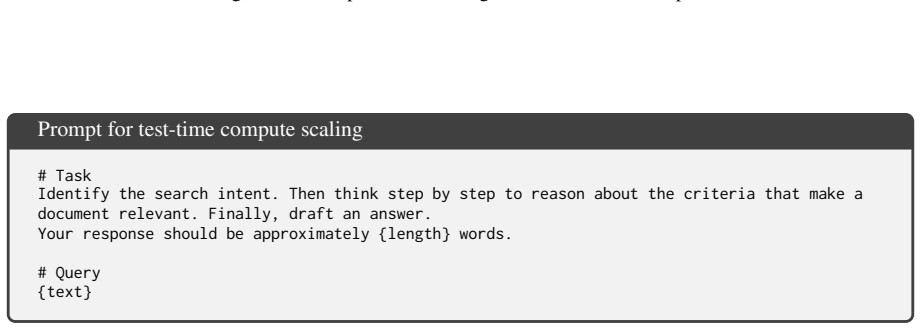
GEM's core discovery is that reasoning and embedding can share one decoder without hurting either. Starting from a query and a meta-instruction, the model generates a response that names the search intent and the key relevance criteria; the response is then concatenated with the query, a reserved <|embed|> token is appended, and the token's last hidden state is used as the query vector in a cosine-similarity ranking against document vectors. Because the reserved token is never predicted during decoding, generation and embedding coexist naturally, and because its representation reuses the KV cache from generation, the extra embedding step adds little encoding time. The authors claim this design outperforms the same backbone trained only for embedding, matches substantially larger retrieval models on BRIGHT, FollowIR, and InstructIR, and supports test-time compute scaling: prompting for longer reasoning yields further retrieval gains, peaking around 1,024 words on BRIGHT.
Load-bearing premise
The scheme's load-bearing premise is that the reasoning the model writes about a query — and the example documents generated from that reasoning — genuinely capture what a real user would count as relevant; if that synthetic signal is systematically off, GEM learns to retrieve artifacts of its own generation rather than the documents users want.
Editorial extensions
If this is right
- An embedding-only retriever leaves measurable performance unused: adding a generation objective and reasoning-aligned pairs to the same 4B backbone raises average nDCG@10 on BRIGHT from 21.4 to 29.1.
- Reasoning-augmented embeddings transfer to instruction following: FollowIR p-MRR rises from +6.8 to +11.7 and InstructIR Robustness@10 from 46.2 to 54.8 relative to the same backbone trained without generation.
- Retrieval quality can be bought with test-time compute: instructing GEM to write longer reasoning lifts BRIGHT nDCG@10 to 30.1 at about 1,024 words, while KV-cache reuse keeps encoding time roughly flat.
- The synthetic document-generation step is a load-bearing training ingredient: removing it drops BRIGHT nDCG@10 from 29.1 to 25.8, although FollowIR p-MRR stays stable.
- Classic query-expansion methods (HyDE, Query2Doc) do not reproduce GEM's instruction-following gains and can degrade p-MRR, so the benefit comes from embedding the reasoning, not from adding it as extra query text.
Reading between the lines
- Editorial inference: the same generate-then-encode pattern could be applied wherever the object to retrieve is defined by an intent rather than a surface phrase — retrieval-augmented generation, conversational search, or recommendation — since the model's own reasoning is what shapes the embedding.
- Editorial inference: the paper notes a clear trade-off it does not fully resolve — an embedding-only model with the same data scores slightly higher on retrieval but degenerates as a generator; a direct cost-benefit study of joint training versus separate reasoner-plus-encoder pipelines would settle where the frontier lies.
- Editorial inference: the collapse on the out-of-domain Pony subset suggests the method's gains inherit the coverage of the synthetic reasoning and document distribution; training on more diverse reasoning corpora is a testable way to extend GEM beyond MS MARCO-derived data.
- Editorial inference: the paper explicitly leaves open whether hallucinations in generated documents or in GEM's own reasoning bias retrieval; an experiment that perturbs the generated documents with known factual errors and measures the retrieval drop would quantify that risk.
Signed reviews
Editorial analysis
A structured set of objections, weighed in public.
Referee Report
Summary. The paper proposes GEM, a single decoder-only model that unifies causal language modeling and contrastive embedding training. For each query, GEM first generates a reasoning response about the user's intent and relevance criteria, then appends a dedicated <|embed|> token whose hidden state is used as the query embedding. Training employs a joint loss over a dataset constructed from Promptriever and ReasonIR hard queries, with response filtering by the same backbone and synthetic positive/hard-negative documents generated by Llama-3.1-8B-Instruct conditioned on the filtered reasoning. Experiments on BRIGHT, FollowIR, and InstructIR report that GEM outperforms its embedding-only same-backbone variant and matches larger baselines, and that prompting longer reasoning at test time yields further gains.
Significance. The generate-then-encode architecture is a clean and practical instantiation of reasoning-augmented retrieval in a single model, avoiding pipeline overhead and enabling test-time compute scaling. The paper includes a same-backbone embedding-only control, an ablation study with significance tests, experiments across multiple backbones, and a code release, which strengthen the empirical case. If the training/evaluation overlap concern and the synthetic-data bias concern are resolved, the work is a solid contribution to retrieval and LLM unification.
major comments (3)
- [Section 4.1, Tables 1 and 2] The manuscript reports no overlap analysis between the training queries (320K Promptriever/MS MARCO samples plus 50K ReasonIR hard queries) and the evaluation queries on BRIGHT and InstructIR. Since InstructIR is built from MS MARCO and BRIGHT is thematically related to ReasonIR's hard-query collection, exact or near-duplicate query overlap could inflate GEM's reported gains relative to baselines that were not trained on those queries. This is load-bearing for the central empirical claim. Please provide an exact and near-duplicate overlap analysis, and demonstrate that the reported results are stable on a non-overlapping subset, or re-run the evaluation after removing any overlapping training queries.
- [Section 4.1, Table 1, Table 2, Table 4] The main comparisons in Tables 1 and 2 use 'Qwen3-4B-Instruct' as the embedding-only control, which is trained only on original Promptriever data, whereas GEM is trained on additional reasoning, synthetic documents, and hard queries. This data difference confounds the claim that reasoning itself causes the improvement. The paper does include the proper control, 'Qwen3-4B-Instruct w/ GEM data' in Table 4, and it still shows a gap favorable to GEM; that control should be reported in the main tables or clearly referenced there.
- [Section 3.1, Eq. (1), Limitations] The data generation pipeline samples responses from the same backbone used for training and filters them with a binary relevance classifier using that same backbone, while documents are synthesized by Llama-3.1-8B-Instruct conditioned on the accepted reasoning. The Limitations section candidly acknowledges hallucination risks, but the potential self-referential bias is not quantified. Specifically, the filter may systematically accept responses that match the backbone's own prior, causing the embedding to be trained to retrieve documents that align with the model's generation style rather than with the external human relevance annotations. An analysis of the correlation between filtering decisions and downstream retrieval performance, or an experiment with a different independent filter, would substantially strengthen the claim that reasoning is the source of the gains.
minor comments (5)
- [Eq. (2)] There is a typesetting error in the denominator: 'PN i=1 |ri|' contains a stray 'P' before 'N'; it should be a sum over the response lengths.
- [Tables 1 and 2] The main results appear to be single runs with no error bars or significance intervals, while Table 4 does report significance tests. Please state explicitly whether the main tables are single runs and consider reporting variance or multiple seeds.
- [Figure 3] Figure 3 combines two plots with different y-axis quantities (nDCG@10 and encoding time in milliseconds) in one panel, which makes it hard to read. Splitting into two panels or adding separate y-axes with clear labels would improve clarity.
- [Section 4.1] The embedding-only variant is named 'Qwen3-4B-Instruct' while its backbone is 'Qwen3-4B-Instruct-2507'; keeping the version suffix consistent would avoid confusion.
- [Section 1] The claim that GEM is the first embedding model to leverage its own generative capabilities for reasoning-aligned embeddings is strong given that GritLM also unifies generation and embedding, albeit in separate modes. Consider softening the claim or explaining why GritLM does not count.
Circularity Check
No significant circularity: GEM's central retrieval claims are tested against external human-labeled benchmarks, and the self-referential training-data loop does not make any reported result equivalent to its inputs by construction.
full rationale
GEM's central claims are evaluated on externally labeled benchmarks (BRIGHT, FollowIR, InstructIR, TREC-DL), so the reported nDCG@10, MAP, and p-MRR numbers are not determined by the training objective by construction. The use of the same backbone for response sampling and filtering, and Llama-3.1-8B-Instruct for document synthesis conditioned on those responses (Section 3.1, Eq. 1, and the document-generation prompts in Appendix C), is a self-distillation-style data-construction loop; the paper's Limitations section explicitly acknowledges that hallucinations and filter inaccuracies can propagate noise. That is a data-quality and validity concern, not a circular derivation: the InfoNCE objective (Eq. 3) is standard, and the claimed reasoning-augmentation effect is measured on held-out human relevance judgments. The only self-citation (Wang et al. 2023b, with Macdonald as co-author) appears in a peripheral related-work sentence on query expansion and is not load-bearing. The test-time compute scaling experiment (Figure 3) varies a prompt-length instruction and measures retrieval on BRIGHT; no fitted parameter is renamed as a prediction. The potential overlap between ReasonIR hard queries and BRIGHT, or between Promptriever/MS MARCO data and InstructIR, would be a data-leakage threat to validity rather than a circularity of the paper's derivation, and cannot be substantiated from the text alone.
Assumptions & free parameters
free parameters (7)
- lambda_gen =
0.1
- lambda_emb =
1.0
- contrastive temperature tau =
0.02
- number of sampled responses K =
8
- training data mix sizes =
260K reasoning, 60K original, 50K hard-query samples
- document generation length distribution =
short 50%, medium 45%, long 5%
- hard negative constraint split =
50/50
assumptions (6)
- standard math InfoNCE contrastive loss and cosine similarity are valid objectives for learning retrieval embeddings.
- domain assumption The original relevance annotations in Promptriever and MS MARCO transfer to generated reasoning responses after LLM filtering.
- ad hoc to paper The meta-instruction prompt in Figure 6 reliably elicits reasoning that captures user intent and relevance criteria.
- domain assumption Documents generated by Llama-3.1-8B-Instruct conditioned on the reasoning are realistic enough to train a retriever.
- ad hoc to paper One generated positive and one generated hard negative per query provide sufficient contrastive signal.
- ad hoc to paper Appending the dedicated <|embed|> token and using last-token pooling yields a query representation aligned with generation.
invented entities (1)
-
<|embed|> dedicated embedding token
Cite this review
Pith. "Pith review of GEM: A Generative Embedding Model Bridging Reasoning and Retrieval." pith.science (2026). https://pith.science/paper/PVMCOXLC
@misc{pith2026260813200,
  author       = {Pith},
  title        = {Pith review of: GEM: A Generative Embedding Model Bridging Reasoning and Retrieval},
  year         = {2026},
  howpublished = {\url{https://pith.science/paper/PVMCOXLC}},
  note         = {Machine review of arXiv:2608.13200}
}
read the original abstract
Modern LLMs excel at reasoning and instruction following, enabling users to express complex and diverse information needs. However, conventional retrievers largely rely on surface-level matching between queries and documents, resulting in a growing gap between how users express their needs and how retrievers interpret them. In this paper, we present GEM, a generative embedding model that augments retrieval through its own knowledge by explicitly reasoning about user intent and relevance criteria. GEM unifies generation and embedding within a single model: it first reasons over the query, then appends an embedding token to encode the enriched context for retrieval. Evaluated on reasoning-intensive and instruction-following retrieval tasks, GEM demonstrates the effectiveness of its reasoning-augmented retrieval, outperforming its non-reasoning variant and matching baselines using substantially larger models. Furthermore, GEM's generative nature allows test-time compute scaling via prompting to further enhance retrieval performance. Our code is available at: https://anonymous.4open.science/r/GEM.
Figures


Figures from the paper (8 more)


Reviewed August 15, 2026 · model on record in the stance chip above.
Discussion (0). Continue with ORCID to comment.