Exploring Line Bundle Standard Models with Transformers
Pith reviewed 2026-07-02 18:31 UTC · model grok-4.3
The pith
A Transformer-based reinforcement learning agent identifies line bundle sums on Calabi-Yau threefolds that satisfy the constraints for heterotic SU(5) standard models.
A machine-rendered reading of the paper's core claim, the machinery that carries it, and where it could break.
Core claim
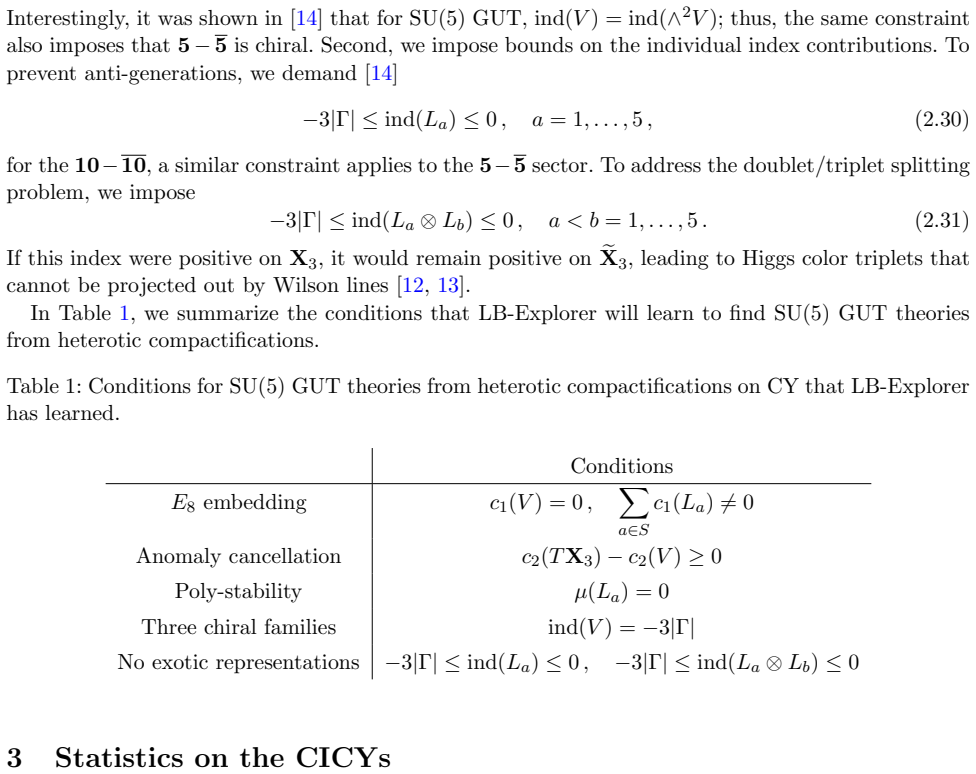
The LB-Explorer efficiently learns constraints on the line bundle sums, guaranteeing the E8 gauge embedding, anomaly cancellation, poly-stability (supersymmetry), chirality of the spectrum, and the absence of exotic matter.
What carries the argument
LB-Explorer, a Transformer-based reinforcement learning environment that searches line bundle configurations on Calabi-Yau threefolds while satisfying multiple physical constraints through policy learning.
If this is right
- Configurations discovered by the agent can be further filtered by equivariant structure of the line bundle sum and detailed particle spectrum requirements.
- A hybrid setup with CP-SAT solvers can perturb RL solutions to impose selected conditions exactly.
- The method extends to any Calabi-Yau threefold with a smooth simplicial Mori cone and freely acting discrete symmetry.
- Such agents provide a tool for systematic exploration of the heterotic string landscape at large numbers of moduli.
Where Pith is reading between the lines
- The learned constraint policies could be transferred to search problems on non-complete-intersection Calabi-Yau threefolds.
- Integration with other machine learning or optimization techniques might enable automated generation of full particle spectra.
- Similar reinforcement learning setups could be adapted to locate standard model vacua in different string theory constructions.
Load-bearing premise
The reinforcement learning architecture trained on specific Calabi-Yau examples will generalize its constraint satisfaction to any Calabi-Yau admitting a smooth, simplicial Mori cone and a freely-acting discrete symmetry.
What would settle it
Running LB-Explorer on a Calabi-Yau threefold outside the tested complete intersection set and checking whether all output configurations satisfy E8 embedding, anomaly cancellation, poly-stability, correct chirality, and absence of exotics without further manual adjustment.
Figures







read the original abstract
We propose a Transformer-based Reinforcement Learning architecture, "LB-Explorer", to search for heterotic line bundle standard models arising from compactifications on smooth Calabi-Yau (CY) threefolds. We construct $E_8\times E_8$ vacua with $\text{SU}(5)$ symmetry, where the $\text{SU}(5)$ can be further broken to the Standard Model gauge group via discrete Wilson lines. We test the LB-Explorer environment on complete intersection Calabi-Yau (CICY) manifolds, though the neural network architecture naturally generalizes to any CY admitting a smooth, simplicial Mori cone and a freely-acting discrete symmetry. The LB-Explorer efficiently learns constraints on the line bundle sums, guaranteeing the $E_8$ gauge embedding, anomaly cancellation, poly-stability (supersymmetry), chirality of the spectrum, and the absence of exotic matter. Valid configurations can be subsequently filtered by imposing the missing constraints, such as the equivariant structure of the line bundle sum and further requirements on the particle spectrum. In this direction, we introduce a hybrid architecture incorporating CP-SAT solvers that aims to impose some of the conditions exactly by perturbing solutions found by the LB-Explorer. The versatility and scalability of the LB-Explorer make it a powerful tool for navigating the string landscape with a large number of moduli. The code and tools necessary to reproduce our findings are available at https://github.com/alexmininno/LB-Explorer
Editorial analysis
A structured set of objections, weighed in public.
Referee Report
Summary. The manuscript proposes LB-Explorer, a Transformer-based reinforcement learning architecture to search for heterotic line bundle standard models on Calabi-Yau threefolds. It constructs E8 imes E8 vacua with SU(5) symmetry (broken to the Standard Model via discrete Wilson lines), tests the method on CICY manifolds, and asserts that the architecture naturally generalizes to any CY with a smooth simplicial Mori cone and freely-acting discrete symmetry. The approach is claimed to efficiently learn constraints guaranteeing E8 gauge embedding, anomaly cancellation, poly-stability, chirality, and absence of exotics, with a hybrid CP-SAT solver component for additional exact constraints; code is provided for reproducibility.
Significance. If the efficiency, constraint-learning guarantees, and generalization claims hold, the work would offer a scalable ML tool for navigating high-dimensional regions of the heterotic string landscape, complementing traditional algebraic geometry searches. The open-sourcing of code and tools is a clear strength that supports reproducibility.
major comments (2)
- [Abstract] Abstract: The assertion that 'the neural network architecture naturally generalizes to any CY admitting a smooth, simplicial Mori cone and a freely-acting discrete symmetry' is unsupported by transfer experiments, ablations on varying Mori cone generators or cohomology rings, or an argument establishing that the state representation (line-bundle integers plus intersection data) and reward formulation remain well-defined and trainable under changes to the discrete group action or cone structure. This extrapolation is load-bearing for the versatility and scalability claims.
- [Abstract] Abstract: No training curves, success rates, explicit formulations of the learned constraints, or validation against known line bundle models are visible, preventing assessment of whether the RL policy actually satisfies the claimed guarantees on E8 embedding, anomaly cancellation, poly-stability, chirality, and absence of exotics.
Simulated Author's Rebuttal
We thank the referee for their careful reading and constructive comments. We address the major comments point by point below.
read point-by-point responses
-
Referee: [Abstract] Abstract: The assertion that 'the neural network architecture naturally generalizes to any CY admitting a smooth, simplicial Mori cone and a freely-acting discrete symmetry' is unsupported by transfer experiments, ablations on varying Mori cone generators or cohomology rings, or an argument establishing that the state representation (line-bundle integers plus intersection data) and reward formulation remain well-defined and trainable under changes to the discrete group action or cone structure. This extrapolation is load-bearing for the versatility and scalability claims.
Authors: The state representation is defined in terms of line-bundle integers together with the intersection numbers of the threefold, quantities that are well-defined for any smooth Calabi-Yau with a simplicial Mori cone. The reward function likewise encodes the physical constraints directly in these data. While the manuscript demonstrates the approach only on CICYs, the architecture itself does not encode manifold-specific features beyond these inputs. We agree that the generalization statement in the abstract is stated too strongly without supporting experiments and will revise it to a more qualified claim, adding a short discussion of the representation’s expected domain of applicability. revision: partial
-
Referee: [Abstract] Abstract: No training curves, success rates, explicit formulations of the learned constraints, or validation against known line bundle models are visible, preventing assessment of whether the RL policy actually satisfies the claimed guarantees on E8 embedding, anomaly cancellation, poly-stability, chirality, and absence of exotics.
Authors: The abstract is necessarily brief. Training curves, success rates, explicit constraint formulations, and comparisons to known line-bundle models appear in Sections 3 and 4 of the main text. To improve immediate visibility of these results we will add a concise performance summary to the abstract and ensure the constraint equations are stated explicitly in the revised introduction. revision: yes
Circularity Check
No circularity: search procedure with empirically tested constraints on CICYs
full rationale
The paper describes an RL-based search algorithm (LB-Explorer) whose reward is constructed to enforce the listed physical constraints (E8 embedding, anomaly cancellation, etc.). Finding valid configurations is therefore the intended output of the method rather than a derived prediction that reduces to its inputs. No mathematical derivation chain, self-citation load-bearing steps, or fitted-input-called-prediction patterns appear. The generalization claim to arbitrary CYs is an untested assertion but does not create circularity in any claimed result. The work is self-contained as a computational tool whose performance is evaluated directly on the manifolds used for training.
Axiom & Free-Parameter Ledger
Reference graph
Works this paper leans on
-
[1]
The Standard Model from String Theory: What Have We Learned?,
F. Marchesano, G. Shiu, and T. Weigand, “The Standard Model from String Theory: What Have We Learned?,”Ann. Rev. Nucl. Part. Sci.74no. 1, (2024) 113–140,arXiv:2401.01939 [hep-th]
-
[2]
Snowmass White Paper: String Theory and Particle Physics,
M. Cvetic, J. Halverson, G. Shiu, and W. Taylor, “Snowmass White Paper: String Theory and Particle Physics,”arXiv:2204.01742 [hep-th]
-
[3]
Counting String Theory Standard Models
A. Constantin, Y.-H. He, and A. Lukas, “Counting String Theory Standard Models,”Phys. Lett. B792(2019) 258–262,arXiv:1810.00444 [hep-th]
work page internal anchor Pith review Pith/arXiv arXiv 2019
-
[4]
QuadrillionF-Theory Compactifications with the Exact Chiral Spectrum of the Standard Model,
M. Cvetiˇ c, J. Halverson, L. Lin, M. Liu, and J. Tian, “QuadrillionF-Theory Compactifications with the Exact Chiral Spectrum of the Standard Model,”Phys. Rev. Lett.123no. 10, (2019) 101601,arXiv:1903.00009 [hep-th]
-
[5]
The Heterotic String,
D. J. Gross, J. A. Harvey, E. J. Martinec, and R. Rohm, “The Heterotic String,”Phys. Rev. Lett.54(1985) 502–505
1985
-
[6]
Heterotic String Theory. 1. The Free Heterotic String,
D. J. Gross, J. A. Harvey, E. J. Martinec, and R. Rohm, “Heterotic String Theory. 1. The Free Heterotic String,”Nucl. Phys. B256(1985) 253
1985
-
[7]
Heterotic String Theory. 2. The Interacting Heterotic String,
D. J. Gross, J. A. Harvey, E. J. Martinec, and R. Rohm, “Heterotic String Theory. 2. The Interacting Heterotic String,”Nucl. Phys. B267(1986) 75–124
1986
-
[8]
Vacuum configurations for superstrings,
P. Candelas, G. T. Horowitz, A. Strominger, and E. Witten, “Vacuum configurations for superstrings,”Nucl. Phys. B258(1985) 46–74
1985
-
[9]
A Superstring Inspired Standard Model,
B. R. Greene, K. H. Kirklin, P. J. Miron, and G. G. Ross, “A Superstring Inspired Standard Model,”Phys. Lett. B180(1986) 69
1986
-
[10]
A Three Generation Superstring Model. 1. Compactification and Discrete Symmetries,
B. R. Greene, K. H. Kirklin, P. J. Miron, and G. G. Ross, “A Three Generation Superstring Model. 1. Compactification and Discrete Symmetries,”Nucl. Phys. B278(1986) 667–693
1986
-
[11]
A Three Generation Superstring Model. 2. Symmetry Breaking and the Low-Energy Theory,
B. R. Greene, K. H. Kirklin, P. J. Miron, and G. G. Ross, “A Three Generation Superstring Model. 2. Symmetry Breaking and the Low-Energy Theory,”Nucl. Phys. B292(1987) 606–652
1987
-
[12]
Two Hundred Heterotic Standard Models on Smooth Calabi-Yau Threefolds
L. B. Anderson, J. Gray, A. Lukas, and E. Palti, “Two Hundred Heterotic Standard Models on Smooth Calabi-Yau Threefolds,”Phys. Rev. D84(2011) 106005,arXiv:1106.4804 [hep-th]
work page internal anchor Pith review Pith/arXiv arXiv 2011
-
[13]
Heterotic Line Bundle Standard Models
L. B. Anderson, J. Gray, A. Lukas, and E. Palti, “Heterotic Line Bundle Standard Models,” JHEP06(2012) 113,arXiv:1202.1757 [hep-th]
work page internal anchor Pith review Pith/arXiv arXiv 2012
-
[14]
A Comprehensive Scan for Heterotic SU(5) GUT models
L. B. Anderson, A. Constantin, J. Gray, A. Lukas, and E. Palti, “A Comprehensive Scan for Heterotic SU(5) GUT models,”JHEP01(2014) 047,arXiv:1307.4787 [hep-th]
work page internal anchor Pith review Pith/arXiv arXiv 2014
-
[15]
Anomaly Cancellation in Supersymmetric D=10 Gauge Theory and Superstring Theory,
M. B. Green and J. H. Schwarz, “Anomaly Cancellation in Supersymmetric D=10 Gauge Theory and Superstring Theory,”Phys. Lett. B149(1984) 117–122
1984
-
[16]
Heterotic Model Building: 16 Special Manifolds
Y.-H. He, S.-J. Lee, A. Lukas, and C. Sun, “Heterotic Model Building: 16 Special Manifolds,” JHEP06(2014) 077,arXiv:1309.0223 [hep-th]
work page internal anchor Pith review Pith/arXiv arXiv 2014
-
[17]
CIPro Package: Complete Intersections in Products of Projective Spaces and Line Bundles
L. B. Anderson, A. Constantin, J. Gray, Y.-H. He, S.-J. Lee, and A. Lukas, “CIPro Package: Complete Intersections in Products of Projective Spaces and Line Bundles,”arXiv:2606.27588 [hep-th]
work page internal anchor Pith review Pith/arXiv arXiv
-
[18]
Explore and Exploit with Heterotic Line Bundle Models,
M. Larfors and R. Schneider, “Explore and Exploit with Heterotic Line Bundle Models,” Fortsch. Phys.68no. 5, (2020) 2000034,arXiv:2003.04817 [hep-th]. 110
-
[19]
Heterotic String Model Building with Monad Bundles and Reinforcement Learning,
A. Constantin, T. R. Harvey, and A. Lukas, “Heterotic String Model Building with Monad Bundles and Reinforcement Learning,”Fortsch. Phys.70no. 2-3, (2022) 2100186, arXiv:2108.07316 [hep-th]
-
[20]
S. A. Abel, A. Constantin, T. R. Harvey, A. Lukas, and L. A. Nutricati, “Decoding Nature with Nature’s Tools: Heterotic Line Bundle Models of Particle Physics with Genetic Algorithms and Quantum Annealing,”Fortsch. Phys.72no. 2, (2024) 2300260,arXiv:2306.03147 [hep-th]
-
[21]
Generating triangulations and fibrations with reinforcement learning,
P. Berglund, G. Butbaia, Y.-H. He, E. Heyes, E. Hirst, and V. Jejjala, “Generating triangulations and fibrations with reinforcement learning,”Phys. Lett. B860(2025) 139158, arXiv:2405.21017 [hep-th]
-
[22]
A. Vaswani, N. Shazeer, N. Parmar, J. Uszkoreit, L. Jones, A. N. Gomez, L. Kaiser, and I. Polosukhin, “Attention Is All You Need,”arXiv e-prints(June, 2017) arXiv:1706.03762, arXiv:1706.03762 [cs.CL]
work page internal anchor Pith review Pith/arXiv arXiv 2017
-
[23]
Complete Intersection Calabi-Yau Manifolds,
P. Candelas, A. M. Dale, C. A. Lutken, and R. Schimmrigk, “Complete Intersection Calabi-Yau Manifolds,”Nucl. Phys. B298(1988) 493
1988
-
[24]
L. B. Anderson, X. Gao, J. Gray, and S.-J. Lee, “Fibrations in CICY Threefolds,”JHEP10 (2017) 077,arXiv:1708.07907 [hep-th]
work page internal anchor Pith review Pith/arXiv arXiv 2017
-
[25]
On Free Quotients of Complete Intersection Calabi-Yau Manifolds
V. Braun, “On Free Quotients of Complete Intersection Calabi-Yau Manifolds,”JHEP04 (2011) 005,arXiv:1003.3235 [hep-th]
work page internal anchor Pith review Pith/arXiv arXiv 2011
-
[26]
Discrete Symmetries of Complete Intersection Calabi-Yau Manifolds,
A. Lukas and C. Mishra, “Discrete Symmetries of Complete Intersection Calabi-Yau Manifolds,”Commun. Math. Phys.379no. 3, (2020) 847–865,arXiv:1708.08943 [hep-th]
-
[27]
Line bundle cohomologies on CICYs with Picard number two,
M. Larfors and R. Schneider, “Line bundle cohomologies on CICYs with Picard number two,” Fortsch. Phys.67no. 12, (2019) 1900083,arXiv:1906.00392 [hep-th]
-
[28]
Cohomology of Line Bundles: A Computational Algorithm
R. Blumenhagen, B. Jurke, T. Rahn, and H. Roschy, “Cohomology of Line Bundles: A Computational Algorithm,”J. Math. Phys.51(2010) 103525,arXiv:1003.5217 [hep-th]
work page internal anchor Pith review Pith/arXiv arXiv 2010
-
[29]
CYTools: A Software Package for Analyzing Calabi-Yau Manifolds,
M. Demirtas, A. Rios-Tascon, and L. McAllister, “CYTools: A Software Package for Analyzing Calabi-Yau Manifolds,”arXiv:2211.03823 [hep-th]
-
[30]
Holes in Calabi-Yau Effective Cones,
N. Gendler, E. Sheridan, M. Stillman, and D. H. Wu, “Holes in Calabi-Yau Effective Cones,” arXiv:2603.11173 [hep-th]
-
[31]
CP-SAT v9.12,
L. Perron and F. Didier, “CP-SAT v9.12,” Google OR-Tools, 2025. https://developers.google.com/optimization/cp/cp_solver/
2025
-
[32]
Monad Bundles in Heterotic String Compactifications
L. B. Anderson, Y.-H. He, and A. Lukas, “Monad Bundles in Heterotic String Compactifications,”JHEP07(2008) 104,arXiv:0805.2875 [hep-th]
work page internal anchor Pith review Pith/arXiv arXiv 2008
-
[33]
Heterotic Compactification, An Algorithmic Approach
L. B. Anderson, Y.-H. He, and A. Lukas, “Heterotic Compactification, An Algorithmic Approach,”JHEP07(2007) 049,arXiv:hep-th/0702210
work page internal anchor Pith review Pith/arXiv arXiv 2007
-
[34]
L. B. Anderson,Heterotic and M-theory Compactifications for String Phenomenology. Other thesis, University of Oxford, 8, 2008.arXiv:0808.3621 [hep-th]
work page internal anchor Pith review Pith/arXiv arXiv 2008
-
[35]
Aspects of (2,0) String Compactifications,
J. Distler and B. R. Greene, “Aspects of (2,0) String Compactifications,”Nucl. Phys. B304 (1988) 1–62
1988
-
[36]
J. Distler and S. Kachru, “(0,2) Landau-Ginzburg theory,”Nucl. Phys. B413(1994) 213–243, arXiv:hep-th/9309110
work page internal anchor Pith review Pith/arXiv arXiv 1994
-
[37]
Some Three Generation (0,2) Calabi-Yau Models
S. Kachru, “Some three generation (0,2) Calabi-Yau models,”Phys. Lett. B349(1995) 76–82, arXiv:hep-th/9501131. 111
work page internal anchor Pith review Pith/arXiv arXiv 1995
-
[38]
ANTI SELF-DUAL YANG-MILLS CONNECTIONS OVER COMPLEX ALGEBRAIC SURFACES AND STABLE VECTOR BUNDLES,
S. K. Donaldson, “ANTI SELF-DUAL YANG-MILLS CONNECTIONS OVER COMPLEX ALGEBRAIC SURFACES AND STABLE VECTOR BUNDLES,”Proc. Lond. Math. Soc.50 (1985) 1–26
1985
-
[39]
On the existence of hermitian-yang-mills connections in stable vector bundles,
K. Uhlenbeck and S. T. Yau, “On the existence of hermitian-yang-mills connections in stable vector bundles,”Commun. Pure Appl. Math.39no. S1, (1986) S257–S293
1986
-
[40]
Heterotic Models from Vector Bundles on Toric Calabi-Yau Manifolds
Y.-H. He, S.-J. Lee, and A. Lukas, “Heterotic Models from Vector Bundles on Toric Calabi-Yau Manifolds,”JHEP05(2010) 071,arXiv:0911.0865 [hep-th]
work page internal anchor Pith review Pith/arXiv arXiv 2010
-
[41]
Complete classification of reflexive polyhedra in four dimensions
M. Kreuzer and H. Skarke, “Complete classification of reflexive polyhedra in four-dimensions,” Adv. Theor. Math. Phys.4(2000) 1209–1230,arXiv:hep-th/0002240
work page internal anchor Pith review Pith/arXiv arXiv 2000
-
[42]
Stabilizing the Complex Structure in Heterotic Calabi-Yau Vacua
L. B. Anderson, J. Gray, A. Lukas, and B. Ovrut, “Stabilizing the Complex Structure in Heterotic Calabi-Yau Vacua,”JHEP02(2011) 088,arXiv:1010.0255 [hep-th]
work page internal anchor Pith review Pith/arXiv arXiv 2011
-
[43]
The Atiyah Class and Complex Structure Stabilization in Heterotic Calabi-Yau Compactifications
L. B. Anderson, J. Gray, A. Lukas, and B. Ovrut, “The Atiyah Class and Complex Structure Stabilization in Heterotic Calabi-Yau Compactifications,”JHEP10(2011) 032, arXiv:1107.5076 [hep-th]
work page internal anchor Pith review Pith/arXiv arXiv 2011
-
[44]
Vacuum Varieties, Holomorphic Bundles and Complex Structure Stabilization in Heterotic Theories
L. B. Anderson, J. Gray, A. Lukas, and B. Ovrut, “Vacuum Varieties, Holomorphic Bundles and Complex Structure Stabilization in Heterotic Theories,”JHEP07(2013) 017, arXiv:1304.2704 [hep-th]
work page internal anchor Pith review Pith/arXiv arXiv 2013
-
[45]
Formulae for Line Bundle Cohomology on Calabi-Yau Threefolds,
A. Constantin and A. Lukas, “Formulae for Line Bundle Cohomology on Calabi-Yau Threefolds,”Fortsch. Phys.67no. 12, (2019) 1900084,arXiv:1808.09992 [hep-th]
-
[46]
Machine Learning Line Bundle Cohomologies of Hypersurfaces in Toric Varieties
D. Klaewer and L. Schlechter, “Machine Learning Line Bundle Cohomologies of Hypersurfaces in Toric Varieties,”Phys. Lett. B789(2019) 438–443,arXiv:1809.02547 [hep-th]
work page internal anchor Pith review Pith/arXiv arXiv 2019
-
[47]
Machine Learning Line Bundle Cohomology,
C. R. Brodie, A. Constantin, R. Deen, and A. Lukas, “Machine Learning Line Bundle Cohomology,”Fortsch. Phys.68no. 1, (2020) 1900087,arXiv:1906.08730 [hep-th]
-
[48]
Geodesics in the extended K¨ ahler cone of Calabi-Yau threefolds,
C. R. Brodie, A. Constantin, A. Lukas, and F. Ruehle, “Geodesics in the extended K¨ ahler cone of Calabi-Yau threefolds,”JHEP03(2022) 024,arXiv:2108.10323 [hep-th]
-
[49]
Generating Functions for Line Bundle Cohomology Dimensions on Complex Projective Varieties,
A. Constantin, “Generating Functions for Line Bundle Cohomology Dimensions on Complex Projective Varieties,”arXiv:2401.14463 [math.AG]
-
[50]
Gopakumar-Vafa hierarchies in winding inflation and uplifts,
F. Carta, A. Mininno, N. Righi, and A. Westphal, “Gopakumar-Vafa hierarchies in winding inflation and uplifts,”JHEP05(2021) 271,arXiv:2101.07272 [hep-th]
-
[51]
Kaleidoscopes, Waves and the Prepotential
R. ´Alvarez-Garc´ ıa and F. Ruehle, “Kaleidoscopes, Waves and the Prepotential,” arXiv:2606.05280 [hep-th]
work page internal anchor Pith review Pith/arXiv arXiv
-
[52]
COMPLETE INTERSECTION CALABI-YAU MANIFOLDS. 2. THREE GENERATION MANIFOLDS,
P. Candelas, C. A. Lutken, and R. Schimmrigk, “COMPLETE INTERSECTION CALABI-YAU MANIFOLDS. 2. THREE GENERATION MANIFOLDS,”Nucl. Phys. B306(1988) 113
1988
-
[53]
New Calabi-Yau Manifolds with Small Hodge Numbers
P. Candelas and R. Davies, “New Calabi-Yau Manifolds with Small Hodge Numbers,”Fortsch. Phys.58(2010) 383–466,arXiv:0809.4681 [hep-th]
work page internal anchor Pith review Pith/arXiv arXiv 2010
-
[54]
Completing the Web of $Z_3$ - Quotients of Complete Intersection Calabi-Yau Manifolds
P. Candelas and A. Constantin, “Completing the Web ofZ 3 - Quotients of Complete Intersection Calabi-Yau Manifolds,”Fortsch. Phys.60(2012) 345–369,arXiv:1010.1878 [hep-th]
work page internal anchor Pith review Pith/arXiv arXiv 2012
-
[55]
Rolling Among Calabi-Yau Vacua,
P. Candelas, P. S. Green, and T. Hubsch, “Rolling Among Calabi-Yau Vacua,”Nucl. Phys. B 330(1990) 49
1990
-
[56]
Moduli Space of Calabi-Yau Manifolds,
P. Candelas and X. de la Ossa, “Moduli Space of Calabi-Yau Manifolds,”Nucl. Phys. B355 (1991) 455–481. 112
1991
-
[57]
On the Connectedness of the Moduli Space of Calabi--Yau Manifolds
A. C. Avram, P. Candelas, D. Jancic, and M. Mandelberg, “On the connectedness of moduli spaces of Calabi-Yau manifolds,”Nucl. Phys. B465(1996) 458–472,arXiv:hep-th/9511230
work page internal anchor Pith review Pith/arXiv arXiv 1996
-
[58]
Triadophilia: A Special Corner in the Landscape
P. Candelas, X. de la Ossa, Y.-H. He, and B. Szendroi, “Triadophilia: A Special Corner in the Landscape,”Adv. Theor. Math. Phys.12no. 2, (2008) 429–473,arXiv:0706.3134 [hep-th]
work page internal anchor Pith review Pith/arXiv arXiv 2008
-
[59]
Proximal Policy Optimization Algorithms
J. Schulman, F. Wolski, P. Dhariwal, A. Radford, and O. Klimov, “Proximal Policy Optimization Algorithms,”arXiv e-prints(July, 2017) arXiv:1707.06347,arXiv:1707.06347 [cs.LG]
work page internal anchor Pith review Pith/arXiv arXiv 2017
-
[60]
J. Lei Ba, J. R. Kiros, and G. E. Hinton, “Layer Normalization,”arXiv e-prints(July, 2016) arXiv:1607.06450,arXiv:1607.06450 [stat.ML]
work page internal anchor Pith review Pith/arXiv arXiv 2016
-
[61]
Understanding the difficulty of training deep feedforward neural networks,
X. Glorot and Y. Bengio, “Understanding the difficulty of training deep feedforward neural networks,” inProceedings of the Thirteenth International Conference on Artificial Intelligence and Statistics, Y. W. Teh and M. Titterington, eds., vol. 9 ofProceedings of Machine Learning Research, pp. 249–256. PMLR, Chia Laguna Resort, Sardinia, Italy, 13–15 may, ...
2010
-
[62]
Reasonable Effectiveness of Random Weighting: A Litmus Test for Multi-Task Learning
B. Lin, F. Ye, Y. Zhang, and I. W. Tsang, “Reasonable Effectiveness of Random Weighting: A Litmus Test for Multi-Task Learning.” 2022.https://arxiv.org/abs/2111.10603
-
[63]
Exponential Moving Average of Weights in Deep Learning: Dynamics and Benefits
D. Morales-Brotons, T. Vogels, and H. Hendrikx, “Exponential Moving Average of Weights in Deep Learning: Dynamics and Benefits.” 2024.https://arxiv.org/abs/2411.18704
-
[64]
FAMO: Fast Adaptive Multitask Optimization
B. Liu, Y. Feng, P. Stone, and Q. Liu, “FAMO: Fast Adaptive Multitask Optimization.” 2023. https://arxiv.org/abs/2306.03792
-
[65]
Z. Wang, Y. Tsvetkov, O. Firat, and Y. Cao, “Gradient Vaccine: Investigating and Improving Multi-task Optimization in Massively Multilingual Models.” 2020. https://arxiv.org/abs/2010.05874
-
[66]
High-Dimensional Continuous Control Using Generalized Advantage Estimation
J. Schulman, P. Moritz, S. Levine, M. Jordan, and P. Abbeel, “High-Dimensional Continuous Control Using Generalized Advantage Estimation,”arXiv e-prints(June, 2015) arXiv:1506.02438,arXiv:1506.02438 [cs.LG]
work page internal anchor Pith review Pith/arXiv arXiv 2015
-
[67]
Breeding Realistic D-Brane Models,
G. J. Loges and G. Shiu, “Breeding Realistic D-Brane Models,”Fortsch. Phys.70no. 5, (2022) 2200038,arXiv:2112.08391 [hep-th]
-
[68]
134 billion intersecting brane models,
G. J. Loges and G. Shiu, “134 billion intersecting brane models,”JHEP12(2022) 097, arXiv:2206.03506 [hep-th]
-
[69]
Vacua with Small Flux Superpotential,
M. Demirtas, M. Kim, L. Mcallister, and J. Moritz, “Vacua with Small Flux Superpotential,” Phys. Rev. Lett.124no. 21, (2020) 211603,arXiv:1912.10047 [hep-th]
-
[70]
Small Flux Superpotentials for Type IIB Flux Vacua Close to a Conifold,
R. ´Alvarez-Garc´ ıa, R. Blumenhagen, M. Brinkmann, and L. Schlechter, “Small Flux Superpotentials for Type IIB Flux Vacua Close to a Conifold,”Fortsch. Phys.68(2020) 2000088,arXiv:2009.03325 [hep-th]
-
[71]
Conifold Vacua with Small Flux Superpotential,
M. Demirtas, M. Kim, L. McAllister, and J. Moritz, “Conifold Vacua with Small Flux Superpotential,”Fortsch. Phys.68(2020) 2000085,arXiv:2009.03312 [hep-th]
-
[72]
Systematics of perturbatively flat flux vacua,
F. Carta, A. Mininno, and P. Shukla, “Systematics of perturbatively flat flux vacua,”JHEP02 (2022) 205,arXiv:2112.13863 [hep-th]
-
[73]
Systematics of perturbatively flat flux vacua for CICYs,
F. Carta, A. Mininno, and P. Shukla, “Systematics of perturbatively flat flux vacua for CICYs,” JHEP08(2022) 297,arXiv:2201.10581 [hep-th]
-
[74]
Toward Realistic Intersecting D-Brane Models
R. Blumenhagen, M. Cvetic, P. Langacker, and G. Shiu, “Toward realistic intersecting D-brane models,”Ann. Rev. Nucl. Part. Sci.55(2005) 71–139,arXiv:hep-th/0502005. 113
work page internal anchor Pith review Pith/arXiv arXiv 2005
-
[75]
Branes with Brains: Exploring String Vacua with Deep Reinforcement Learning
J. Halverson, B. Nelson, and F. Ruehle, “Branes with Brains: Exploring String Vacua with Deep Reinforcement Learning,”JHEP06(2019) 003,arXiv:1903.11616 [hep-th]
work page internal anchor Pith review Pith/arXiv arXiv 2019
-
[76]
Transforming Calabi-Yau Constructions: Generating New Calabi-Yau Manifolds with Transformers,
J. H. T. Yip, C. Arnal, F. Charton, and G. Shiu, “Transforming Calabi-Yau Constructions: Generating New Calabi-Yau Manifolds with Transformers,”arXiv:2507.03732 [hep-th]
-
[77]
Generating Special Triangulations with Transformers
C. Arnal, J. H. T. Yip, F. Charton, and G. Shiu, “Generating Special Triangulations with Transformers,” in . 6, 2026.arXiv:2606.26660 [hep-th]
work page internal anchor Pith review Pith/arXiv arXiv 2026
-
[78]
https://www.gap-system.org
The GAP Group,GAP – Groups, Algorithms, and Programming, Version 4.15.1, 2025. https://www.gap-system.org
2025
-
[79]
https://www.sagemath.org
The Sage Developers,SageMath, the Sage Mathematics Software System (Version 10.8), 2025. https://www.sagemath.org
2025
-
[80]
Integral Cohomology and Mirror Symmetry for Calabi-Yau 3-folds
V. Batyrev and M. Kreuzer, “Integral cohomology and mirror symmetry for Calabi-Yau 3-folds,”arXiv:math/0505432
work page internal anchor Pith review Pith/arXiv arXiv
discussion (0)
Sign in with ORCID, Apple, or X to comment. Anyone can read and Pith papers without signing in.