REVIEW 2 major objections 5 minor 1 cited by
LLMs can turn natural-language combinatorial problems into MiniZinc models for both satisfaction and optimization, yet remain far from automatic.
Reviewed by Pith at T0; open to challenge. T0 means a machine referee read the full paper against a public rubric. the ladder, T0–T4 →
LLM strategies (CoT, knowledge graphs, grammar validation, agents) generate MiniZinc models from text for both CSPs and COPs with competitive but still-limited accuracy; a new unified open dataset and leaderboard are released.
T0 review reviewed 2026-07-12 challenge →
load-bearing objection Solid open infrastructure paper: first unified MiniZinc pipeline for both CSP and COP, competitive baselines, honest about remaining gaps. the 2 major comments →
Text2Model: Modeling Copilots for Text-to-Model Translation
The pith
A machine-rendered reading of the paper's core claim, the machinery that carries it, and where it could break.
The reading
Core claim
A single solver-agnostic pipeline that generates MiniZinc models from natural language can handle both satisfaction and optimization problems, and carefully designed multi-call strategies (especially chain-of-thought plus grammar validation) already match or exceed recent specialized text-to-model systems on the same instances, while still leaving a large fraction of problems unsolved correctly.
What carries the argument
Text2Model copilots that map unstructured problem text into MiniZinc via intermediate representations (chain-of-thought, knowledge graphs, formal grammar checks) and agentic decomposition of parameters, variables, constraints and objectives, evaluated by execution accuracy and solution accuracy against ground-truth models.
Load-bearing premise
That matching the ground-truth objective value (or any feasible solution for satisfaction problems) on the curated Text2Zinc instances is enough to declare a generated model correct, and that those instances fairly represent the difficulty of real combinatorial modeling.
What would settle it
A new collection of problems, or a re-run of the existing leaderboard with a stronger LLM or different intermediate representation, that either pushes solution accuracy well above the reported best figures or shows that none of the proposed copilots improve on plain chain-of-thought.
Editorial analysis
A structured set of objections, weighed in public.
Referee Report
Summary. The paper formalizes text-to-model translation and introduces Text2Model, a suite of LLM copilots (zero-shot, CoT, knowledge-graph intermediates, grammar validation, and agentic decomposition) that generate MiniZinc models from natural-language problem descriptions, together with an online leaderboard. It also releases Text2Zinc, a unified cross-domain dataset of 1,775 instances (110 carefully verified) covering both satisfaction and optimization problems drawn from NLP4LP, ComplexOR, LPWP, CSPLib, Hakank, IndustryOR, MAMO and NL4Opt, plus an interactive editor. Experiments with GPT-5.2 (and ablations with GPT-4/4o and OptiMind) report execution accuracy and solution accuracy (objective-value match) across strategies and compare against Gala, Orlm and OptiMind, concluding that the best copilots are competitive or better on several subsets while remaining solver- and paradigm-agnostic, yet LLMs are still far from push-button combinatorial modeling.
Significance. The work supplies the first publicly available, solver-agnostic benchmark and infrastructure that jointly treats CSPs and COPs under a single MiniZinc pipeline, together with open copilots, a leaderboard and an editor for ongoing curation. These artifacts lower the barrier for reproducible comparison and are likely to become a reference point for subsequent LLM-for-OR research. The empirical finding that CoT+grammar and agentic+code strategies already match or exceed specialized systems on several subsets, while overall solution accuracy remains modest, is a useful, well-documented baseline for the community.
major comments (2)
- §6.1–6.2 and Tables 1–3: Solution accuracy is defined solely as matching the ground-truth objective value (or producing any feasible assignment for satisfaction problems). This is a necessary but incomplete proxy for model correctness; two models can share an objective value while encoding different feasible regions or constraint semantics. The paper already notes the execution–solution gap and supplies an error taxonomy (Appendix G), yet the comparative claims would be stronger if a modest sample of generated models were also checked for constraint fidelity (e.g., by feeding LLM outputs into the ground-truth MiniZinc models as verifiers, which the dataset already supports).
- §5 and Tables 1–2: Only 110 of the 1,775 instances are described as carefully selected, manually verified and augmented; the bulk of the reported numbers (especially MAMO-Easy n=652, NL4Opt n=245) therefore rest on automatically converted or lightly curated data. While the authors correctly frame the results as lower-bound baselines, the paper should state more explicitly which subsets are fully verified versus automatically ingested, so that readers can weight the comparative claims accordingly.
minor comments (5)
- Table 1 header and body: “Knowlege Graph” is misspelled; correct to “Knowledge Graph”.
- §2.4 and Appendix A: The knowledge-graph intermediate is presented as a novel contribution, yet the quantitative gains over plain CoT are modest and sometimes negative (e.g., NLP4LP). A short discussion of when the KG helps versus when it injects noise would help readers decide whether to adopt it.
- §6.3 / Table 4: The Orlm comparison is correctly caveated as directional (different solvers, Pass@k vs. fixed call budgets). Adding a one-sentence reminder of the paradigm difference next to the table itself would further reduce the risk of over-interpretation.
- Figure 2 and Appendix D: Domain and objective distributions are useful; a brief note on how many of the 110 verified instances fall into each domain would make the high-quality core more transparent.
- Throughout: Occasional typographical slips (“intermediaterepresentationsviaknowledge-graphs”, “nad relational”, “solut ion accuracy”) should be cleaned in a final pass.
Circularity Check
No circularity: empirical systems/benchmark paper whose metrics and comparisons are externally defined.
full rationale
Text2Model is an empirical systems and benchmark paper. Its central claims rest on (i) a unified MiniZinc pipeline that is solver- and paradigm-agnostic, (ii) the Text2Zinc dataset that mixes satisfaction and optimization problems, and (iii) measured execution accuracy (does the generated model compile and run?) and solution accuracy (does the objective or feasible assignment match a reference) against external ground-truth models and solvers. These quantities are not defined in terms of any fitted parameter that is later re-presented as a prediction; they are obtained by compiling LLM-generated .mzn code against .dzn instances and comparing solver output to reference values. Self-citations (e.g., to the authors’ earlier Ner4Opt line) appear only in related-work and motivation sections and are not load-bearing premises for the numerical tables or the “first unified architecture/dataset” claim. Comparisons to Gala, Orlm, and OptiMind are re-runs or published numbers on the same instances under the same solution-accuracy metric; they do not reduce by construction to the paper’s own inputs. Consequently there is no self-definitional step, no fitted-input-called-prediction, no uniqueness theorem imported from the authors, and no renaming of a known result that is presented as a derivation. Score 0 is the appropriate outcome.
Axiom & Free-Parameter Ledger
free parameters (2)
- LLM sampling temperature / decoding settings
- Selection of the 110 verified instances
axioms (3)
- domain assumption Matching the ground-truth objective value (or producing a feasible assignment for satisfaction problems) is a sufficient measure of model correctness.
- domain assumption MiniZinc’s global constraints and solver-agnostic compilation constitute a natural and advantageous target language for LLM generation.
- domain assumption The heterogeneous source collections (NLP4LP, ComplexOR, CSPLib, Hakank, IndustryOR, MAMO, NL4Opt, LPWP) can be meaningfully unified under a single schema without distorting difficulty.
invented entities (2)
-
Text2Model copilots suite
independent evidence
-
Text2Zinc dataset + editor
independent evidence
Cite this review
Pith. "Pith review of Text2Model: Modeling Copilots for Text-to-Model Translation." pith.science (2026). https://pith.science/paper/PVX36HTM
@misc{pith2026260412955,
  author       = {Pith},
  title        = {Pith review of: Text2Model: Modeling Copilots for Text-to-Model Translation},
  year         = {2026},
  howpublished = {\url{https://pith.science/paper/PVX36HTM}},
  note         = {Machine review of arXiv:2604.12955}
}
read the original abstract
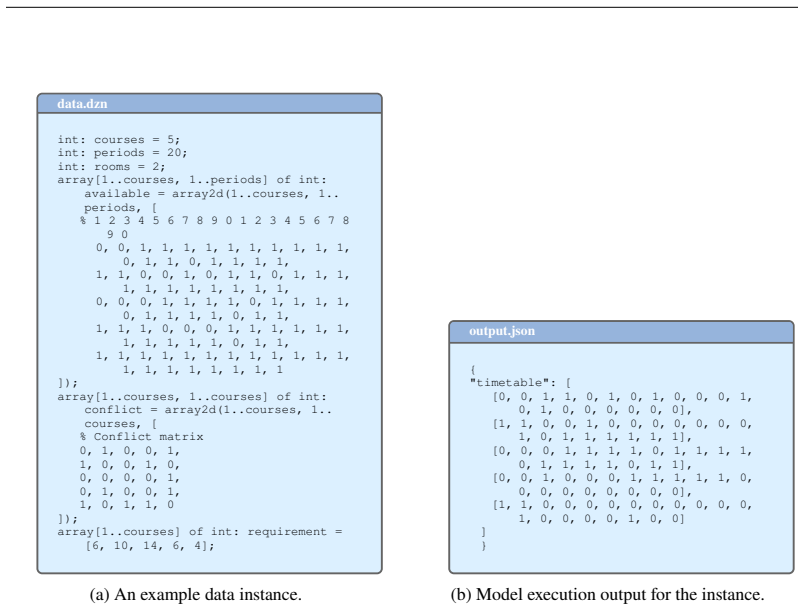
There is growing interest in leveraging large language models (LLMs) for text-to-model translation and optimization tasks. This paper aims to advance this line of research by introducing \textsc{Text2Model} and \textsc{Text2Zinc}. \textsc{Text2Model} is a suite of copilots based on several LLM strategies with varying complexity, along with an online leaderboard. \textsc{Text2Zinc} is a cross-domain dataset for capturing optimization and satisfaction problems specified in natural language, along with an interactive editor with built-in AI assistant. While there is an emerging literature on using LLMs for translating combinatorial problems into formal models, our work is the first attempt to integrate \textit{both} satisfaction and optimization problems within a \textit{unified architecture} and \textit{dataset}. Moreover, our approach is \textit{solver-agnostic} unlike existing work that focuses on translation to a solver-specific model. To achieve this, we leverage \textsc{MiniZinc}'s solver-and-paradigm-agnostic modeling capabilities to formulate combinatorial problems. We conduct comprehensive experiments to compare execution and solution accuracy across several single- and multi-call strategies, including; zero-shot prompting, chain-of-thought reasoning, intermediate representations via knowledge-graphs, grammar-based syntax encoding, and agentic approaches that decompose the model into sequential sub-tasks. Our copilot strategies are competitive, and in parts improve, recent research in this domain. Our findings indicate that while LLMs are promising they are not yet a push-button technology for combinatorial modeling. We contribute \textsc{Text2Model} copilots and leaderboard, and \textsc{Text2Zinc} and interactive editor to open-source to support closing this performance gap.
Figures



Forward citations
Cited by 1 Pith paper
-
Learn2Zinc: Fine-tuning Small Language Models for Text-to-Model Translation in MiniZinc
Fine-tuning small LMs on synthetic and bootstrapped syntax-error corrections lifts MiniZinc execution accuracy from ~0% to 98% in an ensemble, but solution accuracy saturates near 35%.
Reference graph
Works this paper leans on
-
[8]
Use direct and succinct definitions for constraints in the model
-
[10]
Declare all parameters and sets before using them in other declarations to avoid circular dependencies and ordering issues
-
[13]
Declare all identifiers (such as indices or ranges like ‘n‘) before using them in any array or 25 parameter declarations
-
[14]
Explicitlycasttypesifnecessary
Ensuretypeconsistencyinexpressionstoavoidcoercionerrors. Explicitlycasttypesifnecessary
-
[15]
Do not forget the ‘solve‘ keyword
Ensure there is only one objective, which will be a maximization, minimization, or a satisfy problem. Do not forget the ‘solve‘ keyword. Please do not generate any other token, except the MiniZinc code. Problem Description: {problem_description} Input Data Nomenclature and Examples: {data_nomenclature} C.3 Knowledge Graph Code Generation You are an expert...
-
[16]
Problem Description: A formal description describing the optimization problem
-
[17]
Knowledge Graph: Detailing Parameters, Variables, Constraints and Objective
-
[18]
Please do not generate any other token, except the MiniZinc code
Input Data Nomenclature: The MiniZinc code should assume that the data needed, will be provided in a specific format through a .dzn file, so the generated code should assume the same names defined in theinput data. Please do not generate any other token, except the MiniZinc code. Problem Description: {problem_description} Knowledge Graph: “‘ {knowledge_gr...
-
[19]
Fix the compilation error first - Address the specific issue indicated in the error message above
-
[20]
Ensure all parameters and variable names in ‘data.dzn‘ match the generated MiniZinc code
-
[21]
Verify that constraints are properly structured and align with the problem description
-
[22]
minimization
Check the objective function to confirm it is correctly set as: - ‘minimize‘ if ‘{objective_type}‘ is "minimization". - ‘maximize‘ if ‘{objective_type}‘ is "maximization". - ‘satisfy‘ if ‘{objective_type}‘ is "satisfaction"
-
[23]
Ensure no syntax errors exist in the generated MiniZinc code
-
[24]
Validate the order of declarations (parameters, variables, constraints, and objective)
-
[25]
If any issues are found, revise the MiniZinc code accordingly
Identify any missing components or inconsistencies. If any issues are found, revise the MiniZinc code accordingly. Output only the corrected MiniZinc code. 26 C.5 Grammar V alidation You are given a MiniZinc model that has syntax errors. Your task is to fix these syntax errors using the MiniZinc grammar specification provided below. Problem Description: {...
-
[26]
Do not declare values directly from the input data nomenclature and examples within the MiniZinc model
The generated code should assume that data will be provided via a ".dzn" file. Do not declare values directly from the input data nomenclature and examples within the MiniZinc model
-
[27]
Adhere to the input data nomenclature and examples precisely when declaring input parameter names and their data types
-
[28]
If bounds are explicit (e.g., non-negative), include them as constraints
Use bounded variables whenever possible. If bounds are explicit (e.g., non-negative), include them as constraints
-
[29]
Applyelement-wiseconstraintsin a separate constraint block if bounds depend on array elements
Whendefiningarraysofvariables,ensureboundsareintegers. Applyelement-wiseconstraintsin a separate constraint block if bounds depend on array elements
-
[30]
When defining arrays of variables, ensure bounding constraints are applied separately rather than during initialization to avoid type mismatches
-
[31]
Define explicit bounds for all variables used in linear expressions, either in their declaration or through additional constraints
-
[32]
Declare all parameters and sets before using them in other declarations to avoid circular depen- dencies and ordering issues
-
[33]
Declare all identifiers (such as indices or ranges like ‘n‘) before using them in any array or parameter declarations
-
[34]
Ensure that all indices and sets used in parameter and variable declarations are declared before- hand
-
[35]
When declaring variables, ensure they are appropriately typed (e.g., ‘int‘, ‘float‘)
-
[36]
Variables should have meaningful names related to the problem description
-
[37]
Problem Description: {problem_description} 27 Input Data Nomenclature and Examples: {data_nomenclature} C.6.2 Constraints You are an expert MiniZinc developer
Include comments to briefly describe each parameter and variable for clarity. Problem Description: {problem_description} 27 Input Data Nomenclature and Examples: {data_nomenclature} C.6.2 Constraints You are an expert MiniZinc developer. Generate MiniZinc code for the Constraints from a given problem description with additional infor- mation about the par...
-
[38]
Separate constraints into distinct constraint blocks whenever possible
-
[39]
Utilize global constraints as much as possible
-
[40]
When using iteration constructs like ‘forall‘, define the range or set being iterated over properly (e.g., use ‘1..M‘ instead of ‘M‘ for iteration)
-
[41]
Ensure operands in operations are of compatible types to prevent coercion errors
-
[42]
Ensure type consistency in expressions to avoid coercion errors
-
[43]
Clearly comment on the purpose of each constraint for clarity and maintenance
-
[44]
Avoid hardcoding values; use parameters and variables instead
-
[45]
Use meaningful names for all constraint blocks
-
[46]
Only generate constraints and do not generate objective. Problem Description: {problem_description} Input Data Nomenclature and Examples: {data_nomenclature} Parameters and Variables: “‘minizinc {parameters_and_variables} “‘ C.6.3 Objective You are an expert MiniZinc developer. Generate MiniZinc code for the Objective from a given problem description with...
-
[47]
Do not forget the ‘solve‘ keyword
Ensure there is only one objective, which will be a maximization, minimization, or a satisfy problem. Do not forget the ‘solve‘ keyword
-
[48]
Ensure the objective function aligns with the problem description
-
[49]
Verify the correct usage of variables, parameters and constraints in the objective function. Problem Description: {problem_description} Input Data Nomenclature and Examples: {data_nomenclature} Parameters and Variables: “‘minizinc {parameters_and_variables} 28 “‘ Constraints: “‘minizinc {constraints} “‘ C.6.4 Stitch You are an expert MiniZinc developer. G...
-
[50]
Verify that all intermediate sections (parameters, variables, constraints, objective) are consistent and correctly referenced
-
[51]
Confirm that the final MiniZinc code is syntactically accurate and logically coherent
-
[52]
Ensure that the code sections are properly integrated, maintaining the prescribed format
-
[53]
Check for and resolve any circular dependencies or ordering issues in declarations
-
[54]
Check for and resolve any coercion issues
-
[55]
Validate type consistency across all expressions and declarations
-
[56]
Utilize clear and concise comments to describe each section and its components
-
[57]
Make sure global constraints are utilized where applicable to enhance model efficiency
-
[58]
Generate MiniZinc code ONLY. Do NOT generate CPOPT, COPT, or any other format even if the problem description mentions it
Ensure only one objective is defined, using the ‘solve‘ keyword appropriately. Problem Description: {problem_description} Input Data Nomenclature and Examples: {data_nomenclature} Parameters and Variables: “‘minizinc {parameters_and_variables} “‘ Constraints: “‘minizinc {constraints} “‘ Objective: “‘minizinc {objective} “‘ Note: If the.dznfile is empty, w...
2024
This paper was first reviewed by grok-4.5 on July 12, 2026.
discussion (0)
Sign in with ORCID, Apple, or X to comment. Anyone can read and Pith papers without signing in.