REVIEW 2 major objections 1 minor 62 references
On the localization transition from MAA to AA models
T0 review · 2 major / 1 minor · reviewed 2026-06-25 · grok-4.3
Pith's one-line read Superpositions of two MAA potentials produce twice and multiple localization-delocalization transitions.
desk verdict The DMAA model construction is new and the multiple-transition claim is interesting, but the numerics lack scaling and cross-checks so the evidence stays preliminary. read the letter →
The pith
A machine-rendered reading of the paper's core claim, the machinery that carries it, and where it could break.
The reading
What carries the argument
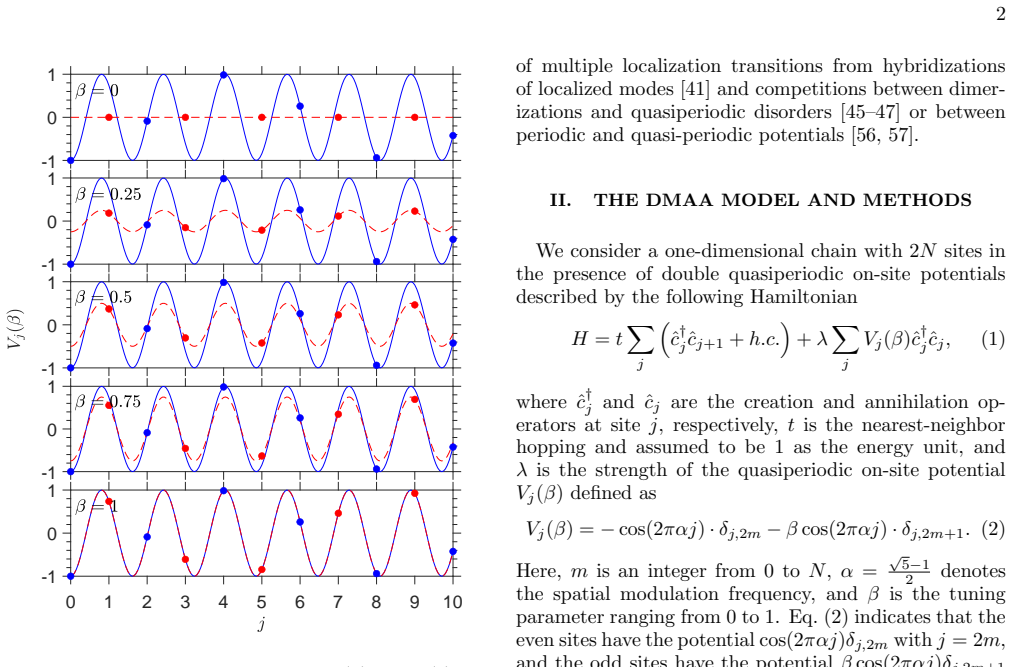
Double quasiperiodic MAA (DMAA) model formed by superposing one primitive MAA potential (nonzero even-site amplitudes) with a second MAA potential (nonzero odd-site amplitudes plus tunable amplitude factor).
What would settle it
Numerical scans or polariton experiments that find only a single localization transition for all values of the tunable odd-site amplitude would falsify the existence of twice and multiple transitions.
Extended reading notes
Core claim
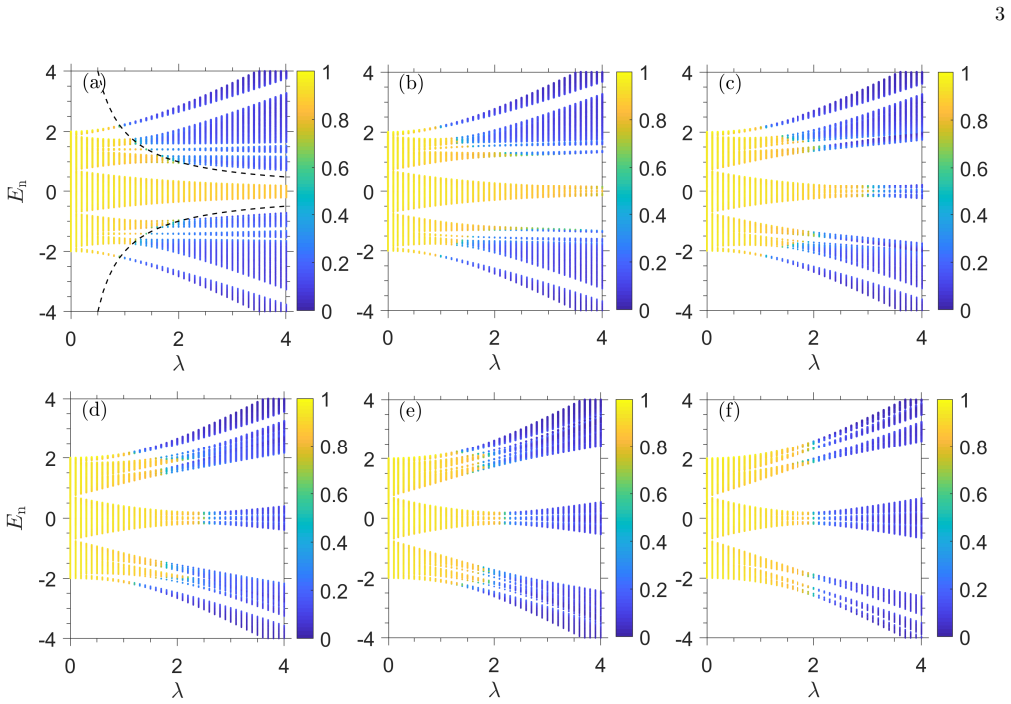
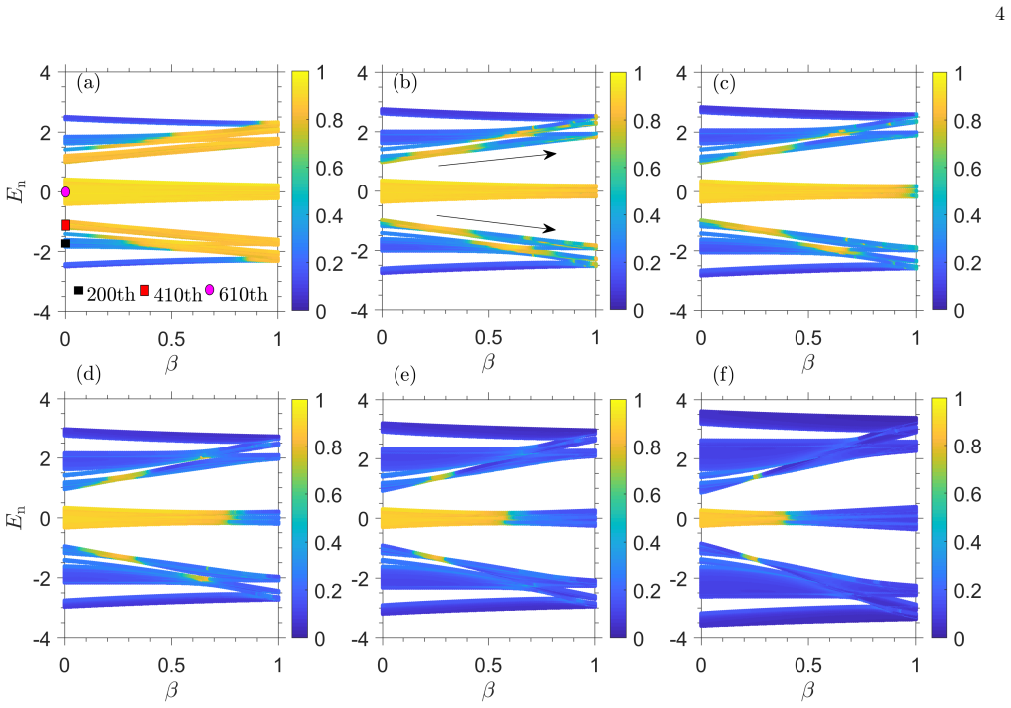
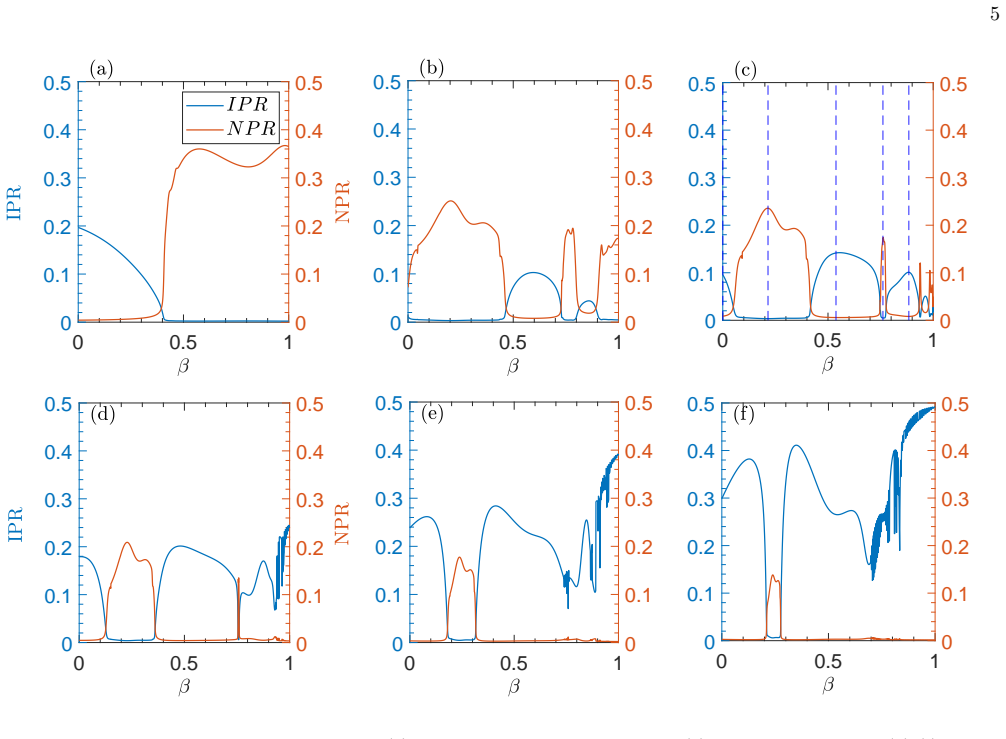
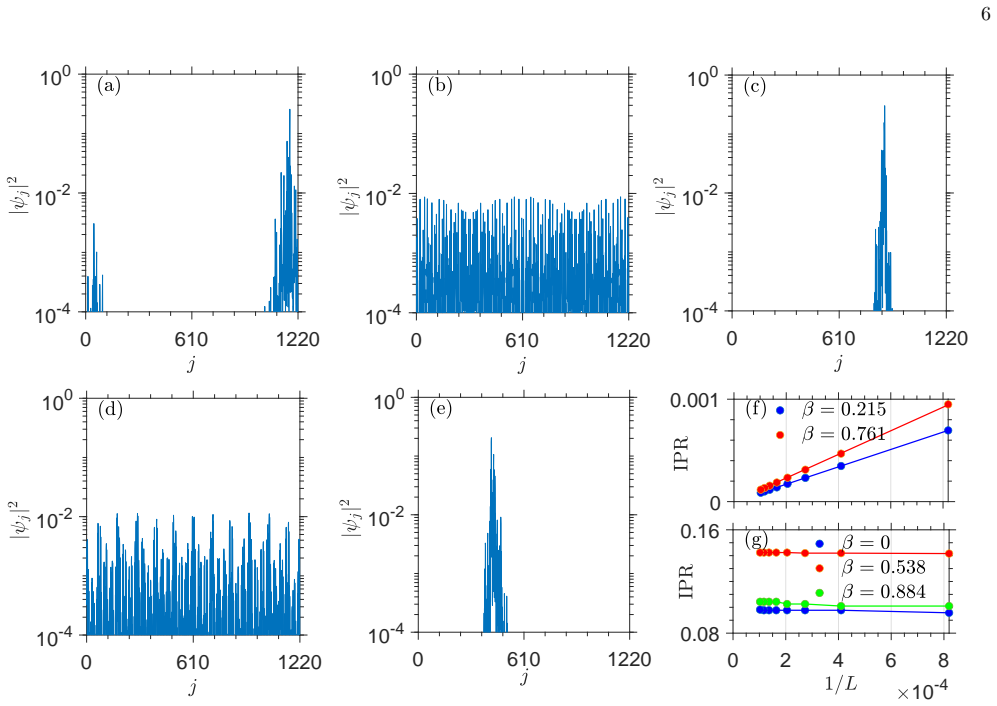
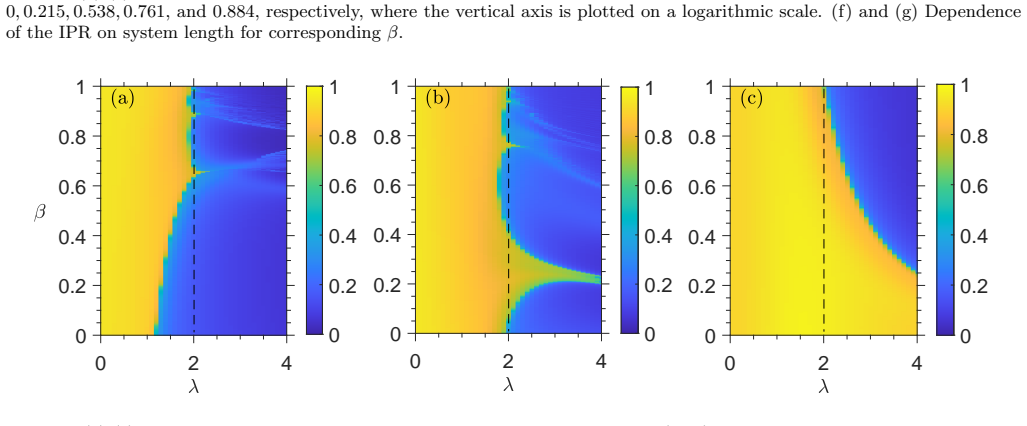
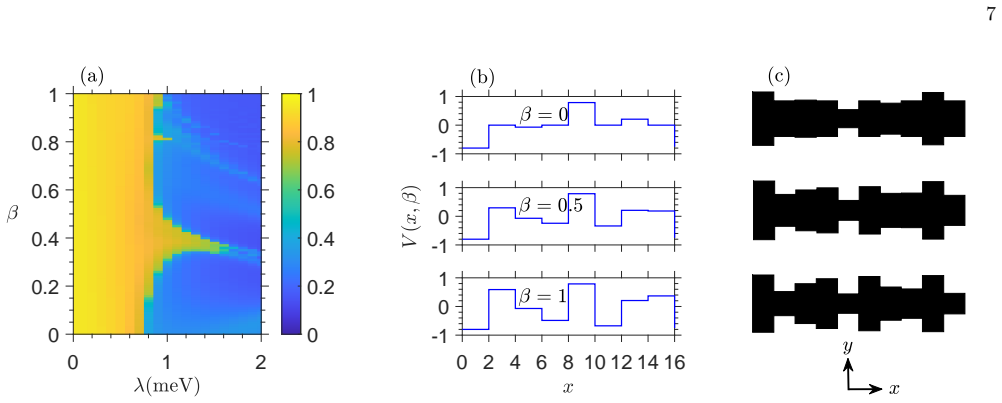
The DMAA model, formed by superposing a primitive MAA potential on even sites with a modified MAA potential on odd sites carrying a tunable amplitude, exhibits new twice and multiple localization-delocalization transitions that arise from competitions among extended, critical, and localized states and are absent from the single-transition behavior of the original MAA model. These transitions are verified by inverse participation ratio, normalized participation ratio, fractal dimension, and real-space wavefunction distributions, with consistent outcomes obtained from continuum simulations of experimental polariton modes.
Load-bearing premise
The chosen numerical diagnostics (IPR, NPR, fractal dimension) together with the specific even-odd site construction of the DMAA potentials suffice to identify and separate multiple transitions without finite-size artifacts or post-hoc tuning.
Editorial extensions
If this is right
- The DMAA model exhibits twice and multiple localization-delocalization transitions in addition to the single transition of the original MAA model.
- Interplays among extended, critical, and localized states produced by the double quasiperiodic potentials are responsible for the additional transitions.
- Inverse participation ratio, normalized participation ratio, fractal dimension, and real-space wavefunction distributions all confirm the new localization features.
- Continuum simulations of polariton modes reproduce the same transitions, supporting experimental realizability.
Reading between the lines
- The tunable amplitude factor could be varied continuously in experiment to map the locations of the extra transitions.
- The same even-odd superposition construction might be applied to other pairs of quasiperiodic models to induce multiple transitions.
- Polariton or cold-atom platforms already used for MAA studies could be adapted to test the DMAA predictions by adding a second incommensurate lattice component.
Signed reviews
Editorial analysis
A structured set of objections, weighed in public.
Referee Report
Summary. The manuscript introduces a double quasiperiodic mosaic Aubry-André (DMAA) model formed by superposing one primitive MAA potential (nonzero even-site amplitudes) with a modified MAA potential (nonzero odd-site amplitudes plus a tunable amplitude factor). It claims that interplays among extended, critical, and localized states produce new twice and multiple localization-delocalization transitions in addition to the original single transition of the MAA model. These features are asserted to be confirmed by numerical diagnostics (IPR, NPR, fractal dimension, real-space wavefunctions) and by continuum simulations of experimental polariton modes.
Significance. If the multiple transitions prove robust, the DMAA construction would supply a concrete framework for interpolating between MAA and AA localization behavior and for exploring state competitions in quasiperiodic systems, with possible experimental relevance to polariton platforms. The superposition approach itself is a natural way to tune between analogous models, but the manuscript does not yet supply the controls needed to establish that the reported extra transitions are intrinsic rather than diagnostic or construction artifacts.
major comments (2)
- [Abstract / numerical results] Abstract and numerical-results section: the claim that 'numerical calculations on inverse participation ratio, normalized participation ratio, fractal dimension and real-space wavefunction distribution confirm such localization features' supplies no system sizes, number of disorder realizations, error bars, or procedure for scanning the tunable amplitude factor. Without these data the reported twice and multiple transitions cannot be assessed for finite-size artifacts or parameter-specific effects.
- [Numerical diagnostics] Numerical diagnostics paragraph: IPR, NPR and fractal dimension are used to locate the additional transitions, yet the text contains no finite-size scaling collapse, no comparison against level statistics or transfer-matrix Lyapunov exponents, and no scan showing that the extra transition points survive when the odd-site amplitude factor is varied continuously or when N is increased by a factor of 4–8. These omissions leave open the possibility that the features arise from the even/odd-site construction rather than from intrinsic state interplays.
minor comments (1)
- [Abstract] The abstract states that 'the continuum model simulations on the experimental polariton modes also yield consistent results' but does not identify the continuum model or the mapping from the DMAA lattice to the polariton system.
Simulated Author's Rebuttal
We thank the referee for the detailed and constructive report. We address each major comment below and will revise the manuscript to incorporate additional numerical details and controls as outlined.
read point-by-point responses
-
Referee: [Abstract / numerical results] Abstract and numerical-results section: the claim that 'numerical calculations on inverse participation ratio, normalized participation ratio, fractal dimension and real-space wavefunction distribution confirm such localization features' supplies no system sizes, number of disorder realizations, error bars, or procedure for scanning the tunable amplitude factor. Without these data the reported twice and multiple transitions cannot be assessed for finite-size artifacts or parameter-specific effects.
Authors: We agree that these methodological details are necessary for assessing robustness. In the revised manuscript we will explicitly state the system sizes employed (N ranging from 512 to 2048), the number of independent realizations used for averaging (typically 200), the inclusion of error bars on all plotted quantities, and the precise procedure for scanning the tunable odd-site amplitude factor. These additions will enable direct evaluation of finite-size effects and parameter dependence. revision: yes
-
Referee: [Numerical diagnostics] Numerical diagnostics paragraph: IPR, NPR and fractal dimension are used to locate the additional transitions, yet the text contains no finite-size scaling collapse, no comparison against level statistics or transfer-matrix Lyapunov exponents, and no scan showing that the extra transition points survive when the odd-site amplitude factor is varied continuously or when N is increased by a factor of 4–8. These omissions leave open the possibility that the features arise from the even/odd-site construction rather than from intrinsic state interplays.
Authors: We acknowledge the utility of additional diagnostics. The revised version will include (i) explicit scans of the extra transition points over a continuous range of the odd-site amplitude factor and (ii) data for system sizes increased by a factor of 4–8 to demonstrate persistence. Finite-size scaling collapse and direct comparisons to level statistics or Lyapunov exponents are complementary approaches; while our wavefunction-based diagnostics already show consistent behavior across sizes, we will add a brief discussion of these alternatives and note that the multi-diagnostic agreement supports an intrinsic origin rather than a construction artifact. Full scaling collapses and Lyapunov calculations lie outside the present scope but can be pursued in follow-up work. revision: partial
Circularity Check
No circularity in numerical construction and diagnostics of DMAA model
full rationale
The paper constructs the DMAA model explicitly by superposing a primitive MAA potential (nonzero even sites) with a modified one (tunable odd-site amplitude) and then computes standard localization diagnostics (IPR, NPR, fractal dimension, wavefunction plots) on the resulting Hamiltonian. No load-bearing step reduces a claimed transition to a fitted parameter, self-citation, or definitional tautology; the multiple transitions are presented as numerical outcomes of the new superposition. The work is self-contained as a model-building and simulation study with no derivation chain that collapses to its inputs.
Assumptions & free parameters
free parameters (1)
- tunable amplitude factor
assumptions (1)
- domain assumption MAA model allows mobility edges whereas the AA model does not
Cite this review
Pith. "Pith review of On the localization transition from MAA to AA models." pith.science (2026). https://pith.science/paper/PWCM3NFB
@misc{pith2026260624720,
  author       = {Pith},
  title        = {Pith review of: On the localization transition from MAA to AA models},
  year         = {2026},
  howpublished = {\url{https://pith.science/paper/PWCM3NFB}},
  note         = {Machine review of arXiv:2606.24720}
}
read the original abstract
Despite their potential similarity between the mosaic Aubry-Andr\'e (MAA) and AA models, the MAA model allows mobility edges (MEs), whereas the AA model does not. Here we develop a new double quasiperiodic MAA (DMAA) model consisting of one primitive MAA with nonzero even-site potentials and the other modified one with both nonzero odd-site potentials and a tunable amplitude factor, to reveal how localization transitions evolve from MAA to AA models. Interplays and competitions among the extended, critical and localized states arising from superpositions of double quasi-periodic MAA potentials enable new twice and multiple localization-delocalization transitions besides the original single localization transition. Our numerical calculations on inverse participation ratio, normalized participation ratio, fractal dimension and real-space wavefunction distribution confirm such localization features. The continuum model simulations on the experimental polariton modes also yield consistent results and hence validate their experimental feasibility. The constructed DMAA model provides a new framework for studying the localization transition processes between two analogous quasiperiodic models and broadens the understanding of Anderson localization.
Figures
Figures from the paper (4 more)
Reference graph
Works this paper leans on
-
[1]
P. W. Anderson, Phys. Rev.109, 1492 (1958)
1958
-
[2]
D. J. Thouless, J. Phys. C5, 77 (1972)
1972
-
[3]
Abrahams, P
E. Abrahams, P. W. Anderson, D. C. Licciardello, and T. V. Ramakrishnan, Phys. Rev. Lett.42, 673 (1979)
1979
-
[4]
P. A. Lee and T. V. Ramakrishnan, Rev. Mod. Phys.57, 287 (1985)
1985
-
[5]
Evers and A
F. Evers and A. D. Mirlin, Rev. Mod. Phys.80, 1355 (2008)
2008
-
[6]
Segev, Y
M. Segev, Y. Silberberg, and D. N. Christodoulides, Nat. Photon.7, 197 (2013)
2013
-
[7]
Yamilov, S
A. Yamilov, S. E. Skipetrov, T. W. Hughes, M. Minkov, Z. Yu, and H. Cao, Nat. Phys.19, 1308 (2023)
2023
-
[8]
Aubry and G
S. Aubry and G. Andr´ e, Ann. Isr. Phys. Soc.3, 18 (1980)
1980
Show all 62 references
-
[9]
Kohmoto, Phys
M. Kohmoto, Phys. Rev. Lett.51, 1198 (1983)
1983
-
[10]
D. J. Thouless, Phys. Rev. Lett.61, 2141 (1988). 8
1988
-
[11]
Roati, C
G. Roati, C. D’Errico, L. Fallani, M. Fattori, C. Fort, M. Zaccanti, G. Modugno, M. Modugno, and M. Ingus- cio, Nature453, 895–898 (2008)
2008
-
[12]
J.-B. Suck, M. Schreiber, and P. H¨ aussler,Quasicrystals: An introduction to structure, physical properties and ap- plications, Vol. 55 (Springer Science & Business Media, 2013)
2013
-
[13]
H. P. L¨ uschen, S. Scherg, T. Kohlert, M. Schreiber, P. Bordia, X. Li, S. Das Sarma, and I. Bloch, Phys. Rev. Lett.120, 160404 (2018)
2018
-
[14]
Jiang, L.-J
H. Jiang, L.-J. Lang, C. Yang, S.-L. Zhu, and S. Chen, Phys. Rev. B100, 054301 (2019)
2019
-
[15]
Y. Liu, Y. Wang, Z. Zheng, and S. Chen, Phys. Rev. B 103, 134208 (2021)
2021
-
[16]
P. G. Harper, Proc. Phys. Soc. London Sect. A68, 874 (1955)
1955
-
[17]
Lahini, R
Y. Lahini, R. Pugatch, F. Pozzi, M. Sorel, R. Morandotti, N. Davidson, and Y. Silberberg, Phys. Rev. Lett.103, 013901 (2009)
2009
-
[18]
Y. E. Kraus, Y. Lahini, Z. Ringel, M. Verbin, and O. Zil- berberg, Phys. Rev. Lett.109, 106402 (2012)
2012
-
[19]
Y. E. Kraus and O. Zilberberg, Phys. Rev. Lett.109, 116404 (2012)
2012
-
[20]
Ganeshan, K
S. Ganeshan, K. Sun, and S. Das Sarma, Phys. Rev. Lett. 110, 180403 (2013)
2013
-
[21]
Sinha, M
A. Sinha, M. M. Rams, and J. Dziarmaga, Phys. Rev. B 99, 094203 (2019)
2019
-
[22]
Zeng and Y
Q.-B. Zeng and Y. Xu, Phys. Rev. Res.2, 033052 (2020)
2020
-
[23]
Xu and S
Z. Xu and S. Chen, Phys. Rev. A103, 043325 (2021)
2021
-
[24]
T. Liu, X. Xia, S. Longhi, and L. Sanchez-Palencia, Sci- Post Phys.12, 027 (2022)
2022
-
[25]
C. M. Soukoulis and E. N. Economou, Phys. Rev. Lett. 48, 1043 (1982)
1982
-
[26]
Ganeshan, J
S. Ganeshan, J. H. Pixley, and S. Das Sarma, Phys. Rev. Lett.114, 146601 (2015)
2015
-
[27]
S. Saha, S. K. Maiti, and S. Karmakar, Physica E: Low- dimensional Systems and Nanostructures83, 358 (2016)
2016
-
[28]
Y. Wang, X. Xia, L. Zhang, H. Yao, S. Chen, J. You, Q. Zhou, and X.-J. Liu, Phys. Rev. Lett.125, 196604 (2020)
2020
-
[29]
X.-C. Zhou, Y. Wang, T.-F. J. Poon, Q. Zhou, and X.-J. Liu, Phys. Rev. Lett.131, 176401 (2023)
2023
-
[30]
J. Gao, I. M. Khaymovich, X.-W. Wang, Z.-S. Xu, A. Io- van, G. Krishna, J. Jieensi, A. Cataldo, A. V. Balatsky, V. Zwiller,et al., Science Bulletin70, 58 (2025)
2025
-
[31]
Banerjee, S
S. Banerjee, S. R. Padhi, and T. Mishra, Phys. Rev. B 111, L220201 (2025)
2025
-
[32]
H.-T. Hu, Y. Chen, X. Lin, A.-M. Guo, Z. Lin, and M. Gong, Phys. Rev. B112, 054201 (2025)
2025
-
[33]
Kondov, W
S. Kondov, W. McGehee, J. Zirbel, and B. DeMarco, Science334, 66 (2011)
2011
-
[34]
Jendrzejewski, A
F. Jendrzejewski, A. Bernard, K. Mueller, P. Cheinet, V. Josse, M. Piraud, L. Pezz´ e, L. Sanchez-Palencia, A. Aspect, and P. Bouyer, Nat. Phys.8, 398 (2012)
2012
-
[35]
Pasek, G
M. Pasek, G. Orso, and D. Delande, Phys. Rev. Lett. 118, 170403 (2017)
2017
-
[36]
D. H. White, T. A. Haase, D. J. Brown, M. D. Hooger- land, M. S. Najafabadi, J. L. Helm, C. Gies, D. Schu- mayer, and D. A. Hutchinson, Nat. Commun.11, 4942 (2020)
2020
-
[37]
Dal Negro, C
L. Dal Negro, C. J. Oton, Z. Gaburro, L. Pavesi, P. John- son, A. Lagendijk, R. Righini, M. Colocci, and D. S. Wiersma, Phys. Rev. Lett.90, 055501 (2003)
2003
-
[38]
Schwartz, G
T. Schwartz, G. Bartal, S. Fishman, and M. Segev, Na- ture446, 52 (2007)
2007
-
[39]
Lahini, A
Y. Lahini, A. Avidan, F. Pozzi, M. Sorel, R. Moran- dotti, D. N. Christodoulides, and Y. Silberberg, Phys. Rev. Lett.100, 013906 (2008)
2008
-
[40]
H. Hu, A. Strybulevych, J. Page, S. E. Skipetrov, and B. A. van Tiggelen, Nat. Phys.4, 945 (2008)
2008
-
[41]
Goblot, A
V. Goblot, A. ˇStrkalj, N. Pernet, J. L. Lado, C. Dorow, A. Lemaitre, L. Le Gratiet, A. Harouri, I. Sagnes, S. Ravets,et al., Nat. Phys.16, 832 (2020)
2020
-
[42]
Zhai, G.-Y
L.-J. Zhai, G.-Y. Huang, and S. Yin, Phys. Rev. B104, 014202 (2021)
2021
-
[43]
Q. Dai, Z. Lu, and Z. Xu, Phys. Rev. B108, 144207 (2023)
2023
-
[44]
Tabanelli, C
H. Tabanelli, C. Castelnovo, and A. ˇStrkalj, Phys. Rev. B110, 184208 (2024)
2024
-
[45]
S. Roy, T. Mishra, B. Tanatar, and S. Basu, Phys. Rev. Lett.126, 106803 (2021)
2021
-
[46]
Padhan, M
A. Padhan, M. K. Giri, S. Mondal, and T. Mishra, Phys. Rev. B105, L220201 (2022)
2022
-
[47]
S. Roy, S. Chattopadhyay, T. Mishra, and S. Basu, Phys. Rev. B105, 214203 (2022)
2022
-
[48]
C. Wu, J. Fan, G. Chen, and S. Jia, New J. Phys.23, 123048 (2021)
2021
-
[49]
Han and L
W. Han and L. Zhou, Phys. Rev. B105, 054204 (2022)
2022
-
[50]
Zhou and W
L. Zhou and W. Han, Phys. Rev. B106, 054307 (2022)
2022
-
[51]
H. Wang, X. Zheng, L. Xiao, S. Jia, J. Chen, and L. Zhang, Phys. Rev. B112, 054202 (2025)
2025
-
[52]
Liu, G.-Q
S.-N. Liu, G.-Q. Zhang, L.-Z. Tang, and D.-W. Zhang, Phys. Lett. A431, 128004 (2022)
2022
-
[53]
Zuo and D
Z.-W. Zuo and D. Kang, Phys. Rev. A106, 013305 (2022)
2022
-
[54]
Z. L. Y. Z. Z. Xu, Frontiers of Physics20, 024204 (2025)
2025
-
[55]
Li and Z
S.-Z. Li and Z. Li, arXiv:2305.12321 (2023)
2023
-
[56]
Wei, Phys
X. Wei, Phys. Rev. B111, 134204 (2025)
2025
-
[57]
Chang, M.-X
P.-J. Chang, M.-X. Zheng, Q.-F. Lu, Z.-Y. Ma, D. Ruan, and G.-L. Long, Phys. Rev. A113, 012206 (2026)
2026
-
[58]
Gopalakrishnan, Phys
S. Gopalakrishnan, Phys. Rev. B96, 054202 (2017)
2017
-
[59]
X. Li, X. Li, and S. Das Sarma, Phys. Rev. B96, 085119 (2017)
2017
-
[60]
Li and S
X. Li and S. Das Sarma, Phys. Rev. B101, 064203 (2020)
2020
-
[61]
S. Y. Jitomirskaya, Ann. Math. , 1159 (1999)
1999
-
[62]
Tanese, E
D. Tanese, E. Gurevich, F. Baboux, T. Jacqmin, A. Lemaˆ ıtre, E. Galopin, I. Sagnes, A. Amo, J. Bloch, and E. Akkermans, Phys. Rev. Lett.112, 146404 (2014)
2014
Reviewed June 25, 2026 · model on record in the stance chip above.
Discussion (0). Continue with ORCID to comment.