REVIEW 3 major objections 4 minor 14 references
Multi-class Hierarchical Question Classification for Multiple Choice Science Exams
T0 review · 3 major / 4 minor · reviewed 2026-08-14 · deepseek-v4-flash
Pith's one-line read This paper claims that fine-grained hierarchical question classification is learnable from a 7,787-question science corpus, and that predicted labels improve a science QA system by +1.7% P@1, with a +10.0% P@1 ceiling for perfect…
desk verdict A solid new dataset and strong QC results, with a QA gain that is real but currently only measured on the development set. read the letter →
The pith
A machine-rendered reading of the paper's core claim, the machinery that carries it, and where it could break.
The reading
What carries the argument
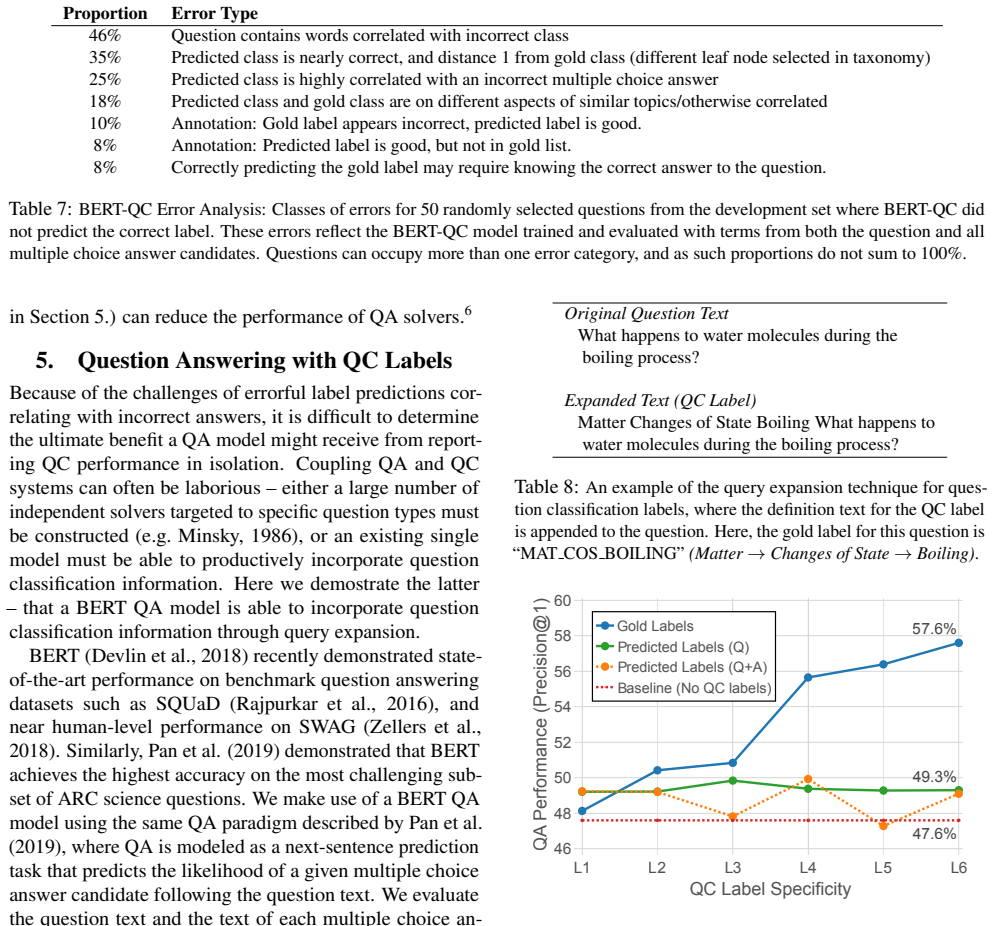
The central object is a six-level hierarchical taxonomy of 406 fine-grained problem domains (for example, Astronomy → Gravitational Pull), annotated on 7,787 multiple-choice science questions, paired with a fine-tuned BERT model (BERT-QC) that treats the taxonomy as a multi-label classification problem by duplicating multi-labeled questions into single-label training instances. The QA integration mechanism is query expansion: the definition text of the predicted label at every level is concatenated to the question before a next-sentence-prediction BERT QA model scores each answer choice. The taxonomy carries the knowledge of what problem type is being asked; BERT-QC carries the mapping from question text to problem type; query expansion carries that type signal into answer selection.
What would settle it
Evaluate the QA+QC system on ARC's official held-out test split, which the paper does not use for QA evaluation, comparing predicted-label runs to no-label runs; if the +1.7% advantage does not appear there, the development-set result does not generalize.
Extended reading notes
Core claim
On the paper's own terms, the central discovery is that a 406-class hierarchical taxonomy of science exam problems can be learned by a single fine-tuned transformer classifier, and that the learned labels are useful downstream. On the ARC corpus, BERT-QC outperforms five adapted baselines by +0.12 MAP and +13.5% P@1 at the finest taxonomy level, while also matching or beating previous learned models on TREC and improving on two biomedical datasets. Feeding the predicted labels into a BERT-based multiple-choice QA model via query expansion raises accuracy by +1.7% P@1 (p<0.01), and using gold labels instead shows a +10.0% P@1 ceiling, indicating most of the remaining benefit is blocked by classification error.
Load-bearing premise
The +1.7% QA gain is measured on the tuning set rather than a final unseen test set, and both the QA settings and the choice of which classifier to use were selected using that same tuning set, so the improvement may not carry over to new questions.
Editorial extensions
If this is right
- A QA system that knows each question's fine-grained problem domain can route to domain-specific solvers instead of applying one generic inference method to all science questions.
- Improving QC accuracy from the current 57.8% toward the gold-label ceiling maps to roughly linear QA gains, so better classifiers directly translate into better exam performance.
- Fine-grained labels make error analysis automatic: per-class QA accuracy tables can be generated in seconds, exposing weak classes such as safety procedures.
- A single learned classifier can replace hand-built rule systems across open-domain, biomedical, and science question sets, since it outperforms prior learned baselines on all three.
Reading between the lines
- As an editorial inference, the development-set-only QA gain means the +1.7% figure should be treated as provisional; the held-out ARC test set is the place to confirm it.
- As an editorial inference, the error-correlation finding implies that QC systems should be evaluated jointly with the downstream multiple-choice QA model, not by label accuracy alone.
- As an editorial inference, the taxonomy invites per-domain specialization: with 406 fine-grained categories, one could build focused solvers or knowledge resources for the weakest classes (for example, Safety Procedures at 7% QA accuracy) rather than one generic model.
- As an editorial inference, the estimated 96% label accuracy means some apparent QC errors are actually annotation errors, so the true classifier ceiling is higher than 57.8% P@1 on this benchmark.
Signed reviews
Editorial analysis
A structured set of objections, weighed in public.
Referee Report
Summary. This paper introduces a large question classification dataset: 7,787 ARC science exam questions annotated with labels from a 462-category (406 observed) hierarchical taxonomy at six levels of specificity. The authors adapt BERT to hierarchical multi-label question classification and report large gains over five baseline methods on ARC, as well as state-of-the-art or near-state-of-the-art results on TREC, GARD, and MLBioMedLAT. They then integrate predicted QC labels into a BERT-based multiple-choice QA model via query expansion, reporting a +1.7% P@1 improvement over the no-label baseline and a +10.0% P@1 ceiling using gold labels.
Significance. The dataset contribution is substantial: it is the largest and most detailed QC corpus for science exams, with interannotator agreement reported at multiple hierarchy levels and a careful comparison against five learned baselines. The BERT-QC model's gains on ARC and across three external benchmarks are valuable, and the analysis of how QC error types interact with multiple-choice QA is insightful. The main limitation is that the headline QA improvement is demonstrated only on the development set, with model selections made on that same set, so the practical QA benefit is not yet established on held-out data.
major comments (3)
- [Section 5, Figure 2, Section 9.3] The reported +1.7% P@1 improvement from predicted QC labels is evaluated only on the ARC development set, while the QA model's hyperparameters, the BERT-Large checkpoint choice, and per-run epoch selection were all determined using that same development set (Section 9.3). The paper does not report QA performance on the ARC test set, even though the QC experiments in Section 4.1 use the standard 3,370/869/3,548 split. Because the existence and magnitude of the QA benefit is a central claim, this omission is load-bearing; the authors should report test-set QA results with the same 10-run protocol, and ideally a pre-registered L6 comparison or a multiple-comparison correction across levels L1–L6.
- [Section 9.3.2] The estimate of 'approximately 96%' annotation accuracy is based on the BERT-QC error analysis: 42.2% of predicted labels differ from gold, and 10% of those errors are attributed to gold-label mistakes, giving 4.2% gold errors. This is circular, because the model's predicted label is used as the 'good' label against which the gold label is judged. A direct and unbiased estimate of gold-label quality, for example from a random sample adjudicated by a third expert, is needed to support this claim.
- [Section 9.3 statistics] The bootstrap pairwise comparison combined with Fisher's method tests the difference between 10 no-label and 10 QC-labeled runs at a single taxonomy level, but the reported p<0.01 does not account for the fact that L6 was selected after inspecting the pattern across all six levels in Figure 2, nor for the model selection performed on the same development set. The significance claim should either be corrected for these selection effects or explicitly presented as an exploratory result.
minor comments (4)
- [Throughout] Typos include 'demostrate' (Section 5), 'exampe' (Table 8), 'algortithm' (Section 5.1), 'quesion' (Section 6), 'targetted' (Introduction), and 'heirarchy' (Table 10).
- [Section 4.1] The text introduces the train/dev/test split for ARC but does not explicitly state whether Table 3 and Table 11 report test-set, development-set, or a combined result; please clarify which split underlies the reported QC numbers.
- [Section 4.2.1, footnote 5] The assertion that Xia et al.'s MS MARCO evaluation is 'in error' is speculative; if the claim is retained, it should be supported by a concrete verification or citation.
- [Table 9] Several categories, including 'Safety - Safety Procedures' (N=14) and 'Earth - Outer Core' (N=12), have very small sample sizes; the 'below chance performance' characterization would benefit from confidence intervals or a caution about N.
Circularity Check
No circularity: the classification and QA results are empirical evaluations against fixed gold labels and external benchmarks.
full rationale
The paper's central claims are not forced by construction. The BERT-QC model is trained on ARC training questions and evaluated against gold taxonomy labels on the standard ARC dev/test split (Table 3), and against held-out benchmark datasets TREC, GARD, and MLBioMedLAT (Tables 4-6). The QA experiment couples this classifier with a separately trained BERT QA model through query expansion; the +1.7% P@1 gain and +10.0% P@1 gold-label ceiling are empirical measurements reported in Figure 2, not algebraic consequences of the model definitions. No parameter is fitted to the predicted quantity and renamed as a prediction, and no uniqueness theorem or load-bearing self-citation is invoked. The secondary estimate of annotation accuracy in Section 9.3.2 is based on a human error analysis of 50 dev-set errors, not on the classifier judging its own labels, so it is not circular by construction. The fact that the QA result is reported on the development set after light hyperparameter tuning is a generalization-risk concern, not a circularity concern.
Assumptions & free parameters
free parameters (2)
- BERT-QC hyperparameters =
LR 2e-5 (L1), 5e-5 (L2-L6); epochs 5/25; max seq 256
- BERT-QA hyperparameters =
LR 1e-5; max seq 128; up to 8 epochs (early stop)
assumptions (3)
- domain assumption ARC is a valid benchmark of standardized science exam questions with reliable answer labels
- ad hoc to paper The 462-category hierarchical taxonomy is a complete and useful ontology for science exam problem domains
- domain assumption Gold QC labels are accurate after annotation resolution
Cite this review
Pith. "Pith review of Multi-class Hierarchical Question Classification for Multiple Choice Science Exams." pith.science (2026). https://pith.science/paper/PWSTSHIV
@misc{pith2026190805441,
  author       = {Pith},
  title        = {Pith review of: Multi-class Hierarchical Question Classification for Multiple Choice Science Exams},
  year         = {2026},
  howpublished = {\url{https://pith.science/paper/PWSTSHIV}},
  note         = {Machine review of arXiv:1908.05441}
}
read the original abstract
Prior work has demonstrated that question classification (QC), recognizing the problem domain of a question, can help answer it more accurately. However, developing strong QC algorithms has been hindered by the limited size and complexity of annotated data available. To address this, we present the largest challenge dataset for QC, containing 7,787 science exam questions paired with detailed classification labels from a fine-grained hierarchical taxonomy of 406 problem domains. We then show that a BERT-based model trained on this dataset achieves a large (+0.12 MAP) gain compared with previous methods, while also achieving state-of-the-art performance on benchmark open-domain and biomedical QC datasets. Finally, we show that using this model's predictions of question topic significantly improves the accuracy of a question answering system by +1.7% P@1, with substantial future gains possible as QC performance improves.
Figures


Reference graph
Works this paper leans on
-
[1]
Introduction Understanding what a question is asking is one of the first steps that humans use to work towards an answer. In the context of question answering, question classification allows automated systems to intelligently target their inference systems to domain-specific solvers capable of addressing specific kinds of questions and problem solving methods...
work page Pith review arXiv 2002
-
[2]
We provide a large challenge dataset of question clas- sification labels for 7,787 standardized science exam questions labeled using a hierarchical taxonomy of 406 detailed problem types across 6 levels of granularity. To the best of our knowledge this is the most detailed ques- tion classification dataset constructed by nearly an order of magnitude, while ...
-
[3]
We empirically demonstrate large performance gains of +0.12 MAP (+13.5% P@1) on science exam ques- tion classification using a BERT-based model over five previous state-of-the art methods, while improving per- formance on two biomedical question datasets by 4-5%. This is the first model to show consistent state-of-the- art performance across multiple questio...
-
[4]
We show predicted question labels significantly improve a strong QA model by +1.7% P@1, where ceiling per- formance with perfect classification can reach +10.0% P@1. We also show that the error distribution of ques- tion classification matters when coupled with multiple choice QA models, and that controlling for correlations between classification labels and ...
-
[5]
Related work Question classification typically makes use of a combina- tion of syntactic, semantic, surface, and embedding methods. Syntactic patterns (Li and Roth, 2006; Silva et al., 2011; Patrick and Li, 2012; Mishra et al., 2013) and syntactic dependencies (Roberts et al., 2014) have been shown to improve performance, while syntactically or semanticall...
work page 2014
-
[6]
Each question is a 4-choice multiple choice ques- tion
Questions and Classification Taxonomy Questions: We make use of the 7,787 science exam ques- tions of the Aristo Reasoning Challenge (ARC) corpus (Clark et al., 2018), which contains standardized 3rd to 9th grade science questions from 12 US states from the past decade. Each question is a 4-choice multiple choice ques- tion. Summary statistics comparing th...
work page 2018
-
[7]
Question Classification Models 4.1. Question Classification on Science Exams We identified 5 common models in previous work primarily intended for learned classifiers rather than hand-crafted rules. We adapt these models to a multi-label hierarchical classifi- cation task by training a series of one-vs-all binary classifiers (Tsoumakas and Katakis, 2007), one f...
work page 2002
-
[8]
Question Answering with QC Labels Because of the challenges of errorful label predictions cor- relating with incorrect answers, it is difficult to determine the ultimate benefit a QA model might receive from report- ing QC performance in isolation. Coupling QA and QC systems can often be laborious – either a large number of independent solvers targeted to s...
work page 2019
Show all 14 references
-
[9]
Conclusion Question classification can enable targetting question an- swering models, but is challenging to implement with high performance without using rule-based methods. In this work we generate the most fine-grained challenge dataset for ques- tion classification, using comp...
-
[10]
Resources Our Appendix and supplementary material (avail- able at http://www.cognitiveai.org/ explanationbank/) includes data, code, experi- ment details, and negative results
-
[11]
We thank the Allen Insi- tute for Artificial Intelligence and National Science Founa- tion (NSF 1815948 to PJ) for funding this work
Acknowledgements The authors wish to thank Elizabeth Wainwright and Stephen Marmorstein for piloting an earlier version of the question classification annotation. We thank the Allen Insi- tute for Artificial Intelligence and National Science Founa- tion (NSF 1815948 to PJ) for f...
-
[12]
Annotation Classification Taxonomy: The full classification taxonomy is included in separate files, both coupled with definitions, and as a graphical visualization
Appendix 9.1. Annotation Classification Taxonomy: The full classification taxonomy is included in separate files, both coupled with definitions, and as a graphical visualization. Annotation Procedure: Primary annotation took place over approximately 8 weeks. Annotators were instru...
2012
-
[14]
and Lin, C.-J
Bibliographical References Chang, C.-C. and Lin, C.-J. (2011). Libsvm: a library for support vector machines. ACM transactions on intelligent systems and technology (TIST), 2(3):27. Clark, P., Harrison, P., and Balasubramanian, N. (2013). A study of the knowledge base requirem...
2011 arXiv
-
[2014]
cat” is distance 10 away from living thing , “car
is determining a heuristic for the termination depth of hypernym expansion, as in Van-tu et al. (2016). Because science exam questions are often grounded in specific exam- ples (e.g. a car rolling down a hill coming to a stop due to friction), we hypothesized that knowing certa...
2016
Reviewed August 14, 2026 · model on record in the stance chip above.
Discussion (0). Continue with ORCID to comment.