REVIEW 2 major objections 5 minor 1 cited by
Enhancing Taiji's Parameter Estimation under Non-Stationarity: a Time-Frequency Domain Framework for Galactic Binaries and Instrumental Noises
T0 review · 2 major / 5 minor · reviewed 2026-08-07 · deepseek-v4-flash
Pith's one-line read A short-time Fourier transform likelihood outperforms frequency-domain analysis for Taiji under non-stationary noise, cutting bias and recovering lost low-SNR binaries.
desk verdict Solid time-frequency framework for Taiji data analysis with a real analytic template; the main caveat is the uncorrelated-pixel likelihood assumption, which needs more validation for fast noise drifts. read the letter →
The pith
A machine-rendered reading of the paper's core claim, the machinery that carries it, and where it could break.
The reading
What carries the argument
The load-bearing object is the STFT template-likelihood pair: a short-time Fourier transform, that is, a windowed Fourier transform that breaks the data into blocks and gives one power spectrum per block. For a Galactic binary, the template factorizes as $\bar{X}_2(t_m,f) \approx e^{-i\pi f T}\tilde{w}_m(f-\dot{\varphi}(t_m)/2\pi)\, A_{X2}(t_m)$, separating the fast phase evolution (which shifts the window function in frequency) from the slow amplitude and orbit modulation $A_{X2}(t_m)$. The noise enters through a time-frequency PSD $S(t,f)$ whose time dependence comes from the same delay operators used in the TDI combinations. Over the resulting pixels, the paper defines an inner product and the extended Whittle likelihood (Eq. 33), which assumes all time-frequency pixels are uncorrelated. That assumption turns a non-stationary, fully correlated problem into a locally stationary, diagonal one that is cheap to evaluate; the implementation reaches roughly $10^4$ likelihood evaluations per second on a GPU.
What would settle it
Inject a simulated Galactic binary into a year of Taiji noise whose amplitude is modulated on a timescale shorter than the 2.5-day segment length, run the STFT inference on many noise realizations, and measure the empirical coverage of the 68% and 95% credible intervals; if coverage falls well below nominal while the frequency-domain method becomes even more biased, the local-stationarity assumption has broken down.
Extended reading notes
Core claim
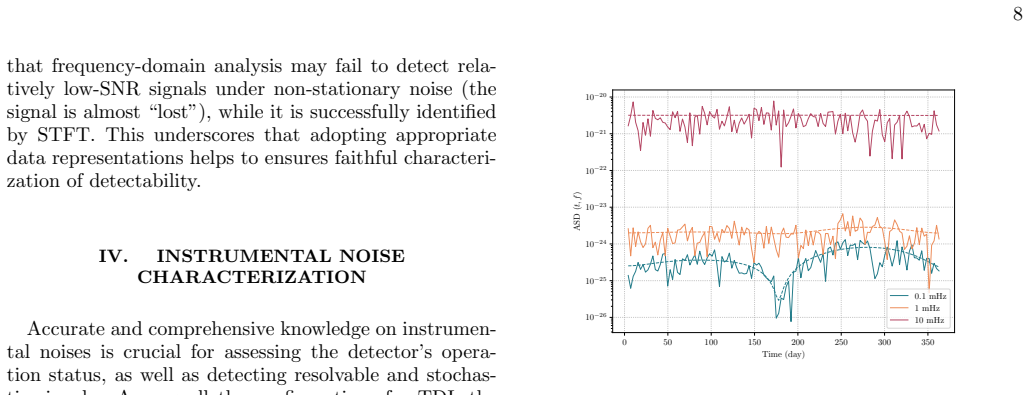
The central discovery is that, under non-stationary noise, the time-frequency likelihood is not just a convenience but the statistically correct model. The paper shows that within segments short enough to be locally stationary, both signal and noise factorize into per-segment, per-frequency pieces: a Galactic binary's STFT template at segment $t_m$ is the window function evaluated at the instantaneous frequency $\dot{\varphi}(t_m)/2\pi$ times a slowly varying amplitude factor $A_{X2}(t_m)$, and the noise power spectrum $S(t_m,f_n)$ is built from the same delay operators that define the time-delay interferometry (TDI) combinations. The extended Whittle likelihood (Eq. 33) then treats every time-frequency pixel as an independent measurement, which is the correct limit of local stationarity and removes the non-diagonal noise covariance that plagues the frequency-domain likelihood. Because the time dependence of the noise is modeled explicitly, parameter estimates are less biased and credible intervals narrower; because the T channel's time-varying transfer function is captured, previously degenerate noise amplitudes become separable.
Load-bearing premise
The whole posterior rests on the assumption that the noise is statistically stationary within each 2.5-day block and that different blocks are independent; if noise drifts on shorter timescales or windowing couples neighboring frequency bins, the likelihood is misspecified and the reported credible intervals could be over-confident.
Editorial extensions
If this is right
- Cutting data into locally stationary STFT segments reduces bias and narrows credible intervals for Galactic binary parameters when noise drifts on monthly timescales.
- A low-SNR verification binary that frequency-domain analysis effectively loses can be recovered by the STFT likelihood.
- Modeling the T channel's time-varying transfer function separates otherwise degenerate acceleration-noise amplitudes, giving substantially tighter posterior constraints.
- The time-frequency likelihood is computationally efficient enough (about $10^4$ evaluations per second per GPU) to serve as an engine for future global fits.
- Because the method rests on the segmentation and the delay operators rather than on Taiji-specific orbits, the same framework transfers to LISA and Tianqin data with the same segment-length logic.
Reading between the lines
- If local stationarity holds, the same time-frequency pixelisation could handle data gaps naturally: a missing block simply drops out of the likelihood sum, something the frequency-domain method cannot do cleanly.
- The framework points toward a fully time-frequency global fit that models resolved binaries, unresolved foreground, and drifting instrument noise together, turning non-stationarity from a nuisance into a modeled feature.
- A natural stress test is the low signal-to-noise regime: the paper's claim predicts that STFT credible intervals stay closer to nominal coverage than frequency-domain intervals even when individual blocks sit near the detection threshold.
- The time-frequency decomposition of the T channel could be extended to separate an anisotropic stochastic foreground from arm-length-driven transfer variations by comparing the modeled $F_{ij,\alpha}(t,f)$ patterns, a direction the paper notes but leaves for future work.
Editorial analysis
A structured set of objections, weighed in public.
Referee Report
Summary. This paper proposes a short-time Fourier transform (STFT) based Bayesian inference framework for the Taiji space-based gravitational wave detector, targeting parameter estimation of Galactic binaries and characterization of instrumental noise under non-stationary conditions. The authors derive STFT templates for the TDI response of verification Galactic binaries (Eq. 27) and a time-frequency noise spectral model (Eq. 29), and define an extended Whittle likelihood (Eq. 33). They validate the templates against an independent time-domain simulator (Fig. 1), perform Bayesian MCMC on 55 VGBs comparing STFT with a frequency-domain benchmark (GBGPU), and apply the method to noise amplitude estimation in the T channel under armlength variations. The main claims are reduced uncertainty and bias, recovery of a low-SNR source missed by frequency-domain analysis, and mitigation of parameter degeneracies.
Significance. If the claims hold, the framework provides a practical, GPU-accelerated time-frequency approach that could be integrated into future LISA/Taiji/Tianqin global analysis pipelines, where non-stationary noise is a recognized challenge. The paper has clear strengths: the STFT template is derived from first principles and checked against a rigorous time-domain simulator, with mismatches at O(10^-3) or better for 1-2.5 day segments; the authors provide open-source codes (Triangle-Simulator, Triangle-GB) and use a standard MCMC sampler (Eryn), making the analysis reproducible; and the P-P plots with KS tests give a direct calibration check for the tested noise scenario. The main risk is that the extended Whittle likelihood assumes uncorrelated time-frequency pixels; this is not automatically satisfied with the chosen Tukey window and is only empirically validated for one slowly-varying noise profile.
major comments (2)
- [Eq. (33) and Section II B] The extended Whittle likelihood in Eq. (33) sums over STFT pixels as independent, stated to follow from 'local stationarity and statistical independence among segments' with citations to Refs. [53,76]. Those references concern WDM wavelets whose near-orthogonality is specifically engineered; the same property does not hold automatically for a short-time Fourier transform with the Tukey window of Eq. (A1). For a segment of length T, the Tukey window transfer function has a mainlobe comparable to the frequency spacing 1/T, so adjacent frequency bins are correlated even for strictly stationary noise. The P-P plots in Fig. 4 are sensitive to this only for the injected one-knot-per-month drift profile. Please provide (a) a direct computation of the STFT pixel correlation matrix for the chosen parameters, and (b) posterior coverage tests for noise drifts on timescales comparable to or shorter than the 2.5-day segment. Without these, the reported uncertainty reductions in Figs. 4 and 8 could partly reflect overconfidence rather than additional information, which would affect every posterior in the paper.
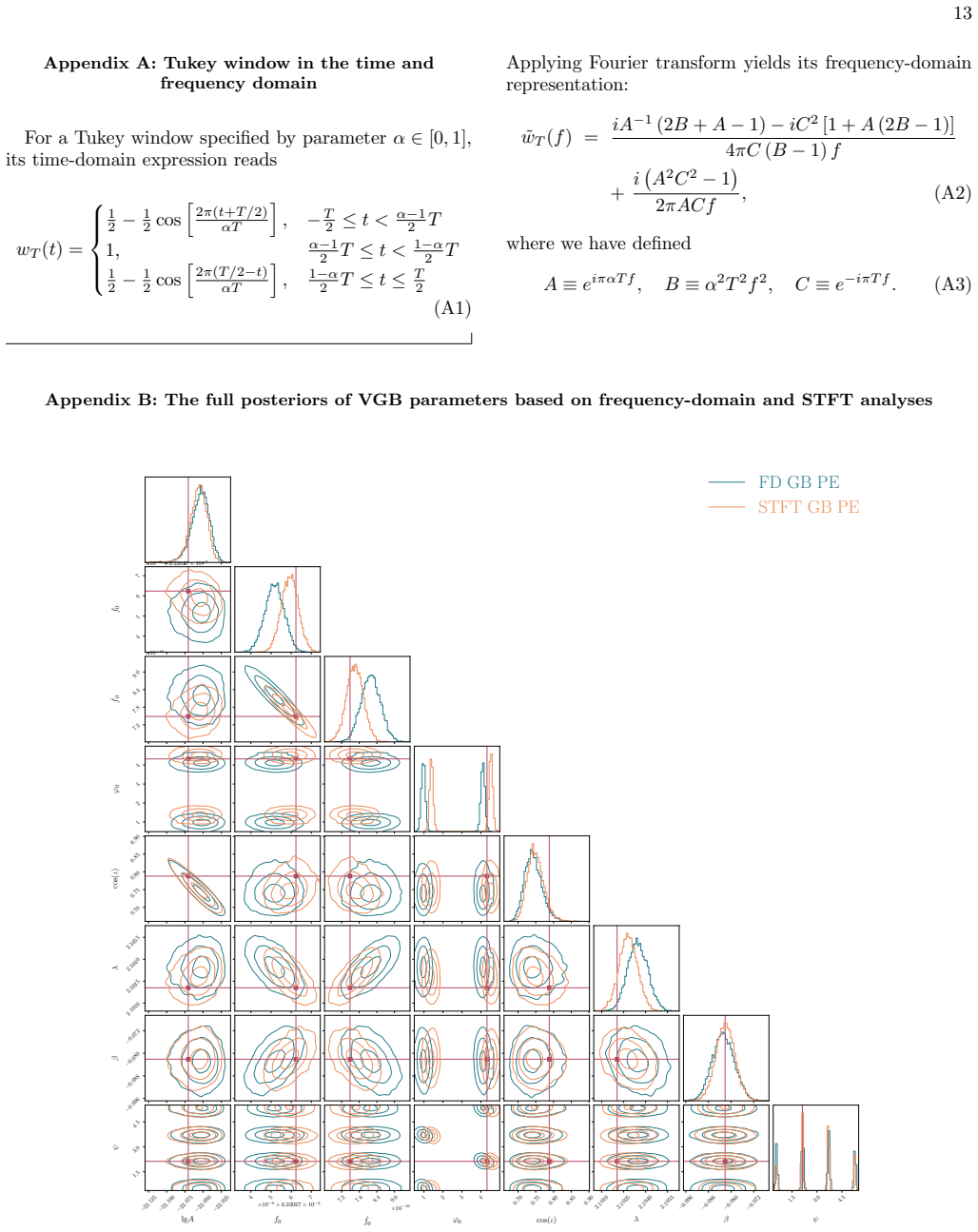
- [Section III, Fig. 5] The abstract's claim that the STFT approach 'successfully recovers low signal-to-noise ratio signals missed by frequency-domain analysis' is supported by a single source, ZTF J2320. The text describes it as relatively low-SNR but does not quote the injected SNR, the recovered SNR, or any detection statistic such as a Bayes factor or false-alarm probability. The figure shows posterior samples, but it is not clear from the plot alone whether the frequency-domain posterior has actually failed to constrain the source or is merely broader. Please quantify the SNR and provide a detection significance; ideally, also give the recovery rate over a population of low-SNR injections rather than a single anecdotal case.
minor comments (5)
- [Section I] The sentence 'A a way around this difficulty' in the Introduction contains a typo ('A a' should be 'A way').
- [Figure 5 caption] The caption contains a typo: 'frequnecy-domain' should be 'frequency-domain'.
- [Section III] The noise amplitude is said to vary by '±1 magnitudes'; please clarify whether this means a factor of 10 in amplitude or in power spectral density, and how the cubic-spline knots are normalized.
- [Appendix A and Eq. (A2)] The frequency-domain Tukey window expression in Eq. (A2) uses definitions A, B, and C but does not state its domain of validity (e.g., excluding f = 0) or explain fully how it is derived from the time-domain window in Eq. (A1); a brief note would improve reproducibility.
- [Equation (31) and surrounding text] The notation 'Nf,m/Tm' is ambiguous: the upper limit of the frequency sum should be written as Nf,m/Tm (the maximum frequency), and the subscript 'Nf,m' should be defined explicitly.
Circularity Check
No significant circularity: the STFT template, noise model, and extended Whittle likelihood are derived from first principles and validated against independent time-domain simulations.
full rationale
The paper's derivation chain is self-contained. The STFT GB template (Eq. 27) is obtained by analytically evaluating the windowed integral in Eq. 23 from the time-domain TDI response, with the slow-variation approximations stated explicitly; its accuracy is checked directly against time-domain waveforms from the public Triangle-Simulator toolkit (Fig. 1), not against the template itself. The time-varying noise PSD (Eqs. 29 and 35) is computed from TDI transfer functions and independently compared with simulated data (Fig. 6). The likelihood (Eq. 33) is the standard extended Whittle form; its diagonal-pixel assumption is justified by external references (Refs. [53,76]), and a potential violation would be a modeling or calibration concern, not a circular step. The only self-references (Ref. [19] for Taiji orbit data and Triangle-GB validation, plus the TriangleDataCenter repositories) are used for simulation infrastructure and benchmarking; Triangle-GB is public code validated against time-domain simulation, so it constitutes independent support rather than a circular premise. No fitted parameter is renamed as a prediction, no uniqueness theorem is imported from the authors' prior work, and no known result is merely relabeled. The reported STFT advantage follows from using time-resolved noise PSDs instead of year-averaged spectra, which is the paper's stated point rather than a definitional tautology.
Assumptions & free parameters
free parameters (5)
- Segment length T_m =
2.5 days
- Tukey window parameter alpha =
0.1
- VGB amplitude scaling factors =
2x for first 25 sources, 4x for remaining 30
- Injected noise drift profile =
+/-1 magnitude around mean, 13 cubic-spline knots over 1 year
- PSD estimation band widths and smoothing filter =
10 microHz (FD), 50 microHz (STFT), Savitzky-Golay smoothing
assumptions (7)
- domain assumption STFT pixels are locally stationary and statistically independent across segments; the extended Whittle likelihood is valid.
- domain assumption Within a segment, the GW phase evolves linearly and detector orbit delays can be approximated by constant phase shifts.
- domain assumption OMS and ACC noise spectral shapes are known, identical for all links, and constant over the mission; only amplitudes are estimated.
- domain assumption All T-channel non-stationarity comes from arm length variations in the transfer functions, not from intrinsic noise drift.
- domain assumption Arm lengths are known to nanosecond precision from ranging and orbit determination.
- domain assumption The median periodogram and Savitzky-Golay smoothing produce an unbiased estimate of the local noise PSD in the Galactic binary analysis.
- standard math Newtonian approximation and third-order phase expansion describe Galactic binary waveforms.
Cite this review
Pith. "Pith review of Enhancing Taiji's Parameter Estimation under Non-Stationarity: a Time-Frequency Domain Framework for Galactic Binaries and Instrumental Noises." pith.science (2026). https://pith.science/paper/PX3OBQJO
@misc{pith2026250610599,
  author       = {Pith},
  title        = {Pith review of: Enhancing Taiji's Parameter Estimation under Non-Stationarity: a Time-Frequency Domain Framework for Galactic Binaries and Instrumental Noises},
  year         = {2026},
  howpublished = {\url{https://pith.science/paper/PX3OBQJO}},
  note         = {Machine review of arXiv:2506.10599}
}
read the original abstract
The data analysis of space-based gravitational wave detectors like Taiji faces significant challenges from non-stationary noise, which compromises the efficacy of traditional frequency-domain analysis. This work proposes a unified framework based on short-time Fourier transform (STFT) to enhance parameter estimation of Galactic binary and characterization of instrumental noise under non-stationarity. Segmenting data into locally stationary intervals, we derive STFT-based models for signals and noises, and implement Bayesian inference via the extended Whittle likelihood. Validated through the analysis of verification Galactic binaries and instrumental noises, our STFT approach outperforms frequency-domain methods by reducing the uncertainty and bias of estimation, successfully recovering low signal-to-noise ratio signals missed by frequency-domain analysis, and mitigating the degeneracy among noise parameters. The framework's robustness against noise drifts and computational efficiency highlight its potential for integration into future global analysis pipelines.
Figures


Figures from the paper (6 more)




Forward citations
Cited by 1 Pith paper
-
Non-stationary noise in gravitational wave analyses: The wavelet domain noise covariance matrix
For slowly varying detector noise, the Wilson-Daubechies-Meyer wavelet noise covariance matrix is approximately diagonal, with off-diagonal terms controlled by the time and frequency derivatives of the dynamic spectral model.
Reference graph
Works this paper leans on
-
[1]
P. Amaro-Seoane, H. Audley, S. Babak, J. Baker, E. Barausse, et al., (2017), 10.48550/arXiv.1702.00786, arxiv:1702.00786 [astro-ph.IM]
-
[2]
Baker et al., (2019), arXiv:1907.06482 [astro-ph.IM]
J. Baker et al., (2019), arXiv:1907.06482 [astro-ph.IM]
arXiv 2019
-
[3]
Hu and Y.-L
W.-R. Hu and Y.-L. Wu, National Science Review 4, 685 (2017), https://academic.oup.com/nsr/article- pdf/4/5/685/31566708/nwx116.pdf
2017
-
[4]
Z. Luo, Z. Guo, G. Jin, Y. Wu, and W. Hu, Results in Physics 16, 102918 (2020)
2020
-
[5]
Z. Luo, Y. Wang, Y. Wu, W. Hu, and G. Jin, Progress of Theoretical and Experimental Physics 2021, 05A108 (2020), https://academic.oup.com/ptep/article- pdf/2021/5/05A108/37953044/ptaa083.pdf
2020
- [6]
-
[7]
K. Li, T. Bogdanovi´ c, D. R. Ballantyne, and M. Bonetti, The Astrophysical Journal 933, 104 (2022)
2022
-
[8]
K. Li, T. Bogdanovi´ c, D. R. Ballantyne, and M. Bonetti, (2022), 10.48550/arXiv.2207.14231, arXiv:2207.14231 [astro-ph.GA]
work page Pith review arXiv doi:10.48550/arxiv.2207.14231 2022
Show all 112 references
- [9]
-
[10]
Lamberts, S
A. Lamberts, S. Blunt, T. B. Littenberg, S. Garrison- Kimmel, T. Kupfer, et al., Monthly Notices of the Royal Astronomical Society 490, 5888 (2019), https://academic.oup.com/mnras/article- pdf/490/4/5888/30995029/stz2834.pdf
2019
-
[11]
Korol, E
V. Korol, E. M. Rossi, P. J. Groot, G. Nele- mans, S. Toonen, et al., Monthly Notices of the Royal Astronomical Society 470, 1894 (2017), https://academic.oup.com/mnras/article- pdf/470/2/1894/18139327/stx1285.pdf
2017
-
[12]
Korol, N
V. Korol, N. Hallakoun, S. Toonen, and N. Karnesis, Monthly Notices of the Royal Astronomical Society511, 5936 (2022), https://academic.oup.com/mnras/article- pdf/511/4/5936/48413134/stac415.pdf
2022
-
[13]
Lisa and the galactic population of compact binaries,
M. Benacquista, “Lisa and the galactic population of compact binaries,” in Handbook of Gravitational Wave Astronomy, edited by C. Bambi, S. Katsanevas, and K. D. Kokkotas (Springer Singapore, Singapore, 2020) pp. 1–24
2020
-
[14]
J. R. Gair, L. Barack, T. Creighton, C. Cutler, S. L. Larson, et al., Class. Quant. Grav. 21, S1595 (2004), arXiv:gr-qc/0405137
2004 arXiv
-
[15]
Chen, C.-S
J. Chen, C.-S. Yan, Y.-J. Lu, Y.-T. Zhao, and J.-Q. 11 Ge, Research in Astronomy and Astrophysics 21, 285 (2021)
2021
-
[16]
Buscicchio, J
R. Buscicchio, J. Torrado, C. Caprini, G. Nar- dini, N. Karnesis, et al., JCAP 01, 084 (2025), arXiv:2410.18171 [astro-ph.HE]
2025 arXiv
-
[17]
Babak, C
S. Babak, C. Caprini, D. G. Figueroa, N. Kar- nesis, P. Marcoccia, et al., JCAP 08, 034 (2023), arXiv:2304.06368 [astro-ph.CO]
2023 arXiv
-
[18]
Caprini et al., JCAP 03, 024 (2020), arXiv:1910.13125 [astro-ph.CO]
C. Caprini et al., JCAP 03, 024 (2020), arXiv:1910.13125 [astro-ph.CO]
2020 arXiv
-
[19]
Du et al., (2025), arXiv:2505.16500 [gr-qc]
M. Du et al., (2025), arXiv:2505.16500 [gr-qc]
2025
-
[20]
Breivik, C
K. Breivik, C. M. F. Mingarelli, and S. L. Larson, Astro- phys. J. 901, 4 (2020), arXiv:1912.02200 [astro-ph.GA]
2020 arXiv
-
[21]
Ebadi, V
R. Ebadi, V. Strokov, E. H. Tanin, E. Berti, and R. L. Walsworth, Phys. Rev. D 111, 044023 (2025)
2025
-
[22]
Liu, W.-H
C. Liu, W.-H. Ruan, and Z.-K. Guo, Phys. Rev. D 107, 064021 (2023), arXiv:2301.02821 [astro-ph.IM]
2023 arXiv
-
[23]
Karnesis, S
N. Karnesis, S. Babak, M. Pieroni, N. Cornish, and T. Littenberg, Phys. Rev. D 104, 043019 (2021), arXiv:2103.14598 [astro-ph.IM]
2021 arXiv
-
[24]
Littenberg, N
T. Littenberg, N. Cornish, K. Lackeos, and T. Robson, Phys. Rev. D 101, 123021 (2020), arXiv:2004.08464 [gr- qc]
2020 arXiv
-
[25]
T. B. Littenberg and N. J. Cornish, Phys. Rev. D 107, 063004 (2023), arXiv:2301.03673 [gr-qc]
2023 arXiv
-
[26]
M. L. Katz, N. Karnesis, N. Korsakova, J. R. Gair, and N. Stergioulas, (2024), arXiv:2405.04690 [gr-qc]
2024 arXiv
-
[27]
S. Deng, S. Babak, M. Le Jeune, S. Marsat, E. Plagnol, et al., Phys. Rev. D 111, 103014 (2025), arXiv:2501.10277 [gr-qc]
2025 arXiv
-
[28]
G. Wang, B. Li, P. Xu, and X. Fan, Phys. Rev. D 106, 044054 (2022)
2022
-
[29]
Hartwig, M
O. Hartwig, M. Lilley, M. Muratore, and M. Pieroni, Phys. Rev. D 107, 123531 (2023)
2023
-
[30]
M. H. A. Davis (1989)
1989
-
[31]
Jaranowski and A
P. Jaranowski and A. Krolak, Analysis of Gravitational- Wave Data , Cambridge Monographs on Particle Physics, Nuclear Physics and Cosmology (Cambridge University Press, 2009)
2009
-
[32]
Muratore, J
M. Muratore, J. Gair, and L. Speri, Phys. Rev. D 109, 042001 (2024)
2024
-
[33]
Caprini, D
C. Caprini, D. G. Figueroa, R. Flauger, G. Nardini, M. Peloso, et al., Journal of Cosmology and Astropar- ticle Physics 2019, 017 (2019)
2019
-
[34]
Flauger, N
R. Flauger, N. Karnesis, G. Nardini, M. Pieroni, A. Ric- ciardone, et al., JCAP 01, 059 (2021), arXiv:2009.11845 [astro-ph.CO]
2021 arXiv
-
[35]
Boileau, N
G. Boileau, N. Christensen, R. Meyer, and N. J. Cor- nish, Phys. Rev. D 103, 103529 (2021)
2021
-
[36]
Baghi, N
Q. Baghi, N. Karnesis, J.-B. Bayle, M. Besan¸ con, and H. Inchausp´ e, Journal of Cosmology and Astroparticle Physics 2023, 066 (2023)
2023
-
[38]
Muratore, D
M. Muratore, D. Vetrugno, S. Vitale, and O. Hartwig, Phys. Rev. D 105, 023009 (2022)
2022
-
[39]
Hartwig and M
O. Hartwig and M. Muratore, Phys. Rev. D 105, 062006 (2022)
2022
-
[40]
Muratore, O
M. Muratore, O. Hartwig, D. Vetrugno, S. Vitale, and W. J. Weber, Phys. Rev. D 107, 082004 (2023)
2023
-
[41]
Wang, X.-Y
P.-P. Wang, X.-Y. Lu, X.-L. Zhao, H.-K. Chen, J. Zhou, et al., Results in Physics 58, 107481 (2024)
2024
-
[42]
Transient noises such as glitches can be ad- dressed with alternative methods like fitting and sub- traction [113, 114]
The focus of this paper primarily lies in slowly drift- ing noises. Transient noises such as glitches can be ad- dressed with alternative methods like fitting and sub- traction [113, 114]
-
[43]
M. R. Adams and N. J. Cornish, Phys. Rev. D 89, 022001 (2014)
2014
-
[44]
S. Lin, B. Hu, X.-H. Zhang, and Y.-X. Liu, Sci. China Phys. Mech. Astron. 66, 299512 (2023), arXiv:2212.14519 [gr-qc]
2023 arXiv
-
[45]
Pozzoli, R
F. Pozzoli, R. Buscicchio, A. Klein, V. Korol, A. Sesana, et al., Phys. Rev. D 111, 063005 (2025), arXiv:2410.08274 [astro-ph.GA]
2025 arXiv
-
[46]
Armano, H
M. Armano, H. Audley, G. Auger, J. T. Baird, M. Bas- san, et al., Phys. Rev. Lett. 116, 231101 (2016)
2016
-
[47]
Armano, H
M. Armano, H. Audley, J. Baird, P. Binetruy, M. Born, et al., Phys. Rev. D 97, 122002 (2018)
2018
-
[48]
Armano, H
M. Armano, H. Audley, J. Baird, P. Binetruy, M. Born, et al., Phys. Rev. Lett. 120, 061101 (2018)
2018
-
[49]
Wang and W.-T
G. Wang and W.-T. Ni, Phys. Scripta 98, 075005 (2023), arXiv:2008.05812 [gr-qc]
2023 arXiv
- [50]
-
[51]
Whittle, Journal of the Royal Statistical Society: Series B (Methodological) 20, 334 (2018), https://academic.oup.com/jrsssb/article- pdf/20/2/334/49096391/jrsssb 20 2 334.pdf
P. Whittle, Journal of the Royal Statistical Society: Series B (Methodological) 20, 334 (2018), https://academic.oup.com/jrsssb/article- pdf/20/2/334/49096391/jrsssb 20 2 334.pdf
2018
-
[52]
Baghi, I
Q. Baghi, I. Thorpe, J. Slutsky, J. Baker, T. Dal Can- ton, et al., Phys. Rev. D 100, 022003 (2019), arXiv:1907.04747 [gr-qc]
2019 arXiv
-
[53]
N. J. Cornish, Phys. Rev. D 102, 124038 (2020)
2020
-
[54]
M. C. Digman and N. J. Cornish, Astrophys. J. 940, 10 (2022), arXiv:2206.14813 [astro-ph.IM]
2022 arXiv
-
[55]
M. C. Digman and N. J. Cornish, Phys. Rev. D 108, 023022 (2023), arXiv:2212.04600 [gr-qc]
2023 arXiv
-
[56]
Tenorio and D
R. Tenorio and D. Gerosa, Phys. Rev. D 111, 104044 (2025), arXiv:2502.11823 [gr-qc]
2025 arXiv
-
[57]
Kumar, A
S. Kumar, A. H. Nitz, and X. J. Forteza, Astrophys. J. 982, 67 (2025), arXiv:2202.12762 [astro-ph.IM]
2025 arXiv
-
[58]
Klimenko, I
S. Klimenko, I. Yakushin, A. Mercer, and G. Mitsel- makher, Classical and Quantum Gravity 25, 114029 (2008), arXiv:0802.3232 [gr-qc]
2008 arXiv
-
[59]
Kupfer et al., Astrophys
T. Kupfer et al., Astrophys. J. 963, 100 (2024), arXiv:2302.12719 [astro-ph.SR]
2024 arXiv
-
[60]
A. W. Criswell, S. Rieck, and V. Mandic, Phys. Rev. D 111, 023025 (2025), arXiv:2410.23260 [astro-ph.IM]
2025 arXiv
-
[61]
Otto, Time-Delay Interferometry Simulations for the Laser Interferometer Space Antenna, Ph.D
M. Otto, Time-Delay Interferometry Simulations for the Laser Interferometer Space Antenna, Ph.D. thesis, Leib- niz U., Hannover (2015)
2015
-
[62]
Hartwig, Instrumental modelling and noise reduction algorithms for the Laser Interferometer Space Antenna, Ph.D
O. Hartwig, Instrumental modelling and noise reduction algorithms for the Laser Interferometer Space Antenna, Ph.D. thesis, Leibniz U., Hannover (2021)
2021
-
[63]
Bayle and O
J.-B. Bayle and O. Hartwig, Phys. Rev. D 107, 083019 (2023)
2023
-
[64]
P. Wu, M. Du, and P. Xu, Opt. Express 32, 43249 (2024), arXiv:2206.10664 [gr-qc]
2024 arXiv
-
[65]
M. L. Katz, J.-B. Bayle, A. J. K. Chua, and M. Vallis- neri, Phys. Rev. D 106, 103001 (2022)
2022
-
[66]
Lisa data challenge manual,
L. WG, “Lisa data challenge manual,” https: //lisa-ldc.lal.in2p3.fr/static/data/pdf/ LDC-manual-002.pdf
-
[67]
Z. Ren, T. Zhao, Z. Cao, Z.-K. Guo, W.-B. Han, et al., Front. Phys. (Beijing) 18, 64302 (2023), arXiv:2301.02967 [gr-qc]
2023 arXiv
-
[68]
J. N. Reinhardt, M. Staab, K. Yamamoto, J.-B. Bayle, A. Hees, et al., Phys. Rev. D 109, 022004 (2024), arXiv:2307.05204 [gr-qc]. 12
2024 arXiv
-
[69]
J. N. Reinhardt, O. Hartwig, and G. Heinzel, Class. Quant. Grav. 42, 055014 (2025), arXiv:2408.09832 [gr- qc]
2025 arXiv
-
[70]
Quang Nam, Y
D. Quang Nam, Y. Lemi` ere, A. Petiteau, J.-B. Bayle, O. Hartwig, et al., Phys. Rev. D 108, 082004 (2023), arXiv:2211.02539 [gr-qc]
2023 arXiv
-
[71]
Tinto and S
M. Tinto and S. Dhurandhar, Living Reviews in Rela- tivity 24 (2021), 10.1007/s41114-020-00029-6
2021 doi
-
[72]
Tinto and S
M. Tinto and S. V. Dhurandhar, Living Rev. Rel. 8, 4 (2005), arXiv:gr-qc/0409034
2005 arXiv
-
[73]
Wang, W.-L
P.-P. Wang, W.-L. Qian, Y.-J. Tan, H.-Z. Wu, and C.-G. Shao, Phys. Rev. D 106, 024003 (2022), arXiv:2205.08709 [gr-qc]
2022 arXiv
-
[74]
T. A. Prince, M. Tinto, S. L. Larson, and J. W. Armstrong, Phys. Rev. D 66, 122002 (2002), arXiv:gr- qc/0209039
2002
-
[75]
M. B. Priestley, Journal of the Royal Statistical Society: Series B (Methodological) 27, 204 (1965), https://rss.onlinelibrary.wiley.com/doi/pdf/10.1111/j.2517- 6161.1965.tb01488.x
1965
-
[76]
Burke, S
O. Burke, S. Marsat, J. R. Gair, and M. L. Katz, (2025), arXiv:2502.17426 [gr-qc]
2025 arXiv
-
[77]
Castelli, Q
E. Castelli, Q. Baghi, J. G. Baker, J. Slutsky, J. Bobin, et al., Class. Quant. Grav. 42, 065018 (2025), arXiv:2411.13402 [gr-qc]
2025 arXiv
-
[78]
P. A. Seoane et al., Gen. Rel. Grav. 54, 3 (2022), arXiv:2107.09665 [astro-ph.IM]
2022 arXiv
-
[79]
N. J. Cornish and T. B. Littenberg, Phys. Rev. D 76, 083006 (2007), arXiv:0704.1808 [gr-qc]
2007 arXiv
-
[80]
Korol, N
V. Korol, N. Hallakoun, S. Toonen, and N. Karne- sis, Mon. Not. Roy. Astron. Soc. 511, 5936 (2022), arXiv:2109.10972 [astro-ph.HE]
2022 arXiv
-
[81]
Korol, E
V. Korol, E. M. Rossi, P. J. Groot, G. Nelemans, S. Too- nen, et al., Mon. Not. Roy. Astron. Soc. 470, 1894 (2017), arXiv:1703.02555 [astro-ph.HE]
2017 arXiv
-
[82]
To set a criterion for the accuracy of template, we require the residual signal-to-noise ratio (SNR) caused by template error to be less than 1
When modeling the TDI response of GB signal, the am- plitude evolves slowly and can be calculated on a sparse time grid without loss of precision, leaving the accu- racy of phase as our primary focus. To set a criterion for the accuracy of template, we require the residual sig...
-
[83]
The difference between dij and dji is crucial for the suppression of laser noise, though
-
[84]
https://github.com/TriangleDataCenter/ Triangle-Simulator
-
[85]
Lindblom, B
L. Lindblom, B. J. Owen, and D. A. Brown, Phys. Rev. D 78, 124020 (2008)
2008
-
[86]
P¨ urrer and C.-J
M. P¨ urrer and C.-J. Haster, Phys. Rev. Res. 2, 023151 (2020)
2020
-
[87]
S. H. Strub, L. Ferraioli, C. Schmelzbach, S. C. St¨ ahler, and D. Giardini, Phys. Rev. D 110, 024005 (2024), arXiv:2403.15318 [gr-qc]
2024 arXiv
-
[88]
M. L. Katz, C. Danielski, N. Karnesis, V. Korol, N. Tamanini, et al., Mon. Not. Roy. Astron. Soc. 517, 697 (2022), arXiv:2205.03461 [astro-ph.EP]
2022 arXiv
-
[89]
Robson, N
T. Robson, N. J. Cornish, N. Tamanini, and S. Toonen, Phys. Rev. D 98, 064012 (2018), arXiv:1806.00500 [gr- qc]
2018 arXiv
-
[90]
mikekatz04/gbgpu: First official public release!
M. L. Katz, “mikekatz04/gbgpu: First official public release!” (2022)
2022
-
[91]
https://github.com/TriangleDataCenter/ Triangle-GB
-
[92]
Allen, W
B. Allen, W. G. Anderson, P. R. Brady, D. A. Brown, and J. D. E. Creighton, Phys. Rev. D85, 122006 (2012), arXiv:gr-qc/0509116
2012 arXiv
-
[93]
R. W. Schafer, IEEE Signal Processing Magazine 28, 111 (2011)
2011
-
[94]
LISA Verification Bi- naries,
LISA Collaboration, “LISA Verification Bi- naries,” https://gitlab.in2p3.fr/LISA/ lisa-verification-binaries (2024)
2024
-
[95]
Karnesis, M
N. Karnesis, M. L. Katz, N. Korsakova, J. R. Gair, and N. Stergioulas, Mon. Not. Roy. Astron. Soc. 526, 4814 (2023), arXiv:2303.02164 [astro-ph.IM]
2023 arXiv
-
[96]
For parameters with multimodal distributions ( e.g., the sky locations of some sources), we employ SCIPY’s find peaks method to select only the peak with maxi- mum likelihood values
-
[97]
C. J. Hogan and P. L. Bender, Phys. Rev. D 64, 062002 (2001), arXiv:astro-ph/0104266
2001 arXiv
-
[99]
Pozzoli, R
F. Pozzoli, R. Buscicchio, C. J. Moore, F. Haardt, and A. Sesana, Phys. Rev. D 109, 083029 (2024), arXiv:2311.12111 [astro-ph.CO]
2024 arXiv
- [100]
-
[101]
Wang, (2025), arXiv:2502.03983 [gr-qc]
G. Wang, (2025), arXiv:2502.03983 [gr-qc]
2025
- [102]
-
[103]
T. B. Littenberg and N. J. Cornish, Phys. Rev. D 91, 084034 (2015), arXiv:1410.3852 [gr-qc]
2015 arXiv
-
[104]
N. J. Cornish and J. D. Romano, Phys. Rev. D 92, 042001 (2015), arXiv:1505.08084 [gr-qc]
2015 arXiv
- [105]
-
[106]
Karnesis, M
N. Karnesis, M. Lilley, and A. Petiteau, Classical and Quantum Gravity 37, 215017 (2020)
2020
-
[107]
Baghi (LDC Working Group), in 56th Rencontres de Moriond on Gravitation (2022) arXiv:2204.12142 [gr- qc]
Q. Baghi (LDC Working Group), in 56th Rencontres de Moriond on Gravitation (2022) arXiv:2204.12142 [gr- qc]
2022 arXiv
-
[108]
J. Kume, M. Peloso, M. Pieroni, and A. Ricciardone, (2024), arXiv:2410.10342 [gr-qc]
2024 arXiv
-
[109]
Chauvineau, T
B. Chauvineau, T. Regimbau, J.-Y. Vinet, and S. Pireaux, Phys. Rev. D 72, 122003 (2005)
2005
-
[110]
Tinto and S
M. Tinto and S. V. Dhurandhar, Living Rev. Rel. 24, 1 (2021)
2021
-
[111]
Hinderer and E
T. Hinderer and E. E. Flanagan, Phys. Rev. D 78, 064028 (2008)
2008
-
[112]
M. L. Katz, A. J. K. Chua, L. Speri, N. Warburton, and S. A. Hughes, Phys. Rev. D 104, 064047 (2021)
2021
-
[113]
Muratore, J
M. Muratore, J. Gair, O. Hartwig, M. L. Katz, and A. Toubiana, (2025), arXiv:2505.19870 [gr-qc]
2025 arXiv
-
[114]
Baghi, N
Q. Baghi, N. Korsakova, J. Slutsky, E. Castelli, N. Kar- nesis, et al., Phys. Rev. D 105, 042002 (2022). 13 Appendix A: T ukey window in the time and frequency domain For a Tukey window specified by parameter α ∈ [0, 1], its time-domain expression reads wT (t) = 1 2 ...
2022
Reviewed August 7, 2026 · model on record in the stance chip above.
Discussion (0). Sign in to comment.