REVIEW 4 major objections 6 minor 1 cited by
Anomalous Hall effect in antiferromagnetic RGaGe (R = Nd, Gd) single crystals
T0 review · 4 major / 6 minor · reviewed 2026-08-16 · deepseek-v4-flash
Pith's one-line read The antiferromagnet NdGaGe shows a large anomalous Hall conductance of about 368 Ω⁻¹ cm⁻¹ at 5 K, and the paper argues from scaling evidence that the effect is intrinsic Berry-curvature physics.
desk verdict A useful new data point for the RGaX family, but the headline AHC in NdGaGe rests on an unvalidated decomposition and the GdGaGe extraction is inconsistent. read the letter →
The pith
A machine-rendered reading of the paper's core claim, the machinery that carries it, and where it could break.
The reading
What carries the argument
The load-bearing object is the two-term decomposition of the Hall resistivity in Eq. (1), $\rho_{yx} = R_0 B + S_H \rho_{xx}^2 M$, where $R_0B$ is the ordinary Hall term and $S_H \rho_{xx}^2 M$ is the anomalous term. The analytic lever is a scaling plot of $\rho_{yx}/B$ against $\rho_{xx}^2 M/B$ in the high-field region: the intercept gives $R_0$ and the slope gives $S_H$, and a straight line is read as evidence for a single intrinsic contribution. Temperature-independent $S_H$ and the nearly zero scaling exponent $\sigma_{xy}^A \propto \sigma_{xx}^{0.04}$ then identify the mechanism as Berry-curvature-dominated. For GdGaGe, where the same scaling is not clean, the paper instead fits Eq. (1) above the spin-flop field to extract a small anomalous resistivity.
What would settle it
Compute the intrinsic anomalous Hall conductivity of NdGaGe from first-principles Berry curvature and compare it with the measured $\approx 368\ \Omega^{-1}\,\mathrm{cm}^{-1}$; or, experimentally, remeasure the Hall effect at higher fields and along multiple crystallographic directions and refit with a multi-band model. If the calculated value misses the measurement, or if a multi-band fit changes the extracted anomalous conductance substantially, the intrinsic claim would be falsified.
Extended reading notes
Core claim
On its own terms, the central result is that NdGaGe combines antiferromagnetic order at $T_N\approx 7.6$ K with a large anomalous Hall conductance of $\sigma_{xy}^A\approx 368\ \Omega^{-1}\,\mathrm{cm}^{-1}$ at 5 K, and that this large response is dominated by the intrinsic Karplus--Luttinger mechanism. The evidence is threefold: the coefficient $S_H$ in $\rho_{yx}^A = S_H \rho_{xx}^2 M$ is essentially constant at $0.075$--$0.081\ \mathrm{V}^{-1}$ in the range 2--10 K, $\sigma_{xy}^A$ barely changes with temperature, and $\sigma_{xy}^A \propto \sigma_{xx}^{0.04}$. In contrast, GdGaGe ($T_N\approx 22.4$ K) has nearly isotropic susceptibility, a spin-flop transition near $B_{\mathrm{flop}}\approx 6.1$ T, and a much weaker anomalous Hall conductance of about $23\ \Omega^{-1}\,\mathrm{cm}^{-1}$. The paper reads this contrast as evidence that the rare-earth ion tunes the electronic structure and therefore the Berry-curvature contribution to transport.
Load-bearing premise
The entire Hall analysis assumes that the anomalous Hall resistivity is exactly proportional to the measured bulk magnetization along the c axis and that the normal and anomalous terms separate cleanly, so no hidden multi-band ordinary Hall effect or field-dependent magnetic contribution distorts the extracted value of about 368 Ω⁻¹ cm⁻¹.
Editorial extensions
If this is right
- NdGaGe becomes a low-temperature antiferromagnetic reference in which a large anomalous Hall conductance does not require a net ferromagnetic moment.
- The same scaling tools applied to other RGaGe members should reveal how rare-earth substitution moves the Fermi level and the Berry curvature, giving a systematic tuning map for the family.
- The nearly constant anomalous Hall angle near 0.9% means the transport signal can serve as a reliable low-temperature probe of the magnetic state.
- The strong c-axis anisotropy in NdGaGe means measurements aligned with the easy axis will access the full anomalous response, while the gadolinium compound offers a field-controlled spin-flop switch.
Reading between the lines
- If the intrinsic picture is correct, a parameter-free first-principles calculation should reproduce the 368 value; the paper does not report such a calculation, so this is a direct test of its central claim.
- The paper ties the anomalous term to the net c-axis magnetization, but an antiferromagnet can also generate Berry curvature from a sublattice or staggered moment; measuring the AHC through the spin-reorientation feature below $T_N$ would distinguish these options.
- The same crystal-growth and measurement recipe could be extended to other RGaGe compounds; the Nd/Gd contrast predicts a trend across the rare-earth series that a small systematic study could confirm or overturn.
Signed reviews
Editorial analysis
A structured set of objections, weighed in public.
Referee Report
Summary. The paper reports the synthesis and characterization of single-crystalline NdGaGe and GdGaGe (tetragonal LaPtSi-type, space group I41md), including magnetic susceptibility, magnetization, magnetoresistance, and Hall effect measurements. NdGaGe orders antiferromagnetically at TN ≈ 7.6 K with strong c-axis anisotropy, shows negative magnetoresistance in the ordered state, and displays a large anomalous Hall conductance of about 368 Ω−1 cm−1 at 5 K. The authors argue this AHC is dominated by the intrinsic Berry-curvature mechanism because the anomalous Hall coefficient S_H ≈ 0.075–0.081 V−1 is nearly temperature independent and σ_xy^A scales as σ_xx^0.04. GdGaGe orders at TN ≈ 22.4 K, exhibits a spin-flop transition near 6.1 T, and is reported to have a much smaller AHC of about 23 Ω−1 cm−1.
Significance. If the central AHC claim is robust, the work adds a new antiferromagnetic RGaGe member to the family of non-centrosymmetric rare-earth compounds with a large intrinsic anomalous Hall response, which is of interest for both Berry-curvature physics and spintronics. The manuscript is strengthened by high-quality single-crystal synthesis, standard Rietveld refinement of powder XRD, careful antisymmetrization of Hall data, and systematic magnetization and transport measurements over a wide temperature range. However, the headline number is extracted under a decomposition assumption that is only partially tested, and the GdGaGe analysis is not consistent with the proposed model; these issues, together with the absence of uncertainty estimates, prevent the paper from establishing the intrinsic origin of the reported AHC as firmly as the text claims.
major comments (4)
- [Hall-effect analysis, Eq. (1) and Fig. 4(a)] The central claim of an intrinsic AHC of about 368 Ω−1 cm−1 rests on the assumption that ρ_yx^A = S_H ρ_xx^2 M(B) holds field by field with the bulk net magnetization M(B). The linearity of the high-field scaling plot in Fig. 4(a) is a consistency check, not a demonstration of uniqueness: any anomalous contribution that tracks M(B) will produce a line in that plot, regardless of whether it is intrinsic Berry-curvature, skew scattering, or side jump. To support the decomposition, the authors should show a field-by-field comparison of the measured ρ_yx^A with S_H ρ_xx^2 M over the full field range, including below saturation and through the hysteresis loop. Without such a check, a multi-band normal Hall effect or an anomalous term tied to a sublattice moment rather than net M is not excluded, and the quoted 368 Ω−1 cm−1 is not established as the intrinsic value.
- [GdGaGe Hall analysis, Eq. (1) and Fig. 3(d)] The treatment of GdGaGe is internally inconsistent with Eq. (1). Above Bflop, the paper performs a linear fit of ρ_yx(B) with a field-independent intercept ρ_yx^A, even though M(B) is explicitly unsaturated up to 7 T. If Eq. (1) applied with a constant S_H, the anomalous term S_H ρ_xx^2 M would continue to increase with field in this region. The extracted values ρ_yx^A ≈ 0.027 μΩ cm and σ_xy^A ≈ 23 Ω−1 cm−1 therefore do not follow from the stated model. The authors need to justify the constant-intercept assumption or re-analyze the data with the same scaling decomposition used for NdGaGe.
- [Fig. 4 and related text] No uncertainties are reported for R0, S_H, σ_xy^A, or the scaling exponent. The claim that S_H is temperature independent (0.075–0.081 V−1) and the exponent 0.04 is obtained from a range of only a few temperatures (2–10 K) in which σ_xy^A is nearly constant while σ_xx changes by a small factor; without confidence intervals and the number of fitted points, the exponent is not meaningfully distinguished from zero. Please provide error bars for all reported fitting parameters and statistical details of the linear fits.
- [Discussion of the intrinsic mechanism, Fig. 4] The phrase that 'the observed linear behavior confirms that the AHE originates predominantly from the intrinsic mechanism' overstates what the data demonstrate. Temperature-independent S_H and a small scaling exponent are consistent with an intrinsic contribution, but they do not rule out extrinsic skew-scattering contributions with similar phenomenology. A direct comparison with a band-structure/Berry-curvature calculation, or a broader test of the scaling law, would be needed to substantiate 'dominated by the intrinsic mechanism'. At minimum, the wording should be softened to 'consistent with'.
minor comments (6)
- [Abstract and introductory text] The word 'Recently' is repeated at the start of the first two sentences, and 'Specially' should be 'Specifically'.
- [Eq. (1)] The sentence 'S_H ρ_xx^2 represents the ordinary and anomalous Hall coefficient' is inconsistent with Eq. (1), where S_H alone is the anomalous Hall coefficient; please correct this wording.
- [Discussion before the Summary] The phrase 'rare-earth irons' should be 'rare-earth ions'.
- [References] In the reference list entry for ref. [19], there is a stray 's' in 'attention s[19-48]'; please fix this typographical error.
- [Fig. 3 caption] The MR definition in the caption uses ρ(B) and ρ(0) while the main text uses ρ_xx(B) and ρ_xx(0); please unify the notation for clarity.
- [Fig. 4(a) inset] The S_H(T) inset would benefit from error bars and a clearer statement of the temperature range; at present the constancy claim is based on inspection only.
Circularity Check
No significant circularity: the AHE extraction is based on independent measurements of Hall resistivity, longitudinal resistivity, and magnetization, and the self-citations are contextual rather than load-bearing.
full rationale
The central AHE analysis is self-contained in the sense required by this pass. Eq. (1) is a standard two-channel parametrization, and the three inputs used for NdGaGe — the measured Hall resistivity ρ_yx(B), the measured longitudinal resistivity ρ_xx, and the measured magnetization M(B) — are experimentally independent quantities. The authors fit R0 and S_H from the high-field scaling plot of ρ_yx/B versus ρ_xx²M/B (Fig. 4(a)), so the numerical values of R0 and S_H are not assumed in advance; they are determined by the data. The quoted AHC of approximately 368 Ω⁻¹cm⁻¹ is then obtained from the standard conversion σ_xy^A = ρ_yx^A/((ρ_yx^A)² + ρ_xx²), using the measured ρ_yx^A and ρ_xx, rather than by identifying the target number with a fit parameter by definition. The intrinsic-mechanism attribution rests on empirical regularities — the approximate temperature independence of S_H (0.075–0.081 V⁻¹) and the weak σ_xy^A versus σ_xx scaling exponent of 0.04 — which are observations that could in principle have failed. The self-citations (refs. [20], [41], [47], [48]) appear in contextual statements about the RAlX/LaPtSi-type material family and earlier related studies; none of them supplies the NdGaGe AHC result or a uniqueness theorem that forces the conclusion. The skepticism about whether Eq. (1) holds field-by-field, especially for GdGaGe above the spin-flop transition, is a legitimate correctness and fitting-assumption concern, but it is not circularity: the decomposition is empirically testable and is, for NdGaGe, tested by the scaling plot. No step in the derivation reduces by construction to its own input, and no load-bearing claim is imported from an unverified self-citation.
Assumptions & free parameters
free parameters (4)
- Ordinary Hall coefficient R0 (NdGaGe) =
positive; carrier density n ~ 10^22 cm^-3
- Anomalous Hall coefficient S_H (NdGaGe) =
0.075 to 0.081 V⁻¹ over 2-10 K
- R0 and ρ_yx^A (GdGaGe) =
ρ_yx^A ≈ 0.027 μΩ cm at 2 K; R0 positive
- Curie-Weiss parameters (C, θ_P, χ0) =
θ_P = -2.39 K (B||a) and +16.04 K (B||c) for NdGaGe; -41.98 K (B||a) and -42.91 K (B||c) for GdGaGe
assumptions (4)
- domain assumption Total Hall resistivity decomposes as ρ_yx = R0 B + S_H ρ_xx² M (Eq. 1).
- domain assumption The bulk isothermal magnetization M(B) along c is the order parameter that drives the anomalous Hall effect in NdGaGe.
- domain assumption Single-band approximation R0 = 1/(ne) for carrier density.
- ad hoc to paper For GdGaGe, the anomalous Hall resistivity is constant above Bflop, allowing a linear fit of ρ_yx(B) with slope R0 and intercept ρ_yx^A.
Cite this review
Pith. "Pith review of Anomalous Hall effect in antiferromagnetic RGaGe (R = Nd, Gd) single crystals." pith.science (2026). https://pith.science/paper/PXADI4AJ
@misc{pith2026250418313,
  author       = {Pith},
  title        = {Pith review of: Anomalous Hall effect in antiferromagnetic RGaGe (R = Nd, Gd) single crystals},
  year         = {2026},
  howpublished = {\url{https://pith.science/paper/PXADI4AJ}},
  note         = {Machine review of arXiv:2504.18313}
}
read the original abstract
Recently, the non-centrosymmetric Weyl semimetallic candidate family RTX (R = rare-earth element, T= poor metal, X = Si and Ge) has recently attracted significant attention due to its exotic quantum states and potential applications in quantum devices. In this study, our comprehensive investigations of high-quality NdGaGe and GdGaGe single crystals reveal distinct magnetic and electrical responses. Both compounds exhibit antiferromagnetic transitions with TN - 7.6 K and 22.4 K for NdGaGe and GdGaGe, respectively. NdGaGe exhibits strong magnetic anisotropy (\c{hi}c /\c{hi}a - 70). In contrast, GdGaGe displays weak magnetic anisotropic behavior (\c{hi}c /\c{hi}a - 1) with a distinctive spin-flop transition. Below TN, NdGaGe shows significant negative magnetoresistance due to the reduced spin-disorder scattering arising from the field-induced spin alignment. GdGaGe exhibits more complex magnetoresistance behavior: positive values at low fields transitioning to negative values attributed to the reduced spin-flop scattering. Specially, NdGaGe demonstrates a large anomalous Hall conductance (AHC) of approximately 368 {\Omega}-1 cm-1, which is dominated by the intrinsic mechanism. These reveal the pivotal role of rare-earth elements in modulating the electronic structure, magnetic properties, and transport characteristics of the RGaGe system, thereby providing valuable insights for developing next-generation spintronic devices.
Figures
Forward citations
Cited by 1 Pith paper
-
Investigation of magnetic and magneto-transport properties in non-centrosymmetric antiferromagnetic semimetal GdGaSi
GdGaSi is a noncentrosymmetric antiferromagnetic semimetal with TN=19 K, electron-dominated transport, and magnetotransport signatures that change across the magnetic transition.
Reference graph
Works this paper leans on
-
[1]
Nagaosa, J
N. Nagaosa, J. Sinova, S. Onoda, A. H. MacDonald, and N. P. Ong, Rev. Mod. Phys. 82, 1539 (2010)
2010
-
[2]
Jungwirth, Q
T. Jungwirth, Q. Niu, and A. MacDonald, Phys. Rev. Lett. 88, 207208 (2002)
2002
-
[3]
A. M. Ionescu and H. Riel, nature 479, 329 (2011)
work page 2011
- [4]
-
[5]
D. D. Awschalom and M. E. Flatté, Nature physics 3, 153 (2007)
work page 2007
-
[6]
Karplus and J
R. Karplus and J. Luttinger, Phys. Rev. 95, 1154 (1954)
1954
-
[7]
Onoda and N
M. Onoda and N. Nagaosa, Phys. Rev. Lett. 90, 206601 (2003)
2003
-
[8]
Xiao, M.-C
D. Xiao, M.-C. Chang, and Q. Niu, Rev. Mod. Phys. 82, 1959 (2010)
2010
Show all 57 references
-
[9]
Q. Wang, S. Sun, X. Zhang, F. Pang, and H. Lei, Phys. Rev. B 94, 075135 (2016)
2016
-
[10]
Q. Wang, Y. Xu, R. Lou, Z. Liu, M. Li, Y. Huang, D. Shen, H. Weng, S. Wang, and H. Lei, Nat. Commun. 9, 1 (2018)
2018
-
[11]
S. N. Guin, K. Manna, J. Noky, S. J. Watzman, C. Fu, N. Kumar, W. Schnelle, C. Shekhar, Y. Sun, and J. Gooth, NPG Asia Materials 11, 16 (2019)
2019
-
[12]
L. Ye, M. Kang, J. Liu, F. Von Cube, C. R. Wicker, T. Suzuki, C. Jozwiak, A. Bostwick, E. Rotenberg, and D. C. Bell, Nature 555, 638 (2018)
2018
-
[13]
E. Liu, Y. Sun, N. Kumar, L. Muechler, A. Sun, L. Jiao, S. -Y. Yang, D. Liu, A. Liang, and Q. Xu, Nature physics 14, 1125 (2018)
2018
-
[14]
Nakatsuji, N
S. Nakatsuji, N. Kiyohara, and T. Higo, Nature 527, 212 (2015)
2015
-
[15]
Markou, D
A. Markou, D. Kriegner, J. Gayles, L. Zhang, Y.- C. Chen, B. Ernst, Y.-H. Lai, W. Schnelle, Y. -H. Chu, and Y. Sun, Phys. Rev. B 100, 054422 (2019)
2019
-
[16]
Smit, Physica 21, 877 (1955)
J. Smit, Physica 21, 877 (1955)
1955
-
[17]
Smit, Physica 24, 39 (1958)
J. Smit, Physica 24, 39 (1958)
1958
-
[18]
Berger, Phys
L. Berger, Phys. Rev. B 2, 4559 (1970)
1970
-
[19]
S.-Y. Xu, N. Alidoust, G. Chang, H. Lu, B. Singh, I. Belopolski, D. S. Sanchez, X. Zhang, G. Bian, and H. Zheng, Sci. Adv. 3, e1603266 (2017)
2017
-
[20]
W. Cao, N. Zhao, C. Pei, Q. Wang, Q. Zhang, T. Ying, Y. Zhao, L. Gao, C. Li, and N. Yu, Phys. Rev. B 105, 174502 (2022)
2022
-
[21]
Chang, B
G. Chang, B. Singh, S.-Y. Xu, G. Bian, S.-M. Huang, C.-H. Hsu, I. Belopolski, N. Alidoust, D. S. Sanchez, and H. Zheng, Phys. Rev. B 97, 041104 (2018)
2018
-
[22]
H.-Y. Yang, B. Singh, J. Gaudet, B. Lu, C.- Y. Huang, W.- C. Chiu, S. -M. Huang, B. Wang, F. Bahrami, and B. Xu, Phys. Rev. B 103, 115143 (2021)
2021
-
[23]
Hodovanets, C
H. Hodovanets, C. Eckberg, P. Zavalij, H. Kim, W. -C. Lin, M. Zic, D. Campbell, J. Higgins, and J. Paglione, Phys. Rev. B 98, 245132 (2018)
2018
-
[24]
Suzuki, L
T. Suzuki, L. Savary, J .-P. Liu, J. W. Lynn, L. Balents, and J. G. Checkelsky, Science 365, 377 (2019)
2019
-
[25]
M. S. Alam, A. Fakhredine, M. Ahmad, P. Tanwar, H. -Y. Yang, F. Tafti, G. Cuono, R. Islam, B. Singh, and A. Lynnyk, Phys. Rev. B 107, 085102 (2023)
2023
-
[26]
Puphal, V
P. Puphal, V. Pomjakushin, N. Kanazawa, V. Ukleev, D. J. Gawryluk, J. Ma, M. Naamneh, N. C. Plumb, L. Keller, and R. Cubitt, Phys. Rev. Lett. 124, 017202 (2020)
2020
-
[27]
L. Wu, S. Chi, H. Zuo, G. Xu, L. Zhao, Y. Luo, and Z. Zhu, npj Quantum Mater. 8 , 4 (2023)
2023
-
[28]
H.-Y. Yang, B. Singh, B. Lu, C.- Y. Huang, F. Bahrami, W. -C. Chiu, D. Graf, S.- M. Huang, B. Wang, and H. Lin, APL Mater. 8 (2020)
2020
-
[29]
M. Lyu, J. Xiang, Z. Mi, H. Zhao, Z. Wang, E. Liu, G. Chen, Z. Ren, G. Li, and P. Sun, Phys. Rev. B 102, 085143 (2020)
2020
-
[30]
D. S. Sanchez, G. Chang, I. Belopolski, H. Lu, J. -X. Yin, N. Alidoust, X. Xu, T. A. Cochran, X. Zhang, and Y. Bian, Nat. Commun. 11, 3356 (2020)
2020
-
[31]
B. Meng, H. Wu, Y. Qiu, C. Wang, Y. Liu, Z. Xia, S. Yuan, H. Chang, and Z. Tian, APL Mater. 7 (2019)
2019
-
[32]
M. Lyu, Z. Wang, K. Ramesh Kumar, H. Zhao, J. Xiang, and P. Sun, J. Appl. Phys. 127 (2020)
2020
-
[33]
Gaudet, H.-Y
J. Gaudet, H.-Y. Yang, S. Baidya, B. Lu, G. Xu, Y. Zhao, J. A. Rodriguez-Rivera, C. M. Hoffmann, D. E. Graf, and D. H. Torchinsky, Nat. Mater. 20, 1650 (2021)
2021
-
[34]
Zhang, X
N. Zhang, X. Ding, F. Zhan, H. Li, H. Li, K. Tang, Y. Qian, S. Pan, X. Xiao, and J. Zhang, Physical Review Research 5, L022013 (2023)
2023
-
[35]
Wang, Q.-X
J.-F. Wang, Q.-X. Dong, Z.-P. Guo, M. Lv, Y.-F. Huang, J.-S. Xiang, Z.-A. Ren, Z.-J. Wang, P.- J. Sun, and G. Li, Phys. Rev. B 105, 144435 (2022)
2022
-
[36]
Wang, Q.-X
J.-F. Wang, Q.-X. Dong, Y.-F. Huang, Z.-S. Wang, Z.-P. Guo, Z.-J. Wang, Z.-A. Ren, G. Li, P.- J. Sun, and X. Dai, Phys. Rev. B 108, 024423 (2023)
2023
-
[37]
C. Li, J. Zhang, Y. Wang, H. Liu, Q. Guo, E. Rienks, W. Chen, F. Bertran, H. Yang, and D. Phuyal, Nat. Commun. 14, 7185 (2023)
2023
-
[38]
Dhital, R
C. Dhital, R. L. Dally, R. Ruvalcaba, R. Gonzalez -Hernandez, J. Guerrero-Sanchez, H. B. Cao, Q. Zhang, W. Tian, Y. Wu, and M. D. Frontzek, Phys. Rev. B 107, 224414 (2023)
2023
-
[39]
J. Zhao, W. Liu, A. Rahman, F. Meng, L. Ling, C. Xi, W. Tong, Y. Bai, Z. Tian, and Y. Zhong, New J. Phys. 24, 013010 (2022)
2022
-
[40]
H.-Y. Yang, J. Gaudet, R. Verma, S. Baidya, F. Bahrami, X. Yao, C.-Y. Huang, L. DeBeer-Schmitt, A. A. Aczel, and G. Xu, Phys. Rev. Mater. 7, 034202 (2023)
2023
-
[41]
W. Cao, Y. Su, Q. Wang, C. Pei, L. Gao, Y. Zhao, C. Li, N. Yu, J. Wang, and Z. Liu, Chin. Phys. Lett. 39, 047501 (2022)
2022
-
[42]
L. Xu, H. Niu, Y. Bai, H. Zhu, S. Yuan, X. He, Y. Han, L. Zhao, Y. Yang, and Z. Xia, J. Phys.: Condens. Matter 34, 485701 (2022)
2022
-
[43]
X. Yao, J. Gaudet, R. Verma, D. E. Graf, H.-Y. Yang, F. Bahrami, R. Zhang, A. A. Aczel, S. Subedi, and D. H. Torchinsky, Phys. Rev. X 13, 011035 (2023)
2023
-
[44]
Y. Gao, S. Lei, E. M. Clements, Y. Zhang, X.- J. Gao, S. Chi, K . T. Law, M. Yi, J. W. Lynn, and E. Morosan, arXiv preprint arXiv:2310.09364 (2023)
2023 arXiv
-
[45]
Cheng, L
E. Cheng, L. Yan, X. Shi, R. Lou, A. Fedorov, M. Behnami, J. Yuan, P. Yang, B. Wang, and J. -G. Cheng, Nat. Commun. 15, 1467 (2024)
2024
-
[46]
A. P. Sakhya, C.-Y. Huang, G. Dhakal, X.-J. Gao, S. Regmi, B. Wang, W. Wen, R.-H. He, X. Yao, and R. Smith, Phys. Rev. Mater. 7, L051202 (2023)
2023
-
[47]
Kunze, M
J. Kunze, M. Köpf, W. Cao, and Y. Qi, Phys. Rev. B 109, 195130 (2024)
2024
-
[48]
K. Wang, W. Shi, W. Cao, X. Yang, Z. Lv, C. Peng, C. Chen, D. Liu, H. Yang, and L. Yang, arXiv preprint arXiv:2503.12887 (2025)
2025 arXiv
-
[49]
D. Ram, L. Joshi, and Z. Hossain, Journal of Magnetism and Magnetic Materials 605, 172326 (2024)
2024
-
[50]
J. Gong, H. Wang, K. Han, X.- Y. Zeng, X.-P. Ma, Y.-T. Wang, J.-F. Lin, X.-Y. Wang, and T.-L. Xia, Phys. Rev. B 109, 024434 (2024)
2024
-
[51]
Sarkis and E
A. Sarkis and E. Callen, Phys. Rev. B 26, 3870 (1982)
1982
-
[52]
Skomski and D
R. Skomski and D. Sellmyer, Journal of Rare Earths 27, 675 (2009)
2009
-
[53]
C. E. Patrick, S. Kumar, G. Balakrishnan, R. S. Edwards, M. R. L ees, L. Petit, and J. B. Staunton, Phys. Rev. Lett. 120, 097202 (2018)
2018
-
[54]
D. Ram, J. Singh, M. Hooda, K. Singh, V. Kanchana, D. Kaczorowski, and Z. Hossain, Phys. Rev. B 108, 235107 (2023)
2023
-
[55]
Kurumaji, M
T. Kurumaji, M. Gen, S. Kitou, and T.-h. Arima, Phys. Rev. B 110, 064409 (2024)
2024
-
[56]
Dheer, Phys
P. Dheer, Phys. Rev. 156, 637 (1967)
1967
-
[57]
Jan and H
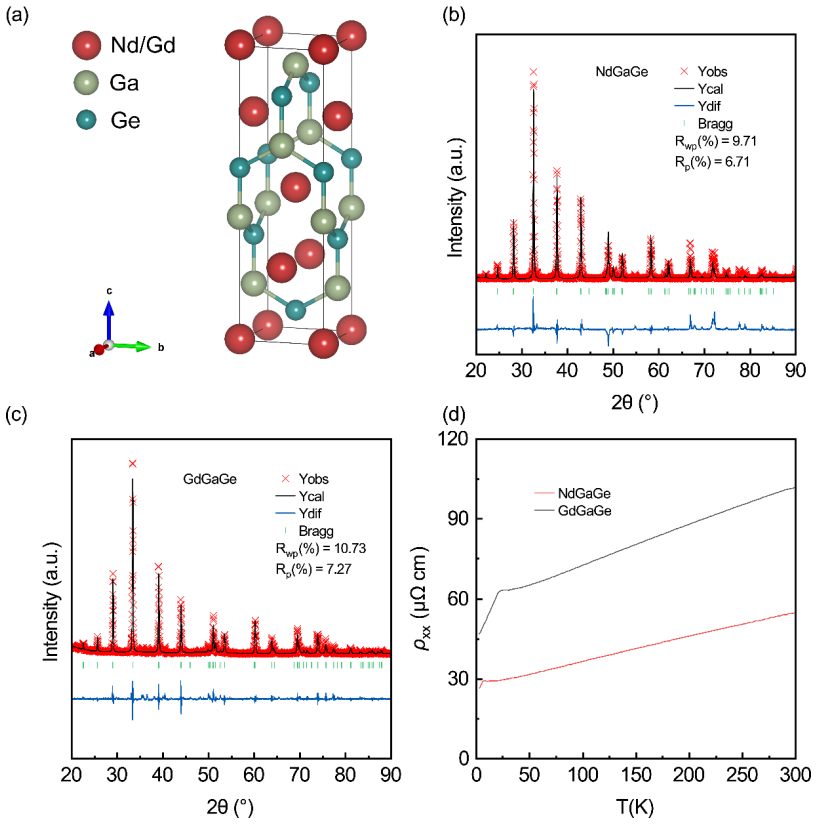
J.-P. Jan and H. Gijsman, Physica 18, 339 (1952). Fig. 1. (a) The crystal structure of Nd GaGe and GdGaGe. ( b) and ( c) Rietveld refinement of the powder XRD patterns of Nd GaGe and GdGaGe, respectively. (d ) Temperature dependence of ρxx(T) in the temperature range from 1.8 ...
1952
Reviewed August 16, 2026 · model on record in the stance chip above.
Discussion (0). Continue with ORCID to comment.