REVIEW 3 major objections 4 minor 4 references
Oxygen Reduction Reaction on Platinum Nanocatalysts Produces Long-Lived, Hysteretic Oxygenated Adsorbates
T0 review · 3 major / 4 minor · reviewed 2026-08-12 · deepseek-v4-flash
Pith's one-line read Oxygen reduction on platinum nanoparticles leaves OOH, OH, and O2 on the surface for over an hour after the reaction stops.
desk verdict A solid in situ Raman study showing persistent, hysteretic O2-induced adsorbates on Pt nanocatalysts at pH 13; the species-specific assignment rests on imported peak positions without in-house isotope verification. read the letter →
The pith
A machine-rendered reading of the paper's core claim, the machinery that carries it, and where it could break.
The reading
What carries the argument
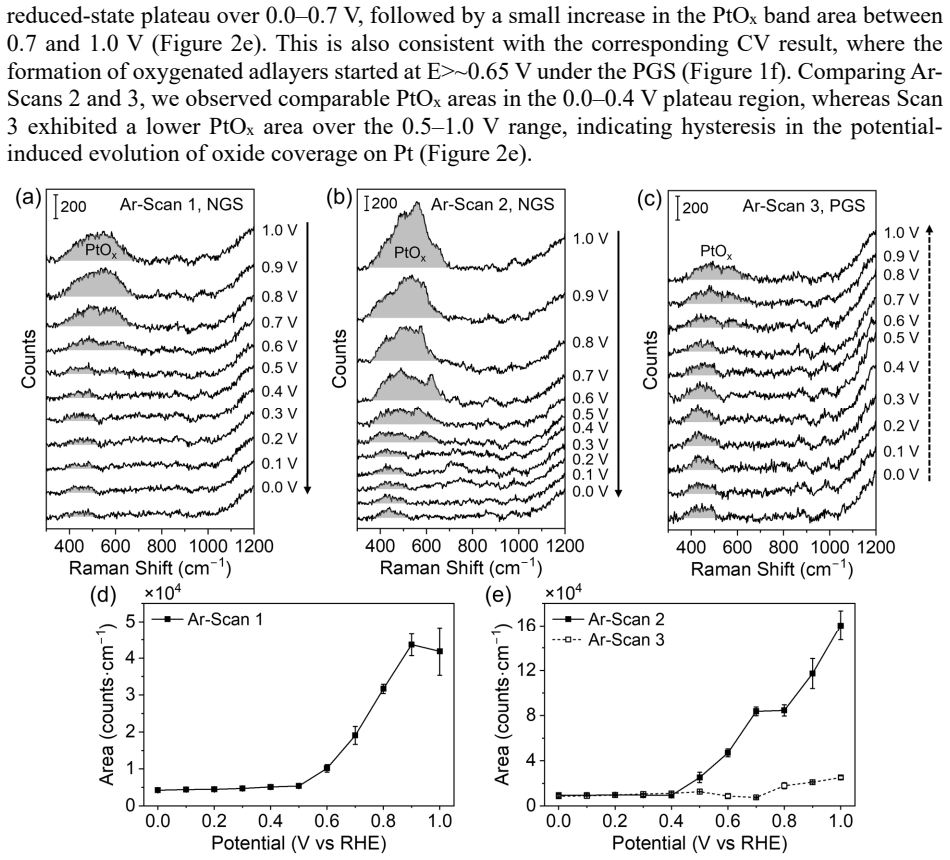
The load-bearing platform is in situ electrochemical nanoparticle-enhanced Raman spectroscopy (EC-NERS) using Au-core/Pt-shell nanoparticles: the Pt shell acts as the oxygen reduction catalyst while the Au core provides plasmonic enhancement, with a calculated Raman enhancement factor up to $4.7 \times 10^{7}$ at interparticle junctions. The argument turns on a difference measurement — a band at roughly 550–950 cm−1 appears only in O2-saturated electrolyte, not in Ar-saturated electrolyte, so it is assigned to oxygen reduction products. Gaussian deconvolution of that unresolved band into components at roughly 686, 778, and 875 cm−1 is the step that converts one broad feature into species-resolved coverage of OOHad, OHad, and O2,ad, using peak positions from prior single-crystal and acidic surface-enhanced Raman studies. A companion band at 320–700 cm−1, treated as amorphous PtOx, provides a simultaneous measure of oxide coverage and reveals a competitive accumulation effect between oxide and intermediates. The potential- and history-dependent areas of these bands are the data that support the long-lived, hysteretic, trap-related conclusions.
What would settle it
A D2O or 18O2 isotope-labeling experiment on the same Au/Pt nanoparticles in 0.1 M KOH or LiOH would settle the central claim: the 686, 778, and 875 cm−1 components must shift by the expected vibrational isotope factors if they are OOHad, OHad, and O2,ad. A complementary check is a time-resolved desorption measurement after the reaction is stopped: if the intermediate band decays with a short lifetime under conditions where the paper claims hour-long persistence, the hysteresis and trapping conclusions would need revision.
Extended reading notes
Core claim
The central discovery is that oxygen reduction on Pt nanocatalysts in alkaline media produces oxygenated adsorbates — OOHad, OHad, and O2,ad — that are highly long-lived and hysteretic, persisting even after the reaction has ended. In O2-saturated 0.1 M KOH or LiOH, a Raman band at roughly 550–950 cm−1 appears only in the presence of oxygen and grows as the potential is lowered; Gaussian deconvolution splits it into components near 686, 778, and 875 cm−1, assigned to the O–O stretch of adsorbed OOH, the Pt–O–H bend of adsorbed OH, and the O–O stretch of bridge-adsorbed O2. The intermediate band remains detectable after 81 minutes at open circuit in KOH and after 112 minutes in LiOH, and it survives a deliberate oxidation hold at 1.1 V. The paper interprets this persistence as the coexistence of kinetically active and kinetically inactive intermediates, proposes an associative oxygen reduction pathway in which a fraction of each intermediate branches into trapped states, and reports that Li+ yields a larger active fraction below 0.3 V while K+ gives flatter, more retained coverage, attributed to cation blocking of defect sites.
Load-bearing premise
The load-bearing premise is that the three fitted Raman peaks at 686, 778, and 875 cm−1 really are adsorbed OOH, OH, and O2 on these platinum nanoparticles; the authors did not verify the assignment on their own surfaces with isotope labeling, so if those peak identifications are wrong, the claim about which species are long-lived collapses.
Editorial extensions
If this is right
- Oxygen reduction intermediates on realistic Pt/C-like catalysts can be detected long after the reaction stops, so delayed or ex-situ vibrational measurements may still report reaction products rather than the resting surface.
- Microkinetic models that predict near-zero intermediate coverage at high overpotential are missing a trapped, inactive adsorbate population on defect-rich nanoparticles, which may explain why measured spectra and kinetic models diverge.
- Cation identity affects not only oxygen reduction activity but also surface speciation: K+ and Li+ produce different fractions of active versus trapped intermediates, so electrolyte choice changes the surface state that subsequent reactions see.
- The first potential scan on an oxide-covered surface differs from later scans: intermediates appear only after PtOx is reduced, whereas previously accumulated intermediates make later scans accumulate intermediates at higher potentials.
- Vibrational band area should not be directly equated with kinetic current, because a substantial part of the spectroscopic signal may come from kinetically inactive adsorbates.
Reading between the lines
- A natural next experiment the paper does not report is isotope labeling: repeating the measurements in D2O or with 18O2 would test the 686/778/875 cm−1 assignments on the authors' own nanoparticle surfaces, and would either confirm or redirect the whole interpretation.
- If trapped adsorbates really are the oxygen reduction intermediates, then pulsed-potential or alternating-current operation should selectively drain the active fraction and expose the desorption kinetics of the trapped fraction, giving a direct measure of the trapping energy that the current work only infers.
- The cation-blocking explanation predicts a systematic trend across the alkali series — smaller cations should block defect sites more effectively and lower the trapped fraction — which could be tested with Cs+, Na+, and Rb+ without changing any other condition.
- A practical consequence the paper leaves implicit is that fuel-cell shutdown may leave a chemically active adsorbate layer on the cathode; on restart, that layer could alter the first-cycle activity or participate in degradation, making the hysteresis relevant beyond spectroscopy.
Editorial analysis
A structured set of objections, weighed in public.
Referee Report
Summary. The paper reports an in situ electrochemical nanoparticle-enhanced Raman spectroscopy (EC-NERS) study of Au/Pt core-shell nanoparticles in 0.1 M KOH and LiOH (pH ~13) during the oxygen reduction reaction (ORR). By comparing Ar- vs O2-saturated electrolytes across multiple potential scans, the authors observe an O2-induced Raman band at ~550–950 cm−1, which they deconvolve into three components assigned to adsorbed OOH, OH, and O2. They report that these adsorbates accumulate during negative-going scans, persist for 81–112 minutes at open circuit and after an oxidation hold at 1.1 V, and show hysteresis between negative- and positive-going scans. The paper proposes an ORR pathway with coexisting kinetically active and inactive intermediates, modulated by electrolyte cations (K+ vs Li+) and by the defect-rich, heterogeneous surface of the Pt nanocatalysts.
Significance. If the species-level assignments and retention results hold, this work is significant because it challenges the common assumption that ORR intermediates exist only transiently and at negligible coverages under high overpotential, and it highlights a gap between single-crystal model studies and realistic nanoparticle catalysts. The paper is also commendable for its systematic controls: O2/Ar comparisons, repeated potential scans, open-circuit retention tests, oxidation-hold tests, and control experiments ruling out Au-core exposure and glassy-carbon degradation. The 3D-FDTD enhancement simulation and electrochemical benchmarking against Pt/C further strengthen the platform characterization. The proposed active/inactive intermediate distinction, if properly supported, would have broad implications for interpreting operando vibrational spectra on practical electrocatalysts.
major comments (3)
- [Intermediate Deconvolution and Reaction Pathway (Figure 4a–d; Methods 3.7)] The central species-level claim rests on a Gaussian deconvolution of an unresolved 550–950 cm−1 envelope into three components at ~686, ~778, and ~875 cm−1, with peak positions imported from prior acidic single-crystal and SERS studies (refs 39, 41, 77–79). No isotope labeling (D2O or 18O2) is performed on the Au/Pt NP surfaces in this work, and the 686 cm−1 component lies directly on the tail of the broad PtOx band (320–700 cm−1). The uniqueness of the three-component fit is not demonstrated: the authors do not report fitting residuals, fixed-versus-floating center tests, or a noise floor for the intermediate band. If the assignments are not transferable to pH-13 polycrystalline NP surfaces, the species-specific conclusions (OOHad, OHad, O2,ad) and the active/inactive partitioning in eqs 1–5 are not supported. Please provide an in-situ isotope control, a rigorous stability/uniqueness analysis of the deconvolution, or explicitly reframe the claims to 'oxygenated adsorbates' without species identification.
- [EC-NERS in O2-Saturated Solution (Figures 3e–g, 4e, S7a/b)] The long-lived retention and hysteretic coverage claims are quantified using uncalibrated Raman band areas of the same deconvolved components. For the retention measurements after 81–112 minutes at open circuit and after the oxidation hold at 1.1 V, the manuscript does not state the detection limit of the intermediate band, the fitting residuals, or the replicate-to-replicate variance. Without a stated noise floor, the finite residual band could partly arise from baseline drift or the PtOx tail rather than from retained ORR intermediates. Please show representative raw spectra with fits at the retention time points and report a quantitative criterion for what constitutes a detectable intermediate band above the noise.
- [Electrolyte Effect (Figure 5g–i; eqs 1–5)] The conclusion that LiOH produces a larger fraction of kinetically active OOHad (i.e., a greater x2 in eq 2) is based on the sharp decay of the OOHad component area below ~0.3 V, while OHad and O2,ad remain roughly constant. Since the Raman band area is a convolution of coverage, scattering cross-section, and local enhancement, and no calibration is provided, the quantitative x_i values and the 'fraction of active species' language are not justified. At minimum, the manuscript should state explicitly that the x_i values are qualitative descriptors of the potential-dependent trends, not measured fractions.
minor comments (4)
- [Abstract and Introduction] The abstract states that the paper 'determined three key intermediates' (OOHad, OHad, O2,ad), but the deconvolution-based assignment is not validated by isotope labeling in this work. Consider tempering the wording to 'assigned to' rather than 'determined' in the abstract and conclusions.
- [Figure 4 and Supporting Information] The Gaussian component colors in Figure 4 are not consistent with the color scheme used in Figure 4e (orange for OOHad, magenta-purple for OHad, green for O2,ad). Please clarify the correspondence in the caption, as the current text describes the shaded areas without a direct color legend.
- [Reaction pathway (eqs 1–5)] Equation (3) includes an adsorbed oxygen atom Oad that is not directly observed in the Raman spectra. The text acknowledges that the exact molecular pathway cannot be identified, but the inclusion of Oad in the central mechanistic scheme could be more explicitly flagged as an assumed intermediate rather than a spectroscopically detected species.
- [General] The paper repeatedly states that statistics were derived from technical replicates, but no error bars or replicate numbers are visible in Figures 3–5. Please indicate how many replicate measurements were averaged and whether the error bars are smaller than the plotted symbols.
Circularity Check
No significant circularity: the species-level claims are empirically anchored and the only self-citation is post-hoc, non-load-bearing.
full rationale
The paper's derivation chain is observational rather than deductive. The O2-dependent 550-950 cm-1 band is isolated by comparing Ar- and O2-saturated spectra, and the deconvoluted components at ~686, ~778, and ~875 cm-1 are assigned using peak positions and a D2O isotopic shift from independent prior studies (refs 39, 41, 77-79). Those assignments are inputs imported from outside the paper, not functions of the paper's own long-lived/hysteretic conclusion, so the species identification is not self-definitional. The long-lived and hysteretic behavior is extracted directly from the potential- and time-dependent evolution of the same experimental band through repeated scans and open-circuit/oxidation holds, with control experiments ruling out Au exposure and carbon corrosion; no fitted parameter is relabeled as a prediction. The active/inactive intermediate partitioning is an interpretive model (eqs 1-5) motivated by the mismatch with microkinetic predictions, not a quantity used to generate the spectra. The only self-citation is ref 88, the authors' arXiv superposition-principle preprint, used as a post-hoc rationalization for why defect-rich concave sites might trap intermediates; it is not load-bearing because the defect-trapping hypothesis is already anchored in the Raman observations and in independent step-site binding literature (refs 73, 84). The paper explicitly acknowledges limitations (e.g., PtOx deconvolution debated, exact molecular pathways unknown, weak O2,ad signal), which are correctness risks rather than circularity. Hence there are no circular steps; the mild score reflects one non-load-bearing self-citation, not a reduction of the claim to its inputs.
Assumptions & free parameters
free parameters (2)
- Gaussian component peak centers for the intermediate band =
686, 778, 875 cm-1
- Baseline and integration windows for band areas =
not reported in main text
assumptions (3)
- domain assumption Raman band area is proportional to adsorbate coverage on the Pt surface under all potentials and electrolyte conditions.
- domain assumption The Raman peaks at approximately 686, 778, and 875 cm-1 correspond to OOHad, OHad, and O2,ad on Pt NP surfaces in pH 13 alkaline electrolytes.
- domain assumption The broad 320 to 700 cm-1 band can be treated as a single PtOx contribution, with hydroxide or other species contributions negligible for the conclusions.
Cite this review
Pith. "Pith review of Oxygen Reduction Reaction on Platinum Nanocatalysts Produces Long-Lived, Hysteretic Oxygenated Adsorbates." pith.science (2026). https://pith.science/paper/PXSYXNSU
@misc{pith2026260808050,
  author       = {Pith},
  title        = {Pith review of: Oxygen Reduction Reaction on Platinum Nanocatalysts Produces Long-Lived, Hysteretic Oxygenated Adsorbates},
  year         = {2026},
  howpublished = {\url{https://pith.science/paper/PXSYXNSU}},
  note         = {Machine review of arXiv:2608.08050}
}
read the original abstract
Aqueous electrocatalysis generates oxygenated intermediates at catalyst surfaces. While intermediate species on single-crystal catalysts have been observed, the nature and evolution of surface oxygenated species on industrially relevant nanoparticle (NP) catalysts remain largely unknown. Here, using in situ Raman spectroscopy, we tracked the formation and potential-dependent evolution of oxygenated adsorbates in alkaline media on NP catalysts with an active platinum (Pt) surface. By comparing spectroscopic features in Ar- vs O2-saturated electrolytes, we determined three key intermediates produced by the oxygen reduction reaction (ORR): adsorbed OOH, OH, and O2. In contrast to the conventional wisdom that intermediates exist only during catalytic reactions, we found these oxygenated adsorbates to be highly long-lived and hysteretic, and to persist even after the termination of ORR. This adsorbate-retention effect exhibits a modest dependence on the surface oxidation state and the electrolyte cations (K+ vs Li+), and is likely facilitated by the heterogeneous nature of the catalyst surface. The results highlight the complexity of surface adsorption structures on realistic catalysts, which often extends beyond that captured by measurements or simulations on model single-crystal surfaces.
Figures


Figures from the paper (3 more)


Reference graph
Works this paper leans on
-
[951]
https://doi.org/10.1038/s41929-018-0168-4. (86) Zhang, B.; Zhang, J.; Hua, M.; Wan, Q.; Su, Z.; Tan, X.; Liu, L.; Zhang, F.; Chen, G.; Tan, D.; Cheng, X.; Han, B.; Zheng, L.; Mo, G. Highly Electrocatalytic Ethylene Production from CO2 on Nanodefective Cu Nanosheets. J. Am. Chem. Soc. 2020, 142 (31), 13606–13613. https://doi.org/10.1021/jacs.0c06420. (87) ...
-
[2431]
(28) Kumeda, T.; Kubo, R.; Hoshi, N.; Nakamu ra, M
https://doi.org/10.1002/cphc.201300404. (28) Kumeda, T.; Kubo, R.; Hoshi, N.; Nakamu ra, M. Activation of Oxygen Reduction Reaction on Well-Defined Pt Electrocatalysts in Alkaline Media Contai ning Hydrophobic Organic Cations. ACS Appl. Energy Mater. 2019, 2 (5), 3904–3909. https://doi.org/10.1021/acsaem.9b00582. (29) Rizo, R.; Fernández-Vidal, J.; Hardwi...
-
[5711]
https://doi.org/10.1002/anie.202015571. (80) Adži ć, R. R.; Wang, J. X. Configuration and Site of O2 Adsorption on the Pt(111) Electrode Surface. J. Phys. Chem. B 1998, 102 (45), 8988–8993. https://doi.org/10.1021/jp981057z. (81) Hansen, H. A.; Viswanathan, V .; Nørskov, J. K. Unifying Kinetic and Thermodynamic Analysis of 2 e – and 4 e – Reduction of Oxy...
-
[5987]
https://doi.org/10.1021/jp5113284. (51) Huang, L.; Wei, M.; Qi, R.; Dong, C.-L.; Da ng, D.; Yang, C.-C.; Xia, C.; Chen, C.; Zaman, S.; Li, F.-M.; You, B.; Xia, B. Y . An Integr ated Platinum-Nanocarbo n Electrocatalyst for Efficient Oxygen Reduction. Nat. Commun. 2022, 13 (1), 6703. https://doi.org/10.1038/s41467-022-34444-w. (52) Tian, R.; Xie, L.; Li, Y...
Reviewed August 12, 2026 · model on record in the stance chip above.
Discussion (0). Continue with ORCID to comment.