Leveraging Phase Information to Boost Unrolled Network Learning for Image Deblurring
Pith reviewed 2026-07-02 19:10 UTC · model grok-4.3
The pith
Decomposing a blurred image into amplitude and phase, estimating both with LMMSE, then unrolling the recovery iterations into a trainable network produces sharper results than spatial-domain unrolling.
A machine-rendered reading of the paper's core claim, the machinery that carries it, and where it could break.
Core claim
By first constructing LMMSE estimators for the amplitude and phase of the blurred observation and then unrolling the resulting iterative phase-amplitude recovery algorithm, the learned network UPADNet recovers the sharp image more accurately than networks that operate directly on the spatial image variable, with the advantage growing in high-noise and limited-data regimes.
What carries the argument
UPADNet, the network formed by unrolling each iteration of the phase-amplitude recovery algorithm and replacing its statistically fixed matrices with parameters trained on paired clean and degraded images.
If this is right
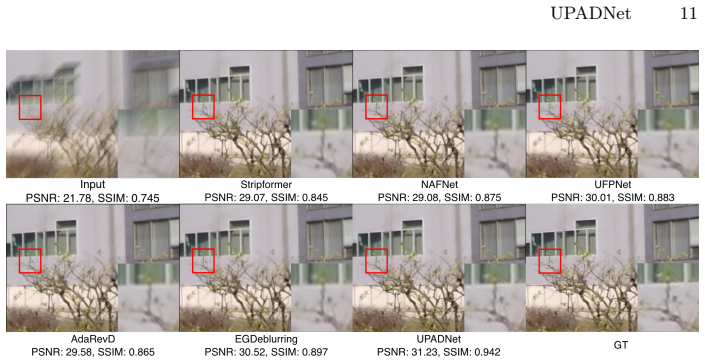
- UPADNet records higher restoration metrics than prior deep networks on the GoPro, RealBlur, and COCO benchmarks.
- The performance gap widens as input noise increases.
- The performance gap also widens when the size of the training set is reduced.
- Each layer of UPADNet corresponds to one iteration of the underlying phase-amplitude algorithm and is trained jointly.
Where Pith is reading between the lines
- The same phase-aware unrolling pattern could be applied to related inverse problems such as image denoising or single-image super-resolution.
- Extending the iteration to enforce consistency across video frames might yield a video deblurring variant without changing the core estimator design.
- Because the LMMSE estimators are derived from signal statistics rather than hand-tuned priors, the method may transfer to new sensor noise characteristics with only modest retraining.
Load-bearing premise
That separating amplitude from phase and estimating the phase accurately is what drives the improvement over direct spatial-domain unrolling, especially when noise is high or training data is limited.
What would settle it
A controlled comparison in which a spatial-domain unrolled network trained on the same data matches or exceeds UPADNet on high-noise GoPro or RealBlur images would show that the phase decomposition is not the decisive factor.
Figures




read the original abstract
While most image deblurring techniques directly restore the spatial image variable, we propose an amplitude and phase decomposition recognizing the importance of accurate phase estimation in recovering sharp image details. To that end, we first develop novel linear minimum mean squared (LMMSE) estimators of the amplitude and phase of the blurred, noisy image observation. An iterative optimization algorithm follows that recovers the sharp image using the aforementioned LMMSE estimators. Finally, matrix parameters that are statistically determined and fixed in the iterative algorithm are now learned using a training dataset of clean and degraded observations. Our deblurring engine is dubbed UPADNet (Unrolled Phase and Amplitude Decomposition Network), such that each iteration of the underlying phase and amplitude recovery algorithm is parameterized and trained end-to-end. Experiments over benchmark evaluation datasets such as GoPro, RealBlur and COCO datasets confirm that UPADNet outperforms state of the art deep networks including those based on algorithm unrolling in the image domain. The benefits of UPADNet are even more pronounced in high noise and limited training data regimes.
Editorial analysis
A structured set of objections, weighed in public.
Referee Report
Summary. The paper claims that decomposing image deblurring into amplitude and phase components, deriving novel LMMSE estimators for the blurred noisy observation, unrolling an iterative recovery algorithm, and end-to-end learning of the matrix parameters yields UPADNet, which outperforms existing deep deblurring networks (including other unrolled methods) on GoPro, RealBlur, and COCO benchmarks, with larger gains under high noise and limited training data.
Significance. If the LMMSE phase estimators are rigorously derived and the empirical gains hold with proper controls, the work would strengthen the case for phase-aware unrolling in inverse problems, extending algorithm-unrolling literature by explicitly targeting phase recovery rather than operating directly in the spatial domain.
major comments (3)
- [Method (LMMSE estimators)] Method section on LMMSE estimators: no derivation of the amplitude or phase LMMSE estimators is supplied, so it is impossible to verify whether the phase estimator respects the circular topology of the argument (2π periodicity, branch-cut equivalence of +ε and −ε errors). If the estimator is simply arg of a complex-valued linear estimator, the claimed benefit reduces to standard complex-domain processing rather than a phase-specific advance.
- [Experiments] Experiments section: the abstract asserts benchmark outperformance and larger gains in high-noise/low-data regimes, yet the manuscript provides neither quantitative error bars, statistical significance tests, nor a description of training/evaluation protocols (data splits, noise levels, number of runs), leaving the central empirical claim unsupported.
- [Unrolling and training] Unrolling and training description: the paper states that matrix parameters are 'statistically determined and fixed' before being learned end-to-end, but supplies no analysis showing that the learned parameters remain independent of the training fit or that the unrolled network generalizes beyond the fitted distribution, undermining the low-data-regime claim.
minor comments (1)
- [Introduction / Method] Notation for amplitude and phase variables is introduced without an explicit forward model relating them to the observed blurred image; a single equation linking the decomposition to the degradation process would improve clarity.
Simulated Author's Rebuttal
We thank the referee for the constructive and detailed comments on our manuscript. We address each major comment below and will revise the manuscript to strengthen the presentation of the LMMSE derivations, experimental protocols, and training analysis.
read point-by-point responses
-
Referee: Method section on LMMSE estimators: no derivation of the amplitude or phase LMMSE estimators is supplied, so it is impossible to verify whether the phase estimator respects the circular topology of the argument (2π periodicity, branch-cut equivalence of +ε and −ε errors). If the estimator is simply arg of a complex-valued linear estimator, the claimed benefit reduces to standard complex-domain processing rather than a phase-specific advance.
Authors: We acknowledge that the submitted manuscript did not include the explicit derivation of the amplitude and phase LMMSE estimators. In the revised version we will add the full derivation, starting from the complex observation model and arriving at the closed-form estimators for both amplitude and phase. The phase estimator is obtained by minimizing the mean-squared error on the phase variable after appropriate linearization around the circular manifold; we will explicitly show that it is not equivalent to taking the argument of a complex linear estimator and will discuss its handling of 2π periodicity and branch-cut equivalence. revision: yes
-
Referee: Experiments section: the abstract asserts benchmark outperformance and larger gains in high-noise/low-data regimes, yet the manuscript provides neither quantitative error bars, statistical significance tests, nor a description of training/evaluation protocols (data splits, noise levels, number of runs), leaving the central empirical claim unsupported.
Authors: We agree that the experimental reporting is incomplete. The revised manuscript will include (i) error bars computed over multiple independent training runs, (ii) statistical significance tests (paired t-tests or Wilcoxon tests) comparing UPADNet against the strongest baselines, and (iii) a detailed protocol section specifying data splits, exact noise variances, training-set sizes for the low-data experiments, and the number of runs performed. revision: yes
-
Referee: Unrolling and training description: the paper states that matrix parameters are 'statistically determined and fixed' before being learned end-to-end, but supplies no analysis showing that the learned parameters remain independent of the training fit or that the unrolled network generalizes beyond the fitted distribution, undermining the low-data-regime claim.
Authors: The parameters are initialized from closed-form statistical estimates derived from the observation model and are subsequently refined by end-to-end gradient descent. While the low-data experiments already demonstrate that the unrolled structure yields larger gains than purely data-driven baselines, we did not supply an explicit analysis of parameter sensitivity to the training distribution. In the revision we will add a short theoretical discussion of the separation between the model-based initialization and the learned corrections, together with an ablation that varies training-set size while keeping the statistical initialization fixed. revision: partial
Circularity Check
No circularity: derivation uses standard LMMSE, iterative algorithm, and external end-to-end training
full rationale
The paper first states standard LMMSE estimators for amplitude and phase of the observation, derives an iterative recovery algorithm from them, and then unrolls the algorithm with learnable parameters trained end-to-end on external clean/degraded image pairs (GoPro, RealBlur, COCO). No equation reduces a reported prediction to a fitted quantity by construction, no self-citation supplies a load-bearing uniqueness theorem, and no ansatz is smuggled via prior work. Performance claims rest on empirical comparison to external benchmarks rather than internal re-labeling of fits.
Axiom & Free-Parameter Ledger
free parameters (1)
- matrix parameters
Reference graph
Works this paper leans on
-
[1]
The importance of phase in signals , author=. Proc. IEEE , volume=
-
[2]
Two-Dimensional Signal and Image Processing , author=
-
[3]
Kundur, D. and Hatzinakos, D. , journal=. Blind image deconvolution , year=
-
[4]
Understanding and evaluating blind deconvolution algorithms , author=
-
[5]
Image Processing and Analysis: Variational, PDE, Wavelet, and Stochastic Methods , author=. 2005 , publisher=
work page 2005
-
[6]
Fundamentals of Statistical Signal Processing: Estimation Theory , author=
-
[7]
Nonlinear total variation based noise removal algorithms , author=. Physica D , volume=
-
[8]
Natural Image Statistics: A Probabilistic Approach to Early Computational Vision , author=
-
[9]
Solutions of Ill-posed Problems , author=
-
[10]
Introduction to Inverse Problems in Imaging , author=
-
[11]
Computational Methods for Inverse Problems , author=
-
[12]
Nonlinear image recovery with half-quadratic regularization , author=
-
[13]
SIAM Journal on Matrix Analysis and Applications , volume=
On the convergence of half-quadratic minimization and iterative reweighted least squares algorithms , author=. SIAM Journal on Matrix Analysis and Applications , volume=
-
[14]
Simple baselines for image restoration , author=
-
[15]
2024 ASABE Annual International Meeting , pages=
Data-Driven Model to Improve Mechanical Harvesters for Nut Trees , author=. 2024 ASABE Annual International Meeting , pages=. 2024 , organization=
work page 2024
-
[16]
bytes: Evaluating llm proficiency in olympiad mathematics , author=
Brains vs. bytes: Evaluating llm proficiency in olympiad mathematics , author=. Conference On Language Modeling , year=
-
[17]
The Eleventh International Conference on Learning Representations , year=
Generalization and Estimation Error Bounds for Model-based Neural Networks , author=. The Eleventh International Conference on Learning Representations , year=
-
[18]
IEEE journal on selected areas in information theory , volume=
Theoretical perspectives on deep learning methods in inverse problems , author=. IEEE journal on selected areas in information theory , volume=
-
[19]
Image quality assessment: from error visibility to structural similarity , author=
-
[20]
IEEE Transactions on Signal Processing , volume=
Optimization guarantees of unfolded ista and admm networks with smooth soft-thresholding , author=. IEEE Transactions on Signal Processing , volume=
- [21]
-
[22]
A clearer picture of total variation blind deconvolution , author=
-
[23]
Linear Algebra and its Applications , volume=
Convergence of the alternating minimization algorithm for blind deconvolution , author=. Linear Algebra and its Applications , volume=. 2000 , publisher=
work page 2000
-
[24]
Efficient and interpretable deep blind image deblurring via algorithm unrolling , author=
-
[25]
Joshi, Neel and Szeliski, Richard and Kriegman, David J , booktitle=CVPR, pages=
-
[26]
Edge-based blur kernel estimation using patch priors , author=. ICCP , pages=
- [27]
-
[28]
Pan, Jinshan and Hu, Zhe and Su, Zhixun and Yang, Ming-Hsuan , journal=PAMI, volume=
-
[29]
ACM SIGGRAPH Asia 2009 papers , pages=
Fast motion deblurring , author=. ACM SIGGRAPH Asia 2009 papers , pages=
work page 2009
- [30]
-
[31]
A late fusion cnn for digital matting , author=
-
[32]
Framelet-based blind motion deblurring from a single image , author=
-
[33]
Blind deconvolution using a normalized sparsity measure , author=
-
[34]
Deblurring images via dark channel prior , author=
-
[35]
Image deblurring via extreme channels prior , author=
- [36]
-
[37]
Bayesian blind deconvolution with general sparse image priors , author=
-
[38]
Deep non-blind deconvolution via generalized low-rank approximation , author=
-
[39]
Image deblurring with coupled dictionary learning , author=
-
[40]
Efficient marginal likelihood optimization in blind deconvolution , author=
-
[41]
Understanding blind deconvolution algorithms , author=
-
[42]
Deep, convergent, unrolled half-quadratic splitting for image deconvolution , author=
-
[43]
l\_0 -regularized intensity and gradient prior for deblurring text images and beyond , author=
- [44]
-
[45]
Two-phase kernel estimation for robust motion deblurring , author=
-
[46]
Acm Siggraph 2006 Papers , pages=
Removing camera shake from a single photograph , author=. Acm Siggraph 2006 Papers , pages=
work page 2006
-
[47]
Contour detection and hierarchical image segmentation , author=
- [48]
-
[49]
Recording and playback of camera shake: Benchmarking blind deconvolution with a real-world database , author=
-
[50]
Kupyn, Orest and Budzan, Volodymyr and Mykhailych, Mykola and Mishkin, Dmytro and Matas, Ji
-
[51]
Huang, Yunshi and Chouzenoux, Emilie and Pesquet, Jean-Christophe , journal=TIP, volume=. Unrolled variational
-
[52]
Non-uniform blind image deblurring using an algorithm unrolling neural network , author=. IVMSP , pages=
-
[53]
Self-supervised non-uniform kernel estimation with flow-based motion prior for blind image deblurring , author=
-
[54]
Mao, Xintian and Li, Qingli and Wang, Yan , booktitle=CVPR, pages=
-
[55]
Stripformer: Strip transformer for fast image deblurring , author=
-
[56]
Algorithm unrolling: Interpretable, efficient deep learning for signal and image processing , author=
-
[57]
2020 Iran Workshop on Communication and Information Theory (IWCIT) , pages=
Multi variable-layer neural networks for decoding linear codes , author=. 2020 Iran Workshop on Communication and Information Theory (IWCIT) , pages=
work page 2020
-
[58]
Neural Computing and Applications , volume=
Unlocking the black box: An in-depth review on interpretability, explainability, and reliability in deep learning , author=. Neural Computing and Applications , volume=
-
[59]
Model-based deep learning , author=. Proc. IEEE , volume=
-
[60]
Photon limited non-blind deblurring using algorithm unrolling , author=
-
[61]
2024 International Conference on Signal Processing and Communications (SPCOM) , pages=
Half-Split ResUNet Denoiser Based Deep Unrolling for Photon Limited Image Deblurring , author=. 2024 International Conference on Signal Processing and Communications (SPCOM) , pages=
work page 2024
-
[62]
Gaussian kernel mixture network for single image defocus deblurring , author=
-
[63]
A convergent neural network for non-blind image deblurring , author=
-
[64]
Deep Joint Unrolling for Deblurring and Low-Light Image Enhancement (
Vo, Tu and Park, Chan Y , booktitle=WACV, pages=. Deep Joint Unrolling for Deblurring and Low-Light Image Enhancement (
-
[65]
Deep-blur: Blind identification and deblurring with convolutional neural networks , author=. Biological Imaging , volume=. 2024 , publisher=
work page 2024
-
[66]
Journal of Artificial Intelligence and Technology , volume=
Multiobjective Reptile Search Algorithm Based Effective Image Deblurring and Restoration , author=. Journal of Artificial Intelligence and Technology , volume=
-
[67]
An algorithm unrolling approach to deep image deblurring , author=
-
[68]
Effective blind image deblurring using matrix-variable optimization , author=
-
[69]
Deep Unrolling Network for SAR Image Despeckling , author=
-
[70]
IEEE Transactions on Signal Processing , year=
Robust Stochastically-Descending Unrolled Networks , author=. IEEE Transactions on Signal Processing , year=
-
[71]
Image restoration based on end-to-end unrolled network , author=. Photonics , volume=
-
[72]
Deep multi-scale convolutional neural network for dynamic scene deblurring , author=
-
[73]
Deep stacked hierarchical multi-patch network for image deblurring , author=
-
[74]
Multi-stage progressive image restoration , author=
-
[75]
Restormer: Efficient transformer for high-resolution image restoration , author=. 2022 , pages=
work page 2022
-
[76]
Wang, Chengyue and Li, Yantai and Zhang, Youwei and Chen, Ying and Fu, Yun and Wang, Yu and An, Wei , booktitle=CVPR, pages=. Uformer: A general
-
[77]
Information Sciences , volume=
MRLPFNet: A multi-resolution low-pass filter network for dynamic scene deblurring , author=. Information Sciences , volume=. 2023 , publisher=
work page 2023
-
[78]
Rethinking coarse-to-fine approach in single image deblurring , author=
-
[79]
Multi-scale residual low-pass filter network for image deblurring , author=
-
[80]
Depth estimation and image restoration by deep learning from defocused images , author=
discussion (0)
Sign in with ORCID, Apple, or X to comment. Anyone can read and Pith papers without signing in.