REVIEW 4 major objections 5 minor 14 references
ShielDroid: A Hybrid Approach Integrating Machine and Deep Learning for Android Malware Detection
T0 review · 4 major / 5 minor · reviewed 2026-08-05 · deepseek-v4-flash
Pith's one-line read A Random Forest plus neural net catches Android malware at 97.5% accuracy.
desk verdict Routine stacking paper with a load-bearing data leakage bug; reported accuracy and real-time claims are not credible. read the letter →
The pith
A machine-rendered reading of the paper's core claim, the machinery that carries it, and where it could break.
The reading
What carries the argument
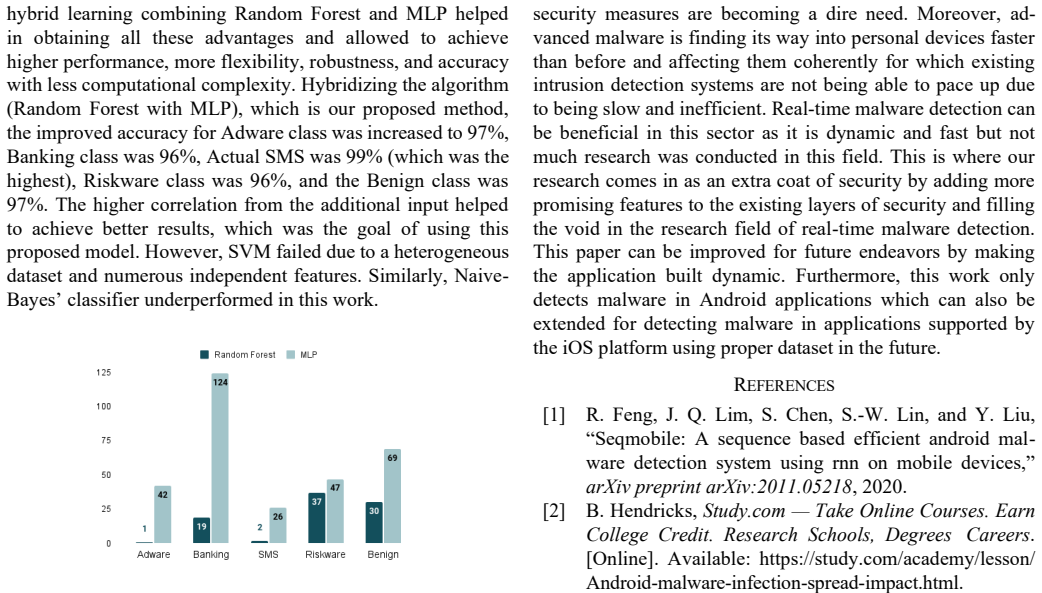
The load-bearing object is the two-stage stack: the Random Forest's 'predicted column' — one class label per sample, produced by 100 decision trees — is treated as an ordinary input feature (the 121st) for the multilayer perceptron. The paper's stated rationale is that this column gives the neural network a distilled, higher-correlation signal to learn from, so the net inherits the forest's strengths and corrects residual errors; the 89 plus 308 recovered samples are offered as evidence that the extra column, not either model alone, carries the gain.
What would settle it
Re-run the pipeline with the independence conditions enforced: pick the top 120 features inside each cross-validation fold and produce the Random Forest prediction column out-of-fold, so no test-row information reaches the MLP. If accuracy falls to near the 93–94% level of the individual models, the reported gain is leakage; if it stays at 97.5%, the hybrid effect is real and the paper's claim survives.
Extended reading notes
Core claim
The paper claims that stacking works: a Random Forest (100 trees, Gini-impurity splits) trained on 11,598 Android apps described by 120 selected behavioral features emits a predicted class per sample; that prediction is appended as an extra column, and a multilayer perceptron (four hidden layers, 256/128/64/32 neurons, ReLU, 5-way softmax) is trained on the resulting 121 inputs. It reports 97.5% accuracy versus 93.6–94% for Random Forest alone and 93% for MLP alone, with total training time of 22.945 seconds. Per class: 99% SMS malware, 97% Adware and Benign, 96% Banking and Riskware; macro precision 0.98, recall 0.97, F1 0.98. The combination is claimed to repair real blind spots: 89 sample
Load-bearing premise
The 97.5% figure assumes the 20% test set stayed fully independent of model construction, but the top 120 features were selected from all 470 before the 80:20 split, so test rows influenced which features were used, and the paper does not state that the Random Forest prediction column given to the MLP was generated out-of-fold rather than from the rows the MLP trained on.
Editorial extensions
If this is right
- If the claim holds, stacking RF predictions into an MLP is a cheap accuracy boost: no new features or data, just re-use of the forest's own outputs, lifting accuracy roughly 3–4 points over either component.
- The combined training cost of about 23 seconds means the model can be rebuilt quickly on fresh malware samples, which is the paper's premise for keeping detection current in real-world deployment.
- The class-level recoveries — especially 124 Banking malware samples the MLP alone missed — imply the hybrid helps most on categories where the single models are weakest.
- The 470-to-120 feature reduction via ANOVA gives the trained model a small input footprint, consistent with the paper's claim that the framework transfers to new high-dimensional datasets.
Reading between the lines
- My reading: the 'predicted column' trick is a two-stage stacking ensemble, and its gain should be sensitive to how the forest's prediction is produced; testing out-of-fold RF predictions would separate a genuine ensemble effect from target leakage, a check the paper does not report.
- My reading: the paper measures 'execution time' as training time, so the real-time claim is really about fast retraining; a field deployment would need per-app inference latency and memory footprint measured before calling it real-time protection.
- My reading: the dataset is class-imbalanced (SMS malware is roughly a third of samples), so the reported macro precision 0.98 / recall 0.97 are the informative numbers; a rerun on a balanced subset would show whether 97.5% survives when classes are equalized.
Editorial analysis
A structured set of objections, weighed in public.
Referee Report
Summary. This manuscript presents ShielDroid, a hybrid Android malware detector. On the CICMalDroid 2020 dataset (five categories), the authors propose selecting the top 120 features via ANOVA, training a Random Forest (RF), and using the RF prediction as an additional input to a multilayer perceptron (MLP). They report that this RF+MLP hybrid achieves 97.5% accuracy with a training time of 22.945 seconds, outperforming RF, MLP, SVM, KNN, and Naive Bayes. The central claim is that the hybrid stacking approach improves detection accuracy over either model alone.
Significance. If the reported performance were obtained under a sound evaluation protocol, this would be a useful empirical benchmark: the paper uses a public dataset, compares several standard baselines, and includes per-class metrics and a confusion matrix. The explicit reporting of training time is also a positive. However, the manuscript provides no code or data, and the evaluation protocol as described contains two forms of target-information leakage (feature selection before the split and ambiguous generation of the RF prediction column). The headline 97.5% accuracy therefore cannot currently be interpreted as a generalization estimate, and the contribution is conditional on a corrected experimental evaluation.
major comments (4)
- [Section V] Feature selection is performed on the full dataset before the train/test split. The paper states: 'The top 120 features were extracted out of the 470 features from the dataset during feature selection using weka and sklearn. The dataset was then divided into train and test data in an 80:20 ratio.' Because the test portion contributes to the chosen feature set, the reported 97.5% accuracy is optimistically biased and is not an unbiased estimate of performance on unseen data. Feature selection must be nested inside the training folds (e.g., in a pipeline or cross-validation loop), and all reported metrics must be recomputed under that protocol.
- [Section III-C] The stacking procedure uses 'the prediction result' of Random Forest as an additional input to the MLP, but the paper does not state whether those predictions were generated out-of-fold. If the RF predictions are in-sample predictions on the same training data used to train the MLP, they encode the true training labels and leak target information into the second-stage classifier, which can substantially inflate the reported accuracy. The authors must specify whether out-of-fold predictions were used; if not, the experiment must be rerun with out-of-fold RF predictions.
- [Sections V and VI, Table I] The main quantitative claim is internally inconsistent. The abstract and one sentence in Section V report the hybrid accuracy as 97.5%; Section V also says the proposed model 'gave the highest accuracy of 0.98' and Table I lists Accuracy as .98. Section V reports RF alone as 93.6% in one sentence and 94% in the comparison list. The discrepancy between 97.5% and 0.98, and between 93.6% and 0.94, must be resolved; otherwise the headline result is ambiguous.
- [Sections IV and V] The dataset size is inconsistent. Section IV states that 13,077 out of 17,341 samples were successfully analyzed by CopperDroid, while Section V says the dataset used has 11,598 rows and 470 columns. The relationship between these numbers is unexplained. Since the entire contribution is empirical, the exact preprocessing chain that yields the 11,598-row dataset must be documented, including any filtering or deduplication steps.
minor comments (5)
- [Section VI] A stratified train-test split is mentioned only at the end of Section VI, after the experimental results are described, while Section V refers only to an 80:20 split. Please state at the point of the split whether stratification was applied and report the class proportions in train and test.
- [Section III-C] There is a recurring typo: 'MPL' should be 'MLP' (e.g., in Section VI). Please correct throughout.
- [Figure 3] The confusion matrix is not readable in the compressed figure and the numerical values are not described in the text beyond macro averages. Please provide a larger figure or a table with the full confusion matrix.
- [Figure 4] The sentence 'The above figure demonstrates...' appears before the figure is displayed. Please fix the cross-reference so the text points to the figure correctly.
- [Section V] No information is given about the computing environment used for the timing measurements (CPU/GPU, memory, operating system). Without this, the reported execution time of 22.945 seconds is not reproducible or comparable.
Circularity Check
No circularity found: the paper reports measured classifier performance, not a derivation that returns its own inputs.
full rationale
The paper's central claim is an empirical accuracy comparison on the CICMalDroid 2020 dataset. There is no equation, theorem, or fitted constant whose output is defined in terms of the target result; the 97.5% accuracy of the RF+MLP hybrid is reported as a measured experimental outcome, not as something derived from the input features by construction. The use of Random Forest predictions as an extra input to the MLP is a legitimate stacked-model design, and the final accuracy is not mathematically forced to equal the Random Forest accuracy or any other input value. Feature selection before the 80/20 split and the unspecified in-sample versus out-of-fold generation of the Random Forest prediction column are correctness and data-leakage risks, but they are not circular reasoning: they do not make the reported accuracy equivalent to an input by definition. There are no self-citations used as load-bearing evidence, no imported uniqueness theorems, and no ansatz smuggled through citation. All sections of the manuscript were considered, including the methodology, experimentation, result analysis, and conclusion; no limitation passage, appended statement, or unusual inserted text asserts a missing proof or circular step. The empirical comparison is self-contained as an experimental study, so the appropriate circularity score under the stated standards is 0.
Assumptions & free parameters
free parameters (7)
- number of selected features =
120
- random forest estimators =
100
- max features per split =
10
- MLP hidden layer sizes =
256, 128, 64, 32
- batch size =
200
- learning rate =
0.001
- epochs =
200
assumptions (4)
- domain assumption The CICMalDroid 2020 ground-truth labels are correct.
- domain assumption The 470 features extracted by CopperDroid are sufficient and meaningful for malware classification.
- standard math ANOVA F-test is an appropriate feature selection method for this classification task.
- standard math Scikit-learn implementations of RF, MLP, SVM, KNN, and NB are correct.
Cite this review
Pith. "Pith review of ShielDroid: A Hybrid Approach Integrating Machine and Deep Learning for Android Malware Detection." pith.science (2026). https://pith.science/paper/PYDALRCS
@misc{pith2026260803250,
  author       = {Pith},
  title        = {Pith review of: ShielDroid: A Hybrid Approach Integrating Machine and Deep Learning for Android Malware Detection},
  year         = {2026},
  howpublished = {\url{https://pith.science/paper/PYDALRCS}},
  note         = {Machine review of arXiv:2608.03250}
}
read the original abstract
The rapid advancement of modern technology has led to a significant increase in the use of smart devices, such as smartphones and tablets, resulting in the widespread adoption of mobile applications. Although applications are required to undergo malware screening before being published on official app stores, many malicious applications successfully evade detection by concealing sophisticated malware variants. These malicious behaviors are often activated only during runtime, making them difficult to identify through conventional static analysis. As a result, malware may remain undetected until after installation, potentially causing irreversible damage to users and their devices. This study presents a real-time Android malware detection framework that analyzes application behavior to accurately identify and classify complex malware. The proposed approach employs a hybrid dynamic analysis technique to distinguish malicious applications from benign ones. After preprocessing and filtering the collected dataset, the applications are classified using multiple machine learning algorithms. A comprehensive performance evaluation is conducted to compare the effectiveness of different classification techniques in terms of detection accuracy and execution time. Experimental results demonstrate that a hybrid model combining Random Forest and a Multilayer Perceptron achieves the best overall performance, attaining an accuracy of 97.5% with an execution time of 22.945 seconds. The proposed framework can enhance mobile device security by enabling timely detection of malicious applications and reducing the risk of cyberattacks.
Figures
Reference graph
Works this paper leans on
-
[1]
SeqMobile: A Sequence Based Efficient Android Malware Detection System Using RNN on Mobile Devices
R. Feng, J. Q. Lim, S. Chen, S. -W. Lin, and Y. Liu, “Seqmobile: A sequence based efficient android mal - ware detection system using rnn on mobile devices,” arXiv preprint arXiv:2011.05218, 2020
work page Pith review arXiv 2011
-
[2]
Hendricks, Study.com — Take Online Courses
B. Hendricks, Study.com — Take Online Courses. Earn College Credit. Research Schools, Degrees Careers. [Online]. Available: https://study.com/academy/lesson/ Android-malware-infection-spread-impact.html
-
[3]
Automated dynamic analysis of ran - somware: Benefits, limitations and use for detection,
D. Sgandurra, L. Mun˜oz-Gonza´lez, R. Mohsen, and E. C. Lupu, “Automated dynamic analysis of ran - somware: Benefits, limitations and use for detection,” arXiv preprint arXiv:1609.03020, 2016
arXiv 2016
-
[4]
Palmer, Mobile malware attacks are booming in 2019: These are the most common threats , Jul
D. Palmer, Mobile malware attacks are booming in 2019: These are the most common threats , Jul. 2019. [Online]. Available: https : / / www. zdnet . com / article / mobile - malware - attacks - are - booming - in - 2019 - these - arehttps : / / www . overleaf . com / project / 612e131113dfbd3a4cab3f79 - the - most - common - threats/
work page 2019
-
[5]
Statista, Android smartphone users in the United States 2014-2022, Mar. 2021. [Online]. Available: https : / / www . statista . com / statistics / 232786 / forecast - of - andrioid-users-in-the-us/
work page 2014
-
[6]
Callaham, The history of Android: The evolution of the biggest mobile OS in the world, May 2021
J. Callaham, The history of Android: The evolution of the biggest mobile OS in the world, May 2021. [Online]. Available: https://www.Androidauthority.com/history- Android-os-name-789433/
work page 2021
-
[7]
Machine learning and deep learning methods for cybersecurity,
Y. Xin, L. Kong, Z. Liu, Y. Chen, Y. Li, H. Zhu, M. Gao, H. Hou, and C. Wang, “Machine learning and deep learning methods for cybersecurity,” Ieee access, vol. 6, pp. 35 365–35 381, 2018
work page 2018
-
[8]
Cyber attacks targeting android cellphones,
N. Varol, A. F. Aydogan, and A. Varol, “Cyber attacks targeting android cellphones,” in 2017 5th International Symposium on Digital Forensic and Security (ISDFS) , IEEE, 2017, pp. 1–5
work page 2017
Show all 14 references
-
[9]
Intelligent mobile malware detection using permission requests and api calls,
M. Alazab, M. Alazab, A. Shalaginov, A. Mesleh, and A. Awajan, “Intelligent mobile malware detection using permission requests and api calls,” Future Generation Computer Systems, vol. 107, pp. 509–521, 2020
2020
-
[10]
Effective android malware detection with a hybrid model based on deep autoencoder and convolutional neural network,
W. Wang, M. Zhao, and J. Wang, “Effective android malware detection with a hybrid model based on deep autoencoder and convolutional neural network,” Journal of Ambient Intelligence and Humanized Computing , vol. 10, no. 8, pp. 3035–3043, 2019
2019
-
[11]
Analysis of variance (anova),
L. Sthle and S. Wold, “Analysis of variance (anova),” Chemometrics and Intelligent Laboratory Systems, vol. 6, no. 4, pp. 259–272, 1989, ISSN: 0169-7439. DOI: https:// doi. org/ 10 . 1016 / 0169 - 7439(89 ) 80095 -
1989
-
[12]
Available: https://www.sciencedirect.com/ science/article/pii/0169743989800954
[Online]. Available: https://www.sciencedirect.com/ science/article/pii/0169743989800954
-
[13]
Ambielli, Gini Impurity (With Examples), Oct
B. Ambielli, Gini Impurity (With Examples), Oct. 2017. [Online]. Available: https://bambielli.com/til/2017-10- 29-gini-impurity/
2017
-
[14]
Dynamic android malware cat - egory classification using semi -supervised deep learn - ing,
S. Mahdavifar, A. F. A. Kadir, R. Fatemi, D. Alhadidi, and A. A. Ghorbani, “Dynamic android malware cat - egory classification using semi -supervised deep learn - ing,” in 2020 IEEE Intl Conf on Dependable, Autonomic and Secure Computing, Intl Conf on Pervasive Intelli - gence...
2020
Reviewed August 5, 2026 · model on record in the stance chip above.
Discussion (0). Continue with ORCID to comment.