REVIEW 3 major objections 6 minor 1 cited by
FinSage: A Multi-aspect RAG System for Financial Filings Question Answering
T0 review · 3 major / 6 minor · reviewed 2026-08-16 · deepseek-v4-flash
Pith's one-line read FinSage claims that a multi-path retrieval pipeline with a DPO-tuned reranker raises financial-filing question answering by 24 percentage points over existing baselines.
desk verdict A coherent industrial RAG stack whose headline numbers are undercut by in-sample evaluation on the private dataset and an uncontrolled FinanceBench comparison; worth a referee, but rejection is right for the current evidence. read the letter →
The pith
A machine-rendered reading of the paper's core claim, the machinery that carries it, and where it could break.
The reading
What carries the argument
The load-bearing mechanism is the multi-path retrieval plus preference-tuned reranking loop. BM25 supplies lexical matching, BGE-M3 supplies dense semantic matching, the metadata retriever matches the query against each chunk's heading-plus-section-summary so that retrieving one metadata instance pulls in all chunks of that section, and HyDE generates hypothetical answers to close lexical and semantic gaps. The chunk bundling module then expands each retrieved chunk to adjacent chunks with cosine similarity above 0.85, and the document reranker combines a cross-encoder score with a metadata recency bonus under a DPO-trained objective, so compliance-relevant and current chunks are preferred.
What would settle it
Retrain the HyDE generator and the reranker from scratch using only filings and questions that are temporally and company-wise separated from the 75 annotated evaluation questions, then rerun retrieval and report recall. If 92.51% recall drops materially, the headline number depends on train/test overlap rather than on the architecture.
Extended reading notes
Core claim
The central claim is that financial-filing QA improves when preprocessing, retrieval, and reranking are each adapted to the domain instead of using off-the-shelf RAG. FinSage converts tables and figures into textual narratives, deduplicates and resolves co-references, attaches section summaries as metadata, and then retrieves through BM25, a dense retriever, a metadata-aware retriever, and a HyDE retriever whose small generator has been fine-tuned on financial data. Retrieved chunks are expanded into bundles of neighboring chunks, reranked by a cross-encoder that was preference-tuned on single-company filings and that adds a recency bonus, and then fed to an LLM for answer generation. The paper reports 92.51% recall on 75 expert-annotated company questions and a 24.06 percentage point accuracy gain over the best baseline on FinanceBench.
Load-bearing premise
The 75 expert questions and their annotated chunks must have been held out from training and tuning of the HyDE generator and the DPO reranker, but the paper never states that split, and both components are described as trained on finance data from the same company.
Editorial extensions
If this is right
- If FinSage's results hold, combining several retrieval paths with query expansion recovers relevant sections that dense and lexical retrieval alone miss, without needing a larger LLM.
- A fine-tuned 7-billion-parameter HyDE generator can outperform a 72-billion-parameter counterpart on this retrieval task, suggesting domain data can substitute for model scale.
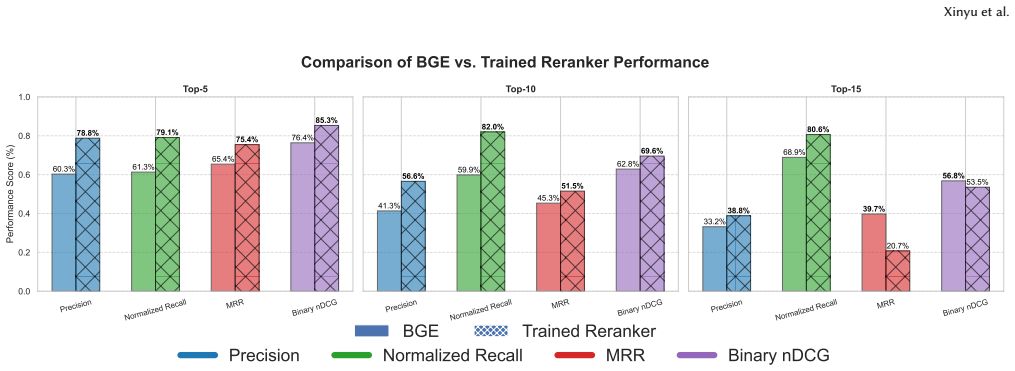
- A preference-tuned reranker yields most of its precision and recall gains in the top-5 to top-10 range, so production systems can keep retrieved context small.
- On this benchmark, graph-based RAG solutions do not beat a well-preprocessed multi-path vector pipeline, so compliance QA deployments do not have to adopt graph representations to get faithful answers.
- Reported end-to-end accuracy of 49.66% (LLM-judged) and 57.05% (manual) on FinanceBench, and 85.33% and 88.00% on the company dataset, indicate the pipeline's gains carry through to final answers, not just retrieval.
Reading between the lines
- Beyond the paper: the reported component gains are not cleanly attributed to FFP, MPR, or DRR; an ablation that holds each component fixed while toggling the others would quantify each one's contribution.
- Beyond the paper: the reranker's time bonus implies recency is load-bearing; a testable extension is to ask the same factual question about an old and a new filing with identical content and check whether ranking consistently favors the newer one.
- Beyond the paper: because the 75-question evaluation is drawn from one company's filings, cross-company or portfolio-level questions are an open test; a mixed-company vector store would reveal whether the metadata and HyDE paths transfer.
- Beyond the paper: metadata retrieval returns entire semantic sections when one metadata instance matches, which likely explains the recall gain but may also inflate false positives; measuring precision per semantic segment could expose where the approach overshoots.
Signed reviews
Editorial analysis
A structured set of objections, weighed in public.
Referee Report
Summary. The paper proposes FinSage, a RAG system for question answering over financial filings. FinSage consists of three components: a multi-modal preprocessing pipeline (FFP) that unifies text, tables, and figures into text chunks with chunk-level metadata; a multi-path retrieval pipeline (MPR) that combines BM25, dense retrieval (BGE-M3), metadata-based retrieval, and HyDE query expansion; and a domain-specialized reranker trained with a claimed Direct Preference Optimization (DPO) objective. The authors report 92.51% retrieval recall on a private 75-question Company dataset built from Lotus Technology filings, 49.66% LLM-judged accuracy on FinanceBench (a claimed 24.06 percentage point improvement over cited baselines), and 85.33%/88.00% QA accuracy on the Company dataset. The system is said to be deployed and to have served over 1,200 users.
Significance. A well-engineered, deployed financial QA system is a worthwhile application contribution, and the architecture sensibly integrates known techniques (metadata-aware retrieval, HyDE, multi-path fusion, and reranking with a time bonus). If the evaluation were properly controlled, the 92.51% recall result on a private dataset would demonstrate value for a specific deployment. However, as presented, the core experimental claims are not supported: the headline Company-dataset numbers appear to be in-sample, the FinanceBench comparison mixes evaluation protocols and judges, and the reranker is not actually trained with DPO as formulated. The paper also provides no code or data release, so the central findings cannot be independently checked. The extensive deployment analytics in Appendix E are helpful but do not substitute for a controlled research evaluation.
major comments (3)
- [Sec. 3.2, 3.3, 4.2.1, 4.2.2, 4.3; Table 1, Figure 5, Table 2] The central evaluation on the Company dataset is not shown to be held-out. Section 3.2 states that HyDE is instruction-fine-tuned "on our custom Company dataset," Section 4.2.2 states that the Document Re-ranker is "trained on single-company financial filings," and Section 3.3 describes an iterative loop in which retrieved documents are re-annotated and the model is retrained "until a satisfactory performance on the new test set is attained." Since Table 1, Figure 5, and the Company rows of Table 2 are all evaluated on the manually annotated Company dataset described in Section 4.1, the 92.51% recall and the reranker gains are at risk of being in-sample measurements of fit to the evaluation set. The paper must state explicitly how the 75 expert questions and their annotated chunks are disjoint from all training and tuning data, provide the actual split, and ideally test on a different company's filings to establish generalization.
- [Section 5.3, Table 2] The FinanceBench comparison is not controlled. The table footnote says results with "*" are from the authors' experiments and all others are "from the original papers," so FinSage's GPT-4o-judged LLM accuracy is compared with numbers obtained under different retrieval settings, chunk sizes, generation prompts, and possibly different evaluation metrics. The claimed 24.06 percentage point improvement over the "best baseline" (49.66% vs. 25.60%) is therefore not established. The authors should re-run all baselines in their own pipeline with the same judge, the same protocol, and the same retrieval and generation settings, and report variance or significance tests.
- [Section 3.3, Eq. (2)] The loss in Eq. (2) is not Direct Preference Optimization. DPO, as introduced by Rafailov et al., optimizes a language model policy against a reference model with a KL penalty; Eq. (2) is a pairwise logistic (contrastive) loss on reranker scores. The paper's third contribution ("fine-tuned via Direct Preference Optimization") is therefore not supported by the formulation, and the cited reference [49] is an instruction-tuning survey rather than the DPO paper. The authors should either implement and report actual DPO or relabel the objective as a pairwise ranking loss and adjust the contribution claim accordingly.
minor comments (6)
- [Abstract] The abstract contains an incomplete sentence: "FinSage achieves an impressive recall of 92.51% on 75 expert-curated questions derived from surpasses the best baseline method..." which appears to be a copy-paste artifact and should be fixed.
- [Figure 5, Table 7, Section 5.2] The main-text Figure 5 reports values that correspond to the R=10 configuration in Table 7 but the caption and Section 5.2 do not state the candidate-bundle size R; the text "from 78.8% to 38.8%" for precision also matches R=10 values only. Please make the configuration explicit and consistent between the figure, table, and text.
- [Eq. (1), Section 3.3] The time bonus function f(\tilde{m}_i) and the scale \beta are never defined; the paper only gives a verbal description of a one-year cutoff. A concrete formula (e.g., a decay function of publication date) is needed for reproducibility.
- [Section 4.3] The definition of "Normalized Recall" (capping the denominator at min(ground truth chunks, K)) makes it an upper bound of standard recall and not comparable to traditional recall values; Table 1 reports "Recall" without specifying whether the capped or uncapped variant is used.
- [Tables 3 and 4, Appendix F] The GraphRAG/LightRAG comparison uses different numbers of questions (71 vs. 75) and a "Faithful Evaluation Score" whose definition and rating scale are not given in the main text; please state the evaluation protocol and score rubric explicitly.
- [Appendix C.1, Table 6] Typographical errors in the command parameters: "gpu-memoty-utilization" should be "gpu-memory-utilization" and "engorce-eager" should be "enforce-eager".
Circularity Check
The Company-dataset recall, reranker gains, and QA scores are in-sample: HyDE is fine-tuned on the custom Company dataset and the DPO reranker is retrained until it performs on a 'new test set,' with no reported split.
-
fitted input called prediction
[Section 3.2 (HyDE retriever) and Section 4.3 / Table 1 (MPR evaluation on the Company dataset)]
"To further enhance HyDE’s performance, we augment the LLM’s domain-specific knowledge through instruction fine-tuning on our custom Company dataset, following the InPars method [7]. ... Our MPR pipeline is evaluated using various combinations of retriever paths by analyzing document chunk recommendation metrics (Recall, Precision, F1) on the in-depth dataset."
The only 'custom Company dataset' defined in the paper is the manually annotated 75-question, 12-filing dataset introduced in Section 4.1, and Section 4.2.1 builds HyDE-SFT training data from finance question-document pairs. Table 1 then reports HyDE-2 and the full FinSage recall on that same Company dataset, with no stated train/test split for the 75 questions or their annotated chunks. The 92.51% recall is therefore measured on the training distribution: the fine-tuned HyDE is a fitted component, and its contribution to the headline recall is in-sample by construction.
-
fitted input called prediction
[Section 3.3 (DRR Model Adjustment), with Section 4.2.2 and Figure 5]
"(3) Model Adjustment: When the model fails to perform on a new test set, the retrieved documents are re-annotated to better represent the underlying patterns and relationships via a careful review and adjustment of training data. The model is retrained on top of the previous version using the updated annotations, refining the ranking ability. This is repeated until a satisfactory performance on the new test set is attained."
This procedure adapts the reranker's training data and weights in direct response to failures on the 'new test set.' Section 4.2.2 says the DRR is 'trained on single-company financial filings,' and Section 4.3 evaluates it against the manually annotated Company ground truth (Figure 5), with no separate held-out set described. The reported reranking improvements are therefore convergence results to the evaluation set, not independent predictions: the model is adjusted until the test-set numbers look satisfactory.
full rationale
The circularity is concentrated on the private Company dataset, which carries the headline 92.51% recall, the reranker gains, and the 85.33%/88.00% QA scores. Two load-bearing components are trained on or adapted to that dataset: HyDE-SFT is instruction fine-tuned on 'our custom Company dataset' (Section 3.2) and then measured on the same dataset (Table 1), and the DPO reranker's own description admits an iterative loop of re-annotating and retraining until performance on a 'new test set' is satisfactory (Section 3.3), while Section 4.3 uses the Company dataset as the evaluation ground truth. No train/test split or exclusion of the 75 expert questions is stated anywhere. These are not mere self-citations; they make the Company-dataset numbers in-sample by construction. The FinanceBench results are genuinely external and provide some independent evidence for the system, though the Table 2 comparison mixes FinSage's own GPT-4o-judged run with numbers taken from the original papers, so the 24.06-point gain is not a controlled comparison. Weighing all of this, the central Company-dataset claims are partially circular, but the FinanceBench evaluation and the architectural description keep the paper from being entirely reducible to its inputs.
Assumptions & free parameters
free parameters (5)
- tau_dedup =
0.7 (cosine similarity threshold)
- tau_exp =
0.85 (chunk expansion threshold)
- K (top-k chunks) =
5 for generation, 10 for retrieval metrics
- chunk_size =
256 tokens for FinanceBench, 200 tokens for Company
- metadata time bonus function f(m_i) and scale beta =
unspecified
assumptions (4)
- domain assumption Manual expert annotations of the Company dataset are correct and complete ground truth.
- domain assumption GPT-4o-based CorrectnessEvaluator scores align with human answer quality.
- domain assumption FinanceBench baseline numbers from the original papers are directly comparable to FinSage's own runs.
- domain assumption PDF parsing and vision-language conversion preserve all relevant filing content.
Cite this review
Pith. "Pith review of FinSage: A Multi-aspect RAG System for Financial Filings Question Answering." pith.science (2026). https://pith.science/paper/PZ3ZFKJN
@misc{pith2026250414493,
  author       = {Pith},
  title        = {Pith review of: FinSage: A Multi-aspect RAG System for Financial Filings Question Answering},
  year         = {2026},
  howpublished = {\url{https://pith.science/paper/PZ3ZFKJN}},
  note         = {Machine review of arXiv:2504.14493}
}
read the original abstract
Leveraging large language models in real-world settings often entails a need to utilize domain-specific data and tools in order to follow the complex regulations that need to be followed for acceptable use. Within financial sectors, modern enterprises increasingly rely on Retrieval-Augmented Generation (RAG) systems to address complex compliance requirements in financial document workflows. However, existing solutions struggle to account for the inherent heterogeneity of data (e.g., text, tables, diagrams) and evolving nature of regulatory standards used in financial filings, leading to compromised accuracy in critical information extraction. We propose the FinSage framework as a solution, utilizing a multi-aspect RAG framework tailored for regulatory compliance analysis in multi-modal financial documents. FinSage introduces three innovative components: (1) a multi-modal pre-processing pipeline that unifies diverse data formats and generates chunk-level metadata summaries, (2) a multi-path sparse-dense retrieval system augmented with query expansion (HyDE) and metadata-aware semantic search, and (3) a domain-specialized re-ranking module fine-tuned via Direct Preference Optimization (DPO) to prioritize compliance-critical content. Extensive experiments demonstrate that FinSage achieves an impressive recall of 92.51% on 75 expert-curated questions derived from surpasses the best baseline method on the FinanceBench question answering datasets by 24.06% in accuracy. Moreover, FinSage has been successfully deployed as financial question-answering agent in online meetings, where it has already served more than 1,200 people.
Figures


Figures from the paper (6 more)



Forward citations
Cited by 1 Pith paper
-
A Role-Aware Multi-Agent Framework for Financial Education Question Answering with LLMs
A role-aware multi-agent pipeline with retrieval and expert critique raises financial multiple-choice accuracy by 6.6-8.3 percentage points over zero-shot CoT across four LLMs.
Reference graph
Works this paper leans on
-
[49]
Wenjia Zhai. 2024. Self-adaptive Multimodal Retrieval-Augmented Generation. arXiv:2410.11321 [cs.CL] https://arxiv.org/abs/2410.11321
arXiv 2024
-
[1]
Garima Agrawal, Tharindu Kumarage, Zeyad Alghamdi, and Huan Liu. 2024. Mindful-RAG: A Study of Points of Failure in Retrieval Augmented Generation. arXiv:2407.12216 [cs.IR] https://arxiv.org/abs/2407.12216
arXiv 2024
-
[2]
Anonymous. 2024. TabMeta: Table Metadata Generation with LLM-Curated Dataset and LLM-Judges. In Submitted to ACL Rolling Review - June 2024 . https: //openreview.net/forum?id=NXYVm3AjG2 under review
work page 2024
-
[3]
Akari Asai, Zeqiu Wu, Yizhong Wang, Avirup Sil, and Hannaneh Hajishirzi. 2024. Self-RAG: Learning to retrieve, generate, and critique through self-reflection. In Proceedings of the Twelfth International Conference on Learning Representations
work page 2024
-
[4]
Arian Askari, Amin Abolghasemi, Gabriella Pasi, Wessel Kraaij, and Suzan Ver- berne. 2023. Injecting the BM25 Score as Text Improves BERT-Based Re-rankers. arXiv:2301.09728 [cs.IR] https://arxiv.org/abs/2301.09728
arXiv 2023
-
[5]
Scott Barnett, Stefanus Kurniawan, Srikanth Thudumu, Zach Brannelly, and Mohamed Abdelrazek. 2024. Seven Failure Points When Engineering a Retrieval Augmented Generation System. arXiv:2401.05856 [cs.SE] https://arxiv.org/abs/ 2401.05856
arXiv 2024
-
[6]
Maciej Besta, Ales Kubicek, Roman Niggli, Robert Gerstenberger, Lucas Weitzen- dorf, Mingyuan Chi, Patrick Iff, Joanna Gajda, Piotr Nyczyk, Jürgen Müller, Hubert Niewiadomski, Marcin Chrapek, Michał Podstawski, and Torsten Hoe- fler. 2024. Multi-Head RAG: Solving Multi-Aspect Problems with LLMs. arXiv:2406.05085 [cs.CL] https://arxiv.org/abs/2406.05085
arXiv 2024
-
[7]
Luiz Bonifacio, Hugo Abonizio, Marzieh Fadaee, and Rodrigo Nogueira. 2022. InPars: Unsupervised Dataset Generation for Information Retrieval. In Proceed- ings of the 45th International ACM SIGIR Conference on Research and Development in Information Retrieval (Madrid, Spain) (SIGIR ’22). Association for Computing Machinery, New York, NY, USA, 2387–2392. do...
arXiv 2022
Show all 57 references
-
[8]
Martin Juan José Bucher and Marco Martini. 2024. Fine-Tuned ’Small’ LLMs (Still) Significantly Outperform Zero-Shot Generative AI Models in Text Classification. arXiv:2406.08660 [cs.CL] https://arxiv.org/abs/2406.08660
2024 arXiv
-
[9]
Deng Cai, Yan Wang, Lemao Liu, and Shuming Shi. 2022. Recent Advances in Retrieval-Augmented Text Generation. InProceedings of the 45th International ACM SIGIR Conference on Research and Development in Information Retrieval (Madrid, Spain) (SIGIR ’22). Association for Computin...
2022
-
[10]
Jianlv Chen, Shitao Xiao, Peitian Zhang, Kun Luo, Defu Lian, and Zheng Liu. 2024. Bge m3-embedding: Multi-lingual, multi-functionality, multi-granularity text embeddings through self-knowledge distillation. arXiv preprint arXiv:2402.03216 (2024)
2024 arXiv
-
[11]
Wenhu Chen, Hexiang Hu, Xi Chen, Pat Verga, and William Cohen. 2022. MuRAG: Multimodal Retrieval-Augmented Generator for Open Question Answering over Images and Text. In Proceedings of the 2022 Conference on Empirical Methods in Natural Language Processing , Yoav Goldberg, Zor...
2022 doi
-
[12]
MinerU Contributors. 2024. MinerU: A One-stop, Open-source, High-quality Data Extraction Tool. https://github.com/opendatalab/MinerU
2024
-
[13]
Moreira, Ronay Ak, Benedikt Schifferer, Mengyao Xu, Radek Osmulski, and Even Oldridge
Gabriel de Souza P. Moreira, Ronay Ak, Benedikt Schifferer, Mengyao Xu, Radek Osmulski, and Even Oldridge. 2024. Enhancing Q&A Text Retrieval with Ranking Models: Benchmarking, fine-tuning and deploying Rerankers for RAG. arXiv:2409.07691 [cs.IR] https://arxiv.org/abs/2409.07691
2024 arXiv
-
[14]
Hervé Déjean, Stéphane Clinchant, and Thibault Formal. 2024. A Thor- ough Comparison of Cross-Encoders and LLMs for Reranking SPLADE. arXiv:2403.10407 [cs.IR] https://arxiv.org/abs/2403.10407
2024 arXiv
-
[15]
Pranab Islam, Anand Kannappan, Douwe Kiela, Rebecca Qian, Nino Scherrer, and Bertie Vidgen. 2023. FinanceBench: A New Benchmark for Financial Question Answering. arXiv:2311.11944 [cs.CL]
2023 arXiv
-
[16]
Mathew Jacob, Erik Lindgren, Matei Zaharia, Michael Carbin, Omar Khattab, and Andrew Drozdov. 2024. Drowning in Documents: Consequences of Scaling Reranker Inference. arXiv:2411.11767 [cs.IR] https://arxiv.org/abs/2411.11767
2024 arXiv
-
[17]
Antonio Jimeno-Yepes, Yao You, Jan Milczek, Sebastian Laverde, and Renyu Li
-
[18]
Jeff Johnson, Matthijs Douze, and Hervé Jégou. 2019. Billion-scale similarity search with GPUs. IEEE Transactions on Big Data 7, 3 (2019), 535–547
2019
-
[19]
Vladimir Karpukhin, Barlas Oguz, Sewon Min, Patrick Lewis, Ledell Wu, Sergey Edunov, Danqi Chen, and Wen-tau Yih. 2020. Dense Passage Retrieval for Open- Domain Question Answering. In Proceedings of the 2020 Conference on Empirical Methods in Natural Language Processing (EMNLP...
2020
-
[20]
klu.ai. [n. d.]. klu.ai. https://docs.klu.ai/
-
[21]
Muzhi Li, Minda Hu, Irwin King, and Ho-fung Leung. 2024. The Integration of Semantic and Structural Knowledge in Knowledge Graph Entity Typing. In Proceedings of the 2024 Conference of the North American Chapter of the Association for Computational Linguistics: Human Language ...
2024 doi
-
[22]
Xiaoxi Li, Jiajie Jin, Yujia Zhou, Yuyao Zhang, Peitian Zhang, Yutao Zhu, and Zhicheng Dou. 2024. From Matching to Generation: A Survey on Generative Information Retrieval. arXiv:2404.14851 [cs.IR] https://arxiv.org/abs/2404.14851
2024 arXiv
-
[23]
Jerry Liu. 2022. LlamaIndex. doi:10.5281/zenodo.1234
2022 doi
-
[24]
Liu, Kevin Lin, John Hewitt, Ashwin Paranjape, Michele Bevilacqua, Fabio Petroni, and Percy Liang
Nelson F. Liu, Kevin Lin, John Hewitt, Ashwin Paranjape, Michele Bevilacqua, Fabio Petroni, and Percy Liang. 2023. Lost in the Middle: How Language Models Use Long Contexts. arXiv:2307.03172 [cs.CL] https://arxiv.org/abs/2307.03172
2023 arXiv
-
[25]
Yanming Liu, Xinyue Peng, Xuhong Zhang, Weihao Liu, Jianwei Yin, Jiannan Cao, and Tianyu Du. 2024. RA-ISF: Learning to answer and understand from retrieval augmentation via iterative self-feedback. arXiv preprint arXiv:2403.06840 (2024)
2024 arXiv
-
[26]
Xinwei Long, Jiali Zeng, Fandong Meng, Zhiyuan Ma, Kaiyan Zhang, Bowen Zhou, and Jie Zhou. 2024. Generative multi-modal knowledge retrieval with large language models. In Proceedings of the Thirty-Eighth AAAI Conference on Artificial Intelligence and Thirty-Sixth Conference on...
2024 doi
-
[27]
Shengjie Ma, Chengjin Xu, Xuhui Jiang, Muzhi Li, Huaren Qu, Cehao Yang, Jiaxin Mao, and Jian Guo. 2025. Think-on-Graph 2.0: Deep and Faithful Large Language Model Reasoning with Knowledge-guided Retrieval Augmented Generation. In The Thirteenth International Conference on Lear...
2025
- [28]
-
[29]
Ben Naismith, Phoebe Mulcaire, and Jill Burstein. 2023. Automated evaluation of written discourse coherence using GPT-4. In Proceedings of the 18th Workshop on Innovative Use of NLP for Building Educational Applications (BEA 2023) , Ekaterina Kochmar, Jill Burstein, Andrea Hor...
2023 doi
-
[30]
Keshavan, Trung Vu, Lukasz Heldt, Lichan Hong, Yi Tay, Vinh Q
Shashank Rajput, Nikhil Mehta, Anima Singh, Raghunandan H. Keshavan, Trung Vu, Lukasz Heldt, Lichan Hong, Yi Tay, Vinh Q. Tran, Jonah Samost, Maciej Kula, Ed H. Chi, and Maheswaran Sathiamoorthy. 2023. Recommender Systems with Generative Retrieval. arXiv:2305.05065 [cs.IR] htt...
2023 arXiv
-
[31]
Monica Riedler and Stefan Langer. 2024. Beyond Text: Optimizing RAG with Multimodal Inputs for Industrial Applications. arXiv:2410.21943 [cs.CL] https: Xinyu et al. //arxiv.org/abs/2410.21943
2024 arXiv
-
[32]
Stephen Robertson, Hugo Zaragoza, et al . 2009. The probabilistic relevance framework: BM25 and beyond. Foundations and Trends® in Information Retrieval 3, 4 (2009), 333–389
2009
-
[33]
Idan Schwartz. 2021. Ensemble of MRR and NDCG models for Visual Dialog. arXiv:2104.07511 [cs.AI] https://arxiv.org/abs/2104.07511
2021 arXiv
-
[34]
SEC. 2024. JP Morgan Affiliates to Pay 151 Million to Resolve SEC Enforcement Actions. https://www.sec.gov/newsroom/press-releases/2024-178
2024
-
[35]
SEC. 2024. SEC Levies More Than 3.8 Million in Penalties in Sweep of Late Beneficial Ownership and Insider Transaction Reports. https://www.sec.gov/ newsroom/press-releases/2024-148
2024
-
[36]
Spurthi Setty, Harsh Thakkar, Alyssa Lee, Eden Chung, and Natan Vidra. 2024. Improving Retrieval for RAG based Question Answering Models on Financial Documents. arXiv:2404.07221 [cs.IR] https://arxiv.org/abs/2404.07221
2024 arXiv
-
[37]
Shalin Shah, Srikanth Ryali, and Ramasubbu Venkatesh. 2024. Multi-Document Financial Question Answering using LLMs. arXiv:2411.07264 [cs.IR] https: //arxiv.org/abs/2411.07264
2024 arXiv
-
[38]
Dewang Sultania, Zhaoyu Lu, Twisha Naik, Franck Dernoncourt, David Se- unghyun Yoon, Sanat Sharma, Trung Bui, Ashok Gupta, Tushar Vatsa, Suhas Suresha, Ishita Verma, Vibha Belavadi, Cheng Chen, and Michael Friedrich. 2024. Domain-specific Question Answering with Hybrid Search....
2024 arXiv
-
[39]
C. Wang, Q. Long, M. Xiao, et al . 2024. Biorag: A RAG-LLM framework for biological question reasoning. arXiv preprint arXiv:2408.01107 (2024)
2024 arXiv
-
[40]
Yile Wang, Peng Li, Maosong Sun, and Yang Liu. 2023. Self-knowledge guided retrieval augmentation for large language models. In Findings of the Association for Computational Linguistics: EMNLP 2023 . 10303–10315
2023
-
[41]
Peng Xia, Kangyu Zhu, Haoran Li, Tianze Wang, Weijia Shi, Sheng Wang, Linjun Zhang, James Zou, and Huaxiu Yao. 2024. MMed-RAG: Versatile Multimodal RAG System for Medical Vision Language Models. arXiv:2410.13085 [cs.LG] https://arxiv.org/abs/2410.13085
2024 arXiv
-
[42]
Suchow, Xiao-Yang Liu, Benyou Wang, Alejandro Lopez-Lira, Jimin Huang, and Sophia Ananiadou
Qianqian Xie, Dong Li, Mengxi Xiao, Zihao Jiang, Ruoyu Xiang, Xiao Zhang, Zhengyu Chen, Yueru He, Weiguang Han, Yuzhe Yang, Shunian Chen, Yifei Zhang, Lihang Shen, Daniel Kim, Zhiwei Liu, Zheheng Luo, Yangyang Yu, Yupeng Cao, Zhiyang Deng, Zhiyuan Yao, Haohang Li, Duanyu Feng,...
-
[43]
Lee Xiong, Chenyan Xiong, Ye Li, Kwok-Fung Tang, Jialin Liu, Paul Bennett, Junaid Ahmed, and Arnold Overwijk. 2020. Approximate nearest neighbor nega- tive contrastive learning for dense text retrieval. arXiv preprint arXiv:2007.00808 (2020)
2020 arXiv
-
[44]
arXiv:2408.11878 [cs.CL] https://arxiv.org/abs/2408.11878
Open-FinLLMs: Open Multimodal Large Language Models for Financial Applications. arXiv:2408.11878 [cs.CL] https://arxiv.org/abs/2408.11878
-
[45]
Ye Yuan, Chengwu Liu, Jingyang Yuan, Gongbo Sun, Siqi Li, and Ming Zhang
-
[46]
Shi Yu, Chaoyue Tang, Bokai Xu, Junbo Cui, Junhao Ran, Yukun Yan, Zheng- hao Liu, Shuo Wang, Xu Han, Zhiyuan Liu, and Maosong Sun. 2025. Vis- RAG: Vision-based Retrieval-augmented Generation on Multi-modality Doc- uments. In The Thirteenth International Conference on Learning ...
2025
-
[47]
Le Zhang, Yihong Wu, Fengran Mo, Jian-Yun Nie, and Aishwarya Agrawal
-
[48]
arXiv:2408.05141 [cs.CL] https://arxiv.org/abs/2408.05141
A Hybrid RAG System with Comprehensive Enhancement on Complex Reasoning. arXiv:2408.05141 [cs.CL] https://arxiv.org/abs/2408.05141
-
[50]
Qingfei Zhao, Ruobing Wang, Yukuo Cen, Daren Zha, Shicheng Tan, Yuxiao Dong, and Jie Tang. 2024. LongRAG: A Dual-Perspective Retrieval-Augmented Genera- tion Paradigm for Long-Context Question Answering. arXiv:2410.18050 [cs.CL] https://arxiv.org/abs/2410.18050
2024 arXiv
-
[51]
Xing, Hao Zhang, Joseph E
Lianmin Zheng, Wei-Lin Chiang, Ying Sheng, Siyuan Zhuang, Zhanghao Wu, Yonghao Zhuang, Zi Lin, Zhuohan Li, Dacheng Li, Eric P. Xing, Hao Zhang, Joseph E. Gonzalez, and Ion Stoica. 2023. Judging LLM-as-a-Judge with MT-Bench and Chatbot Arena. arXiv:2306.05685 [cs.CL] https://ar...
2023 arXiv
-
[52]
Le Zhang, Yihong Wu, Qian Yang, and Jian-Yun Nie. 2024. Exploring the Best Practices of Query Expansion with Large Language Models. In Findings of the Association for Computational Linguistics: EMNLP 2024 . 1872–1883
2024
-
[53]
Shengyu Zhang, Linfeng Dong, Xiaoya Li, Sen Zhang, Xiaofei Sun, Shuhe Wang, Jiwei Li, Runyi Hu, Tianwei Zhang, Fei Wu, and Guoyin Wang. 2024. Instruction Tuning for Large Language Models: A Survey. arXiv:2308.10792 [cs.CL] https: //arxiv.org/abs/2308.10792
2024
-
[56]
he, " “it,
Kunlun Zhu, Yifan Luo, Dingling Xu, Ruobing Wang, Shi Yu, Shuo Wang, Yukun Yan, Zhenghao Liu, Xu Han, Zhiyuan Liu, et al. 2024. Rageval: Scenario specific rag evaluation dataset generation framework. arXiv preprint arXiv:2408.01262 (2024). A Data Preprocessing Details To effec...
2024 arXiv
-
[57]
previous
Generating a concise summary for each block. 2. Aggregating summaries to form a higher-level title summary. 3. Storing the final summary in title_summary. For example, the original JSON format: After summarization: A.8 Text Segmentation To maintain manageable block sizes, text...
-
[2023]
arXiv preprint arXiv:2310.13265 (2023)
MoqaGPT: Zero-Shot Multi-modal Open-domain Question Answering with Large Language Model. arXiv preprint arXiv:2310.13265 (2023)
2023 arXiv
-
[2024]
ArXiv abs/2402.05131 (2024)
Financial Report Chunking for Effective Retrieval Augmented Genera- tion. ArXiv abs/2402.05131 (2024). https://api.semanticscholar.org/CorpusID: 267547721
2024 arXiv
Reviewed August 16, 2026 · model on record in the stance chip above.
Discussion (0). Continue with ORCID to comment.