REVIEW 3 major objections 4 minor 7 references
By splitting a lens space into two solid tori, normalizing flows can learn pushed-forward densities from the 3-sphere with symmetries removed before training, reaching KL errors around 0.1–0.25 nats.
Reviewed by Pith at T0; open to challenge. T0 means a machine referee read the full paper against a public rubric. the ladder, T0–T4 →
Flows on the two solid tori of a lens space can approximate pushforwards of S3 densities onto L(p;q), and the construction deletes distribution symmetries before training.
T0 review reviewed 2026-08-03 challenge →
load-bearing objection Interesting construction undercut by an invalid circle coupling layer; the empirical KL numbers are not flow KLs on S1. the 3 major comments →
Normalizing Flows on Quotient Manifolds via Boundary Quotients
The pith
A machine-rendered reading of the paper's core claim, the machinery that carries it, and where it could break.
The reading
Core claim
The central claim is that the pushforward of an S3 density through the universal covering map ρ:S3→L(p;q) has a tractable density on the Heegaard split T1∪A T2, given by (1/2) psym∘ψ∘ι∘h_i^{-1} on each torus. Symmetrizing the original density makes the expression well-defined on the parts of the torus where the local lift h_i^{-1} is not defined, and the gluing map A ensures the two local pieces agree on the shared boundary. Training two independent flows against normalized local targets qi and recombining them with weights I1,I2 yields a global density; the paper proves for finite covers in general that symmetrization does not change the pushforward, so deleting the group redundancy is loss
What carries the argument
The workhorse is the genus-one Heegaard splitting of L(p;q), which presents the quotient as two solid tori T1,T2 glued by the map A = [[r,p],[s,q]]. Each torus is parametrized by S1 × D2 via maps f1,f2 that lift to S3 as h_1,h_2; the pointwise target density on Ti is p_i = (1/2) psym∘ψ∘ι∘h_i^{-1}, with psym the deck-averaged S3 density. This reduces a global problem on a topologically nontrivial 3-manifold to two local density-estimation problems on S1×D2, where the flow is a sequence of coupling layers that alternately transform the angular coordinate and the two disk coordinates. The 1/2 factor is the Jacobian from pulling the S3 volume element back to the tori, and the use of a symmetric
Load-bearing premise
The load-bearing premise is that the pointwise target formula p1∪A p2 = (1/2) psym∘ψ∘ι∘h_i^{-1} in Appendix A.1 is a well-defined smooth density on the whole glued manifold T1∪A T2, even though h_i^{-1} is only defined on S1\{1}×D2; the paper asserts rather than proves that the symmetrized density extends across the removed fiber and across the boundary identified by A. If that extension fails, every training target qi is wrong.
What would settle it
Evaluate p1∪A p2 from the closed-form formula at several points on the seam S1={1}×D2 and at points near the gluing boundary, using different deck-group representatives in the composition psym∘ψ∘ι∘h_i^{-1}; if the values disagree, or if integrating the density on an epsilon-neighborhood of the seam does not go to zero consistently, the target is not the pushforward density and the reported KL numbers were measured against the wrong object. Alternatively, compare a brute-force Monte Carlo histogram of ρ*μS3 obtained by sampling S3 and projecting with a direct computation of the pullback volume
If this is right
- If the construction is correct, any flow that works on S1×D2 can be reused for lens spaces, so the training cost of a quotient-manifold flow is close to the cost of two local flows rather than a flow on the entire quotient.
- Symmetrization before learning is lossless for the target (Proposition 3), which means p-fold symmetric densities can be learned with p times fewer modes; for the benzene experiment, 24 S3 modes reduce to 2 modes on L(12;1).
- The global KL is expressible as (1−I2)KL_T1 + I2 KL_T2, so practitioners can monitor and certify the full-manifold fit from local training curves plus the weighting constant I2.
- Proposition 3 is stated for any finite-sheeted cover, so the same pushforward-and-symmetrize strategy applies to other quotient manifolds with finite deck groups, not only S3→L(p;q).
Where Pith is reading between the lines
- The abstract promises a general boundary-quotient framework and an instantiation for genus-g surfaces, but the body develops only lens spaces; the paper does not yet supply the genus-g construction, so the generality of the framework is untested.
- A direct check of the target formula at the seam S1={1} and across the gluing boundary (e.g., evaluating p1∪A p2 from two different fundamental-domain representatives) would distinguish approximation error from a possible branch error in the lift; the paper argues well-definedness but does not prove smoothness there.
- Because the trained model is a flow on each torus, one could immediately use it for downstream tasks such as computing expectations of physical observables on the symmetry-reduced configuration space; the benzene experiment only reports KL and mode structure, not such observables.
- The symmetry-deletion principle suggests a more general design rule: for any distribution invariant under a finite group, quotienting out the group before fitting a flow may reduce model capacity requirements; this paper is one concrete realization on lens spaces, and applying it to other quotients would test the rule.
Editorial analysis
A structured set of objections, weighed in public.
Referee Report
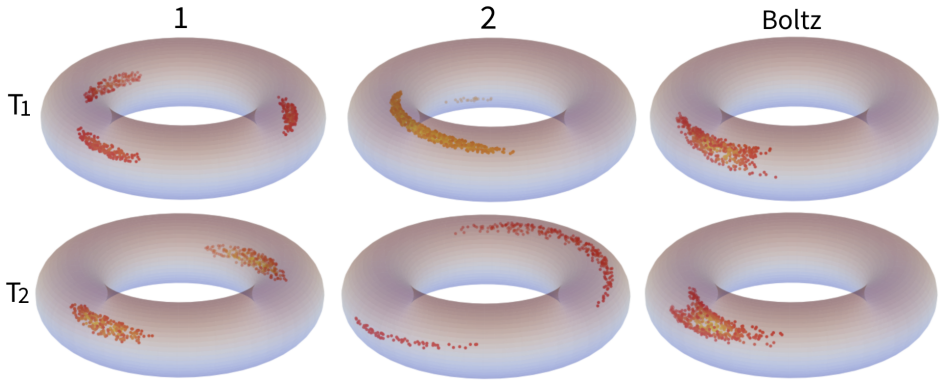
Summary. The paper proposes a framework for learning densities on quotient manifolds arising as boundary quotients of simpler domains, instantiated for lens spaces L(p;q). The method constructs a target distribution on L(p;q) as the pushforward of an S3 density under the universal covering map ρ:S3→L(p;q), using the genus-1 Heegaard splitting into two solid tori T1 and T2. The original S3 density is symmetrized with respect to the deck group, which removes distributional symmetries in the quotient. A separate normalizing flow is trained on each solid torus against the induced local target, and the global target is represented as a Bernoulli mixture of the two local targets. Experiments on vMF-mixture targets for L(3;2) and L(7;3) and on a benzene-inspired Boltzmann distribution for L(12;1) report small KL divergences and qualitatively correct mode structures. Appendices give the pushforward construction, coupling-layer architecture, KL decomposition, and potential function.
Significance. If the construction is made fully rigorous and the flow architecture corrected, the paper could provide a practical and conceptually appealing method for density estimation on quotient manifolds with discrete symmetries. The symmetry-deletion property is mathematically natural and Proposition 3 gives the correct statement. The Heegaard-splitting parametrization is a sensible way to reduce a 3-manifold flow problem to two solid-torus flow problems. The paper does not ship machine-checked proofs or code, but the theoretical derivation in A.1 is internally coherent in broad strokes, and the mixture formulation in §3.1 is a useful contribution. However, the empirical demonstration is currently compromised by an invalid coupling-layer design, and the well-definedness of the target density is asserted rather than proved. With these issues fixed, the approach would be a meaningful step toward normalizing flows on quotient manifolds.
major comments (3)
- [Appendix A.2, coupling layers c1 and c2] The layer c2(y1,y2)=(y1 e^{s2(y2)}+t2(y2), y2), followed by wrapping y1 modulo 2π, does not define a well-defined map on S1×D2. For a lift of a circle diffeomorphism one requires F̃(θ+2π,y2)=F̃(θ,y2)+2π (orientation-preserving case). A single layer of this form gives F̃(θ+2π)=e^{s2}θ+2πe^{s2}+t2, so descent to the circle requires e^{s2}=1 identically. A composition of layers accumulates a total multiplicative factor a(y2)=∏ e^{s_k(y2)}, which is not constrained to be 1 by the architecture. For a generic trained network a(y2)≠1, so the map is many-to-one on the S1 factor and is not a diffeomorphism of S1×D2. Consequently the change-of-variables formula in the loss (A.2) and the KL decomposition (A.3) do not apply, and the KL values in Table 1 are not KL divergences of a normalizing-flow pushforward. This directly undermines the central empirical claim in §4.
- [Appendix A.1, target density p1∪A p2] The target density is defined via the lifted maps h_i^{-1}, which are only defined on S1\{1}×D2, and the paper asserts that the total composition is well-defined on all of S1×D2 because psym is symmetric and h_i^{-1} is well-defined on fibers. This is not a proof. The lifts involve p-th roots and a removed set, and extension across the removed set and across the gluing boundary requires a rigorous continuity/smoothness argument showing that the expression is independent of the chosen branch and of the representative of the Zp action. The statement 'At the boundary of T1, these local properties are still satisfied via the gluing map A' is an unsupported assertion. Since every experimental target qi and every KL value in Table 1 depends on this density, the well-definedness must be established rigorously before the experiments can be interpreted.
- [§4 and Appendix A.3, global/local KL agreement] The reported agreement between the 'Flow-L(p;q)' KL row and the weighted local-KL rows is not an independent validation of the learned densities. Equation A.3 is an exact identity given the mixture model X=(1-X_B)X1+X_B X2 and the definitions of the local KLs; up to Monte Carlo error, the global KL is necessarily the weighted sum of the local KLs. The agreement therefore only checks consistency of the sampling estimates, not the quality of the learned Fθi. Furthermore, all targets are constructed from hand-specified S3 densities and the flows are trained against those same targets; there is no baseline or alternative estimator of the pushforward. The claim of 'strong results' is therefore not fully supported even if the architecture issue were fixed.
minor comments (4)
- [Title/Abstract] The arXiv abstract title is 'Normalizing Flows on Quotient Manifolds via Boundary Quotients', while the paper body title is 'Covering-Space Normalizing Flows: Approximating Pushforwards on Lens Spaces'. These should be aligned.
- [§4] Typo: 'the thirst using a Boltzmann distribution' should be 'the third'.
- [Appendix A.1] Typo: 'caresian' should be 'Cartesian'. Also, the normalization factor appears as p, then 1/(2p), then 1/2 in the same paragraph; please reconcile the factors in the definition of pVi and the final p1∪A p2.
- [§3.2] The reference [5] (Boltzmann Generators) is cited for the coupling-layer construction; a more appropriate citation would be [2] (Normalizing Flows on Tori and Spheres) where circular coupling layers are introduced.
Circularity Check
No significant circularity: targets are analytic pushforwards of known S3 densities; flows are trained against them and symmetry-deletion is a proven consequence, not a fitted prediction.
full rationale
The central derivation chain is self-contained and non-circular. Section 3.1 and A.1 define the target density p1 ∪A p2 directly from a known S3 density pS3 (symmetrized to psym) via the covering map ρ and the Heegaard parametrizations fi; the formula p1 ∪A p2(e^{iθ}, x, y) = 1/2 psym ∘ ψ ∘ ι ∘ h_i^{-1}(e^{iθ}, x, y) is an analytic construction, not an output of training. Proposition 3 proves ρ∗µM = ρ∗µsym by a direct group-average computation, so the claimed symmetry deletion (removal of deck-transformation modes) follows mathematically from the definition of the pushforward target. The flows Fθi are then trained by minimizing KL against these analytic targets; Table 1 reports post-training KL losses, which is standard density-estimation evaluation, not a prediction of a quantity that was used as a fit. No self-citations are used to justify the central claim: references [1]–[7] are external (flows, equivariant flows, quaternion molecular modeling, Boltzmann generators, Maier–Saupe, Pitzer–Gwinn) and support only background or architecture choices. The remaining concerns in the manuscript are correctness issues, not circularity: the unproved smoothness of p1 ∪A p2 at the removed circle S1 × {0} and across the gluing boundary (A.1), and the validity of the S1 coupling layer c2 as a diffeomorphism of the circle after mod-2π wrapping (A.2). If the latter fails, the reported KL values are not true flow KLs, but that is a mathematical flaw in the model class, not a reduction of the paper's claims to their own inputs. There is no fitted parameter renamed as a prediction, no uniqueness theorem imported from the authors, and no known result merely renamed.
Axiom & Free-Parameter Ledger
free parameters (4)
- Prior concentration κ_i and variance σ_i² =
κ_i=5, σ_i=0.25
- Entropy annealing hyperparameters β0 and T =
not reported
- Benzene potential constants κ and V =
κ=5, V=20
- vMF mode centers and concentrations =
concentrations 35, 65, 55, 80
axioms (4)
- standard math Covering-space facts: S3 is the universal cover of L(p;q) and fundamental domains exist for finite covering actions.
- standard math The maps f1, f2 and gluing matrix A define a Heegaard splitting homeomorphism T1 ∪A T2 ≅ L(p;q).
- domain assumption The density formula p1 ∪A p2 = (1/2) psym ∘ ψ ∘ ι ∘ h_i^{-1} extends smoothly across the removed set S1\{1} and across the glued boundary.
- ad hoc to paper Coupling layers with wrap-by-modulus define valid diffeomorphisms on S1×D2.
invented entities (1)
-
boundary quotient
no independent evidence
Cite this review
Pith. "Pith review of Normalizing Flows on Quotient Manifolds via Boundary Quotients." pith.science (2026). https://pith.science/paper/Q22HT5Z7
@misc{pith2026251122882,
  author       = {Pith},
  title        = {Pith review of: Normalizing Flows on Quotient Manifolds via Boundary Quotients},
  year         = {2026},
  howpublished = {\url{https://pith.science/paper/Q22HT5Z7}},
  note         = {Machine review of arXiv:2511.22882}
}
abstract
We introduce boundary quotients and present a framework for learning densities on manifolds that arise as boundary quotients of simpler domains. We show that this framework can be used to construct normalizing flows on quotient manifolds $N/G$, where a discrete group $G$ acts on $N$. We instantiate this construction for genus-$g$ surfaces $\Sigma_g$. When $G$ is finite, we show applicability to symmetry aware learning; we demonstrate this on cyclic quotients of the 3-sphere. Experiments on lens spaces show that simple pre-quotient RealNVP models can achieve strong results while being substantially cheaper to evaluate.
Figures
Reference graph
Works this paper leans on
-
[1]
I. Kobyzev, S. J. D. Prince, and M. Brubaker.Normalizing Flows: An Introduction and Review of Current Methods. arXiv:1908.09257, 2020
Pith/arXiv arXiv 1908
-
[2]
D. J. Rezende, S. Mohamed, et al.Normalizing Flows on Tori and Spheres. arXiv:2002.02428, 2020
Pith/arXiv arXiv 2002
-
[3]
Katsman, A
I. Katsman, A. Lou, D. Lim, Q. Jiang, S.-N. Lim, and C. De Sa.Equivariant Manifold Flows. InAdvances in Neural Information Processing Systems (NeurIPS), 2021
2021
-
[4]
C. F. F. Karney.Quaternions in Molecular Modeling. arXiv:physics/0506177, 2006
Pith/arXiv arXiv 2006
-
[5]
F. No´ e, S. Olsson, J. K¨ ohler, and H. Wu.Boltzmann Generators: Sampling Equilibrium States of Many-Body Systems with Deep Learning. arXiv:1812.01729, 2019
Pith/arXiv arXiv 2019
-
[6]
Maier and A
W. Maier and A. Saupe.Eine einfache molekulare Theorie des nematischen kristallinfl¨ ussigen Zustandes.Zeitschrift f¨ ur Naturforschung A, 14:882–889, 1959
1959
-
[7]
K. S. Pitzer and W. D. Gwinn.Energy Levels and Thermodynamic Functions for Molecules with Internal Rotation I.J. Chem. Phys., 10(7):428–440, 1942. A Appendix A.1 Construction of the Pushforward We give a more in depth description of how we obtain smooth densities on lens spaces via pushforward distributions originating from S3. But first, we note that the...
1942
This paper was first reviewed by deepseek-v4-flash on August 3, 2026.
discussion (0)
Sign in with ORCID, Apple, or X to comment. Anyone can read and Pith papers without signing in.