REVIEW 4 major objections 5 minor 42 references
RISE: Radius of Influence based Subgraph Extraction for 3D Molecular Graph Explanation
T0 review · 4 major / 5 minor · reviewed 2026-08-16 · deepseek-v4-flash
Pith's one-line read Per-atom radii isolate the chemical bonds a 3D GNN relies on
desk verdict RISE's per-atom radius parameterization is a genuinely new and mostly effective way to explain 3D GNNs, producing clean bond-level subgraphs, but the paper overclaims 'exact' optimization, skips a same-group baseline (3DGraphX), and its radius-only search space cannot express angle-dependent motifs. read the letter →
The pith
A machine-rendered reading of the paper's core claim, the machinery that carries it, and where it could break.
The reading
What carries the argument
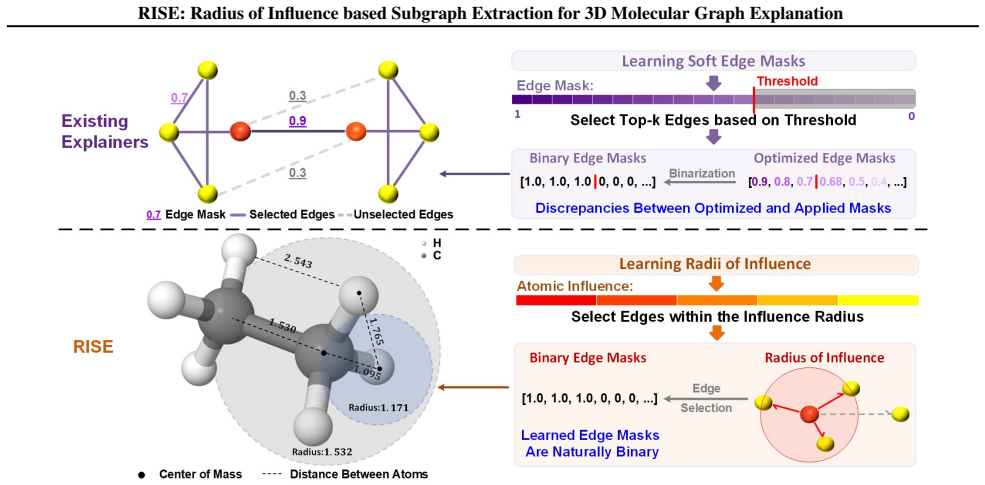
The load-bearing object is the directed proximity graph (DPG): a geometric graph on points in 3D space in which a directed edge $i \to j$ is present iff $d_{ij} < r_i$, with a radius $r_i$ attached to each source node. RISE optimizes these $n$ radii rather than edges, and the gate $M_{ij} = \sigma(k(M^r_i - d_{ij}))$ turns the hard radius rule into a differentiable mask whose $k\to\infty$ limit is exact, with the budget enforced by scaling the radii so that $\|M^r\|_1 \le B$ by construction. This single mechanism carries the whole argument: it makes the search space match the cut-off construction of 3D graphs, embeds distance decay directly into the explanation, removes the discrete-to-continuous relaxation gap that plagues soft edge masks, and is what lets the extracted subgraph be read as a set of atomic interaction spheres rather than a list of arbitrary edges.
What would settle it
Build a synthetic 3D regression task where the target is controlled by a three-atom angular interaction, such as a hydrogen bond whose strength depends on both distance and angle, so that keeping the decisive contact forces the radius to also include a distracting nearby atom. Train a 3D GNN, run RISE and an unconstrained edge-mask explainer at the same budget, and compare the MAE of predictions made from each extracted subgraph; if the edge-mask subgraph has strictly lower MAE than any radius-based subgraph, then RISE's directed-proximity search space cannot contain the optimal explanation.
Extended reading notes
Core claim
The central claim is that an explanatory subgraph for a 3D molecular GNN should be defined as a directed proximity graph parameterized by one radius of influence per atom. In a directed proximity graph an edge from atom $i$ to atom $j$ exists exactly when the Euclidean distance $d_{ij}$ is below atom $i$'s radius $r_i$, so RISE replaces the dense $n\times n$ edge-mask optimization of GNNExplainer and PGExplainer with $n$ continuous radius variables, using a sigmoid gate $M_{ij}=1/(1+e^{-k(r_i-d_{ij})})$ to make the cut differentiable while preserving exactness at large $k$. The paper claims this reformulation is the only explanation pipeline that naturally accounts for both differences between 2D and 3D GNNs, namely that edges are cut-off-based rather than chemical bonds and that message importance decays with distance, and that it is therefore the only one that yields chemically interpretable substructures: under a small budget RISE keeps chemical bonds and only chemical bonds, as illustrated on ethane, while baseline explainers return scattered, chemically meaningless edges. Quantitatively, RISE is reported to consistently outperform GNNExplainer, PGExplainer, and LRI-Bernoulli across budgets on QM9 and GEOM with both invariant (SchNet, DimeNet) and equivariant (SEGNN) backbones, while preserving fewer edges than the baselines.
Load-bearing premise
RISE's whole argument rests on the assumption that the truly important part of a 3D molecule for the model's prediction can always be expressed by shrinking each atom's radius independently — every edge the explanation keeps must be inside its source atom's radius, and every edge it cuts must be outside it, so no decisive interaction can depend on direction, angle, or any nonlocal context.
Editorial extensions
If this is right
- If RISE is right, explanation of 3D molecular GNNs can be done without ever constructing an edge-mask matrix: one radius per atom is enough.
- At small budgets, the extracted subgraph should read as chemical bonds only, giving chemists a direct visual check of what the model used instead of a cloud of thresholded edge weights.
- Because the radius gate is differentiable and no sparsity or discreteness penalties are needed, RISE avoids the thresholding gap that soft-mask explainers pay for in fidelity.
- The same radius parameterization transfers across invariant and equivariant backbones and across datasets, so the method is a general replacement for edge-mask explainers in 3D molecular settings.
Reading between the lines
- Beyond the paper, the learned radii themselves could serve as a compact atom-level importance profile: an atom whose radius stays large under tight budgets is one whose entire local neighborhood is decisive, which could be compared across properties to expose which interaction ranges matter for dipole moment versus orbital energies.
- One extension the paper leaves implicit: because radii shrink monotonically as the budget decreases, RISE naturally produces nested explanation subgraphs, so a single optimization run could animate how the model's reliance spreads from the nearest contacts outward.
- A limitation the paper acknowledges is long-range context; a testable consequence is that for macromolecules the per-atom radius rule will need angular or directional corrections, such as hydrogen bonds that depend on both distance and angle, which the current directed-proximity formulation cannot express.
Signed reviews
Editorial analysis
A structured set of objections, weighed in public.
Referee Report
Summary. The paper proposes RISE, an instance-level explanation method for 3D molecular GNNs. Instead of optimizing a dense binary edge mask, RISE assigns each atom a learnable radius of influence, so that a directed edge from atom i to atom j is retained when the interatomic distance is smaller than i's radius. The authors motivate this design by arguing that 3D GNNs differ from 2D GNNs both in representation (distance-cutoff dense edges) and in learning (distance-dependent message importance), and they provide annulus-removal experiments suggesting that closer edges are more important. RISE is evaluated on QM9 and GEOM with SchNet, DimeNet, and SEGNN backbones and is compared with GNNExplainer, PGExplainer, and LRI-Bernoulli; the reported fidelity, measured by prediction MAE on the retained subgraph, is generally better for RISE under comparable or more favorable edge budgets for the baselines. The paper also claims exact optimization without continuous-mask relaxation and claims that RISE is the only existing pipeline yielding chemically interpretable substructures.
Significance. If the central claims hold, RISE would be a useful and practical contribution to 3D molecular GNN interpretability: per-atom radii give a compact, chemically suggestive explanation format, the authors provide code, and the empirical comparison covers multiple backbones, datasets, and properties. The proximity-annulus analysis in Sec. 4.1 is a nice empirical probe of how 3D GNNs use distance. However, the paper's strongest advertised advantages--'exact optimization' and being 'the only' interpretable 3D explainer--are overstated relative to what is actually shown. The DPG search-space restriction is a real limitation that is not tested against angle-dependent interactions, which matters because the evaluation includes DimeNet and SEGNN. The core idea is defensible and the empirical results are promising, but the load-bearing theoretical and expressivity claims need to be corrected or substantiated before the paper can be accepted.
major comments (4)
- [§3.2, Eq. (7); contribution ③] The claim that RISE 'does not require the relaxation from binary masks to continuous masks' and 'allows exact optimization' is contradicted by Eq. (7). There, M_ij is defined as a sigmoid of k(M^r_i - d_ij), which is a continuous relaxation of the desired indicator function: it is never exactly binary, and the final discrete DPG must still be recovered by thresholding or by reading off the optimized radii. The consistency advantage over GNNExplainer-style soft masks is therefore a matter of degree, not an exact equivalence. Please remove the word 'exact' from the contribution and Sec. 3.3, or provide a formal argument that the sigmoid in Eq. (7) is not a relaxation and that the optimized solution is exactly the discrete DPG.
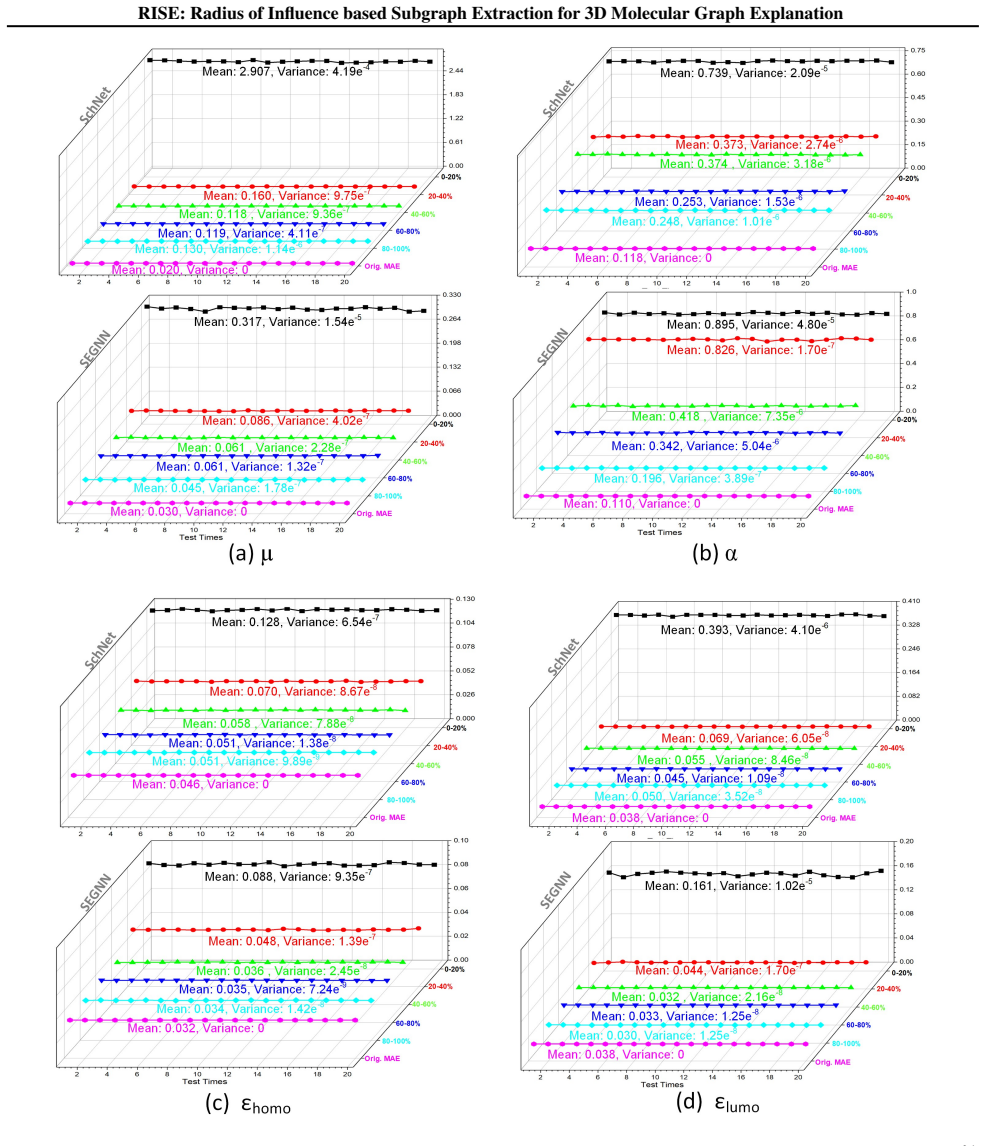
- [Definition 3.1, Eq. (7); Tables 3 and 7] The DPG search space makes edge retention depend only on the source-node radius and the pairwise distance, so it cannot express angle-dependent or other multi-body interactions. This is load-bearing because RISE is evaluated on DimeNet (Table 7) and SEGNN (Table 3), whose message passing uses bond angles and equivariant geometric features: an interaction that matters because of a specific angle cannot be isolated by any radius assignment, since enlarging a radius to include the angular partner also includes all shorter edges from that atom. The annulus-removal evidence in Table 1 is aggregate and monotone, but it does not establish that per-node radii can represent the optimal subgraph in individual molecules; the same table also shows that removing the outermost annulus (80-100%) roughly doubles SchNet's alpha MAE, indicating that long-range edges carry nontrivial signal. I request either a controlled synthetic experiment with an angle-dependent ground-truth subgraph that compares RISE with a full edge-mask explainer under the same budget, or a clear statement that RISE is intentionally restricted to distance-only interactions, with correspondingly weaker claims about angle-aware backbones.
- [§3.1.1, Eq. (3)] Eq. (3) is mathematically malformed. The left-hand side is an argmin, the first right-hand term is an objective value evaluated at the soft-masked graph, and the second right-hand term is a difference between predictions, but the inequality connecting them is never derived; the loss L is used with different argument structures and the second term does not show its target. Since this equation is the paper's only formal argument for the inconsistency of soft-mask optimization, it should be replaced by a precise statement (for example, a triangle-inequality bound relating the suboptimality of the thresholded mask to the soft-objective gap plus a prediction-difference term) or removed.
- [§3.3, contribution ④] The claim that RISE is 'the only explanation pipeline that can produce chemically interpretable explanatory subgraphs' is stronger than the evidence. Interpretability is assessed qualitatively on a small number of molecules (Fig. 4 and Appendix D), and the 'chemical bonds only' outcome is conditional on an unspecified 'appropriate small budget.' No quantitative interpretability metric, no comparison of interpretation quality across budgets, and no study of how often the bond-only behavior occurs are provided. The claim should be softened to what the experiments actually support, or supplemented with a quantitative evaluation.
minor comments (5)
- [Table 1, caption] The caption says values 'in most cells are strictly greater than the previous ones in the row,' but several adjacent cells are equal (e.g., SchNet alpha 0.373 vs. 0.373 and SchNet epsilon_HOMO 0.051 vs. 0.051). Rephrase to 'non-decreasing' or 'generally increasing.'
- [Eqs. (5) and (8)] The budget notation mixes normalized masks with physical radii: Eq. (5) forms the effective radius as M^r ⊙ R, while Eq. (8) constrains ||M^r||_1 ≤ B with B = ρ||R||_1. Since R has units of length and M^r is dimensionless, please clarify the normalization of R and the exact quantity being constrained.
- [Appendix H, Table 6] The hyperparameter search table contains malformed entries, including a duplicated 'λpred = 1, λpred ∈ {0.1, 0.5, 1.0}' for GNNExplainer and unexplained quantities 'Z ∈ [1, 10]' for PGExplainer and LRI-Bernoulli. Please correct the notation and define Z.
- [References and Related Work] The reference list includes Liu et al. (2025, 3DGraphX), but the main text does not discuss this prior 3D explanation work; given the paper's 'first to identify' claims, the distinction should be stated explicitly.
- [Abstract and Fig. 1] The abstract contains the grammar error 'an radius of influence'; also, the values quoted in Fig. 1 (C-H 1.171 > 1.095, C-C 1.532 > 1.530) would be clearer if the thresholding rule used to decide edge retention from the optimized radii were stated in the caption.
Circularity Check
No significant circularity: RISE's radius-based subgraph search is optimized against the same fidelity loss used for evaluation and all baselines, and its distance-dependence motivation is an independent empirical observation.
full rationale
I walked the claimed derivation chain from Eqs. (1)-(2) through Definition 3.1 and Eqs. (5)-(8). The DPG definition is a modeling choice, not a derived result: RISE restricts the search to edge sets of the form {i->j : d_ij < r_i} and optimizes r_i to minimize L(Y; Phi(P, M^r ⊙ R, X)) under the budget B = ρ||R||_1. Evaluation then reports the MAE of predictions made with the extracted subgraph, which is exactly the objective minimized. This is the standard post-hoc explanation fidelity protocol and is applied identically to GNNExplainer, PGExplainer, and LRI-Bernoulli, so it is a fair comparative benchmark rather than a fitted input being renamed as a prediction. The proximity analysis in Sec. 4.1 (annulus deletion and random intra-annulus masking) is a separate empirical study used to motivate the radius ansatz; it is not a fitted parameter of RISE and no result in Sec. 4.2 is forced by it. The claim that RISE is 'the only explanation pipeline that can produce chemically interpretable explanatory subgraphs' is a design-expressiveness and visualization claim, not a circular derivation. The self-citations in the reference list (e.g., 3DGraphX, SphereNet, ComENet) are not invoked as load-bearing justification for any step of the method or for the uniqueness claim. Concerns about angle-dependent interactions or the expressiveness of the DPG search space are limitations on scope and verifiability, not circular reasoning; the paper itself concedes long-range dependencies as future work. I find no step where an equation is equivalent to its inputs by construction or where a claim depends on an unverified self-citation chain.
Assumptions & free parameters
free parameters (3)
- Per-node radius parameters Theta_i, Omega_i (effective radii r_i) =
not reported per graph
- Sigmoid temperature k =
not reported; described as 'typically large'
- Budget ratio rho =
0.3 to 0.7 across experiments
assumptions (4)
- domain assumption Edges in 3D molecular graphs are constructed from a distance cutoff, not from chemical bonds
- domain assumption The importance of a message decays with the Euclidean distance between nodes
- standard math A sigmoid with large k approximates a step function and yields approximate binary masks
- domain assumption Minimizing prediction loss on the explanatory subgraph is the correct objective for explanation fidelity
Cite this review
Pith. "Pith review of RISE: Radius of Influence based Subgraph Extraction for 3D Molecular Graph Explanation." pith.science (2026). https://pith.science/paper/Q27KU3Q2
@misc{pith2026250502247,
  author       = {Pith},
  title        = {Pith review of: RISE: Radius of Influence based Subgraph Extraction for 3D Molecular Graph Explanation},
  year         = {2026},
  howpublished = {\url{https://pith.science/paper/Q27KU3Q2}},
  note         = {Machine review of arXiv:2505.02247}
}
read the original abstract
3D Geometric Graph Neural Networks (GNNs) have emerged as transformative tools for modeling molecular data. Despite their predictive power, these models often suffer from limited interpretability, raising concerns for scientific applications that require reliable and transparent insights. While existing methods have primarily focused on explaining molecular substructures in 2D GNNs, the transition to 3D GNNs introduces unique challenges, such as handling the implicit dense edge structures created by a cut-off radius. To tackle this, we introduce a novel explanation method specifically designed for 3D GNNs, which localizes the explanation to the immediate neighborhood of each node within the 3D space. Each node is assigned an radius of influence, defining the localized region within which message passing captures spatial and structural interactions crucial for the model's predictions. This method leverages the spatial and geometric characteristics inherent in 3D graphs. By constraining the subgraph to a localized radius of influence, the approach not only enhances interpretability but also aligns with the physical and structural dependencies typical of 3D graph applications, such as molecular learning.
Figures


Figures from the paper (6 more)


Reference graph
Works this paper leans on
-
[1]
and Gomez-Bombarelli, R
Axelrod, S. and Gomez-Bombarelli, R. Geom, energy-annotated molecular conformations for property prediction and molecular generation. Scientific Data, 9 0 (1): 0 185, 2022
2022
-
[2]
P., Kornbluth, M., Molinari, N., Smidt, T
Batzner, S., Musaelian, A., Sun, L., Geiger, M., Mailoa, J. P., Kornbluth, M., Molinari, N., Smidt, T. E., and Kozinsky, B. E (3)-equivariant graph neural networks for data-efficient and accurate interatomic potentials. Nature communications, 13 0 (1): 0 2453, 2022
2022
-
[3]
Brandstetter, J., Hesselink, R., van der Pol, E., Bekkers, E. J., and Welling, M. Geometric and physical quantities improve e(3) equivariant message passing. In International Conference on Learning Representations, 2022. URL https://openreview.net/forum?id=_xwr8gOBeV1
work page 2022
-
[4]
M., Bruna, J., Cohen, T., and Veličković, P
Bronstein, M. M., Bruna, J., Cohen, T., and Veličković, P. Geometric deep learning: Grids, groups, graphs, geodesics, and gauges, 2021. URL https://arxiv.org/abs/2104.13478
arXiv 2021
-
[5]
Molcpt: Molecule continuous prompt tuning to generalize molecular representation learning
Diao, C., Zhou, K., Liu, Z., Huang, X., and Hu, X. Molcpt: Molecule continuous prompt tuning to generalize molecular representation learning. arXiv preprint arXiv:2212.10614, 2022
arXiv 2022
-
[6]
Duval, A., Mathis, S. V., Joshi, C. K., Schmidt, V., Miret, S., Malliaros, F. D., Cohen, T., Liò, P., Bengio, Y., and Bronstein, M. A hitchhiker's guide to geometric gnns for 3d atomic systems, 2024. URL https://arxiv.org/abs/2312.07511
arXiv 2024
-
[7]
Cooperative explanations of graph neural networks
Fang, J., Wang, X., Zhang, A., Liu, Z., He, X., and Chua, T.-S. Cooperative explanations of graph neural networks. In Proceedings of the Sixteenth ACM International Conference on Web Search and Data Mining, WSDM '23, pp.\ 616–624, New York, NY, USA, 2023. Association for Computing Machinery. ISBN 9781450394079. doi:10.1145/3539597.3570378. URL https://doi...
arXiv 2023
-
[8]
and Lenssen, J
Fey, M. and Lenssen, J. E. Fast graph representation learning with PyTorch Geometric . In ICLR Workshop on Representation Learning on Graphs and Manifolds, 2019
2019
Show all 42 references
-
[9]
B., Worrall, D
Fuchs, F. B., Worrall, D. E., Fischer, V., and Welling, M. Se(3)-transformers: 3d roto-translation equivariant attention networks. In Advances in Neural Information Processing Systems 34 (NeurIPS), 2020
2020
-
[10]
Deciphering interaction fingerprints from protein molecular surfaces using geometric deep learning
Gainza, P., Sverrisson, F., Monti, F., Rodola, E., Boscaini, D., Bronstein, M., and Correia, B. Deciphering interaction fingerprints from protein molecular surfaces using geometric deep learning. Nature Methods, 2020
2020
-
[11]
Topology-aware graph pooling networks
Gao, H., Liu, Y., and Ji, S. Topology-aware graph pooling networks. IEEE Transactions on Pattern Analysis and Machine Intelligence, 43 0 (12): 0 4512--4518, 2021
2021
-
[12]
Directional message passing for molecular graphs
Gasteiger, J., Groß, J., and Günnemann, S. Directional message passing for molecular graphs. In International Conference on Learning Representations, 2020
2020
-
[13]
and Fujita, T
Hansch, C. and Fujita, T. p - - analysis. a method for the correlation of biological activity and chemical structure. Journal of the American Chemical Society, 86 0 (8): 0 1616--1626, 1964. doi:10.1021/ja01062a035
1964 doi
-
[14]
Graphlime: Local interpretable model explanations for graph neural networks
Huang, Q., Yamada, M., Tian, Y., Singh, D., and Chang, Y. Graphlime: Local interpretable model explanations for graph neural networks. IEEE Transactions on Knowledge and Data Engineering, 35 0 (7): 0 6968--6972, 2023. doi:10.1109/TKDE.2022.3187455
2023
-
[15]
Leach, A. R. Molecular modelling: principles and applications. Pearson education, 2001
2001
-
[16]
M., Zhang, X., and Ji, S
Liu, M., Luo, Y., Wang, L., Xie, Y., Yuan, H., Gui, S., Yu, H., Xu, Z., Zhang, J., Liu, Y., Yan, K., Liu, H., Fu, C., Oztekin, B. M., Zhang, X., and Ji, S. DIG : A turnkey library for diving into graph deep learning research. Journal of Machine Learning Research, 22 0 (240): 0...
2021
-
[17]
3DG raphx: Explaining 3D molecular graph models via incorporating chemical priors
Liu, X., Luo, D., Gao, W., and Liu, Y. 3DG raphx: Explaining 3D molecular graph models via incorporating chemical priors. In Proceedings of the 31th ACM SIGKDD International Conference on Knowledge Discovery and Data Mining, 2025
2025
-
[18]
Deep learning of high-order interactions for protein interface prediction
Liu, Y., Yuan, H., Cai, L., and Ji, S. Deep learning of high-order interactions for protein interface prediction. In Proceedings of the 26th ACM SIGKDD International Conference on Knowledge Discovery and Data Mining, pp.\ 679--687, 2020
2020
-
[19]
Spherical message passing for 3D molecular graphs
Liu, Y., Wang, L., Liu, M., Lin, Y., Zhang, X., Oztekin, B., and Ji, S. Spherical message passing for 3D molecular graphs. In International Conference on Learning Representations, 2022
2022
-
[20]
Parameterized explainer for graph neural network
Luo, D., Cheng, W., Xu, D., Yu, W., Zong, B., Chen, H., and Zhang, X. Parameterized explainer for graph neural network. In Larochelle, H., Ranzato, M., Hadsell, R., Balcan, M., and Lin, H. (eds.), Advances in Neural Information Processing Systems, volume 33, pp.\ 19620--19631....
2020
-
[21]
Multi-view graph neural networks for molecular property prediction
Ma, H., Bian, Y., Rong, Y., Huang, W., Xu, T., Xie, W., Ye, G., and Huang, J. Multi-view graph neural networks for molecular property prediction. arXiv preprint arXiv:2005.13607, 2020
2005 arXiv
-
[22]
Interpretable geometric deep learning via learnable randomness injection
Miao, S., Luo, Y., Liu, M., and Li, P. Interpretable geometric deep learning via learnable randomness injection. In The Eleventh International Conference on Learning Representations, 2023. URL https://openreview.net/forum?id=6u7mf9s2A9
2023
-
[23]
O., Rupp, M., and Von Lilienfeld, O
Ramakrishnan, R., Dral, P. O., Rupp, M., and Von Lilienfeld, O. A. Quantum chemistry structures and properties of 134 kilo molecules. Scientific data, 1 0 (1): 0 1--7, 2014
2014
-
[24]
G., Hoogeboom, E., and Welling, M
Satorras, V. G., Hoogeboom, E., and Welling, M. E (n) equivariant graph neural networks. In International conference on machine learning, pp.\ 9323--9332. PMLR, 2021
2021
-
[25]
u tt, K., Kindermans, P.-J., Felix, H. E. S., Chmiela, S., Tkatchenko, A., and M \
Sch \"u tt, K., Kindermans, P.-J., Felix, H. E. S., Chmiela, S., Tkatchenko, A., and M \"u ller, K.-R. SchNet : A continuous-filter convolutional neural network for modeling quantum interactions. In Advances in neural information processing systems, pp.\ 991--1001, 2017
2017
-
[26]
Empowering active learning for 3D molecular graphs with geometric graph isomorphism
Subedi, R., Wei, L., Gao, W., Chakraborty, S., and Liu, Y. Empowering active learning for 3D molecular graphs with geometric graph isomorphism. In The 38th Annual Conference on Neural Information Processing Systems, 2024
2024
-
[27]
J., Eismann, S., Watkins, A
Townshend, R. J., Eismann, S., Watkins, A. M., Rangan, R., Karelina, M., Das, R., and Dror, R. O. Geometric deep learning of rna structure. Science, 2021
2021
-
[28]
Tusnády, G. E. and Simon, I. Principles governing amino acid composition of integral membrane proteins: application to topology prediction11edited by j. thornton. Journal of Molecular Biology, 283 0 (2): 0 489--506, 1998. ISSN 0022-2836. doi:https://doi.org/10.1006/jmbi.1998.2...
1998
-
[29]
A site distance effect induced by reactant molecule matchup in single-atom catalysts for fenton-like reactions
Wang, B., Cheng, C., Jin, M., He, J., Zhang, H., Ren, W., Li, J., Wang, D., and Li, Y. A site distance effect induced by reactant molecule matchup in single-atom catalysts for fenton-like reactions. Angewandte Chemie, 134 0 (33): 0 e202207268, 2022 a
2022
-
[30]
ComENet : Towards complete and efficient message passing for 3D molecular graphs
Wang, L., Liu, Y., Lin, Y., Liu, H., and Ji, S. ComENet : Towards complete and efficient message passing for 3D molecular graphs. In The 36th Annual Conference on Neural Information Processing Systems, pp.\ 650--664, 2022 b
2022
-
[31]
Learning hierarchical protein representations via complete 3D graph networks
Wang, L., Liu, H., Liu, Y., Kurtin, J., and Ji, S. Learning hierarchical protein representations via complete 3D graph networks. In The Eleventh International Conference on Learning Representations, 2023. URL https://openreview.net/forum?id=9X-hgLDLYkQ
2023
-
[32]
N., Gomes, J., Geniesse, C., Pappu, A
Wu, Z., Ramsundar, B., Feinberg, E. N., Gomes, J., Geniesse, C., Pappu, A. S., Leswing, K., and Pande, V. Moleculenet: a benchmark for molecular machine learning. Chemical science, 9 0 (2): 0 513--530, 2018
2018
-
[33]
Task-agnostic graph explanations
Xie, Y., Katariya, S., Tang, X., Huang, E., Rao, N., Subbian, K., and Ji, S. Task-agnostic graph explanations. Advances in Neural Information Processing Systems, 35: 0 12027--12039, 2022
2022
-
[34]
Periodic graph transformers for crystal material property prediction
Yan, K., Liu, Y., Lin, Y., and Ji, S. Periodic graph transformers for crystal material property prediction. In The 36th Annual Conference on Neural Information Processing Systems, pp.\ 15066--15080, 2022
2022
-
[35]
Gnnexplainer: Generating explanations for graph neural networks
Ying, Z., Bourgeois, D., You, J., Zitnik, M., and Leskovec, J. Gnnexplainer: Generating explanations for graph neural networks. In Wallach, H., Larochelle, H., Beygelzimer, A., d Alch\' e -Buc, F., Fox, E., and Garnett, R. (eds.), Advances in Neural Information Processing Syst...
2019
-
[36]
Xgnn: Towards model-level explanations of graph neural networks
Yuan, H., Tang, J., Hu, X., and Ji, S. Xgnn: Towards model-level explanations of graph neural networks. In Proceedings of the 26th ACM SIGKDD International Conference on Knowledge Discovery ; Data Mining. ACM, August 2020. doi:10.1145/3394486.3403085. URL http://dx.doi.org/10....
2020
-
[37]
On explainability of graph neural networks via subgraph explorations
Yuan, H., Yu, H., Wang, J., Li, K., and Ji, S. On explainability of graph neural networks via subgraph explorations. In Meila, M. and Zhang, T. (eds.), Proceedings of the 38th International Conference on Machine Learning, volume 139 of Proceedings of Machine Learning Research,...
2021
-
[38]
Explainability in graph neural networks: A taxonomic survey
Yuan, H., Yu, H., Gui, S., and Ji, S. Explainability in graph neural networks: A taxonomic survey. IEEE transactions on pattern analysis and machine intelligence, 45 0 (5): 0 5782--5799, 2022
2022
-
[39]
Mixupexplainer: Generalizing explanations for graph neural networks with data augmentation
Zhang, J., Luo, D., and Wei, H. Mixupexplainer: Generalizing explanations for graph neural networks with data augmentation. In Proceedings of 29th ACM SIGKDD Conference on Knowledge Discovery and Data Mining (SIGKDD), 2023
2023
-
[40]
Regexplainer: Generating explanations for graph neural networks in regression tasks
Zhang, J., Chen, Z., Mei, H., Da, L., Luo, D., and Wei, H. Regexplainer: Generating explanations for graph neural networks in regression tasks. In The Thirty-Eighth Annual Conference on Neural Information Processing Systems, 2024. URL https://arxiv.org/abs/2307.07840
2024 arXiv
-
[41]
F., Tehrani, A
Zhang, X., Wang, L., Helwig, J., Luo, Y., Fu, C., Xie, Y., Liu, M., Lin, Y., Xu, Z., Yan, K., Adams, K., Weiler, M., Li, X., Fu, T., Wang, Y., Yu, H., Xie, Y., Fu, X., Strasser, A., Xu, S., Liu, Y., Du, Y., Saxton, A., Ling, H., Lawrence, H., St \"a rk, H., Gui, S., Edwards, C...
2025 arXiv
-
[42]
write newline
" write newline "" before.all 'output.state := FUNCTION n.dashify 't := "" t empty not t #1 #1 substring "-" = t #1 #2 substring "--" = not "--" * t #2 global.max substring 't := t #1 #1 substring "-" = "-" * t #2 global.max substring 't := while if t #1 #1 substring * t #2 gl...
Reviewed August 16, 2026 · model on record in the stance chip above.
Discussion (0). Continue with ORCID to comment.