REVIEW 4 major objections 5 minor 1 cited by
AI-Powered Assistive Technologies for Visual Impairment
T0 review · 4 major / 5 minor · reviewed 2026-08-10 · deepseek-v4-flash
Pith's one-line read AI-powered assistive technologies—computer vision apps, NLP screen readers, and wearables—have already improved independence, mobility, education, and social interaction for visually impaired people, the review argues.
desk verdict A tidy but unreliable narrative review: the organization and coverage are fine, but the reference list has placeholder entries and synthetic DOIs that undermine the whole enterprise. read the letter →
The pith
A machine-rendered reading of the paper's core claim, the machinery that carries it, and where it could break.
The reading
What carries the argument
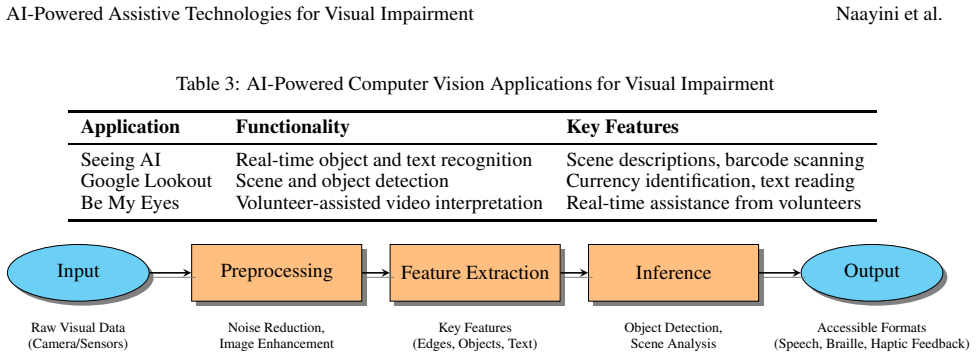
The paper's organizing device is a three-part taxonomy: computer vision turns camera input into speech, Braille, or haptic feedback; natural language processing turns text and voice into accessible information; and wearable devices embed these capabilities in glasses and bands for real-time use. Alongside the taxonomy, the review introduces a simple accessibility metric, $A = U_f/U_t \times 100$, where $U_f$ counts functionalities accessible to visually impaired users and $U_t$ counts functionalities available to sighted users. This ratio is offered as a quantitative way to score a technology's accessibility, and the rest of the argument proceeds through tables that pair each technology with its functionality and its claimed benefit.
What would settle it
Checking whether the cited DOIs and product pages resolve to real publications and working tools—and then running a small user study where participants complete navigation and reading tasks with Seeing AI, Envision Glasses, and OrCam MyEye—would settle the claim: if the flagship tools do not perform as described, or users show no measurable improvement, the review's central assertion fails.
Extended reading notes
Core claim
The central claim, stated on the paper's own terms, is that AI-powered assistive technologies represent a significant advancement in the quality of life for visually impaired individuals. The review organizes the field into three streams—computer vision, natural language processing, and wearable devices—and maps each to concrete tools: apps that read barcodes and describe scenes, screen readers and voice assistants that convert text and commands into speech or Braille, and glasses and wristbands that recognize faces or detect obstacles. It argues that these capabilities translate into measurable gains across independent living, navigation, education, employment, social interaction, and mental well-being. The paper also claims that the remaining obstacles are not primarily technical, since the tools exist and work; the obstacles are cost, the digital divide, ethical and privacy risks, and weak adaptation to languages and cultures outside English-speaking contexts.
Load-bearing premise
The review's reliability depends on the premise that its cited sources genuinely exist and accurately describe the tools, studies, and policies they cover; if key citations are fabricated or inaccurate, the overview's account of the field would lose its support.
Editorial extensions
If this is right
- Off-the-shelf apps such as Seeing AI, Google Lookout, and Be My Eyes already give users real-time reading, indoor navigation, and on-demand human help in ordinary settings.
- Screen readers and AI-enhanced Braille displays, including free options, give visually impaired students and workers access to textbooks, code, and web platforms that were previously hard to use.
- Wearables such as Envision Glasses, OrCam MyEye, and the Sunu Band make object recognition, face identification, and obstacle avoidance practical outside the lab.
- The same evidence implies that without subsidies, open-source alternatives, and reliable connectivity, the benefits concentrate among wealthier users and leave rural and low-income populations behind.
- Future gains depend on privacy-preserving local processing, bias mitigation, support for low-resource languages, and integration with augmented reality, IoT, and 5G.
Reading between the lines
- The accessibility ratio $A$ could be turned into a standardized benchmark: for each device, enumerate its full feature list, count how many are usable without sight, and track how that ratio changes under poor lighting, low bandwidth, and non-English input.
- The same computer-vision and NLP stack described here generalizes to situational impairments—reading a phone screen in glare, navigating while distracted, or bridging a language barrier—so the design lessons extend beyond registered visual impairment.
- A controlled field study measuring task-completion time, error rate, and self-reported independence with these tools would put quantitative weight behind the quality-of-life claim; the paper reports vendor capabilities and qualitative impacts rather than such measurements.
Editorial analysis
A structured set of objections, weighed in public.
Referee Report
Summary. This manuscript is a narrative review of AI-powered assistive technologies for people with visual impairments. It surveys computer vision, natural language processing, and wearable devices; discusses applications in independent living, mobility, education, social interaction, and mental health; and outlines challenges and future directions. The paper presents no new experimental data; its argument rests entirely on a synthesis of cited sources, many of which are product pages or references that cannot be verified.
Significance. If its evidence base were trustworthy, this review would provide a useful, well-organized entry point to an important and growing application area. The broad qualitative message—that AI-based tools can improve independence and quality of life—is consistent with common knowledge and prior work. The paper's structure, tables, and pipeline figures make the landscape accessible to a broad readership. However, the manuscript's contribution as a review depends entirely on the reliability of its citations, and that reliability is not established. The review therefore cannot currently serve as a dependable synthesis for the field.
major comments (4)
- [§4.3.3, §4.5, §5.3, §5.4, §4.1.2] The evidentiary basis of the review is compromised by unverifiable references. Refs [17] and [24] use the synthetic-looking DOI prefix 10.5678; ref [20] lists 'John Smith and Sarah Lee' with a placeholder e-location ID in JMIR; ref [29] uses generic names and has no verifiable DOI; ref [30] assigns an Elsevier DOI (10.1016/j.jair.2023.03.015) to the Journal of Artificial Intelligence Research, which is not an Elsevier journal, and lists 'Jane Doe and John Smith'; ref [12] points to a domain that does not resolve. These references support specific claims: workplace productivity in §4.3.3, mental-health effects in §4.5, usability challenges in §5.3, cultural and linguistic adaptation in §5.4, and smart-home voice assistants in §4.1.2. Since the paper presents no original data, these citations are the entire support for the central claim. I could not verify them, and their placeholder features suggest they may be fabricated; the authors must either verify and correct every reference or remove the unsupported claims.
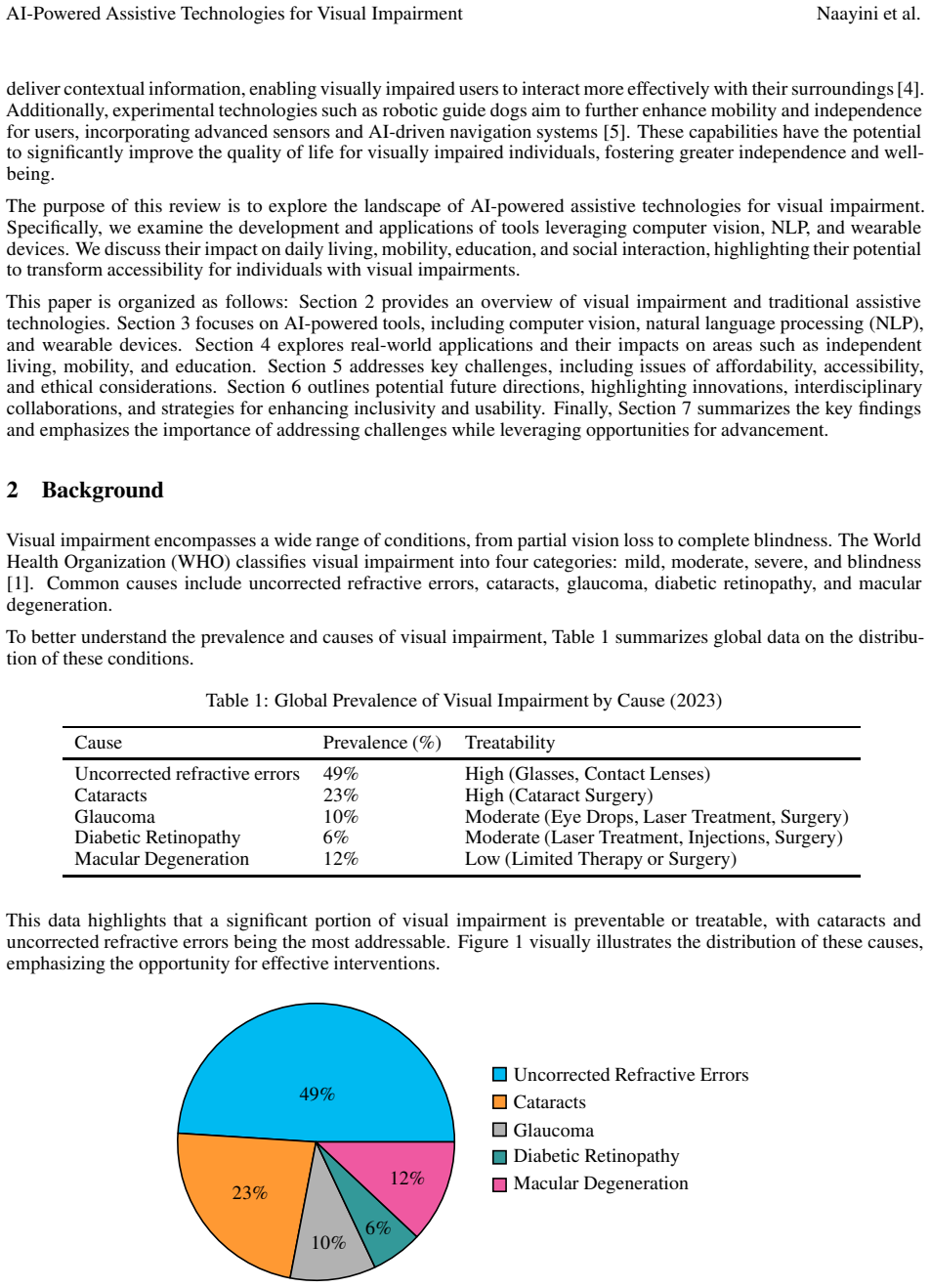
- [Table 1 and §5.1] Quantitative statements are presented without independent sourcing. Table 1 reports prevalence percentages (49%, 23%, 10%, 6%, 12%) for causes of visual impairment without any citation, and the 2023 date and treatability classifications also lack sources. §5.1 states that OrCam MyEye and Envision Glasses cost 'upwards of $2,000' and cites vendor pages [11,4]; vendor marketing is not an adequate basis for cost and effectiveness claims. These figures matter because the policy recommendations in §4.6 and §6 rest on assumptions about prevalence and affordability. The authors should replace vendor pages and unsourced statistics with peer-reviewed or official WHO/CDC data, or clearly label them as approximate industry figures.
- [§2.2] The accessibility metric A is defined but never used anywhere else in the manuscript. The equation, introduced as a 'mathematical framework for accessibility metrics,' is not referenced in any later section, no values are computed, and no existing study is shown to have applied this specific formula. Either demonstrate its use in evaluating the technologies reviewed, or delete Section 2.2, because as written it is an orphaned formalism that does not contribute to the review's argument.
- [§3.1–3.3 and §4.4] Product capability claims rely heavily on manufacturer descriptions and promotional pages (e.g., refs [3], [4], [11], [18], [19]). For example, the claim that Seeing AI enables users to identify products by reading barcodes and that OrCam MyEye provides facial recognition is taken at face value from the vendors. No independent evaluation, user study, or benchmark is cited. A review of assistive technology should at least acknowledge the absence of peer-reviewed evaluations and distinguish vendor-reported features from measured performance.
minor comments (5)
- [References] Reference [1] has a truncated URL and should be completed and verified.
- [Author affiliations] The email address 'Chiranjeevi.Bua@colorado.edu' appears to be a typo for 'Chiranjeevi.Bura@colorado.edu'.
- [Figure 3] Figure 3 is a generic flowchart and is not referenced in the text; consider removing it or integrating it explicitly.
- [Reference [32]] Reference [32] is a self-citation by two of the authors and appears in §6.2 in the context of federated learning; this is acceptable, but the authors should double-check the formatting of the journal name and DOI.
- [General formatting] The abstract, keywords, and running headers contain line-break artifacts and irregular spacing that should be cleaned in the final version.
Circularity Check
No circularity: the review synthesizes external claims and contains no derivation loop, fitted prediction, or load-bearing self-citation.
full rationale
This manuscript is a narrative review of AI-powered assistive technologies for visual impairment. It presents no new experiments, no fitted parameters, and no mathematical derivation that is then used to support its conclusions. The only quantitative formula, A = Uf/Ut × 100 in Section 2.2, is introduced as an illustrative accessibility metric and is not used to predict an outcome or to justify any later claim; it is a definition, not a circular step. The central conclusion that AI-powered assistive technologies improve quality of life is supported by citations to vendor pages, news reports, and prior studies, and it is not derived from any of the paper's own constructs. The single self-citation, Reference [32], appears in Section 6.2 within a bullet about federated learning and data privacy. That citation supports a future-direction suggestion and is not load-bearing for the paper's main claims, so it does not constitute circularity. Concerns about the verifiability of some cited references are evidentiary or integrity concerns about the review's sourcing, not circularity within the paper's reasoning chain. Under the stated rules, no quoted equation, definition, or self-citation reduces the paper's claims to its own inputs. The appropriate finding is therefore a score of 0.
Assumptions & free parameters
assumptions (3)
- domain assumption The global prevalence and cause-distribution statistics in Table 1 are accurate.
- domain assumption Commercial products work as described in the text.
- ad hoc to paper The cited academic references are real and support the statements attributed to them.
Cite this review
Pith. "Pith review of AI-Powered Assistive Technologies for Visual Impairment." pith.science (2026). https://pith.science/paper/Q2JY2LCE
@misc{pith2026250315494,
  author       = {Pith},
  title        = {Pith review of: AI-Powered Assistive Technologies for Visual Impairment},
  year         = {2026},
  howpublished = {\url{https://pith.science/paper/Q2JY2LCE}},
  note         = {Machine review of arXiv:2503.15494}
}
read the original abstract
Artificial Intelligence (AI) is revolutionizing assistive technologies. It offers innovative solutions to enhance the quality of life for individuals with visual impairments. This review examines the development, applications, and impact of AI-powered tools in key domains, such as computer vision, natural language processing (NLP), and wearable devices. Specific advancements include object recognition for identifying everyday items, scene description for understanding surroundings, and NLP-driven text-to-speech systems for accessing digital information. Assistive technologies like smart glasses, smartphone applications, and AI-enabled navigation aids are discussed, demonstrating their ability to support independent travel, facilitate social interaction, and increase access to education and employment opportunities. The integration of deep learning models, multimodal interfaces, and real-time data processing has transformed the functionality and usability of these tools, fostering inclusivity and empowerment. This article also addresses critical challenges, including ethical considerations, affordability, and adaptability in diverse environments. Future directions highlight the need for interdisciplinary collaboration to refine these technologies, ensuring equitable access and sustainable innovation. By providing a comprehensive overview, this review underscores AI's transformative potential in promoting independence, enhancing accessibility, and fostering social inclusion for visually impaired individuals.
Figures

Figures from the paper (2 more)


Forward citations
Cited by 1 Pith paper
-
Talking Spell: A Wearable System Enabling Real-Time Anthropomorphic Voice Interaction with Everyday Objects
Talking Spell is a wearable system that detects objects, creates an anthropomorphic persona for each, and lets users hold voice conversations with them via a touch-triggered wand.
Reference graph
Works this paper leans on
-
[17]
The role of voice assista nts in enhancing workplace productivity for visually impaired individuals
Laura Peters and Derek Wilson. The role of voice assista nts in enhancing workplace productivity for visually impaired individuals. Journal of Accessible T echnology in W orkplaces , 11(3):180–195, 2024. https://doi.org/10.5678/jatw.2024.004567
-
[20]
The role of ai in mental health a ssessment and treatment personalization
John Smith and Sarah Lee. The role of ai in mental health a ssessment and treatment personalization. Journal of Medical Internet Research, 26(1):e12345, 2024
work page 2024
-
[24]
Encouraging accessibility i n ai development through public policy
Alex Chen and Priya Singh. Encouraging accessibility i n ai development through public policy. Journal of AI Ethics, 10(4):240–259, 2024. https://doi.org/10.5678/jaie.2024.003456
-
[29]
Rebecca Johnson and Thomas Lee. Usability challenges i n assistive technologies: Bridging the gap between innovation and accessibility. International Journal of Human-Computer Interaction , 36(7):620–645, 2024
work page 2024
-
[30]
Adapting ai for multilingual an d multicultural contexts: A comprehensive review
Jane Doe and John Smith. Adapting ai for multilingual an d multicultural contexts: A comprehensive review. Journal of Artificial Intelligence Research , 56(3):123–145, 2023. https://doi.org/10.1016/j.jair.2023.03.015
-
[12]
https://www.accessibilitytechjournal.com/articles/voice-assistants
Mark Johnson. Smart home integration for visually impa ired individuals: The role of voice assistants, 2024. "https://www.accessibilitytechjournal.com/articles/voice-assistants"
work page 2024
-
[3]
Seeing ai: A free app that narrates the world a round you, 2023
Microsoft. Seeing ai: A free app that narrates the world a round you, 2023. https://www.microsoft.com/en-us/ai/seeing-ai
work page 2023
-
[4]
Envision glasses: Ai-powered smart glasses f or the visually impaired, 2023
Envision. Envision glasses: Ai-powered smart glasses f or the visually impaired, 2023. https://www.letsenvision.com
work page 2023
-
[11]
Orcam myeye: Ai-powered wearable assistive technology, 2023
OrCam Technologies. Orcam myeye: Ai-powered wearable assistive technology, 2023. https://www.orcam.com/en/myeye/. 10 AI-Powered Assistive Technologies for Visual Impairment N aayini et al
work page 2023
-
[18]
Orcam myeye: Wearable assistive t echnology
OrCam Technologies. Orcam myeye: Wearable assistive t echnology. https://www.orcam.com/. Accessed: 2025-01-11
work page 2025
-
[19]
Be my eyes: V olunteer network connecting mil lions, 2024
Be My Eyes. Be my eyes: V olunteer network connecting mil lions, 2024. https://www.bemyeyes.com
work page 2024
Show all 41 references
-
[1]
World Report on Vision, 2019
World Health Organization. World Report on Vision, 2019. https://www.who.int/publications-detail/world-repor t-on
2019
-
[2]
The economic burden of g lobal blindness: A price too high! The British Journal of Ophthalmology , 80(4):276, 1996
Andrew F Smith and J Graham Smith. The economic burden of g lobal blindness: A price too high! The British Journal of Ophthalmology , 80(4):276, 1996. https://doi.org/10.1136/bjo.80.4.276
1996 doi
-
[5]
Chinese robot guide dog aims to improve indepen dence for visually impaired
Reuters. Chinese robot guide dog aims to improve indepen dence for visually impaired. https://www.reuters.com/business/healthcare-pharmac euticals/chinese-robot-guide-dog-aims-improve-ind
-
[6]
How ai is revolutionizing assistive tech nology for the visually impaired
TechStrong AI. How ai is revolutionizing assistive tech nology for the visually impaired. https://techstrong.ai/articles/how-ai-is-revolution izing-assistive-technology-for-the-visually-impa 2023
2023
-
[7]
Deep lear ning based wearable as- sistive system for visually impaired people
Yimin Lin, Kai Wang, Wanxin Yi, and Shiguo Lian. Deep lear ning based wearable as- sistive system for visually impaired people. In Proceedings of the IEEE/CVF Inter- national Conference on Computer Vision W orkshops (ICCVW) , pages 2504–2513, 2019. https://openaccess.thecvf.co...
2019
-
[8]
Lookout: Ai-powered vision assistance, 2023
Google. Lookout: Ai-powered vision assistance, 2023. https://support.google.com/accessibility/android/answer/903
2023
-
[9]
Natural language processing in assistive tech- nologies
Inge Gavat, Andreea Griparis, and Svetlana Segarceanu. Natural language processing in assistive tech- nologies. The Romanian Journal of T echnical Sciences. Applied Mechan ics., 68(2-3):129–140, 2023. http://dx.doi.org/10.59277/RJTS-AM.2023.2-3.02
2023 doi
-
[10]
Airis : An ai-powered wearable assistive device for the visually im paired
Dionysia Danai Brilli, Evangelos Georgaras, Stefania Tsilivaki, Nikos Melanitis, and Konstantina Nikita. Airis : An ai-powered wearable assistive device for the visually im paired. arXiv preprint arXiv:2405.07606 , 2024. https://doi.org/10.48550/arXiv.2405.07606
-
[13]
National federation of the blind jernigan institute research collaboration: Su nu band, 2015
National Federation of the Blind. National federation of the blind jernigan institute research collaboration: Su nu band, 2015. https://nfb.org/blog/national-federation-blind-jern igan-institute-research-collaboration-su
2015
-
[14]
Jaws screen reader
Freedom Scientific. Jaws screen reader. https://www.freedomscientific.com/. Accessed: 2025-01-11
2025
-
[15]
Nvda: Nonvisual desktop access
NV Access. Nvda: Nonvisual desktop access. https://www.nvaccess.org/. Accessed: 2025-01-11
2025
-
[16]
Making mathematics acc essible through ai and braille displays
Microsoft Accessibility Blog. Making mathematics acc essible through ai and braille displays. https://blogs.microsoft.com/accessibility/making-ma thematics-accessible/. Accessed: 2025-01-11
2025
-
[21]
Impact of ai-powered ass istive technologies on mental health and well-being: A review of recent innovations
Alice Taylor and Mark Johnson. Impact of ai-powered ass istive technologies on mental health and well-being: A review of recent innovations. International Journal of Human-Computer Interaction , 39(8):967–984, 2023
2023
-
[22]
Government subsidi es and initiatives for assistive technologies
Norden and Australian Government. Government subsidi es and initiatives for assistive technologies. https://www.norden.org/en/info-norden/loan-assistiv e-devices-norway, 2024. Accessed: 2025- 01-11
2024
-
[23]
Who report on assistive tec hnology accessibility, 2023
World Health Organization. Who report on assistive tec hnology accessibility, 2023. https://www.who.int/news-room/fact-sheets/detail/as sistive-technology
2023
-
[25]
Training programs fo r visually impaired individuals, 2023
National Federation of the Blind. Training programs fo r visually impaired individuals, 2023. https://www.nfb.org/resources/training
2023
-
[26]
Privacy in the ai era: How do we protect our personal information? https://hai.stanford.edu/news/privacy-ai-era-how-do -we-protect-our-personal-information ,
Stanford HAI. Privacy in the ai era: How do we protect our personal information? https://hai.stanford.edu/news/privacy-ai-era-how-do -we-protect-our-personal-information ,
-
[27]
Biased technology: Automated discrim ination in facial recognition
ACLU Minnesota. Biased technology: Automated discrim ination in facial recognition. https://www.aclu-mn.org/en/news/biased-technology-a utomated-discrimination-facial-recognition,
-
[31]
Police surveillance and facial recognition: Why data pri- vacy is an imperative for communities of color, 2023
Caitlin Chin Nicol Turner Lee. Police surveillance and facial recognition: Why data pri- vacy is an imperative for communities of color, 2023. Access ed: 2025-01-11 [Online] https://www.brookings.edu/articles/police-surveilla nce-and-facial-recognition
2023
-
[32]
Federated learning and data pri- vacy: A review of challenges and opportunities
Praveen Kumar Myakala, Chiranjeevi Bura, and Anil Kuma r Jonnalagadda. Federated learning and data pri- vacy: A review of challenges and opportunities. International Journal of Research Publication and Reviews , 5(12):1867–1879, 2024. https://doi.org/10.55248/gengpi.5.1224.3512
2024
-
[33]
Diverse ai training data for inclusivity and eli minating bias
Shaip. Diverse ai training data for inclusivity and eli minating bias. https://www.shaip.com/blog/diverse-ai-training-data -for-inclusivity-and-eliminating-bias/ ,
-
[34]
Ai for accessibility: Empowering people wi th disabilities, 2023
Microsoft. Ai for accessibility: Empowering people wi th disabilities, 2023. https://www.microsoft.com/en-us/ai/ai-for-accessibi lity
2023
-
[35]
Government Accountability Office
U.S. Government Accountability Office. Facial recogni tion technology: Current and planned uses by federal agencies, 2021. https://www.gao.gov/assets/gao-21-526.pdf
2021
-
[36]
Facial recognition technology re gulation: A practical guide for congress, 2019
Open the Government. Facial recognition technology re gulation: A practical guide for congress, 2019. https://www.openthegovernment.org/wp-content/upload s/2019/07/Facial-Recognition-Technology-Regulation_
2019
-
[37]
11 AI-Powered Assistive Technologies for Visual Impairment N aayini et al
Accessed: 2025-01-11. 11 AI-Powered Assistive Technologies for Visual Impairment N aayini et al
2025
-
[38]
Denise RS Almeida, Konstantin Shmarko, and Elizabeth L omas. The ethics of facial recogni- tion technologies, surveillance, and accountability in an age of artificial intelligence: a compar- ative analysis of us, eu, and uk regulatory frameworks. AI and Ethics , 2(3):377–387, 2...
2021 doi
-
[41]
Natural language understanding of lo w-resource languages in voice assistants: Advance- ments, challenges and mitigation strategies
Ashlesha V Kadam. Natural language understanding of lo w-resource languages in voice assistants: Advance- ments, challenges and mitigation strategies. International Journal of Language, Literature and Culture (IJLLC),
-
[42]
https://aipublications.com/uploads/issue_files/3IJLLC-OCT20231-Natural.pdf. 12
-
[2023]
Accessed: 2025-01-11
2025
-
[2024]
Accessed: 2025-01-09
2025
Reviewed August 10, 2026 · model on record in the stance chip above.
Discussion (0). Continue with ORCID to comment.