REVIEW 87 references
LiAuto-GeoX: Efficient Grounded Driving Transformer
T0 review · reviewed 2026-06-28 · grok-4.3
Pith's one-line read A 155M-parameter transformer distilled from a large LiDAR-grounded geometry model runs at 220 FPS for real-time dense 3D reconstruction in driving scenes.
desk verdict The paper's distillation losses for a 155M driving geometry model are the concrete new element, but the abstract gives no experimental details to back the 220 FPS and transfer claims. read the letter →
The pith
A machine-rendered reading of the paper's core claim, the machinery that carries it, and where it could break.
The reading
What carries the argument
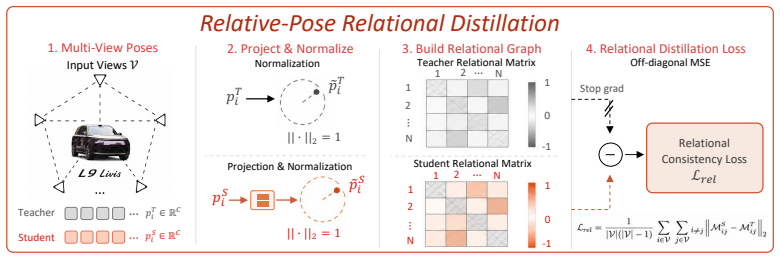
Geometry-preserving distillation framework that combines mask-guided depth-aware distillation to retain metric structures and relative-pose relational distillation to enforce cross-view consistency.
What would settle it
A direct comparison on a held-out driving dataset showing that the 155M model loses long-range depth accuracy or cross-view consistency relative to the teacher model would falsify the claim that the distillation framework preserves the required geometric fidelity.
Extended reading notes
Core claim
LiAuto-GeoX learns a high-capacity driving geometry model from large-scale surround-view data with sparse LiDAR priors, then distills the capability into a 155M-parameter compact model through mask-guided depth-aware distillation that emphasizes geometrically informative regions and relative-pose relational distillation that enforces cross-view spatial consistency, resulting in 220 FPS dense reconstruction on KITTI that transfers directly to autonomy tasks with the reported performance numbers.
Load-bearing premise
The mask-guided depth-aware and relative-pose relational distillation steps successfully transfer fine-grained metric structures and cross-view spatial consistency from the large teacher model to the compact student.
Editorial extensions
If this is right
- The distilled model supports real-time onboard dense 3D reconstruction at 220 FPS on KITTI.
- The retained geometry improves trajectory prediction to 90.6 PDMS.
- The retained geometry improves occupancy prediction to 24.63 mIoU.
- The retained geometry improves future-frame prediction to 47.67 IoU.
- Efficient dense reconstruction can serve as a foundational representation for multiple autonomy tasks rather than only a perception output.
Reading between the lines
- The same distillation recipe could be tested on other surround-view camera rigs or additional sensor suites to check transferability.
- The geometry features might be fused into end-to-end planning networks to measure gains in closed-loop driving metrics.
- If LiDAR is unavailable at deployment, the model could be further adapted with self-supervised signals derived only from video.
- Scaling the teacher model size or training data volume would likely produce even stronger compact students under the same distillation losses.
Editorial analysis
A structured set of objections, weighed in public.
Referee Report
Summary. The manuscript presents LiAuto-GeoX, an efficient grounded driving transformer for deployable ego-centric 3D scene understanding in autonomous driving. The approach involves training a high-capacity teacher model from large-scale surround-view data with sparse LiDAR priors for geometric grounding, followed by distillation to a 155M-parameter student model using mask-guided depth-aware distillation and relative-pose relational distillation. The student model is claimed to run at 220 FPS on KITTI while maintaining high-fidelity dense reconstruction and achieving strong transfer performance on downstream tasks including 90.6 PDMS in trajectory prediction, 24.63 mIoU in occupancy prediction, and 47.67 IoU in future-frame prediction.
Significance. If the results hold, this work is significant for autonomous driving perception by demonstrating that dense 3D reconstruction can be made real-time and onboard-deployable while serving as a transferable geometric foundation for trajectory, occupancy, and future-frame prediction tasks. The geometry-preserving distillation approach, combining mask-guided depth-aware and relative-pose relational losses, addresses a practical gap between large visual geometry models and resource-constrained deployment. Concrete metrics on the KITTI benchmark and downstream tasks constitute a strength when accompanied by rigorous ablations and hardware specifications in the full manuscript.
Simulated Author's Rebuttal
We thank the referee for the positive assessment of LiAuto-GeoX and the recommendation to accept. The recognition that the geometry-preserving distillation approach addresses a practical gap in real-time onboard deployment is appreciated.
Circularity Check
No significant circularity; claims are empirical
full rationale
The provided abstract and context contain no equations, derivations, or self-citations that reduce predictions to fitted inputs by construction. Performance numbers (220 FPS, PDMS/mIoU/IoU scores) are presented as measured outcomes of training and distillation on data, not as outputs forced by the method's own definitions. The distillation framework is described at a high level without algebraic self-reference. This is the common case of a self-contained empirical pipeline with no load-bearing circular steps.
Assumptions & free parameters
Cite this review
Pith. "Pith review of LiAuto-GeoX: Efficient Grounded Driving Transformer." pith.science (2026). https://pith.science/paper/Q2W32UDU
@misc{pith2026260605774,
  author       = {Pith},
  title        = {Pith review of: LiAuto-GeoX: Efficient Grounded Driving Transformer},
  year         = {2026},
  howpublished = {\url{https://pith.science/paper/Q2W32UDU}},
  note         = {Machine review of arXiv:2606.05774}
}
read the original abstract
Dense 3D reconstruction has demonstrated immense potential for spatial understanding, yet its viability as a real-time, onboard representation for autonomous driving remains an open challenge. Existing large-scale visual geometry models typically require substantial computational resources and lack the long-range geometric fidelity, surround-view consistency, and real-time efficiency demanded by dynamic driving environments. To bridge this gap, we present \textbf{LiAuto-GeoX}, an efficient grounded driving transformer designed for deployable, ego-centric 3D scene understanding. Our approach begins by learning a high-capacity driving geometry model from large-scale surround-view data, utilizing sparse LiDAR priors to provide robust geometric grounding in distant, ambiguous, or structure-sparse regions. We then instantiate this capability into a highly compact 155M-parameter onboard model through a novel geometry-preserving distillation framework. This framework employs mask-guided depth-aware distillation to retain fine-grained metric structures by emphasizing geometrically informative regions, and relative-pose relational distillation to enforce cross-view spatial consistency through pose-induced geometric relations. Extensive evaluations reveal that \textbf{LiAuto-GeoX} runs at 220 FPS on KITTI while maintaining high-fidelity dense reconstruction, enabling real-time deployment. The learned geometry transfers seamlessly to downstream autonomy tasks, achieving 90.6 PDMS in trajectory prediction, 24.63 mIoU in occupancy prediction, and 47.67 IoU in future-frame prediction. These all demonstrate that efficient dense 3D reconstruction can transcend its traditional role as a perception target to serve as a scalable, foundational geometric representation for next-generation autonomous driving.
Figures


Figures from the paper (4 more)


Reference graph
Works this paper leans on
-
[1]
nuscenes: A multimodal dataset for autonomous driving
Holger Caesar, Varun Bankiti, Alex H Lang, Sourabh V ora, Venice Erin Liong, Qiang Xu, Anush Krishnan, Yu Pan, Giancarlo Baldan, and Oscar Beijbom. nuscenes: A multimodal dataset for autonomous driving. InCVPR, pages 11621–11631, 2020
2020
-
[2]
Vadv2: End-to-end vectorized autonomous driving via probabilistic planning.ICLR, 2026
Shaoyu Chen, Bo Jiang, Hao Gao, Bencheng Liao, Qing Xu, Qian Zhang, Chang Huang, Wenyu Liu, and Xinggang Wang. Vadv2: End-to-end vectorized autonomous driving via probabilistic planning.ICLR, 2026
2026
-
[3]
Drivinggpt: Unifying driving world modeling and planning with multi-modal autoregressive transformers
Yuntao Chen, Yuqi Wang, and Zhaoxiang Zhang. Drivinggpt: Unifying driving world modeling and planning with multi-modal autoregressive transformers. InICCV, pages 26890–26900, 2025
2025
-
[4]
Bevdistill: Cross-modal bev distillation for multi-view 3d object detection.arXiv, 2022
Zehui Chen, Zhenyu Li, Shiquan Zhang, Liangji Fang, Qinhong Jiang, and Feng Zhao. Bevdistill: Cross-modal bev distillation for multi-view 3d object detection.arXiv, 2022
2022
-
[5]
Openscene: The largest up-to-date 3d occupancy prediction bench- mark in autonomous driving
OpenScene Contributors. Openscene: The largest up-to-date 3d occupancy prediction bench- mark in autonomous driving. InCVPR, pages 18–22, 2023
2023
-
[6]
Sparseworld: A flexible, adaptive, and efficient 4d occupancy world model powered by sparse and dynamic queries
Chenxu Dang, Haiyan Liu, Jason Bao, Pei An, Xinyue Tang, An Pan, Jie Ma, Bingchuan Sun, and Yan Wang. Sparseworld: A flexible, adaptive, and efficient 4d occupancy world model powered by sparse and dynamic queries. InAAAI, volume 40, pages 3497–3505, 2026
2026
-
[7]
Navsim: Data-driven non-reactive autonomous vehicle simulation and benchmarking.NeurIPS, 37:28706–28719, 2024
Daniel Dauner, Marcel Hallgarten, Tianyu Li, Xinshuo Weng, Zhiyu Huang, Zetong Yang, Hongyang Li, Igor Gilitschenski, Boris Ivanovic, Marco Pavone, et al. Navsim: Data-driven non-reactive autonomous vehicle simulation and benchmarking.NeurIPS, 37:28706–28719, 2024
2024
-
[8]
Sparseworld-tc: Trajectory-conditioned sparse occupancy world model.arXiv, 2025
Jiayuan Du, Yiming Zhao, Zhenglong Guo, Yong Pan, Wenbo Hou, Zhihui Hao, Kun Zhan, and Qijun Chen. Sparseworld-tc: Trajectory-conditioned sparse occupancy world model.arXiv, 2025
2025
Show all 87 references
-
[9]
Artemis: Autoregressive end-to-end trajectory planning with mixture of experts for autonomous driving.IEEE RAL, 11(1):226–233, 2025
Renju Feng, Ning Xi, Duanfeng Chu, Rukang Wang, Zejian Deng, Anzheng Wang, Liping Lu, Jinxiang Wang, and Yanjun Huang. Artemis: Autoregressive end-to-end trajectory planning with mixture of experts for autonomous driving.IEEE RAL, 11(1):226–233, 2025
2025
-
[10]
Are we ready for autonomous driving? the kitti vision benchmark suite
Andreas Geiger, Philip Lenz, and Raquel Urtasun. Are we ready for autonomous driving? the kitti vision benchmark suite. InCVPR, pages 3354–3361. IEEE, 2012
2012
-
[11]
Dome: Taming diffusion model into high-fidelity controllable occupancy world model.arXiv, 2024
Songen Gu, Wei Yin, Bu Jin, Xiaoyang Guo, Junming Wang, Haodong Li, Qian Zhang, and Xiaoxiao Long. Dome: Taming diffusion model into high-fidelity controllable occupancy world model.arXiv, 2024
2024
-
[12]
3d packing for self-supervised monocular depth estimation
Vitor Guizilini, Rares Ambrus, Sudeep Pillai, Allan Raventos, and Adrien Gaidon. 3d packing for self-supervised monocular depth estimation. InCVPR, pages 2485–2494, 2020
2020
-
[13]
Distilling the knowledge in a neural network
Geoffrey Hinton, Oriol Vinyals, and Jeff Dean. Distilling the knowledge in a neural network. arXiv, 2015
2015
-
[14]
Lrm: Large reconstruction model for single image to 3d
Yicong Hong, Kai Zhang, Jiuxiang Gu, Sai Bi, Yang Zhou, Difan Liu, Feng Liu, Kalyan Sunkavalli, Trung Bui, and Hao Tan. Lrm: Large reconstruction model for single image to 3d. InICLR, volume 2024, pages 50678–50702, 2024
2024
-
[15]
One thousand and one hours: Self-driving motion prediction dataset
John Houston, Guido Zuidhof, Luca Bergamini, Yawei Ye, Long Chen, Ashesh Jain, Sammy Omari, Vladimir Iglovikov, and Peter Ondruska. One thousand and one hours: Self-driving motion prediction dataset. InCoRL, pages 409–418. PMLR, 2021
2021
-
[16]
Planning-oriented autonomous driving
Yihan Hu, Jiazhi Yang, Li Chen, Keyu Li, Chonghao Sima, Xizhou Zhu, Siqi Chai, Senyao Du, Tianwei Lin, Wenhai Wang, et al. Planning-oriented autonomous driving. InCVPR, pages 17853–17862, 2023
2023
-
[17]
Bevdet4d: Exploit temporal cues in multi-camera 3d object detection.arXiv, 2022
Junjie Huang and Guan Huang. Bevdet4d: Exploit temporal cues in multi-camera 3d object detection.arXiv, 2022. 17
2022
-
[18]
Bevdet: High-performance multi-camera 3d object detection in bird-eye-view.arXiv, 2021
Junjie Huang, Guan Huang, Zheng Zhu, Yun Ye, and Dalong Du. Bevdet: High-performance multi-camera 3d object detection in bird-eye-view.arXiv, 2021
2021
-
[19]
Tig-bev: Multi-view bev 3d object detection via target inner-geometry learning.arXiv, 2022
Peixiang Huang, Li Liu, Renrui Zhang, Song Zhang, Xinli Xu, Baichao Wang, and Guoyi Liu. Tig-bev: Multi-view bev 3d object detection via target inner-geometry learning.arXiv, 2022
2022
-
[20]
Tri-perspective view for vision-based 3d semantic occupancy prediction
Yuanhui Huang, Wenzhao Zheng, Yunpeng Zhang, Jie Zhou, and Jiwen Lu. Tri-perspective view for vision-based 3d semantic occupancy prediction. InCVPR, pages 9223–9232, 2023
2023
-
[21]
Occtens: 3d occupancy world model via temporal next-scale prediction.IEEE RAL, 2026
Bu Jin, Songen Gu, Xiaotao Hu, Yupeng Zheng, Xiaoyang Guo, Qian Zhang, Xiaoxiao Long, and Wei Yin. Occtens: 3d occupancy world model via temporal next-scale prediction.IEEE RAL, 2026
2026
-
[22]
3d gaussian splatting for real-time radiance field rendering.ACM Trans
Bernhard Kerbl, Georgios Kopanas, Thomas Leimkühler, George Drettakis, et al. 3d gaussian splatting for real-time radiance field rendering.ACM Trans. Graph., 42(4):139–1, 2023
2023
-
[23]
X3kd: Knowledge distillation across modal- ities, tasks and stages for multi-camera 3d object detection
Marvin Klingner, Shubhankar Borse, Varun Ravi Kumar, Behnaz Rezaei, Venkatraman Narayanan, Senthil Yogamani, and Fatih Porikli. X3kd: Knowledge distillation across modal- ities, tasks and stages for multi-camera 3d object detection. InCVPR, pages 13343–13353, 2023
2023
-
[24]
Grounding image matching in 3d with mast3r
Vincent Leroy, Yohann Cabon, and Jérôme Revaud. Grounding image matching in 3d with mast3r. InECCV, pages 71–91. Springer, 2024
2024
-
[25]
Semi-supervised vision-centric 3d occupancy world model for autonomous driving
Xiang Li, Pengfei Li, Yupeng Zheng, Wei Sun, Yan Wang, et al. Semi-supervised vision-centric 3d occupancy world model for autonomous driving. InICLR, volume 2025, pages 62563–62580, 2025
2025
-
[26]
V oxformer: Sparse voxel transformer for camera-based 3d semantic scene completion
Yiming Li, Zhiding Yu, Christopher Choy, Chaowei Xiao, Jose M Alvarez, Sanja Fidler, Chen Feng, and Anima Anandkumar. V oxformer: Sparse voxel transformer for camera-based 3d semantic scene completion. InCVPR, pages 9087–9098, 2023
2023
-
[27]
Enhancing end-to-end autonomous driving with latent world model.ICLR, 2025
Yingyan Li, Lue Fan, Jiawei He, Yuqi Wang, Yuntao Chen, Zhaoxiang Zhang, and Tieniu Tan. Enhancing end-to-end autonomous driving with latent world model.ICLR, 2025
2025
-
[28]
End-to-end driving with online trajectory evaluation via bev world model
Yingyan Li, Yuqi Wang, Yang Liu, Jiawei He, Lue Fan, and Zhaoxiang Zhang. End-to-end driving with online trajectory evaluation via bev world model. InICCV, pages 27137–27146, 2025
2025
-
[29]
Drivevla-w0: World models amplify data scaling law in autonomous driving.ICLR, 2026
Yingyan Li, Shuyao Shang, Weisong Liu, Bing Zhan, Haochen Wang, Yuqi Wang, Yuntao Chen, Xiaoman Wang, Yasong An, Chufeng Tang, et al. Drivevla-w0: World models amplify data scaling law in autonomous driving.ICLR, 2026
2026
-
[30]
Bevdepth: Acquisition of reliable depth for multi-view 3d object detection
Yinhao Li, Zheng Ge, Guanyi Yu, Jinrong Yang, Zengran Wang, Yukang Shi, Jianjian Sun, and Zeming Li. Bevdepth: Acquisition of reliable depth for multi-view 3d object detection. InAAAI, volume 37, pages 1477–1485, 2023
2023
-
[31]
Recogdrive: A reinforced cognitive framework for end-to-end autonomous driving.ICLR, 2026
Yongkang Li, Kaixin Xiong, Xiangyu Guo, Fang Li, Sixu Yan, Gangwei Xu, Lijun Zhou, Long Chen, Haiyang Sun, Bing Wang, et al. Recogdrive: A reinforced cognitive framework for end-to-end autonomous driving.ICLR, 2026
2026
-
[32]
Hydra-mdp: End-to-end multimodal planning with multi-target hydra-distillation.arXiv, 2024
Zhenxin Li, Kailin Li, Shihao Wang, Shiyi Lan, Zhiding Yu, Yishen Ji, Zhiqi Li, Ziyue Zhu, Jan Kautz, Zuxuan Wu, et al. Hydra-mdp: End-to-end multimodal planning with multi-target hydra-distillation.arXiv, 2024
2024
-
[33]
Bevformer: learning bird’s-eye-view representation from lidar-camera via spatiotemporal transformers.IEEE TPAMI, 47(3):2020–2036, 2024
Zhiqi Li, Wenhai Wang, Hongyang Li, Enze Xie, Chonghao Sima, Tong Lu, Qiao Yu, and Jifeng Dai. Bevformer: learning bird’s-eye-view representation from lidar-camera via spatiotemporal transformers.IEEE TPAMI, 47(3):2020–2036, 2024
2020
-
[34]
Diffusion-based contextual reconstruction for point cloud segmentation with limited annotations.AAAI, 40(8): 6780–6788, Mar
Jiawei Lian, Zhengxue Wang, Wentao Qu, Haobo Jiang, Le Hui, and Jian Yang. Diffusion-based contextual reconstruction for point cloud segmentation with limited annotations.AAAI, 40(8): 6780–6788, Mar. 2026. doi: 10.1609/aaai.v40i8.37610. 18
2026 doi
-
[35]
Bevfusion: A simple and robust lidar-camera fusion framework
Tingting Liang, Hongwei Xie, Kaicheng Yu, Zhongyu Xia, Zhiwei Lin, Yongtao Wang, Tao Tang, Bing Wang, and Zhi Tang. Bevfusion: A simple and robust lidar-camera fusion framework. NeurIPS, 35:10421–10434, 2022
2022
-
[36]
Diffusiondrive: Truncated diffusion model for end-to-end autonomous driving
Bencheng Liao, Shaoyu Chen, Haoran Yin, Bo Jiang, Cheng Wang, Sixu Yan, Xinbang Zhang, Xiangyu Li, Ying Zhang, Qian Zhang, et al. Diffusiondrive: Truncated diffusion model for end-to-end autonomous driving. InCVPR, pages 12037–12047, 2025
2025
-
[37]
I2- world: Intra-inter tokenization for efficient dynamic 4d scene forecasting
Zhimin Liao, Ping Wei, Ruijie Zhang, Shuaijia Chen, Haoxuan Wang, and Ziyang Ren. I2- world: Intra-inter tokenization for efficient dynamic 4d scene forecasting. InICCV, pages 25810–25819, 2025
2025
-
[38]
Adathinkdrive: Adaptive thinking via reinforcement learning for autonomous driving.arXiv, 2025
Yuechen Luo, Fang Li, Shaoqing Xu, Zhiyi Lai, Lei Yang, Qimao Chen, Ziang Luo, Zixun Xie, Shengyin Jiang, Jiaxin Liu, et al. Adathinkdrive: Adaptive thinking via reinforcement learning for autonomous driving.arXiv, 2025
2025
-
[39]
Nerf: Representing scenes as neural radiance fields for view synthesis.CACM, 65 (1):99–106, 2021
Ben Mildenhall, Pratul P Srinivasan, Matthew Tancik, Jonathan T Barron, Ravi Ramamoorthi, and Ren Ng. Nerf: Representing scenes as neural radiance fields for view synthesis.CACM, 65 (1):99–106, 2021
2021
-
[40]
Mast3r-slam: Real-time dense slam with 3d reconstruction priors
Riku Murai, Eric Dexheimer, and Andrew J Davison. Mast3r-slam: Real-time dense slam with 3d reconstruction priors. InCVPR, pages 16695–16705, 2025
2025
-
[41]
Dinov2: Learning robust visual features without supervision.arXiv, 2023
Maxime Oquab, Timothée Darcet, Théo Moutakanni, Huy V o, Marc Szafraniec, Vasil Khalidov, Pierre Fernandez, Daniel Haziza, Francisco Massa, Alaaeldin El-Nouby, et al. Dinov2: Learning robust visual features without supervision.arXiv, 2023
2023
-
[42]
Renderocc: Vision-centric 3d occupancy prediction with 2d rendering supervision
Mingjie Pan, Jiaming Liu, Renrui Zhang, Peixiang Huang, Xiaoqi Li, Hongwei Xie, Bing Wang, Li Liu, and Shanghang Zhang. Renderocc: Vision-centric 3d occupancy prediction with 2d rendering supervision. InICRA, pages 12404–12411. IEEE, 2024
2024
-
[43]
Omnivggt: Omni-modality driven visual geometry grounded transformer.arXiv, 2025
Haosong Peng, Hao Li, Yalun Dai, Yushi Lan, Yihang Luo, Tianyu Qi, Zhengshen Zhang, Yufeng Zhan, Junfei Zhang, Wenchao Xu, et al. Omnivggt: Omni-modality driven visual geometry grounded transformer.arXiv, 2025
2025
-
[44]
Lift, splat, shoot: Encoding images from arbitrary camera rigs by implicitly unprojecting to 3d
Jonah Philion and Sanja Fidler. Lift, splat, shoot: Encoding images from arbitrary camera rigs by implicitly unprojecting to 3d. InECCV, pages 194–210. Springer, 2020
2020
-
[45]
Multi-modal fusion transformer for end-to-end autonomous driving
Aditya Prakash, Kashyap Chitta, and Andreas Geiger. Multi-modal fusion transformer for end-to-end autonomous driving. InCVPR, pages 7077–7087, 2021
2021
-
[46]
Fastvggt: Training-free acceleration of visual geometry transformer.arXiv, 2025
You Shen, Zhipeng Zhang, Yansong Qu, Xiawu Zheng, Jiayi Ji, Shengchuan Zhang, and Liujuan Cao. Fastvggt: Training-free acceleration of visual geometry transformer.arXiv, 2025
2025
-
[47]
Come: Adding scene-centric forecasting control to occupancy world model.NeurIPS, 38:70–96, 2026
Yining Shi, Kun Jiang, Qiang Meng, Ke Wang, Jiabao Wang, Wenchao Sun, Tuopu Wen, et al. Come: Adding scene-centric forecasting control to occupancy world model.NeurIPS, 38:70–96, 2026
2026
-
[48]
Litevggt: Boosting vanilla vggt via geometry-aware cached token merging
Zhijian Shu, Cheng Lin, Tao Xie, Wei Yin, Ben Li, Zhiyuan Pu, Weize Li, Yao Yao, Xun Cao, Xiaoyang Guo, et al. Litevggt: Boosting vanilla vggt via geometry-aware cached token merging. arXiv, 2025
2025
-
[49]
Drivelm: Driving with graph visual question answering
Chonghao Sima, Katrin Renz, Kashyap Chitta, Li Chen, Hanxue Zhang, Chengen Xie, Jens Beißwenger, Ping Luo, Andreas Geiger, and Hongyang Li. Drivelm: Driving with graph visual question answering. InECCV, pages 256–274. Springer, 2024
2024
-
[50]
Training very deep networks
Rupesh K Srivastava, Klaus Greff, and Jürgen Schmidhuber. Training very deep networks. NeurIPS, 28, 2015
2015
-
[51]
Scalability in perception for autonomous driving: Waymo open dataset
Pei Sun, Henrik Kretzschmar, Xerxes Dotiwalla, Aurelien Chouard, Vijaysai Patnaik, Paul Tsui, James Guo, Yin Zhou, Yuning Chai, Benjamin Caine, et al. Scalability in perception for autonomous driving: Waymo open dataset. InCVPR, pages 2446–2454, 2020. 19
2020
-
[52]
Occ3d: A large-scale 3d occupancy prediction benchmark for autonomous driving.NeurIPS, 36:64318–64330, 2023
Xiaoyu Tian, Tao Jiang, Longfei Yun, Yucheng Mao, Huitong Yang, Yue Wang, Yilun Wang, and Hang Zhao. Occ3d: A large-scale 3d occupancy prediction benchmark for autonomous driving.NeurIPS, 36:64318–64330, 2023
2023
-
[53]
Drivevlm: The convergence of autonomous driving and large vision-language models.arXiv, 2024
Xiaoyu Tian, Junru Gu, Bailin Li, Yicheng Liu, Yang Wang, Zhiyong Zhao, Kun Zhan, Peng Jia, Xianpeng Lang, and Hang Zhao. Drivevlm: The convergence of autonomous driving and large vision-language models.arXiv, 2024
2024
-
[54]
Least-squares estimation of transformation parameters between two point patterns.IEEE TPAMI, 13(4):376–380, 1991
Shinji Umeyama. Least-squares estimation of transformation parameters between two point patterns.IEEE TPAMI, 13(4):376–380, 1991
1991
-
[55]
Vggt: Visual geometry grounded transformer
Jianyuan Wang, Minghao Chen, Nikita Karaev, Andrea Vedaldi, Christian Rupprecht, and David Novotny. Vggt: Visual geometry grounded transformer. InCVPR, pages 5294–5306, 2025
2025
-
[56]
Regularizing nighttime weirdness: Efficient self-supervised monocular depth estimation in the dark
Kun Wang, Zhenyu Zhang, Zhiqiang Yan, Xiang Li, Baobei Xu, Jun Li, and Jian Yang. Regularizing nighttime weirdness: Efficient self-supervised monocular depth estimation in the dark. InICCV, pages 16055–16064, 2021
2021
-
[57]
Continuous 3d perception model with persistent state
Qianqian Wang, Yifei Zhang, Aleksander Holynski, Alexei A Efros, and Angjoo Kanazawa. Continuous 3d perception model with persistent state. InCVPR, pages 10510–10522, 2025
2025
-
[58]
Dust3r: Geometric 3d vision made easy
Shuzhe Wang, Vincent Leroy, Yohann Cabon, Boris Chidlovskii, and Jerome Revaud. Dust3r: Geometric 3d vision made easy. InCVPR, pages 20697–20709, 2024
2024
-
[59]
Openoccupancy: A large scale benchmark for surrounding semantic occupancy perception
Xiaofeng Wang, Zheng Zhu, Wenbo Xu, Yunpeng Zhang, Yi Wei, Xu Chi, Yun Ye, Dalong Du, Jiwen Lu, and Xingang Wang. Openoccupancy: A large scale benchmark for surrounding semantic occupancy perception. InICCV, pages 17850–17859, 2023
2023
-
[60]
pi3: Permutation-equivariant visual geometry learning.arXiv, 2025
Yifan Wang, Jianjun Zhou, Haoyi Zhu, Wenzheng Chang, Yang Zhou, Zizun Li, Junyi Chen, Jiangmiao Pang, Chunhua Shen, and Tong He. pi3: Permutation-equivariant visual geometry learning.arXiv, 2025
2025
-
[61]
Distillbev: Boosting multi-camera 3d object detection with cross-modal knowledge distillation
Zeyu Wang, Dingwen Li, Chenxu Luo, Cihang Xie, and Xiaodong Yang. Distillbev: Boosting multi-camera 3d object detection with cross-modal knowledge distillation. InICCV, pages 8637–8646, 2023
2023
-
[62]
Surroundocc: Multi-camera 3d occupancy prediction for autonomous driving
Yi Wei, Linqing Zhao, Wenzhao Zheng, Zheng Zhu, Jie Zhou, and Jiwen Lu. Surroundocc: Multi-camera 3d occupancy prediction for autonomous driving. InICCV, pages 21729–21740, 2023
2023
-
[63]
Weathergen: A unified diverse weather generator for lidar point clouds via spider mamba diffusion
Yang Wu, Yun Zhu, Kaihua Zhang, Jianjun Qian, Jin Xie, and Jian Yang. Weathergen: A unified diverse weather generator for lidar point clouds via spider mamba diffusion. InCVPR, pages 17019–17028, 2025
2025
-
[64]
Gem: Generating lidar world model via deformable mamba.arXiv, 2026
Yang Wu, Zhaojiang Liu, Qiang Meng, Youquan Liu, Renliang Weng, Jianjun Qian, Jian Yang, and Jin Xie. Gem: Generating lidar world model via deformable mamba.arXiv, 2026
2026
-
[65]
Distill to think, foresee to act: Cognitive-physical reinforcement learning for autonomous driving.arXiv, 2026
Yang Wu, Qiang Meng, Zhaojiang Liu, Youquan Liu, Jian Yang, and Jin Xie. Distill to think, foresee to act: Cognitive-physical reinforcement learning for autonomous driving.arXiv, 2026
2026
-
[66]
Drivelaw: Unifying planning and video generation in a latent driving world.CVPR, 2026
Tianze Xia, Yongkang Li, Lijun Zhou, Jingfeng Yao, Kaixin Xiong, Haiyang Sun, Bing Wang, Kun Ma, Guang Chen, Hangjun Ye, et al. Drivelaw: Unifying planning and video generation in a latent driving world.CVPR, 2026
2026
-
[67]
Pandaset: Advanced sensor suite dataset for autonomous driving
Pengchuan Xiao, Zhenlei Shao, Steven Hao, Zishuo Zhang, Xiaolin Chai, Judy Jiao, Zesong Li, Jian Wu, Kai Sun, Kun Jiang, et al. Pandaset: Advanced sensor suite dataset for autonomous driving. InITSC, pages 3095–3101. IEEE, 2021
2021
-
[68]
Goalflow: Goal-driven flow matching for multimodal trajectories generation in end-to-end autonomous driving
Zebin Xing, Xingyu Zhang, Yang Hu, Bo Jiang, Tong He, Qian Zhang, Xiaoxiao Long, and Wei Yin. Goalflow: Goal-driven flow matching for multimodal trajectories generation in end-to-end autonomous driving. InCVPR, pages 1602–1611, 2025
2025
-
[69]
Delta- triplane transformers as occupancy world models.arXiv, 2025
Haoran Xu, Peixi Peng, Guang Tan, Yiqian Chang, Yisen Zhao, and Yonghong Tian. Delta- triplane transformers as occupancy world models.arXiv, 2025. 20
2025
-
[70]
Occ-llm: Enhancing autonomous driving with occupancy-based large language models
Tianshuo Xu, Hao Lu, Xu Yan, Yingjie Cai, Bingbing Liu, and Yingcong Chen. Occ-llm: Enhancing autonomous driving with occupancy-based large language models. InICRA, pages 8434–8441. IEEE, 2025
2025
-
[71]
Depth anything: Unleashing the power of large-scale unlabeled data
Lihe Yang, Bingyi Kang, Zilong Huang, Xiaogang Xu, Jiashi Feng, and Hengshuang Zhao. Depth anything: Unleashing the power of large-scale unlabeled data. InCVPR, pages 10371– 10381, 2024
2024
-
[72]
Depth anything v2.NeurIPS, 37:21875–21911, 2024
Lihe Yang, Bingyi Kang, Zilong Huang, Zhen Zhao, Xiaogang Xu, Jiashi Feng, and Hengshuang Zhao. Depth anything v2.NeurIPS, 37:21875–21911, 2024
2024
-
[73]
Masked generative distillation
Zhendong Yang, Zhe Li, Mingqi Shao, Dachuan Shi, Zehuan Yuan, and Chun Yuan. Masked generative distillation. InECCV, pages 53–69. Springer, 2022
2022
-
[74]
Drivesuprim: Towards precise trajectory selection for end-to-end planning
Wenhao Yao, Zhenxin Li, Shiyi Lan, Zi Wang, Xinglong Sun, Jose M Alvarez, and Zuxuan Wu. Drivesuprim: Towards precise trajectory selection for end-to-end planning. InAAAI, volume 40, pages 11910–11918, 2026
2026
-
[75]
Mvsnet: Depth inference for unstructured multi-view stereo
Yao Yao, Zixin Luo, Shiwei Li, Tian Fang, and Long Quan. Mvsnet: Depth inference for unstructured multi-view stereo. InECCV, pages 767–783, 2018
2018
-
[76]
Flashocc: Fast and memory-efficient occupancy prediction via channel-to-height plugin.arXiv, 2023
Zichen Yu, Changyong Shu, Jiajun Deng, Kangjie Lu, Zongdai Liu, Jiangyong Yu, Dawei Yang, Hui Li, and Yan Chen. Flashocc: Fast and memory-efficient occupancy prediction via channel-to-height plugin.arXiv, 2023
2023
-
[77]
Paying more attention to attention: Improving the performance of convolutional neural networks via attention transfer.arXiv, 2016
Sergey Zagoruyko and Nikos Komodakis. Paying more attention to attention: Improving the performance of convolutional neural networks via attention transfer.arXiv, 2016
2016
-
[78]
An efficient occupancy world model via decoupled dynamic flow and image-assisted training.arXiv, 2024
Haiming Zhang, Ying Xue, Xu Yan, Jiacheng Zhang, Weichao Qiu, Dongfeng Bai, Bingbing Liu, Shuguang Cui, and Zhen Li. An efficient occupancy world model via decoupled dynamic flow and image-assisted training.arXiv, 2024
2024
-
[79]
Epona: Autoregressive diffusion world model for autonomous driving
Kaiwen Zhang, Zhenyu Tang, Xiaotao Hu, Xingang Pan, Xiaoyang Guo, Yuan Liu, Jingwei Huang, Li Yuan, Qian Zhang, Xiao-Xiao Long, et al. Epona: Autoregressive diffusion world model for autonomous driving. InICCV, pages 27220–27230, 2025
2025
-
[80]
Pointdistiller: Structured knowledge distillation towards efficient and compact 3d detection
Linfeng Zhang, Runpei Dong, Hung-Shuo Tai, and Kaisheng Ma. Pointdistiller: Structured knowledge distillation towards efficient and compact 3d detection. InCVPR, pages 21791– 21801, 2023
2023
-
[81]
Copilot4d: Learning unsupervised world models for autonomous driving via discrete diffusion
Lunjun Zhang, Yuwen Xiong, Ze Yang, Sergio Casas, Rui Hu, and Raquel Urtasun. Copilot4d: Learning unsupervised world models for autonomous driving via discrete diffusion. InICLR, volume 2024, pages 7269–7299, 2024
2024
-
[82]
Decoupled knowledge distillation
Borui Zhao, Quan Cui, Renjie Song, Yiyu Qiu, and Jiajun Liang. Decoupled knowledge distillation. InCVPR, pages 11953–11962, 2022
2022
-
[83]
From forecasting to planning: Policy world model for collaborative state-action prediction.NeurIPS, 38:134585–134611, 2026
Zhida Zhao, Talas Fu, Yifan Wang, Lijun Wang, and Huchuan Lu. From forecasting to planning: Policy world model for collaborative state-action prediction.NeurIPS, 38:134585–134611, 2026
2026
-
[84]
Unidistill: A universal cross-modality knowledge distillation framework for 3d object detection in bird’s-eye view
Shengchao Zhou, Weizhou Liu, Chen Hu, Shuchang Zhou, and Chao Ma. Unidistill: A universal cross-modality knowledge distillation framework for 3d object detection in bird’s-eye view. In CVPR, pages 5116–5125, 2023
2023
-
[85]
Autovla: A vision-language-action model for end-to-end autonomous driving with adaptive reasoning and reinforcement fine-tuning.NeurIPS, 2025
Zewei Zhou, Tianhui Cai, Seth Z Zhao, Yun Zhang, Zhiyu Huang, Bolei Zhou, and Jiaqi Ma. Autovla: A vision-language-action model for end-to-end autonomous driving with adaptive reasoning and reinforcement fine-tuning.NeurIPS, 2025
2025
-
[86]
Dvgt: Driving visual geometry transformer.arXiv, 2025
Sicheng Zuo, Zixun Xie, Wenzhao Zheng, Shaoqing Xu, Fang Li, Shengyin Jiang, Long Chen, Zhi-Xin Yang, and Jiwen Lu. Dvgt: Driving visual geometry transformer.arXiv, 2025
2025
-
[87]
Dvgt-2: Vision-geometry-action model for autonomous driving at scale.arXiv, 2026
Sicheng Zuo, Zixun Xie, Wenzhao Zheng, Shaoqing Xu, Fang Li, Hanbing Li, Long Chen, Zhi-Xin Yang, and Jiwen Lu. Dvgt-2: Vision-geometry-action model for autonomous driving at scale.arXiv, 2026. 21
2026
Reviewed June 28, 2026 · model on record in the stance chip above.
Discussion (0). Sign in to comment.