Anharmonic Quantum Transport Analysis of Thermal Transport Anomalies in Ultrathin Silicon Nanowires
Pith reviewed 2026-06-29 16:29 UTC · model grok-4.3
The pith
Thermal conductivity in silicon nanowires reaches a minimum at diameters of 5.5-6.2 nm before rising again from 10-300 K.
A machine-rendered reading of the paper's core claim, the machinery that carries it, and where it could break.
Core claim
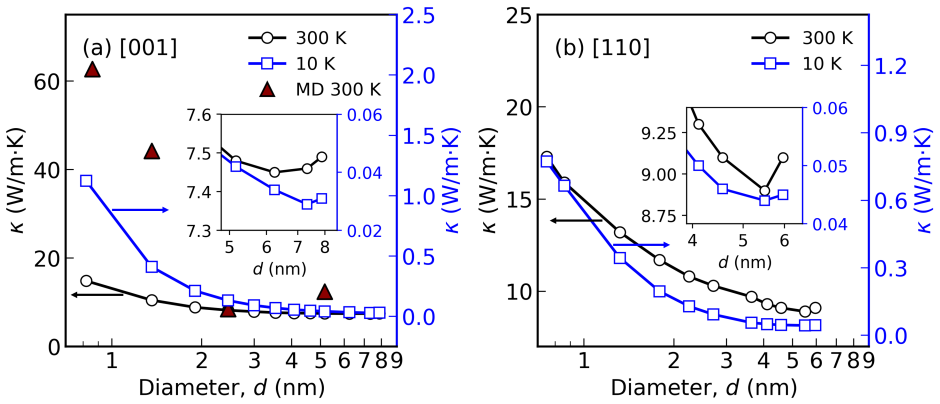
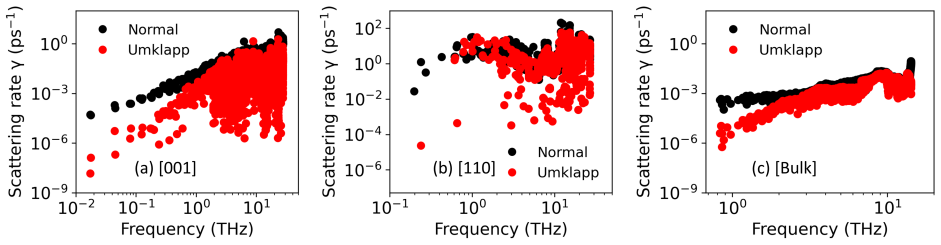
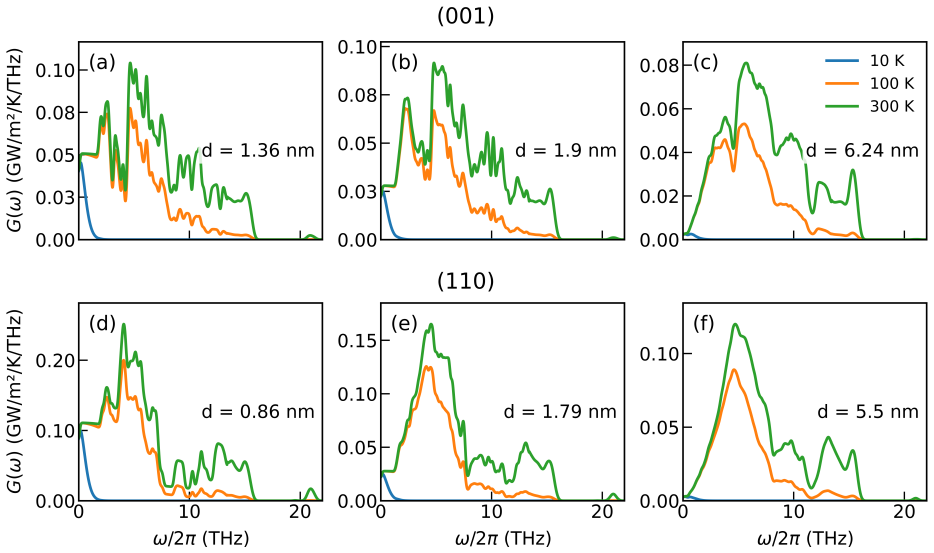
For [001]- and [110]-oriented NWs, thermal conductivity k decreases with diameter d to a minimum at d_c = 6.24 nm and 5.50 nm respectively then rises with d for a temperature range of 10-300 K. At room temperature this behavior arises from dominant momentum-conserving normal scattering relative to Umklapp processes in confined regimes thereby enabling Poiseuille-like hydrodynamic phonon flow that competes with boundary scattering. At cryogenic temperatures strong radial confinement quantizes the phonon spectrum and only low-frequency phonons below 2 THz significantly contribute to heat transport through quasi-ballistic propagation of long-wavelength modes as shown by the spectral thermal con
What carries the argument
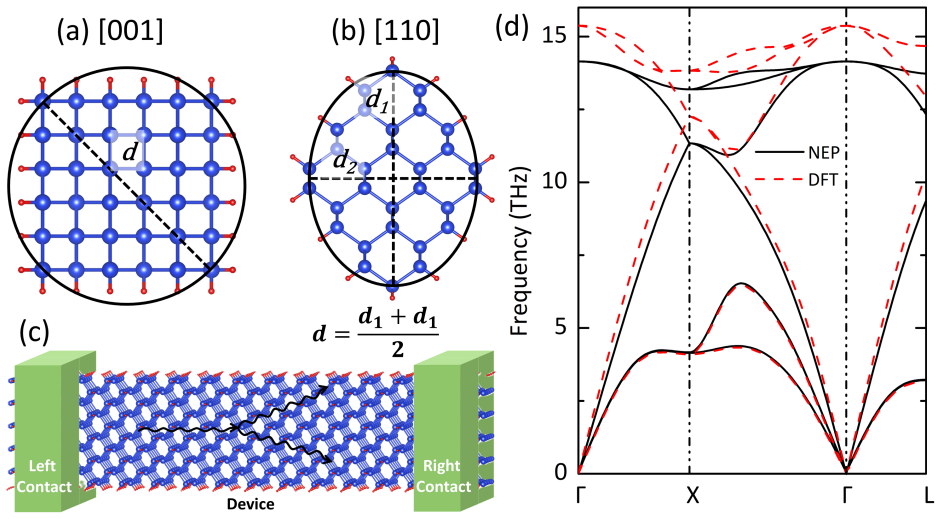
Anharmonic non-equilibrium Green's function (NEGF) simulations combined with density-functional-theory-trained neuroevolution potentials for computing phonon scattering rates and transport in radially confined nanowire geometries.
If this is right
- Thermal conductivity shows non-monotonic diameter dependence from 10 K to room temperature in the studied orientations.
- Dominant normal phonon scattering enables Poiseuille-like hydrodynamic flow that competes with boundary scattering in ultrathin wires.
- Only phonons below 2 THz contribute significantly at cryogenic temperatures via quasi-ballistic long-wavelength propagation.
- Classical molecular dynamics overestimates thermal conductivity in thinner nanowires at low temperatures due to Boltzmann statistics and neglect of quantum suppression.
Where Pith is reading between the lines
- The identified critical diameters could serve as targets for tuning thermal resistance in nanowire-based devices for thermal management or thermoelectric applications.
- Analogous non-monotonic transport might appear in other low-dimensional semiconductors when normal scattering dominates under strong radial confinement.
- Direct low-temperature measurements of spectral thermal conductance could independently test the claim that only sub-2 THz modes carry heat in the quasi-ballistic regime.
- Incorporating electron-phonon interactions into the same NEGF framework might reveal how the phonon anomalies affect overall device performance.
Load-bearing premise
The density-functional-theory-trained neuroevolution potentials accurately capture anharmonic phonon interactions and the resulting scattering rates in the radially confined nanowire geometries across the studied temperature range.
What would settle it
Experimental measurement of thermal conductivity as a function of diameter in [001] and [110] silicon nanowires that shows either no minimum near 5.5-6.2 nm or a minimum at a substantially different diameter at 300 K or at 10 K would falsify the reported non-monotonic behavior and its assigned mechanisms.
Figures
read the original abstract
Thermal transport in low-dimensional semiconductors is crucial for advancing thermal management in nanoelectronics, quantum devices, and thermoelectric devices. Recent molecular dynamics (MD) studies have identified a nonmonotonic dependence of thermal conductivity (k) on diameter in ultrathin silicon nanowires (NWs). However, classical MD methods are limited at low temperatures and in strongly confined regimes. This work introduces a fully quantum-mechanical perspective on this anomaly by employing anharmonic non-equilibrium Green's function (NEGF) simulations combined with density-functional-theory-trained neuroevolution potentials. For [001]- and [110]-oriented NWs, k decreases with diameter d to a minimum at d_c = 6.24 nm and 5.50 nm, respectively, then rises with d, for a temperature range of 10-300 K. At room temperature, this behavior arises from dominant momentum-conserving normal scattering relative to Umklapp processes in confined regimes, thereby enabling Poiseuille-like hydrodynamic phonon flow that competes with boundary scattering. At cryogenic temperatures, strong radial confinement quantizes the phonon spectrum, and only low-frequency phonons (< 2 THz) significantly contribute to heat transport through quasi-ballistic propagation of long-wavelength modes, as demonstrated by the spectral thermal conductance. In contrast to classical MD, which is inaccurate at low temperatures due to overexcitation of high-frequency vibrations by Boltzmann statistics, neglect of quantum suppression, and overestimation of thermal conductivity in thinner NWs with stronger quantum confinement, the NEGF framework provides quantitative accuracy even at low temperatures, such as 10 K.
Editorial analysis
A structured set of objections, weighed in public.
Referee Report
Summary. The manuscript applies anharmonic non-equilibrium Green's function (NEGF) transport calculations, using neuroevolution potentials (NEP) trained on bulk DFT data, to silicon nanowires. It reports nonmonotonic thermal conductivity k(d) with minima at d_c = 6.24 nm ([001]) and 5.50 nm ([110]), persisting from 10 K to 300 K. At room temperature the minimum is attributed to dominance of momentum-conserving normal processes enabling Poiseuille-like hydrodynamic flow that competes with boundary scattering; at cryogenic temperatures it is attributed to radial quantization that restricts transport to quasi-ballistic low-frequency (<2 THz) modes. The work contrasts this with classical MD, which overestimates k at low T due to Boltzmann statistics.
Significance. If the central results hold, the paper supplies a quantum-mechanical account of the nonmonotonic diameter dependence previously seen in classical MD, together with a concrete mechanistic distinction between hydrodynamic and quantized regimes. The NEGF framework itself is a methodological strength for low-temperature regimes where classical statistics fail.
major comments (2)
- [Computational methods / results sections on potential training and scattering-rate extraction] The central mechanistic claims (normal-process dominance at 300 K and low-frequency quantization at 10 K) rest on the accuracy of three-phonon scattering rates inside the nanowires. The NEP is trained exclusively on bulk DFT configurations and transferred to NW geometries, yet no benchmark is supplied that compares NEP-derived anharmonic matrix elements, scattering rates, or NEGF conductance against direct DFT-based anharmonic calculations for any NW diameter. Surface reconstruction and radial confinement alter phonon dispersions and matrix elements; without this check the hydrodynamic interpretation cannot be verified. (Computational methods / results sections on potential training and scattering-rate extraction.)
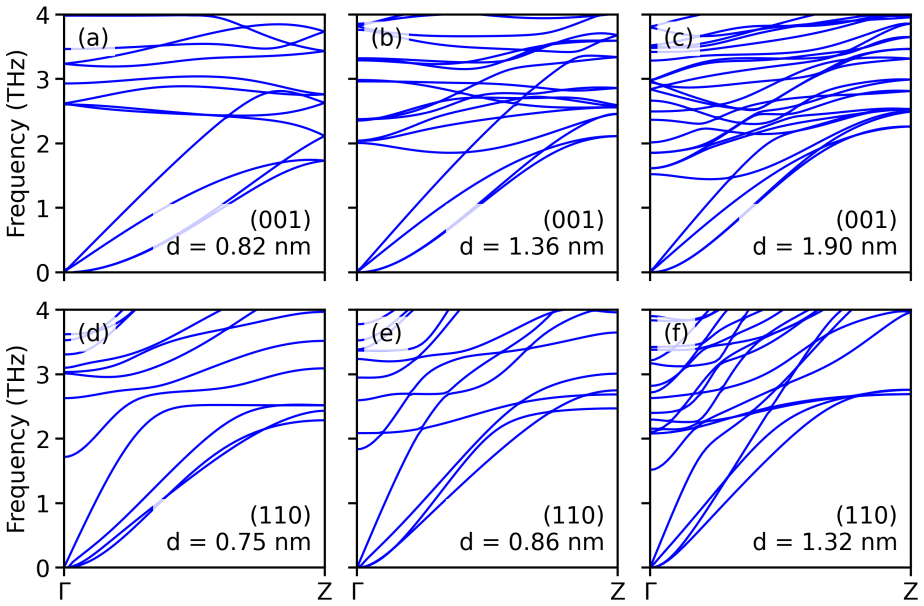
- [Results section on spectral conductance and temperature-dependent k(d)] The spectral thermal conductance plots and the stated cutoff (<2 THz) at 10 K are presented as evidence for quasi-ballistic long-wavelength transport, but the manuscript supplies neither the underlying phonon dispersion relations for the NWs nor a quantitative decomposition of normal versus Umklapp contributions as functions of diameter. These data are required to substantiate the claimed competition between hydrodynamic flow and boundary scattering. (Results section on spectral conductance and temperature-dependent k(d).)
minor comments (2)
- [Abstract and results] Notation for the critical diameters d_c is introduced in the abstract but the precise fitting procedure or uncertainty on these values is not stated in the main text.
- [Figure captions] Figure captions should explicitly state the supercell sizes, k-point sampling, and convergence criteria used for the NEGF calculations at each diameter.
Simulated Author's Rebuttal
We thank the referee for the careful reading and constructive comments on our manuscript. We address each major comment below.
read point-by-point responses
-
Referee: [Computational methods / results sections on potential training and scattering-rate extraction] The central mechanistic claims (normal-process dominance at 300 K and low-frequency quantization at 10 K) rest on the accuracy of three-phonon scattering rates inside the nanowires. The NEP is trained exclusively on bulk DFT configurations and transferred to NW geometries, yet no benchmark is supplied that compares NEP-derived anharmonic matrix elements, scattering rates, or NEGF conductance against direct DFT-based anharmonic calculations for any NW diameter. Surface reconstruction and radial confinement alter phonon dispersions and matrix elements; without this check the hydrodynamic interpretation cannot be verified. (Computational methods / results sections on potential training and scattering-rate extraction.)
Authors: We agree that a direct benchmark of NEP-derived anharmonic matrix elements and scattering rates against DFT calculations performed on the nanowire geometries would provide stronger validation. However, such DFT-based anharmonic calculations for nanowires with diameters of several nanometers are computationally prohibitive at present due to the large supercell sizes required. The NEP was trained and validated extensively against DFT for bulk silicon, including third-order force constants, and we have verified that the computed harmonic dispersions in the nanowires follow expected trends from the literature. We will revise the methods section to include an expanded discussion of the transferability assumptions, potential limitations arising from surface effects, and the rationale for using the bulk-trained potential. revision: partial
-
Referee: [Results section on spectral conductance and temperature-dependent k(d)] The spectral thermal conductance plots and the stated cutoff (<2 THz) at 10 K are presented as evidence for quasi-ballistic long-wavelength transport, but the manuscript supplies neither the underlying phonon dispersion relations for the NWs nor a quantitative decomposition of normal versus Umklapp contributions as functions of diameter. These data are required to substantiate the claimed competition between hydrodynamic flow and boundary scattering. (Results section on spectral conductance and temperature-dependent k(d).)
Authors: We agree that including the phonon dispersion relations and a quantitative decomposition of normal versus Umklapp scattering contributions would better support the mechanistic interpretations. We will add plots of the phonon dispersions for representative [001] and [110] nanowire diameters (both in the main text or supplementary information) and extract and present the diameter-dependent ratio of normal to Umklapp scattering rates from the NEGF calculations to quantify the dominance of momentum-conserving processes. revision: yes
Circularity Check
No significant circularity; derivation applies established methods to NW geometries without reduction to inputs by construction
full rationale
The paper computes nonmonotonic k(d) via NEGF + NEP potentials trained on bulk DFT, then interprets the result in terms of normal vs. Umklapp scattering and quantized modes. No equation or claim reduces a prediction to a fitted parameter by definition, nor does any load-bearing step rest on a self-citation chain whose validity is internal to the present work. The transferability of bulk-trained NEP to NWs is an assumption (potentially weak), but it is not circular; the output quantities are generated by the simulation rather than being tautological with the inputs. This matches the default expectation of a non-circular application of existing techniques.
Axiom & Free-Parameter Ledger
Reference graph
Works this paper leans on
-
[1]
2(a) and (b), respectively
and [110] directions are shown in Fig. 2(a) and (b), respectively. Consistent with previous studies on Si and GaP NWs [15, 19, 22], we observe a nonmonotonic dependence ofκond. For the thinnest consideredd, our methods estimateκof 14.9 W/m.K and 17.3 W/m.K at 300 K for [001] and [110] NWs, respectively. The calculatedκfor [001] NWs is significantly lower,...
-
[2]
At 10 K for isotropically pure Si ( 28Si) NWs, the Umklapp and isotope scattering are effectively frozen out for the thermally active low-frequency phonons
NWs and≈5.50 nm for [110] NWs, and then increases monotonically with increasing diameter. At 10 K for isotropically pure Si ( 28Si) NWs, the Umklapp and isotope scattering are effectively frozen out for the thermally active low-frequency phonons. Hence, the heat transport is primarily governed by boundary scattering and confinement-induced modified phonon...
-
[3]
D. G. Cahill, W. K. Ford, K. E. Goodson, G. D. Mahan, A. Majumdar, H. J. Maris, R. Merlin, and S. R. Phillpot, Nanoscale thermal transport, Journal of Applied Physics93, 793 (2003)
2003
-
[4]
Nomura, R
M. Nomura, R. Anufriev, Z. Zhang, J. Maire, Y. Guo, R. Yanagisawa, and S. Volz, Review of thermal transport in phononic crystals, Materials Today Physics22, 100613 (2022)
2022
-
[5]
Zhang, P
P. Zhang, P. Yuan, X. Jiang, S. Zhai, J. Zeng, Y. Xian, H. Qin, and D. Yang, A theoretical review on interfacial thermal transport at the nanoscale, Small14, 1702769 (2018)
2018
-
[6]
Beardo, W
A. Beardo, W. Chen, B. McBennett, T. Karimzadeh Sabet, E. E. Nelson, T. H. Culman, H. C. Kapteyn, J. L. Knobloch, M. M. Murnane, and I. Dabo, Nanoscale confinement of phonon flow and heat transport, npj Computational Materials11, 172 (2025)
2025
-
[7]
Machida, N
Y. Machida, N. Matsumoto, T. Isono, and K. Behnia, Phonon hydrodynamics and ultrahigh– room-temperature thermal conductivity in thin graphite, Science367, 309 (2020)
2020
-
[8]
M. E. Siemens, Q. Li, R. Yang, K. A. Nelson, E. H. Anderson, M. M. Murnane, and H. C. Kapteyn, Quasi-ballistic thermal transport from nanoscale interfaces observed using ultrafast coherent soft X-ray beams, Nature materials9, 26 (2010)
2010
-
[9]
Shakouri, Nanoscale thermal transport and microrefrigerators on a chip, Proceedings of the IEEE94, 1613 (2006)
A. Shakouri, Nanoscale thermal transport and microrefrigerators on a chip, Proceedings of the IEEE94, 1613 (2006)
2006
-
[10]
A. I. Hochbaum, R. Chen, R. D. Delgado, W. Liang, E. C. Garnett, M. Najarian, A. Majum- dar, and P. Yang, Enhanced thermoelectric performance of rough silicon nanowires, Nature 451, 163 (2008). 13
2008
-
[11]
R. Chen, J. Lee, W. Lee, and D. Li, Thermoelectrics of nanowires, Chemical Reviews119, 9260 (2019)
2019
-
[12]
Chang, J
J. Chang, J. Gao, I. Esmaeil Zadeh, A. W. Elshaari, and V. Zwiller, Nanowire-based integrated photonics for quantum information and quantum sensing, Nanophotonics12, 339 (2023)
2023
-
[13]
A. I. Hochbaum and P. Yang, Semiconductor nanowires for energy conversion, Chemical Re- views110, 527 (2010)
2010
-
[14]
M. Y. Swinkels and I. Zardo, Nanowires for heat conversion, Journal of Physics D: Applied Physics51, 353001 (2018)
2018
-
[15]
N. P. Dasgupta, J. Sun, C. Liu, S. Brittman, S. C. Andrews, J. Lim, H. Gao, R. Yan, and P. Yang, 25th anniversary article: semiconductor nanowires–synthesis, characterization, and applications, Advanced Materials26, 2137 (2014)
2014
-
[16]
A. I. Boukai, Y. Bunimovich, J. Tahir-Kheli, J.-K. Yu, W. A. Goddard Iii, and J. R. Heath, Silicon nanowires as efficient thermoelectric materials, Nature451, 168 (2008)
2008
-
[17]
Y. Zhou, X. Zhang, and M. Hu, Nonmonotonic diameter dependence of thermal conductivity of extremely thin Si nanowires: competition between hydrodynamic phonon flow and boundary scattering, Nano Letters17, 1269 (2017)
2017
-
[18]
Ponomareva, D
I. Ponomareva, D. Srivastava, and M. Menon, Thermal conductivity in thin silicon nanowires: phonon confinement effect, Nano Letters7, 1155 (2007)
2007
-
[19]
Donadio and G
D. Donadio and G. Galli, Temperature dependence of the thermal conductivity of thin silicon nanowires, Nano Letters10, 847 (2010)
2010
-
[20]
Rashid, L
Z. Rashid, L. Zhu, and W. Li, Effect of confinement on anharmonic phonon scattering and thermal conductivity in pristine silicon nanowires, Physical Review B97, 075441 (2018)
2018
-
[21]
K. Xu, Y. Li, D. Ding, T. Liang, J. Wu, and J. Xu, Critical Size Transitions in Silicon Nanowires: Amorphization, Phonon Hydrodynamics, and Thermal Conductivity, The Journal of Physical Chemistry Letters16, 8580 (2025)
2025
-
[22]
Zaccone, Phonon-confinement theory of thermal conductivity in ultrathin silicon films, Journal of Applied Physics138, 225305 (2025)
A. Zaccone, Phonon-confinement theory of thermal conductivity in ultrathin silicon films, Journal of Applied Physics138, 225305 (2025)
2025
-
[23]
Liang, K
T. Liang, K. Xu, M. Han, Y. Yao, Z. Zhang, X. Zeng, J. Xu, and J. Wu, Abnormally high thermal conductivity in fivefold twinned diamond nanowires, Materials Today Physics25, 100705 (2022). 14
2022
-
[24]
Gireesan, P
S. Gireesan, P. Torres, F. X. Alvarez, and P. A. Bobbert, Diameter-dependent thermal con- ductivity of ultrathin GaP nanowires: a molecular dynamics study, Physical Review B101, 024307 (2020)
2020
-
[25]
P. Yuan, R. Wang, T. Wang, X. Wang, and Y. Xie, Nonmonotonic thickness-dependence of in- plane thermal conductivity of few-layered MoS2: 2.4 to 37.8 nm, Physical Chemistry Chemical Physics20, 25752 (2018)
2018
-
[26]
C. Liu, P. Lu, D. Li, Y. Zhao, and M. Hao, Non-monotonic thickness dependent and anisotropic in-plane thermal transport in layered titanium trisulphide, Materials Today Nano17, 100165 (2022)
2022
-
[27]
C. Wu, C. Liu, Y. Tao, Y. Zhang, and Y. Chen, Anomalous layer thickness dependent thermal conductivity of Td-WTe2 through first-principles calculation, Physics Letters A384, 126751 (2020)
2020
-
[28]
H. Dong, Y. Shi, P. Ying, K. Xu, T. Liang, Y. Wang, Z. Zeng, X. Wu, W. Zhou, S. Xiong, S. Chen, and Z. Fan, Molecular dynamics simulations of heat transport using machine-learned potentials: A mini-review and tutorial on GPUMD with neuroevolution potentials, Journal of Applied Physics135(2024)
2024
-
[29]
Wang, Quantum thermal transport from classical molecular dynamics, Physical Review Letters99, 160601 (2007)
J.-S. Wang, Quantum thermal transport from classical molecular dynamics, Physical Review Letters99, 160601 (2007)
2007
-
[30]
Zeng, Y.-Y
Y.-J. Zeng, Y.-Y. Liu, W.-X. Zhou, and K.-Q. Chen, Nanoscale thermal transport: Theoretical method and application, Chinese Physics B27, 036304 (2018)
2018
-
[31]
Datta,Quantum transport: atom to transistor(Cambridge University Press, 2005)
S. Datta,Quantum transport: atom to transistor(Cambridge University Press, 2005)
2005
-
[32]
X. Chen, Y. Liu, and W. Duan, Thermal engineering in low-dimensional quantum devices: A tutorial review of nonequilibrium Green’s function methods, Small Methods2, 1700343 (2018)
2018
-
[34]
Y. Guo, Z. Zhang, M. Bescond, S. Xiong, M. Nomura, and S. Volz, Anharmonic phonon- phonon scattering at the interface between two solids by nonequilibrium Green’s function formalism, Physical Review B103, 174306 (2021). 15
2021
-
[40]
Fan, Improving the accuracy of the neuroevolution machine learning potential for multi- component systems, Journal of Physics: Condensed Matter34, 125902 (2022)
Z. Fan, Improving the accuracy of the neuroevolution machine learning potential for multi- component systems, Journal of Physics: Condensed Matter34, 125902 (2022)
2022
-
[41]
Singh, L
M. Singh, L. Patra, C. Zhang, G. J. MacDougall, S. Datta, D. G. Cahill, and S. Kumar, Revealing Phonon Bridge Effect for Amorphous vs Crystalline Metal–Silicide Layers at Si/Ti Interfaces by a Machine Learning Potential, ACS Applied Electronic Materials8, 2373 (2026)
2026
-
[42]
Smidstrup, T
S. Smidstrup, T. Markussen, P. Vancraeyveld, J. Wellendorff, J. Schneider, T. Gunst, B. Ver- stichel, D. Stradi, P. A. Khomyakov, U. G. Vej-Hansen,et al., Quantumatk: an integrated platform of electronic and atomic-scale modelling tools, Journal of Physics: Condensed Matter 32, 015901 (2019)
2019
-
[43]
D. Li, Y. Wu, P. Kim, L. Shi, P. Yang, and A. Majumdar, Thermal conductivity of individual silicon nanowires, Applied Physics Letters83, 2934 (2003)
2003
-
[44]
J. Lee, W. Lee, J. Lim, Y. Yu, Q. Kong, J. J. Urban, and P. Yang, Thermal transport in silicon nanowires at high temperature up to 700 K, Nano Letters16, 4133 (2016)
2016
-
[45]
K. R. Hahn, C. Melis, F. Bernardini, L. Paulatto, and L. Colombo, Thermal transport in H-terminated ultrathin [110] Si nanowires: A first principles study, The European Physical Journal Plus138, 1028 (2023)
2023
-
[46]
He and G
Y. He and G. Galli, Microscopic origin of the reduced thermal conductivity of silicon nanowires, Physical Review Letters108, 215901 (2012). 16
2012
-
[47]
S. Gao, S. Hong, S. Park, H. Y. Jung, W. Liang, Y. Lee, C. W. Ahn, J. Y. Byun, J. Seo, M. G. Hahm, H. Kim, K. Kim, Y. Yi, H. Wang, M. Upmanyu, S.-G. Lee, Y. Homma, H. Terrones, and Y. J. Jung, Catalyst-free synthesis of sub-5 nm silicon nanowire arrays with massive lattice contraction and wide bandgap, Nature Communications13, 3467 (2022)
2022
-
[48]
Dames and G
C. Dames and G. Chen, Theoretical phonon thermal conductivity of Si/Ge superlattice nanowires, Journal of Applied Physics95, 682 (2004)
2004
-
[49]
Casimir, Note on the conduction of heat in crystals, Physica5, 495 (1938)
H. Casimir, Note on the conduction of heat in crystals, Physica5, 495 (1938)
1938
-
[50]
Xu, Nonlocal heat conduction in silicon nanowires and carbon nanotubes, Heat and Mass Transfer57, 843 (2021)
M. Xu, Nonlocal heat conduction in silicon nanowires and carbon nanotubes, Heat and Mass Transfer57, 843 (2021)
2021
-
[51]
Liang, P
T. Liang, P. Ying, K. Xu, Z. Ye, C. Ling, Z. Fan, and J. Xu, Mechanisms of temperature- dependent thermal transport in amorphous silica from machine-learning molecular dynamics, Physical Review B108, 184203 (2023)
2023
-
[52]
Y. Wang, Z. Fan, P. Qian, M. A. Caro, and T. Ala-Nissila, Quantum-corrected thickness- dependent thermal conductivity in amorphous silicon predicted by machine learning molecular dynamics simulations, Physical Review B107, 054303 (2023)
2023
-
[53]
K. Xu, Y. Hao, T. Liang, P. Ying, J. Xu, J. Wu, and Z. Fan, Accurate prediction of heat conductivity of water by a neuroevolution potential, The Journal of Chemical Physics158, 204114 (2023)
2023
-
[54]
X. Gu, Z. Fan, and H. Bao, Thermal conductivity prediction by atomistic simulation methods: Recent advances and detailed comparison, Journal of Applied Physics130, 210902 (2021). 17 Supplementary Information: Anharmonic Quantum Transport Analysis of Thermal Transport Anomalies in Ultrathin Silicon Nanowires Lokanath Patra,1 Mayur Pratap Singh, 1 and Satis...
2021
-
[55]
Kresse and J
G. Kresse and J. Furthm¨ uller, Efficiency of ab-initio total energy calculations for metals and semiconductors using a plane-wave basis set, Computational Materials Science6, 15 (1996)
1996
-
[56]
Kresse and J
G. Kresse and J. Furthm¨ uller, Efficient iterative schemes for ab initio total-energy calculations using a plane-wave basis set, Physical Review B54, 11169 (1996)
1996
-
[57]
P. E. Bl¨ ochl, Projector augmented-wave method, Physical Review B50, 17953 (1994)
1994
-
[58]
J. P. Perdew, K. Burke, and M. Ernzerhof, Generalized gradient approximation made simple, Physical Review Letters77, 3865 (1996)
1996
-
[59]
H. J. Monkhorst and J. D. Pack, Special points for Brillouin-zone integrations, Physical Review B13, 5188 (1976)
1976
-
[60]
Z. Fan, Z. Zeng, C. Zhang, Y. Wang, K. Song, H. Dong, Y. Chen, and T. Ala-Nissila, Neu- roevolution machine learning potentials: Combining high accuracy and low cost in atomistic simulations and application to heat transport, Physical Review B104, 104309 (2021)
2021
-
[61]
Unruh, R
D. Unruh, R. V. Meidanshahi, S. M. Goodnick, G. Cs´ anyi, and G. T. Zim´ anyi, Gaussian approximation potential for amorphous Si: H, Physical Review Materials6, 065603 (2022)
2022
-
[62]
Z. Yan, L. Chen, M. Yoon, and S. Kumar, Phonon transport at the interfaces of vertically stacked graphene and hexagonal boron nitride heterostructures, Nanoscale8, 4037 (2016)
2016
-
[63]
Z. Yan, L. Chen, M. Yoon, and S. Kumar, The role of interfacial electronic properties on phonon transport in two-dimensional MoS 2 on metal substrates, ACS Applied Materials & Interfaces8, 33299 (2016)
2016
-
[64]
Y. Guo, M. Bescond, Z. Zhang, M. Luisier, M. Nomura, and S. Volz, Quantum mechanical modeling of anharmonic phonon-phonon scattering in nanostructures, Physical Review B102, 195412 (2020)
2020
-
[65]
Y. Guo, Z. Zhang, M. Bescond, S. Xiong, M. Nomura, and S. Volz, Anharmonic phonon- phonon scattering at the interface between two solids by nonequilibrium Green’s function formalism, Physical Review B103, 174306 (2021)
2021
-
[66]
J.-S. Wang, J. Wang, and N. Zeng, Nonequilibrium Green’s function approach to mesoscopic thermal transport, Physical Review B74, 033408 (2006). 8
2006
-
[67]
Mingo, Anharmonic phonon flow through molecular-sized junctions, Physical Review B74, 125402 (2006)
N. Mingo, Anharmonic phonon flow through molecular-sized junctions, Physical Review B74, 125402 (2006)
2006
-
[68]
Luisier, Atomistic modeling of anharmonic phonon-phonon scattering in nanowires, Phys- ical Review B86, 245407 (2012)
M. Luisier, Atomistic modeling of anharmonic phonon-phonon scattering in nanowires, Phys- ical Review B86, 245407 (2012)
2012
-
[69]
Z. Fan, Y. Wang, P. Ying, K. Song, J. Wang, Y. Wang, Z. Zeng, K. Xu, E. Lindgren, J. M. Rahm,et al., GPUMD: A package for constructing accurate machine-learned potentials and performing highly efficient atomistic simulations, The Journal of Chemical Physics157(2022)
2022
-
[70]
Z. Fan, H. Dong, A. Harju, and T. Ala-Nissila, Homogeneous nonequilibrium molecular dy- namics method for heat transport and spectral decomposition with many-body potentials, Physical Review B99, 064308 (2019). 9
2019
discussion (0)
Sign in with ORCID, Apple, or X to comment. Anyone can read and Pith papers without signing in.