REVIEW 1 major objections 38 references
Relaxation of Incommensurate Structures via Quantum Models
T0 review · 1 major / 0 minor · reviewed 2026-07-01 · grok-4.3
Pith's one-line read A variational quantum framework places displacement fields on configuration space and the Hamiltonian in reciprocal space to define relaxed energy, local density of states, and forces for incommensurate Schrödinger models through thermodyna
desk verdict The paper's configuration-space variational setup with reciprocal-space Hamiltonian and exponential convergence proof for the anisotropic approximation is the real contribution, but the thermodynamic limit step remains the least secured part. read the letter →
The pith
A machine-rendered reading of the paper's core claim, the machinery that carries it, and where it could break.
The reading
What carries the argument
The variational quantum framework that formulates displacement fields on configuration space and represents the electronic Hamiltonian in reciprocal space, allowing thermodynamic limits to produce well-defined relaxed quantities.
What would settle it
A concrete incommensurate Schrödinger model for which the thermodynamic limit of the relaxed energy or forces fails to converge would falsify the claim that the framework yields well-defined quantities.
Extended reading notes
Core claim
We develop a variational quantum framework for structural relaxation in incommensurate Schrödinger models, where displacement fields are formulated on the configuration space and the electronic Hamiltonian is represented in reciprocal space. This yields well-defined relaxed energy, local density of states, and forces through thermodynamic limits. We propose an anisotropic scattering-channel approximation, and prove exponential convergence of the approximate equilibria. Numerical experiments are performed to support the analysis and show that the model captures domain-wall formation and its impact on the electronic spectrum.
Load-bearing premise
The thermodynamic limit exists and produces well-defined relaxed quantities for incommensurate systems that lack global translational symmetry.
Editorial extensions
If this is right
- Relaxed energy, local density of states, and forces become well-defined objects for incommensurate systems via thermodynamic limits.
- The anisotropic scattering-channel approximation produces equilibria that converge exponentially to the exact relaxed states.
- Domain-wall formation appears naturally and alters the electronic spectrum in the computed equilibria.
- Numerical experiments confirm both the convergence analysis and the appearance of domain walls.
Reading between the lines
- The same configuration-space formulation could be tested on other incommensurate models whose thermodynamic limits are already known to exist.
- Forces obtained this way might be inserted into larger-scale molecular-dynamics simulations of aperiodic materials without requiring artificial periodic supercells.
- If the exponential convergence rate holds uniformly, the approximation could be used to reach system sizes inaccessible to direct diagonalization.
Signed reviews
Editorial analysis
A structured set of objections, weighed in public.
Referee Report
Summary. The paper develops a variational quantum framework for structural relaxation in incommensurate Schrödinger models. Displacement fields are formulated on the configuration space and the electronic Hamiltonian is represented in reciprocal space. This is claimed to yield well-defined relaxed energy, local density of states, and forces through thermodynamic limits. An anisotropic scattering-channel approximation is proposed with a proof of exponential convergence of the approximate equilibria. Numerical experiments support the analysis by showing domain-wall formation and its impact on the electronic spectrum.
Significance. If the thermodynamic limit exists rigorously and the convergence proof is valid, the framework could advance modeling of relaxation in systems without global translational symmetry, such as moiré structures or quasicrystals, by providing a variational approach with controlled approximations and explicit convergence rates.
major comments (1)
- Abstract: The assertion that the variational formulation 'yields well-defined relaxed energy, local density of states, and forces through thermodynamic limits' is the load-bearing premise for the entire framework, including the anisotropic approximation and exponential convergence proof. No explicit construction of the limit, control of boundary terms, or verification that the limit is independent of cutoff procedure is visible; if this premise fails, all downstream claims become undefined.
Simulated Author's Rebuttal
We thank the referee for their thorough review and for highlighting the foundational role of the thermodynamic limit in our framework. We address the single major comment below and will revise the manuscript accordingly to strengthen the exposition.
read point-by-point responses
-
Referee: Abstract: The assertion that the variational formulation 'yields well-defined relaxed energy, local density of states, and forces through thermodynamic limits' is the load-bearing premise for the entire framework, including the anisotropic approximation and exponential convergence proof. No explicit construction of the limit, control of boundary terms, or verification that the limit is independent of cutoff procedure is visible; if this premise fails, all downstream claims become undefined.
Authors: We agree that the thermodynamic limit is central and that its construction requires explicit detail. In the manuscript, the configuration-space formulation of displacements and the reciprocal-space Hamiltonian are introduced in Section 2, with the relaxed quantities defined via limits of finite-domain approximations as the cutoff tends to infinity. However, the referee is correct that a self-contained subsection rigorously constructing the limit, bounding boundary terms, and proving cutoff independence is not present. We will add this material (new subsection 2.4) in the revision, including the requisite estimates. This will also clarify how the limit underpins the subsequent anisotropic approximation and its exponential convergence. The abstract claim will be retained but cross-referenced to the new subsection. revision: yes
Circularity Check
No significant circularity; derivation is self-contained
full rationale
The paper formulates displacement fields on configuration space and the Hamiltonian in reciprocal space, then asserts that thermodynamic limits produce well-defined relaxed energy, LDOS, and forces. It introduces an anisotropic scattering-channel approximation and proves exponential convergence of the resulting approximate equilibria. No quoted step reduces a claimed prediction or equilibrium to a fitted parameter, self-definition, or self-citation chain; the convergence proof is presented as an independent mathematical result rather than a renaming or tautology. The thermodynamic-limit premise is an assumption, not a circular redefinition of the outputs. This is the normal case of a self-contained derivation.
Assumptions & free parameters
Cite this review
Pith. "Pith review of Relaxation of Incommensurate Structures via Quantum Models." pith.science (2026). https://pith.science/paper/Q44O5IZT
@misc{pith2026260631104,
  author       = {Pith},
  title        = {Pith review of: Relaxation of Incommensurate Structures via Quantum Models},
  year         = {2026},
  howpublished = {\url{https://pith.science/paper/Q44O5IZT}},
  note         = {Machine review of arXiv:2606.31104}
}
read the original abstract
Accurately modeling structural relaxation in incommensurate systems is intrinsically challenging due to the absence of global translational symmetry. In this work, we develop a variational quantum framework for structural relaxation in incommensurate Schr\"{o}dinger models, where displacement fields are formulated on the configuration space and the electronic Hamiltonian is represented in reciprocal space. This yields well-defined relaxed energy, local density of states, and forces through thermodynamic limits. We propose an anisotropic scattering-channel approximation, and prove exponential convergence of the approximate equilibria. Numerical experiments are performed to support the analysis and show that the model captures domain-wall formation and its impact on the electronic spectrum.
Figures
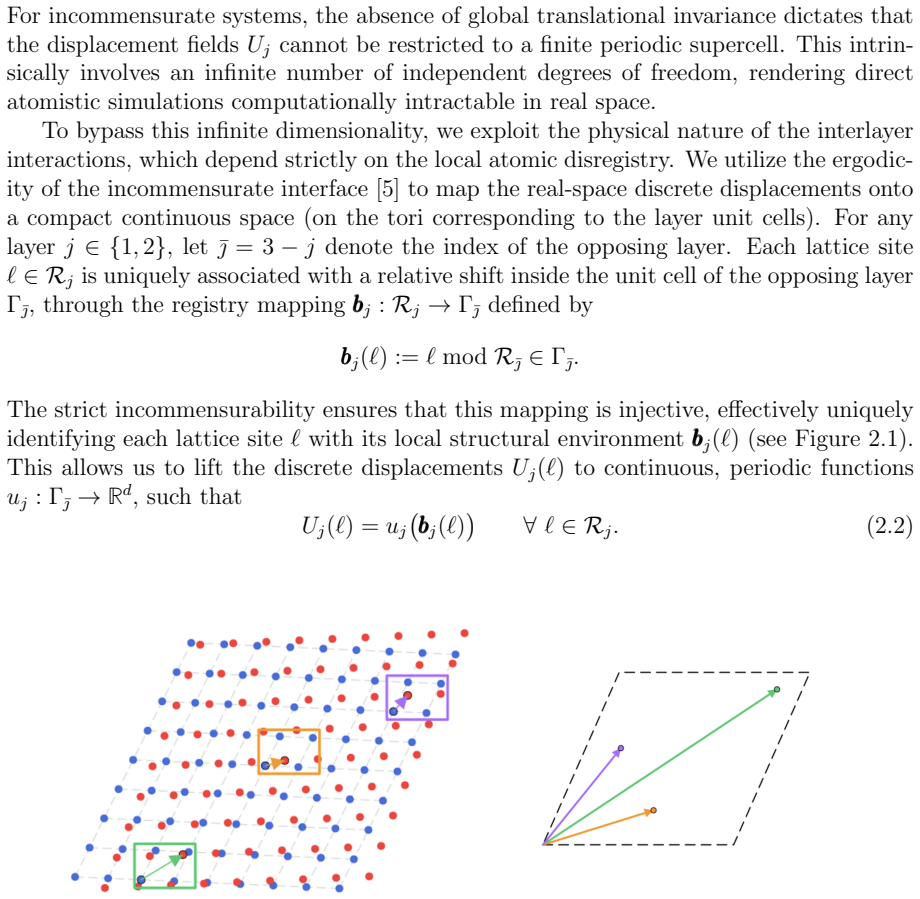


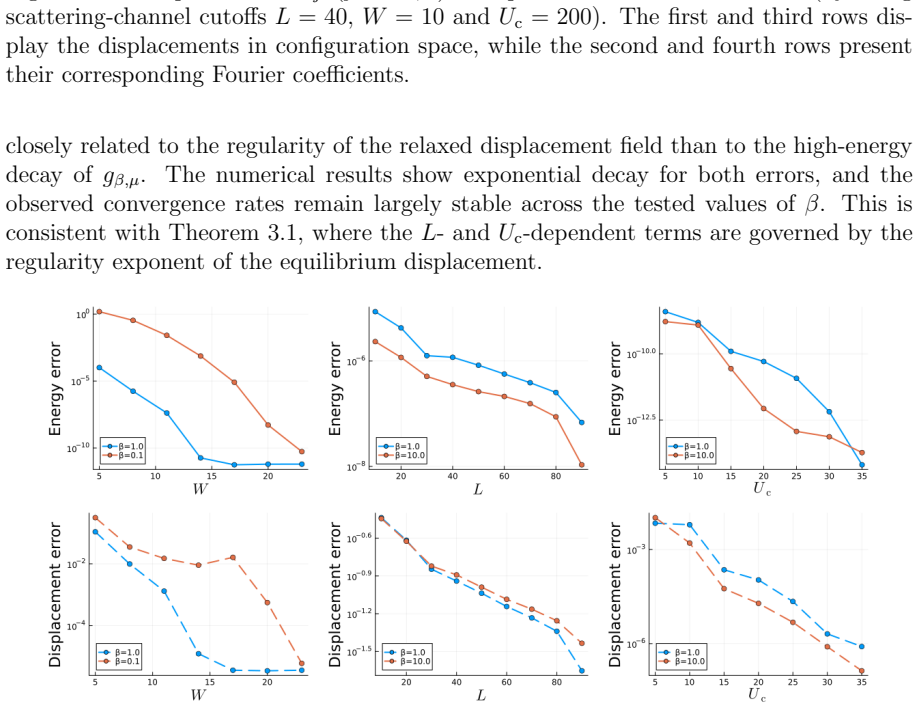
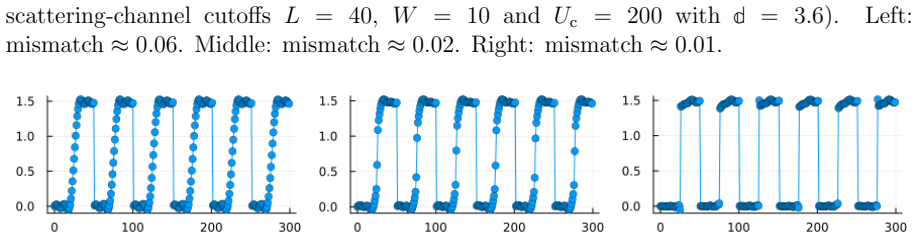
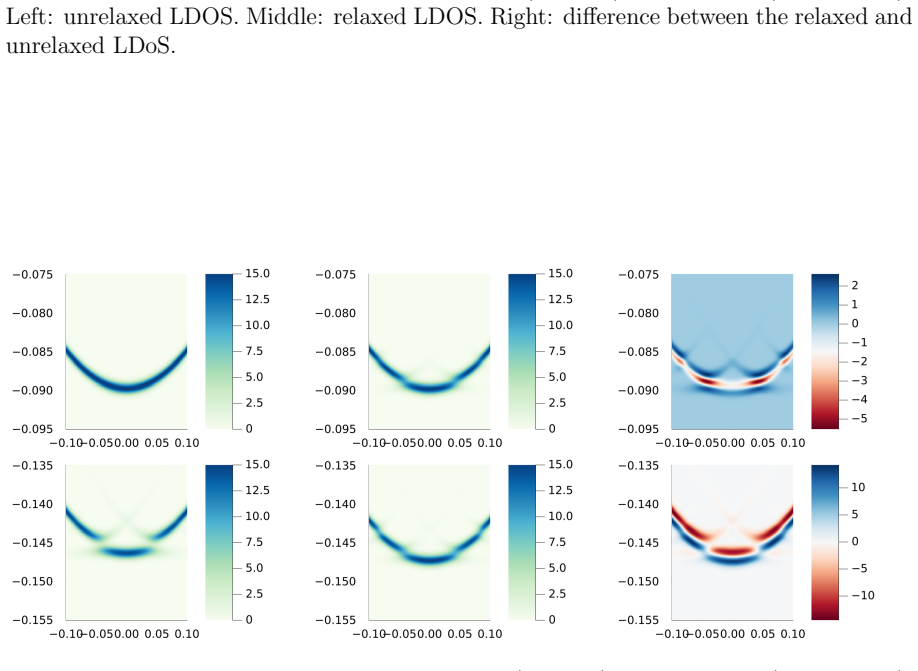
Figures from the paper (5 more)


Reference graph
Works this paper leans on
- [1]
- [2]
-
[3]
R. Bistritzer and A. H. MacDonald. Transport between twisted graphene layers. Phys. Rev. B, 81:245412, 2010
work page 2010
-
[4]
R. Bistritzer and A. H. MacDonald. Moir´ e bands in twisted double-layer graphene. PNAS, 108(30):12233–12237, 2011
work page 2011
-
[5]
E. Canc` es, P. Cazeaux, and M. Luskin. Generalized Kubo formulas for the transport properties of incommensurate 2D atomic heterostructures. J. Math. Phys., 58(6):063502, 2017
work page 2017
-
[6]
Kohn-Sham models for encapsulated two-dimensional materials
E. Canc` es, D. Gontier, and S. Perrin-Roussel. Kohn-sham models for encapsulated two- dimensional materials.https://arxiv.org/abs/2606.11785, 2026
work page Pith review arXiv 2026
-
[7]
Y. Cao, V. Fatemi, A. Demir, S. Fang, S. L. Tomarken, J. Y. Luo, J. D. Sanchez-Yamagishi, K. Watanabe, T. Taniguchi, E. Kaxiras, R. C. Ashoori, and P. Jarillo-Herrero. Corre- lated insulator behaviour at half-filling in magic-angle graphene superlattices. Nature, 556(7699):80–84, 2018. 35
work page 2018
-
[8]
S. Carr, D. Massatt, S. B. Torrisi, P. Cazeaux, M. Luskin, and E. Kaxiras. Relaxation and domain formation in incommensurate two-dimensional heterostructures. Phys. Rev. B, 98:224102, 2018
work page 2018
Show all 38 references
-
[9]
H. Chen, F. Q. Nazar, and C. Ortner. Geometry equilibration of crystalline defects in quantum and atomistic descriptions. Math. Models Methods Appl. Sci., 29(3):419–492, 2019
2019
-
[10]
Chen and C
H. Chen and C. Ortner. QM/MM methods for crystalline defects. Part 1: Locality of the tight binding model. Multiscale Model. Simul., 14(1):232–264, 2016
2016
-
[11]
Combes and L
J.M. Combes and L. Thomas. Asymptotic behaviour of eigenfunctions for multiparticle Schr¨ odinger operators.Commun. Math. Phys., 34(4):251–270, 1973
1973
-
[12]
S. Dai, Y. Xiang, and D. J. Srolovitz. Twisted bilayer graphene: Moir´ e with a twist. Nano Lett., 16(9):5923–5927, 2016
2016
-
[13]
C. Dean, L. Wang, P. Maher, C. Forsythe, F. Ghahari, Y. Gao, J. Katoch, M. Ishigami, P. Moon, M. Koshino, et al. Hofstadter’s butterfly and the fractal quantum Hall effect in Moir´ e superlattices.Nature, 497(7451):598–602, 2013
2013
-
[14]
S. Fang, S. Carr, Z. Zhu, D. Massatt, and E. Kaxiras. Angle-dependent ab initio low-energy hamiltonians for a relaxed twisted bilayer graphene heterostructure.https://arxiv.org/ abs/1908.00058, 2019
1908
-
[15]
S. Fang, R. K. Defo, S. N. Shirodkar, S. Lieu, G. A. Tritsaris, and E. Kaxiras. Ab ini- tio tight-binding hamiltonian for transition metal dichalcogenides. Physical Review B, 92(20):205108, 2015
2015
-
[16]
G. B. Folland. Real Analysis: Modern Techniques and Their Applications. John Wiley & Sons, 2nd edition, 1999
1999
-
[17]
A. K. Geim and I. V. Grigorieva. Van der Waals heterostructures. Nature, 499(7459):419– 425, 2013
2013
-
[18]
Horn and C.R
R.A. Horn and C.R. Johnson. Matrix Analysis. Cambridge University Press, 2012
2012
-
[19]
M. Hott, A. B. Watson, and M. Luskin. From incommensurate bilayer heterostructures to Allen–Cahn: an exact thermodynamic limit. Arch. Ration. Mech. Anal., 248:103, 2024
2024
-
[20]
D. S. Koda, F. Bechstedt, M. Marques, and L. K. Teles. Coincidence lattices of 2D crystals: Heterostructure predictions and applications. J. Phys. Chem. A, 120:10895–10908, 2016
2016
-
[21]
H. P. Komsa and A. V. Krasheninnikov. Electronic structures and optical properties of realistic transition metal dichalcogenide heterostructures from first principles. Phys. Rev. B, 88(8):085318, 2013
2013
-
[22]
T. Kong, A. B. Watson, M. Luskin, and K. D. Stubbs. Interacting twisted bilayer graphene with systematic modeling of structural relaxation. Electron. Struct., 7:035001, 2025
2025
-
[23]
Y. Li, Y. Song, and A. Zhou. Spectral analysis of the Schr¨ odinger operator for the incom- mensurate system.https://arxiv.org/abs/2602.08308, 2026
2026
-
[24]
G. C. Loh and R. Pandey. A graphene–boron nitride lateral heterostructure–a first- principles study of its growth, electronic properties, and chemical topology. J. Mater. Chem. C, 3(23):5918–5932, 2015. 36
2015
-
[25]
Massatt, S
D. Massatt, S. Carr, and M. Luskin. Electronic observables for relaxed bilayer two- dimensional heterostructures in momentum space. Multiscale Modeling Simul., 21(4):1344– 1378, 2023
2023
-
[26]
Massatt, M
D. Massatt, M. Luskin, and C. Ortner. Electronic density of states for incommensurate layers. Multiscale Modeling & Simulation, 15(1):476–499, 2017
2017
-
[27]
N. N. T. Nam and M. Koshino. Lattice relaxation and energy band modulation in twisted bilayer graphene. Phys. Rev. B, 96:075311, 2017
2017
-
[28]
Nocedal and S
J. Nocedal and S. J. Wright. Numerical Optimization. Springer Series in Operations Research and Financial Engineering. Springer, 2nd edition, 2006
2006
-
[29]
C. Ortner. A priori and a posteriori analysis of the quasinonlocal quasicontinuum method in 1d. Math. Comp., 80(275):1265–1285, 2011
2011
-
[30]
Ortner and F
C. Ortner and F. Theil. Justification of the Cauchy–Born approximation of elastodynamics. Arch. Ration. Mech. Anal., 207:1025–1073, 2013
2013
-
[31]
X. Quan, H. Chen, A. Zhou, and D. Massatt. Self-consistent density functional models for incommensurate systems with yukawa potential, 2026. In preparation
2026
-
[32]
Tarnopolsky, A
G. Tarnopolsky, A. J. Kruchkov, and A. Vishwanath. Origin of magic angles in twisted bilayer graphene. Phys. Rev. Lett., 122:106405, 2019
2019
-
[33]
Tu.https://github.com/tumengfan/BilayerDFT.jl.git, 2026
M. Tu.https://github.com/tumengfan/BilayerDFT.jl.git, 2026
2026
-
[34]
T. Wang, H. Chen, A. Zhou, Y. Zhou, and D. Massatt. Convergence of the planewave ap- proximations for quantum incommensurate systems. Multiscale Model. Simul., 23(1):545– 576, 2025
2025
-
[35]
A. B. Watson, T. Kong, A. H. MacDonald, and M. Luskin. Bistritzer–macdonald dynamics in twisted bilayer graphene. J. Math. Phys., 64:031502, 2023
2023
-
[36]
A. B. Watson and M. Luskin. Existence of the first magic angle for the chiral model of bilayer graphene. J. Math. Phys., 62:091502, 2021
2021
-
[37]
M. Xu, T. Liang, M. Shi, and H. Chen. Graphene-like two-dimensional materials. Chem. Rev., 113(5):3766–3798, 2013
2013
-
[38]
H. Yoo, R. Engelke, S. Carr, et al. Atomic and electronic reconstruction at the van der waals interface in twisted bilayer graphene. Nat. Mater., 18:448–453, 2019. 37
2019
Reviewed July 1, 2026 · model on record in the stance chip above.
Discussion (0). Continue with ORCID to comment.