REVIEW 3 major objections 4 minor 1 cited by
Gradient Flow Algorithms for Density Propagation in Stochastic Systems
T0 review · 3 major / 4 minor · reviewed 2026-08-14 · deepseek-v4-flash
Pith's one-line read A time-only discretization can compute transient joint probability densities of stochastic systems without gridding the state space.
desk verdict Promising point-cloud Sinkhorn/JKO density propagation, but the central claim is unproven: no consistency for the outer split, so treat it as a strong heuristic until that is fixed. read the letter →
The pith
A machine-rendered reading of the paper's core claim, the machinery that carries it, and where it could break.
The reading
What carries the argument
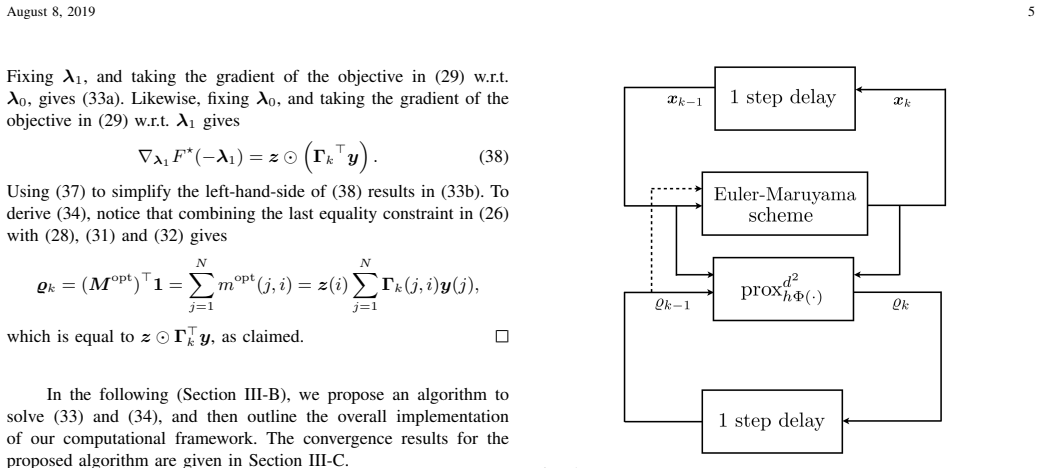
The load-bearing object is the JKO proximal recursion, a variational replacement of the Fokker-Planck-Kolmogorov PDE in which each small time step solves $\arg\inf_{\varrho} \frac{1}{2} W^2(\varrho_{k-1},\varrho) + h F(\varrho)$ with $W$ the 2-Wasserstein metric and $F$ the free energy. Entropic regularization of the inner optimal-transport coupling makes the optimal matrix have the Sinkhorn form $m_{\mathrm{opt}}(i,j) = \exp(\lambda_0(i)h/\epsilon) \exp(-C_k(i,j)/(2\epsilon)) \exp(\lambda_1(j)h/\epsilon)$, algebraicizing the problem. The resulting fixed-point equations are solved by a block-coordinate iteration whose contraction is established in the Thompson metric, $d_T(z,\tilde{z}) = \log \max_i \max(z_i/\tilde{z}_i, \tilde{z}_i/z_i)$, on the positive orthant, using Perron-Frobenius positivity of the kernel $\Gamma_k = \exp(-C_k/2\epsilon)$. The point-cloud locations advance independently by the Euler-Maruyama scheme, so the whole algorithm is a temporal recursion on weighted scattered data rather than a spatial discretization.
What would settle it
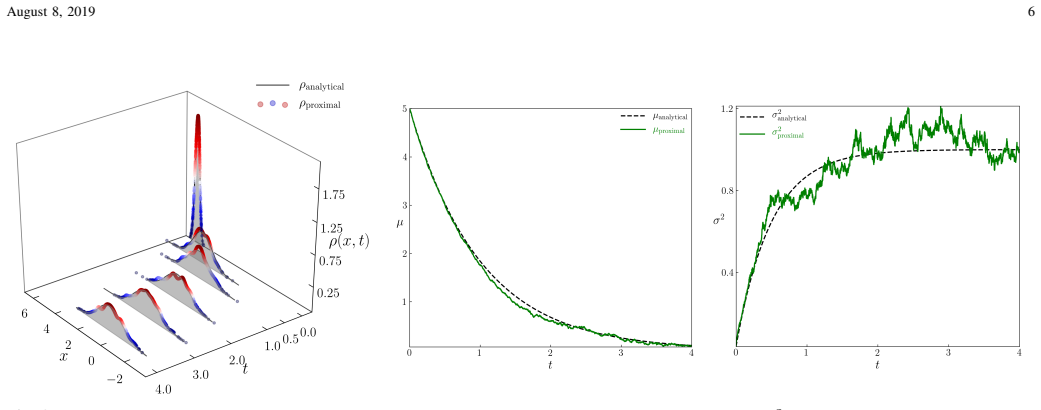
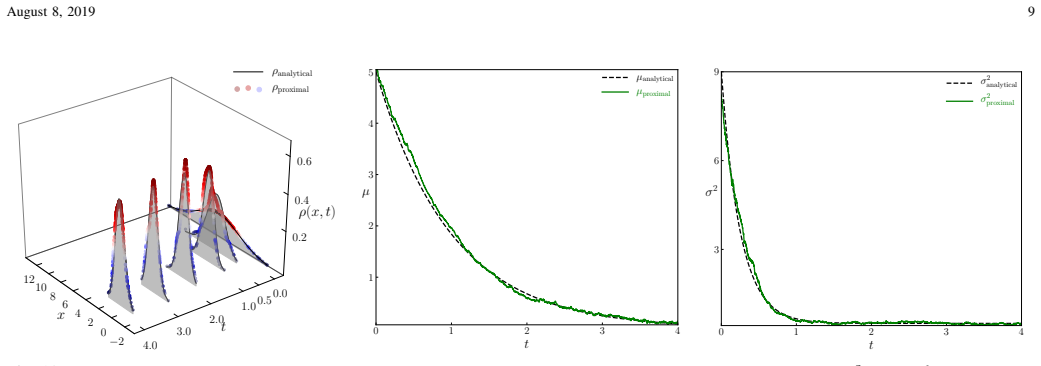
Run the Ornstein-Uhlenbeck benchmark of Section IV-A1 with the same $N=400$ and $\epsilon=5\times 10^{-2}$ while shrinking $h$ from $10^{-2}$ to $10^{-6}$, and compare the proximal weighted mean and variance against the exact formulas $\mu_0 \exp(-at)$ and $(\sigma_0^2 - 1/(a\beta)) \exp(-2at) + 1/(a\beta)$; if the error does not systematically decrease as $h \to 0$, the claimed consistency of the split scheme is false. Separately, compute the Thompson contraction factor of the linear map $z \mapsto \Gamma_k z$ for random positive $z$ with a randomly generated cost matrix $C_k$; if any eigenvalue of the associated projective map has modulus at least one, the asserted Perron-Frobenius strict contractivity fails.
Extended reading notes
Core claim
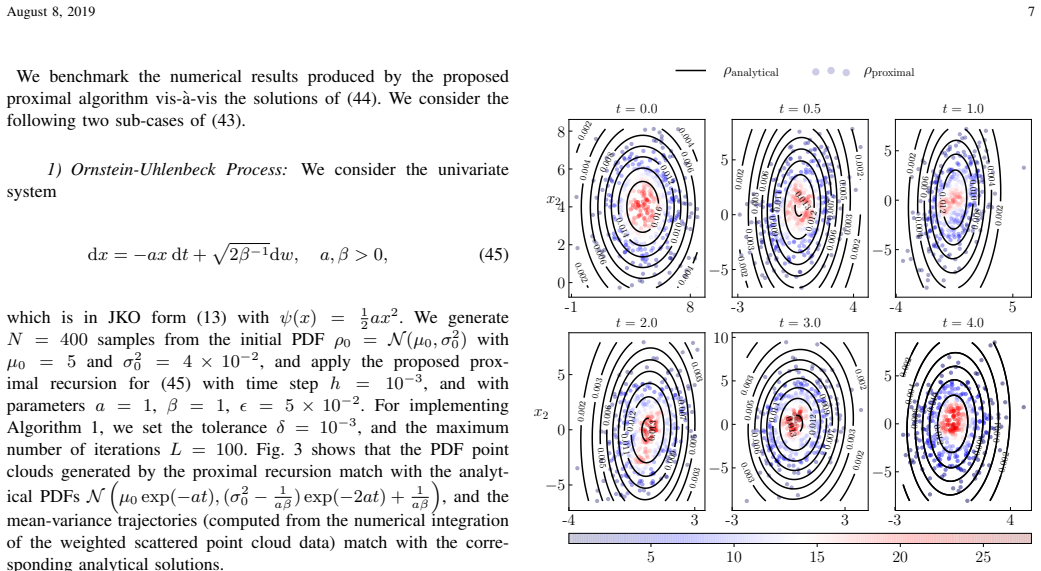
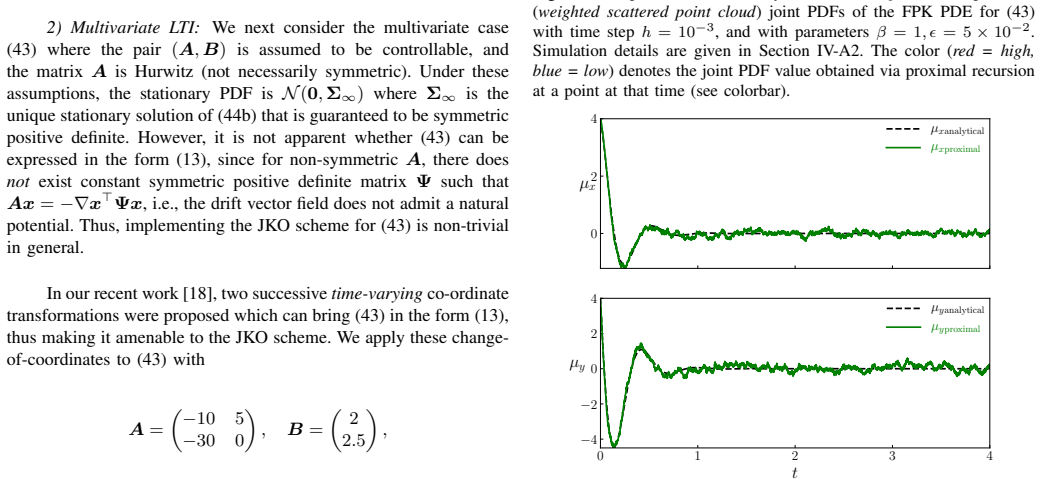
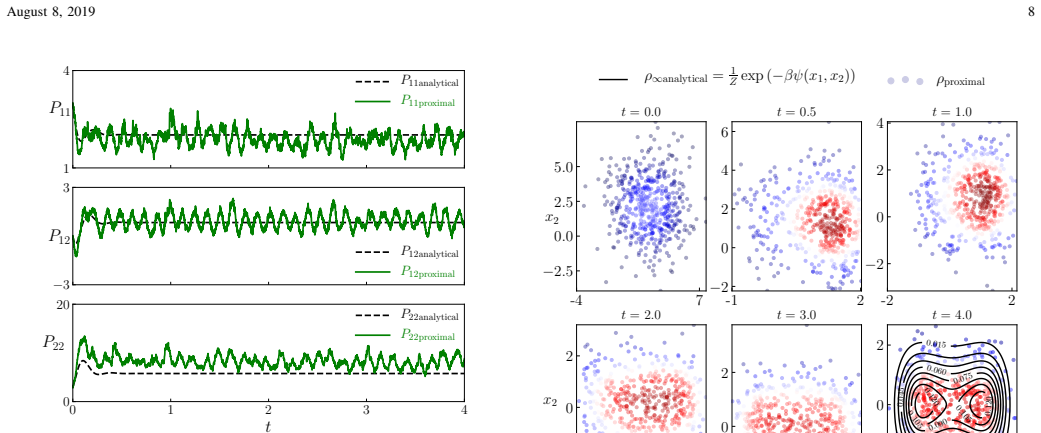
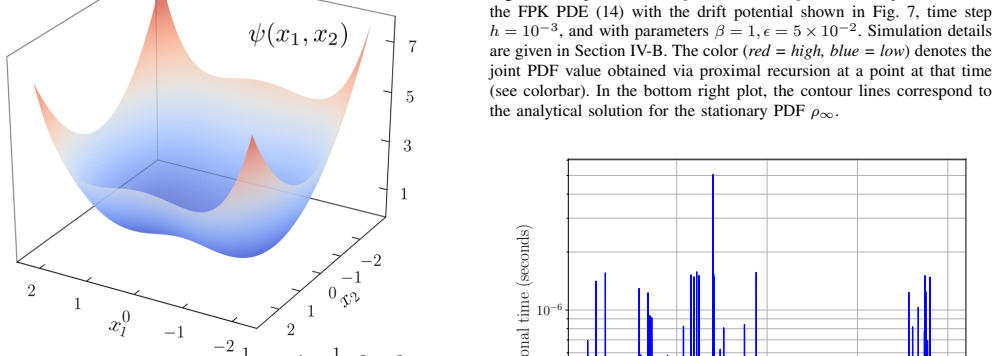
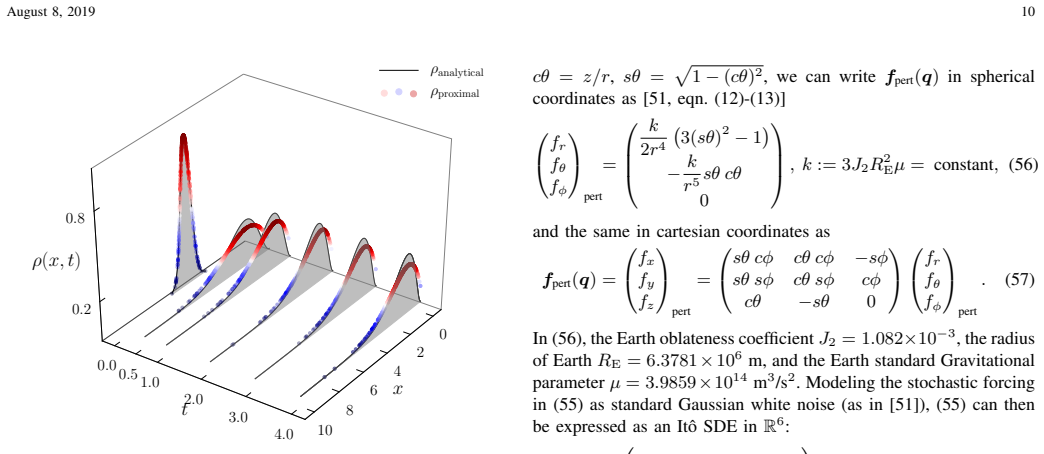
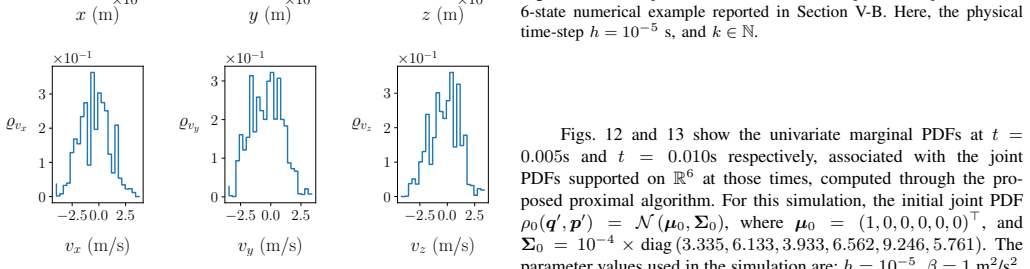
The central claim is that the proximal recursion $\varrho_k = \arg\min_{\varrho} \frac{1}{2} W^2(\varrho_{k-1}, \varrho) + h F(\varrho)$ is computationally tractable in higher dimensions once the transport term is entropy-regularized and dualized. The optimality conditions collapse to the coupled equations $y \odot (\Gamma_k z) = \varrho_{k-1}$ and $z \odot (\Gamma_k^\top y) = \xi_{k-1} \odot z - \beta\epsilon/h$, with the updated density given by $\varrho_k = z \odot (\Gamma_k^\top y)$. The authors prove that the block-coordinate iteration for these equations is strictly contractive in the Thompson metric on the positive orthant, so Algorithm 1 has a unique fixed point and converges; combining this weight update with Euler-Maruyama moves of the particle locations gives the full density-propagation algorithm. They demonstrate the scheme on linear Gaussian systems, a bimodal nonlinear system, a McKean-Vlasov mean-field problem, a multiplicative-noise process via the Lamperti transform, and a six-state mixed conservative-dissipative satellite dynamics example.
Load-bearing premise
The load-bearing premise is that combining Euler-Maruyama point-location updates with the Sinkhorn-style weight updates reproduces the JKO scheme, and hence the Fokker-Planck-Kolmogorov PDE, as the time step $h$ tends to zero; the paper proves contraction of the inner fixed-point iteration but does not prove this outer consistency, and it also asserts rather than proves the Perron-Frobenius strict contraction of $\Gamma_k$.
Editorial extensions
If this is right
- Transient joint PDFs for nonlinear Itô SDEs with gradient drift can be computed as weighted point clouds at a cost that scales with the number of particles, not with the state-space volume, so the method sidesteps the curse of dimensionality.
- Each proximal weight update provably converges to a unique fixed point, giving a deterministic inner loop with a global contraction guarantee for every physical time step.
- Systems outside JKO canonical form, including multiplicative noise and mixed conservative-dissipative drift, can be brought into the framework by coordinate transforms or modified transport cost functions, as shown for the CIR process and a satellite problem.
- The McKean-Vlasov case with interaction potentials is handled by a semi-implicit free energy, so mean-field density evolution is available at the same proximal-scheme cost.
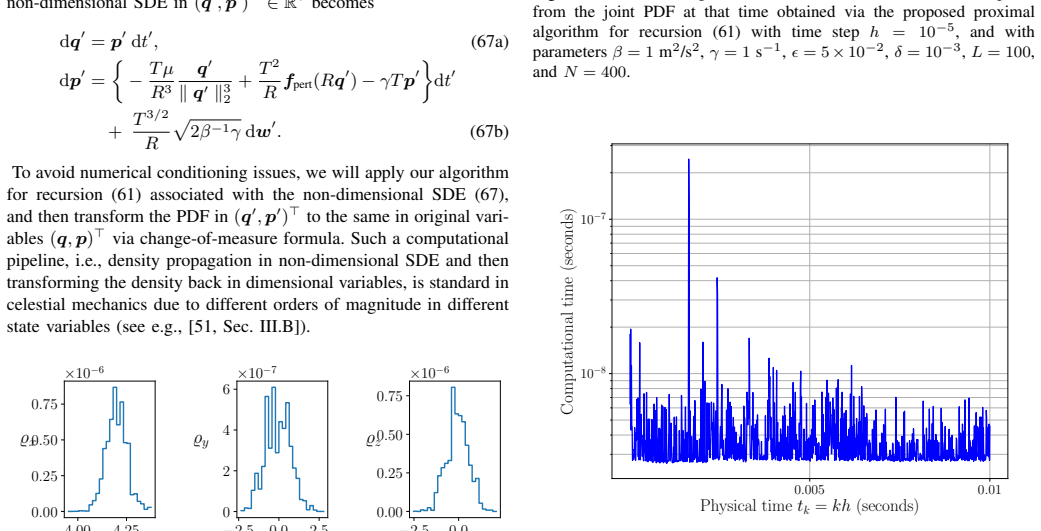
- Reported runtimes near $10^{-6}$ seconds per proximal update at $N=400$, against a physical time step of $10^{-3}$ seconds, indicate the scheme is fast enough for repeated density propagation in filtering and control loops.
Reading between the lines
- If the split scheme is only consistent in the limit $h\to 0$, practical accuracy will depend on the joint tuning of $h$, the regularization $\epsilon$, and particle number $N$; the paper proves contraction of the inner fixed-point iteration but not consistency of the outer split, so the observed accuracy in examples may not hold uniformly across parameters.
- Because the inner iteration is a positive-cone contraction, an adaptive time-stepping rule driven by the measured Thompson contraction rate could reduce the number of physical steps while preserving the fixed-point guarantee.
- The same dual Sinkhorn structure can be applied to nonlinear filtering by replacing the free-energy term with a data-likelihood term, yielding an optimal-transport-based Bayesian update for the prior density propagated by this scheme.
- The fixed-point equations match the structure of entropic optimal transport, so the transient densities computed here may coincide with Schrödinger-bridge interpolations in the small-noise limit, tying uncertainty propagation to stochastic control.
Signed reviews
Editorial analysis
A structured set of objections, weighed in public.
Referee Report
Summary. The paper develops a computational framework for propagating joint probability density functions (PDFs) of stochastic systems described by Fokker-Planck-Kolmogorov (FPK) and McKean-Vlasov equations. The approach is based on the Jordan-Kinderlehrer-Otto (JKO) gradient-flow formulation, discretizing time while keeping the state space continuous. The proposed algorithm represents the density as a weighted point cloud, advances the support points via Euler-Maruyama, and updates the weights by solving an entropic-regularized optimal transport proximal recursion. The inner fixed-point iteration (Algorithm 1) is proved contractive in the Thompson metric (Theorem 3), and numerical examples for linear Gaussian, nonlinear non-Gaussian, McKean-Vlasov, CIR, and a satellite dynamics problem are compared against analytical solutions or stationary densities.
Significance. If the full algorithmic pipeline were proved convergent to the underlying PDEs as the time step tends to zero, the paper would offer a novel, non-parametric, grid-free method for uncertainty propagation that avoids spatial discretization and its curse of dimensionality. The paper contains explicit algorithmic details, benchmarks against known analytical solutions, and timing measurements. However, the theoretical support provided only covers the inner Sinkhorn fixed-point recursion; the consistency of the outer splitting scheme with the JKO flow is not established. This missing analysis currently limits the significance of the central claims, although the numerical evidence suggests the approach may have merit.
major comments (3)
- [III-C and overall] The paper's abstract and introduction claim that the proposed scheme is 'theoretically equivalent to solving the underlying transport PDEs' in the small time-step limit, but the only convergence result proved (Theorem 3 and Corollary 4) concerns the inner fixed-point iteration for fixed h, epsilon, and C_k. No theorem or error estimate connects the two-step update (Euler-Maruyama for positions, then Algorithm 1 for weights) to the JKO scheme or to the FPK/McKean-Vlasov PDE as h tends to zero. The numerical experiments use a single time step h = 10^{-3} and do not report any error-versus-h study, so they do not fill this gap.
- [III-A, Eq. (27)] The entropic regularization parameter epsilon is taken fixed and is not scaled with the time step h. In the objective (27), the term epsilon H(M) is not multiplied by h, whereas hF(rho) is. As h tends to zero with epsilon fixed, the relative weighting changes, and the limit of the proximal step need not be the gradient flow of F. The paper never sends epsilon to zero (e.g., by choosing epsilon = epsilon(h) with a suitable rate) nor proves that the entropically regularized minimizer converges to the unregularized JKO step. Without this, the claimed equivalence of the proximal recursion to the original free-energy gradient flow is not established.
- [III, paragraph before Eq. (23)] There is an inconsistency in the meaning of the weights rho^i_k. The text states that rho^i_k 'denotes the value of the joint PDF evaluated at that point,' but Eq. (23) treats rho as a probability vector in the simplex, so the weights are probability masses summing to one. The discrete free energy in (27), equal to <psi + beta^{-1} log rho, rho>, is the negative entropy of the atomic measure, not the continuous free energy integral rho log rho dx. No convergence analysis is provided to show that the discrete weighted point cloud approximates the continuous density as N grows, which is necessary to justify the claim that the algorithm computes the transient joint PDF.
minor comments (4)
- [Theorem 1, Eq. (33b)] Equation (33b) is typeset ambiguously; it should read z \odot (Gamma_k^\top y) = \xi_{k-1} \odot z^{-\beta\epsilon/h}. The exponent on z is not clearly displayed.
- [Proof of Theorem 3] The statement that the positive linear map Gamma_k is contractive in the Thompson metric 'by Perron-Frobenius theorem' is imprecise; the correct result is Birkhoff's contraction theorem for strictly positive matrices. Since the map theta_1 is already strictly contractive, this claim is not needed for the conclusion.
- [Algorithm 1] The initialization z0 is chosen randomly. The authors could note that the Banach contraction principle guarantees convergence from any initial point in the positive orthant, so the random choice is immaterial to the convergence.
- [Section IV and V] The computational-time plots (Figs. 9 and 14) do not state the hardware and software environment, which makes the timing results difficult to reproduce or compare.
Circularity Check
No circularity: the algorithm is validated against independent analytical solutions, and the JKO equivalence is cited from external prior work; the only gaps are unproved consistency, not circularity.
full rationale
The paper's claimed derivation chain is: (1) the JKO theorem, cited to the external works [21] and [23], states that the Wasserstein proximal recursion with the free energy functional converges to the FPK PDE; (2) the paper discretizes that recursion into a finite-dimensional entropic-regularized optimal transport problem (eq. 27); (3) dualization yields the fixed-point system (33); (4) Algorithm 1 is a block-coordinate iteration proven to converge to that fixed point (Theorem 3, Corollary 4); and (5) the support points are moved by Euler-Maruyama updates (39), with weights updated by Algorithm 1. At no step is the target density used as an input: no parameter is fitted to the reference PDFs, and the numerical benchmarks are independent analytical solutions for the OU process, the multivariate LTI system, and the McKean-Vlasov flow, plus the known stationary Gibbs density for the nonlinear example. The regularization parameter epsilon is fixed by the user, not calibrated to match the output. The contraction proof is internal to the discrete fixed-point map, and the JKO-to-PDE equivalence is an external mathematical result, not an assumption equivalent to the paper's own prediction. The self-citations [18], [19], and [25] are motivational or supply coordinate transformations in the MIMO linear example; they are not invoked as uniqueness theorems forbidding alternatives, and the transforms are externally checkable prior work. The manuscript itself flags the main open issue: no consistency or error estimate connects the Euler-Maruyama/Sinkhorn split to the JKO scheme as h tends to 0 with epsilon fixed, and the proof of Theorem 3 asserts Perron-Frobenius contractivity of Gamma_k without demonstration. Those are correctness and proof-completeness gaps, not circular reductions of the claimed predictions to the inputs.
Assumptions & free parameters
free parameters (4)
- epsilon (entropic regularization) =
5e-2
- time step h =
10^-3 (10^-5 in the satellite example)
- sample count N =
400
- initial PDF approximation for Dirac delta (CIR example) =
N(5, 10^-4)
assumptions (5)
- domain assumption The proximal recursion (9) with d = W2 and Phi = F converges to the FPK flow as h tends to 0 (Jordan-Kinderlehrer-Otto).
- standard math The entropically regularized problem (27) has zero duality gap.
- domain assumption The Euler-Maruyama scheme converges strongly to the SDE solution when the drift is globally Lipschitz.
- standard math A positive linear map Gamma_k is a strict contraction in the Thompson metric on the positive orthant.
- domain assumption The semi-implicit scheme (48) with F(rho_{k-1}, rho) converges to the McKean-Vlasov flow as h tends to 0.
Cite this review
Pith. "Pith review of Gradient Flow Algorithms for Density Propagation in Stochastic Systems." pith.science (2026). https://pith.science/paper/Q5FKVYKE
@misc{pith2026190800533,
  author       = {Pith},
  title        = {Pith review of: Gradient Flow Algorithms for Density Propagation in Stochastic Systems},
  year         = {2026},
  howpublished = {\url{https://pith.science/paper/Q5FKVYKE}},
  note         = {Machine review of arXiv:1908.00533}
}
read the original abstract
We develop a new computational framework to solve the partial differential equations (PDEs) governing the flow of the joint probability density functions (PDFs) in continuous-time stochastic nonlinear systems. The need for computing the transient joint PDFs subject to prior dynamics arises in uncertainty propagation, nonlinear filtering and stochastic control. Our methodology breaks away from the traditional approach of spatial discretization or function approximation -- both of which, in general, suffer from the "curse-of-dimensionality". In the proposed framework, we discretize time but not the state space. We solve infinite dimensional proximal recursions in the manifold of joint PDFs, which in the small time-step limit, is theoretically equivalent to solving the underlying transport PDEs. The resulting computation has the geometric interpretation of gradient flow of certain free energy functional with respect to the Wasserstein metric arising from the theory of optimal mass transport. We show that dualization along with an entropic regularization, leads to a cone-preserving fixed point recursion that is proved to be contractive in Thompson metric. A block co-ordinate iteration scheme is proposed to solve the resulting nonlinear recursions with guaranteed convergence. This approach enables remarkably fast computation for non-parametric transient joint PDF propagation. Numerical examples and various extensions are provided to illustrate the scope and efficacy of the proposed approach.
Figures

Figures from the paper (10 more)


Forward citations
Cited by 1 Pith paper
-
Hopfield Neural Network Flow: A Geometric Viewpoint
Hopfield network dynamics are recast as natural gradient descent with an activation-dependent Riemannian metric, and as a Wasserstein gradient flow in the probability-measure space for the stochastic diffusion machine.
Reference graph
Works this paper leans on
-
[1]
Risken, Fokker-Planck equation: Methods of solution and applica- tions
H. Risken, Fokker-Planck equation: Methods of solution and applica- tions. Springer, 1996
work page 1996
-
[2]
M. Ehrendorfer, “The Liouville equation and its potential usefulness for the prediction of forecast skill. part I: Theory,” Monthly Weather Review, vol. 122, no. 4, pp. 703–713, 1994
work page 1994
-
[3]
A. Halder and R. Bhattacharya, “Beyond Monte Carlo: A computational framework for uncertainty propagation in planetary entry, descent and landing,” in AIAA Guidance, Navigation, and Control Conference, 2010, p. 8029
work page 2010
-
[4]
Dispersion analysis in hypersonic flight during planetary entry using stochastic Liouville equation,
——, “Dispersion analysis in hypersonic flight during planetary entry using stochastic Liouville equation,” Journal of Guidance, Control, and Dynamics, vol. 34, no. 2, pp. 459–474, 2011
work page 2011
-
[5]
Fokker-Planck-equation approach to flow alignment in liquid crystals,
S. Hess, “Fokker-Planck-equation approach to flow alignment in liquid crystals,”Zeitschrift f¨ur Naturforschung A, vol. 31, no. 9, pp. 1034–1037, 1976
work page 1976
-
[6]
W. Muschik and B. Su, “Mesoscopic interpretation of Fokker-Planck equation describing time behavior of liquid crystal orientation,” The Journal of Chemical Physics , vol. 107, no. 2, pp. 580–584, 1997
work page 1997
-
[7]
Y . P. Kalmykov and W. T. Coffey, “Analytical solutions for rotational diffusion in the mean field potential: application to the theory of dielectric relaxation in nematic liquid crystals,” Liquid crystals, vol. 25, no. 3, pp. 329–339, 1998
work page 1998
-
[8]
Diffusion-based motion planning for a nonholonomic flexible needle model,
W. Park, J. S. Kim, Y . Zhou, N. J. Cowan, A. M. Okamura, and G. S. Chirikjian, “Diffusion-based motion planning for a nonholonomic flexible needle model,” in Robotics and Automation, 2005. ICRA 2005. Proceedings of the 2005 IEEE International Conference on . IEEE, 2005, pp. 4600–4605
work page 2005
Show all 52 references
-
[9]
Kinematic state estimation and motion planning for stochastic nonholonomic sys- tems using the exponential map,
W. Park, Y . Liu, Y . Zhou, M. Moses, and G. S. Chirikjian, “Kinematic state estimation and motion planning for stochastic nonholonomic sys- tems using the exponential map,” Robotica, vol. 26, no. 4, pp. 419–434, 2008
2008
-
[10]
A framework of space–time continuous models for algorithm design in swarm robotics,
H. Hamann and H. W ¨orn, “A framework of space–time continuous models for algorithm design in swarm robotics,” Swarm Intelligence , vol. 2, no. 2-4, pp. 209–239, 2008
2008
-
[11]
Nonlinear filter design using Fokker- Planck-Kolmogorov probability density evolutions,
S. Challa and Y . Bar-Shalom, “Nonlinear filter design using Fokker- Planck-Kolmogorov probability density evolutions,” IEEE Transactions on Aerospace and Electronic Systems, vol. 36, no. 1, pp. 309–315, 2000
2000
-
[12]
Nonlinear filters: beyond the Kalman filter,
F. Daum, “Nonlinear filters: beyond the Kalman filter,” IEEE Aerospace and Electronic Systems Magazine , vol. 20, no. 8, pp. 57–69, 2005
2005
-
[13]
Model validation: A probabilistic formulation,
A. Halder and R. Bhattacharya, “Model validation: A probabilistic formulation,” inDecision and Control and European Control Conference (CDC-ECC), 2011 50th IEEE Conference on . IEEE, 2011, pp. 1692– 1697
2011
-
[14]
Further results on probabilistic model validation in Wasserstein metric,
——, “Further results on probabilistic model validation in Wasserstein metric,” in Decision and Control (CDC), 2012 IEEE 51st Annual Conference on. IEEE, 2012, pp. 5542–5547
2012
-
[15]
Probabilistic model validation for uncertain nonlinear systems,
——, “Probabilistic model validation for uncertain nonlinear systems,” Automatica, vol. 50, no. 8, pp. 2038–2050, 2014
2014
-
[16]
Optimal transport approach for probabilistic robustness analysis of F-16 controllers,
A. Halder, K. Lee, and R. Bhattacharya, “Optimal transport approach for probabilistic robustness analysis of F-16 controllers,” Journal of Guidance, Control, and Dynamics, vol. 38, no. 10, pp. 1935–1946, 2015
1935
-
[17]
R. E. Bellman, Dynamic Programming. Courier Dover Publications, 1957
1957
-
[18]
Gradient flows in uncertainty propagation and filtering of linear Gaussian systems,
A. Halder and T. T. Georgiou, “Gradient flows in uncertainty propagation and filtering of linear Gaussian systems,” 2017 IEEE Conference on Decision and Control, arXiv preprint arXiv:1704.00102 , 2017
2017 arXiv
-
[19]
Gradient flows in filtering and Fisher-Rao geometry,
——, “Gradient flows in filtering and Fisher-Rao geometry,” in 2018 Annual American Control Conference (ACC) . IEEE, 2018, pp. 4281– 4286
2018
-
[20]
Proximal algorithms,
N. Parikh, S. Boyd et al. , “Proximal algorithms,” Foundations and Trends R© in Optimization, vol. 1, no. 3, pp. 127–239, 2014
2014
-
[21]
The variational formulation of the Fokker–Planck equation,
R. Jordan, D. Kinderlehrer, and F. Otto, “The variational formulation of the Fokker–Planck equation,” SIAM Journal on Mathematical Analysis , vol. 29, no. 1, pp. 1–17, 1998
1998
-
[22]
Villani, Topics in optimal transportation
C. Villani, Topics in optimal transportation . American Mathematical Soc., 2003, no. 58. August 8, 2019 13
2003
-
[23]
Ambrosio, N
L. Ambrosio, N. Gigli, and G. Savar ´e, Gradient flows: in metric spaces and in the space of probability measures . Springer Science & Business Media, 2008
2008
-
[24]
{Euclidean, metric, and Wasserstein} gradient flows: an overview,
F. Santambrogio, “{Euclidean, metric, and Wasserstein} gradient flows: an overview,” Bulletin of Mathematical Sciences , vol. 7, no. 1, pp. 87– 154, 2017
2017
-
[25]
Proximal recursion for solving the Fokker- Planck equation,
K. F. Caluya and A. Halder, “Proximal recursion for solving the Fokker- Planck equation,” in 2019 Annual American Control Conference (ACC) , 2019
2019
-
[26]
A computational fluid mechanics so- lution to the monge-kantorovich mass transfer problem,
J.-D. Benamou and Y . Brenier, “A computational fluid mechanics so- lution to the monge-kantorovich mass transfer problem,” Numerische Mathematik, vol. 84, no. 3, pp. 375–393, 2000
2000
-
[27]
Nonlocal crowd dynamics models for several populations,
R. M. Colombo and M. L ´ecureux-Mercier, “Nonlocal crowd dynamics models for several populations,” Acta Mathematica Scientia , vol. 32, no. 1, pp. 177–196, 2012
2012
-
[28]
The bounded confidence model of opinion dynamics,
J. Gomez-Serrano, C. Graham, and J.-Y . Le Boudec, “The bounded confidence model of opinion dynamics,” Mathematical Models and Methods in Applied Sciences , vol. 22, no. 02, p. 1150007, 2012
2012
-
[29]
Stability theory of stochastic models in opinion dynamics,
Z. Askarzadeh, R. Fu, A. Halder, Y . Chen, and T. T. Georgiou, “Stability theory of stochastic models in opinion dynamics,” IEEE Transactions on Automatic Control, doi: https://doi.org/10.1109/TAC.2019.2912490 , 2019
2019
-
[30]
Trend to equilibrium for dissipative equations, functional inequalities and mass transportation,
C. Villani, “Trend to equilibrium for dissipative equations, functional inequalities and mass transportation,” Contemporary Mathematics, vol. 353, p. 95, 2004
2004
-
[31]
Kinetic equilibration rates for granular media and related equations: entropy dissipation and mass transportation estimates,
J. A. Carrillo, R. J. McCann, and C. Villani, “Kinetic equilibration rates for granular media and related equations: entropy dissipation and mass transportation estimates,” Revista Matem ´atica Iberoamericana, vol. 19, no. 3, pp. 971–1018, 2003
2003
-
[32]
Generalized Sinkhorn iterations for regular- izing inverse problems using optimal mass transport,
J. Karlsson and A. Ringh, “Generalized Sinkhorn iterations for regular- izing inverse problems using optimal mass transport,” SIAM Journal on Imaging Sciences, vol. 10, no. 4, pp. 1935–1962, 2017
1935
-
[33]
Sinkhorn distances: Lightspeed computation of optimal transport,
M. Cuturi, “Sinkhorn distances: Lightspeed computation of optimal transport,” in Advances in neural information processing systems , 2013, pp. 2292–2300
2013
-
[34]
Iterative Bregman projections for regularized transportation problems,
J.-D. Benamou, G. Carlier, M. Cuturi, L. Nenna, and G. Peyr ´e, “Iterative Bregman projections for regularized transportation problems,” SIAM Journal on Scientific Computing, vol. 37, no. 2, pp. A1111–A1138, 2015
2015
-
[35]
Entropic and displacement interpolation: a computational approach using the Hilbert metric,
Y . Chen, T. Georgiou, and M. Pavon, “Entropic and displacement interpolation: a computational approach using the Hilbert metric,” SIAM Journal on Applied Mathematics , vol. 76, no. 6, pp. 2375–2396, 2016
2016
-
[36]
On the relation between optimal transport and Schr ¨odinger bridges: A stochastic control viewpoint,
Y . Chen, T. T. Georgiou, and M. Pavon, “On the relation between optimal transport and Schr ¨odinger bridges: A stochastic control viewpoint,” Journal of Optimization Theory and Applications , vol. 169, no. 2, pp. 671–691, 2016
2016
-
[37]
P. E. Kloeden and E. Platen, Numerical solution of stochastic differential equations. Springer Science & Business Media, 2013, vol. 23
2013
-
[38]
Strong and weak diver- gence in finite time of Euler’s method for stochastic differential equations with non-globally Lipschitz continuous coefficients,
M. Hutzenthaler, A. Jentzen, and P. E. Kloeden, “Strong and weak diver- gence in finite time of Euler’s method for stochastic differential equations with non-globally Lipschitz continuous coefficients,” Proceedings of the Royal Society A: Mathematical, Physical and Engineering S...
2010
-
[39]
Strong convergence of an explicit numerical method for SDEs with nonglobally Lipschitz continuous coefficients,
M. Hutzenthaler, A. Jentzen, P. E. Kloeden et al., “Strong convergence of an explicit numerical method for SDEs with nonglobally Lipschitz continuous coefficients,” The Annals of Applied Probability , vol. 22, no. 4, pp. 1611–1641, 2012
2012
-
[40]
Hutzenthaler and A
M. Hutzenthaler and A. Jentzen, Numerical approximations of stochastic differential equations with non-globally Lipschitz continuous coefficients. American Mathematical Society, 2015, vol. 236, no. 1112
2015
-
[41]
Strong convergence of Euler-type methods for nonlinear stochastic differential equations,
D. J. Higham, X. Mao, and A. M. Stuart, “Strong convergence of Euler-type methods for nonlinear stochastic differential equations,”SIAM Journal on Numerical Analysis , vol. 40, no. 3, pp. 1041–1063, 2002
2002
-
[42]
On certain contraction mappings in a partially ordered vector space,
A. C. Thompson, “On certain contraction mappings in a partially ordered vector space,” Proceedings of the American Mathematical Society , vol. 14, no. 3, pp. 438–443, 1963
1963
-
[43]
Nonlinear equations based on jointly homogeneous mappings,
Y . Lim, “Nonlinear equations based on jointly homogeneous mappings,” Linear Algebra and Its Applications, vol. 430, no. 1, pp. 279–285, 2009
2009
-
[44]
R. D. Nussbaum and D. Hilbert, Hilbert’s projective metric and iterated nonlinear maps. American Mathematical Soc., 1988, vol. 391
1988
-
[45]
Uniform propagation of chaos for McKean-Vlasov equations,
F. Malrieu, “Uniform propagation of chaos for McKean-Vlasov equations,” https://tinyurl.com/ycxk5g9t, 2011, [Online; accessed 18- November-2018]
2011
-
[46]
An augmented Lagrangian approach to Wasserstein gradient flows and applications,
J.-D. Benamou, G. Carlier, and M. Laborde, “An augmented Lagrangian approach to Wasserstein gradient flows and applications,” ESAIM: Pro- ceedings and Surveys , vol. 54, pp. 1–17, 2016
2016
-
[47]
On some nonlinear evolution systems which are pertur- bations of Wasserstein gradient flows,
M. Laborde, “On some nonlinear evolution systems which are pertur- bations of Wasserstein gradient flows,” Topological Optimization and Optimal Transport: In the Applied Sciences , vol. 17, p. 304, 2017
2017
-
[48]
A theory of the term structure of interest rates,
J. C. Cox, J. E. Ingersoll Jr, and S. A. Ross, “A theory of the term structure of interest rates,” Econometrica, vol. 53, no. 2, pp. 385–408, 1985
1985
-
[49]
J. K. Møller and H. Madsen, From state dependent diffusion to constant diffusion in stochastic differential equations by the Lamperti transform . DTU Informatics, 2010
2010
-
[50]
Functional quantization of a class of Brownian diffusions: a constructive approach,
H. Luschgy and G. Pag `es, “Functional quantization of a class of Brownian diffusions: a constructive approach,” Stochastic Processes and their Applications, vol. 116, no. 2, pp. 310–336, 2006
2006
-
[51]
Uncertainty forecasting in the perturbed two- body problem via tensor decomposition,
Y . Sun and M. Kumar, “Uncertainty forecasting in the perturbed two- body problem via tensor decomposition,” in American Control Confer- ence (ACC), 2016 . IEEE, 2016, pp. 5431–5436
2016
-
[52]
Conservative-dissipative approximation schemes for a generalized Kramers equation,
M. H. Duong, M. A. Peletier, and J. Zimmer, “Conservative-dissipative approximation schemes for a generalized Kramers equation,” Mathemat- ical Methods in the Applied Sciences , vol. 37, no. 16, pp. 2517–2540, 2014
2014
Reviewed August 14, 2026 · model on record in the stance chip above.
Discussion (0). Continue with ORCID to comment.