REVIEW 3 major objections 5 minor 93 references
Benchmarking the Robustness of Semantic Segmentation Models
T0 review · 3 major / 5 minor · reviewed 2026-08-14 · deepseek-v4-flash
Pith's one-line read The paper establishes that, within DeepLabv3+, semantic segmentation models that are more accurate on clean images are usually also more robust to realistic image corruptions, with Xception-71 the most robust backbone and the Dense…
desk verdict A careful, large-scale robustness benchmark for segmentation that produces usable design rules, but its reliance on unvalidated synthetic corruptions and single training runs means the headline trend should be read as a strong empirical observation, not a law. read the letter →
The pith
A machine-rendered reading of the paper's core claim, the machinery that carries it, and where it could break.
The reading
What carries the argument
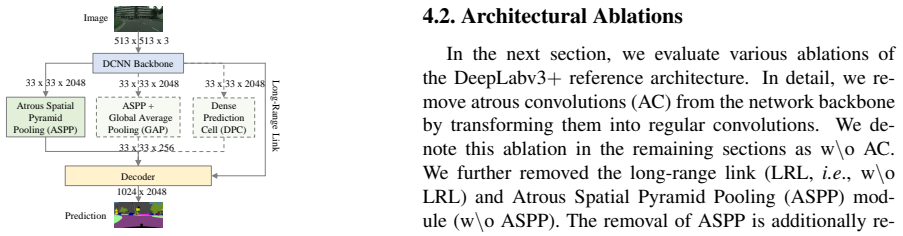
The load-bearing object is the DeepLabv3+ model family used as a controlled testbed: six network backbones (MobileNet-V2, ResNet-50, ResNet-101, Xception-41, Xception-65, Xception-71), each with five architectural ablations (removing atrous convolutions, removing the atrous spatial pyramid pooling module, replacing it with a Dense Prediction Cell, removing the long-range link, and adding global average pooling), all retrained on clean data. Robustness is measured by Corruption Degradation, the sum of mIoU losses over severity levels divided by the same sum for a reference model, and by relative Corruption Degradation, which subtracts the clean-data loss. These metrics turn a large corruption suite into per-property comparisons, isolating the effect of a single architectural change.
What would settle it
Take a camera with measured sensor noise and lens point-spread function, capture the same Cityscapes-like scenes clean and degraded, and rerun the six backbones and the Dense Prediction Cell ablation. If Xception-71 no longer has the lowest corruption degradation, or if the Dense Prediction Cell variant no longer degrades more than the reference model, the paper's central ranking fails outside its synthetic benchmark.
Extended reading notes
Core claim
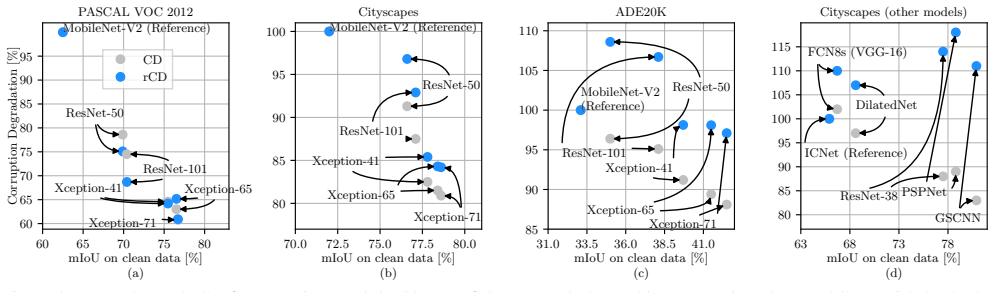
On the paper's own terms, the discovery is that robustness to image corruptions in DeepLabv3+ semantic segmentation is governed by two factors: backbone strength and architectural module choice. Across Cityscapes, PASCAL VOC 2012, and ADE20K, corruption degradation generally shrinks as clean mean intersection-over-union grows, so the most accurate backbones are usually the most robust, in contrast to the pattern reported for ImageNet classifiers. Atrous convolutions and the long-range link help against blur, noise, and geometric distortion, and the atrous spatial pyramid pooling module is important for decent overall performance. The Dense Prediction Cell, designed purely to maximize clean-data accuracy, consistently reduces robustness, especially for Xception-71, suggesting that clean-only neural architecture search can overfit to the clean objective.
Load-bearing premise
The entire ranking rests on the assumption that the nineteen synthetic corruptions, including the new intensity-dependent noise and PSF blur, behave like the distortions a real deployed camera produces, and the paper does not validate that correspondence against physical camera images.
Editorial extensions
If this is right
- Practitioners can usually select the most accurate DeepLabv3+ backbone, Xception-71, without paying a robustness penalty, since it has the lowest corruption degradation on all three datasets.
- Atrous convolutions should be kept in segmentation backbones: removing them consistently increases degradation under blur, noise, and geometric distortion on Cityscapes.
- The atrous spatial pyramid pooling module is structurally important for robustness, not just accuracy; removing it raises corruption degradation across datasets and backbones.
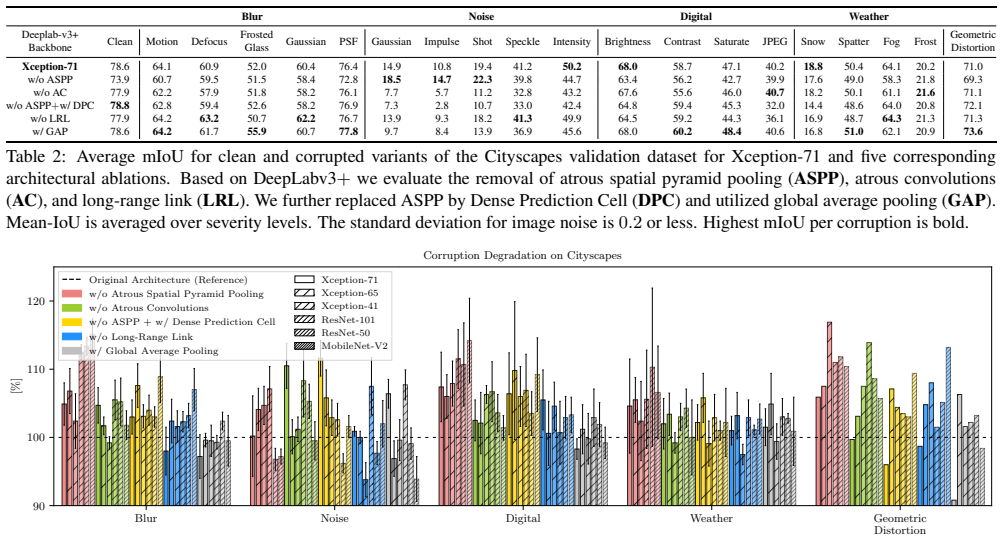
- Deploying a Dense Prediction Cell in safety-critical settings is risky: it wins on clean mIoU for Xception-71 but raises corruption degradation to roughly 109 to 115 percent for noise and similar levels for other corruptions.
- Because clean accuracy and robustness are positively correlated within this architecture, robustness does not have to be traded against performance when selecting segmentation backbones.
Reading between the lines
- A testable extension is to feed the same corruption suite to other neural-architecture-search-derived modules: if the Dense Prediction Cell result generalizes, clean-only search objectives should be expected to systematically overfit to clean images, and robustness should become a search objective.
- The paper's shape-bias speculation invites a direct experiment: measure whether Xception backbones classify corrupted Cityscapes objects with more shape reliance than ResNet backbones, and whether that predicts their robustness advantage.
- The new intensity-dependent noise model and PSF blur are generated synthetically, so an obvious next check is whether the same rankings survive on images from a real camera whose sensor noise and lens aberrations were measured, since the benchmark does not validate its corruptions against physical captures.
- If the positive performance-robustness relationship holds for other segmentation architectures, model selection for autonomous driving could use clean mIoU as a rough robustness proxy, reducing the need for exhaustive corruption testing.
Signed reviews
Editorial analysis
A structured set of objections, weighed in public.
Referee Report
Summary. The paper presents a large-scale robustness benchmark for semantic segmentation, centered on DeepLabv3+ with six network backbones and five architectural ablations, evaluated on Cityscapes, PASCAL VOC 2012, and ADE20K. The corruption suite combines 15 ImageNet-C corruptions with three newly proposed degradations (intensity-dependent camera noise, spatially varying PSF blur, and geometric distortion), yielding almost 400,000 corrupted validation images. Robustness is measured using Corruption Degradation (CD) and relative Corruption Degradation (rCD). The two central claims are that, contrary to full-image classification, DeepLabv3+ robustness often increases with clean-data performance (with Xception-71 the most robust backbone), and that specific architectural properties matter: atrous convolutions and the long-range link generally help, while the Dense Prediction Cell hurts robustness despite improving clean accuracy.
Significance. If the claims hold, this is one of the first and most extensive robustness studies for semantic segmentation, and it provides actionable architectural guidance for deploying segmentation models in safety-critical settings. The paper's strengths are its scale (102 retrained models, three datasets, 19 corruptions), its consistent evaluation protocol, the explicit separation of CD and rCD, and the qualitative and quantitative ablation evidence. The proposed realistic noise and PSF blur models are a step beyond standard Gaussian-only corruptions. However, the external validity of the benchmark depends crucially on whether the synthetic corruptions faithfully represent real camera degradations, and the statistical support for some design rules is currently weak because each configuration is trained only once.
major comments (3)
- [Section 3.2 (Eq. 3); Section 3.1] The proposed 'more realistic' corruptions are not validated against real camera data, although the introduction and abstract motivate the benchmark with practical applications such as autonomous driving. The intensity-dependent noise model in Eq. (3) has a free severity parameter w_s but no fit to measured sensor noise (e.g., dark-frame or flat-field statistics), the PSF kernels are generated with Zemax without comparison to a real lens PSF, and the severity calibration is provided only for the noise category (Table A.1); blur, weather, digital, and geometric severities have no SNR or perceptual anchor. Since the headline trend and the design rules (atrous helps, DPC hurts) are averages over these synthetic corruptions, the transfer to deployment is an unsubstantiated leap. I ask for a quantitative validation of the new corruption models against real camera outputs, or for the conclusions to be explicitly restricted to the synthetic corruption suite.
- [Section 5.3 (Table 2)] The text states that the most distinct 'statistically significant' results are discussed, but no significance test is reported anywhere and each architecture/ablation is trained only once. Table 2 reports a standard deviation for image noise of 0.2 or less, yet no test statistic, confidence interval, or number of repeated runs is given. Several conclusions rest on small CD differences, especially on ADE20K where the mean CD for most ablations is within 1-2% of 100 (Tables B.9-B.10). The authors should either provide repeated training runs with a paired test over corruptions or rephrase the claim as 'consistent differences' and remove the term 'statistically significant'; otherwise the proposed design rules may be partly driven by optimization noise.
- [Section 5.2 (Fig. 4)] The central claim that robustness increases with model performance contrasts the DeepLabv3+ backbone results with results for full-image classification, but the comparison mixes architecture family and task. For non-DeepLab segmentation models in Fig. 4(d), the CD decreases with clean performance while the rCD stays above 100% - the same pattern the authors attribute to classification. The 'most cases' wording is honest, but the claim should identify explicitly that the positive performance-robustness correlation is an intra-architecture finding for DeepLabv3+ with MobileNet-V2 as reference, not a general property of semantic segmentation models. Please make this scope explicit in the abstract and conclusions.
minor comments (5)
- [Eqs. (1)-(2)] Equations (1) and (2) sum over s=1 to 5, while the text and table captions state that only the first three severity levels are used for the noise category; please define an explicit severity set in the equation or add a sentence explaining the convention.
- [Table 1 / Section 3.2] PSF blur is described as having three severity levels and geometric distortion has no severity levels, but Table 1 reports an 'average mIoU' for each corruption without explaining how the averaging over severity is performed for these two corruptions; please clarify.
- [Table 2 caption] The statement 'The standard deviation for image noise is 0.2 or less' is ambiguous: it is unclear whether this is a deviation across images, across severity levels, or across training runs. Please state the source and computation explicitly.
- [Fig. 4] The panels label the y-axis 'Corruption Degradation [%]' but plot both CD and rCD, and each legend repeats the reference model name; please split or relabel the panels to avoid confusion.
- [Section 5.3] The notation w\o, w/, and w\DPC is visually error-prone; using standard text such as 'without AC' and 'with DPC' would improve readability.
Circularity Check
No circularity: the robustness benchmark reports measured mIoU/CD/rCD values, and the headline performance-robustness trend is an empirical observation, not a consequence of the definitions or of any self-citation.
full rationale
This paper is an empirical benchmark study. The central claims—that DeepLabv3+ robustness often increases with clean mIoU, that atrous convolutions help against blur and noise, and that DPC reduces robustness—are read off from measured mIoU tables (Tables 1 and 2) and from Corruption Degradation (CD) / relative Corruption Degradation (rCD) values computed via Eqs. (1) and (2). CD and rCD are ratio metrics that normalize a model's degradation by a reference model's degradation, but nothing in these definitions forces the observed ordering of backbones or the ablation effects; the correlation with clean performance is an empirical result about the trained models, not an identity. The synthetic corruption suite (ImageNet-C plus the proposed intensity-dependent noise, PSF blur, and geometric distortion) is a benchmark construction, and its realism relative to real cameras is a legitimate external-validity concern, but it is not a circularity: the results are measured performance under that suite, not quantities fitted to reproduce the conclusion. No parameter is fitted to a subset of the robustness data and then renamed a prediction, no uniqueness theorem is imported from the authors' prior work, and the references contain no load-bearing self-citation chain. The paper is self-contained as a benchmark evaluation, so no circular step is present.
Assumptions & free parameters
free parameters (1)
- Intensity-dependent noise strength w_s =
One value per severity level (1-5), not disclosed numerically
assumptions (3)
- domain assumption mIoU, CD, and rCD as defined in Equations 1 and 2 are adequate measures of robustness for ranking models.
- domain assumption The ImageNet-C corruptions and the proposed intensity noise, PSF blur, and geometric distortion represent realistic input degradation.
- ad hoc to paper A single training run per configuration is sufficient to support statements about statistically significant differences in robustness.
Cite this review
Pith. "Pith review of Benchmarking the Robustness of Semantic Segmentation Models." pith.science (2026). https://pith.science/paper/Q5QHATKU
@misc{pith2026190805005,
  author       = {Pith},
  title        = {Pith review of: Benchmarking the Robustness of Semantic Segmentation Models},
  year         = {2026},
  howpublished = {\url{https://pith.science/paper/Q5QHATKU}},
  note         = {Machine review of arXiv:1908.05005}
}
read the original abstract
When designing a semantic segmentation module for a practical application, such as autonomous driving, it is crucial to understand the robustness of the module with respect to a wide range of image corruptions. While there are recent robustness studies for full-image classification, we are the first to present an exhaustive study for semantic segmentation, based on the state-of-the-art model DeepLabv3+. To increase the realism of our study, we utilize almost 400,000 images generated from Cityscapes, PASCAL VOC 2012, and ADE20K. Based on the benchmark study, we gain several new insights. Firstly, contrary to full-image classification, model robustness increases with model performance, in most cases. Secondly, some architecture properties affect robustness significantly, such as a Dense Prediction Cell, which was designed to maximize performance on clean data only.
Figures


Figures from the paper (2 more)
Reference graph
Works this paper leans on
-
[1]
Mur- ray, Benoit Steiner, Paul Tucker, Vijay Vasudevan, Pete War- den, Martin Wicke, Yuan Yu, and Xiaoqiang Zheng
Martin Abadi, Paul Barham, Jianmin Chen, Zhifeng Chen, Andy Davis, Jeffrey Dean, Matthieu Devin, Sanjay Ghe- mawat, Geoffrey Irving, Michael Isard, Manjunath Kudlur, Josh Levenberg, Rajat Monga, Sherry Moore, Derek G. Mur- ray, Benoit Steiner, Paul Tucker, Vijay Vasudevan, Pete War- den, Martin Wicke, Yuan Yu, and Xiaoqiang Zheng. Tensor- Flow: A system f...
2016
-
[2]
Anurag Arnab, Ondrej Miksik, and Philip H. S. Torr. On the Robustness of Semantic Segmentation Models to Adversar- ial Attacks. In CVPR, 2018
2018
-
[3]
Aharon Azulay and Yair Weiss. Why do deep convolutional networks generalize so poorly to small image transforma- tions? CoRR, abs/1805.12177, 2018
arXiv 2018
-
[4]
SegNet: A Deep Convolutional Encoder-Decoder Architec- ture for Image Segmentation
Vijay Badrinarayanan, Alex Kendall, and Roberto Cipolla. SegNet: A Deep Convolutional Encoder-Decoder Architec- ture for Image Segmentation. In PAMI, 2017
2017
-
[5]
Learning to Remove Rain in Traf- fic Surveillance by Using Synthetic Data
Chris H Bahnsen, David Vzquez, Antonio M Lpez, and Thomas B Moeslund. Learning to Remove Rain in Traf- fic Surveillance by Using Synthetic Data. In VISI-GRAPP, 2019
2019
-
[6]
CNN-Cert: An Efficient Framework for Certifying Robustness of Convolutional Neural Networks
Akhilan Boopathy, Tsui-Wei Weng, Pin-Yu Chen, Sijia Liu, and Luca Daniel. CNN-Cert: An Efficient Framework for Certifying Robustness of Convolutional Neural Networks. In AAAI, Jan. 2019
2019
-
[7]
DeepCorrect: Correcting DNN models against Image Distortions
Tejas S. Borkar and Lina J. Karam. DeepCorrect: Correcting DNN models against Image Distortions. arXiv:1705.02406 [cs.CV], 2017
work page Pith review arXiv 2017
-
[8]
Adversarial Examples Are Not Easily Detected: Bypassing Ten Detection Methods
Nicholas Carlini and David Wagner. Adversarial Examples Are Not Easily Detected: Bypassing Ten Detection Methods. In Proceedings of the 10th ACM Workshop on Artificial In- telligence and Security, AISec ’17, pages 3–14, New York, NY , USA, 2017. ACM
2017
Show all 93 references
-
[9]
Nicholas Carlini and David A. Wagner. Towards Evaluating the Robustness of Neural Networks. 2017 IEEE Symposium on Security and Privacy (SP), 2017
2017
-
[10]
Collins, Yukun Zhu, George Papandreou, Barret Zoph, Florian Schroff, Hartwig Adam, and Jonathon Shlens
Liang-Chieh Chen, Maxwell D. Collins, Yukun Zhu, George Papandreou, Barret Zoph, Florian Schroff, Hartwig Adam, and Jonathon Shlens. Searching for Efficient Multi-Scale Ar- chitectures for Dense Image Prediction. In NIPS, 2018
2018
-
[11]
Liang-Chieh Chen, George Papandreou, Iasonas Kokkinos, Kevin Murphy, and Alan L. Yuille. Semantic Image Segmen- tation with Deep Convolutional Nets and Fully Connected CRFs. In ICLR, volume abs/1412.7062, 2015
2015 arXiv
-
[12]
Liang-Chieh Chen, George Papandreou, Iasonas Kokkinos, Kevin Murphy, and Alan L. Yuille. DeepLab: Semantic Image Segmentation with Deep Convolutional Nets, Atrous Convolution, and Fully Connected CRFs. In TPAMI, 2017
2017
-
[13]
Rethinking Atrous Convolution for Seman- tic Image Segmentation, 2017
Liang-Chieh Chen, George Papandreou, Florian Schroff, and Hartwig Adam. Rethinking Atrous Convolution for Seman- tic Image Segmentation, 2017
2017
-
[14]
Encoder-Decoder with Atrous Separable Convolution for Semantic Image Segmentation
Liang-Chieh Chen, Yukun Zhu, George Papandreou, Florian Schroff, and Hartwig Adam. Encoder-Decoder with Atrous Separable Convolution for Semantic Image Segmentation. In ECCV, 2018
2018
-
[15]
Domain adaptive faster r-cnn for object de- tection in the wild
Yuhua Chen, Wen Li, Christos Sakaridis, Dengxin Dai, and Luc Van Gool. Domain adaptive faster r-cnn for object de- tection in the wild. In CVPR, pages 3339–3348, 2018
2018
-
[16]
Xception: Deep Learning with Depthwise Separable Convolutions
Francois Chollet. Xception: Deep Learning with Depthwise Separable Convolutions. In CVPR, 2017
2017
-
[17]
Parseval Networks: Improv- ing Robustness to Adversarial Examples
Moustapha Cisse, Piotr Bojanowski, Edouard Grave, Yann Dauphin, and Nicolas Usunier. Parseval Networks: Improv- ing Robustness to Adversarial Examples. In Doina Precup and Yee Whye Teh, editors, Proceedings of the 34th Inter- national Conference on Machine Learning , Proceedin...
2017
-
[18]
The Cityscapes Dataset for Semantic Urban Scene Understanding
Marius Cordts, Mohamed Omran, Sebastian Ramos, Timo Rehfeld, Markus Enzweiler, Rodrigo Benenson, Uwe Franke, Stefan Roth, and Bernt Schiele. The Cityscapes Dataset for Semantic Urban Scene Understanding. In CVPR, 2016
2016
-
[19]
Le.Intriguing Properties of Adversarial Exam- ples
Ekin Dogus Cubuk, Barret Zoph, Samuel Stern Schoenholz, and Quoc V . Le.Intriguing Properties of Adversarial Exam- ples. 2018
2018
-
[20]
Dark model adaptation: Semantic image segmentation from daytime to nighttime
Dengxin Dai and Luc Van Gool. Dark model adaptation: Semantic image segmentation from daytime to nighttime. In ITSC, pages 3819–3824. IEEE, 2018
2018
-
[21]
J. Deng, W. Dong, R. Socher, L.-J. Li, K. Li, and L. Fei-Fei. ImageNet: A Large-Scale Hierarchical Image Database. In CVPR, 2009
2009
-
[22]
A study and comparison of human and deep learning recognition performance under visual distortions
Samuel Dodge and Lina Karam. A study and comparison of human and deep learning recognition performance under visual distortions. In 2017 26th international conference on computer communication and networks (ICCCN) , pages 1–
2017
-
[23]
Dodge and Lina J
Samuel F. Dodge and Lina J. Karam. Understanding how im- age quality affects deep neural networks. In Quomex, 2016
2016
-
[24]
Mark Everingham, Luc Van Gool, Christopher K. I. Williams, John Winn, and Andrew Zisserman. The Pascal Visual Object Classes (VOC) Challenge. In IJCV, 2010
2010
-
[25]
A. W. Fitzgibbon. Simultaneous linear estimation of multi- ple view geometry and lens distortion. In CVPR, volume 1, pages I–I, Dec. 2001
2001
-
[26]
Geirhos, P
R. Geirhos, P. Rubisch, C. Michaelis, M. Bethge, F. A. Wich- mann, and W. Brendel. ImageNet-trained CNNs are biased towards texture; increasing shape bias improves accuracy and robustness. In ICLR, May 2019
2019
-
[27]
Medina Temme, Jonas Rauber, Heiko H
Robert Geirhos, Carlos R. Medina Temme, Jonas Rauber, Heiko H. Schtt, Matthias Bethge, and Felix A. Wichmann. Generalisation in humans and deep neural networks. NIPS, abs/1808.08750, 2018
2018 arXiv
-
[28]
Adversarial Examples Are a Natural Consequence of Test Error in Noise
Justin Gilmer, Nicolas Ford, Nicholas Carlini, and Ekin Cubuk. Adversarial Examples Are a Natural Consequence of Test Error in Noise. In Kamalika Chaudhuri and Rus- lan Salakhutdinov, editors, Proceedings of the 36th Interna- tional Conference on Machine Learning, volume 97 of...
2019
-
[29]
Deep Learning
Ian Goodfellow, Yoshua Bengio, and Aaron Courville. Deep Learning. MIT Press, 2016
2016
-
[30]
Grauman and T
K. Grauman and T. Darrell. The Pyramid Match Kernel: Dis- criminative Classification with Sets of Image Features. In ICCV, 2005
2005
-
[31]
Towards Deep Neural Net- work Architectures Robust to Adversarial Examples
Shixiang Gu and Luca Rigazio. Towards Deep Neural Net- work Architectures Robust to Adversarial Examples. NIPS Workshop on Deep Learning and Representation Learning , abs/1412.5068, 2014
2014 arXiv
-
[32]
Hypercolumns for object segmentation and fine- grained localization
Bharath Hariharan, Pablo Arbelez, Ross Girshick, and Jiten- dra Malik. Hypercolumns for object segmentation and fine- grained localization. In CVPR, pages 447–456, 2015
2015
-
[33]
Multiple view ge- ometry in computer vision
Richard Hartley and Andrew Zisserman. Multiple view ge- ometry in computer vision . Cambridge university press, 2003
2003
-
[34]
Hasirlioglu, A
S. Hasirlioglu, A. Kamann, I. Doric, and T. Brandmeier. Test methodology for rain influence on automotive surround sen- sors. In ITSC, pages 2242–2247, Nov. 2016
2016
-
[35]
Spatial Pyramid Pooling in Deep Convolutional Networks for Visual Recognition
Kaiming He, Xiangyu Zhang, Shaoqing Ren, and Jian Sun. Spatial Pyramid Pooling in Deep Convolutional Networks for Visual Recognition. In ECCV, 2014
2014
-
[36]
Delving Deep into Rectifiers: Surpassing Human-Level Per- formance on ImageNet Classification
Kaiming He, Xiangyu Zhang, Shaoqing Ren, and Jian Sun. Delving Deep into Rectifiers: Surpassing Human-Level Per- formance on ImageNet Classification. ICCV, pages 1026– 1034, 2015
2015
-
[37]
Deep Residual Learning for Image Recognition
Kaiming He, Xiangyu Zhang, Shaoqing Ren, and Jian Sun. Deep Residual Learning for Image Recognition. In CVPR, 2016
2016
-
[38]
Radiometric CCD camera calibration and noise estimation
Glenn E Healey and Raghava Kondepudy. Radiometric CCD camera calibration and noise estimation. PAMI, 16(3):267– 276, 1994
1994
-
[39]
Benchmarking Neu- ral Network Robustness to Common Corruptions and Per- turbations
Dan Hendrycks and Thomas Dietterich. Benchmarking Neu- ral Network Robustness to Common Corruptions and Per- turbations. Proceedings of the International Conference on Learning Representations, 2019
2019
-
[40]
Henriques and Andrea Vedaldi
Joo F. Henriques and Andrea Vedaldi. Warped Convolutions: Efficient Invariance to Spatial Transformations. In ICML, 2017
2017
-
[41]
Holschneider, R
M. Holschneider, R. Kronland-Martinet, J. Morlet, and P. Tchamitchian. A Real-Time Algorithm for Signal Analysis with the Help of the Wavelet Transform. In J.-M. Combes, A. Grossmann, and P. Tchamitchian, editors,Wavelets. Time- Frequency Methods and Phase Space, page 286, 1989
1989
-
[42]
Howard, Menglong Zhu, Bo Chen, Dmitry Kalenichenko, Weijun Wang, Tobias Weyand, Marco An- dreetto, and Hartwig Adam
Andrew G. Howard, Menglong Zhu, Bo Chen, Dmitry Kalenichenko, Weijun Wang, Tobias Weyand, Marco An- dreetto, and Hartwig Adam. MobileNets: Efficient Con- volutional Neural Networks for Mobile Vision Applications. CoRR, abs/1704.04861, 2017
2017 arXiv
-
[43]
Weinberger
Gao Huang, Zhuang Liu, Laurens van der Maaten, and Kil- ian Q. Weinberger. Densely Connected Convolutional Net- works. CVPR, pages 2261–2269, 2017
2017
-
[44]
Kwiatkowska, Sen Wang, and Min Wu
Xiaowei Huang, Marta Z. Kwiatkowska, Sen Wang, and Min Wu. Safety Verification of Deep Neural Networks. In CAV, 2017
2017
-
[45]
Batch Normalization: Accelerating Deep Network Training by Reducing Internal Covariate Shift
Ioffe, Sergey and Szegedy, Christian. Batch Normalization: Accelerating Deep Network Training by Reducing Internal Covariate Shift. In ICML, 2015
2015
-
[46]
Computer Vision for Autonomous Vehicles: Problems, Datasets and State-of-the-Art
Joel Janai, Fatma Gney, Aseem Behl, and Andreas Geiger. Computer Vision for Autonomous Vehicles: Problems, Datasets and State-of-the-Art. Arxiv, 2017
2017
-
[47]
Joshi, R
N. Joshi, R. Szeliski, and D. J. Kriegman. PSF estimation using sharp edge prediction. InCVPR, pages 1–8, June 2008
2008
-
[48]
Kamann, S
A. Kamann, S. Hasirlioglu, I. Doric, T. Speth, T. Brandmeier, and U. T. Schwarz. Test Methodology for Automotive Sur- round Sensors in Dynamic Driving Situations. In 2017 IEEE 85th Vehicular Technology Conference (VTC Spring), pages 1–6, June 2017
2017
-
[49]
Tsung-Wei Ke, Michael Maire, and Stella X. Yu. Multigrid Neural Architectures. In CVPR, pages 4067–4075, 2017
2017
-
[50]
Imagenet classification with deep convolutional neural net- works
Alex Krizhevsky, Ilya Sutskever, and Geoffrey E Hinton. Imagenet classification with deep convolutional neural net- works. In Advances in neural information processing sys- tems, pages 1097–1105, 2012
2012
-
[51]
Be- yond Bags of Features: Spatial Pyramid Matching for Rec- ognizing Natural Scene Categories
Svetlana Lazebnik, Cordelia Schmid, and Jean Ponce. Be- yond Bags of Features: Spatial Pyramid Matching for Rec- ognizing Natural Scene Categories. In CVPR, Washington, DC, USA, 2006
2006
-
[52]
Yann LeCun, Yoshua Bengio, and Geoffrey E. Hinton. Deep learning. In Nature, 2015
2015
-
[53]
Gradient-based learning applied to document recog- nition
Yann Lecun, Lon Bottou, Yoshua Bengio, and Patrick Haffner. Gradient-based learning applied to document recog- nition. Proceedings of the IEEE, 1998
1998
-
[54]
Network in net- work
Min Lin, Qiang Chen, and Shuicheng Yan. Network in net- work. In ICLR, 2014
2014
-
[55]
C. Liu, R. Szeliski, S. Bing Kang, C. L. Zitnick, and W. T. Freeman. Automatic Estimation and Removal of Noise from a Single Image. PAMI, 30(2):299–314, Feb. 2008
2008
-
[56]
Fully Convolutional Networks for Semantic Segmentation
Jonathan Long, Evan Shelhamer, and Trevor Darrell. Fully Convolutional Networks for Semantic Segmentation. In CVPR, volume abs/1411.4038, 2015
2015 arXiv
-
[57]
Lukas, J
J. Lukas, J. Fridrich, and M. Goljan. Digital camera identi- fication from sensor pattern noise. IEEE Transactions on In- formation Forensics and Security, 1(2):205–214, June 2006
2006
-
[58]
On Detecting Adversarial Perturbations
Jan Hendrik Metzen, Tim Genewein, V olker Fischer, and Bastian Bischoff. On Detecting Adversarial Perturbations. In ICLR, 2017
2017
-
[59]
Michaelis, B
C. Michaelis, B. Mitzkus, R. Geirhos, E. Rusak, O. Bring- mann, A. S. Ecker, M. Bethge, and W. Brendel. Bench- marking Robustness in Object Detection: Autonomous Driv- ing when Winter is Coming. In Machine Learning for Autonomous Driving Workshop, NeurIPS 2019 , volume 1907074...
2019
-
[60]
Visual Quality Enhancement Of Images Under Adverse Weather Conditions
Jashojit Mukherjee, K Praveen, and Venugopala Madumbu. Visual Quality Enhancement Of Images Under Adverse Weather Conditions. In ITSC, pages 3059–3066. IEEE, 2018
2018
-
[61]
Exploring Generaliza- tion in Deep Learning
Behnam Neyshabur, Srinadh Bhojanapalli, David McAllester, and Nathan Srebro. Exploring Generaliza- tion in Deep Learning. In NIPS, 2017
2017
-
[62]
Modeling local and global deformations in Deep Learning: Epitomic convolution, Multiple Instance Learn- ing, and sliding window detection
George Papandreou, Iasonas Kokkinos, and Pierre-Andr Savalle. Modeling local and global deformations in Deep Learning: Epitomic convolution, Multiple Instance Learn- ing, and sliding window detection. InCVPR, pages 390–399, 2015
2015
-
[63]
ENet: A Deep Neural Network Ar- chitecture for Real-Time Semantic Segmentation
Adam Paszke, Abhishek Chaurasia, Sangpil Kim, and Eu- genio Culurciello. ENet: A Deep Neural Network Ar- chitecture for Real-Time Semantic Segmentation. CoRR, abs/1606.02147, 2016
2016 arXiv
-
[64]
Automatic Dif- ferentiation in PyTorch
Adam Paszke, Sam Gross, Soumith Chintala, Gregory Chanan, Edward Yang, Zachary DeVito, Zeming Lin, Alban Desmaison, Luca Antiga, and Adam Lerer. Automatic Dif- ferentiation in PyTorch. In NIPS Autodiff Workshop, 2017
2017
-
[65]
Efficient neural architecture search via parameter sharing
Hieu Pham, Melody Y Guan, Barret Zoph, Quoc V Le, and Jeff Dean. Efficient neural architecture search via parameter sharing. ICML, 2018
2018
-
[66]
Deformable convolutional net- workscoco detection and segmentation challenge 2017 entry
Haozhi Qi, Zheng Zhang, Bin Xiao, Han Hu, Bowen Cheng, Yichen Wei, and Jifeng Dai. Deformable convolutional net- workscoco detection and segmentation challenge 2017 entry. In ICCV COCO Challenge Workshop, volume 15, 2017
2017
-
[67]
Girshick, and Ali Farhadi
Joseph Redmon, Santosh Kumar Divvala, Ross B. Girshick, and Ali Farhadi. You Only Look Once: Unified, Real-Time Object Detection. In CVPR, pages 779–788, 2016
2016
-
[68]
Se- mantic foggy scene understanding with synthetic data.IJCV, 126(9):973–992, 2018
Christos Sakaridis, Dengxin Dai, and Luc Van Gool. Se- mantic foggy scene understanding with synthetic data.IJCV, 126(9):973–992, 2018
2018
-
[69]
Guided Curriculum Model Adaptation and Uncertainty-Aware Eval- uation for Semantic Nighttime Image Segmentation
Christos Sakaridis, Dengxin Dai, and Luc Van Gool. Guided Curriculum Model Adaptation and Uncertainty-Aware Eval- uation for Semantic Nighttime Image Segmentation. In ICCV, 2019
2019
-
[70]
MobileNetV2: Inverted Residuals and Linear Bottlenecks
Mark Sandler, Andrew Howard, Menglong Zhu, Andrey Zh- moginov, and Liang-Chieh Chen. MobileNetV2: Inverted Residuals and Linear Bottlenecks. In CVPR, 2018
2018
-
[71]
Overfeat: Integrated recognition, localization and detection using convolutional networks
Pierre Sermanet, David Eigen, Xiang Zhang, Michal Math- ieu, Robert Fergus, and Yann Lecun. Overfeat: Integrated recognition, localization and detection using convolutional networks. In ICLR, 2014
2014
-
[72]
Meet P. Shah. Semantic Segmenta- tion Architectures Implemented in PyTorch. https://github.com/meetshah1995/pytorch-semseg, 2017
2017
-
[73]
Intrinsic parameter cali- bration procedure for a (high-distortion) fish-eye lens cam- era with distortion model and accuracy estimation
Shishir Shah and JK Aggarwal. Intrinsic parameter cali- bration procedure for a (high-distortion) fish-eye lens cam- era with distortion model and accuracy estimation. Pattern Recognition, 29(11):1775–1788, 1996
1996
-
[74]
Very Deep Con- volutional Networks for Large-Scale Image Recognition
Karen Simonyan and Andrew Zisserman. Very Deep Con- volutional Networks for Large-Scale Image Recognition. In ICLR, 2015
2015
-
[75]
Feature Quantization for Defending Against Dis- tortion of Images
Zhun Sun, Mete Ozay, Yan Zhang, Xing Liu, and Takayuki Okatani. Feature Quantization for Defending Against Dis- tortion of Images. In CVPR, June 2018
2018
-
[76]
Going deeper with convolutions
Christian Szegedy, Wei Liu, Yangqing Jia, Pierre Sermanet, Scott Reed, Dragomir Anguelov, Dumitru Erhan, Vincent Vanhoucke, and Andrew Rabinovich. Going deeper with convolutions. In CVPR, 2015
2015
-
[77]
Gated-SCNN: Gated Shape CNNs for Semantic Seg- mentation
Towaki Takikawa, David Acuna, Varun Jampani, and Sanja Fidler. Gated-SCNN: Gated Shape CNNs for Semantic Seg- mentation. ICCV, 2019
2019
-
[78]
Examining the Impact of Blur on Recog- nition by Convolutional Networks
Igor Vasiljevic, Ayan Chakrabarti, and Gregory Shakhnarovich. Examining the Impact of Blur on Recog- nition by Convolutional Networks. arXiv:1611.05760 [cs.CV], abs/1611.05760, 2016
2016 arXiv
-
[79]
Towards Robust CNN- Based Object Detection through Augmentation with Syn- thetic Rain Variations
Georg V olk, Mueller Stefan, Alexander von Bernuth, Den- nis Hospach, and Oliver Bringmann. Towards Robust CNN- Based Object Detection through Augmentation with Syn- thetic Rain Variations. In ITSC, 2019
2019
-
[80]
Modeling and calibration of automated zoom lenses
Reg G Willson. Modeling and calibration of automated zoom lenses. In Videometrics III, volume 2350, pages 170–187. International Society for Optics and Photonics, 1994
1994
-
[81]
Wider or deeper: Revisiting the resnet model for visual recognition
Zifeng Wu, Chunhua Shen, and Anton Van Den Hengel. Wider or deeper: Revisiting the resnet model for visual recognition. Pattern Recognition, 90:119–133, 2019
2019
-
[82]
Enhancing the Perfor- mance of Convolutional Neural Networks on Quality De- graded Datasets
Jonghwa Yim and Kyung-Ah Sohn. Enhancing the Perfor- mance of Convolutional Neural Networks on Quality De- graded Datasets. DICTA, 2017
2017
-
[83]
Delft University of Technology Delft, 1998
Ian T Young, Jan J Gerbrands, and Lucas J Van Vliet.Funda- mentals of image processing, volume 841. Delft University of Technology Delft, 1998
1998
-
[84]
Multi-Scale Context Aggre- gation by Dilated Convolutions
Fisher Yu and Vladlen Koltun. Multi-Scale Context Aggre- gation by Dilated Convolutions. In ICLR, 2016
2016
-
[85]
ICNet for Real-Time Semantic Segmen- tation on High-Resolution Images
Hengshuang Zhao, Xiaojuan Qi, Xiaoyong Shen, Jianping Shi, and Jiaya Jia. ICNet for Real-Time Semantic Segmen- tation on High-Resolution Images. In ECCV, 2018
2018
-
[86]
Pyramid Scene Parsing Network
Hengshuang Zhao, Jianping Shi, Xiaojuan Qi, Xiaogang Wang, and Jiaya Jia. Pyramid Scene Parsing Network. In CVPR, 2017
2017
-
[87]
Good- fellow
Stephan Zheng, Yang Song, Thomas Leung, and Ian J. Good- fellow. Improving the Robustness of Deep Neural Networks via Stability Training. In CVPR, pages 4480–4488, 2016
2016
-
[88]
Scene parsing through ade20k dataset
Bolei Zhou, Hang Zhao, Xavier Puig, Sanja Fidler, Adela Barriuso, and Antonio Torralba. Scene parsing through ade20k dataset. In CVPR, pages 633–641, 2017
2017
-
[89]
Semantic under- standing of scenes through the ade20k dataset
Bolei Zhou, Hang Zhao, Xavier Puig, Tete Xiao, Sanja Fi- dler, Adela Barriuso, and Antonio Torralba. Semantic under- standing of scenes through the ade20k dataset. IJCV, pages 1–20, 2016
2016
-
[90]
On Classifi- cation of Distorted Images with Deep Convolutional Neural Networks
Yiren Zhou, Sibo Song, and Ngai-Man Cheung. On Classifi- cation of Distorted Images with Deep Convolutional Neural Networks. ICASSP, 2017
2017
-
[91]
Barret Zoph and Quoc V . Le. Neural Architecture Search with Reinforcement Learning. 2017
2017
-
[92]
jpeg compression
Barret Zoph, Vijay Vasudevan, Jonathon Shlens, and Quoc V Le. Learning transferable architectures for scalable image recognition. In CVPR, pages 8697–8710, 2018. Supplemental Material We provide further information about the utilized image corruptions and the conducted experim...
2018
-
[93]
On ADE20K, the mIoU de- creases between 1.2 % (Xception-65) and 7.7 % (ResNet- 50)
and 12.0 % (ResNet-50). On ADE20K, the mIoU de- creases between 1.2 % (Xception-65) and 7.7 % (ResNet- 50). On Cityscapes, the mIoU decreases between 2.4 % (Xception-41) and 7.1 % (MobileNet-V2). Therefore, the corresponding CD scores are oftentimes considerably high. On PASCA...
2012
Reviewed August 14, 2026 · model on record in the stance chip above.
Discussion (0). Continue with ORCID to comment.