Charting the different phases of Yang-Mills-Chern-Simons-Higgs theories
Pith reviewed 2026-06-28 00:40 UTC · model grok-4.3
The pith
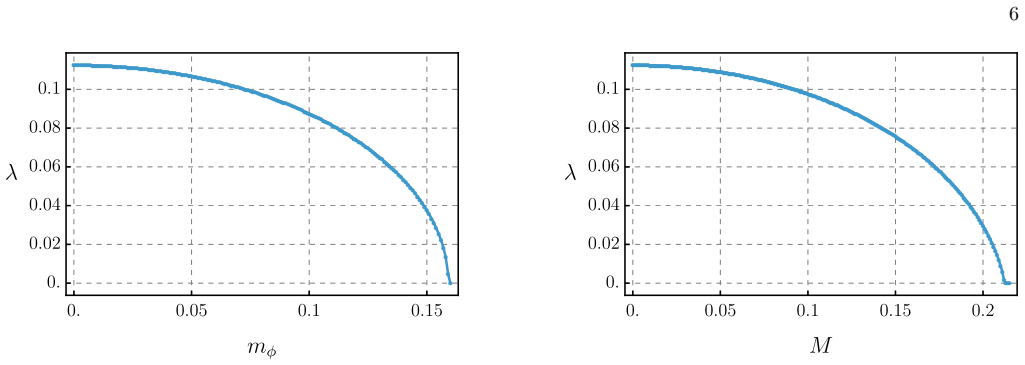
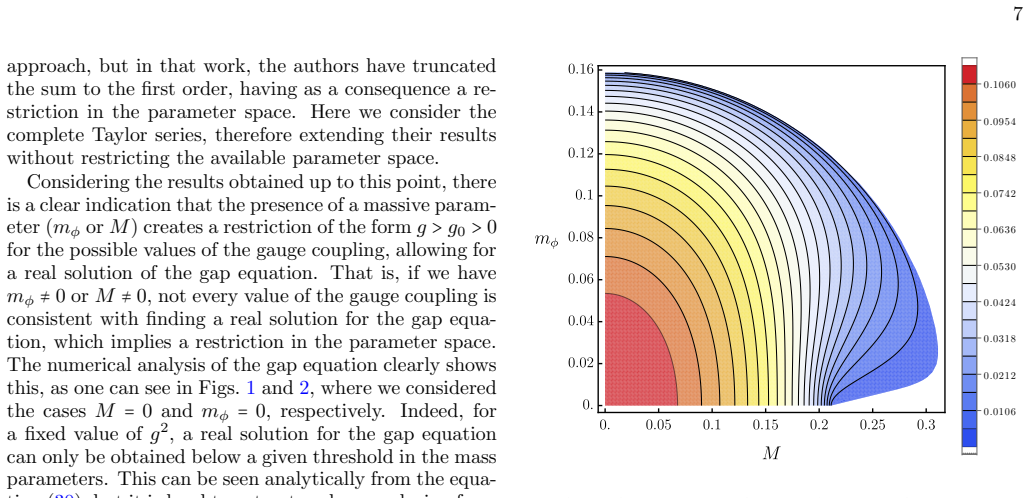
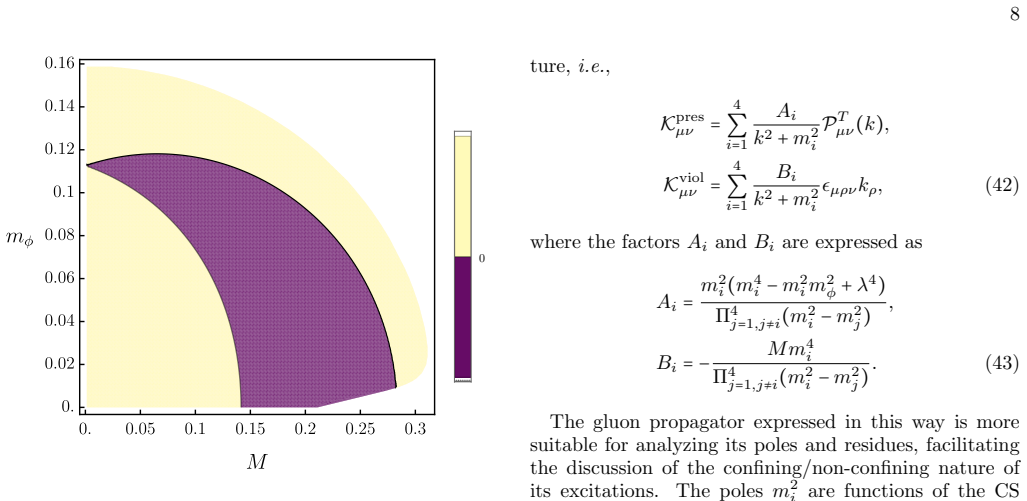
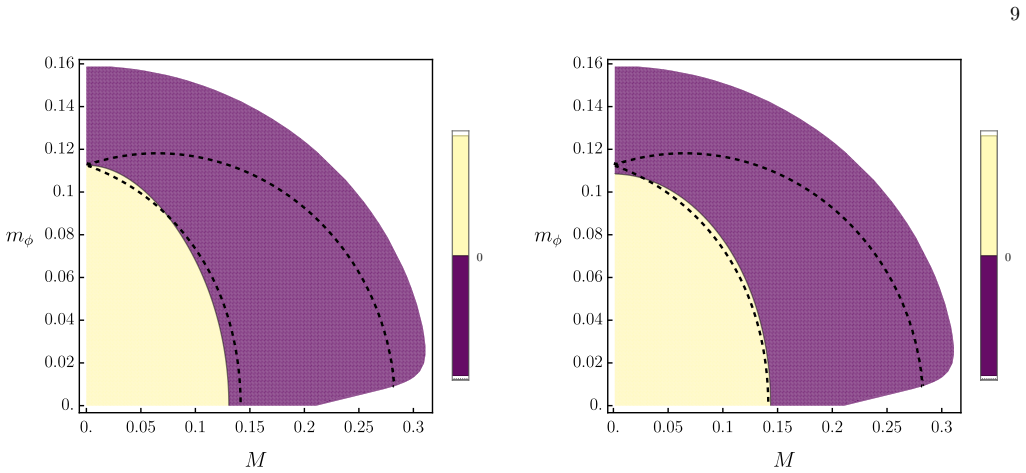
Fixing the Gribov parameter via its gap equation in Yang-Mills-Chern-Simons-Higgs theory reveals a confining phase with all complex gluon poles and a deconfined phase allowing real poles.
A machine-rendered reading of the paper's core claim, the machinery that carries it, and where it could break.
Core claim
The analytic structure of the gluon propagator changes with the inclusion of Higgs and Chern-Simons terms. When the Gribov parameter is fixed by its gap equation, the theory occupies either a confining phase, where all poles remain complex, or a deconfined phase, where real poles can appear. The gap equation therefore links the three mass parameters and the coupling, determining which phase is realized and showing how their relative sizes control the relevance of the Gribov restriction.
What carries the argument
The gap equation for the Gribov parameter, which determines its value from the Higgs mass, Chern-Simons mass, and gauge coupling to enforce the elimination of Gribov copies.
If this is right
- In the confining phase all gluon poles stay complex, so no physical gluon excitations propagate.
- In the deconfined phase real poles become possible, permitting would-be physical gluon modes.
- The Gribov parameter is no longer an independent input but is fixed by the competition among the three mass scales.
- Only certain combinations of Higgs mass, Chern-Simons mass, and coupling satisfy the gap equation, restricting the physical parameter space.
Where Pith is reading between the lines
- The same gap-equation constraint may produce analogous phase boundaries in other three-dimensional gauge theories that include topological mass terms.
- Numerical evaluation of the propagator at fixed mass ratios could map the boundary between the two phases directly from the gap equation.
- Extending the analysis to adjoint Higgs fields or to four dimensions would test whether the two-phase structure survives when the gap equation is solved under different symmetry constraints.
Load-bearing premise
The original gap equation for the Gribov parameter remains valid and sufficient after the Higgs and Chern-Simons terms are added, without requiring extra constraints or modifications.
What would settle it
An explicit computation of the one-loop effective action showing that the gap equation acquires new terms from the Higgs or Chern-Simons interaction, or a lattice measurement of the gluon propagator that finds real poles outside the region allowed by the gap equation.
Figures
read the original abstract
We explore Yang-Mills-Chern-Simons theories coupled to a Higgs-like field in the fundamental representation of $SU(2)$ quantized in linear covariant gauges in three Euclidean dimensions. We analyze the modifications in the analytic structure of the gluon propagator due to the elimination of infinitesimal Gribov copies. The interplay between the Higgs, the Chern-Simons and Gribov mass parameters is investigated. Two different phases are identified: a confining one, where all poles are complex, and a deconfined one, where would-be physical gluon excitation can appear. Unlike previous works, the Gribov parameter is consistently fixed by its gap equation as a function of the other mass parameters and the gauge coupling. This imposes a constraint in the parameter space and makes transparent how the competition of the mass parameters affects the relevance of the Gribov parameter for the characterization of the spectrum of the theory.
Editorial analysis
A structured set of objections, weighed in public.
Referee Report
Summary. The paper studies Yang-Mills-Chern-Simons-Higgs theories in three-dimensional Euclidean space quantized in linear covariant gauges. It analyzes the gluon propagator after Gribov-Zwanziger elimination of infinitesimal Gribov copies, focusing on the interplay among the Higgs mass, Chern-Simons parameter, Gribov mass, and gauge coupling. Two phases are identified: a confining phase with all complex poles and a deconfined phase allowing would-be physical gluon excitations. Unlike prior work, the Gribov parameter is fixed via its gap equation expressed as a function of the remaining mass parameters and coupling, thereby constraining the parameter space.
Significance. If the gap equation is correctly adapted to the modified action, the work supplies a constrained phase diagram for the gluon spectrum in the presence of Chern-Simons and fundamental Higgs terms. This could clarify how competing mass scales control confinement versus deconfinement in three-dimensional gauge theories and provides a concrete, parameter-dependent criterion for the analytic structure of the propagator.
major comments (1)
- [gap equation and phase classification sections] The central claim that the Gribov parameter can be consistently fixed by its gap equation (thereby delineating the confining and deconfined phases) rests on the assumption that the horizon condition retains its standard form up to parameter dependence after the Chern-Simons and Higgs terms are added. The manuscript does not display the explicit re-derivation of the gap equation from the modified Faddeev-Popov operator that incorporates the ε_μνρ A^μ ∂^ν A^ρ structure and the Higgs-gauge coupling; without these steps the analytic continuation used to classify poles cannot be verified.
minor comments (1)
- Notation for the Chern-Simons level and Higgs vev should be introduced once and used uniformly; occasional redefinition of symbols across sections reduces readability.
Simulated Author's Rebuttal
We thank the referee for the careful reading of our manuscript and for highlighting the need for explicit verification of the gap equation. We address the single major comment below.
read point-by-point responses
-
Referee: [gap equation and phase classification sections] The central claim that the Gribov parameter can be consistently fixed by its gap equation (thereby delineating the confining and deconfined phases) rests on the assumption that the horizon condition retains its standard form up to parameter dependence after the Chern-Simons and Higgs terms are added. The manuscript does not display the explicit re-derivation of the gap equation from the modified Faddeev-Popov operator that incorporates the ε_μνρ A^μ ∂^ν A^ρ structure and the Higgs-gauge coupling; without these steps the analytic continuation used to classify poles cannot be verified.
Authors: We agree that the explicit re-derivation of the gap equation from the modified Faddeev-Popov operator (including the Chern-Simons term ε_μνρ A^μ ∂^ν A^ρ and the fundamental Higgs coupling) must be shown to substantiate the horizon condition and subsequent pole analysis. The original manuscript presented the final form of the gap equation as a function of the remaining parameters but omitted the intermediate steps of its derivation for conciseness. In the revised version we will add a dedicated subsection (or appendix) that starts from the modified operator, computes the horizon function, and arrives at the gap equation. This addition will make the analytic continuation and phase classification fully verifiable while leaving the reported phases and conclusions unchanged. revision: yes
Circularity Check
No significant circularity detected
full rationale
The paper applies the standard Gribov-Zwanziger horizon condition (gap equation) to fix the Gribov parameter γ as a function of the Higgs mass, Chern-Simons parameter, and gauge coupling, then examines the resulting gluon propagator poles to classify confining vs. deconfined phases. This is a direct computational consequence of the model's quadratic action plus the independent horizon constraint; the phase labels are not used to define or fit γ, nor does any equation reduce to a tautology by construction. No self-citation chains, ansatz smuggling, or renaming of known results appear as load-bearing steps. The derivation remains self-contained against the external GZ framework.
Axiom & Free-Parameter Ledger
free parameters (1)
- Gribov mass parameter
axioms (1)
- domain assumption The gap equation for the Gribov parameter holds without modification when Higgs and Chern-Simons terms are present.
Reference graph
Works this paper leans on
-
[1]
Jovem Cientista do Nosso Estado
ADP acknowledges CNPq under the grant PQ-2 (312211/2022-8), FAPERJ under the “Jovem Cientista do Nosso Estado” program (E-26/204.457/2025)
2022
-
[2]
D. J. Gross and F. Wilczek, Ultraviolet Behavior of Nonabelian Gauge Theories, Phys. Rev. Lett.30, 1343 (1973)
1973
-
[3]
H. D. Politzer, Reliable Perturbative Results for Strong Interactions?, Phys. Rev. Lett.30, 1346 (1973)
1973
-
[4]
Greensite,An introduction to the confinement problem, Vol
J. Greensite,An introduction to the confinement problem, Vol. 821 (2011)
2011
-
[5]
Brambillaet al., QCD and Strongly Coupled Gauge Theories: Challenges and Perspectives, Eur
N. Brambillaet al., QCD and Strongly Coupled Gauge Theories: Challenges and Perspectives, Eur. Phys. J. C 74, 2981 (2014), arXiv:1404.3723 [hep-ph]
Pith/arXiv arXiv 2014
-
[6]
Faddeev and V
L. Faddeev and V. Popov, Feynman Diagrams for the Yang-Mills Field, Phys. Lett. B25, 29 (1967)
1967
-
[7]
V. N. Gribov, Quantization of Nonabelian Gauge Theo- ries, Nucl. Phys.B139, 1 (1978), [1(1977)]
1978
-
[8]
Singer, Some Remarks on the Gribov Ambiguity, Com- mun
I. Singer, Some Remarks on the Gribov Ambiguity, Com- mun. Math. Phys.60, 7 (1978)
1978
-
[9]
N. Vandersickel and D. Zwanziger, The Gribov prob- lem and QCD dynamics, Phys. Rept.520, 175 (2012), arXiv:1202.1491 [hep-th]
Pith/arXiv arXiv 2012
-
[10]
R. Sobreiro and S. Sorella, Introduction to the Gribov ambiguities in Euclidean Yang-Mills theories, in13th Jorge Andre Swieca Summer School on Particle and Fields(2005) arXiv:hep-th/0504095
Pith/arXiv arXiv 2005
-
[11]
Zwanziger, Local and Renormalizable Action From the Gribov Horizon, Nucl
D. Zwanziger, Local and Renormalizable Action From the Gribov Horizon, Nucl. Phys.B323, 513 (1989)
1989
-
[12]
D. Dudal, S. P. Sorella, N. Vandersickel, and H. Ver- schelde, New features of the gluon and ghost propaga- tor in the infrared region from the Gribov-Zwanziger ap- proach, Phys. Rev.D77, 071501 (2008), arXiv:0711.4496 [hep-th]
Pith/arXiv arXiv 2008
-
[13]
D. Dudal, J. A. Gracey, S. P. Sorella, N. Vander- sickel, and H. Verschelde, A Refinement of the Gribov- Zwanziger approach in the Landau gauge: Infrared prop- agators in harmony with the lattice results, Phys. Rev. D78, 065047 (2008), arXiv:0806.4348 [hep-th]
Pith/arXiv arXiv 2008
-
[14]
D. Dudal, S. P. Sorella, and N. Vandersickel, The dy- namical origin of the refinement of the Gribov-Zwanziger theory, Phys. Rev. D84, 065039 (2011), arXiv:1105.3371 [hep-th]
Pith/arXiv arXiv 2011
-
[15]
van Baal, More (thoughts on) Gribov copies, Nucl
P. van Baal, More (thoughts on) Gribov copies, Nucl. Phys.B369, 259 (1992)
1992
-
[16]
Dell’Antonio and D
G. Dell’Antonio and D. Zwanziger, Every gauge orbit passes inside the Gribov horizon, Commun. Math. Phys. 138, 291 (1991)
1991
-
[17]
Zwanziger, Action From the Gribov Horizon, Nucl
D. Zwanziger, Action From the Gribov Horizon, Nucl. Phys. B321, 591 (1989)
1989
-
[18]
A. Sternbeck, L. von Smekal, D. B. Leinweber, and A. G. Williams, Comparing SU(2) to SU(3) gluodynam- ics on large lattices, PoSLA TTICE2007, 340 (2007), arXiv:0710.1982 [hep-lat]
Pith/arXiv arXiv 2007
-
[19]
A. Cucchieri and T. Mendes, What’s up with IR gluon and ghost propagators in Landau gauge? A puzzling answer from huge lattices, PoSLA TTICE2007, 297 (2007), arXiv:0710.0412 [hep-lat]
Pith/arXiv arXiv 2007
-
[20]
A. Cucchieri and T. Mendes, Constraints on the IR be- havior of the gluon propagator in Yang-Mills theories, Phys. Rev. Lett.100, 241601 (2008), arXiv:0712.3517 [hep-lat]
Pith/arXiv arXiv 2008
-
[21]
V. G. Bornyakov, V. K. Mitrjushkin, and M. Muller- Preussker, Infrared behavior and Gribov ambiguity in SU(2) lattice gauge theory, Phys. Rev. D79, 074504 (2009), arXiv:0812.2761 [hep-lat]
Pith/arXiv arXiv 2009
-
[22]
I. L. Bogolubsky, E. M. Ilgenfritz, M. Muller-Preussker, and A. Sternbeck, Lattice gluodynamics computation of Landau gauge Green’s functions in the deep infrared, Phys. Lett.B676, 69 (2009), arXiv:0901.0736 [hep-lat]
Pith/arXiv arXiv 2009
-
[23]
A. Cucchieri, D. Dudal, T. Mendes, and N. Van- dersickel, Modeling the Gluon Propagator in Landau Gauge: Lattice Estimates of Pole Masses and Dimension- Two Condensates, Phys. Rev. D85, 094513 (2012), arXiv:1111.2327 [hep-lat]
Pith/arXiv arXiv 2012
-
[24]
A. Cucchieri, D. Dudal, T. Mendes, and N. Vandersickel, Modeling the Landau-gauge ghost propagator in 2, 3, and 4 spacetime dimensions, Phys. Rev. D93, 094513 (2016), arXiv:1602.01646 [hep-lat]. 13
Pith/arXiv arXiv 2016
-
[25]
G. P. de Brito and A. D. Pereira, Infrared gluon propaga- tor in the refined Gribov-Zwanziger scenario at one-loop order in the Landau gauge, Phys. Rev. D110, 074005 (2024), arXiv:2405.07779 [hep-th]
arXiv 2024
-
[26]
G. P. de Brito, P. De Fabritiis, and A. D. Pereira, Re- fined Gribov-Zwanziger theory coupled to scalar fields in the Landau gauge, Phys. Rev. D107, 114006 (2023), arXiv:2302.04827 [hep-th]
arXiv 2023
-
[27]
G. P. de Brito, P. De Fabritiis, and A. D. Pereira, Quark propagator at one loop in the refined Gribov- Zwanziger framework, Phys. Rev. D112, 014014 (2025), arXiv:2505.10602 [hep-th]
arXiv 2025
- [28]
- [29]
-
[30]
M. A. L. Capri, D. Dudal, A. J. G´ omez, M. S. Guimaraes, I. F. Justo, S. P. Sorella, and D. Vercauteren, Semiclas- sical analysis of the phases of 4d SU(2)Higgs gauge sys- tems with cutoff at the Gribov horizon, Phys. Rev. D88, 085022 (2013)
2013
-
[31]
M. A. L. Capri, D. Dudal, M. S. Guimaraes, I. F. Justo, S. P. Sorella, and D. Vercauteren, The (IR-)relevance of the Gribov ambiguity in SU(2) x U(1) gauge theories with fundamental Higgs matter, Annals Phys.343, 72 (2014), arXiv:1309.1402 [hep-th]
Pith/arXiv arXiv 2014
-
[32]
M. A. L. Capri, D. Dudal, A. J. Gomez, M. S. Guimaraes, I. F. Justo, and S. P. Sorella, A study of the Higgs and confining phases in Euclidean SU(2) Yang-Mills theories in 3d by taking into account the Gribov horizon, Eur. Phys. J. C73, 2346 (2013), arXiv:1210.4734 [hep-th]
Pith/arXiv arXiv 2013
-
[33]
M. A. L. Capri, D. Dudal, M. S. Guimaraes, I. F. Justo, S. P. Sorella, and D. Vercauteren,SU(2)×U(1)Yang- Mills theories in 3dwith Higgs field and Gribov ambi- guity, Eur. Phys. J. C73, 2567 (2013), arXiv:1305.4155 [hep-th]
Pith/arXiv arXiv 2013
-
[34]
Fradkin and S
E. Fradkin and S. H. Shenker, Phase diagrams of lattice gauge theories with Higgs fields, Phys. Rev. D19, 3682 (1979)
1979
-
[35]
Canfora, A
F. Canfora, A. Gomez, S. P. Sorella, and D. Vercauteren, Study of Yang–Mills–Chern–Simons theory in presence of the Gribov horizon, Annals of Physics345, 166 (2014)
2014
-
[36]
A. J. Gomez, S. Gonzalez, and S. P. Sorella, Yang–mills–chern–simons system in the presence of a gribov horizon with fundamental higgs matter, Journal of Physics A: Mathematical and Theoretical49, 065401 (2016)
2016
-
[37]
L. C. Ferreira, A. D. Pereira, and R. F. Sobreiro, Hints of confinement and deconfinement in Yang-Mills-Chern- Simons theories in the maximal Abelian gauge, Phys. Rev. D101, 105022 (2020)
2020
-
[38]
C. P. Felix and C. W. Kao, Implications of the topological Chern-Simons mass in the gap equation, Phys. Rev. D 105, 094016 (2022), arXiv:2105.09133 [hep-th]
arXiv 2022
-
[39]
L. C. Ferreira, D. R. Granado, I. F. Justo, and A. D. Pereira, Infrared propagators of Yang-Mills-Chern- Simons theories in linear covariant gauges, Phys. Rev. D 104, 045007 (2021)
2021
-
[40]
Deser, R
S. Deser, R. Jackiw, and S. Templeton, Topologically massive gauge theories, Annals of Physics140, 372 (1982)
1982
-
[41]
Deser, R
S. Deser, R. Jackiw, and S. Templeton, Three- Dimensional Massive Gauge Theories, Phys. Rev. Lett. 48, 975 (1982)
1982
-
[42]
Delduc, C
F. Delduc, C. Lucchesi, O. Piguet, and S. P. Sorella, Ex- act Scale Invariance of the Chern-Simons Theory in the Landau Gauge, Nucl. Phys. B346, 313 (1990)
1990
-
[43]
G. Giavarini, C. P. Martin, and F. Ruiz Ruiz, Chern- Simons theory as the large mass limit of topologically massive Yang-Mills theory, Nucl. Phys. B381, 222 (1992), arXiv:hep-th/9206007
Pith/arXiv arXiv 1992
-
[44]
O. M. Del Cima, D. H. T. Franco, J. A. Helayel-Neto, and O. Piguet, On the nonrenormalization properties of gauge theories with Chern-Simons terms, JHEP02, 002, arXiv:hep-th/9711191
-
[45]
O. M. Del Cima, D. H. T. Franco, J. A. Helayel-Neto, and O. Piguet, An Algebraic proof on the finiteness of Yang-Mills-Chern-Simons theory in D = 3, Lett. Math. Phys.47, 265 (1999), arXiv:math-ph/9904030
Pith/arXiv arXiv 1999
-
[46]
D. O. R. Azevedo, O. M. Del Cima, T. S. Dias, and E. D. Pereira, Interpolating gauge-fixing for Yang–Mills–Chern–Simons theory inD=3, Eur. Phys. J. C84, 917 (2024), arXiv:2406.09515 [hep-th]
arXiv 2024
-
[47]
D. O. R. Azevedo and A. D. Pereira, Finiteness of the Yang-Mills-Chern-Simons action in linear covariant gauges by taking into account gauge copies, Phys. Rev. D111, 085028 (2025), arXiv:2502.03284 [hep-th]
arXiv 2025
-
[48]
M. A. L. Capri, D. Dudal, M. S. Guimaraes, L. F. Palhares, and S. P. Sorella, An all-order proof of the equivalence between Gribov’s no-pole and Zwanziger’s horizon conditions, Phys. Lett.B719, 448 (2013), arXiv:1212.2419 [hep-th]
Pith/arXiv arXiv 2013
-
[49]
M. A. L. Capri, D. Dudal, D. Fiorentini, M. S. Guimaraes, I. F. Justo, A. D. Pereira, B. W. Mintz, L. F. Palhares, R. F. Sobreiro, and S. P. Sorella, Ex- act nilpotent nonperturbative BRST symmetry for the Gribov-Zwanziger action in the linear covariant gauge, Phys. Rev. D92, 045039 (2015), arXiv:1506.06995 [hep- th]
Pith/arXiv arXiv 2015
-
[50]
M. A. L. Capri, D. Fiorentini, M. S. Guimaraes, B. W. Mintz, L. F. Palhares, S. P. Sorella, D. Dudal, I. F. Justo, A. D. Pereira, and R. F. Sobreiro, More on the nonperturbative Gribov-Zwanziger quantization of lin- ear covariant gauges, Phys. Rev. D93, 065019 (2016), arXiv:1512.05833 [hep-th]
Pith/arXiv arXiv 2016
-
[51]
M. A. L. Capri, D. Dudal, D. Fiorentini, M. S. Guimaraes, I. F. Justo, A. D. Pereira, B. W. Mintz, L. F. Palhares, R. F. Sobreiro, and S. P. Sorella, Local and BRST-invariant Yang-Mills theory within the Gribov horizon, Phys. Rev. D94, 025035 (2016), arXiv:1605.02610 [hep-th]
Pith/arXiv arXiv 2016
-
[52]
M. A. L. Capri, D. Dudal, A. D. Pereira, D. Fiorentini, M. S. Guimaraes, B. W. Mintz, L. F. Palhares, and S. P. Sorella, Nonperturbative aspects of Euclidean Yang-Mills theories in linear covariant gauges: Nielsen identities and a BRST-invariant two-point correlation function, Phys. Rev. D95, 045011 (2017), arXiv:1611.10077 [hep-th]
Pith/arXiv arXiv 2017
-
[53]
M. A. L. Capri, D. Fiorentini, A. D. Pereira, and S. P. Sorella, Renormalizability of the refined Gribov- Zwanziger action in linear covariant gauges, Phys. Rev. D96, 054022 (2017), arXiv:1708.01543 [hep-th]. 14
Pith/arXiv arXiv 2017
-
[54]
M. A. L. Capri, D. Dudal, M. S. Guimaraes, A. D. Pereira, B. W. Mintz, L. F. Palhares, and S. P. Sorella, The universal character of Zwanziger’s horizon function in Euclidean Yang–Mills theories, Phys. Lett. B781, 48 (2018), arXiv:1802.04582 [hep-th]
Pith/arXiv arXiv 2018
-
[55]
M. A. L. Capri, D. Fiorentini, A. D. Pereira, and S. P. Sorella, A non-perturbative study of matter field propa- gators in Euclidean Yang–Mills theory in linear covariant, Curci–Ferrari and maximal Abelian gauges, Eur. Phys. J. C77, 546 (2017), arXiv:1703.03264 [hep-th]
Pith/arXiv arXiv 2017
-
[56]
P. Zhang and J.-Y. Chen, An explicit categorical con- struction of instanton density in lattice Yang-Mills the- ory, JHEP06, 085, arXiv:2411.07195 [hep-lat]
-
[57]
Z.-A. Xu and J.-Y. Chen, Lattice Chern-Simons-Maxwell theory and its chirality, JHEP08, 062, arXiv:2410.11034 [hep-th]
-
[58]
C. Peng, M. C. Diamantini, L. Funcke, S. M. A. Hassan, K. Jansen, S. K¨ uhn, D. Luo, and P. Naredi, Hamiltonian Lattice Formulation of Compact Maxwell-Chern-Simons Theory, (2025), arXiv:2407.20225 [hep-th]
arXiv 2025
discussion (0)
Sign in with ORCID, Apple, or X to comment. Anyone can read and Pith papers without signing in.