REVIEW 4 major objections 5 minor 1 cited by
Some physical implications of regularization ambiguities in SU(2) gauge-invariant loop quantum cosmology
T0 review · 4 major / 5 minor · reviewed 2026-08-14 · deepseek-v4-flash
Pith's one-line read The paper claims that in Thiemann-regularized loop quantum cosmology, the lattice-spacing choice fixes the pre-bounce matter: mu0 gives w=-1/3 (string gas), bar-mu gives w=-1 (cosmological constant), and gauge-covariant fluxes only…
desk verdict Worth taking seriously: a clean qualitative split in Thiemann-regularized LQC (mu0 gives w=-1/3 emergent matter, bar-mu gives an emergent cosmological constant), with the caveat that the whole analysis rests on an explicit effective-dynamics conjecture. read the letter →
The pith
A machine-rendered reading of the paper's core claim, the machinery that carries it, and where it could break.
The reading
What carries the argument
The machinery is the regularized Hamiltonian constraint on a fixed lattice, evaluated on cosmological phase-space variables. The paper uses two regularization layers: the Thiemann regularization, in which the Euclidean and Lorentzian parts of the constraint are quantized separately, and, for the basic variables, gauge-covariant fluxes, which transform covariantly under the local SU(2) gauge symmetry and replace the triad variables by expressions carrying a factor $\mathrm{sinc}(c\epsilon/2)=\sin(c\epsilon/2)/(c\epsilon/2)$. The asymptotic analysis works by finding the fixed points of $c\epsilon$ where the matter energy density vanishes ($c=0$ for the future, $c=\beta_+/\epsilon$ for the past) and expanding the Friedmann equation around them. Whether the leading emergent term is $1/p$ or constant depends on whether the regulator $\epsilon$ is the constant $\mu_0$ or the triad-dependent $\bar\mu=\sqrt{\Delta/p}$: the $1/p$ dependence of the constant regulator survives in the past branch, while $\bar\mu$ cancels it and leaves a cosmological-constant term.
What would settle it
Quantize the Thiemann-regularized Hamiltonian constraint with gauge-covariant fluxes, including the operator ordering implied by the construction used in [19], and compute its expectation value on the semiclassical states used for the effective dynamics, without first replacing the dynamics by a classical lattice flow; if the resulting asymptotic Friedmann equation lacks the $1/p$ term for $\mu_0$ or the constant term for $\bar\mu$, the classification is an artifact of the classical truncation. A separate decisive check is whether the $\bar\mu$-scheme can be derived from the full lattice theory: a derivation would select the $w=-1$ pre-bounce branch, while a no-go result would leave the $\mu_0$ branch as the only full-theory candidate.
Extended reading notes
Core claim
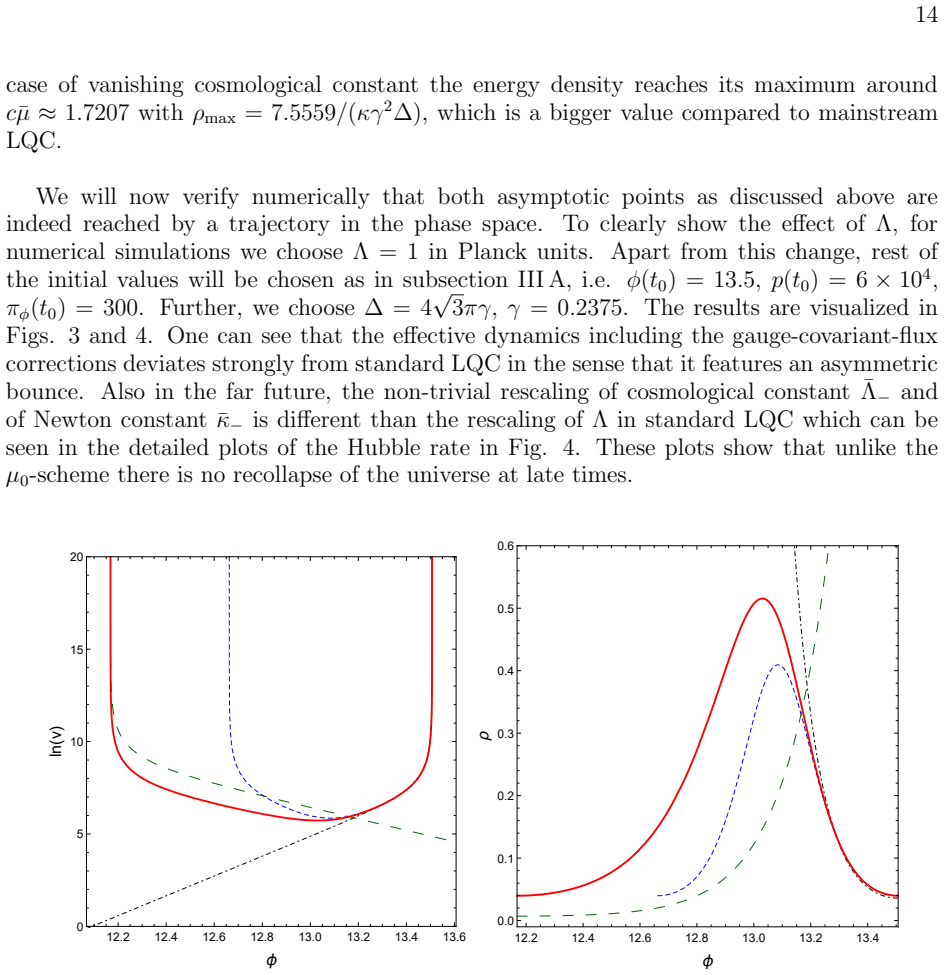
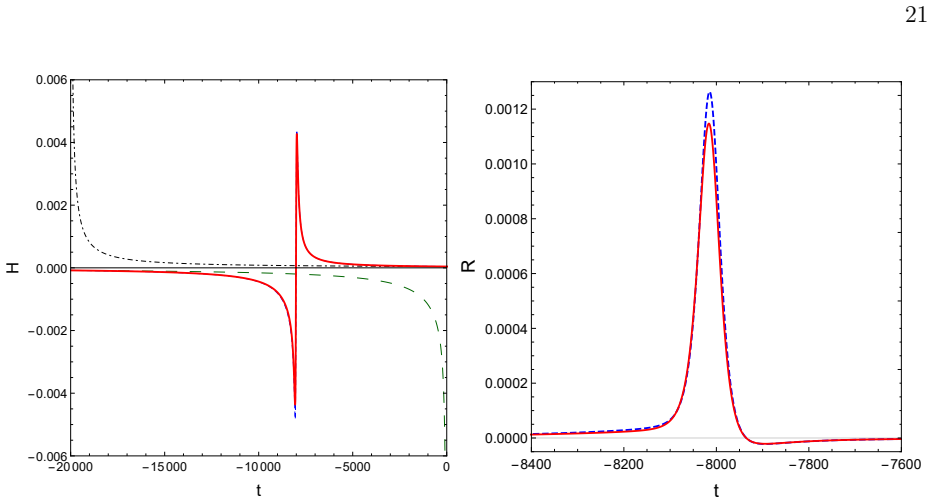
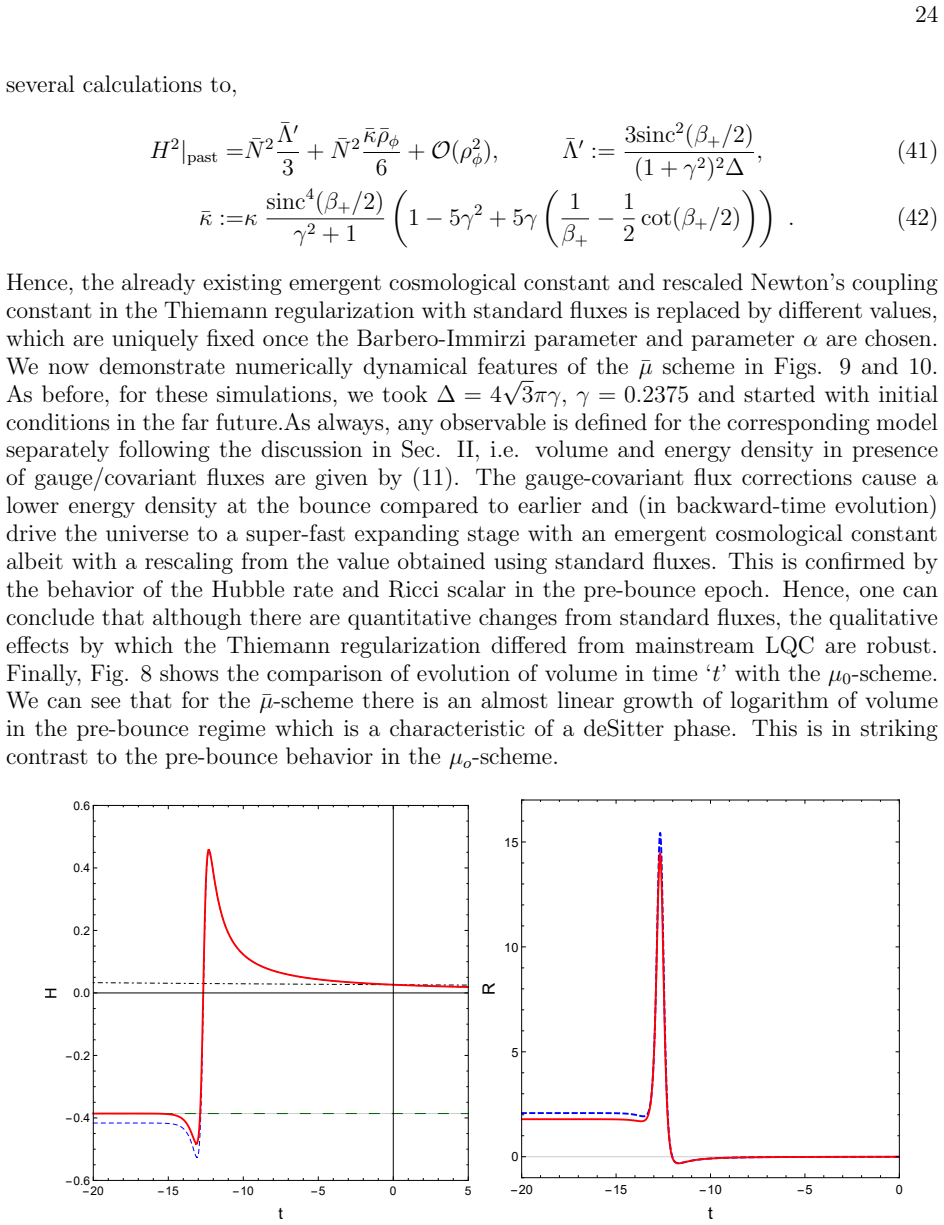
On its own terms, the paper's central new claim is that for the Thiemann-regularized scalar constraint, the nature of emergent matter in the pre-bounce regime is fixed by the regularization parameter. The asymptotic Friedmann equation in the $\mu_0$-scheme contains a term $1/p$ (equivalently $1/a^2$), which in classical general relativity corresponds to a fluid with equation of state $w=-1/3$---a string gas or coasting cosmology. In the $\bar\mu$-scheme the regulator's triad dependence removes this $1/p$ term and leaves a constant, so the pre-bounce matter is an emergent cosmological constant with $w=-1$. The authors verify that the same dichotomy holds with purely classical triads and with gauge-covariant fluxes: equations (30) and (33) for $\mu_0$, equations (39) and (41) for $\bar\mu$, the latter differing only in rescaled coefficients. They also show that including a positive cosmological constant does not change the known verdict on the two schemes: $\mu_0$ still recollapses at late times, while $\bar\mu$ asymptotes to a classical Friedmann universe with rescaled Newton's constant and cosmological constant.
Load-bearing premise
The load-bearing premise is the paper's explicit conjecture that one can skip quantization and let a classical lattice-regularized version of the dynamics stand in for the full quantum theory; if that conjecture fails, the emergent-matter classification is a property of a classical truncation, not of quantum gravity.
Editorial extensions
If this is right
- For the Thiemann-regularized dynamics, the pre-bounce universe is not a single prediction: $\mu_0$ gives a coasting or string-gas phase ($w=-1/3$), while $\bar\mu$ gives a de Sitter-like phase ($w=-1$).
- Adding gauge-covariant flux modifications changes the coefficients of the emergent terms and the rescaling of Newton's constant, but not the equations of state.
- The $\mu_0$-scheme remains inviable with a positive cosmological constant: it bounces but then recollapses at late times, producing cyclic evolution rather than the classical asymptotic de Sitter behavior.
- In the $\bar\mu$-scheme with $\Lambda>0$, the late-time and pre-bounce branches each match a classical Friedmann universe with rescaled constants, and the rescaling differs between branches, giving the asymmetric bounce a preferred post-bounce branch consistent with observed constants.
- The qualitative results are insensitive to initial conditions: more than 500 simulations with different $\pi_\varphi$ yield the same asymmetric-bounce and emergent-matter picture.
Reading between the lines
- The asymptotic-expansion method suggests a general dictionary between regulator dependence and emergent equation of state: if the regulator scales as a power of the triad, that power fixes the effective barotropic index of the pre-bounce fluid; the paper's $\mu_0$ ($w=-1/3$) and $\bar\mu$ ($w=-1$) cases are two entries, and its remark about Wheeler-DeWitt-type regulators ($w=1/3$) is a third.
- If the effective-dynamics conjecture fails, the distinction may not survive full quantization; a direct check would be to compute subleading corrections from the coherent-state expectation values and see whether the $1/p$ or constant terms are corrected or washed out.
- Within the model, the pre-bounce equation of state is a potential observable discriminator between regulator schemes: a coasting $w=-1/3$ pre-bounce would favor $\mu_0$-type lattices, while a de Sitter pre-bounce would favor $\bar\mu$-type lattices, although current observations cannot directly probe the pre-bounce epoch.
- The same fixed-point-expansion technique could be applied to other symmetry-reduced sectors, such as black-hole interiors, where the paper notes different regulators already produce qualitatively different spacetimes; the emergent-matter classification may provide a unified way to compare them.
Signed reviews
Editorial analysis
A structured set of objections, weighed in public.
Referee Report
Summary. This paper studies two layers of regularization ambiguities in loop quantum cosmology with a massless scalar field: the choice of discreteness parameter (μ0 versus \bar μ) and the form of the Hamiltonian constraint (standard versus Thiemann regularization), with and without gauge-covariant flux modifications. For a positive cosmological constant, the paper reports numerically that the μ0 scheme still exhibits a late-time recollapse and cyclic evolution, while the \bar μ scheme approaches a classical Friedmann phase with rescaled gravitational and cosmological constants. The central new claim concerns Thiemann regularization without Λ: in the pre-bounce region the μ0 scheme produces an effective 1/p term in the Friedmann equation, interpreted as an emergent fluid with equation of state w = -1/3 (string gas or coasting cosmology), whereas the \bar μ scheme produces a constant term with w = -1 (emergent cosmological constant). The authors show that this classification is qualitatively unchanged when gauge-covariant fluxes are included, with only the numerical coefficients modified.
Significance. If the claims hold, the paper gives a concrete dynamical prediction that distinguishes the μ0 and \bar μ regularizations for a very simple matter source: a qualitative change in the pre-bounce equation of state. This is of genuine interest for the LQC/LQG community because it sharpens the quantization-ambiguity problem and connects it to observable cosmological signatures such as string-gas or coasting behavior. The analytic core is a strength: the fixed-point analysis at cμ0 = β+ and the resulting 1/p versus p^0 scaling determine the w = -1/3 versus w = -1 classification, and the arbitrary matching parameter α cancels from that classification. The numerical robustness scan over πφ values is a useful complement, and the authors are explicit about the paper's main assumption, namely the effective-dynamics conjecture. The classification is therefore presented in a way that can be checked independently at the level of the regularized dynamics, even if its status as a statement about the full quantum theory remains to be established.
major comments (4)
- [Sec. II and Sec. V] The central result is obtained under the explicit conjecture stated in Sec. II: 'we will skip the quantization part and conjecture that the main effect of any quantization ... can be studied by a regularized dynamics on the lattice,' and reiterated in Sec. V. The new string-gas branch for the μ0 scheme is located at cμ0 ≈ 1.34 rad, in the most quantum regime of the model, where coherent-state or Ehrenfest arguments for the effective description are least established, and no comparison with a quantum difference equation or with coherent-state expectation values is provided for this branch. Please either supply such evidence or explicitly restrict the abstract's claims to statements about the regularized classical flow rather than about the quantum theory.
- [Sec. IV.B, Eq. (35)] As printed, Eq. (35) has a plus sign inside the trigonometric bracket, whereas the equivalent brackets in Eqs. (25) and (26) carry a minus sign. With the plus sign, sin^2(c\bar μ) + (1+γ^2)/(4γ^2) sin^2(2c\bar μ) is strictly positive for 0 < c\bar μ < π, so the constraint cannot vanish in the presence of positive matter density. This contradicts the fixed-point condition c\bar μ = β+ in Eq. (37) and the asymptotic expansion leading to Eq. (38). Please correct the sign or explain the different convention.
- [Sec. IV, Eq. (25)] The gauge-covariant Thiemann-regularized Hamiltonian (25), which underlies the quantitative statements in Sec. IV, is imported from Ref. [19], which is marked 'to appear'. Because the expression is not derived in this manuscript and is not yet independently available, the referee cannot verify the sinc factors or the relative sign of the two trigonometric terms. Please include a derivation in an appendix, or restrict the gauge-covariant claims to those that follow from the published no-flux Hamiltonian (26).
- [Sec. III.A, Figs. 1-2] The conclusion that the μ0 scheme remains unviable with a positive cosmological constant after gauge-covariant flux modifications is supported by one representative value of Λ and a set of initial data in Figs. 1-2, supplemented by a scan over πφ. This is weaker than the corresponding analytic result for standard LQC, which establishes a recollapse for any positive Λ. Please state explicitly the parameter range over which the recollapse was verified, or add an analytic argument for the gauge-covariant case.
minor comments (5)
- [Eqs. (34) and (42)] The coefficients \bar κ in Eqs. (34) and (42) are displayed without derivation; a short outline of the expansion or a supplemental computation file would help the reader reproduce them.
- [Fig. 9 caption] The caption contains 'gauge/covariant' with an unnecessary slash; it should read 'gauge-covariant'.
- [Sec. III.B, Eqs. (21)-(23)] The free parameter α appears explicitly in the rescaled constants, and the text notes this; it would be useful to state explicitly that the w-classification and the absence of recollapse are independent of α, since this is what makes those results robust.
- [Sec. V, penultimate paragraph] The observation that the emergent equation of state coincides with the threshold for late-time departure from GR is interesting but is not derived; please provide the argument or cite the specific prior result.
- [Figs. 1-10] No numerical tolerances or convergence checks are reported for the simulations; a brief statement on error control would strengthen confidence in the quoted bounce and recollapse values.
Circularity Check
No circularity: the μ0 versus μ̄ emergent-matter dichotomy follows by direct asymptotic expansion of the regularized Hamiltonian constraints, not from fitting or from self-citation.
full rationale
The paper's central claim—that in Thiemann-regularized LQC the pre-bounce emergent matter has w = −1/3 in the μ0-scheme and w = −1 in the μ̄-scheme, with or without gauge-covariant fluxes—is obtained by asymptotic expansion of the stated Hamiltonian constraints, not by fitting or by importing the conclusion. In the μ0 case, requiring ρφ → 0 fixes cμ0 at β+ (Eq. 27), and the leading term in the Friedmann equation is N²/[p(1+γ²)²μ0²] (Eq. 30), whose 1/p dependence gives w = −1/3; replacing μ0 by μ̄ = √(Δ/p) changes this term into the p-independent emergent cosmological constant of Eqs. (39)/(41). The paper itself states the substitution explicitly: 'if in above equation one substitutes functional dependence of ¯µ then the triad dependence of the first term disappears and one obtains an emergent matter which will behave as a cosmological constant. This is exactly what happens in the ¯µ-scheme.' The free matching parameter α cancels in the leading classification. The gauge-covariant Thiemann Hamiltonian (25) is imported from Ref. [19] (one author overlap, 'to appear'), but the same μ0/μ̄ dichotomy is derived from the triad version (26), so the cited result is not needed for the central claim; likewise, the previously known μ̄ emergent de Sitter phase [41] is re-derived here rather than assumed. The uniqueness conclusion from Ref. [32] is a concluding extrapolation supported by the paper's own recollapse analysis, not a load-bearing input to the emergent-matter result. The explicit 'regularized dynamics' conjecture of Sec. II ('we will skip the quantization part and conjecture that the main effect of any quantization that introduces a finite regularization ϵ of the manifold can be studied by a regularized dynamics on the lattice') is a limitation on quantum-to-classical fidelity, not circularity. No step reduces a 'prediction' to its own definition or to a fitted parameter, so the derivation is self-contained for the claim it makes.
Assumptions & free parameters
free parameters (3)
- Barbero-Immirzi parameter gamma =
0.2375
- Regularization scale mu0 (or Delta in the bar-mu scheme) =
mu0 = 3*sqrt(3) in Planck units; Delta = 4*sqrt(3)*pi*gamma
- Matching parameter alpha =
arbitrary nonzero real
assumptions (5)
- domain assumption Effective dynamics conjecture
- ad hoc to paper Thiemann-regularized Hamiltonian with gauge-covariant fluxes from Ref. [19]
- domain assumption Gauge-covariant flux formulas depend on a path choice rho_x
- domain assumption Spatially flat isotropic symmetry reduction with massless scalar and Lambda
- standard math Classical FRW matching to define rescaled constants
Cite this review
Pith. "Pith review of Some physical implications of regularization ambiguities in SU(2) gauge-invariant loop quantum cosmology." pith.science (2026). https://pith.science/paper/Q6QCQE7C
@misc{pith2026190807543,
  author       = {Pith},
  title        = {Pith review of: Some physical implications of regularization ambiguities in SU(2) gauge-invariant loop quantum cosmology},
  year         = {2026},
  howpublished = {\url{https://pith.science/paper/Q6QCQE7C}},
  note         = {Machine review of arXiv:1908.07543}
}
abstract
The way physics of loop quantum gravity is affected by the underlying quantization ambiguities is an open question. We address this issue in the context of loop quantum cosmology using gauge-covariant fluxes. Consequences are explored for two choices of regularization parameters: $\mu_0$ and $\bar \mu$ in presence of a positive cosmological constant, and two choices of regularizations of the Hamiltonian constraint in loop quantum cosmology: the standard and the Thiemann regularization. We show that novel features of singularity resolution and bounce, occurring due to gauge-covariant fluxes, exist also for Thiemann-regularized dynamics. The $\mu_0$-scheme is found to be unviable as in standard loop quantum cosmology when a positive cosmological constant is included. Our investigation brings out a surprising result that the nature of emergent matter in the pre-bounce regime is determined by the choice of regulator in the Thiemann regularization of the scalar constraint whether or not one uses gauge-covaraint fluxes. Unlike $\bar \mu$-scheme where the emergent matter is a cosmological constant, the emergent matter in $\mu_0$-scheme behaves as a string gas.
Figures


Figures from the paper (7 more)




Forward citations
Cited by 1 Pith paper
-
New Loop Quantum Cosmology Modifications from Gauge-covariant Fluxes
Gauge-covariant flux corrections in loop quantum cosmology produce an asymmetric quantum bounce with a (2/pi)^4 rescaling of Newton's constant in the pre-bounce branch.
Reference graph
Works this paper leans on
-
[19]
Thiemann, Complexifier coherent states for quantum general relativity
T. Thiemann, Complexifier coherent states for quantum general relativity. Class. Quant. Grav. , 2063- 2118 23 (2006)
work page 2006
-
[1]
In the presence of gauge-covariant fluxes, the same exercise yields [51]: Cµ0 gc,Λ[N] =− 6N κγ2µ2 0 √p sin2(cµ0)sinc(cµ0/2) + Nπ 2 φ 2√p3 sinc−3(cµ0/2) + 2 κNΛ√p3sinc3(cµ0/2) . (14) The above expression can be seen to be obtained from (13) via using gauge-covariant triads p ↦→ pg.c. := p sinc2(cµ0/2). We note that this expression is different from the one i...
-
[2]
Ashtekar, New variables for classical and Quantum Gravity
A. Ashtekar, New variables for classical and Quantum Gravity. Phys. Rev. Lett. 57, 2244-2247 (1986) 11 Interestingly, in this case a departure from GR at late times is favorable as it resolves the classical big rip singularity (see [61, 66] for details). 28
work page 1986
-
[3]
(15) Here the Barbero-Immirzi parameter is set to γ = 0.2375 as is customary in the LQC literature. For these numerical solutions we assume Λ = 10−10 in Planck units.We choose as initial state at late times φ(t0) = 13.5 a universe withp(t0) = 6× 10⁴ andπφ(t0) = 300. The latter value turns out to be a constant of motion, as the scalar constraint does not d...
work page 2000
-
[4]
Barbero, A real polynomial formulation of General Relativity in terms of connection
J.F. Barbero, A real polynomial formulation of General Relativity in terms of connection. Phys. Rev. D 49, 6935-6938 (1994)
work page 1994
-
[5]
R. Arnowitt, S. Deser, C. Misner, The Dynamics of General Relativity. In: Gravitation: An introduc- tion to current research by L Witten (ed) New York 227-265 (1962)
work page 1962
-
[6]
A. Ashtekar, J. Lewandowski, Background independent quantum gravity: A Status report. Class. Quant. Grav., R53-R152 21 (2004)
work page 2004
-
[7]
Ashtekar, New Hamiltonian formulation of General Relativity
A. Ashtekar, New Hamiltonian formulation of General Relativity. Phys. Rev. D 36, 1587-1602 (1987)
work page 1987
Show all 73 references
-
[8]
Thiemann, Quantum Spin Dynamics (QSD) I
T. Thiemann, Quantum Spin Dynamics (QSD) I. Class. Quant. Grav. 15, 839-873 (1998)
1998
-
[9]
Rovelli, Quantum Gravity
C. Rovelli, Quantum Gravity. Cambridge University Press (2004)
2004
-
[10]
Giesel, T
K. Giesel, T. Thiemann, Algebraic Quantum Gravity (AQG) I. Conceptual Setup. Class. Quant. Grav. 24 2465-2498, (2007)
2007
-
[11]
Thiemann, Modern Canonical Quantum General Relativity
T. Thiemann, Modern Canonical Quantum General Relativity. Cambridge University Press (2007)
2007
-
[12]
Thiemann, Gauge Field Theory Coherent States (GCS): I
T. Thiemann, Gauge Field Theory Coherent States (GCS): I. General Properties. Class. Quant. Grav. 18, 2025-2064 (2001)
2001
-
[13]
Thiemann, Quantum Spin Dynamics (QSD) II
T. Thiemann, Quantum Spin Dynamics (QSD) II. Class. Quant. Grav. 15, 875-905 (1998)
1998
-
[14]
Thiemann, O
T. Thiemann, O. Winkler. Gauge Field Theory Coherent States (GCS): III. Ehrenfest Theorems. Class. Quant. Grav., 4629-4682 18 (2001)
2001
-
[15]
Giesel, T
K. Giesel, T. Thiemann, Algebraic Quantum Gravity (AQG) II. Semiclassical Analysis. Class. Quant. Grav. 24 2499-2565, (2007)
2007
-
[16]
Sahlmann, T
H. Sahlmann, T. Thiemann, O. Winkler, Coherent states for canonical quantum General Relativity and the infinite tensor product extension. Nucl. Phys. B 606, 401-440 (2001)
2001
-
[17]
Thiemann, O
T. Thiemann, O. Winkler, Gauge Field Theory Coherent States (GCS): II. Peakedness Properties. Class. Quant. Grav. , 2561-2636 18 (2001)
2001
-
[18]
Dapor, K
A. Dapor, K. Liegener, Cosmological Coherent State Expectation Values in LQG I. Isotropic Kinemat- ics. Class. Quant. Grav. 35, 135011 (2018)
2018
-
[20]
Bojowald, Loop Quantum Cosmology
M. Bojowald, Loop Quantum Cosmology. Living Rev. Relativity 8, 11 (2005)
2005
-
[21]
Dapor, K
A. Dapor, K. Liegener, Cosmological Effective Hamiltonian from full Loop Quantum Gravity. Phys. Lett. B 785, 506-510 (2018)
2018
-
[22]
The key question was whether gauge-covariant fluxes modify these conclusions
in the asymptotic regime. The key question was whether gauge-covariant fluxes modify these conclusions. Qualitatively the answer turns out to be in the negative. The gauge- covariant flux modifications do modify the rescalings of emergent cosmological constant and Newton’s coupli...
-
[23]
Liegener, L
K. Liegener, L. Rudnicki, Cosmological Coherent State Expectation Values in LQG II. Thiemann- regularized Hamiltonian. (to appear)
-
[24]
B. F. Li, P. Singh and A. Wang, Genericness of pre-inflationary dynamics and probability of slow-roll inflation in modified loop quantum cosmologies, [arXiv:1906.01001] (2019)
2019 arXiv
-
[25]
Ashtekar, P
A. Ashtekar, P. Singh, Loop Quantum Cosmology: A Status Report. Class. Quant. Grav. 28, 213001 (2011)
2011
-
[26]
B. Li, P. Singh, A. Wang, Towards Cosmological Dynamics from Loop Quantum Gravity. Phys Rev. D 97, 084029 (2018)
2018
-
[27]
B. F. Li, P. Singh and A. Wang, Qualitative dynamics and inflationary attractors in loop cosmology, Phys. Rev. D 98, 066016 (2018)
2018
-
[28]
Schander, T
S. Schander, T. Thiemann, Quantum Cosmological Backreactions I: Cosmological Space Adiabatic Perturbation Theory. [arXiv:1906.08166] (2019) J. Neuser, S. Schander, T. Thiemann, Quantum Cosmological Backreactions II: Purely Homogeneous Quantum Cosmology. [arXiv:1906.08185] (201...
2019 arXiv
-
[29]
de Haro, The Dapor-Liegener model of Loop Quantum Cosmology: A dynamical analysis
J. de Haro, The Dapor-Liegener model of Loop Quantum Cosmology: A dynamical analysis. Eur. Phys. J.C, 78, 926 (2018)
2018
-
[30]
Agullo, Primordial power spectrum form the Dapor-Liegener model of loop quantum cosmology
I. Agullo, Primordial power spectrum form the Dapor-Liegener model of loop quantum cosmology. Gen. Re. Grav. 50, 91 (2018)
2018
-
[31]
Stottmeister, T
A. Stottmeister, T. Thiemann, Coherent States, quantum gravity and the Born-Oppenheimer approx- imation, I: General considerations. Jour. Math. Phys. 57, 063509 (2016) A. Stottmeister, T. Thiemann, Coherent states, quantum gravity and the Born-Oppenheimer approx- 29 imation, I...
2016
-
[32]
Corichi, P
A. Corichi, P. Singh, Is loop quantization in cosmology unique? Phys. Rev. D 78, 024034 (2008)
2008
-
[33]
Ashtekar, T
A. Ashtekar, T. Pawlowski, P. Singh, Quantum Nature of the Big Bang. Phys. Rev. Lett. 96, 141301 (2006)
2006
-
[34]
Ashtekar, T
A. Ashtekar, T. Pawlowski, P. Singh, Quantum Nature of the Big Bang: An Analytical and Numerical Investigation. Phys. Rev. D 73, 124038 (2006)
2006
-
[35]
Ashtekar, T
A. Ashtekar, T. Pawlowski, P. Singh, Quantum Nature of the Big Bang: Improved dynamics. Phys. Rev. D 74, 084003 (2006)
2006
-
[36]
Singh, Is classical flat Kasner spacetime flat in quantum gravity?, Int
P. Singh, Is classical flat Kasner spacetime flat in quantum gravity?, Int. J. Mod. Phys. D 25, 1642001 (2016)
2016
-
[37]
Bojowald, D
M. Bojowald, D. Cartin, G. Khanna, Lattice refining loop quantum cosmology, anisotropic models and stability. Phys. Rev. D 76 064018 (2017)
2017
-
[38]
Corichi and P
A. Corichi and P. Singh, A Geometric perspective on singularity resolution and uniqueness in loop quantum cosmology, Phys. Rev. D 80, 044024 (2009)
2009
-
[39]
Singh and E
P. Singh and E. Wilson-Ewing, Quantization ambiguities and bounds on geometric scalars in anisotropic loop quantum cosmology, Class. Quant. Grav. 31, 035010 (2014)
2014
-
[40]
Ashtekar, J
A. Ashtekar, J. Olmedo and P. Singh, Quantum extension of the Kruskal spacetime, Phys. Rev. D 98, 126003 (2018)
2018
-
[41]
C. G. Boehmer and K. Vandersloot, Loop Quantum Dynamics of the Schwarzschild Interior, Phys. Rev. D 76, 104030 (2007)
2007
-
[42]
Corichi and P
A. Corichi and P. Singh, Loop quantization of the Schwarzschild interior revisited, Class. Quant. Grav. 33, 055006 (2016)
2016
-
[43]
Olmedo, S
J. Olmedo, S. Saini and P. Singh, From black holes to white holes: a quantum gravitational, symmetric bounce, Class. Quant. Grav. 34, 225011 (2017)
2017
-
[44]
B. Bahr, B. Dittrich, Improved and Perfect Actions in Discrete Gravity. Phys. Rev. D 80, 124030 (2009)
2009
-
[45]
Assanioussi, A
M. Assanioussi, A. Dapor, K. Liegener, T. Pawlowski, Emergent de Sitter epoch of the quantum Cosmos. Phys. Rev. Lett. 121, 081303 (2018)
2018
-
[46]
Assanioussi, A
M. Assanioussi, A. Dapor, K. Liegener, T. Pawlowski, Emergent de Sitter epoch of the quantum Cosmos: a detailed analysis. [arXiv:1906.05315] (2019)
2019 arXiv
-
[47]
J. Yang, Y. Ding, Y. Ma, Alternative quantisation of the Hamiltonian in loop quantum cosmology II: Including the Lorentz term. Phys. Lett. B 682, 1-7 (2009)
2009
-
[48]
Singh, Numerical loop quantum cosmology: an overview, Class
P. Singh, Numerical loop quantum cosmology: an overview, Class. Quant. Grav. 29, 244002 (2012)
2012
-
[49]
Bahr, On background-independent renormalization of spin foam models
B. Bahr, On background-independent renormalization of spin foam models. Class. Quant. Grav. 34, 075001 (2014)
2014
-
[50]
T. Lang, K. Liegener, T. Thiemann, Hamiltonian Renormalisation I: Derivation from Osterwalder- Schrader Reconstruction. Class. Quant. Grav. 35, 245011 (2018) T. Lang, K. Liegener, T. Thiemann, Hamiltonian Renormalisation II: Renormalisation Flow of 1+1 30 dimensional free scal...
2018
-
[51]
Ashtekar, M
A. Ashtekar, M. Bojowald and J. Lewandowski, “ Mathematical structure of loop quantum cosmology, Adv. Theor. Math. Phys. 7, 233 (2003)
2003
-
[52]
Thiemann, Quantum Spin Dynamics (QSD): VII
T. Thiemann, Quantum Spin Dynamics (QSD): VII. Symplectic Structures and Continuum Lattice Formulations of Gauge Field Theories. Class. Quant. Grav. 18, 3293 (2001)
2001
-
[53]
Saini and P
S. Saini and P. Singh, Von Neumann stability of modified loop quantum cosmologies, Class. Quant. Grav. 36, no. 10, 105010 (2019)
2019
-
[54]
Liegener, P
K. Liegener, P. Singh, Gauge invariant bounce form quantum geometry. [arXiv:1906.02759] (2019)
2019 arXiv
-
[55]
Liegener, P
K. Liegener, P. Singh, New Loop Quantum Cosmology Modifications from Gauge-covariant Fluxes. [arXiv:1908.07001] (2019)
2019 arXiv
-
[56]
Ashtekar, J
A. Ashtekar, J. Lewandowski, D. Marolf, J Mourao, T. Thiemann. Quantization of diffeomorphism invariant theories of connections with local degrees of freedom, J. Math. Phys 36, 6456-6493 [arXiv:gr- qc/9504018] (1995)
1995
-
[57]
Engle, I
J. Engle, I. Vilensky, Deriving loop quantum cosmology dynamics from diffeomorphism invariance, [arXiv:1802.01543] (2018)
2018 arXiv
-
[58]
R. H. Brandenberger, String Gas Cosmology: Progress and Problems, Class. Quant. Grav. 28, 204005 (2011)
2011
-
[59]
E. W. Kolb, A Coasting Cosmology, Astrophys. J. 344, 543 (1989)
1989
-
[60]
Ashtekar, J Lewnadowski, Quantum Theory of Gravity I: Area Operators
A. Ashtekar, J Lewnadowski, Quantum Theory of Gravity I: Area Operators. Class. Quant. Grav. 14, A55-A82 (1997)
1997
-
[61]
Marolf, Refined algebraic quantization: Systems with a single constraint
D. Marolf, Refined algebraic quantization: Systems with a single constraint. [arXiv:gr-qc/9508015] (1995)
1995 arXiv
-
[62]
D. Marolf, Group averaging and refined algebraic quantization: Where are we now? in: Recent de- velopments in theoretical and experimental general relativity, gravitation and relativistic field theories. Proceedings, 9th Marcel Grossmann Meeting, MG’9, Rome, Italy, July 2-8, 200...
2000
-
[63]
K. Noui, A. Perez and K. Vandersloot, On the physical Hilbert space of loop quantum cosmology, Phys. Rev. D 71, 044025 (2005)
2005
-
[64]
Husain and O
V. Husain and O. Winkler, Quantum resolution of black hole singularities, Class. Quant. Grav. 22, L127 (2005)
2005
-
[65]
Singh, Are loop quantum cosmos never singular? Class
P. Singh, Are loop quantum cosmos never singular? Class. Quant. Grav. 26, 125005 (2009)
2009
-
[66]
effective dynamics
and for µo case the departures arise for equation of state less than −1/3 [32]. Similar conclusions apply for other choices of ϵ [32]. Since our results show that despite non-trivial changes in the structure of Hamiltonian constraint due to gauge-covariant fluxes, the µ0- schem...
-
[67]
Saini and P
S. Saini and P. Singh, Generic absence of strong singularities and geodesic completeness in modified loop quantum cosmologies, Class. Quant. Grav. 36, no. 10, 105014 (2019)
2019
-
[68]
Bojowald, Homogeneous loop quantum cosmology, Class
M. Bojowald, Homogeneous loop quantum cosmology, Class. Quant. Grav.19, 2717, (2002)
2002
-
[69]
Loop quantum cosmology and inhomogeneities,
M. Bojowald, “Loop quantum cosmology and inhomogeneities,” Gen. Rel. Grav. 38, 1771 (2006)
2006
-
[70]
M. Sami, P. Singh and S. Tsujikawa, Avoidance of future singularities in loop quantum cosmology, Phys. Rev. D 74, 043514 (2006)
2006
-
[71]
Assanioussi, A
M. Assanioussi, A. Dapor, K. Liegener, Perspectives on the dynamics in loop effective black hole interior, [arXiv:1908.05756] (2019)
2019 arXiv
-
[72]
C. G. Boehmer and K. Vandersloot, Stability of the Schwarzschild Interior in Loop Quantum Gravity, 31 Phys. Rev. D 78, 067501 (2008)
2008
-
[73]
Dadhich, A
N. Dadhich, A. Joe and P. Singh, Emergence of the product of constant curvature spaces in loop quantum cosmology, Class. Quant. Grav. 32, 185006 (2015)
2015
Reviewed August 14, 2026 · model on record in the stance chip above.
Discussion (0). Continue with ORCID to comment.