Generative Modeling of Quantum Distribution with Functional Flow Matching
Pith reviewed 2026-07-02 16:14 UTC · model grok-4.3
The pith
Converting density matrices to spin Wigner functions lets functional flow matching generate accurate multi-qubit quantum states.
A machine-rendered reading of the paper's core claim, the machinery that carries it, and where it could break.
Core claim
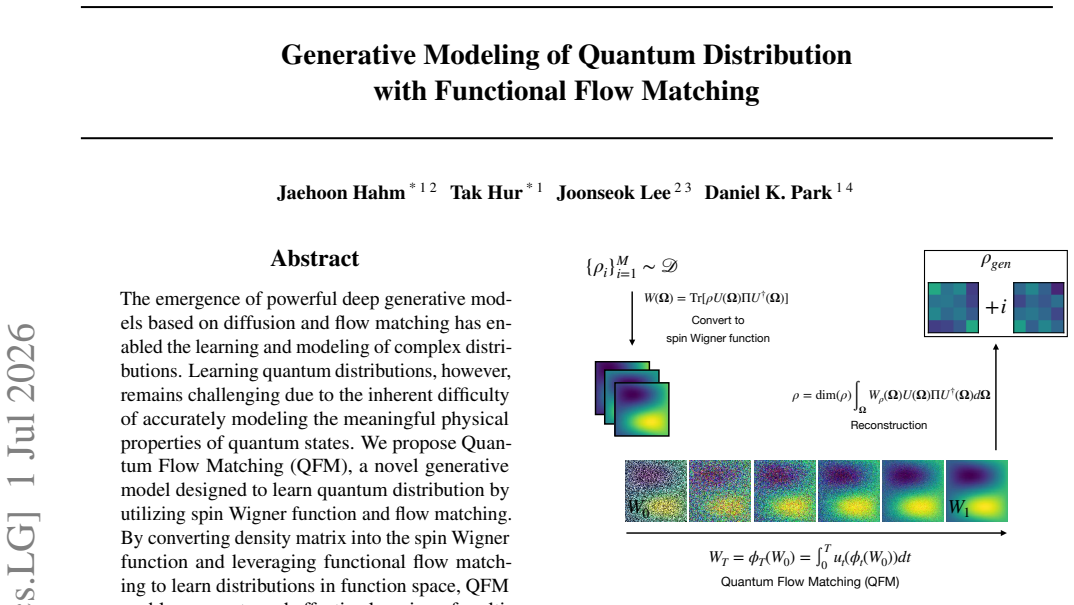
By converting density matrix into the spin Wigner function and leveraging functional flow matching to learn distributions in function space, QFM enables accurate and effective learning of multi-qubit quantum distributions. The generated states are evaluated on trace, purity, and entanglement entropy to confirm they capture the underlying physics.
What carries the argument
Spin Wigner function representation of the density matrix, used as input for functional flow matching that operates in function space.
If this is right
- Generated samples reproduce trace, purity, and entanglement entropy of the training quantum distributions.
- Learning occurs in function space rather than directly on matrix elements.
- The approach applies to multi-qubit systems without post-processing steps.
- Physical properties of the original distribution are recovered directly from the generated states.
Where Pith is reading between the lines
- The method could reduce the cost of sampling large entangled states by avoiding explicit matrix storage.
- It might be combined with existing quantum simulators to generate training data for hybrid models.
- Extending the same conversion to continuous-variable systems would test whether the function-space advantage persists.
- One could measure whether the generated states satisfy additional observables such as correlation functions not used during training.
Load-bearing premise
The spin Wigner function contains all information needed for flow matching to reproduce the original density matrices and their physical properties without extra constraints.
What would settle it
Generate samples from a known multi-qubit distribution, reconstruct the density matrices, and check whether the average trace deviates from 1 or the average entanglement entropy deviates from the training set by more than numerical tolerance.
Figures
read the original abstract
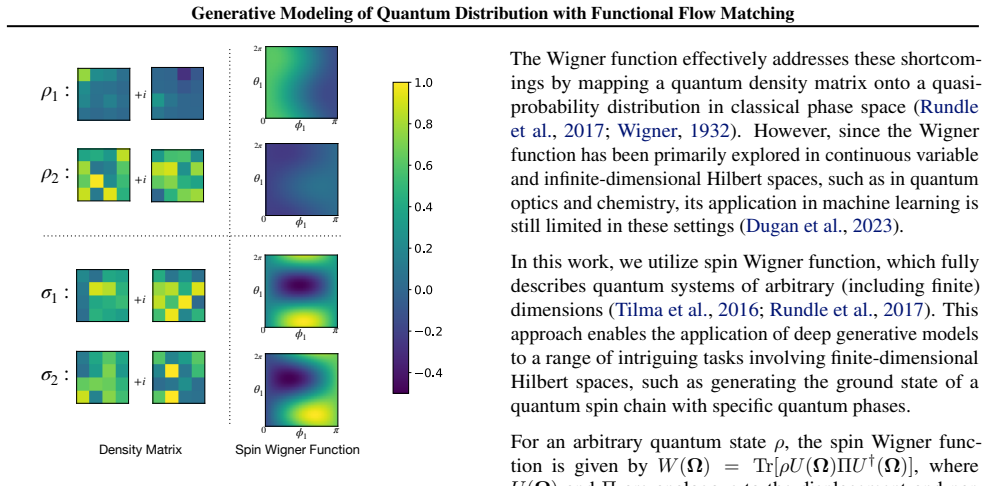
The emergence of powerful deep generative models based on diffusion and flow matching has enabled the learning and modeling of complex distributions. Learning quantum distributions, however, remains challenging due to the inherent difficulty of accurately modeling the meaningful physical properties of quantum states. We propose Quantum Flow Matching (QFM), a novel generative model designed to learn quantum distribution by utilizing spin Wigner function and flow matching. By converting density matrix into the spin Wigner function and leveraging functional flow matching to learn distributions in function space, QFM enables accurate and effective learning of multi-qubit quantum distributions. We demonstrate the effectiveness of our method by evaluating physical quantities such as trace, purity, and entanglement entropy of the generated quantum states, accurately capturing the underlying physics of the given quantum distributions.
Editorial analysis
A structured set of objections, weighed in public.
Referee Report
Summary. The manuscript proposes Quantum Flow Matching (QFM), which converts quantum density matrices to spin Wigner functions and applies functional flow matching to learn their distributions in function space for multi-qubit systems. It claims this approach enables accurate generative modeling of quantum distributions, as shown by the generated states reproducing physical quantities including trace, purity, and entanglement entropy.
Significance. A method that reliably generates samples from quantum distributions while preserving algebraic constraints and physical observables would be a useful addition to the intersection of generative modeling and quantum information. The current manuscript, however, supplies no quantitative results, baselines, or validation metrics, so the significance cannot be assessed from the provided text.
major comments (1)
- [Abstract] Abstract: The claim that generated states 'accurately capturing the underlying physics' rests on the untested assumption that functional flow matching on spin Wigner functions produces functions whose inverse transform yields valid density matrices (Hermitian, trace-1, positive semidefinite) without post-processing; no fraction of invalid samples, projection steps, or quantitative match to target distributions is reported.
minor comments (1)
- The abstract would be strengthened by the inclusion of at least one concrete numerical result (e.g., mean absolute error on purity or entanglement entropy) and a brief statement of the training procedure.
Simulated Author's Rebuttal
We thank the referee for their feedback. We address the major comment below.
read point-by-point responses
-
Referee: [Abstract] Abstract: The claim that generated states 'accurately capturing the underlying physics' rests on the untested assumption that functional flow matching on spin Wigner functions produces functions whose inverse transform yields valid density matrices (Hermitian, trace-1, positive semidefinite) without post-processing; no fraction of invalid samples, projection steps, or quantitative match to target distributions is reported.
Authors: We thank the referee for this observation. The manuscript reports quantitative evaluations of trace, purity, and entanglement entropy on generated states to demonstrate agreement with target distributions. However, we did not report the fraction of samples yielding valid density matrices after the inverse Wigner transform, nor any projection steps. We agree these details are necessary and will add them, including the percentage of valid (Hermitian, trace-1, PSD) samples and any post-processing, to the revised manuscript. revision: yes
Circularity Check
No significant circularity; application of external flow-matching technique
full rationale
The paper presents QFM as converting density matrices to spin Wigner functions and applying functional flow matching (an existing method) to learn distributions in function space. No equations, self-citations, or derivations in the abstract reduce the claimed result to a fit or self-referential definition by construction. Physical quantities are evaluated post-generation, with no evidence of fitted parameters renamed as predictions or uniqueness theorems imported from the authors' prior work. The derivation chain is self-contained against external benchmarks and receives the default non-finding.
Axiom & Free-Parameter Ledger
axioms (1)
- domain assumption Conversion of density matrices to spin Wigner functions preserves all information needed to recover physical observables such as purity and entanglement entropy.
Reference graph
Works this paper leans on
-
[1]
Q-flow: generative modeling for differential equations of open quantum dynamics with normalizing flows , author=. Proc. of the International Conference on Machine Learning (ICML) , year=
-
[2]
Physical review , volume=
On the quantum correction for thermodynamic equilibrium , author=. Physical review , volume=. 1932 , publisher=
1932
-
[3]
Physical review letters , volume=
Wigner functions for arbitrary quantum systems , author=. Physical review letters , volume=. 2016 , publisher=
2016
-
[4]
Physical Review A , volume=
Simple procedure for phase-space measurement and entanglement validation , author=. Physical Review A , volume=. 2017 , publisher=
2017
-
[5]
Flow Matching for Generative Modeling
Flow matching for generative modeling , author=. arXiv:2210.02747 , year=
work page internal anchor Pith review Pith/arXiv arXiv
-
[6]
Functional Flow Matching , author=. arXiv:2305.17209 , year=
-
[7]
Fourier Neural Operator for Parametric Partial Differential Equations
Fourier neural operator for parametric partial differential equations , author=. arXiv:2010.08895 , year=
work page internal anchor Pith review Pith/arXiv arXiv 2010
-
[8]
Score-Based Generative Modeling through Stochastic Differential Equations
Score-based generative modeling through stochastic differential equations , author=. arXiv:2011.13456 , year=
work page internal anchor Pith review Pith/arXiv arXiv 2011
-
[9]
Advances in neural information processing systems (NeurIPS) , year=
Denoising diffusion probabilistic models , author=. Advances in neural information processing systems (NeurIPS) , year=
-
[10]
Nature communications , volume=
Generalization properties of neural network approximations to frustrated magnet ground states , author=. Nature communications , volume=. 2020 , publisher=
2020
-
[11]
Quantum , volume=
Introduction to Haar Measure Tools in Quantum Information: A Beginner's Tutorial , author=. Quantum , volume=. 2024 , publisher=
2024
-
[12]
Physical review A , volume=
Genuinely multipartite entangled states and orthogonal arrays , author=. Physical review A , volume=. 2014 , publisher=
2014
-
[13]
Quantum Science and Technology , volume=
Quantum autoencoders for efficient compression of quantum data , author=. Quantum Science and Technology , volume=. 2017 , publisher=
2017
-
[14]
Nature communications , volume=
Generalization in quantum machine learning from few training data , author=. Nature communications , volume=. 2022 , publisher=
2022
-
[15]
Nature Communications , volume=
Understanding quantum machine learning also requires rethinking generalization , author=. Nature Communications , volume=. 2024 , publisher=
2024
-
[16]
Advances in Neural Information Processing Systems , volume=
Improving diffusion models for inverse problems using manifold constraints , author=. Advances in Neural Information Processing Systems , volume=
-
[17]
Advances in Neural Information Processing Systems , volume=
Denoising diffusion restoration models , author=. Advances in Neural Information Processing Systems , volume=
-
[18]
arXiv preprint arXiv:2405.14283 , year=
Diffusion-based Quantum Error Mitigation using Stochastic Differential Equation , author=. arXiv preprint arXiv:2405.14283 , year=
-
[19]
Nature Machine Intelligence , volume=
Reconstructing quantum states with generative models , author=. Nature Machine Intelligence , volume=. 2019 , publisher=
2019
-
[20]
Reviews of Modern Physics , volume=
Machine learning and the physical sciences , author=. Reviews of Modern Physics , volume=. 2019 , publisher=
2019
-
[21]
Langley , title =
P. Langley , title =. Proceedings of the 17th International Conference on Machine Learning (ICML 2000) , address =. 2000 , pages =
2000
-
[22]
T. M. Mitchell. The Need for Biases in Learning Generalizations. 1980
1980
-
[23]
M. J. Kearns , title =
-
[24]
Machine Learning: An Artificial Intelligence Approach, Vol. I. 1983
1983
-
[25]
R. O. Duda and P. E. Hart and D. G. Stork. Pattern Classification. 2000
2000
-
[26]
Suppressed for Anonymity , author=
-
[27]
Newell and P
A. Newell and P. S. Rosenbloom. Mechanisms of Skill Acquisition and the Law of Practice. Cognitive Skills and Their Acquisition. 1981
1981
-
[28]
A. L. Samuel. Some Studies in Machine Learning Using the Game of Checkers. IBM Journal of Research and Development. 1959
1959
discussion (0)
Sign in with ORCID, Apple, or X to comment. Anyone can read and Pith papers without signing in.