REVIEW 3 major objections 5 minor 54 references
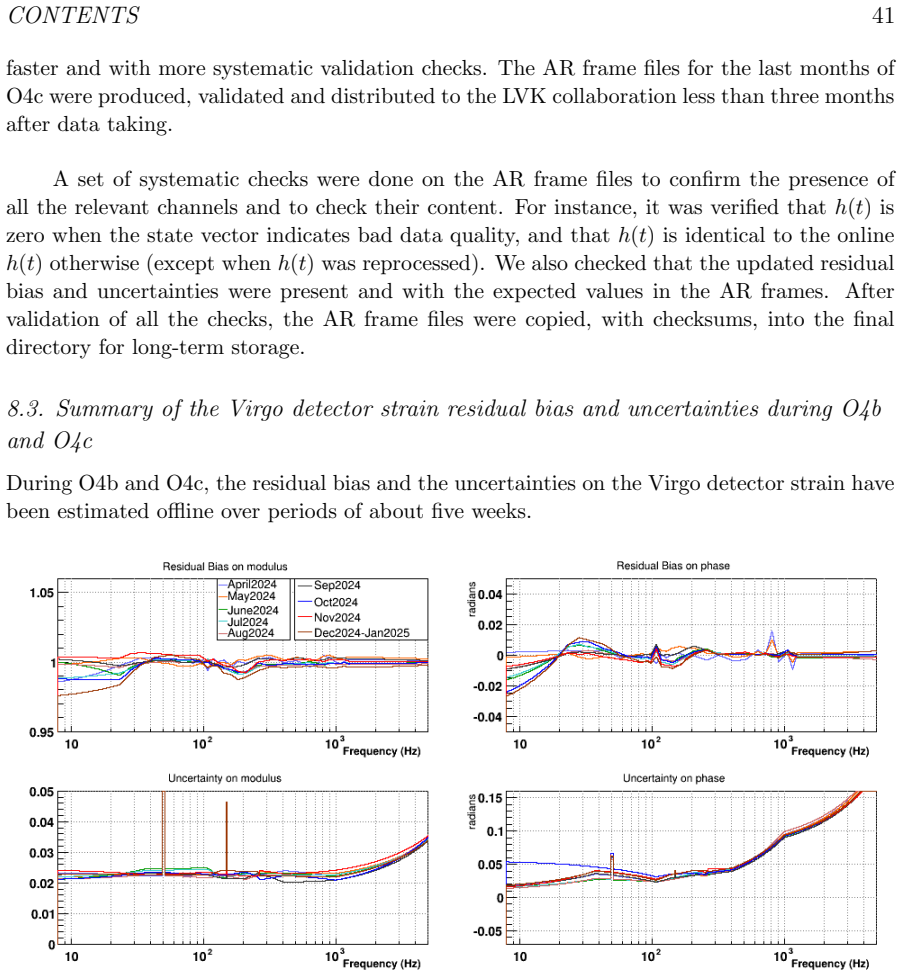
The Advanced Virgo+ detector's strain data from the O4 observing run are calibrated with residual bias below about 1 percent in amplitude and 20 milliradians in phase most of the time, and with frequency-dependent uncertainties of 2–3 perce
Reviewed by Pith at T0; open to challenge. T0 means a machine referee read the full paper against a public rubric. the ladder, T0–T4 →
T0 review · deepseek-v4-flash
2026-08-01 12:54 UTC pith:QAFOOB5I
load-bearing objection A transparent, well-executed O4 calibration paper; the uncertainty claims are credible, with two disclosed soft spots — the 50 Hz phase uncertainty understatement and the unverified Ncal absolute scale — neither of which sinks the central result. the 3 major comments →
Calibration of the AdvancedVirgo+ Gravitational Wave Detector and Reconstruction of the Detector Strain h(t) during the Observing Run O4
The pith
A machine-rendered reading of the paper's core claim, the machinery that carries it, and where it could break.
Core claim
The central claim is that the Analysis-Ready strain h(t) delivered for O4b and O4c is an unbiased estimate of the true gravitational-wave strain at the level of roughly 1 percent in modulus and 20 milliradians in phase (most of the time), with frequency-dependent uncertainties of about 2–3 percent in amplitude and below 30 milliradians in phase over 10–2000 Hz, except near 50 Hz and 150 Hz. The calibration chain rests on a Newtonian calibrator that sets the absolute length scale, with the photon calibrators re-scaled to match it—a factor of 1.09 applied to the NE photon calibrator. The photon calibrators then transfer the calibration to the mirror actuators, reaching 0.77 percent modulus pre
What carries the argument
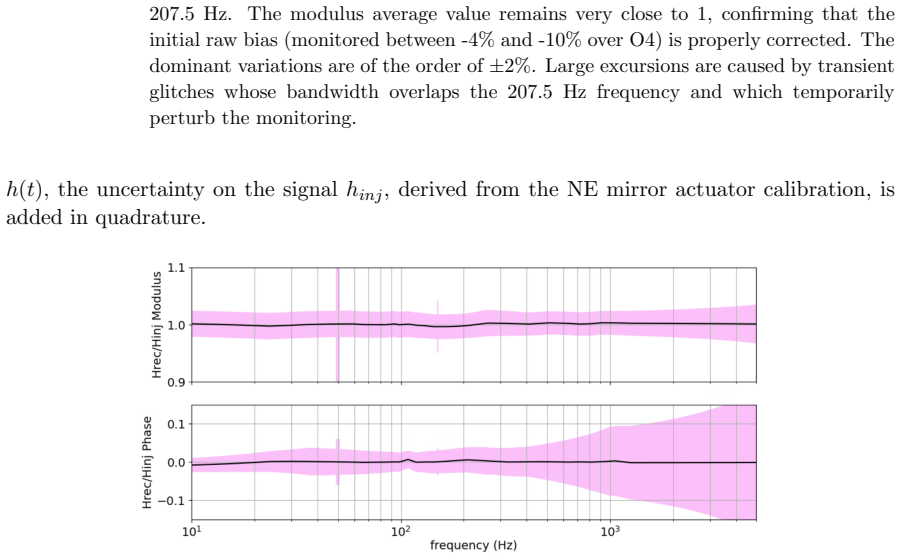
The key mechanism is a calibration-transfer chain. A Newtonian calibrator—rotating masses near a mirror that exert a calculable gravitational force—sets the absolute length scale; photon calibrators, which push mirrors with laser radiation pressure, transfer that scale up to roughly 2 kHz; and a set of permanently injected sine-wave lines continuously measures the ratio of reconstructed to injected strain, h_unbias/h_inj, to quantify residual bias and uncertainty. The ratio-based monitoring detects relative errors but inherits any common-scale error from the absolute reference.
Load-bearing premise
The absolute length scale of Virgo's O4 strain data rests on the Newtonian calibrator's force model; if that model (rotor masses, geometry, or the aluminum-to-PVC rotor change) is off by more than its claimed ~0.12%, the whole strain scale—and every distance inferred from it—shifts without being caught by the paper's ratio-based monitors, because those monitors compare against the same absolute scale.
What would settle it
Compare a loud gravitational-wave event's luminosity distance estimated with Virgo's O4 strain against the distance inferred by an independently calibrated detector in the same network; a common shift larger than the combined quoted uncertainties would reveal an unaccounted absolute-scale error in the Newtonian-calibrator chain. A second, more direct check: install a third independently calibrated Newtonian rotor pair at 36 Hz and test whether the NE/WE calibration constants (currently 1.09 and 1.00) hold.
If this is right
- The publicly released O4 strain data can be used in gravitational-wave analyses with per-frequency calibration uncertainties already incorporated, so no extra systematic penalty is needed.
- Because the online strain series is corrected for bias in near real time, low-latency searches using the 10-second-delayed data stream do not lose detection efficiency to calibration bias.
- Source parameter estimation for the O4 events—distances, masses, sky localization—is not degraded by Virgo calibration uncertainties, according to the paper.
- Frequency-dependent bias and uncertainty channels stored alongside the strain time series allow analysts to apply calibration errors bin by bin rather than as a single global number.
Where Pith is reading between the lines
- The paper leaves implicit that the Newtonian calibrator's absolute scale is the only anchor for all absolute distances from Virgo O4 events; if that scale carries an unmodeled offset, it propagates uniformly into luminosity distances and Hubble-constant measurements without appearing in the internal consistency checks.
- A direct extension would be to monitor the Ncal-vs-Pcal ratio over the full run and to use a third independent calibrator at a different frequency; such a cross-check could validate the 1.09/1.00 factors outside the 36 Hz band.
- The paper notes that the quoted phase uncertainty near 50 Hz is underestimated by about an order of magnitude; whether that is harmless depends entirely on analyses continuing to veto those bands, which could be verified by re-running parameter estimation with a correctly inflated uncertainty.
Editorial analysis
A structured set of objections, weighed in public.
Referee Report
Summary. This paper reports the calibration of the Advanced Virgo+ detector and the reconstruction of the calibrated strain h(t) during the O4b and O4c observing periods. The calibration uses the Newtonian calibrator (Ncal) as the primary length reference for the first time, with the Photon calibrators (Pcal) rescaled accordingly and then used to calibrate the mirror actuators. The paper describes the online and offline ('AnalysisReady') h(t) production, including online bias correction, permanent calibration-line monitoring, broadband injection checks, and frequency-dependent uncertainty estimation. The claims are that the residual bias is mostly below ~1% in modulus and 20 mrad in phase, that the amplitude/phase uncertainties are about 2–3% and below 30 mrad in 10–2000 Hz (except near 50 Hz and 150 Hz), and that Virgo calibration uncertainties did not affect the O4 source-parameter estimation.
Significance. If the claims are correct, this is an important calibration paper: it underpins the public GWOSC O4 Virgo strain data used for parameter estimation, cosmology, and tests of gravity. The paper's strengths include a very long continuous run (O4b+O4c), a clear breakdown of actuator uncertainties (Tables 2–3), permanent in-run monitoring with many cross-checks (Ncal vs Pcal vs mirror actuators; Fig. 2), broadband injection validation (Fig. 17), and the first online bias correction for Virgo. The machine-readable-like frequency-dependent bias and uncertainty channels are a useful product. However, two load-bearing issues need to be addressed: (1) the absolute strain scale is anchored to the Ncal without an independent validation that would catch a common multiplicative scale error in the ratio-based checks; and (2) the paper itself admits that the phase uncertainty around 50 Hz is underestimated in the delivered data product. These issues directly affect the strength of the central claims.
major comments (3)
- [§3.2, Tables 2–3, §7.2–7.4, §9] The absolute strain scale is now set by the Ncal, but the uncertainty budget and the validation chain are not independent of that choice. §3.2 states that Ncal was used as the main length reference, that the NE Pcal was corrected by a factor 1.09 (WE: 1.00), and that Pcal uncertainties were retained because Ncal stability 'was not yet assessed.' However, after this rescaling, Tables 2–3 still list 'Pcal calibration 0.5%' as if Pcal were the absolute reference. More importantly, all in-run bias/uncertainty estimates (§7.2–7.4) are based on h_unbias/h_inj, where h_inj is computed from the NE actuator model that inherits the Ncal scale via the corrected Pcal. A multiplicative error in the Ncal force model (e.g., rotor masses/geometry or the aluminum-to-PVC change) cancels in every one of these ratios. The Ncal-vs-Pcal comparison in Fig. 2 constrains only relative drift, and the 'confirmatio
- [§7.4, Fig. 17(b), Fig. 19] The paper explicitly acknowledges that the phase uncertainty around 50 Hz is underestimated: §7.4 says 'there is a known inconsistency in this estimate' and that the phase uncertainty should be of order 500 mrad, not the 50 mrad quoted in the text and presumably in the AR frame files. Because the AR files are the public data product and the paper's purpose is to provide reliable frequency-dependent uncertainties, this is not merely cosmetic: a user who does not excise the 49–51 Hz band will severely underestimate the phase error. Please correct the AR frame uncertainty vectors (or clearly flag the band as invalid), and update the abstract/text so that the 50 Hz phase uncertainty is not misleadingly quoted as ~50 mrad.
- [§9] The sentence 'For O4, the estimation of the source parameters was not affected by the Virgo calibration uncertainties' is a strong causal claim, but this paper does not report any injection/recovery or parameter-estimation study that varies the calibration within the quoted uncertainties and demonstrates no impact. If this conclusion is based on external GWTC analyses (e.g., refs [47], [54]), please cite the specific studies; otherwise soften the claim to something like 'within the quoted uncertainties, the LVK analyses did not identify a measurable impact.' As written, the statement overreaches what the calibration validation in §7 can establish, especially given the 50 Hz uncertainty issue in the previous comment.
minor comments (5)
- [§3.1] The sentence 'In order to frequency band where the interferometer is most sensitive, the SR mirror was added...' appears to be missing a word; likely 'In order to broaden the frequency band where the interferometer is most sensitive...'.
- [§3.2] The text gives Ncal uncertainties of 0.17% [24] before the run and 0.12% [25] after the rotor change, but it is not immediately clear whether 0.17% refers to the pre-PVC configuration or to a different estimate. Please clarify the chronology and which uncertainty applies to which Ncal configuration.
- [Fig. 2 caption] The caption mentions a 6-mm displacement of the WE mirror that introduced a 0.4% bias in the WE Pcal until May 2025. Please state whether these periods are flagged in data quality or corrected in the AR frames, so that users know whether the 0.4% excursion affects the delivered h(t).
- [Eq. (3)] The factor TF_true/TF_pole is explained in the text but not defined in the equation itself. A brief definition or a pointer to §7.1 would help readers who skip the prose.
- [References] Several key technical references (e.g., [15], [21], [22]) are listed as 'in preparation' or 'preprint.' For a calibration paper, this is acceptable, but please ensure the versions are public or provide technical notes in the TDS at the time of publication.
Circularity Check
No significant circularity; absolute scale is set by external Newtonian/photon calibrators and the ratio-based monitoring is a disclosed self-consistency check.
full rationale
The absolute length scale is anchored externally: the Newtonian calibrator force is computed from rotor masses and geometry via Newtonian gravity, and the photon calibrator applies a calculable radiation pressure; neither depends on the reconstructed strain h(t) (§3.2, §5). The 1.09 NE-Pcal correction is an empirical adjustment of the Pcal to match the Ncal reference, not a fit to h(t). The h_unbias/h_inj monitoring (§7.1, §7.4) is explicitly a relative check: h_inj is built from the same actuator models used in the reconstruction, so a common multiplicative scale error would cancel in the ratio. The paper does not use this ratio alone for the absolute scale; it adds the NE actuator calibration uncertainty (0.77%, traced through the Pcal/Ncal chain) in quadrature. The only by-construction element is that the residual bias measured with NE injections is flat after the bias correction is derived from those same injections; the paper states this openly (§7.3.1) and corroborates with WE injections and broadband injections, which are not forced to unity. The admitted underestimation of the 50 Hz/150 Hz phase uncertainty (§7.4, Fig. 17) and the unassessed Ncal stability (§3.2) are limitations of the uncertainty budget, not circular definitions. The central claim therefore rests on external physical calibrators plus honestly propagated uncertainties; I find no significant circularity.
Axiom & Free-Parameter Ledger
free parameters (8)
- NE mirror actuator model (gain, pole, zero, delay, Table 1) =
G=0.434 µm/V; f_p=105.5 Hz; f_z=110.1/6648 Hz; delay −157.6 µs
- WE mirror actuator model (until May 2025) =
G=0.409 µm/V; f_p=193.5 Hz; f_z=197.7/5269 Hz; delay −155.3 µs
- WE mirror actuator model (from June 2025) =
G=0.426 µm/V; f_p=137.2 Hz; f_z=139.4/8805.6 Hz; delay −163.4 µs
- NE/WE Pcal correction factors =
1.09 (NE), 1.00 (WE)
- Optical gain (time-varying) =
~3.2×10^9 W/m (1.8×10^9 during Oct 2025 anomaly)
- Double cavity pole frequency (time-varying) =
~180 Hz (195 Hz before 24 Jun 2024)
- Bias correction function B_raw =
interpolated at 0.125 Hz resolution from 27-line injections (up to 4% modulus, 50 mrad phase)
- Noise-subtraction transfer functions =
two witness channels (LSC MICH 8-200 Hz, LSC SRCL 8-40 Hz), updated every 240 s
axioms (8)
- standard math Long-wavelength approximation: h(t) = ΔL(t)/L0 with L0 = 3 km
- domain assumption Newtonian calibrator produces a known force from rotating masses (Newtonian gravity)
- domain assumption Photon calibrator applies known radiation pressure from a modulated laser
- domain assumption Interferometer optical response R is identical during reference and target measurement datasets (minutes apart)
- ad hoc to paper Optical response is a single-pole cavity approximation; the resulting bias is compensated later in the data analysis chain via the antenna pattern
- domain assumption End-mirror actuation has an additional 10 µs delay relative to the response to a passing GW
- domain assumption Photodiode sensing chain modeled as 8th-order Butterworth at 10 kHz plus pure delay, accurate to 0.01%/0.4 µs
- ad hoc to paper Line-based bias/uncertainty monitoring at 11 frequencies is interpolable to the full band
read the original abstract
From 10 April 2024 15:00 UTC to 18 November 2025 16:00 UTC, the AdvancedVirgo+ gravitational wave detector participated in the LIGO-Virgo-KAGRA O4 observing run, started on 24 May 2023 15:00 UTC. Around 173 transient gravitational wave (GW) sources, all corresponding to coalescences of binary compact objects involving black holes and neutron stars, were detected online during the two run periods O4b and O4c when Virgo was taking data in the detector network. Despite its sensitivity being limited around 55 Mpc, the inclusion of Virgo into the network allowed to improve the accuracy of the source parameter estimation, in particular the sky localisation of the detected events. This article describes the AdvancedVirgo+ detector calibration and the reconstruction of the detector strain h(t) during O4, as well as the estimation of the associated frequency-dependent uncertainties. The detector calibration is based on auxiliary actuators, Newtonian Calibrators and Photon Calibrators, described in other publications. The h(t) reconstruction, including linear noise subtraction, was processed online with a latency of about 10 s. The so-called AnalysisReady strain data were then produced offline. Most of the time, the strain time series was a copy of the online time series, but with updated frequency-dependent uncertainties, around 2-3% in amplitude and below 30 mrad in phase in the 10-2000 Hz frequency band, with the exception of larger uncertainties around 50 Hz and 150 Hz. The AnalysisReady strain data and associated uncertainties have been used for the offline LIGO-Virgo-KAGRA data analysis and are also the data made publicly available through the Gravitational Wave Open Science Center (GWOSC).
Figures



Reference graph
Works this paper leans on
-
[2]
org/superevents/public/O4/
The Gravitational-Wave Candidate Event Database (GraceDB) URLhttps://gracedb.ligo. org/superevents/public/O4/
-
[3]
Abbott R et al. (LIGO Scientific Collaboration and Virgo Collaboration) 2026 Gwtc-5: Compact CONTENTS44 binary coalescences observed by ligo and virgo during the second half of the fourth observing run (Preprint2605.27225) URLhttps://arxiv.org/abs/2605.27225v2
Pith/arXiv arXiv 2026
-
[4]
L VK Collaboration 2026 to be published in CQG URLhttps://arxiv.org/abs/2508.18079
Pith/arXiv arXiv 2026
-
[5]
(LIGO Scientific Collaboration) 2015 Classical and Quantum Gravity32074001 URL http://stacks.iop.org/0264-9381/32/i=7/a=074001
Aasi J et al. (LIGO Scientific Collaboration) 2015 Classical and Quantum Gravity32074001 URL http://stacks.iop.org/0264-9381/32/i=7/a=074001
2015
-
[6]
(LIGO Scientific Collaboration) 2020 Phys
Buikema A et al. (LIGO Scientific Collaboration) 2020 Phys. Rev. D102(6) 062003 URL https://link.aps.org/doi/10.1103/PhysRevD.102.062003
-
[7]
Viets A, Wade M, Urban A, Kandhasamy S, Betzwieser J, Brown D A, Burguet-Castell J, Cahillane C, Goetz E, Izumi K et al. 2018 Classical and Quantum Gravity35095015 URL https://iopscience.iop.org/article/10.1088/1361-6382/aab658
-
[8]
(Virgo Collaboration) 2019 Phys
Acernese F et al. (Virgo Collaboration) 2019 Phys. Rev. Letters123231108 URLhttps://ui. adsabs.harvard.edu/abs/2019PhRvL.123w1108A
2019
-
[9]
Mehmet M and Vahlbruch H 2020 Galaxies8ISSN 2075-4434 URLhttps://www.mdpi.com/ 2075-4434/8/4/79
2020
-
[10]
Akutsu T e a 2021 Progress of Theoretical and Experimental Physics202105A101 ISSN 2050- 3911 (Preprinthttps://academic.oup.com/ptep/article-pdf/2021/5/05A101/37974994/ ptaa125.pdf) URLhttps://doi.org/10.1093/ptep/ptaa125
-
[11]
Accadia T, et al (Virgo Collaboration) 2012 The AdV Technical Design Report VIR-0128A-12 URLhttps://tds.virgo-gw.eu/ql/?c=8940
2012
-
[12]
Acernese F et al. (Virgo Collaboration) 2015 Classical and Quantum Gravity32024001 (Preprint 1408.3978) URLhttps://iopscience.iop.org/article/10.1088/0264-9381/32/2/024001
Pith/arXiv arXiv 2015
-
[13]
Technical Report VIR-0596A-19 URLhttps://tds.virgo-gw.eu/ql/?c=14430
Accadia T, et al (Virgo Collaboration) 2019 The Advanced Virgo Plus Phase I - Design Report. Technical Report VIR-0596A-19 URLhttps://tds.virgo-gw.eu/ql/?c=14430
2019
-
[14]
Meers B J 1988 Phys. Rev. D38(8) 2317–2326 URLhttps://link.aps.org/doi/10.1103/ PhysRevD.38.2317
1988
-
[15]
The Virgo Collaboration 2026 in preparationxxxxxx (Preprintxxx)
2026
-
[16]
LSC Calibration Group 2022 O4 calibration requirements document LIGO-T2100015-v1 URL https://dcc.ligo.org/LIGO-T2100015
2022
-
[17]
(KAGRA Collaboration, LIGO Scientific Collaboration and Virgo Collaboration) 2018 Living Rev
Abbott B P et al. (KAGRA Collaboration, LIGO Scientific Collaboration and Virgo Collaboration) 2018 Living Rev. Relativ.21(Preprint1304.0670) URLhttps://link.springer.com/ article/10.1007/s41114-018-0012-9
Pith/arXiv arXiv 2018
-
[18]
Abbott B P et al. (Virgo Collaboration) 2018 Classical and Quantum Gravity35205004 (Preprint 1807.03275) URLhttps://iopscience.iop.org/article/10.1088/1361-6382/aadf1a
Pith/arXiv arXiv 2018
-
[19]
Quantum Grav.25184017 (Preprint arXiv:0808.3805) URLhttps://doi.org/10.1088/0264-9381/25/18/184017
Rakhmanov M, Romano R D and Whelan J T 2008 Class. Quantum Grav.25184017 (Preprint arXiv:0808.3805) URLhttps://doi.org/10.1088/0264-9381/25/18/184017
Pith/arXiv arXiv 2008
-
[20]
Accadia T et al. (Virgo Collaboration) 2014 Classical and Quantum Gravity31165013 (Preprint1401.6066) URLhttps://iopscience.iop.org/article/10.1088/0264-9381/31/ 16/165013
Pith/arXiv arXiv 2014
-
[21]
Frappez F, Grimaud C, Lagabbe P, Masserot A, Rolland L, and Verkindt D 2026 in preparation xxxxxx (Preprintxxx)
2026
-
[22]
Grimaud C 2025 Virgo interferometer calibration and h(t) detector strain reconstruction uncertainty computation during the O4 observing run Phd thesis Universit´ e Savoie Mont Blanc URLhttps://hal.science/tel-05493377v1
2025
-
[23]
Estevez D, Lagabbe P, Masserot A, Rolland L, Seglar-Arroyo M and Verkindt D 2021 Classical and Quantum Gravity38075007 (Preprint2009.08103) URLhttps://iopscience.iop.org/ article/10.1088/1361-6382/abe2db
Pith/arXiv arXiv 2021
-
[24]
1088/1361-6382/ad869c
F Aubin, E Dangelser, D Estevez, A Masserot, B Mours, T Pradier, A Syx and P Van Hove 2024 Classical and Quantum Gravity41235003 ISSN 1361-6382 URLhttp://dx.doi.org/10. 1088/1361-6382/ad869c
2024
-
[25]
Syx A 2025 Calibration of the Virgo gravitational waves detector using a Newtonian Calibrator for the observing run O4 Phd thesis Universit´ e de Strasbourg URLhttps://theses.hal.science/ CONTENTS45 tel-05100604v1
2025
-
[26]
Estevez, D and Mours, B and Pradier, T 2021 Classical and Quantum Gravity38075012 URL https://doi.org/10.1088/1361-6382/abe2da
-
[27]
Gravitational wave open science center URLhttps://www.gw-openscience.org/
-
[28]
Acernese F et al. (The Virgo Collaboration) 2022 Classical and Quantum Gravity39045006 URL https://dx.doi.org/10.1088/1361-6382/ac3c8e
-
[29]
Quantum Grav.191623–1629 URLhttps://doi.org/10.1088/ 0264-9381/19/7/353
Virgo Collaboration 2002 Class. Quantum Grav.191623–1629 URLhttps://doi.org/10.1088/ 0264-9381/19/7/353
2002
-
[30]
Aisa D, Aisa S, Campeggi C, Colombini M, Conte A, Farnesini L, Majorana E, Mezzani F, Montani M, Naticchioni L, Perciballi M, Piergiovanni F, Piluso A, Puppo P, Rapagnani P, Travasso F, Vicer` e A and Vocca H 2016 Nuclear Instruments and Methods in Physics Research Section A: Accelerators, Spectrometers, Detectors and Associated Equipment824 644–645 ISSN ...
2016
-
[31]
L Naticchioni and Virgo Collaboration 2018 J. Phys.: Conf. Ser.957012002 URLhttps: //iopscience.iop.org/article/10.1088/1742-6596/957/1/012002
-
[32]
Allocca A, Bersanetti D, Casanueva Diaz J, De Rossi C, Mantovani M, Masserot A, Rolland L, Ruggi P, Swinkels B, Tapia San Martin E N, Vardaro M and Was M 2020 Galaxies8ISSN 2075-4434 URLhttps://www.mdpi.com/2075-4434/8/4/85
2020
-
[33]
Lagabbe P 2023 Improving the Advanced Virgo+ calibration with the photon calibrator for the 04 run Phd thesis Universit´ e Savoie Mont Blanc URLhttps://theses.hal.science/tel-04280527
2023
-
[34]
2024 Metrologia61054002 URLhttps://hal.science/hal-04664048
Bhattacharjee D et al. 2024 Metrologia61054002 URLhttps://hal.science/hal-04664048
2024
-
[35]
Rolland L, Van Haevermaet H and Frappez F 2026 Calibration of Virgo B1 (and B1p) photodiodes sensing for the fourth Observing run (ER16, O4b and O4c) VIR-0186A-26 URLhttps: //tds.virgo-gw.eu/ql/?c=22592
2026
-
[36]
Estevez, D and Mours, B and Rolland, L and Seglar-Arroyo, M and Verkindt, D 2020 Hrec package documentation VIR-0590A-20 URLhttps://tds.virgo-gw.eu/ql/?c=15715
2020
-
[37]
Rolland, L and Seglar-Arroyo, M and Verkindt, D 2025 Hrec package documentation VIR-0590B-20 URLhttps://tds.virgo-gw.eu/ql/?c=15715
2025
-
[38]
Aubin F et al. 2026 Journal of Physics: Conference Series3177012068 URLhttps:// iopscience.iop.org/article/10.1088/1742-6596/3177/1/012068
-
[39]
2019 Physical Review D99042001 URLhttps://journals.aps.org/prd/ abstract/10.1103/PhysRevD.99.042001
Driggers J C, Vitale S, Lundgren A, Evans M, Kawabe K, Dwyer S, Izumi K, Schofield R, Effler A, Sigg D et al. 2019 Physical Review D99042001 URLhttps://journals.aps.org/prd/ abstract/10.1103/PhysRevD.99.042001
-
[40]
Davis D, Massinger T, Lundgren A, Driggers J C, Urban A L and Nuttall L 2019 Classical and Quantum Gravity36055011 URLhttps://iopscience.iop.org/article/10.1088/ 1361-6382/ab01c5
2019
-
[41]
L VK Collaboration 2026 to be published in CQG URLhttps://arxiv.org/abs/2605.27223
Pith/arXiv arXiv 2026
-
[42]
Abac A G et al. (The LIGO Scientific Collaboration and the Virgo Collaboration and the KAGRA Collaboration) URLhttps://arxiv.org/abs/2508.18081v2
-
[43]
Rolland, L 2015 Notes on single-pole cavity approximation and long-wavelength interferometer approximations VIR-0530A-15 URLhttps://tds.virgo-gw.eu/ql/?c=11260
2015
-
[44]
Aubin F et al. 2026 Journal of Physics: Conference Series3177012082 URLhttps:// iopscience.iop.org/article/10.1088/1742-6596/3177/1/012082
-
[45]
Verkindt D 2021 Transfer Functions Monitor (TFMoni) Users Manual VIR-059A-21 URLhttps: //tds.virgo-gw.eu/ql/?c=16707
2021
-
[46]
Verkindt D, Rolland L, Seglar-Arroyo M and Estevez D 2021 Advanced Virgo calibration monitoring during the observing run O3 VIR-0544A-21 URLhttps://tds.virgo-gw.eu/ql/ ?c=16792
2021
-
[47]
Abbott, R and others (LIGO Scientific Collaboration and Virgo Collaboration) 2026 GWTC- CONTENTS46 5.0: Methods for Identifying and Characterizing Gravitational-wave Transients (Preprint 2605.27224) URLhttps://arxiv.org/abs/2605.27224
Pith/arXiv arXiv 2026
-
[48]
Verkindt, D and Rolland, L 2025 Virgo C01 and AR frames production for O4b and O4c VIR- 0836A-25 URLhttps://tds.virgo-gw.eu/ql/?c=22019
2025
-
[49]
Verkindt, D and Rolland, L 2025 HoftAR1U02 AR frames production and checks (also in DCC LIGO-T2500329-v2) VIR-0941A-25 URLhttps://tds.virgo-gw.eu/ql/?c=22126
2025
-
[50]
Verkindt, D and Rolland, L 2025 O4c Virgo Analysis Ready (AR) frames production: checks and review (also in DCC LIGO-T2500399) VIR-1198B-25 URLhttps://tds.virgo-gw.eu/ql/?c= 22386
2025
-
[51]
Virgo Data Acquisition Group 2019 Specification of a Common Data Frame Format for Interferometric Gravitational Wave Detectors (IGWD) VIR-0067B-08 and LIGO-T970130-v2 URLhttps://tds.virgo-gw.eu/ql/?c=2080
2019
-
[52]
Verkindt, D and Rolland, L 2026 in LIGO Virgo KAGRA Calibration Uncertainty LIGO-T2500288 URLhttps://dcc.ligo-wa.caltech.edu/LIGO-T2500288/public
2026
-
[53]
Ryan Fisher, Gary Hemming, Marie-Anne Bizouard, Duncan Brown, Peter Couvares, Florent Robinet, Didier Verkindt DQSEGDB: A time-interval database for storing gravitational wave observatory metadata URLhttps://cnrs.hal.science/hal-03898630
-
[54]
L VK collaboration 2026 LIGO Virgo KAGRA Calibration Uncertainty (O4) LIGO-T2500288-v5 URLhttps://dcc.ligo.org/LIGO-T2500288
2026
-
[55]
Abbott, R and others (LIGO Scientific Collaboration and Virgo Collaboration) 2026 Open Data from LIGO, Virgo, and KAGRA through the Second Part of the Fourth Observing Run (Preprint 2605.27090) URLhttps://arxiv.org/abs/2605.27090 CONTENTS47 Appendix 9.1. Actuators models parameters What we refer to as an Advanced Virgo+ mirror actuator is represented by a...
Pith/arXiv arXiv 2026
discussion (0)
Sign in with ORCID, Apple, or X to comment. Anyone can read and Pith papers without signing in.