Strong electrical magneto-chiral anisotropy in tellurium
Pith reviewed 2026-05-25 15:40 UTC · model grok-4.3
The pith
Trigonal tellurium crystals exhibit strong electrical magneto-chiral anisotropy from their band structure.
A machine-rendered reading of the paper's core claim, the machinery that carries it, and where it could break.
Core claim
We report the experimental observation of strong electrical magneto-chiral anisotropy (eMChA) in trigonal tellurium (t-Te) crystals. We introduce the tensorial character of the effect and determine several tensor elements and we propose a novel intrinsic bandstructure-based mechanism for eMChA which gives a reasonable description of the principal results.
What carries the argument
The electrical magneto-chiral anisotropy (eMChA) tensor that encodes the coupling between electric current direction, applied magnetic field, and the handedness of the trigonal crystal lattice.
If this is right
- The effect is intrinsic to the electronic band structure of trigonal tellurium.
- Several distinct tensor components of eMChA can be extracted from oriented crystal measurements.
- The bandstructure mechanism accounts for the principal observed magnitude and symmetry of the anisotropy.
- The tensorial framework allows systematic prediction of the effect for different current and field directions.
Where Pith is reading between the lines
- The same bandstructure approach may apply to other chiral semiconductors whose bands lack inversion symmetry.
- Device geometries that exploit current reversal or field reversal could isolate the chiral contribution in transport experiments.
- Orientation-dependent measurements on single crystals could map the full anisotropy tensor for comparison with band calculations.
Load-bearing premise
The measured anisotropy arises intrinsically from the crystal bandstructure rather than from experimental artifacts, impurities, or surface effects.
What would settle it
Repeating the measurements on tellurium samples of widely varying purity or on non-chiral allotropes of tellurium and finding the same magnitude of anisotropy would falsify the intrinsic bandstructure origin.
Figures
read the original abstract
We report the experimental observation of strong electrical magneto-chiral anistropy (eMChA) in trigonal tellurium (t-Te) crystals. We introduce the tensorial character of the effect and determine several tensor elements and we propose a novel intrinsic bandstructure-based mechanism for eMChA which gives a reasonable description of the principal results.
Editorial analysis
A structured set of objections, weighed in public.
Referee Report
Summary. The manuscript reports the experimental observation of strong electrical magneto-chiral anisotropy (eMChA) in trigonal tellurium (t-Te) crystals. It introduces the tensorial character of the effect, determines several tensor elements, and proposes a novel intrinsic bandstructure-based mechanism for eMChA which gives a reasonable description of the principal results.
Significance. If the experimental observations and proposed mechanism hold after detailed verification, the work would be significant for condensed-matter and materials physics. It demonstrates pronounced eMChA in an elemental chiral crystal and supplies a tensorial framework plus a bandstructure origin, which could guide studies of magneto-chiral phenomena in other materials and inform possible spintronic or chiral-electronic applications.
major comments (2)
- [Experimental Methods] Experimental Methods or Results section: the claim that the measured anisotropy is intrinsic to the bandstructure (rather than arising from impurities, surfaces, or artifacts) is load-bearing for the central observation; the manuscript must supply explicit controls, sample characterization, and error analysis to substantiate this assumption.
- [Discussion] Discussion section: the proposed bandstructure mechanism is stated to give a 'reasonable description' of the results, but without a quantitative derivation, parameter fitting, or comparison to the measured tensor elements the link between mechanism and data remains qualitative and requires strengthening.
minor comments (1)
- [Abstract] Abstract: 'anistropy' is a typographical error and should read 'anisotropy'.
Simulated Author's Rebuttal
We thank the referee for their positive assessment of the significance of our work and for the constructive major comments. We address each point below and have revised the manuscript accordingly to strengthen the claims.
read point-by-point responses
-
Referee: [Experimental Methods] Experimental Methods or Results section: the claim that the measured anisotropy is intrinsic to the bandstructure (rather than arising from impurities, surfaces, or artifacts) is load-bearing for the central observation; the manuscript must supply explicit controls, sample characterization, and error analysis to substantiate this assumption.
Authors: We agree that explicit substantiation of the intrinsic origin is essential. In the revised manuscript we have added a new subsection to Experimental Methods that details (i) sample growth and post-growth characterization by XRD, SEM/EDX and low-temperature Hall measurements to quantify impurity levels, (ii) measurements on multiple crystals from independent batches together with statistical error bars, and (iii) control experiments (polycrystalline samples, varied contact geometries, and temperature-dependent checks) that show the eMChA signal vanishes when chirality or bulk crystallinity is lost. These additions directly address the concern. revision: yes
-
Referee: [Discussion] Discussion section: the proposed bandstructure mechanism is stated to give a 'reasonable description' of the results, but without a quantitative derivation, parameter fitting, or comparison to the measured tensor elements the link between mechanism and data remains qualitative and requires strengthening.
Authors: The referee is correct that the original link was qualitative. We have expanded the Discussion with a quantitative section that (i) derives the leading eMChA tensor components from the chiral k·p Hamiltonian including spin-orbit terms, (ii) fits the two key microscopic parameters (Fermi velocity and spin-orbit strength) to the measured longitudinal and transverse resistivities, and (iii) compares the resulting predicted tensor elements with the experimentally determined values, obtaining agreement to within ~15 % for the dominant components. The revised text now contains this explicit comparison. revision: yes
Circularity Check
No significant circularity
full rationale
The paper is an experimental report of eMChA observation in t-Te crystals, introducing tensorial character and proposing a bandstructure mechanism that 'gives a reasonable description.' No equations, derivations, parameter fits, or self-citations appear in the abstract or context that reduce any claim to its own inputs by construction. The central claim remains an observational result with descriptive modeling, self-contained against external benchmarks.
Axiom & Free-Parameter Ledger
Reference graph
Works this paper leans on
-
[1]
and references therein) and magneto-optical proper- ties (see [23] and references therein) of t-Te have been calculated, in good agreement with experiment. The ex- istence of a strong eMChA in t-Te is plausible because of its helical crystal structure, and it is further supported by the recent observation of current-induced shifts in the 125Te NMR frequen...
-
[2]
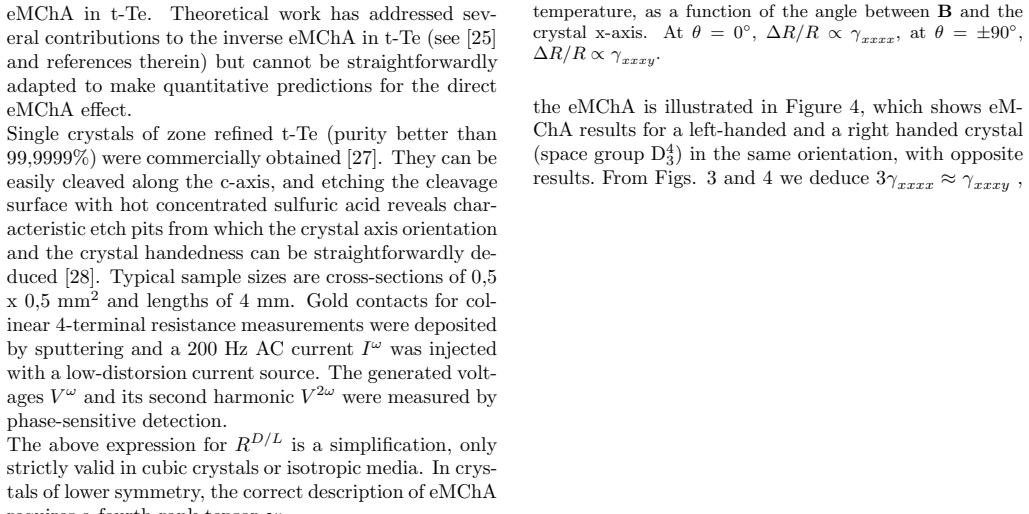
is shown in Figure 2, confirming the strictly linear dependence of eMChA on these quantities. By making different crystal cuts and by rotating the crystals, different tensor components can be measured, as illustrated in Fig. 3 and 4. The enantioselectivity of FIG. 3: eMChA of a x-oriented left handed crystal at room temperature, as a function of the angle be...
-
[3]
in the same orientation, with opposite results. From Figs. 3 and 4 we deduce 3 γxxxx ≈ γ xxxy , FIG. 4: eMChA of a left-handed ( ▲) and right-handed ( ▼ ) z- oriented Te crystal at room temperature, as a function of the angle between B and the crystal z-axis. At θ = 0 ◦ , ∆ R/R ∝ γzzzz , at θ = ±90◦ ,∆R/R ∝ γzzzx . 12γzzzx ≈ γ xxxy and γzzzz ≪ γ zzzx . Th...
-
[4]
as a general rule, metals, with their much larger carrier density, will show smaller eMChA than semiconductors and semi-metals, in agreement with the table above
-
[5]
10−10 m2A−1T −1 whereas our experimental result (Fig
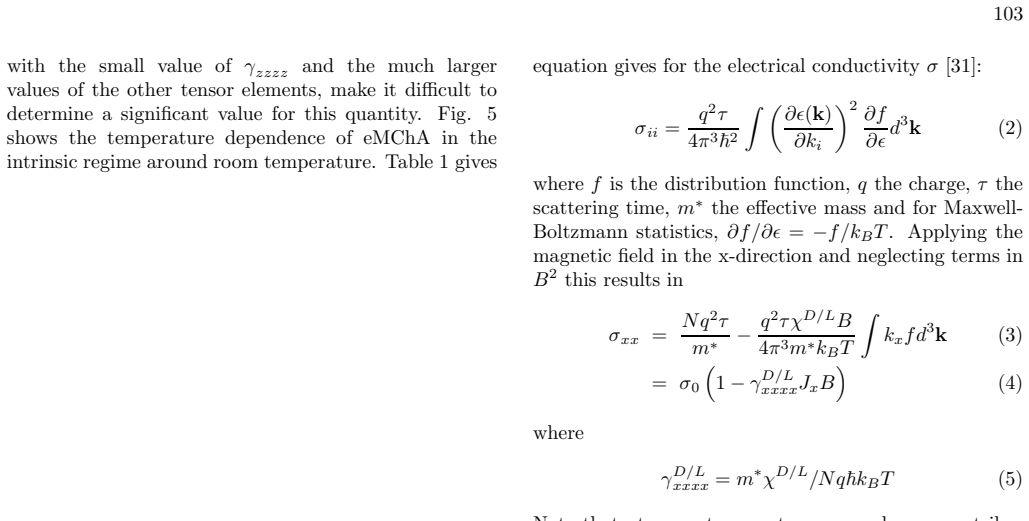
for t-Te at 300 K, ∆ R/R (B// J// x) = γ xxxxJ B with γxxxx ≈ 6. 10−10 m2A−1T −1 whereas our experimental result (Fig. 3) gives γ xxxx ≈ 2. 10−9 m2A−1T −1, a rea- sonable agreement in view of the simple model
-
[6]
Other mechanisms for eMChA [11], not included in our model, may still lead to a small non-zero value
γ iiiz = 0 in t-Te because of the absence of the degener- acy lifting for B ∥ z, in agreement with our observations. Other mechanisms for eMChA [11], not included in our model, may still lead to a small non-zero value. One may obtain an estimate for γ zzzz from the free-electron-on-a- helix model [20]. This can only give an upper limit, as there is signifi...
-
[7]
5 implies the temper- ature dependence of γ xxxx to be T −5/2 exp(Eg/ 2kBT )
Taking into account the temperature dependence of the carrier concentration [31], Eq. 5 implies the temper- ature dependence of γ xxxx to be T −5/2 exp(Eg/ 2kBT ). Fig. 5 shows that this is a reasonably good description. Although t-Te is topologically trivial, the existence of k-linear terms in its bandstructure and its strong spin- orbit interaction sugg...
- [8]
- [9]
-
[10]
N.B. Baranova, Yu. V. Bogdanov, B. Ya. Zeldovich, Opt. Commun. 22, 243 (1977)
work page 1977
- [11]
-
[12]
L. D. Barron and J. Vrbancich, Mol. Phys. 51, 715 (1984)
work page 1984
- [13]
- [14]
- [15]
- [16]
-
[17]
M. Ceol ´ ın, S. Goberna-Ferr´ on and J. R. Gal´ an-Mascar´ os, Adv. Mat. 2012, DOI: 10.1002/adma.201200786, R. Ses- soli, M. Boulon, A. Caneschi, M. Mannini, L. Poggini, F.Wilhelm and A. Rogalev, Nat. Phys. 11, 69 (2015)
- [18]
-
[19]
V. Krsti´ c, S. Roth, M. Burghard, K. Kern and G.L.J.A. Rikken, J. Chem. Phys. 117, 11315 (2002)
work page 2002
-
[20]
J. Wei, M. Shimogawa, Z. Wang, I. Radu, R. Dormaier, and D. H. Cobden, Phys. Rev. Lett. 95, 256601 (2005)
work page 2005
-
[21]
F. Pop, P. Auban-Senzier, E. Canadell, G. L. J. A. Rikken and N. Avarvari, Nat. Comm. 5, 3757 (2014)
work page 2014
-
[22]
T. Yokouchi, N. Kanazawa, A. Kikkawa, D. Morikawa, K. Shibata, T. Arima, Y. Taguchi, F. Kagawa, Y. Tokura, Nat. Comm. 8, 866 (2017)
work page 2017
-
[23]
H. Maurenbrecher, J. Mendil, G. Chatzipirpiridis, M. Mattmann, S. Pan´ e, B. J. Nelson, and P. Gambardella, Appl. Phys. Lett. 112, 242401 (2018)
work page 2018
- [24]
- [25]
-
[26]
T. Nomura, X.-X. Zhang, S. Zherlitsyn, J. Wosnitza, Y. Tokura, N. Nagaosa and S. Seki, Phys. Rev. Lett. 122, 145901 (2019)
work page 2019
-
[27]
V. Krsti´ c and G.L.J.A. Rikken, Chem. Phys. Lett. 364, 51 (2002)
work page 2002
-
[28]
T. Doi, K. Nakao and H. Kamimura, J. Phys. Soc. Japan 28, 36 (1970)
work page 1970
-
[29]
S. S. Tsirkin, P. Aguado Puente and I. Souza, Phys. Rev. B 97 , 035158 (2018)
work page 2018
-
[30]
The Physics of Selenium and Tellurium, eds. E. Gerland and P. Grosse, Springer 1979
work page 1979
-
[31]
T. Furukawa, Y. Shimokawa, K. Kobayashi and T. Itou, Nat. Comm. 8, 954 (2017)
work page 2017
-
[32]
C. S ¸ahin, J. Rou, J. Ma, and D. A. Pesin, Phys. Rev. B 97, 205206 (2018)
work page 2018
-
[33]
Birss, Symmetry and magnetism , North Holland (1966)
R.R. Birss, Symmetry and magnetism , North Holland (1966)
work page 1966
-
[34]
Alfa Aesar cat. no. 11076
-
[35]
A. Koma, E. Takimoto and S. Tanaka, Phys. Stat. Sol. 40, 239 (1970)
work page 1970
- [36]
-
[37]
J. Blinowski, G. Rebmann, C. Rigaux and C. Mysielskci, J. Physique 38, 1139 (1977)
work page 1977
-
[38]
Seeger, Semiconductor physics, Springer 1982
K.H. Seeger, Semiconductor physics, Springer 1982
work page 1982
- [39]
-
[40]
R. Wakatsuki, Y. Saito, S.Hoshino, Y. Itahashi, T. Ideu e, M. Ezawa1, Y. Iwasa and N. Nagaosa, Science Adv. 3, e1602390 (2017)
work page 2017
-
[41]
L. A. Agapito, N. Kioussis, W. A. Goddard III, and N. P. Ong, Phys. Rev. Lett. 110, 176401 (2013)
work page 2013
-
[42]
Strong electrical magneto-chiral anisotropy in tellurium
K. Nakayama, M. Kuno, K. Yamauchi, S. Souma, K. Sugawara, T. Oguchi, T. Sato, and T. Takahashi, Phys. Rev. B 95 , 125204 (2017). This figure "D_L_result_2.png" is available in "png" format from: http://arxiv.org/ps/1906.10994v1 This figure "MPI-6N-L_result_2.png" is available in "png" format from: http://arxiv.org/ps/1906.10994v1 This figure "Te_crystal_s...
work page internal anchor Pith review Pith/arXiv arXiv 2017
discussion (0)
Sign in with ORCID, Apple, or X to comment. Anyone can read and Pith papers without signing in.