REVIEW 3 major objections 6 minor
Angry but Accurate: Detecting and Profiling the Counter-Misinformation Ecosystem on Twitter
T0 review · 3 major / 6 minor · reviewed 2026-07-12 · grok-4.5
Pith's one-line read Posts that oppose COVID-19 misinformation on Twitter are angrier, more disgusted, and sadder than posts that spread it.
desk verdict Solid scale-up of a known pattern: anti-misinfo COVID tweets are modestly angrier/sadder/disgusted and come from more established accounts; the result is useful but rests on an imperfect NLI labeler without a human-checked subsample. read the letter →
The pith
A machine-rendered reading of the paper's core claim, the machinery that carries it, and where it could break.
The reading
What carries the argument
A domain-specific natural-language-inference (NLI) classifier, fine-tuned on COVID-19 misinformation data and synthetic pairs, that labels claim–tweet pairs as supporting, opposing, or neutral; after filtering, it yields 264,737 stance-labeled tweets whose user- and text-level features are then compared with Cliff’s delta and SHAP-interpreted classifiers.
What would settle it
Re-label a large random sample of the same claim–tweet pairs with independent human coders or a substantially more accurate stance model; if the anger/disgust/sadness elevation and the established-user pattern disappear or reverse under the cleaner labels, the central claim fails.
Extended reading notes
Core claim
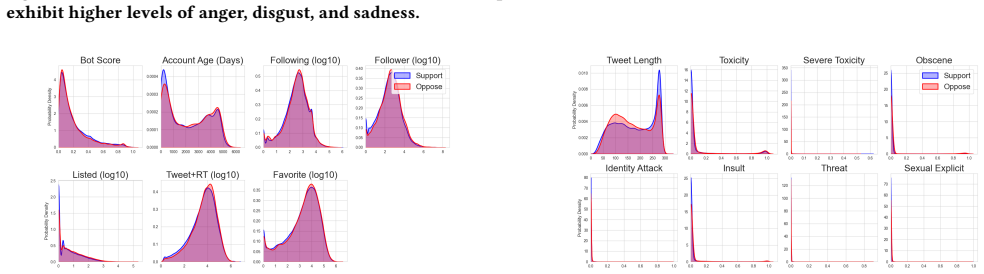
At scale on COVID-19 Twitter, posts that oppose fact-checked false claims carry higher levels of anger, disgust, and sadness than posts that support those claims. The differences are modest in size but consistent in direction across the negative emotions. The opposing posts also tend to come from more established users—older accounts, more followers, higher listed counts—while bot scores do not cleanly separate the two sides.
Load-bearing premise
That residual errors from the stance classifier and the filtering of neutral or ambiguous cases do not reverse or invent the group-level differences in emotion and account attributes between support and oppose posts.
Editorial extensions
If this is right
- Content-moderation systems that flag negative emotion as a proxy for misinformation risk downranking or silencing legitimate corrections.
- Negative affect is not a reliable truth signal: corrective discourse can be angrier than the falsehoods it targets.
- Counter-misinformation activity is disproportionately carried by more established accounts rather than by bots or brand-new users.
- User- and text-level features alone carry a weak but real signal for separating support from oppose, even without tweet semantics.
- Platforms that formalize community fact-checking should expect the corrective population to sound frustrated rather than neutral.
Reading between the lines
- If the pattern holds beyond COVID-19, emotion-based downranking could systematically weaken organic correction on political and climate topics as well.
- The length and surprise elevation on the pro-misinformation side may reflect narrative packaging of pseudo-evidence; testing whether shorter corrections are more persuasive would be a direct follow-on experiment.
- Demographic or partisan covariates, unobserved here, may partly drive the ‘established user’ pattern; matching on those covariates would test whether establishment itself predicts corrective behavior.
Signed reviews
Editorial analysis
A structured set of objections, weighed in public.
Referee Report
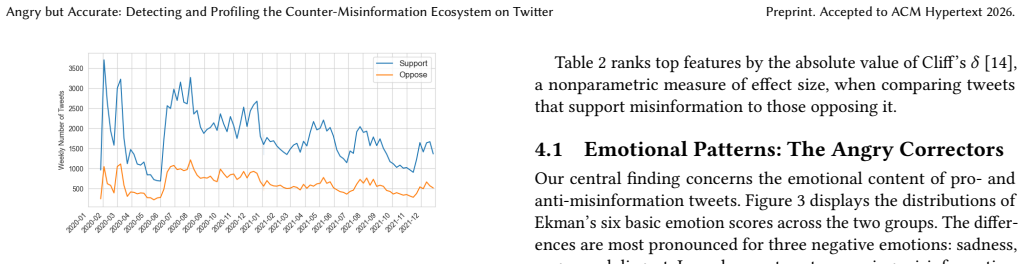
Summary. The paper profiles the counter-misinformation ecosystem on Twitter during COVID-19 by aggregating 15,374 fact-checked false claims, retrieving candidate tweets via BM25, and labeling claim–tweet pairs with a domain-specific NLI model from the authors’ prior work, yielding 264,737 tweets (195,922 supporting and 68,815 opposing false claims). It then compares 23 user- and text-level features—including Demux Ekman emotion scores, DeToxify toxicity, Botometer scores, and account metadata—using Cliff’s δ, distributional plots, and a weak feature-only classifier with SHAP. The central claim is that anti-misinformation posts are more emotionally negative than pro-misinformation posts (higher sadness, anger, and disgust; |δ|≈0.10–0.125), contrary to the common view that negative affect is a signature of falsehood, and that opposing posts tend to come from more established users (older accounts, more followers, higher listed counts). Bot scores do not separate the groups; feature-only models achieve only modest above-chance separation (RF F1≈0.632).
Significance. If the stance–emotion association survives tighter label validation, the result is a useful corrective to both research and platform practice: negative emotion is not a reliable proxy for falsehood, and moderation that downranks emotionally charged content risks suppressing organic correction. Strengths include scale across a broad claim set, discrete-emotion measurement rather than dictionary coding, honest reporting of modest effect sizes and weak feature-only separability, and extension of smaller prior observations on COVID-19 and crisis correction. The NLI-plus-profiling pipeline is a reusable template for studying the response side of misinformation at scale. The contribution is empirical and comparative rather than theoretical; its value hinges on whether residual labeling error can be shown not to invent the reported group differences.
major comments (3)
- [§3.2.1–3.2.2, Table 2, Figure 3] §3.2.1–3.2.2, Table 2, Figure 3: The central emotion claim (higher sadness/anger/disgust in anti-misinformation tweets; Cliff’s δ ≈ −0.125/−0.098/−0.097) rests entirely on NLI labels with F1_Con = 0.745 and F1_Ent = 0.779. Neutrals and cross-claim ambiguities are filtered, but the paper reports no human-validated subsample of the final 264,737 tweets and no sensitivity analysis under systematic misclassification (e.g., angry supporting tweets preferentially labeled as opposing). Because the reported |δ| values are modest, even moderate label bias could invent or reverse the pattern. A stratified human audit of the analytical set (or confusion-matrix-conditioned emotion distributions on held-out labeled pairs) is needed before the scaled claim can be treated as secure.
- [§3.2.2, §4.2, Table 2] §3.2.2, §4.2, Table 2, Figure 4: The sample comprises 264,737 tweets from 201,334 users, so user-level features (followers, listed count, account age, activity) are repeated across a user’s tweets. Cliff’s δ and the SHAP analysis treat tweets as independent observations. Dependence can inflate the apparent separation on user attributes that are constant within user. Report user-level aggregates (one observation per user, or per-user mean stance) or cluster-robust comparisons so that the “more established users” claim is not an artifact of tweet multiplicity.
- [§3.1.2, §4.1] §3.1.2, §4.1: Candidate tweets are the BM25 top-100 per claim. Lexical retrieval can under-sample paraphrastic corrections and over-sample posts that restate claim wording, which may systematically shape emotion and length profiles (e.g., terse “that’s false” vs. elaborate supporting narratives). A brief retrieval-sensitivity check—e.g., comparing emotion δ on high- vs. low-BM25 ranks, or on a denser retrieval slice—would show whether the angry-corrector pattern is robust to the retrieval design.
minor comments (6)
- [Table 2] Table 2 reports only features with |δ|>0.05. A full appendix table of all 23 features (including toxicity and bot scores) would let readers see null results and avoid selective emphasis.
- [§3.2.3, §4] Toxicity is measured (§3.2.3) but barely discussed in Results; either report the δ values or state explicitly that toxicity did not differentiate the groups.
- [Figure 3] Figure 3 KDEs would be clearer with a shared x-axis scale and a note on whether scores are calibrated probabilities or raw model outputs.
- [§4.3, Table 3] §4.3: Undersampling the majority class for the feature-only classifiers is fine for balanced accuracy, but report the original class prior and, if possible, PR-AUC on the natural imbalance so readers can judge operational utility.
- [§1] The term “counter-misinformation ecosystem” is useful but introduced without a precise operational definition; a one-sentence definition in §1 would help.
- [Abstract, §4.2] Minor: “listed more often” / “higher listed counts” is clear to Twitter researchers but could be glossed once for a broader Hypertext/Web audience.
Circularity Check
Minor self-citation of the authors' prior NLI/CMG labeling pipeline; emotion and user-feature contrasts use independent scorers and are not forced by construction.
-
self citation load bearing
[Abstract; §3.2.1 Classifier Training and Evaluation]
"applying a domain-specific NLI model from our prior work to a large corpus of COVID-19 tweets, we classify 264,737 posts as supporting or opposing false claims [...] We use the previous fine-tuning dataset and the two-step fine-tuning process described in [11]"
The binary partition into pro- and anti-misinformation groups that all subsequent comparisons rest on is produced by a classifier whose architecture, fine-tuning data, CMG augmentation, and reported metrics are justified solely by citation to the authors' own prior paper. This is self-citation of a measurement tool rather than a definitional loop or fitted-parameter-as-prediction; the emotion/user deltas themselves are not algebraically forced by [11].
full rationale
The paper's central empirical claim is a between-group comparison (anti- vs. pro-misinformation tweets) on 23 features. Stance labels come from an NLI model whose training recipe and reported F1 are taken from the authors' prior work [11], which is ordinary self-citation of a measurement instrument. Emotion scores (Demux/Ekman), toxicity (DeToxify), bot scores (Botometer), and raw Twitter account metadata are produced by independent tools never fitted to the stance labels or to the target deltas. Cliff's δ and the RF/SHAP analyses are post-hoc descriptive statistics on those independently measured features; nothing is defined so that the observed negative-emotion elevation must hold by construction. There is no uniqueness theorem, no ansatz smuggled via self-citation, no parameter fitted on a subset and then re-presented as a prediction of a near-identical quantity, and no renaming of a known result. Residual classifier error is a validity concern (acknowledged in §5.1), not circularity. Score 2 reflects only the non-load-bearing self-citation of the labeling tool.
Assumptions & free parameters
free parameters (2)
- BM25 retrieval depth per claim =
100
- Majority-class undersampling for stance classifiers =
balanced to minority class size
assumptions (5)
- domain assumption The domain-fine-tuned DeBERTa NLI model (F1_macro≈0.805) labels support vs oppose of false COVID-19 claims accurately enough that residual errors do not reverse group-level emotion and user-feature differences.
- domain assumption Demux multi-label scores validly measure Ekman’s six basic emotions in this tweet domain for comparative purposes.
- domain assumption DeToxify toxicity scores and Botometer X bot-likelihood scores are sufficiently valid on 2020–2021 COVID-19 tweets for null/secondary comparisons.
- domain assumption Public, non-deleted COVID-19 tweets retrieved by BM25 against aggregated fact-checked false claims are representative enough of organic support and opposition for the stated profiling claims.
- standard math Cliff’s delta is an appropriate effect-size summary for comparing the two stance groups on the chosen features.
invented entities (1)
-
counter-misinformation ecosystem
Cite this review
Pith. "Pith review of Angry but Accurate: Detecting and Profiling the Counter-Misinformation Ecosystem on Twitter." pith.science (2026). https://pith.science/paper/QBABR2WA
@misc{pith2026260702900,
  author       = {Pith},
  title        = {Pith review of: Angry but Accurate: Detecting and Profiling the Counter-Misinformation Ecosystem on Twitter},
  year         = {2026},
  howpublished = {\url{https://pith.science/paper/QBABR2WA}},
  note         = {Machine review of arXiv:2607.02900}
}
read the original abstract
On social media, many users actively push back against false claims. Understanding who pushes back and how they do so matters, as this corrective activity is central to how misinformation is contested. We study this counter-misinformation ecosystem at scale: applying a domain-specific NLI model from our prior work to a large corpus of COVID-19 tweets, we classify 264,737 posts as supporting or opposing false claims and compare 23 user- and text-level features across the two groups. Contrary to the dominant assumption that negative emotion is a signature of falsehood, we find that misinformation-opposing posts are more emotionally negative than misinformation-supporting posts, with higher levels of anger, disgust, and sadness. These differences are modest in magnitude but consistent in direction across the negative emotions. We also find that posts opposing misinformation tend to come from more established users, i.e., older accounts, more followers, and higher listed counts.
Figures


Figures from the paper (2 more)

Reviewed July 12, 2026 · model on record in the stance chip above.
Discussion (0). Continue with ORCID to comment.