REVIEW 5 major objections 4 minor 288 references
Doctoral Thesis: Geometric Deep Learning For Camera Pose Prediction, Registration, Depth Estimation, and 3D Reconstruction
T0 review · 5 major / 4 minor · reviewed 2026-08-05 · deepseek-v4-flash
Pith's one-line read This thesis claims that injecting geometric priors—skyline and ground-plane cues, SE(3)-equivariant surfels, focal-stack attention, and wavelet depth features—lets deep models consistently outperform prior state-of-the-art on camera pose es
desk verdict Four methods, three already published, wrapped in a thesis whose abstract overpromises and whose integration claim is never tested. read the letter →
The pith
A machine-rendered reading of the paper's core claim, the machinery that carries it, and where it could break.
The reading
What carries the argument
Four mechanisms carry the argument: (1) natural geometric primitives—the skyline and ground plane—used as reference cues for roll and pitch tracking, fused by an adaptive particle filter sampling on a multi-resolution spherical manifold; (2) SE(3)-equivariant 2D Gaussian surfel features, encoded by an E2PN-style symmetric convolutional kernel, to make registration robust to rigid transformations and input uncertainty; (3) a Transformer self-attention encoder coupled with an LSTM that sequentially fuses tokens along the focal stack dimension, enabling arbitrary stack lengths and monocular pre-training; and (4) wavelet-transformed depth features, projected onto triplanes and fused via a 2D U-N
What would settle it
Collect a flight sequence in terrain with a curved skyline and uneven ground below 300 meters, using servo-motor ground truth for roll and pitch; if the fusion's RMSE stops beating the IMU-only Madgwick filter, the central drift-resistance claim fails.
Extended reading notes
Core claim
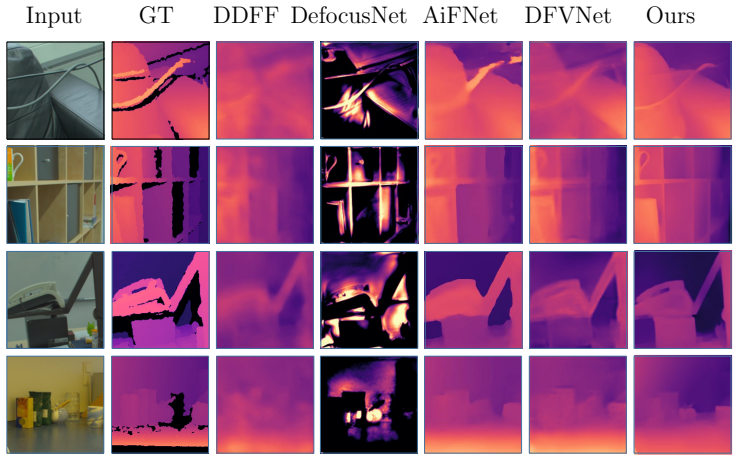
On the paper's own terms, geometric deep learning bridges the gap between traditional geometry-based methods and data-driven approaches: each of the four proposed methods consistently outperforms state-of-the-art techniques on its individual 3D vision task. The camera pose system uses natural skyline and ground-plane primitives, fused with IMU data through an adaptive particle filter on a spherical manifold, to achieve real-time orientation tracking that is more stable than IMU-only solutions. The registration method introduces a surfel-based SE(3)-equivariant framework that learns position and orientation representations from 2D Gaussian surfels, achieving superior accuracy in indoor and ou
Load-bearing premise
The pose-tracking system assumes the skyline can be approximated by a straight line and that, above 300 meters, the ground is flat and perpendicular to gravity; the thesis itself notes that curved mountain skylines challenge this assumption.
Editorial extensions
If this is right
- Camera orientation tracking runs in real time on an embedded Jetson Nano and beats IMU-only filtering against drift in natural scenes, making it deployable for drone-based imaging.
- Surfel-based equivariant registration retains high recall on low-inlier point clouds and degrades gracefully even with only 256 sampled points, supporting robotics and mobile scanning use cases.
- FocDepthFormer accepts any number of focal-stack frames, so one trained model can serve different stack sizes and can be pre-trained on monocular RGB-D data to reduce reliance on scarce focal-stack datasets.
- Wavelet-conditioned implicit SDF reconstruction yields more complete and detailed meshes across object-scale and architectural-scale scenes, and is described as a plug-and-play module for existing implicit SDF frameworks.
- The modular design suggests that improvements in pose, registration, depth, and reconstruction each strengthen the corresponding stage of a full 3D reconstruction pipeline.
Reading between the lines
- Editorial inference: the pose estimator's reliance on a single straight skyline and a flat ground plane means the claimed robustness likely holds only in open terrain; the thesis itself acknowledges curved mountain skylines as a failure mode.
- Editorial inference: because the four modules are evaluated separately, the thesis does not prove that chaining them into one end-to-end reconstruction pipeline preserves the individual gains; a system-level integration test would be a natural next step.
- Editorial inference: the wavelet-conditioning idea could plausibly transfer to other implicit representations, such as radiance-field or Gaussian-splatting reconstructions, where high-frequency detail is also a bottleneck.
- Editorial inference: the latent LSTM fusion for focal stacks suggests a general recipe for any ordered image set with per-frame focus cues, including smartphone refocus stacks or light-field captures.
Editorial analysis
A structured set of objections, weighed in public.
Referee Report
Summary. The thesis combines geometric priors with deep learning across four 3D vision tasks. Chapter 3 proposes a camera-orientation tracker that fuses IMU data with skyline and ground-plane cues through an adaptive particle filter on a spherical manifold, targeting UAV/natural-environment operation. Chapter 4 introduces a surfel-based registration network with an SE(3)-equivariant encoder, cross-attention, and Huber loss, evaluated on 3DMatch and KITTI. Chapter 5 presents FocDepthFormer, a Transformer-LSTM architecture for depth-from-focal-stack with arbitrary stack length, evaluated on DDFF, FOD500, Mobile Depth, and LightField4D. Chapter 6 proposes a wavelet-conditioned implicit SDF reconstruction method that fuses multi-scale wavelet-transformed depth features with triplane features, evaluated on DTU, Tanks and Temples, and a cultural heritage dataset. The abstract claims that the four methods 'consistently outperform state-of-the-art techniques across individual 3D vision tasks.'
Significance. If fully supported, the thesis would contribute practical geometry-aware modules for pose tracking, registration, depth estimation, and reconstruction. Notable strengths are the real-time embedded deployment of the pose tracker, the use of explicit surface orientation and uncertainty in registration, the LSTM-based variable-length focal-stack processing, and the wavelet-conditioned implicit surface prior. However, the broad SOTA claim is not consistently supported by the reported tables, and one chapter's assumptions are untested in the environments the chapter targets. The correctable nature of these issues makes the manuscript worth revising.
major comments (5)
- [Abstract and §4, Table 4.1] The abstract states that the four methods 'consistently outperform state-of-the-art techniques across individual 3D vision tasks.' Table 4.1 directly contradicts this for Chapter 4 on KITTI: Ours has RE=1.57°, while SpinNet achieves RE=1.08°. The text in §4.4.1 claims a 'smaller rotation error (around 8-11% reduction)' compared to the second-best model, but on KITTI the rotation error is about 45% larger than SpinNet's. This is load-bearing for the central claim and must be corrected, either by reporting the comparable/competitive status on that metric or by removing the overclaim.
- [§3.4, Tables 3.1 and 3.2] The mixed-test duration is reported as 960 s in Table 3.1 and 9200 s in Table 3.2. Several entries in Table 3.2 are missing (notably R-VIO and DM-VIO in several rows), yet the prose states that the proposed method 'performs consistently across different sequences' and compares favorably. In addition, the text first says ORB-SLAM3, R-VIO, and DM-VIO were selected for comparison, then says these algorithms were found unsuitable and the comparison is against IMU-only Madgwick filtering. The experimental protocol and table completeness must be clarified before the robustness and superiority claims of Chapter 3 can be accepted.
- [§3.3.2, §3.3.3, §3.5] The skyline tracking assumes a straight-line skyline (Eqs. 3.1–3.4) and the ground-plane cue assumes a flat ground orthogonal to gravity above 300 m (Eqs. 3.8–3.12). Section 3.5 explicitly acknowledges that 'complex terrains with curved mountains challenge the straight-line assumption.' Yet all experiments in §3.4 are rooftop or drone sequences with largely linear horizons and planar ground. There is no evaluation on curved mountain skylines, partially occluded horizons, or non-planar terrain, which are precisely the 'natural environments' claimed in the abstract. If these geometric cues fail, the particle filter is left with only IMU, and the claimed advantage over IMU-only solutions vanishes. This is a correctness-risk concern: the central pose-tracking claim for unstructured natural scenes is not yet demonstrated.
- [§5.3.1, Table 5.3] In the FOD500 results, AiFNet is reported with absRel=0.400, sqrRel=4.32e-1, yet δ1=85.12. These values are mutually implausible: an absRel of 0.400 typically corresponds to much lower δ1 accuracy. This suggests a data entry or metric-calculation error. Because the table is used to show that the proposed method outperforms baselines, the correctness of the baseline numbers is essential. Please verify all entries in Table 5.3 and report corrected values.
- [§4.4.2, Table 4.4] The robustness analysis states that 'the registration error remains within 4-5% of the input translation, and the rotation error within 3-4%.' For the largest perturbation (100°, 200 cm), Table 4.4 reports TE=12.59 cm, which is 6.3% of the input translation, not within 5%. The textual summary is therefore inconsistent with the table. Either the claim or the table should be corrected.
minor comments (4)
- [§3.3] The equation numbering is inconsistent: the text refers to 'Equation 1' while equations are numbered (3.1)–(3.20). Algorithm 1 has garbled line references and undefined symbols (ε, δt, b, Ω1, Ω2, Ω3). Please polish the pseudocode and define all variables.
- [§5.2.1 and §5.2.4] The Circle-of-Confusion definition appears both as Eq. (5.1) and Eq. (5.9), with slightly different notation. The symbol δ is used both for the accuracy threshold in Eq. (5.15) and for the variance in Eq. (5.8), causing ambiguity.
- [§4, Tables] In Table 4.1, the RoReg row contains a stray arrow '↓' and the column alignment is inconsistent. In Table 4.2, the 'Average' column is formatted differently from the other columns. Please unify table formatting.
- [Overall] There are several typos and formatting artifacts, e.g., 'AutoV AE' in §6.10, '3D Unet' without hyphenation, and inconsistent use of 'SOTA' vs. 'state-of-the-art.' A careful proofreading pass is needed.
Circularity Check
No significant circularity; the thesis validates four independent methods against external benchmarks without reducing any derivation to its own inputs.
full rationale
The thesis is an empirical compilation. Each content chapter proposes a method and evaluates it on public benchmarks (3DMatch/KITTI, DDFF/FOD500, DTU/Tanks-and-Temples). The geometric relationships used in Chapter 3 (skyline slope/intercept to roll/pitch, ground-plane normal via Rodrigues' formula) are analytical cues, not fitted quantities renamed as predictions. The particle filter variances are tuned constants, not the claimed output. Chapter 4's equivariant encoder is an architectural choice adapted from prior work and tested by ablations; no prediction is defined in terms of the fitted parameters. Chapter 5 uses the Circle-of-Confusion formula only as motivation, while depth is learned from data with external supervision. Chapter 6 conditions an implicit SDF on wavelet-transformed depth features from a monocular depth prior; although this raises a possible domain-overlap concern, the text does not assert that the prior was trained on the evaluation targets, and conditioning a reconstruction on an independent depth cue is not definitionally circular. The self-citations in Chapters 3–5 refer to the author's own peer-reviewed papers, which are independent prior publications and are not invoked as the sole justification for the present claims. The acknowledged limitations (curved skylines, view-dependent appearance, textureless scenes, memory footprint) are honest caveats that affect generalization but do not make any derivation equivalent to its inputs. No load-bearing step reduces by construction to a fitted value or to a self-citation chain.
Assumptions & free parameters
free parameters (6)
- Particle filter variances and thresholds (Chapter 3) =
Not fully specified; 'set as a constant according to practical tests'
- Surfel uncertainty normalization C and inverse-depth range (Chapter 4, Eq. 4.5-4.7) =
Not specified numerically
- Huber loss threshold delta (Chapter 4, Eq. 4.10) =
0.6 m
- LSTM token activation threshold and loss weight (Chapter 5) =
activation threshold 0.4, alpha = 0.2
- Wavelet decomposition levels and pretrained wavelet autoencoder weights (Chapter 6) =
Three resolutions; autoencoder pretrained on sharp depth maps
- Pretrained monocular depth model used in Chapter 6 =
Not named in the available text
assumptions (7)
- domain assumption The skyline in natural scenes can be approximated as a straight line for roll and pitch estimation (Chapter 3, Eq. 3.1-3.4)
- domain assumption The ground plane is flat and orthogonal to the gravity vector when the camera is above 300 m (Chapter 3, Section 3.3.3)
- domain assumption The camera is never upside down during operation (Chapter 3, Section 3.3.2)
- domain assumption Surface normals derived from depth gradients are accurate enough to serve as equivariant input signals (Chapter 4, Section 4.3.1)
- standard math The Circle-of-Confusion model correctly describes defocus blur as a function of depth and focus distance (Chapter 5, Eq. 5.1)
- standard math The zero-crossing of an implicit SDF corresponds to the reconstructed surface and can be optimized via ray sampling (Chapter 6, Section 6.1)
- domain assumption A pretrained monocular depth model provides a reliable geometric prior for wavelet feature conditioning (Chapter 6, Figure 6.7)
Cite this review
Pith. "Pith review of Doctoral Thesis: Geometric Deep Learning For Camera Pose Prediction, Registration, Depth Estimation, and 3D Reconstruction." pith.science (2026). https://pith.science/paper/QBPOGJN3
@misc{pith2026250901873,
  author       = {Pith},
  title        = {Pith review of: Doctoral Thesis: Geometric Deep Learning For Camera Pose Prediction, Registration, Depth Estimation, and 3D Reconstruction},
  year         = {2026},
  howpublished = {\url{https://pith.science/paper/QBPOGJN3}},
  note         = {Machine review of arXiv:2509.01873}
}
read the original abstract
Modern deep learning developments create new opportunities for 3D mapping technology, scene reconstruction pipelines, and virtual reality development. Despite advances in 3D deep learning technology, direct training of deep learning models on 3D data faces challenges due to the high dimensionality inherent in 3D data and the scarcity of labeled datasets. Structure-from-motion (SfM) and Simultaneous Localization and Mapping (SLAM) exhibit robust performance when applied to structured indoor environments but often struggle with ambiguous features in unstructured environments. These techniques often struggle to generate detailed geometric representations effective for downstream tasks such as rendering and semantic analysis. Current limitations require the development of 3D representation methods that combine traditional geometric techniques with deep learning capabilities to generate robust geometry-aware deep learning models. The dissertation provides solutions to the fundamental challenges in 3D vision by developing geometric deep learning methods tailored for essential tasks such as camera pose estimation, point cloud registration, depth prediction, and 3D reconstruction. The integration of geometric priors or constraints, such as including depth information, surface normals, and equivariance into deep learning models, enhances both the accuracy and robustness of geometric representations. This study systematically investigates key components of 3D vision, including camera pose estimation, point cloud registration, depth estimation, and high-fidelity 3D reconstruction, demonstrating their effectiveness across real-world applications such as digital cultural heritage preservation and immersive VR/AR environments.
Figures


Figures from the paper (75 more)






Reference graph
Works this paper leans on
-
[1]
Satr: Zero-shot semantic segmentation of 3d shapes
Abdelreheem, A., Skorokhodov, I., Ovsjanikov, M., and Wonka, P. Satr: Zero-shot semantic segmentation of 3d shapes. In Proceedings of the IEEE/CVF International Conference on Computer Vision (2023), pp. 15166–15179
2023
-
[2]
Slic superpixels compared to state-of-the-art super- pixel methods
Achanta, R., Shaji, A., Smith, K., Lucchi, A., Fua, P., and Susstrunk, S. Slic superpixels compared to state-of-the-art super- pixel methods. IEEE transactions on pattern analysis and machine intelligence 34 (05 2012)
2012
-
[3]
Depthformer: Multiscale vision transformer for monocular depth estimation with global local infor- mation fusion
Agarwal, A., and Arora, C. Depthformer: Multiscale vision transformer for monocular depth estimation with global local infor- mation fusion. In 2022 IEEE International Conference on Image Pro- cessing (ICIP) (2022), IEEE, pp. 3873–3877
2022
-
[4]
Alpert, B. K. Hybrid gauss-trapezoidal quadrature rules. SIAM Journal on Scientific Computing 20 , 5 (1999), 1551–1584
1999
-
[5]
Video sta- bilization of the nao robot using imu data
Alquisiris-Quecha, O., and Martinez-Carranza, J. Video sta- bilization of the nao robot using imu data. In Robot Operating System (ROS). Springer, Cham, 2020, pp. 147–162
2020
-
[6]
Yolopose: Transformer-based multi-object 6d pose estimation using keypoint re- gression
Amini, A., Selvam Periyasamy, A., and Behnke, S. Yolopose: Transformer-based multi-object 6d pose estimation using keypoint re- gression. In International Conference on Intelligent Autonomous Sys- tems (2022), Springer, pp. 392–406
2022
-
[7]
Deblur and deep depth from single defocus image
Anwar, S., Hayder, Z., and Porikli, F. Deblur and deep depth from single defocus image. Machine vision and applications 32 , 1 (2021), 1–13
2021
-
[8]
Spinnet: Learning a general surface descriptor for 3d point cloud registration
Ao, S., Hu, Q., Yang, B., Markham, A., and Guo, Y. Spinnet: Learning a general surface descriptor for 3d point cloud registration. 146 In Proceedings of the IEEE/CVF conference on computer vision and pattern recognition (2021), pp. 11753–11762
2021
Show all 288 references
-
[9]
A hybrid motion esti- mation for video stabilization based on an imu sensor
Auysakul, J., Xu, H., and Pooneeth, V. A hybrid motion esti- mation for video stabilization based on an imu sensor. Sensors 18 , 8 (2018), 2708
2018
-
[10]
Multi-view depth estima- tion by fusing single-view depth probability with multi-view geometry
Bae, G., Budvytis, I., and Cipolla, R. Multi-view depth estima- tion by fusing single-view depth probability with multi-view geometry. In Proceedings of the IEEE/CVF Conference on Computer Vision and Pattern Recognition (2022), pp. 2842–2851
2022
-
[11]
Pointdsc: Robust point cloud registration using deep spatial consistency
Bai, X., Luo, Z., Zhou, L., Chen, H., Li, L., Hu, Z., Fu, H., and Tai, C.-L. Pointdsc: Robust point cloud registration using deep spatial consistency. In Proceedings of the IEEE/CVF Conference on Computer Vision and Pattern Recognition (2021), pp. 15859–15869
2021
-
[12]
D3feat: Joint learning of dense detection and description of 3d local features
Bai, X., Luo, Z., Zhou, L., Fu, H., Quan, L., and Tai, C.-L. D3feat: Joint learning of dense detection and description of 3d local features. In Proceedings of the IEEE/CVF conference on computer vision and pattern recognition (2020), pp. 6359–6367
2020
-
[13]
Extracting the depth and all-in-focus image from a focal stack
Barratt, S., and Hannel, B. Extracting the depth and all-in-focus image from a focal stack. In Proceedings of the IEEE International Conference on Computer Vision (2015), pp. 3451–3459
2015
-
[14]
Barron, J. T. A general and adaptive robust loss function. In Pro- ceedings of the IEEE/CVF conference on computer vision and pattern recognition (2019), pp. 4331–4339
2019
-
[15]
T., Mildenhall, B., Tancik, M., Hedman, P., Martin-Brualla, R., and Srinivasan, P
Barron, J. T., Mildenhall, B., Tancik, M., Hedman, P., Martin-Brualla, R., and Srinivasan, P. P. Mip-nerf: A mul- tiscale representation for anti-aliasing neural radiance fields. In Pro- ceedings of the IEEE/CVF international conference on computer vision (2021), pp. 5855–5864
2021
-
[16]
T., Mildenhall, B., Verbin, D., Srinivasan, P
Barron, J. T., Mildenhall, B., Verbin, D., Srinivasan, P. P., and Hedman, P. Mip-nerf 360: Unbounded anti-aliased neural radi- ance fields. In Proceedings of the IEEE/CVF conference on computer vision and pattern recognition (2022), pp. 5470–5479
2022
-
[17]
Sift features tracking for video stabilization
Battiato, S., et al. Sift features tracking for video stabilization. In 14th International Conference on Image Analysis and Processing (ICIAP 2007) (2007), IEEE. 147
2007
-
[18]
Efficient surfel-based slam using 3d laser range data in urban environments
Behley, J., and Stachniss, C. Efficient surfel-based slam using 3d laser range data in urban environments. In Robotics: Science and Systems (2018), vol. 2018, p. 59
2018
-
[19]
T., Ignatov, A., and Timofte, R.Phonedepth: A dataset for monocular depth estimation on mobile devices
Benavides, F. T., Ignatov, A., and Timofte, R.Phonedepth: A dataset for monocular depth estimation on mobile devices. In Proceed- ings of the IEEE/CVF Conference on Computer Vision and Pattern Recognition (2022), pp. 3049–3056
2022
-
[20]
G., Russo, M., Giordano, A., and Spallone, R
Bevilacqua, M. G., Russo, M., Giordano, A., and Spallone, R. 3d reconstruction, digital twinning, and virtual reality: Architec- tural heritage applications. In 2022 IEEE Conference on Virtual Re- ality and 3D User Interfaces Abstracts and Workshops (VR W) (2022), IEEE, pp. 92–96
2022
-
[21]
L., Sminchisescu, C., Theobalt, C., and Pons- Moll, G
Bhatnagar, B. L., Sminchisescu, C., Theobalt, C., and Pons- Moll, G. Loopreg: Self-supervised learning of implicit surface corre- spondences, pose and shape for 3d human mesh registration. Advances in Neural Information Processing Systems 33 (2020), 12909–12922
2020
-
[22]
Learning less is more-6d camera localization via 3d surface regression
Brachmann, E., and Rother, C. Learning less is more-6d camera localization via 3d surface regression. In Proceedings of the IEEE con- ference on computer vision and pattern recognition (2018), pp. 4654– 4662
2018
-
[23]
M., Bruna, J., LeCun, Y., Szlam, A., and V an- dergheynst, P
Bronstein, M. M., Bruna, J., LeCun, Y., Szlam, A., and V an- dergheynst, P. Geometric deep learning: going beyond euclidean data. IEEE Signal Processing Magazine 34 , 4 (2017), 18–42
2017
-
[24]
Fourier image transformer
Buchholz, T.-O., and Jug, F. Fourier image transformer. In Proceedings of the IEEE/CVF Conference on Computer Vision and Pattern Recognition (2022), pp. 1846–1854
2022
-
[25]
J., Montiel, J
Campos, C., Elvira, R., Gomez, J. J., Montiel, J. M. M., and Tardos, J. D. ORB-SLAM3: An accurate open-source library for visual, visual-inertial and multi-map SLAM. IEEE Transactions on Robotics 37, 6 (2021), 1874–1890
2021
-
[26]
A computational approach to edge detection.IEEE Transactions on Pattern Analysis and Machine Intelligence 6 (1986), 679–698
Canny, J., et al. A computational approach to edge detection.IEEE Transactions on Pattern Analysis and Machine Intelligence 6 (1986), 679–698. 148
1986
-
[27]
Attitude estimation using horizon detection in thermal images
Carrio, A., Bavle, H., and Campoy, P. Attitude estimation using horizon detection in thermal images. International Journal of Micro Air Vehicles 10 , 4 (2018), 352–361
2018
-
[28]
Carvalho, M., Le Saux, B., Trouv ´e-Peloux, P., Almansa, A., and Champagnat, F. Deep depth from defocus: how can de- focus blur improve 3d estimation using dense neural networks? In Proceedings of the European Conference on Computer Vision (ECCV) Workshops (2018), pp. 0–0
2018
-
[29]
Depth prediction without the sensors: Leveraging structure for unsu- pervised learning from monocular videos
Casser, V., Pirk, S., Mahjourian, R., and Angelova, A. Depth prediction without the sensors: Leveraging structure for unsu- pervised learning from monocular videos. In Proceedings of the AAAI conference on artificial intelligence (2019), vol. 33, pp. 8001–8008
2019
-
[30]
A program to build e (n)- equivariant steerable cnns
Cesa, G., Lang, L., and Weiler, M. A program to build e (n)- equivariant steerable cnns. In International conference on learning rep- resentations (2022)
2022
-
[31]
E., Ilg, E., Schmidt, T., Straub, J., Lovegrove, S., and Newcombe, R
Chabra, R., Lenssen, J. E., Ilg, E., Schmidt, T., Straub, J., Lovegrove, S., and Newcombe, R. Deep local shapes: Learning local sdf priors for detailed 3d reconstruction. In Computer Vision– ECCV 2020: 16th European Conference, Glasgow, UK, August 23–28, 2020, Proceedings, Par...
2020
-
[32]
G., Yu, B., and Vetterli, M.Adaptive wavelet thresh- olding for image denoising and compression
Chang, S. G., Yu, B., and Vetterli, M.Adaptive wavelet thresh- olding for image denoising and compression. IEEE transactions on image processing 9, 9 (2000), 1532–1546
2000
-
[33]
Pgsr: Planar-based gaussian splatting for efficient and high-fidelity surface reconstruction
Chen, D., Li, H., Ye, W., W ang, Y., Xie, W., Zhai, S., W ang, N., Liu, H., Bao, H., and Zhang, G. Pgsr: Planar-based gaussian splatting for efficient and high-fidelity surface reconstruction. arXiv preprint arXiv:2406.06521 (2024)
2024 arXiv
-
[34]
Equiv- ariant point network for 3d point cloud analysis
Chen, H., Liu, S., Chen, W., Li, H., and Hill, R. Equiv- ariant point network for 3d point cloud analysis. In Proceedings of the IEEE/CVF conference on computer vision and pattern recognition (2021), pp. 14514–14523
2021
-
[35]
A., and Brachmann, E
Chen, S., Cavallari, T., Prisacariu, V. A., and Brachmann, E. Map-relative pose regression for visual re-localization. In Proceed- ings of the IEEE/CVF Conference on Computer Vision and Pattern Recognition (2024), pp. 20665–20674. 149
2024
-
[36]
Learn- ing a wavelet-like auto-encoder to accelerate deep neural networks
Chen, T., Lin, L., Zuo, W., Luo, X., and Zhang, L. Learn- ing a wavelet-like auto-encoder to accelerate deep neural networks. In Proceedings of the AAAI Conference on Artificial Intelligence (2018), vol. 32
2018
-
[37]
G., and Gui, L.-Y
Cheng, Y.-C., Lee, H.-Y., Tulyakov, S., Schwing, A. G., and Gui, L.-Y. Sdfusion: Multimodal 3d shape completion, reconstruc- tion, and generation. In Proceedings of the IEEE/CVF Conference on Computer Vision and Pattern Recognition (2023), pp. 4456–4465
2023
-
[38]
Implicit func- tions in feature space for 3d shape reconstruction and completion
Chibane, J., Alldieck, T., and Pons-Moll, G. Implicit func- tions in feature space for 3d shape reconstruction and completion. In IEEE Conference on Computer Vision and Pattern Recognition (CVPR) (jun 2020), IEEE
2020
-
[39]
Self-supervised real-time video stabilization, 2021
Choi, J., Park, J., S, I., and Kweon . Self-supervised real-time video stabilization, 2021. arXiv preprint arXiv:2111.05980
2021 arXiv
-
[40]
Diffusion-sdf: Conditional generative modeling of signed distance functions
Chou, G., Bahat, Y., and Heide, F. Diffusion-sdf: Conditional generative modeling of signed distance functions. In Proceedings of the IEEE/CVF international conference on computer vision (2023), pp. 2262–2272
2023
-
[41]
Deep global registration
Choy, C., Dong, W., and Koltun, V. Deep global registration. In CVPR (2020)
2020
-
[42]
In Proceedings of the IEEE/CVF international conference on computer vision (2019), pp
Choy, C., Park, J., and Koltun, V.Fully convolutional geometric features. In Proceedings of the IEEE/CVF international conference on computer vision (2019), pp. 8958–8966
2019
-
[43]
B., Xu, D., Gwak, J., Chen, K., and Savarese, S
Choy, C. B., Xu, D., Gwak, J., Chen, K., and Savarese, S. 3d-r2n2: A unified approach for single and multi-view 3d object re- construction. In Proceedings of the European Conference on Computer Vision (ECCV) (2016)
2016
-
[44]
Real-time camera pose estimation for sports fields
Citraro, L., M ´arquez-Neila, P., Savare, S., Jayaram, V., Dubout, C., Renaut, F., Hasfura, A., Ben Shitrit, H., and Fua, P. Real-time camera pose estimation for sports fields. Machine Vision and Applications 31 , 3 (2020), 16
2020
-
[45]
S., Geiger, M., K¨ohler, J., and Welling, M
Cohen, T. S., Geiger, M., K¨ohler, J., and Welling, M. Spher- ical cnns. arXiv preprint arXiv:1801.10130 (2018). 150
2018 arXiv
-
[46]
Surfel based geometry reconstruction
Dahl, V., Aanæs, H., and Bærentzen, J. Surfel based geometry reconstruction. pp. 39–44
-
[47]
Deng, C., Litany, O., Duan, Y., Poulenard, A., Tagliasac- chi, A., and Guibas, L. J. Vector neurons: A general framework for so (3)-equivariant networks. In Proceedings of the IEEE/CVF In- ternational Conference on Computer Vision (2021), pp. 12200–12209
2021
-
[48]
An image is worth 16x16 words: Transformers for image recognition at scale
Dosovitskiy, A., Beyer, L., Kolesnikov, A., Weissenborn, D., Zhai, X., Unterthiner, T., Dehghani, M., Minderer, M., Heigold, G., Gelly, S., et al. An image is worth 16x16 words: Transformers for image recognition at scale. arXiv preprint arXiv:2010.11929 (2020)
2010 arXiv
-
[49]
Dh3d: Deep hierarchical 3d descriptors for robust large-scale 6dof relocalization
Du, J., W ang, R., and Cremers, D. Dh3d: Deep hierarchical 3d descriptors for robust large-scale 6dof relocalization. In Computer Vision–ECCV 2020: 16th European Conference, Glasgow, UK, August 23–28, 2020, Proceedings, Part IV 16 (2020), Springer, pp. 744–762
2020
-
[50]
Se(3) equivariant graph neural networks with complete local frames
Du, W., Zhang, H., Du, Y., Meng, Q., Chen, W., Zheng, N., Shao, B., and Liu, T.-Y. Se(3) equivariant graph neural networks with complete local frames. In International Conference on Machine Learning (2022), PMLR, pp. 5583–5608
2022
-
[51]
Fixed-wing attitude estimation using computer vision based horizon detection
Dusha, D., Boles, W., and W alker, R. Fixed-wing attitude estimation using computer vision based horizon detection. In Proceed- ings of AIAC12: 2nd Australasian Unmanned Air Vehicles Conference (2007), Waldron Smith Management
2007
-
[52]
Depth map prediction from a single image using a multi-scale deep network
Eigen, D., Puhrsch, C., and Fergus, R. Depth map prediction from a single image using a multi-scale deep network. Advances in neural information processing systems 27 (2014)
2014
-
[53]
J.A point set generation network for 3d object reconstruction from a single image
F an, H., Su, H., and Guibas, L. J.A point set generation network for 3d object reconstruction from a single image. In Proceedings of the IEEE conference on computer vision and pattern recognition (2017), pp. 605–613
2017
-
[54]
Unsupervised monocular depth prediction for indoor continuous video streams
Feng, Y., Wu, S., K ¨op¨ukl¨u, O., Kang, X., and Tombari, F. Unsupervised monocular depth prediction for indoor continuous video streams. arXiv preprint arXiv:1911.08995 (2019). 151
1911 arXiv
-
[55]
A., and Nowak, R
Figueiredo, M. A., and Nowak, R. D. An em algorithm for wavelet-based image restoration. IEEE Transactions on Image Pro- cessing 12, 8 (2003), 906–916
2003
-
[56]
Finzi, M., Stanton, S., Izmailov, P., and Wilson, A. G. Gen- eralizing convolutional neural networks for equivariance to lie groups on arbitrary continuous data. In International Conference on Machine Learning (2020), PMLR, pp. 3165–3176
2020
-
[57]
A., and Bolles, R
Fischler, M. A., and Bolles, R. C. Random sample consensus: a paradigm for model fitting with applications to image analysis and automated cartography. Communications of the ACM 24 , 6 (1981), 381–395
1981
-
[58]
Geowizard: Unleashing the diffusion priors for 3d geometry estimation from a single image
Fu, X., Yin, W., Hu, M., W ang, K., Ma, Y., Tan, P., Shen, S., Lin, D., and Long, X. Geowizard: Unleashing the diffusion priors for 3d geometry estimation from a single image. In ECCV (2024)
2024
-
[59]
Se (3)-transformers: 3d roto-translation equivariant attention networks
Fuchs, F., Worrall, D., Fischer, V., and Welling, M. Se (3)-transformers: 3d roto-translation equivariant attention networks. Advances in neural information processing systems 33 (2020), 1970– 1981
2020
-
[60]
B., W agstaff, E., Dauparas, J., and Posner, I
Fuchs, F. B., W agstaff, E., Dauparas, J., and Posner, I. Iterative se (3)-transformers. In Geometric Science of Information: 5th International Conference, GSI 2021, Paris, France, July 21–23, 2021, Proceedings 5 (2021), Springer, pp. 585–595
2021
-
[61]
Fuentes-Pacheco, J., Ruiz-Ascencio, J., and Rend ´on- Mancha, J. M. Visual simultaneous localization and mapping: a survey. Artificial intelligence review 43 (2015), 55–81
2015
-
[62]
Wavelet convo- lutional neural networks
Fujieda, S., Takayama, K., and Hachisuka, T. Wavelet convo- lutional neural networks. arXiv preprint arXiv:1805.08620 (2018)
2018 arXiv
-
[63]
Deep depth from focal stack with defocus model for camera-setting invariance
Fujimura, Y., Iiyama, M., Funatomi, T., and Mukaigawa, Y. Deep depth from focal stack with defocus model for camera-setting invariance. International Journal of Computer Vision (2023), 1–16
2023
-
[64]
In 2013 IEEE/RSJ Inter- national Conference on Intelligent Robots and Systems (2013), IEEE, pp
Furgale, P., Rehder, J., and Siegwart, R.Unified temporal and spatial calibration for multi-sensor systems. In 2013 IEEE/RSJ Inter- national Conference on Intelligent Robots and Systems (2013), IEEE, pp. 1280–1286. 152
2013
-
[65]
K., Carneiro, G., and Reid, I
Garg, R., Bg, V. K., Carneiro, G., and Reid, I. Unsuper- vised cnn for single view depth estimation: Geometry to the rescue. In Computer Vision–ECCV 2016: 14th European Conference, Amster- dam, The Netherlands, October 11-14, 2016, Proceedings, Part VIII 14 (2016), Springer, p...
2016
-
[66]
Are we ready for au- tonomous driving? the kitti vision benchmark suite
Geiger, A., Lenz, P., and Urtasun, R. Are we ready for au- tonomous driving? the kitti vision benchmark suite. In 2012 IEEE conference on computer vision and pattern recognition (2012), IEEE, pp. 3354–3361
2012
-
[67]
Real- time rgb-d camera relocalization
Glocker, B., Izadi, S., Shotton, J., and Criminisi, A. Real- time rgb-d camera relocalization. In 2013 IEEE International Sym- posium on Mixed and Augmented Reality (ISMAR) (2013), IEEE, pp. 173–179
2013
-
[68]
J.Unsupervised monocular depth estimation with left-right consistency
Godard, C., Mac Aodha, O., and Brostow, G. J.Unsupervised monocular depth estimation with left-right consistency. In Proceed- ings of the IEEE conference on computer vision and pattern recognition (2017), pp. 270–279
2017
-
[69]
Godard, C., Mac Aodha, O., Firman, M., and Brostow, G. J. Digging into self-supervised monocular depth estimation. In Proceed- ings of the IEEE/CVF International Conference on Computer Vision (2019), pp. 3828–3838
2019
-
[70]
Godard, C., Mac Aodha, O., Firman, M., and Brostow, G. J. Digging into self-supervised monocular depth prediction
-
[71]
D., Guibas, L
Gojcic, Z., Zhou, C., Wegner, J. D., Guibas, L. J., and Birdal, T. Learning multiview 3d point cloud registration. In Pro- ceedings of the IEEE/CVF conference on computer vision and pattern recognition (2020), pp. 1759–1769
2020
-
[72]
Depth from videos in the wild: Unsupervised monocular depth learning from unknown cameras
Gordon, A., Li, H., Jonschkowski, R., and Angelova, A. Depth from videos in the wild: Unsupervised monocular depth learning from unknown cameras. In Proceedings of the IEEE/CVF International Conference on Computer Vision (2019), pp. 8977–8986
2019
-
[73]
Sugar: Surface-aligned gaussian splatting for efficient 3d mesh reconstruction and high-quality mesh rendering
Gu´edon, A., and Lepetit, V. Sugar: Surface-aligned gaussian splatting for efficient 3d mesh reconstruction and high-quality mesh rendering. In Proceedings of the IEEE/CVF Conference on Computer Vision and Pattern Recognition (2024), pp. 5354–5363. 153
2024
-
[74]
In Proceedings of the IEEE conference on computer vision and pattern recognition workshops (2017), pp
Guo, T., Seyed Mousavi, H., Huu Vu, T., and Monga, V.Deep wavelet prediction for image super-resolution. In Proceedings of the IEEE conference on computer vision and pattern recognition workshops (2017), pp. 104–113
2017
-
[75]
Learning monoc- ular depth by distilling cross-domain stereo networks
Guo, X., Li, H., Yi, S., Ren, J., and W ang, X. Learning monoc- ular depth by distilling cross-domain stereo networks. In Proceed- ings of the European Conference on Computer Vision (ECCV) (2018), pp. 484–500
2018
-
[76]
Single image depth estimation trained via depth from defocus cues
Gur, S., and Wolf, L. Single image depth estimation trained via depth from defocus cues. In Proceedings of the IEEE/CVF Conference on Computer Vision and Pattern Recognition (2019), pp. 7683–7692
2019
-
[77]
Particle filter theory and practice with posi- tioning applications
Gustafsson, F., et al. Particle filter theory and practice with posi- tioning applications. IEEE Aerospace and Electronic Systems Magazine 25, 7 (2010), 53–82
2010
-
[78]
Leveraging photometric consistency over time for sparsely supervised hand-object reconstruction
Hasson, Y., Tekin, B., Bogo, F., Laptev, I., Pollefeys, M., and Schmid, C. Leveraging photometric consistency over time for sparsely supervised hand-object reconstruction. In Proceedings of the IEEE/CVF conference on computer vision and pattern recognition (2020), pp. 571–580
2020
-
[79]
G., Staab, M
Hazirbas, C., Soyer, S. G., Staab, M. C., Leal-Taix ´e, L., and Cremers, D. Deep depth from focus. In Asian conference on computer vision (2018), Springer, pp. 525–541
2018
-
[80]
Lotus: Diffusion-based visual foundation model for high-quality dense prediction
He, J., Li, H., Yin, W., Liang, Y., Li, L., Zhou, K., Liu, H., Liu, B., and Chen, Y.-C. Lotus: Diffusion-based visual foundation model for high-quality dense prediction. arXiv preprint arXiv:2409.18124 (2024)
2024 arXiv
-
[81]
Multi-task learning for monocular depth and defocus estimations with real images
He, R., Hong, H., Fu, B., and Liu, F. Multi-task learning for monocular depth and defocus estimations with real images. arXiv preprint arXiv:2208.09848 (2022)
2022 arXiv
-
[82]
Fourier transformer: Fast long range modeling by removing se- quence redundancy with fft operator
He, Z., Yang, M., Feng, M., Yin, J., W ang, X., Leng, J., and Lin, Z. Fourier transformer: Fast long range modeling by removing se- quence redundancy with fft operator. arXiv preprint arXiv:2305.15099 (2023). 154
2023 arXiv
-
[83]
Real-time loop closure in 2d lidar slam
Hess, W., Kohler, D., Rapp, H., and Andor, D. Real-time loop closure in 2d lidar slam. In 2016 IEEE international conference on robotics and automation (ICRA) (2016), IEEE, pp. 1271–1278
2016
-
[84]
Long short-term memory
Hochreiter, S., and Schmidhuber, J. Long short-term memory. Neural computation 9 , 8 (1997), 1735–1780
1997
-
[85]
A dataset and evaluation methodology for depth estima- tion on 4d light fields
Honauer, K., Johannsen, O., Kondermann, D., and Gold- luecke, B. A dataset and evaluation methodology for depth estima- tion on 4d light fields. In Asian conference on computer vision (2016), Springer, pp. 19–34
2016
-
[86]
Gradient-based uncertainty for monocular depth estimation
Hornauer, J., and Belagiannis, V. Gradient-based uncertainty for monocular depth estimation. In European Conference on Computer Vision (2022), Springer, pp. 613–630
2022
-
[87]
Neural wavelet-domain diffusion for 3d shape generation, inversion, and ma- nipulation
Hu, J., Hui, K.-H., Liu, Z., Li, R., and Fu, C.-W. Neural wavelet-domain diffusion for 3d shape generation, inversion, and ma- nipulation. ACM Transactions on Graphics 43 , 2 (2024), 1–18
2024
-
[88]
Revisiting single image depth estimation: Toward higher resolution maps with accurate object boundaries
Hu, J., Ozay, M., Zhang, Y., and Okatani, T. Revisiting single image depth estimation: Toward higher resolution maps with accurate object boundaries. In 2019 IEEE Winter Conference on Applications of Computer Vision (WACV) (2019), IEEE, pp. 1043–1051
2019
-
[89]
A refractive stereo structured-light 3-d measurement system for immersed object
Hu, Y., Rao, W., Qi, L., Dong, J., Cai, J., and F an, H. A refractive stereo structured-light 3-d measurement system for immersed object. IEEE Transactions on Instrumentation and Measurement 72 (2022), 1–13
2022
-
[90]
Real-time large scale 3d reconstruction by fusing kinect and imu data
Huai, J., Zhang, Y., and Yilmaz, A. Real-time large scale 3d reconstruction by fusing kinect and imu data. ISPRS Annals of the Photogrammetry, Remote Sensing and Spatial Information Sciences 2 (2015), 491–496
2015
-
[91]
Robocentric visual-inertial odometry
Huai, Z., and Huang, G. Robocentric visual-inertial odometry. The International Journal of Robotics Research 41 , 7 (2022), 667–689
2022
-
[92]
2d gaussian splatting for geometrically accurate radiance fields
Huang, B., Yu, Z., Chen, A., Geiger, A., and Gao, S. 2d gaussian splatting for geometrically accurate radiance fields. In ACM SIGGRAPH 2024 conference papers (2024), pp. 1–11. 155
2024
-
[93]
2d gaussian splatting for geometrically accurate radiance fields
Huang, B., Yu, Z., Chen, A., Geiger, A., and Gao, S. 2d gaussian splatting for geometrically accurate radiance fields. In SIG- GRAPH 2024 Conference Papers (2024), Association for Computing Machinery
2024
-
[94]
2d gaussian splatting for geometrically accurate radiance fields
Huang, B., Yu, Z., Chen, A., Geiger, A., and Gao, S. 2d gaussian splatting for geometrically accurate radiance fields. In ACM SIGGRAPH 2024 conference papers (2024), pp. 1–11
2024
-
[95]
Wavelet-srnet: A wavelet-based cnn for multi-scale face super resolution
Huang, H., He, R., Sun, Z., and Tan, T. Wavelet-srnet: A wavelet-based cnn for multi-scale face super resolution. In Proceed- ings of the IEEE international conference on computer vision (2017), pp. 1689–1697
2017
-
[96]
Wavedm: Wavelet-based diffusion models for image restoration
Huang, Y., Huang, J., Liu, J., Yan, M., Dong, Y., Lyu, J., Chen, C., and Chen, S. Wavedm: Wavelet-based diffusion models for image restoration. IEEE Transactions on Multimedia (2024)
2024
-
[97]
Trans-blstm: Transformer with bidirectional lstm for language under- standing
Huang, Z., Xu, P., Liang, D., Mishra, A., and Xiang, B. Trans-blstm: Transformer with bidirectional lstm for language under- standing. arXiv preprint arXiv:2003.07000 (2020)
2003 arXiv
-
[98]
Neural wavelet-domain diffusion for 3d shape generation
Hui, K.-H., Li, R., Hu, J., and Fu, C.-W. Neural wavelet-domain diffusion for 3d shape generation. InSIGGRAPH Asia 2022 Conference Papers (2022), pp. 1–9
2022
-
[99]
Block-recurrent transformers
Hutchins, D., Schlag, I., Wu, Y., Dyer, E., and Neyshabur, B. Block-recurrent transformers. arXiv preprint arXiv:2203.07852 (2022)
2022 arXiv
-
[100]
L., Zaidi, S., Dupont, E., Teh, Y
Hutchinson, M., Lan, C. L., Zaidi, S., Dupont, E., Teh, Y. W., and Kim, H. Lietransformer: Equivariant self-attention for lie groups, 2020
2020
-
[101]
Kinectfusion: real-time 3d reconstruction and inter- action using a moving depth camera
Izadi, S., Kim, D., Hilliges, O., Molyneaux, D., Newcombe, R., Kohli, P., Shotton, J., Hodges, S., Freeman, D., Davi- son, A., et al. Kinectfusion: real-time 3d reconstruction and inter- action using a moving depth camera. In Proceedings of the 24th annual ACM symposium on Use...
2011
-
[102]
Steerable partial differential opera- tors for equivariant neural networks
Jenner, E., and Weiler, M. Steerable partial differential opera- tors for equivariant neural networks. In International Conference on Learning Representations (2022). 156
2022
-
[103]
Large scale multi-view stereopsis evaluation
Jensen, R., Dahl, A., Vogiatzis, G., Tola, E., and Aanæs, H. Large scale multi-view stereopsis evaluation. In Proceedings of the IEEE conference on computer vision and pattern recognition (2014), pp. 406–413
2014
-
[104]
Gaussianshader: 3d gaussian splatting with shading functions for reflective surfaces
Jiang, Y., Tu, J., Liu, Y., Gao, X., Long, X., W ang, W., and Ma, Y. Gaussianshader: 3d gaussian splatting with shading functions for reflective surfaces. In Proceedings of the IEEE/CVF Conference on Computer Vision and Pattern Recognition (2024), pp. 5322–5332
2024
-
[105]
A taxonomy and evaluation of dense light field depth estimation algorithms
Johannsen, O., Honauer, K., Goldluecke, B., Alperovich, A., Battisti, F., Bok, Y., Brizzi, M., Carli, M., Choe, G., Diebold, M., et al. A taxonomy and evaluation of dense light field depth estimation algorithms. In Proceedings of the IEEE Conference on Computer Vision and Patt...
2017
-
[106]
R., V andewalle, P., Khoshel- ham, K., and Gong, D
Kang, X., Han, F., F ayjie, A. R., V andewalle, P., Khoshel- ham, K., and Gong, D. Focdepthformer: Transformer with latent lstm for depth estimation from focal stack. In Australasian Joint Con- ference on Artificial Intelligence (2024), Springer, pp. 273–290
2024
-
[107]
Adaptive sampling-based particle filter for visual-inertial gimbal in the wild
Kang, X., Herrera, A., Lema, H., V alencia, E., and V ande- walle, P. Adaptive sampling-based particle filter for visual-inertial gimbal in the wild. In 2023 IEEE International Conference on Robotics and Automation (ICRA) (2023), IEEE, pp. 2738–2744
2023
-
[108]
In European Conference on Computer Vision (2024), Springer, pp
Kang, X., Luan, Z., Khoshelham, K., and W ang, B.Equi-gspr: Equivariant se (3) graph network model for sparse point cloud registra- tion. In European Conference on Computer Vision (2024), Springer, pp. 149–167
2024
-
[109]
Multi- view geometry-aware diffusion transformer for indoor novel view syn- thesis
Kang, X., Xiang, Z., Zhang, Z., and Khoshelham, K. Multi- view geometry-aware diffusion transformer for indoor novel view syn- thesis. In ICLR 2025 Workshop on Deep Generative Model in Machine Learning: Theory, Principle and Efficacy (2025)
2025
-
[110]
3d reconstruction & assessment framework based on affordable 2d lidar
Kang, X., Yin, S., and Fen, Y. 3d reconstruction & assessment framework based on affordable 2d lidar. In 2018 IEEE/ASME Interna- tional Conference on Advanced Intelligent Mechatronics (AIM) (2018), IEEE, pp. 292–297
2018
-
[111]
Robust data association for object-level semantic slam
Kang, X., and Yuan, S. Robust data association for object-level semantic slam. arXiv preprint arXiv:1909.13493 (2019). 157
1909 arXiv
-
[112]
Integrated visual-inertial odometry and image stabilization for image processing
Kang, X., and Yuan, S. Integrated visual-inertial odometry and image stabilization for image processing. Google Patents, US Patent App 18 , 035,479 (2023)
2023
-
[113]
Integrated visual-inertial odometry and image stabilization for image processing, December 28 2023
Kang, X., and Yuan, S. Integrated visual-inertial odometry and image stabilization for image processing, December 28 2023
2023
-
[114]
2d surfel-based 3d point cloud registration with robust equivariant se (3) features
Kang, X., Zhao, H., Khoshelham, K., and Patrick, V. 2d surfel-based 3d point cloud registration with robust equivariant se (3) features. In The conference proceedings and published in IEEE Xplore of 2025 IEEE International Geoscience and Remote Sensing Symposium (2025)
2025
-
[115]
C., and Schindler, K
Ke, B., Obukhov, A., Huang, S., Metzger, N., Daudt, R. C., and Schindler, K. Repurposing diffusion-based image generators for monocular depth estimation. In Proceedings of the IEEE/CVF Confer- ence on Computer Vision and Pattern Recognition (2024), pp. 9492– 9502
2024
-
[116]
Posenet: A convo- lutional network for real-time 6-dof camera relocalization
Kendall, A., Grimes, M., and Cipolla, R. Posenet: A convo- lutional network for real-time 6-dof camera relocalization. In Proceed- ings of the IEEE international conference on computer vision (2015), pp. 2938–2946
2015
-
[117]
3d gaussian splatting for real-time radiance field rendering
Kerbl, B., Kopanas, G., Leimk ¨uhler, T., and Drettakis, G. 3d gaussian splatting for real-time radiance field rendering. ACM Transactions on Graphics 42 , 4 (July 2023)
2023
-
[118]
3d gaussian splatting for real-time radiance field rendering
Kerbl, B., Kopanas, G., Leimk ¨uhler, T., and Drettakis, G. 3d gaussian splatting for real-time radiance field rendering. ACM Transactions on Graphics 42 , 4 (2023), 1–14
2023
-
[119]
Stereonet: Guided hierarchical refinement for real- time edge-aware depth prediction
Khamis, S., F anello, S., Rhemann, C., Kowdle, A., V alentin, J., and Izadi, S. Stereonet: Guided hierarchical refinement for real- time edge-aware depth prediction. In Proceedings of the European con- ference on computer vision (ECCV) (2018), pp. 573–590
2018
-
[120]
Trinerflet: A wavelet based multiscale triplane nerf representation
Khatib, R., and Giryes, R. Trinerflet: A wavelet based multiscale triplane nerf representation. arXiv preprint arXiv:2401.06191 (2024)
2024 arXiv
-
[121]
Defining the market potential of industry specific drone software: Case: Metropolia innovation hub of smart mobility
Kipponen, S. Defining the market potential of industry specific drone software: Case: Metropolia innovation hub of smart mobility. 158
-
[122]
C., Lo, W.-Y., Doll ´ar, P., and Girshick, R
Kirillov, A., Mintun, E., Ravi, N., Mao, H., Rolland, C., Gustafson, L., Xiao, T., Whitehead, S., Berg, A. C., Lo, W.-Y., Doll ´ar, P., and Girshick, R. Segment anything. arXiv:2304.02643 (2023)
2023 arXiv
-
[123]
Tanks and temples: Benchmarking large-scale scene reconstruction
Knapitsch, A., Park, J., Zhou, Q.-Y., and Koltun, V. Tanks and temples: Benchmarking large-scale scene reconstruction. ACM Transactions on Graphics (ToG) 36 , 4 (2017), 1–13
2017
-
[124]
Kong, X., Liu, S., Taher, M., and Davison, A. J. vmap: Vec- torised object mapping for neural field slam. In Proceedings of the IEEE/CVF Conference on Computer Vision and Pattern Recognition (2023), pp. 952–961
2023
-
[125]
Segmenting sky pixels in images: Analysis and comparison
La Place, C., Urooj, A., and Borji, A. Segmenting sky pixels in images: Analysis and comparison. In 2019 IEEE Winter Conference on Applications of Computer Vision (WACV) (2019), IEEE
2019
-
[126]
Deeper depth prediction with fully convolutional residual networks
Laina, I., Rupprecht, C., Belagiannis, V., Tombari, F., and Navab, N. Deeper depth prediction with fully convolutional residual networks. In 2016 Fourth international conference on 3D vision (3DV) (2016), IEEE, pp. 239–248
2016
-
[127]
Fast algorithms for convolutional neural networks
Lavin, A., and Gray, S. Fast algorithms for convolutional neural networks. In Proceedings of the IEEE conference on computer vision and pattern recognition (2016), pp. 4013–4021
2016
-
[128]
3d video stabilization with depth estimation by cnn-based optimization
Lee, Y.-C., et al. 3d video stabilization with depth estimation by cnn-based optimization. In Proceedings of the IEEE/CVF Conference on Computer Vision and Pattern Recognition (2021)
2021
-
[129]
Pattern-driven colorization of 3d sur- faces
Leifman, G., and Tal, A. Pattern-driven colorization of 3d sur- faces. In Proceedings of the IEEE Conference on Computer Vision and Pattern Recognition (2013), pp. 241–248
2013
-
[130]
Deep online video stabilization using imu sensors
Li, C., et al. Deep online video stabilization using imu sensors. IEEE Transactions on Multimedia (2022)
2022
-
[131]
Li, J. C. L., Liu, C., Huang, B., and Wong, N.Learning spatially collaged fourier bases for implicit neural representation. In Proceed- ings of the AAAI Conference on Artificial Intelligence (2024), vol. 38, pp. 13492–13499. 159
2024
-
[132]
Diffusion-sdf: Text-to- shape via voxelized diffusion
Li, M., Duan, Y., Zhou, J., and Lu, J. Diffusion-sdf: Text-to- shape via voxelized diffusion. In Proceedings of the IEEE/CVF con- ference on computer vision and pattern recognition (2023), pp. 12642– 12651
2023
-
[133]
H., and Tombari, F
Li, Y., Lyu, C., Di, Y., Zhai, G., Lee, G. H., and Tombari, F. Geogaussian: Geometry-aware gaussian splatting for scene rendering. In European Conference on Computer Vision(2025), Springer, pp. 441– 457
2025
-
[134]
H., Unberath, M., Liu, M.-Y., and Lin, C.-H
Li, Z., M ¨uller, T., Evans, A., Taylor, R. H., Unberath, M., Liu, M.-Y., and Lin, C.-H. Neuralangelo: High-fidelity neural sur- face reconstruction. In Proceedings of the IEEE/CVF Conference on Computer Vision and Pattern Recognition (2023), pp. 8456–8465
2023
-
[135]
Through the looking glass: Neural 3d reconstruction of transparent shapes
Li, Z., Yeh, Y.-Y., and Chandraker, M. Through the looking glass: Neural 3d reconstruction of transparent shapes. In Proceedings of the IEEE/CVF Conference on Computer Vision and Pattern Recog- nition (2020), pp. 1262–1271
2020
-
[136]
E., Zhu, M., and Ghaffari, M
Lin, C. E., Zhu, M., and Ghaffari, M. Se3et: Se (3)-equivariant transformer for low-overlap point cloud registration. IEEE Robotics and Automation Letters (2024)
2024
-
[137]
B., and Yu, J
Lin, H., Chen, C., Kang, S. B., and Yu, J. Depth recovery from light field using focal stack symmetry. In Proceedings of the IEEE International Conference on Computer Vision (2015), pp. 3451–3459
2015
-
[138]
Scale invariant feature transform
Lindeberg, T. Scale invariant feature transform
-
[139]
Scale invariant feature transform
Lindeberg, T., et al. Scale invariant feature transform. In Pro- ceedings of the International Conference on Computer Vision (2012), p. 10491
2012
-
[140]
B., V an Veen, D., Park, J
Lindell, D. B., V an Veen, D., Park, J. J., and Wetzstein, G. Bacon: Band-limited coordinate networks for multiscale scene rep- resentation. In Proceedings of the IEEE/CVF conference on computer vision and pattern recognition (2022), pp. 16252–16262
2022
-
[141]
Light field reconstruction from focal stack based on landweber iterative scheme
Liu, C., Qiu, J., and Jiang, M. Light field reconstruction from focal stack based on landweber iterative scheme. In Mathematics in Imaging (2017), Optica Publishing Group, pp. MM2C–3. 160
2017
-
[142]
Mirrorgaussian: Reflecting 3d gaussians for reconstructing mirror reflections
Liu, J., Tang, X., Cheng, F., Yang, R., Li, Z., Liu, J., Huang, Y., Lin, J., Liu, S., Wu, X., et al. Mirrorgaussian: Reflecting 3d gaussians for reconstructing mirror reflections. In European Conference on Computer Vision (2024), Springer, pp. 377–393
2024
-
[143]
Se (3) group convolutional neural networks and a study on group convolutions and equivariance for dwi segmentation
Liu, R., Lauze, F., Bekkers, E., Erleben, K., and Darkner, S. Se (3) group convolutional neural networks and a study on group convolutions and equivariance for dwi segmentation
-
[144]
Neural rays for occlusion-aware image-based rendering
Liu, Y., Peng, S., Liu, L., W ang, Q., W ang, P., Theobalt, C., Zhou, X., and W ang, W. Neural rays for occlusion-aware image-based rendering. In Proceedings of the IEEE/CVF Conference on Computer Vision and Pattern Recognition (2022), pp. 7824–7833
2022
-
[145]
Hybrid neural fusion for full-frame video stabi- lization
Liu, Y.-L., et al. Hybrid neural fusion for full-frame video stabi- lization. In Proceedings of the IEEE/CVF International Conference on Computer Vision (2021)
2021
-
[146]
Swin transformer: Hierarchical vision transformer using shifted windows
Liu, Z., Lin, Y., Cao, Y., Hu, H., Wei, Y., Zhang, Z., Lin, S., and Guo, B. Swin transformer: Hierarchical vision transformer using shifted windows. In Proceedings of the IEEE/CVF International Conference on Computer Vision (2021), pp. 10012–10022
2021
-
[147]
Finer: Flexible spectral-bias tuning in implicit neu- ral representation by variable-periodic activation functions
Liu, Z., Zhu, H., Zhang, Q., Fu, J., Deng, W., Ma, Z., Guo, Y., and Cao, X. Finer: Flexible spectral-bias tuning in implicit neu- ral representation by variable-periodic activation functions. In Proceed- ings of the IEEE/CVF Conference on Computer Vision and Pattern Recognitio...
2024
-
[148]
E., and Cline, H
Lorensen, W. E., and Cline, H. E. Marching cubes: A high resolution 3d surface construction algorithm. In Seminal graphics: pi- oneering efforts that shaped the field . 1998, pp. 347–353
1998
-
[149]
Linear least-squares optimization for point-to-plane icp surface registration
Low, K.-L. Linear least-squares optimization for point-to-plane icp surface registration. Chapel Hill, University of North Carolina 4 , 10 (2004), 1–3
2004
-
[150]
Sift-the scale invariant feature transform
Lowe, G. Sift-the scale invariant feature transform. Int. J 2 , 91-110 (2004), 2
2004
-
[151]
Sparse-to-dense: Depth prediction from sparse depth samples and a single image
Ma, F., and Karaman, S. Sparse-to-dense: Depth prediction from sparse depth samples and a single image. In 2018 IEEE international conference on robotics and automation (ICRA)(2018), IEEE, pp. 4796– 4803. 161
2018
-
[152]
End-to-end optimized versatile image compression with wavelet-like transform
Ma, H., Liu, D., Yan, N., Li, H., and Wu, F. End-to-end optimized versatile image compression with wavelet-like transform. IEEE Transactions on Pattern Analysis and Machine Intelligence 44 , 3 (2020), 1247–1263
2020
-
[153]
An efficient orientation filter for inertial and iner- tial/magnetic sensor arrays
Madgwick, S. An efficient orientation filter for inertial and iner- tial/magnetic sensor arrays. Tech. Rep. 25, x-io and University of Bristol (UK), 2010
2010
-
[154]
3d pose regression using convolutional neural networks
Mahendran, S., Ali, H., and Vidal, R. 3d pose regression using convolutional neural networks. In Proceedings of the IEEE interna- tional conference on computer vision workshops (2017), pp. 2174–2182
2017
-
[155]
Mallat, S. G. A theory for multiresolution signal decomposition: the wavelet representation. IEEE transactions on pattern analysis and machine intelligence 11 , 7 (1989), 674–693
1989
-
[156]
Tfpose: Direct human pose estimation with transformers
Mao, W., Ge, Y., Shen, C., Tian, Z., W ang, X., and W ang, Z. Tfpose: Direct human pose estimation with transformers. arXiv preprint arXiv:2103.15320 (2021)
2021 arXiv
-
[157]
Martin-Brualla, R., Radwan, N., Sajjadi, M. S. M., Barron, J. T., Dosovitskiy, A., and Duckworth, D. NeRF in the Wild: Neural Radiance Fields for Unconstrained Photo Collections. In CVPR (2021)
2021
-
[158]
H., and Davison, A
Matsuki, H., Murai, R., Kelly, P. H., and Davison, A. J. Gaussian splatting slam. arXiv preprint arXiv:2312.06741 (2023)
2023 arXiv
-
[159]
Full- frame video stabilization
Matsushita, Y., Ofek, E., Tang, X., and Shum, H.-Y. Full- frame video stabilization. In 2005 IEEE computer society conference on computer vision and pattern recognition (CVPR’05) (2005), vol. 1, IEEE, pp. 50–57
2005
-
[160]
Voxnet: A 3d convolutional neu- ral network for real-time object recognition
Maturana, D., and Scherer, S. Voxnet: A 3d convolutional neu- ral network for real-time object recognition. In 2015 IEEE/RSJ inter- national conference on intelligent robots and systems (IROS) (2015), IEEE, pp. 922–928
2015
-
[161]
Focus on defocus: bridging the synthetic to real domain gap for depth estimation
Maximov, M., Galim, K., and Leal-Taix´e, L. Focus on defocus: bridging the synthetic to real domain gap for depth estimation. In Proceedings of the IEEE/CVF Conference on Computer Vision and Pattern Recognition (2020), pp. 1071–1080. 162
2020
-
[162]
Cornet: Context- based ordinal regression network for monocular depth estimation.IEEE Transactions on Circuits and Systems for Video Technology (2021)
Meng, X., F an, C., Ming, Y., and Yu, H. Cornet: Context- based ordinal regression network for monocular depth estimation.IEEE Transactions on Circuits and Systems for Video Technology (2021)
2021
-
[163]
B., Khamis, S., Hoppe, H., Pandey, R., Snavely, N., and Martin-Brualla, R
Meshry, M., Goldman, D. B., Khamis, S., Hoppe, H., Pandey, R., Snavely, N., and Martin-Brualla, R. Neural rerendering in the wild. In Proceedings of the IEEE/CVF Conference on Computer Vision and Pattern Recognition (2019), pp. 6878–6887
2019
-
[164]
Miangoleh, S. M. H., Dille, S., Mai, L., Paris, S., and Aksoy, Y. Boosting monocular depth estimation models to high-resolution via content-adaptive multi-resolution merging. In Proceedings of the IEEE/CVF Conference on Computer Vision and Pattern Recognition (2021), pp. 9685–9694
2021
-
[165]
Mihail, R. P. W., Bessinger, S., Jacobs, Z., and Jacobs, N. Sky segmentation in the wild: An empirical study. In 2016 IEEE Win- ter Conference on Applications of Computer Vision (WACV) (March 2016), IEEE, pp. 1–6
2016
-
[166]
P., and Barron, J
Mildenhall, B., Hedman, P., Martin-Brualla, R., Srini- vasan, P. P., and Barron, J. T. Nerf in the dark: High dy- namic range view synthesis from noisy raw images. In Proceedings of the IEEE/CVF conference on computer vision and pattern recognition (2022), pp. 16190–16199
2022
-
[167]
P., Tancik, M., Barron, J
Mildenhall, B., Srinivasan, P. P., Tancik, M., Barron, J. T., Ramamoorthi, R., and Ng, R. Nerf: Representing scenes as neural radiance fields for view synthesis. In ECCV (2020)
2020
-
[168]
P., Tancik, M., Barron, J
Mildenhall, B., Srinivasan, P. P., Tancik, M., Barron, J. T., Ramamoorthi, R., and Ng, R. Nerf: Representing scenes as neural radiance fields for view synthesis. Communications of the ACM 65 , 1 (2021), 99–106
2021
-
[169]
K., and Singh, R
Mishra, D., Singh, S. K., and Singh, R. K. Wavelet-based deep auto encoder-decoder (wdaed)-based image compression. IEEE Trans- actions on Circuits and Systems for Video Technology 31 , 4 (2020), 1452–1462
2020
-
[170]
J., Fl ¨ory, S., Ovsjanikov, M., Gelfand, N., Guibas, L
Mitra, N. J., Fl ¨ory, S., Ovsjanikov, M., Gelfand, N., Guibas, L. J., and Pottmann, H. Dynamic geometry registra- tion. In Symposium on geometry processing (2007), pp. 173–182. 163
2007
-
[171]
Variational depth from focus reconstruction
Moeller, M., Benning, M., Sch ¨onlieb, C., and Cremers, D. Variational depth from focus reconstruction. IEEE Transactions on Image Processing 24, 12 (2015), 5369–5378
2015
-
[172]
Y., Elghamrawy, H., Givigi, S
Moemen, M. Y., Elghamrawy, H., Givigi, S. N., and Noureldin, A. 3-d reconstruction and measurement system based on multimobile robot machine vision. IEEE Transactions on Instru- mentation and Measurement 70 (2020), 1–9
2020
-
[173]
K., Perumal, S
Mohideen, S. K., Perumal, S. A., and Sathik, M. M. Image de-noising using discrete wavelet transform. International Journal of Computer Science and Network Security 8 , 1 (2008), 213–216
2008
-
[174]
Mur-Artal, R., Montiel, J. M. M., and Tardos, J. D. Orb- slam: a versatile and accurate monocular slam system. IEEE transac- tions on robotics 31 , 5 (2015), 1147–1163
2015
-
[175]
Point set registration: Coherent point drift
Myronenko, A., and Song, X. Point set registration: Coherent point drift. IEEE transactions on pattern analysis and machine intel- ligence 32, 12 (2010), 2262–2275
2010
-
[176]
Fourierformer: Transformer meets generalized fourier integral theorem
Nguyen, T., Pham, M., Nguyen, T., Nguyen, K., Osher, S., and Ho, N. Fourierformer: Transformer meets generalized fourier integral theorem. Advances in Neural Information Processing Systems 35 (2022), 29319–29335
2022
-
[177]
An efficient solution to the five-point relative pose prob- lem
Nist´er, D. An efficient solution to the five-point relative pose prob- lem. IEEE Transactions on Pattern Analysis and Machine Intelligence 26, 6 (2004), 756–770
2004
-
[178]
I., Mutter, D., Marescaux, J., and Padoy, N
Nwoye, C. I., Mutter, D., Marescaux, J., and Padoy, N. Weakly supervised convolutional lstm approach for tool tracking in la- paroscopic videos. International journal of computer assisted radiology and surgery 14 , 6 (2019), 1059–1067
2019
-
[179]
Unisurf: Unifying neural implicit surfaces and radiance fields for multi-view reconstruction
Oechsle, M., Peng, S., and Geiger, A. Unisurf: Unifying neural implicit surfaces and radiance fields for multi-view reconstruction. In Proceedings of the IEEE/CVF International Conference on Computer Vision (2021), pp. 5589–5599
2021
-
[180]
A survey of structure from motion*
¨Ozyes ¸il, O., Voroninski, V., Basri, R., and Singer, A. A survey of structure from motion*. Acta Numerica 26 (2017), 305–364. 164
2017
-
[181]
Pan, L., Bar´ath, D., Pollefeys, M., and Sch ¨onberger, J. L. Global structure-from-motion revisited. In European Conference on Computer Vision (2024), Springer, pp. 58–77
2024
-
[182]
Colored point cloud reg- istration revisited
Park, J., Zhou, Q.-Y., and Koltun, V. Colored point cloud reg- istration revisited. In Proceedings of the IEEE international conference on computer vision (2017), pp. 143–152
2017
-
[183]
J., Florence, P., Straub, J., Newcombe, R., and Lovegrove, S
Park, J. J., Florence, P., Straub, J., Newcombe, R., and Lovegrove, S. Deepsdf: Learning continuous signed distance func- tions for shape representation. In Proceedings of the IEEE/CVF con- ference on computer vision and pattern recognition(2019), pp. 165–174
2019
-
[184]
An accurate and fast point-to- plane registration technique
Park, S.-Y., and Subbarao, M. An accurate and fast point-to- plane registration technique. Pattern Recognition Letters 24, 16 (2003), 2967–2976
2003
-
[185]
Convolutional occupancy networks
Peng, S., Niemeyer, M., Mescheder, L., Pollefeys, M., and Geiger, A. Convolutional occupancy networks. In Computer Vision– ECCV 2020: 16th European Conference, Glasgow, UK, August 23–28, 2020, Proceedings, Part III 16 (2020), Springer, pp. 523–540
2020
-
[186]
Pentland, A. P. A new sense for depth of field. IEEE transactions on pattern analysis and machine intelligence (1987), 523–531
1987
-
[187]
Surfels: Surface elements as rendering primitives
Pfister, H., Zwicker, M., Baar, J., and Gross, M. Surfels: Surface elements as rendering primitives. Proceedings of the ACM SIG- GRAPH Conference on Computer Graphics (05 2000)
2000
-
[188]
Pinto, B., and Anurenjan, P. R. Video stabilization using speeded up robust features. In 2011 International Conference on Com- munications and Signal Processing (2011), IEEE
2011
-
[189]
Slicenet: deep dense depth estimation from a single indoor panorama using a slice-based representation
Pintore, G., Agus, M., Almansa, E., Schneider, J., and Gob- betti, E. Slicenet: deep dense depth estimation from a single indoor panorama using a slice-based representation. In Proceedings of the IEEE/CVF Conference on Computer Vision and Pattern Recognition (2021), pp. 11536–11545
2021
-
[190]
Fcnn: Fourier convolutional neural networks
Pratt, H., Williams, B., Coenen, F., and Zheng, Y. Fcnn: Fourier convolutional neural networks. In Machine Learning and Knowledge Discovery in Databases: European Conference, ECML PKDD 2017, Skopje, Macedonia, September 18–22, 2017, Proceedings, Part I 17 (2017), Springer, pp....
2017
-
[191]
R., Su, H., Mo, K., and Guibas, L
Qi, C. R., Su, H., Mo, K., and Guibas, L. J. Pointnet: Deep learning on point sets for 3d classification and segmentation. In Pro- ceedings of the IEEE conference on computer vision and pattern recog- nition (2017), pp. 652–660
2017
-
[192]
Vins-mono: A robust and versa- tile monocular visual-inertial state estimator
Qin, T., Li, P., and Shen, S. Vins-mono: A robust and versa- tile monocular visual-inertial state estimator. IEEE Transactions on Robotics 34, 4 (2018), 1004–1020
2018
-
[193]
Geotransformer: Fast and robust point cloud registration with geometric transformer
Qin, Z., Yu, H., W ang, C., Guo, Y., Peng, Y., Ilic, S., Hu, D., and Xu, K. Geotransformer: Fast and robust point cloud registration with geometric transformer. IEEE Transactions on Pattern Analysis and Machine Intelligence 45 , 8 (2023), 9806–9821
2023
-
[194]
Geometric transformer for fast and robust point cloud registration
Qin, Z., Yu, H., W ang, C., Guo, Y., Peng, Y., and Xu, K. Geometric transformer for fast and robust point cloud registration. In Proceedings of the IEEE/CVF conference on computer vision and pattern recognition (2022), pp. 11143–11152
2022
-
[195]
Looking through the glass: Neural surface recon- struction against high specular reflections
Qiu, J., Jiang, P.-T., Zhu, Y., Yin, Z.-X., Cheng, M.-M., and Ren, B. Looking through the glass: Neural surface recon- struction against high specular reflections. In Proceedings of the IEEE/CVF Conference on Computer Vision and Pattern Recognition (2023), pp. 20823–20833
2023
-
[196]
Single image depth prediction with wavelet decomposition
Ramamonjisoa, M., Firman, M., W atson, J., Lepetit, V., and Turmukhambetov, D. Single image depth prediction with wavelet decomposition. In Proceedings of the IEEE/CVF conference on com- puter vision and pattern recognition (2021), pp. 11089–11098
2021
-
[197]
Vision trans- formers for dense prediction
Ranftl, R., Bochkovskiy, A., and Koltun, V. Vision trans- formers for dense prediction. In Proceedings of the IEEE/CVF inter- national conference on computer vision (2021), pp. 12179–12188
2021
-
[198]
Towards robust monocular depth estimation: Mixing datasets for zero-shot cross-dataset transfer
Ranftl, R., Lasinger, K., Hafner, D., Schindler, K., and Koltun, V. Towards robust monocular depth estimation: Mixing datasets for zero-shot cross-dataset transfer. IEEE Transactions on Pattern Analysis and Machine Intelligence (TPAMI) (2020)
2020
-
[199]
Review of motion estimation and video stabilization techniques for hand held mobile video
Rawat, P., and Singhai, J. Review of motion estimation and video stabilization techniques for hand held mobile video. Signal & Image Processing: An International Journal (SIPIJ) 2 (2011). 166
2011
-
[200]
Extending kalibr: Calibrating the extrinsics of multiple imus and of individual axes
Rehder, J., Nikolic, J., Schneider, T., Hinzmann, T., and Siegwart, R. Extending kalibr: Calibrating the extrinsics of multiple imus and of individual axes. In 2016 IEEE International Conference on Robotics and Automation (ICRA) (2016), IEEE, pp. 4304–4311
2016
-
[201]
Ags-mesh: Adaptive gaussian splatting and meshing with geometric priors for indoor room reconstruction using smartphones
Ren, X., Turkulainen, M., W ang, J., Seiskari, O., Melekhov, I., Kannala, J., and Rahtu, E. Ags-mesh: Adaptive gaussian splatting and meshing with geometric priors for indoor room reconstruction using smartphones. In International Conference on 3D Vision (3DV) (2025)
2025
-
[202]
Real-time adaptive image compres- sion
Rippel, O., and Bourdev, L. Real-time adaptive image compres- sion. In International Conference on Machine Learning (2017), PMLR, pp. 2922–2930
2017
-
[203]
Aifnet: All-in- focus image restoration network using a light field-based dataset
Ruan, L., Chen, B., Li, J., and Lam, M.-L. Aifnet: All-in- focus image restoration network using a light field-based dataset. IEEE Transactions on Computational Imaging 7 (2021), 675–688
2021
-
[204]
B., Blodow, N., and Beetz, M
Rusu, R. B., Blodow, N., and Beetz, M. Fast point feature histograms (fpfh) for 3d registration. In 2009 IEEE international con- ference on robotics and automation (2009), IEEE, pp. 3212–3217
2009
-
[205]
Sadat, S., Buhmann, J., Bradley, D., Hilliges, O., and We- ber, R. M. Litevae: Lightweight and efficient variational autoencoders for latent diffusion models. arXiv preprint arXiv:2405.14477 (2024)
2024 arXiv
-
[206]
A., Lucey, S., and Choset, H
Sarode, V., Li, X., Goforth, H., Aoki, Y., Srivatsan, R. A., Lucey, S., and Choset, H. Pcrnet: Point cloud registration network using pointnet encoding. arXiv preprint arXiv:1908.07906 (2019)
1908 arXiv
-
[207]
G., Hoogeboom, E., and Welling, M.E(n) equiv- ariant graph neural networks, 2021
Satorras, V. G., Hoogeboom, E., and Welling, M.E(n) equiv- ariant graph neural networks, 2021
2021
-
[208]
Understanding the limitations of cnn-based absolute camera pose re- gression
Sattler, T., Zhou, Q., Pollefeys, M., and Leal-Taixe, L. Understanding the limitations of cnn-based absolute camera pose re- gression. In Proceedings of the IEEE/CVF conference on computer vision and pattern recognition (2019), pp. 3302–3312
2019
-
[209]
Wavelet coding of volumetric medical datasets
Schelkens, P., Munteanu, A., Barbarien, J., Galca, M., Giro-Nieto, X., and Cornelis, J. Wavelet coding of volumetric medical datasets. IEEE Transactions on medical Imaging 22, 3 (2003), 441–458. 167
2003
-
[210]
L., and Frahm, J.-M
Sch¨onberger, J. L., and Frahm, J.-M. Structure-from-motion revisited. In Conference on Computer Vision and Pattern Recognition (CVPR) (2016)
2016
-
[211]
L., and Frahm, J.-M
Schonberger, J. L., and Frahm, J.-M. Structure-from-motion revisited. In Proceedings of the IEEE conference on computer vision and pattern recognition (2016), pp. 4104–4113
2016
-
[212]
L., Zheng, E., Pollefeys, M., and Frahm, J.-M
Sch¨onberger, J. L., Zheng, E., Pollefeys, M., and Frahm, J.-M. Pixelwise view selection for unstructured multi-view stereo. In European Conference on Computer Vision (ECCV) (2016)
2016
-
[213]
Surfelmeshing: Online surfel-based mesh reconstruction
Sch¨ops, T., Sattler, T., and Pollefeys, M. Surfelmeshing: Online surfel-based mesh reconstruction. IEEE transactions on pattern analysis and machine intelligence 42 , 10 (2019), 2494–2507
2019
-
[214]
Generalized-icp
Segal, A., Haehnel, D., and Thrun, S. Generalized-icp. In Robotics: science and systems (2009), vol. 2, Seattle, W A, p. 435
2009
-
[215]
Nicp: Dense normal based point cloud registration
Serafin, J., and Grisetti, G. Nicp: Dense normal based point cloud registration. In 2015 IEEE/RSJ International Conference on Intelligent Robots and Systems (IROS) (2015), IEEE, pp. 742–749
2015
-
[216]
M., and Tagliasacchi, A
Shabanov, A., Govindarajan, S., Reading, C., Goli, L., Re- bain, D., Yi, K. M., and Tagliasacchi, A. Banf: Band-limited neural fields for levels of detail reconstruction. In Proceedings of the IEEE/CVF Conference on Computer Vision and Pattern Recognition (2024), pp. 20571–20580
2024
-
[217]
Shabayek, A. E. R., et al. Vision-based uav attitude estimation: Progress and insights. Journal of Intelligent & Robotic Systems 65 , 1 (2012), 295–308
2012
-
[218]
Learning single and multi-scene camera pose regression with transformer encoders
Shavit, Y., Ferens, R., and Keller, Y. Learning single and multi-scene camera pose regression with transformer encoders. Com- puter Vision and Image Understanding 243 (2024), 103982
2024
-
[219]
Camera pose auto-encoders for im- proving pose regression
Shavit, Y., and Keller, Y. Camera pose auto-encoders for im- proving pose regression. In European Conference on Computer Vision (2022), Springer, pp. 140–157
2022
-
[220]
Shen, K., and Delp, E. J. Wavelet based rate scalable video com- pression. IEEE transactions on circuits and systems for video technol- ogy 9, 1 (1999), 109–122. 168
1999
-
[221]
Accurate multiple view 3d reconstruction using patch-based stereo for large-scale scenes
Shen, S. Accurate multiple view 3d reconstruction using patch-based stereo for large-scale scenes. IEEE transactions on image processing 22, 5 (2013), 1901–1914
2013
-
[222]
Diffusion-based signed distance fields for 3d shape generation
Shim, J., Kang, C., and Joo, K. Diffusion-based signed distance fields for 3d shape generation. In Proceedings of the IEEE/CVF con- ference on computer vision and pattern recognition (2023), pp. 20887– 20897
2023
-
[223]
Scene coordinate regression forests for camera relocalization in rgb-d images
Shotton, J., Glocker, B., Zach, C., Izadi, S., Criminisi, A., and Fitzgibbon, A. Scene coordinate regression forests for camera relocalization in rgb-d images. In Proceedings of the IEEE conference on computer vision and pattern recognition (2013), pp. 2930–2937
2013
-
[224]
Fully self-supervised depth estimation from defocus clue
Si, H., Zhao, B., W ang, D., Gao, Y., Chen, M., W ang, Z., and Li, X. Fully self-supervised depth estimation from defocus clue. In Proceedings of the IEEE/CVF Conference on Computer Vision and Pattern Recognition (2023), pp. 9140–9149
2023
-
[225]
Texturify: Generating textures on 3d shape surfaces
Siddiqui, Y., Thies, J., Ma, F., Shan, Q., Nießner, M., and Dai, A. Texturify: Generating textures on 3d shape surfaces. In European Conference on Computer Vision (2022), Springer, pp. 72– 88
2022
-
[226]
Indoor segmentation and support inference from rgbd images
Silberman, N., Hoiem, D., Kohli, P., and Fergus, R. Indoor segmentation and support inference from rgbd images. In European conference on computer vision (2012), Springer, pp. 746–760
2012
-
[227]
Implicit neural representations with periodic activa- tion functions
Sitzmann, V., Martel, J., Bergman, A., Lindell, D., and Wetzstein, G. Implicit neural representations with periodic activa- tion functions. Advances in neural information processing systems 33 (2020), 7462–7473
2020
-
[228]
On the importance of stereo for accurate depth estimation: An efficient semi- supervised deep neural network approach
Smolyanskiy, N., Kamenev, A., and Birchfield, S. On the importance of stereo for accurate depth estimation: An efficient semi- supervised deep neural network approach. In Proceedings of the IEEE conference on computer vision and pattern recognition workshops (2018), pp. 1007–1015
2018
-
[229]
Scale-tooltool steerable networks
Sosnovik, I., Szmaja, M., and Smeulders, A. Scale-tooltool steerable networks. arXiv preprint arXiv:1910.11093 (2019). 169
1910 arXiv
-
[230]
Multi-resolution surfel maps for efficient dense 3d modeling and tracking
St¨uckler, J., and Behnke, S. Multi-resolution surfel maps for efficient dense 3d modeling and tracking. Journal of Visual Communi- cation and Image Representation 25 , 1 (2014), 137–147
2014
-
[231]
Noise robust depth from focus using a ring difference filter
Surh, J., Jeon, H.-G., Park, Y., Im, S., Ha, H., and So Kweon, I. Noise robust depth from focus using a ring difference filter. In Proceedings of the IEEE Conference on Computer Vision and Pattern Recognition (2017), pp. 6328–6337
2017
-
[232]
Suwajanakorn, S., Hernandez, C., and Seitz, S. M. Depth from focus with your mobile phone. In Proceedings of the IEEE Con- ference on Computer Vision and Pattern Recognition (2015), pp. 3497– 3506
2015
-
[233]
Tang, H., Cohen, S., Price, B., Schiller, S., and Kutulakos, K. N. Depth from defocus in the wild. In Proceedings of the IEEE con- ference on computer vision and pattern recognition (2017), pp. 2740– 2748
2017
-
[234]
Neural shape deformation priors
Tang, J., Markhasin, L., W ang, B., Thies, J., and Nießner, M. Neural shape deformation priors. Advances in Neural Information Processing Systems 35 (2022), 17117–17132
2022
-
[235]
Tensor field networks: Rotation- and translation-equivariant neural networks for 3d point clouds
Thomas, N., Smidt, T., Kearnes, S., Yang, L., Li, L., Kohlhoff, K., and Riley, P. Tensor field networks: Rotation- and translation-equivariant neural networks for 3d point clouds. arXiv preprint arXiv:1802.08219 (2018)
2018 arXiv
-
[236]
Simultaneous localization and mapping
Thrun, S. Simultaneous localization and mapping. In Robotics and cognitive approaches to spatial mapping . Springer, 2008, pp. 13–41
2008
-
[237]
A., Nguyen, C., and Li, H
Tong, J., Muthu, S., Maken, F. A., Nguyen, C., and Li, H. Seeing through the glass: Neural 3d reconstruction of object inside a transparent container. In Proceedings of the IEEE/CVF Conference on Computer Vision and Pattern Recognition (2023), pp. 12555–12564
2023
-
[238]
Dn-splatter: Depth and normal priors for gaussian splatting and meshing
Turkulainen, M., Ren, X., Melekhov, I., Seiskari, O., Rahtu, E., and Kannala, J. Dn-splatter: Depth and normal priors for gaussian splatting and meshing. arXiv preprint arXiv:2403.17822 (2024)
2024 arXiv
-
[239]
N., Kaiser, L., and Polosukhin, I
V aswani, A., Shazeer, N., Parmar, N., Uszkoreit, J., Jones, L., Gomez, A. N., Kaiser, L., and Polosukhin, I. Attention 170 is all you need. Advances in neural information processing systems 30 (2017)
2017
-
[240]
Kiss-icp: In defense of point-to- point icp–simple, accurate, and robust registration if done the right way
Vizzo, I., Guadagnino, T., Mersch, B., Wiesmann, L., Behley, J., and Stachniss, C. Kiss-icp: In defense of point-to- point icp–simple, accurate, and robust registration if done the right way. IEEE Robotics and Automation Letters 8 , 2 (2023), 1029–1036
2023
-
[241]
W alha, A., W ali, A., and Alimi, A. M. Video stabilization for aerial video surveillance. Aasri Procedia 4 (2013), 72–77
2013
-
[242]
M.Video stabilization with moving object detecting and tracking for aerial video surveillance
W alha, A., W ali, A., and Alimi, A. M.Video stabilization with moving object detecting and tracking for aerial video surveillance. Mul- timedia Tools and Applications 74 (2015), 6745–6767
2015
-
[243]
Roreg: Pairwise point cloud registration with oriented descriptors and local rotations
W ang, H., Liu, Y., Hu, Q., W ang, B., Chen, J., Dong, Z., Guo, Y., W ang, W., and Yang, B. Roreg: Pairwise point cloud registration with oriented descriptors and local rotations. IEEE Trans- actions on Pattern Analysis and Machine Intelligence (2023)
2023
-
[244]
A 3-d reconstruction method for large freeform surfaces based on mobile robotic measure- ment and global optimization
W ang, J., Gong, Z., Tao, B., and Yin, Z. A 3-d reconstruction method for large freeform surfaces based on mobile robotic measure- ment and global optimization. IEEE Transactions on Instrumentation and Measurement 71 (2022), 1–9
2022
-
[245]
Real-time scalable dense surfel mapping
W ang, K., Gao, F., and Shen, S. Real-time scalable dense surfel mapping. In 2019 International conference on robotics and automation (ICRA) (2019), IEEE, pp. 6919–6925
2019
-
[246]
Bridging unsupervised and su- pervised depth from focus via all-in-focus supervision
W ang, N.-H., W ang, R., Liu, Y.-L., Huang, Y.-H., Chang, Y.-L., Chen, C.-P., and Jou, K. Bridging unsupervised and su- pervised depth from focus via all-in-focus supervision. In Proceedings of the IEEE/CVF International Conference on Computer Vision (2021), pp. 12621–12631
2021
-
[247]
Neus: Learning neural implicit surfaces by volume ren- dering for multi-view reconstruction
W ang, P., Liu, L., Liu, Y., Theobalt, C., Komura, T., and W ang, W. Neus: Learning neural implicit surfaces by volume ren- dering for multi-view reconstruction. arXiv preprint arXiv:2106.10689 (2021)
2021 arXiv
-
[248]
W ang, Y., and Solomon, J. M. Deep closest point: Learn- ing representations for point cloud registration. In Proceedings of the IEEE/CVF international conference on computer vision (2019), pp. 3523–3532. 171
2019
-
[249]
En- hancing point cloud registration with transformer: cultural heritage protection of the terracotta warriors
W ang, Y., Zhou, P., Geng, G., An, L., and Zhou, M. En- hancing point cloud registration with transformer: cultural heritage protection of the terracotta warriors. Heritage Science 12 , 1 (2024), 314
2024
-
[250]
Puzzlefusion++: Auto- agglomerative 3d fracture assembly by denoise and verify
W ang, Z., Chen, J., and Furukawa, Y. Puzzlefusion++: Auto- agglomerative 3d fracture assembly by denoise and verify. arXiv preprint arXiv:2406.00259 (2024)
2024 arXiv
-
[251]
General E(2)-Equivariant Steerable CNNs
Weiler, M., and Cesa, G. General E(2)-Equivariant Steerable CNNs. In Conference on Neural Information Processing Systems (NeurIPS) (2019)
2019
-
[252]
Weiler, M., Geiger, M., Welling, M., Boomsma, W., and Cohen, T. S. 3d steerable cnns: Learning rotationally equivariant features in volumetric data. Advances in Neural Information Processing Systems 31 (2018)
2018
-
[253]
A., and Storath, M
Weiler, M., Hamprecht, F. A., and Storath, M. Learning steerable filters for rotation equivariant cnns. In Proceedings of the IEEE Conference on Computer Vision and Pattern Recognition (2018), pp. 849–858
2018
-
[254]
J., Straub, J., Green, S., Szeliski, R., Butterfield, S., Verma, S., New- combe, R
Whelan, T., Goesele, M., Lovegrove, S. J., Straub, J., Green, S., Szeliski, R., Butterfield, S., Verma, S., New- combe, R. A., Goesele, M., et al. Reconstructing scenes with mirror and glass surfaces. ACM Trans. Graph. 37 , 4 (2018), 102
2018
-
[255]
Wong, L. H. K., Kang, X., Bai, K., and Zhang, J. A survey of robotic navigation and manipulation with physics simulators in the era of embodied ai. arXiv preprint arXiv:2505.01458 (2025)
2025 arXiv
-
[256]
Posecnn: A convolutional neural network for 6d object pose estimation in clut- tered scenes
Xiang, Y., Schmidt, T., Narayanan, V., and Fox, D. Posecnn: A convolutional neural network for 6d object pose estimation in clut- tered scenes. arXiv preprint arXiv:1711.00199 (2017)
2017 arXiv
-
[257]
Early convolutions help transformers see better
Xiao, T., Singh, M., Mintun, E., Darrell, T., Doll ´ar, P., and Girshick, R. Early convolutions help transformers see better. Advances in Neural Information Processing Systems 34 (2021), 30392– 30400
2021
-
[258]
Deep3d: Fully automatic 2d-to-3d video conversion with deep convolutional neural networks
Xie, J., Girshick, R., and F arhadi, A. Deep3d: Fully automatic 2d-to-3d video conversion with deep convolutional neural networks. In European conference on computer vision (2016), Springer, pp. 842–857. 172
2016
-
[259]
Aggregated residual transformations for deep neural networks
Xie, S., et al. Aggregated residual transformations for deep neural networks. In Proceedings of the IEEE Conference on Computer Vision and Pattern Recognition (2017)
2017
-
[260]
Xiong, Y., and Shafer, S. A. Depth from focusing and defocusing. In Proceedings of IEEE Conference on Computer Vision and Pattern Recognition (1993), IEEE, pp. 68–73
1993
-
[261]
Youtube-vos: Sequence-to- sequence video object segmentation
Xu, N., Yang, L., F an, Y., Yang, J., Yue, D., Liang, Y., Price, B., Cohen, S., and Huang, T. Youtube-vos: Sequence-to- sequence video object segmentation. In Proceedings of the European conference on computer vision (ECCV) (2018), pp. 585–601
2018
-
[262]
Disn: Deep implicit surface network for high-quality single-view 3d reconstruction
Xu, Q., W ang, W., Ceylan, D., Mech, R., and Neumann, U. Disn: Deep implicit surface network for high-quality single-view 3d reconstruction. Advances in neural information processing systems 32 (2019)
2019
-
[263]
Simultaneous localization and mapping using cameras capturing multiple spectra of light, June 8 2023
Xueyang, K., Xu, L., Zou, Y., Xu, H., and Ma, L. Simultaneous localization and mapping using cameras capturing multiple spectra of light, June 8 2023. US Patent App. 18/004,795
2023
-
[264]
Deep depth from focus with differential focus volume
Yang, F., Huang, X., and Zhou, Z. Deep depth from focus with differential focus volume. In Proceedings of the IEEE/CVF Conference on Computer Vision and Pattern Recognition (2022), pp. 12642–12651
2022
-
[265]
Robust video sta- bilization based on particle filter tracking of projected camera motion
Yang, J., Schonfeld, D., and Mohamed, M. Robust video sta- bilization based on particle filter tracking of projected camera motion. IEEE Transactions on Circuits and Systems for Video Technology 19 , 7 (2009), 945–954
2009
-
[266]
Depth anything: Unleashing the power of large-scale unlabeled data
Yang, L., Kang, B., Huang, Z., Xu, X., Feng, J., and Zhao, H. Depth anything: Unleashing the power of large-scale unlabeled data. In CVPR (2024)
2024
-
[267]
Depth anything: Unleashing the power of large-scale unlabeled data
Yang, L., Kang, B., Huang, Z., Xu, X., Feng, J., and Zhao, H. Depth anything: Unleashing the power of large-scale unlabeled data. arXiv preprint arXiv:2401.10891 (2024)
2024 arXiv
-
[268]
Depth anything v2
Yang, L., Kang, B., Huang, Z., Zhao, Z., Xu, X., Feng, J., and Zhao, H. Depth anything v2. arXiv:2406.09414 (2024)
2024 arXiv
-
[269]
Deep vir- tual stereo odometry: Leveraging deep depth prediction for monocular 173 direct sparse odometry
Yang, N., W ang, R., Stuckler, J., and Cremers, D. Deep vir- tual stereo odometry: Leveraging deep depth prediction for monocular 173 direct sparse odometry. In Proceedings of the European conference on computer vision (ECCV) (2018), pp. 817–833
2018
-
[270]
Volume rendering of neural implicit surfaces
Yariv, L., Gu, J., Kasten, Y., and Lipman, Y. Volume rendering of neural implicit surfaces. Advances in Neural Information Processing Systems 34 (2021), 4805–4815
2021
-
[271]
P., Szeliski, R., Barron, J
Yariv, L., Hedman, P., Reiser, C., Verbin, D., Srinivasan, P. P., Szeliski, R., Barron, J. T., and Mildenhall, B. Bakedsdf: Meshing neural sdfs for real-time view synthesis. In ACM SIGGRAPH 2023 Conference Proceedings (2023), pp. 1–9
2023
-
[272]
3d gaussian splatting with deferred reflection
Ye, K., Hou, Q., and Zhou, K. 3d gaussian splatting with deferred reflection. In ACM SIGGRAPH 2024 Conference Papers (2024), pp. 1– 10
2024
-
[273]
Enforcing geometric constraints of virtual normal for depth prediction
Yin, W., Liu, Y., Shen, C., and Yan, Y. Enforcing geometric constraints of virtual normal for depth prediction. In Proceedings of the IEEE/CVF International Conference on Computer Vision (2019), pp. 5684–5693
2019
-
[274]
Real-time selfie video stabilization
Yu, J., et al. Real-time selfie video stabilization. In Proceedings of the IEEE/CVF Conference on Computer Vision and Pattern Recogni- tion (2021)
2021
-
[275]
Learning video stabilization using optical flow
Yu, J., and Ramamoorthi, R. Learning video stabilization using optical flow. In Proceedings of the IEEE/CVF Conference on Computer Vision and Pattern Recognition (2020)
2020
-
[276]
Wavefill: A wavelet-based generation network for image inpainting
Yu, Y., Zhan, F., Lu, S., Pan, J., Ma, F., Xie, X., and Miao, C. Wavefill: A wavelet-based generation network for image inpainting. In Proceedings of the IEEE/CVF international conference on computer vision (2021), pp. 14114–14123
2021
-
[277]
Sdfstu- dio: A unified framework for surface reconstruction, 2022
Yu, Z., Chen, A., Antic, B., Peng, S., Bhattacharyya, A., Niemeyer, M., Tang, S., Sattler, T., and Geiger, A. Sdfstu- dio: A unified framework for surface reconstruction, 2022
2022
-
[278]
Ef- ficient and probabilistic adaptive voxel mapping for accurate online lidar odometry
Yuan, C., Xu, W., Liu, X., Hong, X., and Zhang, F. Ef- ficient and probabilistic adaptive voxel mapping for accurate online lidar odometry. IEEE Robotics and Automation Letters 7 , 3 (2022), 8518–8525. 174
2022
-
[279]
3dmatch: Learning local geometric descriptors from rgb-d reconstructions
Zeng, A., Song, S., Nießner, M., Fisher, M., Xiao, J., and Funkhouser, T. 3dmatch: Learning local geometric descriptors from rgb-d reconstructions. In Proceedings of the IEEE conference on com- puter vision and pattern recognition (2017), pp. 1802–1811
2017
-
[280]
3dmatch: Learning local geometric descriptors from rgb-d reconstructions
Zeng, A., Song, S., Nießner, M., Fisher, M., Xiao, J., and Funkhouser, T. 3dmatch: Learning local geometric descriptors from rgb-d reconstructions. In CVPR (2017)
2017
-
[281]
Zhang, F., Prisacariu, V., Yang, R., and Torr, P. H. Ga-net: Guided aggregation net for end-to-end stereo matching. In Proceed- ings of the IEEE/CVF Conference on Computer Vision and Pattern Recognition (2019), pp. 185–194
2019
-
[282]
3d registration with maximal cliques
Zhang, X., Yang, J., Zhang, S., and Zhang, Y. 3d registration with maximal cliques. In Proceedings of the IEEE/CVF conference on computer vision and pattern recognition (2023), pp. 17745–17754
2023
-
[283]
A flexible new technique for camera calibration
Zhang, Z. A flexible new technique for camera calibration. IEEE Transactions on pattern analysis and machine intelligence 22 , 11 (2000), 1330–1334
2000
-
[284]
Locally attentional sdf diffusion for controllable 3d shape generation
Zheng, X.-Y., Pan, H., W ang, P.-S., Tong, X., Liu, Y., and Shum, H.-Y. Locally attentional sdf diffusion for controllable 3d shape generation. ACM Transactions on Graphics (ToG) 42 , 4 (2023), 1–13
2023
-
[285]
Udiff: Generating conditional unsigned distance fields with optimal wavelet diffusion
Zhou, J., Zhang, W., Ma, B., Shi, K., Liu, Y.-S., and Han, Z. Udiff: Generating conditional unsigned distance fields with optimal wavelet diffusion. In Proceedings of the IEEE/CVF Conference on Computer Vision and Pattern Recognition (2024), pp. 21496–21506
2024
-
[286]
Fast global registration
Zhou, Q.-Y., Park, J., and Koltun, V. Fast global registration. In Computer Vision–ECCV 2016: 14th European Conference, Amster- dam, The Netherlands, October 11-14, 2016, Proceedings, Part II 14 (2016), Springer, pp. 766–782
2016
-
[287]
A., and Peng, H
Zhu, M., Ghaffari, M., Clark, W. A., and Peng, H. E2pn: Efficient se (3)-equivariant point network. In Proceedings of the IEEE/CVF Conference on Computer Vision and Pattern Recognition (2023), pp. 1223–1232
2023
-
[288]
R., and Pollefeys, M
Zhu, Z., Peng, S., Larsson, V., Xu, W., Bao, H., Cui, Z., Os- wald, M. R., and Pollefeys, M. Nice-slam: Neural implicit scal- able encoding for slam. In Proceedings of the IEEE/CVF Conference on Computer Vision and Pattern Recognition (2022), pp. 12786–12796. 175
2022
Reviewed August 5, 2026 · model on record in the stance chip above.
Discussion (0). Sign in to comment.