The Fundamental Limits of Valid Transport Map Estimation
Pith reviewed 2026-06-30 06:50 UTC · model grok-4.3
The pith
Estimating any valid transport map is statistically as hard as estimating the optimal transport map under standard stability assumptions.
A machine-rendered reading of the paper's core claim, the machinery that carries it, and where it could break.
Core claim
Under standard, though strong, stability assumptions from the OT literature, estimating any valid transport map is statistically as hard as estimating the OT map. The minimax risk for any transport map therefore matches the risk for the optimal map when bounded density ratios or Lipschitz continuity hold. When these assumptions fail, examples show that alternative transport maps can be learned substantially more accurately than the OT map.
What carries the argument
Minimax lower bounds that equate the estimation difficulty of any valid transport map to the OT map via stability assumptions on density ratios or map continuity.
If this is right
- Sample-complexity lower bounds apply to any method whose output is evaluated as a transport map, including flow matching and diffusion-based generative models.
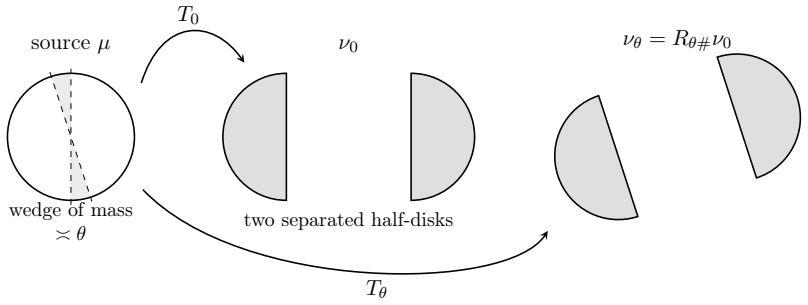
- When stability assumptions fail, targeting a non-optimal transport map can produce lower estimation error than targeting the OT map.
- The minimax framing supplies rigorous statistical limits for modern transport-based generative methods even when their target maps are analytically complex.
- Clarifies the precise conditions under which sub-optimal maps deliver a real statistical advantage.
Where Pith is reading between the lines
- If real data distributions routinely violate the stability conditions, generative models could gain sample efficiency by deliberately targeting easier-to-estimate maps rather than OT maps.
- Identifying the weakest conditions that still allow some maps to be easier than others would extend the result beyond the strong stability regime.
- The equivalence suggests that computational tractability, rather than statistical rate improvement, becomes the dominant design goal once stability holds.
Load-bearing premise
The stability assumptions such as bounded density ratios or Lipschitz continuity of the transport map are needed to make the sample complexity of any valid map match that of the OT map.
What would settle it
A pair of distributions with unbounded density ratios where a non-optimal but valid transport map achieves strictly lower minimax estimation error than the OT map at the rate given by the stability-free lower bound.
Figures

read the original abstract
Many modern generative modeling methods, including diffusion models, normalizing flows, and flow matching, estimate transport maps or plans between distributions without explicitly targeting an optimal transport (OT) map. In applications like generative modeling, the transport cost itself is irrelevant, and this makes it natural to target maps which are more tractable from either a statistical or computational standpoint. In this short note, we formalize the task of estimating any valid transport map in a rigorous minimax framework. One consequence of this framing is that it yields sample complexity lower bounds for any method whose learned object is evaluated as a transport map or plan, including flow matching and diffusion-based generative models, in settings where direct analysis would be challenging due to the analytic complexity of the methods and their target maps. We observe that, under standard, though strong, stability assumptions from the OT literature, estimating any valid transport map is statistically as hard as estimating the OT map. We complement these results with some examples showing that when these stability assumptions fail, alternative transport maps can be learned substantially more accurately than the OT map. Our minimax framing provides a rigorous foundation for understanding the statistical limits of modern transport-based generative methods and clarifies when targeting sub-optimal maps can provide real statistical advantages.
Editorial analysis
A structured set of objections, weighed in public.
Referee Report
Summary. The manuscript formalizes estimation of any valid transport map (not necessarily optimal) between distributions in a minimax framework. Under standard stability assumptions from the OT literature (bounded density ratios or Lipschitz continuity of the map), it claims that the sample-complexity lower bounds for any valid map match those of the OT map. The paper complements the equivalence result with explicit counter-examples showing that, when the stability assumptions fail, alternative maps can be estimated with substantially better rates. The framing is positioned to supply lower bounds for generative methods (diffusion, flow matching, normalizing flows) whose learned objects are evaluated as transport maps.
Significance. If the minimax constructions hold, the work supplies a clean, assumption-conditional hardness result that applies directly to a broad class of modern generative models whose analytic targets are otherwise difficult to analyze. The explicit counter-examples when stability fails are a constructive strength, delineating the precise regime in which targeting sub-optimal maps yields statistical gains. The approach avoids circularity by deriving lower bounds from standard statistical estimation arguments rather than from fitted quantities.
minor comments (2)
- The abstract and introduction would benefit from a single sentence that explicitly names the two stability conditions (bounded density ratios, Lipschitz continuity) rather than referring only to 'standard assumptions from the OT literature.'
- Because the note is short, a brief remark on whether the minimax constructions extend immediately to the empirical-measure setting used in practice would help readers connect the theory to the generative-modeling applications mentioned.
Simulated Author's Rebuttal
We thank the referee for their positive assessment of the manuscript and for recommending acceptance. We appreciate the recognition of the minimax framing and the value of the counter-examples when stability assumptions fail.
Circularity Check
No significant circularity
full rationale
The paper frames the problem of estimating any valid transport map via a standard minimax analysis and derives sample-complexity lower bounds under stability assumptions (bounded density ratios, Lipschitz maps) taken from the existing OT literature. These assumptions are explicitly external, the paper supplies counter-examples showing that the equivalence fails when they are dropped, and no derivation step reduces a claimed prediction or lower bound to a fitted parameter or self-citation by construction. The central result is therefore a conditional statement whose content is independent of the paper's own fitted quantities or prior self-references.
Axiom & Free-Parameter Ledger
axioms (1)
- domain assumption Standard stability assumptions from the OT literature (e.g., bounded density ratios or Lipschitz continuity of transport maps) hold.
Reference graph
Works this paper leans on
-
[1]
M. S. Albergo, N. M. Boffi, and E. Vanden-Eijnden. Stochastic interpolants: A unifying framework for flows and diffusions.Journal of Machine Learning Research, 26(209):1–80, 2025. 13
2025
-
[2]
Balakrishnan and T
S. Balakrishnan and T. Manole. Stability bounds for smooth optimal transport maps and their statistical implications.Electronic Journal of Statistics, 2026. To appear
2026
-
[3]
Balakrishnan, T
S. Balakrishnan, T. Manole, and L. Wasserman. Statistical inference for optimal transport maps: Recent advances and perspectives.Statistical Science, 2025
2025
-
[4]
Y. Brenier. Polar factorization and monotone rearrangement of vector-valued functions. Communications on Pure and Applied Mathematics, 44:375–417, 1991
1991
-
[5]
L. A. Caffarelli. The Regularity of Mappings with a Convex Potential.Journal of the American Mathematical Society, 5:99–104, 1992
1992
-
[6]
N. Deb, P. Ghosal, and B. Sen. Rates of Estimation of Optimal Transport Maps using Plug-in Estimators via Barycentric Projections.Advances in Neural Information Process- ing Systems 34, 2021
2021
-
[7]
Delalande and Q
A. Delalande and Q. Merigot. Quantitative stability of optimal transport maps under variations of the target measure.Duke Mathematical Journal, 172(17):3321–3357, 2023
2023
-
[8]
L. Dinh, J. Sohl-Dickstein, and S. Bengio. Density estimation using real NVP. InInter- national Conference on Learning Representations, 2017
2017
-
[9]
Divol, J
V. Divol, J. Niles-Weed, and A.-A. Pooladian. Optimal transport map estimation in general function spaces.The Annals of Statistics, 2022
2022
-
[10]
Figalli.The Monge–Ampère Equation and Its Applications
A. Figalli.The Monge–Ampère Equation and Its Applications. Zurich Lectures in Ad- vanced Mathematics. European Mathematical Society, Zürich, 2017
2017
-
[11]
J. Ho, A. Jain, and P. Abbeel. Denoising diffusion probabilistic models. InAdvances in Neural Information Processing Systems, volume 33, pages 6840–6851. Curran Associates, Inc., 2020
2020
-
[12]
Hütter and P
J.-C. Hütter and P. Rigollet. Minimax rates of estimation for smooth optimal transport maps.The Annals of Statistics, 49:1166–1194, 2021
2021
-
[13]
Letrouit
C. Letrouit. Lectures on quantitative stability of optimal transport, May 2025. Notes du Cours Peccot, Collège de France, May–June 2025. Preliminary version
2025
-
[14]
Letrouit
C. Letrouit. Unstable optimal transport maps.Comptes Rendus. Mathématique, 364: 333–344, 2026
2026
-
[15]
Gluingmethodsforquantitativestabilityofoptimaltransport maps, 2024
C.LetrouitandQ.Mérigot. Gluingmethodsforquantitativestabilityofoptimaltransport maps, 2024
2024
-
[16]
Lipman, R
Y. Lipman, R. T. Q. Chen, H. Ben-Hamu, M. Nickel, and M. Le. Flow matching for gen- erative modeling. InThe Eleventh International Conference on Learning Representations, 2023
2023
-
[17]
X. Liu, C. Gong, and Q. Liu. Flow straight and fast: Learning to generate and transfer data with rectified flow. InThe Eleventh International Conference on Learning Repre- sentations, 2023
2023
-
[18]
Manole, S
T. Manole, S. Balakrishnan, J. Niles-Weed, and L. Wasserman. Plugin estimation of smooth optimal transport maps.The Annals of Statistics, 52(3):966–998, 2024. 14
2024
- [19]
-
[20]
Quantitativestabilityofoptimaltransportmaps and linearization of the 2-Wasserstein space
Q.Mérigot, A.Delalande, andF.Chazal. Quantitativestabilityofoptimaltransportmaps and linearization of the 2-Wasserstein space. InInternational Conference on Artificial Intelligence and Statistics, pages 3186–3196. PMLR, 2020
2020
-
[21]
Niles-Weed and Q
J. Niles-Weed and Q. Berthet. Minimax estimation of smooth densities in wasserstein distance.The Annals of Statistics, 50(3):1519–1540, 2022
2022
-
[22]
Papamakarios, E
G. Papamakarios, E. Nalisnick, D. J. Rezende, S. Mohamed, and B. Lakshminarayanan. Normalizing flows for probabilistic modeling and inference.Journal of Machine Learning Research, 22(57):1–64, 2021
2021
-
[23]
Peyré and M
G. Peyré and M. Cuturi. Computational optimal transport with applications to data sciences.Foundations and Trends in Machine Learning, 11(5-6):355–607, 2019
2019
-
[24]
Rezende and S
D. Rezende and S. Mohamed. Variational inference with normalizing flows. InProceedings of the 32nd International Conference on Machine Learning, volume 37 ofProceedings of Machine Learning Research, pages 1530–1538. PMLR, 2015
2015
-
[25]
Sohl-Dickstein, E
J. Sohl-Dickstein, E. Weiss, N. Maheswaranathan, and S. Ganguli. Deep unsupervised learning using nonequilibrium thermodynamics. InProceedings of the 32nd International Conference on Machine Learning, volume37ofProceedings of Machine Learning Research, pages 2256–2265. PMLR, 2015
2015
-
[26]
Score-based generative modeling through stochastic differential equations
Y.Song, J.Sohl-Dickstein, D.P.Kingma, A.Kumar, S.Ermon, andB.Poole. Score-based generative modeling through stochastic differential equations. InInternational Conference on Learning Representations, 2021
2021
-
[27]
A. B. Tsybakov.Introduction to Nonparametric Estimation. Springer Science & Business Media, 2008
2008
-
[28]
Villani.Topics in Optimal Transportation, volume 58 ofGraduate Studies in Mathe- matics
C. Villani.Topics in Optimal Transportation, volume 58 ofGraduate Studies in Mathe- matics. American Mathematical Society, Providence, RI, 2003
2003
-
[29]
Villani.Optimal Transport: Old and New, volume 338 ofGrundlehren der mathema- tischen Wissenschaften
C. Villani.Optimal Transport: Old and New, volume 338 ofGrundlehren der mathema- tischen Wissenschaften. Springer, Berlin, Heidelberg, 2009. 15 A The One-Dimensional Case The one-dimensional case of transport is special and in this section we discuss it briefly. In higher dimensions, stability of the OT map is a nontrivial regularity property. In one dime...
2009
-
[30]
, n, Z Gj ∥Tσ(x)−T σ(j)(x)∥2 2 dµ(x) = 4a2ε
For everyσ∈ {±1} n and everyj= 1, . . . , n, Z Gj ∥Tσ(x)−T σ(j)(x)∥2 2 dµ(x) = 4a2ε. Thus the local separation condition in Lemma 6 holds with ∆j = 4a2ε
-
[31]
In particular, sinceε= 1/n, there is a universal constantρ0 >0such that ρ(P ⊗n σ , P ⊗n σ(j))≥ρ 0 for all sufficiently largen
IfP σ =ν σ, then for everyσand everyj, ρ(P ⊗n σ , P ⊗n σ(j)) = (1−ε) n. In particular, sinceε= 1/n, there is a universal constantρ0 >0such that ρ(P ⊗n σ , P ⊗n σ(j))≥ρ 0 for all sufficiently largen. Proof.Letσ (j) be obtained fromσby flipping thejth sign. On the left source ball, yσ(j) j,L −y σ j,L = (0,2σ ja), and on the right source ball, yσ(j) j,R −y σ...
discussion (0)
Sign in with ORCID, Apple, or X to comment. Anyone can read and Pith papers without signing in.