REVIEW 4 major objections 6 minor 43 references
Benchmarking Universal Machine Learning Interatomic Potentials for Real-Time Analysis of Inelastic Neutron Scattering Data
T0 review · 4 major / 6 minor · reviewed 2026-08-07 · deepseek-v4-flash
Pith's one-line read The paper claims that the newest universal machine learning interatomic potentials can compute phonon dispersions and vibrational spectra at near-DFT accuracy, fast enough to enable real-time interpretation and steering of inelastic…
desk verdict Useful benchmark with real experimental checks; the missing train/test overlap analysis is the main thing to fix before trusting the quantitative accuracy claims. read the letter →
The pith
A machine-rendered reading of the paper's core claim, the machinery that carries it, and where it could break.
The reading
What carries the argument
The central object is the universal machine learning interatomic potential (uMLIP): a pretrained neural network that maps atomic coordinates directly to energies and forces, standing in for the DFT electronic-structure calculation. The argument is carried by a multi-stage benchmark pipeline: reference phonons are computed with DFT on a new database of 4,869 crystals; each uMLIP relaxes atomic coordinates with the cell shape and volume frozen, then produces phonons through the same finite-displacement machinery; agreement is scored by frequency mean absolute error, Spearman rank correlation of the phonon density of states, and errors in vibrational free energy, entropy, and heat capacity; the final stage overlays or simulates experimental INS spectra, including single-crystal S(Q,E) maps that test both frequencies and polarization vectors.
What would settle it
Re-run the same benchmark on a set of crystals drawn from outside the training-data universe (e.g., molecular crystals, hydrogen-bonded frameworks, and materials with soft or imaginary phonon modes) with cell volumes allowed to relax; if the per-mode frequency error of ORB v3 or MatterSim rises well above the reported mean or the density-of-states Spearman coefficient drops below roughly 0.9, the near-DFT and real-time claims would not transfer. A cheaper check is to count how many of the 4,869 structures, or near-duplicates, appear in the uMLIP training sets, and re-score after removing them.
Extended reading notes
Core claim
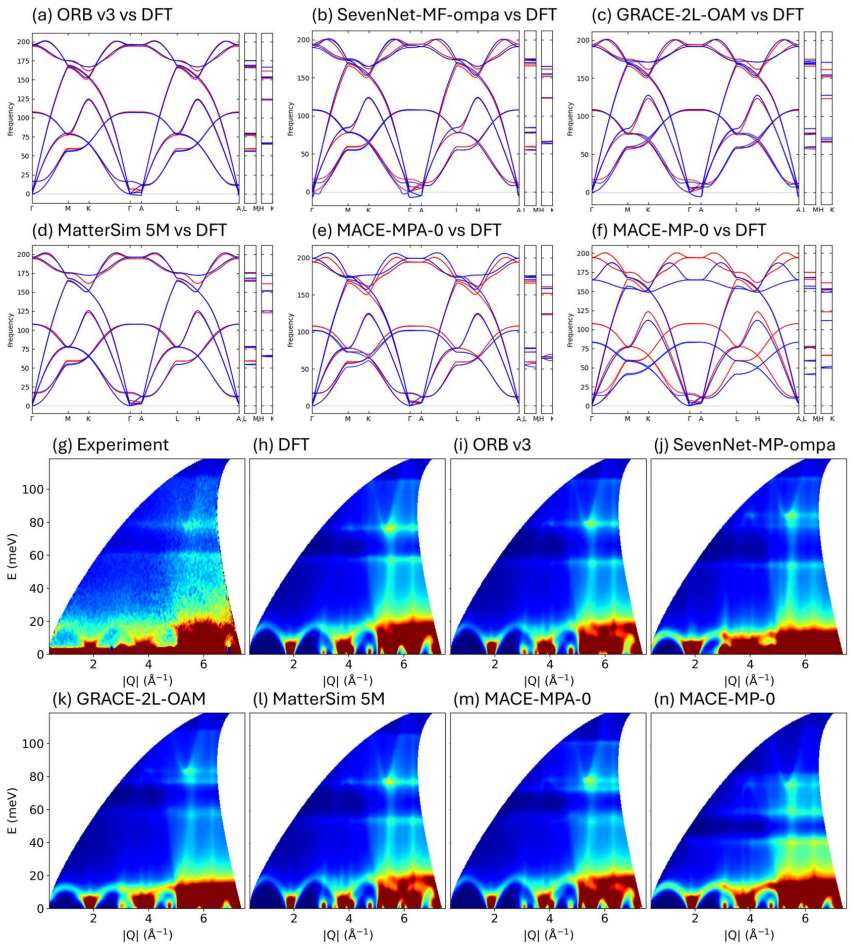
The central claim is that universal machine learning interatomic potentials have crossed a practical threshold: they can reproduce DFT-quality phonon dispersion and INS spectra closely enough for peak assignment, and they do it fast enough for interactive use. On the aggregate benchmark, ORB v3 has the smallest mean frequency error, about 0.50 meV against DFT, with a mean phonon density-of-states Spearman coefficient above 0.95; SevenNet-MF-ompa and GRACE-2L-OAM follow, and MACE-MPA-0, MatterSim, and eSEN-30M-OAM trail. The experimental comparisons sharpen the story: on single-crystal cuprite and RuCl3, MatterSim gives the best match to measured S(Q,E), including mode intensities that test the phonon polarization vectors as well as the frequencies. For hydrogen-containing organics, the fine-tuned MACE-OFF is the only model consistently close enough for spectral interpretation. A notable secondary claim is that energy- and force-based leaderboard rankings do not predict INS performance, so application-level benchmarking is required.
Load-bearing premise
The load-bearing premise is that the 4,869 crystals chosen from a public materials database, all small, stable, and held at fixed DFT cell shapes and volumes, are representative of the systems where uMLIPs will be used; because the tested models were mostly trained on that same database, an overlap between training and test sets would artificially inflate the near-DFT score.
Editorial extensions
If this is right
- If the benchmark is right, routine phonon and INS analysis can move from DFT clusters to a laptop or local GPU, with each spectrum computed in seconds to minutes.
- Neutron experiments could be steered during data collection: measured spectra can be compared immediately against candidate structural models to decide the next measurement.
- The top models vary by material class, so choosing the potential for the sample matters more than using the highest-ranked general model.
- Energy- and force-based leaderboard rankings alone do not identify the right model for spectra; application-level benchmarks are needed for vibrational-spectroscopy users.
- The 4,869-crystal phonon database becomes a reusable resource for testing future uMLIPs against DFT on phonon-derived properties.
Reading between the lines
- Because the benchmark froze cell shape and volume, its conclusions do not yet cover temperature- or pressure-dependent phonon properties; an editorial guess is that lattice-constant errors in uMLIPs will become visible once volume relaxation is allowed.
- The near-DFT INS intensity match for RuCl3 implies uMLIP polarization vectors are already physically meaningful; if that holds, the same potentials may be usable for phonon lifetimes and thermal conductivity, though higher-order force constants remain untested.
- A direct overlap audit between the benchmark crystals and the uMLIP training databases, none of which is reported, would settle how much of the near-DFT accuracy is memorization; until then the accuracy should be read as a database-domain claim.
- The weak performance on hybrid frameworks and drug-like crystals suggests that hydrogen-containing and metal-organic systems are the next targeted-training frontier; a uMLIP fine-tuned on beamline-relevant molecular crystals would be the natural test.
Editorial analysis
A structured set of objections, weighed in public.
Referee Report
Summary. The paper introduces a DFT-based phonon database of 4,869 inorganic crystals (up to 12 atoms per unit cell, stable phonon spectra, from the Materials Project) and benchmarks twelve universal machine learning interatomic potentials (uMLIPs) against it using atomic-coordinate errors, phonon-frequency mean absolute errors, PDOS Spearman coefficients, and thermodynamic properties. The authors then simulate inelastic neutron scattering (INS) spectra for graphite, Ba3ZnRu2O9, Cu2O, RuCl3, and several hydrogen-containing systems (ZrH2, ZIF-8, polyethylene, toluene, butyric acid, remdesivir) and compare them with experimental data. They conclude that the most recent uMLIPs can achieve near-DFT accuracy for phonon and vibrational-spectrum calculations, and that integration into the INSPIRED software permits real-time analysis and experiment steering.
Significance. If the central claims hold, this is a valuable methodological contribution: a well-documented open phonon database, a systematic and reproducible DFT-vs-uMLIP benchmark spanning multiple observables, and a demonstration of uMLIP-based INS simulations across a diverse set of experimental scenarios. The main strengths are the open release of the database and scripts, the care taken in the DFT reference calculations (LO-TO splitting, spin polarization, consistent relaxation), and the broad experimental coverage. The principal limitations are that the benchmark set is drawn from the same Materials Project family used to train the tested potentials without any overlap control, that the experimental comparisons are purely qualitative, and that the 'real-time' speed claim is not backed by measured runtimes. These gaps mean the results are best read as a conditional demonstration rather than a fully validated claim of general near-DFT accuracy.
major comments (4)
- [§2 Results and Discussion; §4 Methods (database construction)] The benchmark set consists of 4,869 crystals chosen from the Materials Project (Methods: 'The crystals included in the benchmarking database are chosen from the Materials Project'), while all twelve uMLIPs were trained to a substantial extent on Materials Project-derived datasets (MPtrj for SevenNet-0/CHGNet/M3GNet; MPtrj/OMat24/Alexandria for ORB, MACE-MPA-0, eqV2 M; MatterSim's own set also draws on similar PBE-level data). No de-duplication or overlap analysis is reported between the benchmark crystals and these training sets. Because the test set is restricted to stable small-cell crystals at PBE-level, the reported frequency MAEs (Table S2) and PDOS Spearman coefficients (Table S3) may reflect in-distribution accuracy rather than generalization. This directly bears on the headline claim of 'near DFT accuracy' for routine use. Please quantify overlap (e.g., with pymatgen's StructureMatcher or a composition-plus-spacegroup check against each model's training set) and report the error statistics separately for overlapping and non-overlapping crystals; if overlap is pervasive, add a held-out test on chemically distinct systems or re-scope the claim.
- [§2 Results and Discussion, Figures 2–6] The experimental INS validation is stated as the 'ultimate benchmark' and used to 'verify the applicability' of the uMLIPs (Conclusion), but all comparisons are made visually, without any numerical metric. Statements such as 'it is clear that ORB v3 and MatterSim are among the best' (Figure 2) and 'MatterSim achieves near-DFT accuracy' (Figure 5) are not supported by quantitative agreement scores. Please add objective measures for the experimental comparisons, such as peak-position errors for identified bands, spectral correlation coefficients, or RMS errors between simulated and measured S(Q,E); alternatively, explicitly present these as qualitative case studies rather than verification.
- [Conclusion; §1 Introduction] A central advertised outcome is real-time analysis ('may only take seconds to minutes', Conclusion), but the manuscript reports no timing measurements, hardware details, or scaling data for any of the simulated systems. Without measured wall-clock times (even for a few representative examples such as graphite, Ba3ZnRu2O9, and ZIF-8), the real-time claim is unsupported. Please include a small benchmark of computational cost with stated hardware and software settings.
- [§4 Methods; Conclusion] The benchmark explicitly excludes materials with significant phonon instability ('crystals with significant phonon instability ... were not included') and evaluates phonons at fixed DFT/Materials Project cell volumes ('We did not relax the volume or shape of the unit cells'). These restrictions are acknowledged in Methods, but the Conclusion's statement that the named uMLIPs 'can potentially be used to perform calculations of phonon dispersion and vibrational spectra with near DFT accuracy' is not qualified by them. Since real INS workflows often encounter hydrides, molecular crystals, and anharmonic/unstable systems (several of which appear in the paper's own experimental section), please either qualify the generality claim or add a small set of validation cases outside the stable-small-cell regime to bound the scope.
minor comments (6)
- [§4 Methods, Eq. (4)] The text states that the Spearman coefficient 'ranges between 0 and 1', but the statistic defined in Eq. (4) can be negative, and Table S3 indeed reports negative minimum values for eqV2 M, ORB v1, and MACE-MP-0. Please correct the range description.
- [Table S1 caption] The caption refers to 'the 5000 benchmark DFT calculations' while the database contains 4,869 crystals; please reconcile the numbers.
- [Conclusion] MACE-OFF is listed among the models capable of near-DFT accuracy, but it is not included in the systematic database benchmark (Tables S1–S6); its support comes only from the qualitative organic experimental comparisons. Please clarify that its status rests on those case studies.
- [§2 Results and Discussion] The prose ranking of models that 'follow closely' (MatterSim 5M, MACE-MPA-0, eSEN-30M-OAM) is inconsistent with Table S2, where eSEN-30M-OAM has a lower mean frequency MAE (1.20 meV) than MatterSim (1.43 meV) and MACE-MPA-0 (1.61 meV). Please adjust the text or the table presentation.
- [§4 Methods] The k-point density descriptions ('160 Å^-3' for DFT and '1000 per Å^-3 in the reciprocal unit cell' for the phonon grid) are non-standard and ambiguous; please define these quantities explicitly (e.g., number of k-points per reciprocal volume) or report the actual mesh divisions.
- [§1 Introduction] The sentence 'Our benchmark with INS spectra also highlights that similar performance in traditional metrics does necessarily translate to similar performance in a specific application' appears to miss a 'not' before 'necessarily'; please correct the typo.
Circularity Check
No circularity: uMLIP benchmark uses fixed pretrained models and independent DFT reference; data-overlap concern is a generalization limitation, not a circular derivation.
full rationale
The paper is a benchmark rather than a derivation: it computes a new DFT phonon database for 4,869 Materials Project crystals and compares fixed, pretrained uMLIPs against it. No target quantity is fitted to the benchmark data; the uMLIP weights were fixed before this work, and the reported MAEs and Spearman coefficients are direct comparisons of independently computed phonon properties. Equations (1)-(4) define ordinary distance, frequency-error, thermodynamic-error, and rank-correlation metrics; none of them defines a uMLIP output in terms of the DFT target or vice versa. The closest concern is that the test set is drawn from the Materials Project while most tested uMLIPs were trained on MP-derived databases, so the benchmark may be in-distribution; however, this is a generalization and independence limitation, not a circular reduction, and the paper's experimental INS comparisons provide external grounding. Self-citations to INSPIRED and OCLIMAX are tool citations, not load-bearing mathematical premises. Therefore no circular step can be exhibited.
Assumptions & free parameters
assumptions (5)
- domain assumption DFT-PBE phonons from VASP/Phonopy are a sufficient ground truth for benchmarking forces and frequencies.
- standard math The harmonic/quasiharmonic approximation with finite displacements captures the vibrational properties under test.
- ad hoc to paper Materials Project stable crystals with cells up to 12 atoms are representative of real INS analysis workloads.
- ad hoc to paper The benchmark set does not substantially overlap uMLIP training data.
- domain assumption The incoherent approximation and INSPIRED/OCLIMAX methodology convert phonon eigenvectors to reliable simulated INS intensities.
Cite this review
Pith. "Pith review of Benchmarking Universal Machine Learning Interatomic Potentials for Real-Time Analysis of Inelastic Neutron Scattering Data." pith.science (2026). https://pith.science/paper/QCPUTHQO
@misc{pith2026250601860,
  author       = {Pith},
  title        = {Pith review of: Benchmarking Universal Machine Learning Interatomic Potentials for Real-Time Analysis of Inelastic Neutron Scattering Data},
  year         = {2026},
  howpublished = {\url{https://pith.science/paper/QCPUTHQO}},
  note         = {Machine review of arXiv:2506.01860}
}
read the original abstract
The accurate calculation of phonons and vibrational spectra remains a significant challenge, requiring highly precise evaluations of interatomic forces. Traditional methods based on the quantum description of the electronic structure, while widely used, are computationally expensive and demand substantial expertise. Emerging universal machine learning interatomic potentials (uMLIPs) offer a transformative alternative by employing pre-trained neural network surrogates to predict interatomic forces directly from atomic coordinates. This approach dramatically reduces computation time and minimizes the need for technical knowledge. In this paper, we produce a phonon database comprising nearly 5,000 inorganic crystals to benchmark the performance of several leading uMLIPs. We further assess these models in real-world applications by using them to analyze experimental inelastic neutron scattering data collected on a variety of materials. Through detailed comparisons, we identify the strengths and limitations of these uMLIPs, providing insights into their accuracy and suitability for fast calculations of phonons and related properties, as well as for real-time interpretation of neutron scattering spectra. Our findings highlight how the rapid advancement of AI in science is revolutionizing experimental research and data analysis.
Figures


Figures from the paper (3 more)


Reference graph
Works this paper leans on
-
[1]
Reissland, J. A. The physics of phonons; London ; New York : Wiley, 1973
work page 1973
-
[2]
First principles phonon calculations in materials science
Togo, A.; Tanaka, I. First principles phonon calculations in materials science. Scripta Materialia 2015, 108, 1--5
2015
-
[3]
Inelastic Scattering , revision 1.0 ed.; California Institute of Technology, 2020
Fultz, B. Inelastic Scattering , revision 1.0 ed.; California Institute of Technology, 2020
work page 2020
-
[4]
utt, K. T.; Tkatchenko, A.; M\
Unke, O. T.; Chmiela, S.; Sauceda, H. E.; Gastegger, M.; Poltavsky, I.; Sch\"utt, K. T.; Tkatchenko, A.; M\"uller, K.-R. Machine Learning Force Fields . Chem. Rev. 2021, 121, 10142--10186
work page 2021
-
[5]
Riebesell, J.; Goodall, R. E. A.; Benner, P.; Chiang, Y.; Deng, B.; Ceder, G.; Asta, M.; Lee, A. A.; Jain, A.; Persson, K. A. Matbench Discovery -- A framework to evaluate machine learning crystal stability predictions. 2024; http://arxiv.org/abs/2308.14920
arXiv 2024
-
[6]
Deng, B.; Choi, Y.; Zhong, P.; Riebesell, J.; Anand, S.; Li, Z.; Jun, K.; Persson, K. A.; Ceder, G. Systematic softening in universal machine learning interatomic potentials. npj Comput Mater 2025, 11, 1--9
work page 2025
-
[7]
Loew, A.; Sun, D.; Wang, H.-C.; Botti, S.; Marques, M. A. L. Universal Machine Learning Interatomic Potentials are Ready for Phonons . 2024; http://arxiv.org/abs/2412.16551
arXiv 2024
-
[8]
Togo, A. atztogo/phonondb. 2025; https://github.com/atztogo/phonondb
work page 2025
Show all 43 references
-
[9]
T.; Li, M.; Cheng, Y
Han, B.; Savici, A. T.; Li, M.; Cheng, Y. INSPIRED : Inelastic neutron scattering prediction for instantaneous results and experimental design. Computer Physics Communications 2024, 304, 109288
2024
-
[10]
P.; Hautier, G.; Chen, W.; Richards, W
Jain, A.; Ong, S. P.; Hautier, G.; Chen, W.; Richards, W. D.; Dacek, S.; Cholia, S.; Gunter, D.; Skinner, D.; Ceder, G. et al. Commentary: The Materials Project : A materials genome approach to accelerating materials innovation. APL Materials 2013, 1, 011002
2013
-
[11]
M.; Barroso-Luque, L.; Levine, D
Fu, X.; Wood, B. M.; Barroso-Luque, L.; Levine, D. S.; Gao, M.; Dzamba, M.; Zitnick, C. L. Learning Smooth and Expressive Interatomic Potentials for Physical Property Prediction . 2025; http://arxiv.org/abs/2502.12147
2025 arXiv
-
[12]
Orb-v3: atomistic simulation at scale
Rhodes, B.; Vandenhaute, S.; Šimkus, V.; Gin, J.; Godwin, J.; Duignan, T.; Neumann, M. Orb-v3: atomistic simulation at scale. 2025; https://arxiv.org/abs/2504.06231
2025 arXiv
-
[13]
Scalable Parallel Algorithm for Graph Neural Network Interatomic Potentials in Molecular Dynamics Simulations
Park, Y.; Kim, J.; Hwang, S.; Han, S. Scalable Parallel Algorithm for Graph Neural Network Interatomic Potentials in Molecular Dynamics Simulations. J. Chem. Theory Comput. 2024, 20, 4857--4868
2024
-
[14]
Data-Efficient Multifidelity Training for High-Fidelity Machine Learning Interatomic Potentials
Kim, J.; Kim, J.; Kim, J.; Lee, J.; Park, Y.; Kang, Y.; Han, S. Data-Efficient Multifidelity Training for High-Fidelity Machine Learning Interatomic Potentials. J. Am. Chem. Soc. 2024, 147, 1042--1054
2024
-
[15]
Graph Atomic Cluster Expansion for Semilocal Interactions beyond Equivariant Message Passing
Bochkarev, A.; Lysogorskiy, Y.; Drautz, R. Graph Atomic Cluster Expansion for Semilocal Interactions beyond Equivariant Message Passing . Phys. Rev. X 2024, 14, 021036
2024
-
[16]
Yang, H.; Hu, C.; Zhou, Y.; Liu, X.; Shi, Y.; Li, J.; Li, G.; Chen, Z.; Chen, S.; Zeni, C. et al. MatterSim : A Deep Learning Atomistic Model Across Elements , Temperatures and Pressures . 2024; http://arxiv.org/abs/2405.04967
2024 arXiv
-
[17]
M.; Kov\'acs, D
Batatia, I.; Benner, P.; Chiang, Y.; Elena, A. M.; Kov\'acs, D. P.; Riebesell, J.; Advincula, X. R.; Asta, M.; Avaylon, M.; Baldwin, W. J. et al. A foundation model for atomistic materials chemistry. 2024; http://arxiv.org/abs/2401.00096
2024 arXiv
-
[18]
P.; Simm, G
Batatia, I.; Kovacs, D. P.; Simm, G. N. C.; Ortner, C.; Csanyi, G. MACE : Higher Order Equivariant Message Passing Neural Networks for Fast and Accurate Force Fields. Advances in Neural Information Processing Systems. 2022
2022
-
[19]
P.; Musaelian, A.; Simm, G
Batatia, I.; Batzner, S.; Kov \'a cs, D. P.; Musaelian, A.; Simm, G. N. C.; Drautz, R.; Ortner, C.; Kozinsky, B.; Cs \'a nyi, G. The Design Space of E(3)-Equivariant Atom-Centered Interatomic Potentials. 2022
2022
-
[20]
M.; Dzamba, M.; Gao, M.; Rizvi, A.; Zitnick, C
Barroso-Luque, L.; Shuaibi, M.; Fu, X.; Wood, B. M.; Dzamba, M.; Gao, M.; Rizvi, A.; Zitnick, C. L.; Ulissi, Z. W. Open Materials 2024 ( OMat24 ) Inorganic Materials Dataset and Models . 2024; http://arxiv.org/abs/2410.12771
2024 arXiv
-
[21]
Orb: A Fast, Scalable Neural Network Potential
Neumann, M.; Gin, J.; Rhodes, B.; Bennett, S.; Li, Z.; Choubisa, H.; Hussey, A.; Godwin, J. Orb: A Fast, Scalable Neural Network Potential. 2024; https://arxiv.org/abs/2410.22570
2024 arXiv
-
[22]
J.; Ceder, G
Deng, B.; Zhong, P.; Jun, K.; Riebesell, J.; Han, K.; Bartel, C. J.; Ceder, G. CHGNet as a pretrained universal neural network potential for charge-informed atomistic modelling. Nat Mach Intell 2023, 5, 1031--1041
2023
-
[23]
Chen, C.; Ong, S. P. A universal graph deep learning interatomic potential for the periodic table. Nat Comput Sci 2022, 2, 718--728
2022
-
[24]
Computer-assisted IR spectra prediction -- linked similarity searches for structures and spectra
Baumann, K.; Clerc, J. Computer-assisted IR spectra prediction -- linked similarity searches for structures and spectra. Analytica Chimica Acta 1997, 348, 327--343
1997
-
[25]
A deep learning model for predicting selected organic molecular spectra
Zou, Z.; Zhang, Y.; Liang, L.; Wei, M.; Leng, J.; Jiang, J.; Luo, Y.; Hu, W. A deep learning model for predicting selected organic molecular spectra. Nat Comput Sci 2023, 3, 957--964
2023
-
[26]
Squires, G. L. Introduction to the Theory of Thermal Neutron Scattering , 3rd ed.; Cambridge University Press: Cambridge, 2012
2012
-
[27]
E.; Kolesnikov, A
Granroth, G. E.; Kolesnikov, A. I.; Sherline, T. E.; Clancy, J. P.; Ross, K. A.; Ruff, J. P. C.; Gaulin, B. D.; Nagler, S. E. SEQUOIA : A Newly Operating Chopper Spectrometer at the SNS . J. Phys.: Conf. Ser. 2010, 251, 012058
2010
-
[28]
Q.; Daemen, L
Cheng, Y. Q.; Daemen, L. L.; Kolesnikov, A. I.; Ramirez-Cuesta, A. J. Simulation of Inelastic Neutron Scattering Spectra Using OCLIMAX . J. Chem. Theory Comput. 2019, 15, 1974--1982
2019
-
[29]
M.; Stone, M
Cheng, Y.; Wu, G.; Pajerowski, D. M.; Stone, M. B.; Savici, A. T.; Li, M.; Ramirez-Cuesta, A. J. Direct prediction of inelastic neutron scattering spectra from the crystal structure*. Mach. Learn.: Sci. Technol. 2023, 4, 015010
2023
-
[30]
N.; Kim, D
Saunders, C. N.; Kim, D. S.; Hellman, O.; Smith, H. L.; Weadock, N. J.; Omelchenko, S. T.; Granroth, G. E.; Bernal-Choban, C. M.; Lohaus, S. H.; Abernathy, D. L. et al. Thermal expansion and phonon anharmonicity of cuprite studied by inelastic neutron scattering and ab initio ...
2022
-
[31]
D.; Wang, X.; Abernathy, D
Mu, S.; Dixit, K. D.; Wang, X.; Abernathy, D. L.; Cao, H.; Nagler, S. E.; Yan, J.; Lampen-Kelley, P.; Mandrus, D.; Polanco, C. A. et al. Role of the third dimension in searching for Majorana fermions in - RuCl3 via phonons. Phys. Rev. Research 2022, 4, 013067
2022
-
[32]
A.; Daemen, L
Seeger, P. A.; Daemen, L. L.; Larese, J. Z. Resolution of VISION , a crystal-analyzer spectrometer. Nuclear Instruments and Methods in Physics Research Section A: Accelerators, Spectrometers, Detectors and Associated Equipment 2009, 604, 719--728
2009
-
[33]
P.; Moore, J
Kov\'acs, D. P.; Moore, J. H.; Browning, N. J.; Batatia, I.; Horton, J. T.; Pu, Y.; Kapil, V.; Witt, W. C.; Magd a u, I.-B.; Cole, D. J. et al. MACE - OFF : Transferable Short Range Machine Learning Force Fields for Organic Molecules . 2025; http://arxiv.org/abs/2312.15211
2025 arXiv
-
[34]
I.; Bernholc, J.; Lu, W.; Ramirez-Cuesta, A
Zhang, J.; Cheng, Y.; Kolesnikov, A. I.; Bernholc, J.; Lu, W.; Ramirez-Cuesta, A. J. Study of Anharmonicity in Zirconium Hydrides Using Inelastic Neutron Scattering and Ab - Initio Computer Modeling . Inorganics 2021, 9, 29
2021
-
[35]
E.; Fern\'andez-Catal\'a, J.; Cheng, Y.; Daemen, L.; Ramirez-Cuesta, A
Casco, M. E.; Fern\'andez-Catal\'a, J.; Cheng, Y.; Daemen, L.; Ramirez-Cuesta, A. J.; Cuadrado-Collados, C.; Silvestre-Albero, J.; Ramos-Fernandez, E. V. Understanding ZIF -8 Performance upon Gas Adsorption by Means of Inelastic Neutron Scattering . ChemistrySelect 2017, 2, 2750--2753
2017
-
[36]
L.; Kolesnikov, A
Mamontov, E.; Cheng, Y.; Daemen, L. L.; Kolesnikov, A. I.; Ramirez-Cuesta, A. J.; Ryder, M. R.; Stone, M. B. Low rotational barriers for the most dynamically active methyl groups in the proposed antiviral drugs for treatment of SARS - CoV -2, apilimod and tetrandrine. Chemical...
2021
-
[37]
Efficient iterative schemes for ab initio total-energy calculations using a plane-wave basis set
Kresse, G.; Furthm\"uller, J. Efficient iterative schemes for ab initio total-energy calculations using a plane-wave basis set. Phys. Rev. B 1996, 54, 11169--11186
1996
-
[38]
Bl\"ochl, P. E. Projector augmented-wave method. Phys. Rev. B 1994, 50, 17953--17979
1994
-
[39]
P.; Burke, K.; Ernzerhof, M
Perdew, J. P.; Burke, K.; Ernzerhof, M. Generalized Gradient Approximation Made Simple. Phys. Rev. Lett. 1996, 77, 3865--3868
1996
-
[40]
Implementation strategies in phonopy and phono3py
Togo, A.; Chaput, L.; Tadano, T.; Tanaka, I. Implementation strategies in phonopy and phono3py. J. Phys. Condens. Matter 2023, 35, 353001
2023
-
[41]
First-principles Phonon Calculations with Phonopy and Phono3py
Togo, A. First-principles Phonon Calculations with Phonopy and Phono3py. J. Phys. Soc. Jpn. 2023, 92, 012001
2023
-
[42]
H.; Mortensen, J
Larsen, A. H.; Mortensen, J. J.; Blomqvist, J.; Castelli, I. E.; Christensen, R.; Dułak, M.; Friis, J.; Groves, M. N.; Hammer, B.; Hargus, C. et al. The atomic simulation environment—a Python library for working with atoms. Journal of Physics: Condensed Matter 2017, 29, 273002
2017
-
[43]
hݳrev Æ [ҘH4zx^SS F :4P2h:sFm65m6^x @ P롌J<hӦMS6@
Ong, S. P.; Richards, W. D.; Jain, A.; Hautier, G.; Kocher, M.; Cholia, S.; Gunter, D.; Chevrier, V. L.; Persson, K. A.; Ceder, G. Python Materials Genomics (pymatgen): A robust, open-source python library for materials analysis. Computational Materials Science 2013, 68, 314--...
2013
Reviewed August 7, 2026 · model on record in the stance chip above.
Discussion (0). Sign in to comment.