REVIEW 5 major objections 4 minor 43 references
iPanda: An LLM-based Agent for Automated Conformance Testing of Communication Protocols
T0 review · 5 major / 4 minor · reviewed 2026-08-06 · deepseek-v4-flash
Pith's one-line read An LLM agent that reads protocol specs, writes conformance tests, and debugs them lifts first-try test-program success by 4.7 to 10.8 times.
desk verdict Useful pipeline, but the headline Pass@1 gain is inflated by an unfair repair budget; the core idea and the RFC 9177 find survive scrutiny. read the letter →
The pith
A machine-rendered reading of the paper's core claim, the machinery that carries it, and where it could break.
The reading
What carries the argument
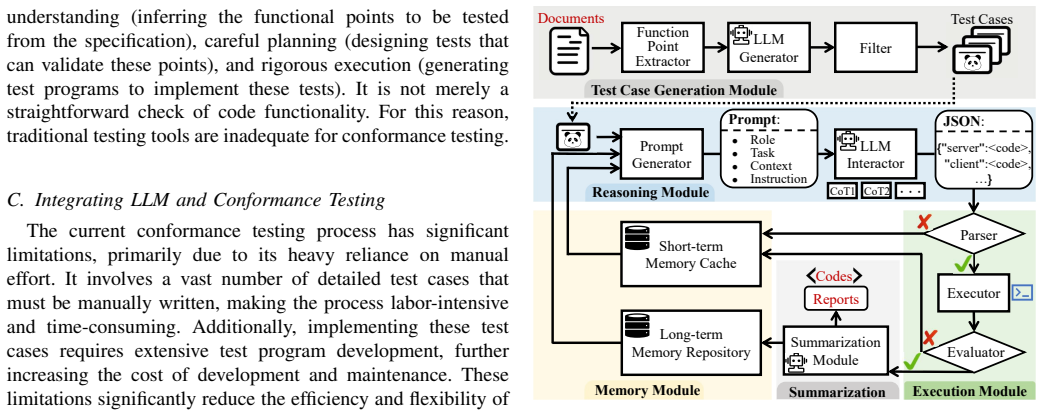
The load-bearing mechanism is the iterative optimization loop of Section III-C: each failed program, its execution log, and a debugging prompt are appended to the model's context, so the next generated program is conditioned on actual runtime feedback rather than only on the original test case. The loop is bounded by a short-term memory window of 10 interactions and a default retry cap of 6, and it is coupled to an automated testing platform that parses the JSON blueprint, launches subprograms in an isolated virtual environment, and returns execution errors. Two supporting mechanisms carry the input side: keyword-based test-case generation locates functional points by RFC 2119 keywords such as MUST and SHALL, reaching 87.5% section coverage across 32 CoAP-related RFC documents, and code-oriented retrieval-augmented generation retrieves implementation source files by cosine similarity to ground API usage in the generated programs.
What would settle it
Run the published CoAP-set and RSocket-set through an independent oracle—human-authored tests or an existing conformance checker—and compare each program's Pass@1 label against the oracle's verdict; if many LLM-labeled successes fail the oracle, the reported multi-fold improvements do not measure true conformance.
Extended reading notes
Core claim
The paper's central claim is that the bottleneck in LLM-based conformance testing is not understanding the specification but grounding that understanding in the concrete API of an implementation library and producing code that actually executes. iPanda closes that loop: keyword-based test-case generation turns MUST and SHALL statements into structured cases; a customized chain-of-thought strategy decomposes each case into per-role subprograms and a startup-order blueprint in JSON; the execution platform runs the program and returns real error logs; and the iterative optimization algorithm uses those logs as context for repair, up to a default maximum of six attempts. The ablation studies attribute most of the gain to the repair loop, and retrieval-augmented generation to API grounding when the library is too new for the model to know it: on the RSocket set, enabling RAG raises Pass@1 from 14.51% to 38.71%. The paper presents iPanda as the first LLM-based framework that integrates specification, implementation, and test execution into one conformance-testing process.
Load-bearing premise
The claimed success rates assume that the model's judgment of whether its own generated tests pass, judged against assertions the same model wrote, is trustworthy, since the only shields are a keyword filter and manual review.
Editorial extensions
If this is right
- If the Pass@1 gains are real, protocol conformance suites can be built from specification documents alone, without a human test engineer writing each script.
- The ablation results imply that libraries with little training exposure benefit most from retrieval-augmented generation, while the iterative repair loop helps regardless of model scale.
- The finding that increasing repair iterations helps more than increasing repeated sampling favors sequential, feedback-driven generation over parallel sampling for this task.
- Concentrating negative samples in RFC 9177 matches the implementation's documented lack of support, so the pipeline can point testers to specific unimplemented specification areas.
- The pipeline is protocol-agnostic and model-agnostic in the paper's setup, so the same agent can be pointed at other RFC-based protocols with a new specification document and implementation library.
Reading between the lines
- Editorial inference: because the evaluator is the same model that wrote the assertions, an independent oracle could change the Pass@1 numbers; the paper's manual review is a filter, not a formal oracle.
- Editorial inference: the 87.5% section coverage bounds the claim's scope; the generated sets do not exercise the 12.5% of specification text without keywords.
- Editorial inference: a natural stress test is to run iPanda on a protocol with a mature, hand-written conformance suite and compare verdicts, which would separate genuine specification checking from convergence on the model's own criteria.
Editorial analysis
A structured set of objections, weighed in public.
Referee Report
Summary. iPanda is an LLM-based agent for protocol conformance testing. It extracts functional points from RFC-style specifications via a keyword-based test-case generator, uses retrieval-augmented generation and a customized chain-of-thought to produce executable test programs for a target implementation library, executes these programs, and iteratively repairs them with execution feedback up to a maximum reasoning step Smax. The framework is evaluated on a CoAP test set (231 cases, aiocoap) and an RSocket test set (62 cases, rsocket-py) with GPT-4o, DeepSeek-V3, and Qwen2.5-Coder-32B, reporting Pass@1 improvements of 4.675x to 10.751x over a pure-LLM baseline and a conformance finding that aiocoap has not implemented RFC 9177.
Significance. If the reported results are valid, iPanda would be a useful contribution to the relatively unexplored area of LLM-based protocol conformance testing. The architecture is sensible, the RFC 9177 finding is specific and externally corroborated by the aiocoap README, and the use of execution feedback for iterative repair is a plausible mechanism for improving test-program generation. However, the headline gains are currently not fairly measured, the correctness assessment relies on the LLM evaluating its own outputs, and at least one ablation claim is directly contradicted by the reported table. These issues are load-bearing for the paper's central quantitative claims, so the manuscript needs substantial revision before the results can be accepted at face value.
major comments (5)
- [§IV-C, Table II, Abstract] The headline Pass@1 comparisons do not compare like with like. According to §IV-A4, the baseline receives a single generation with no feedback, while iPanda runs Algorithm 1 with up to Smax=6 iterations. Equation (5) with k=1 measures first-try success for the baseline but final-output success for iPanda. The paper's own Fig. 4(a) provides a budget-matched comparison: at Smax=1,k=6 the number of positive samples is 89, and at Smax=6,k=1 it is 182, a ratio of about 2.0 for GPT-4o rather than the claimed 4.675x. The abstract's improvement factors must be recomputed with equal budgets or explicitly reframed as agent-vs-single-shot rather than Pass@1. There is also an internal inconsistency: Fig. 4(a) reports 31 positive samples at Smax=1,k=1, while Table II's baseline of 17.32% on 231 samples implies 40 positive samples; this discrepancy needs to be explained.
- [§IV-E and §III-D] The correctness labels that define Pass@1 and the conformance findings are produced by the LLM evaluating its own generated programs against its own test assertions, supplemented by a keyword filter and manual review. No independent oracle, released execution logs, or inter-rater protocol is described. Because the iterative optimization loop receives feedback from the same evaluator that defines success, the reported gains could partly reflect the model learning to satisfy its own criteria rather than true specification conformance. The paper should at minimum report manual verification statistics for a sample of positive and negative classifications, ideally with independent annotators, and release execution artifacts so the RFC 9177 finding can be reproduced.
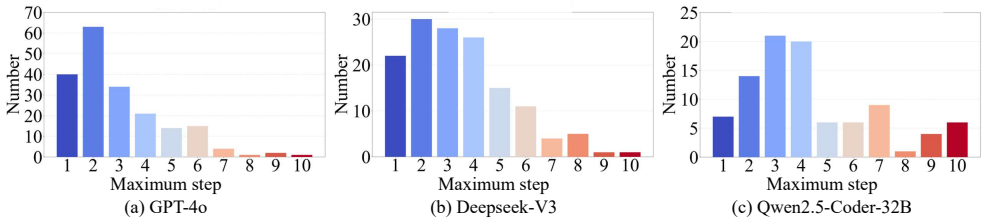
- [§IV-B and §IV-C] The maximum iteration step is selected on the same CoAP-set that is later used for the headline results. Specifically, §IV-B constructs a histogram of required reasoning iterations on the CoAP-set and then sets Smax=6 for all subsequent experiments, and Table II reports the resulting Pass@1 on the same CoAP-set. This is a data-dependent parameter selection that can inflate the reported improvement. The authors should report Pass@1 for other values of Smax, use a separate validation set for parameter selection, or otherwise quantify the selection effect.
- [Table III and §IV-D] The ablation claim that 'on the RSocket-set, even without the iterative optimization algorithm, iPanda still outperforms the baseline' is contradicted by Table III, which reports 3.23% for iPanda without iterative optimization versus 11.29% for the baseline on RSocket-set. This suggests that adding code-oriented RAG without the iterative loop decreases performance on that dataset, which also weakens the stated conclusion about RAG's effectiveness. The table and the text must be reconciled, and the interpretation of the RAG ablation needs to be revisited.
- [§IV-A5, Eq. (5)] Equation (5) defines Pass@k using the XOR operator, but the standard metric Pass@k is the probability that at least one of k generated solutions is correct, which requires a logical OR. Using XOR changes the metric: if two generated solutions are both correct, XOR returns 0, undercounting successes. This affects the quantitative interpretation of all the reported improvements and should be corrected.
minor comments (4)
- [§I and §VI] There are several language and formatting issues: 'we using iPanda to perform' in the contributions list, 'ierative optimization algorithm' in the conclusion, and 'B Corresponding Authors' in the author block. These should be fixed in a copyediting pass.
- [§IV-E] RFC 9177 is mentioned by name but is not included in the reference list; a proper citation for RFC 9177 should be added.
- [References] Reference [25], for boofuzz, contains the placeholder text 'THIS REFERENCE STILL NEEDS TO BE FIXED' and must be completed.
- [§I] The claim of being 'the first' LLM-based framework for protocol conformance testing is asserted without a systematic survey; given the existence of related tools discussed in §V, such a claim should be made more cautiously or supported by a dedicated prior-work comparison.
Circularity Check
Reported Pass@1 gains rest on self-generated test assertions and a test-set-tuned iteration cap; the RFC 9177 finding gives partial external grounding.
-
self definitional
[Sec. III-A and Sec. III-C; metric in Sec. IV-A-5]
""The test cases generated by the LLM comprise four components: ... test assertions ... The test assertions define the criteria for judging test success, which serve as the basis for evaluating the results. ... Once the program runs without errors, the LLM evaluates the success of the test by comparing the test assertions defined in the test case with the executed program and its results.""
The 'Test Assertion' in each test case is written by the LLM during keyword-based TCG, and the same LLM later labels the generated test program as passing by checking it against that self-written assertion. Pass@1 in Eq. (5) therefore measures whether the LLM's program is consistent with the LLM's own assertion text, not whether the program satisfies an externally fixed conformance criterion. The semantic labels behind Table II are produced by the system itself, with no independent oracle for the pass/fail classification of individual generated programs.
-
fitted input called prediction
[Sec. IV-B and Sec. IV-C / Table II]
""when setting the maximum step to 10, using GPT-4o, iPanda successfully tested 195 cases in the CoAP-set ... Resultly, we set the maximum step of iterations to 6 in subsequent experiments to achieve the optimal marginal benefit. ... P ass@1 is improved by 4.675×(GPT-4o), 6×(Deepseek-V3), and 10.751×(Qwen2.5-Coder-32B) respectively.""
Smax=6 is selected by inspecting the iteration-cost histogram computed on the CoAP-set, and the same CoAP-set is then used to report the final Pass@1 in Table II. The reported 'prediction' is thus measured under a hyperparameter fitted to the evaluation set itself. In addition, the baseline is a single generation while iPanda receives up to six repair rounds (Alg. 1); the paper's own Fig. 4(a) shows Smax=1,k=6 gives 89 positives whereas Smax=6,k=1 gives 182, shrinking the apparent GPT-4o gain under an equal-budget comparison. The headline factors therefore partly reflect test-set tuning and budget asymmetry rather than a pure first-try success rate.
full rationale
The paper is not built on a self-citation chain or an imported uniqueness theorem; references to the authors' prior work (e.g., Autodroid) are background and not load-bearing. However, the central quantitative claim is partially self-referential. The test-case assertions that define 'success' are LLM-generated, and the same LLM is the judge of whether its own program satisfies those assertions; no independent oracle is used for the semantic pass labels in Table II. The iterative optimization loop itself is a legitimate mechanism, and the RFC 9177 conformance finding is externally corroborated by aiocoap's GitHub documentation, which is genuine evidence. Still, the reported 4.675x-10.751x gains are not a pure Pass@1 comparison: Smax=6 is chosen from the CoAP-set histogram and then used to report Pass@1 on the same CoAP-set, and the baseline is single-shot while iPanda is allowed up to six repair rounds. The paper's own Fig. 4(a) provides the equal-budget data point (Smax=1,k=6: 89 positives; Smax=6,k=1: 182 positives), which materially reduces the headline factor. These issues do not make the whole framework circular, but they make the headline metric partly defined by the system's own outputs and tuning choices.
Assumptions & free parameters
free parameters (3)
- Maximum reasoning iterations Smax =
6
- Short-term memory window size m =
10
- Sampling temperature and top-p =
0 and 0.1
assumptions (4)
- domain assumption RFC 2119 keywords (MUST, SHALL, etc.) reliably locate the functional points that need conformance testing.
- domain assumption A generated test program that executes and whose assertions pass under LLM evaluation demonstrates conformance.
- domain assumption The manually reviewed CoAP-set and RSocket-set are valid and unbiased benchmarks.
- domain assumption The single-step pure-LLM baseline is a fair comparator for measuring iPanda's added value.
Cite this review
Pith. "Pith review of iPanda: An LLM-based Agent for Automated Conformance Testing of Communication Protocols." pith.science (2026). https://pith.science/paper/QDKEK2Z4
@misc{pith2026250700378,
  author       = {Pith},
  title        = {Pith review of: iPanda: An LLM-based Agent for Automated Conformance Testing of Communication Protocols},
  year         = {2026},
  howpublished = {\url{https://pith.science/paper/QDKEK2Z4}},
  note         = {Machine review of arXiv:2507.00378}
}
read the original abstract
Conformance testing is essential for ensuring that protocol implementations comply with their specifications. However, traditional testing approaches involve manually creating numerous test cases and scripts, making the process labor-intensive and inefficient. Recently, Large Language Models (LLMs) have demonstrated impressive text comprehension and code generation abilities, providing promising opportunities for automation. In this paper, we propose iPanda, the first framework that leverages LLMs to automate protocol conformance testing. Given a protocol specification document and its implementation, iPanda first employs a keyword-based method to automatically generate comprehensive test cases. Then, it utilizes retrieval-augmented generation and customized CoT strategy to effectively interpret the implementation and produce executable test programs. To further enhance programs' quality, iPanda incorporates an iterative optimization mechanism to refine generated test scripts interactively. Finally, by executing and analyzing the generated tests, iPanda systematically verifies compliance between implementations and protocol specifications. Comprehensive experiments on various protocols show that iPanda significantly outperforms pure LLM-based approaches, improving the success rate (Pass@1) of test-program generation by factors ranging from 4.675 times to 10.751 times.
Figures

Figures from the paper (1 more)

Reference graph
Works this paper leans on
-
[1]
Llmif: Augmented large language model for fuzzing iot devices,
J. Wang, L. Yu, and X. Luo, “Llmif: Augmented large language model for fuzzing iot devices,” in 2024 IEEE Symposium on Security and Privacy (SP). IEEE, 2024, pp. 881–896
work page 2024
-
[2]
Autodroid: Llm-powered task automation in android,
H. Wen, Y . Li, G. Liu, S. Zhao, T. Yu, T. J.-J. Li, S. Jiang, Y . Liu, Y . Zhang, and Y . Liu, “Autodroid: Llm-powered task automation in android,” in Proceedings of the 30th Annual International Conference on Mobile Computing and Networking , 2024, pp. 543–557
work page 2024
-
[3]
Autodroid-v2: Boosting slm-based gui agents via code generation,
H. Wen, S. Tian, B. Pavlov, W. Du, Y . Li, G. Chang, S. Zhao, J. Liu, Y . Liu, Y .-Q. Zhanget al., “Autodroid-v2: Boosting slm-based gui agents via code generation,” arXiv preprint arXiv:2412.18116 , 2024
arXiv 2024
-
[4]
rsocket. (2024) Rsocket. [Online]. Available: https://rsocket.io/about/ protocol/
work page 2024
-
[5]
rsocket py. (2025) rsocket-py. [Online]. Available: https://github.com/ rsocket/rsocket-py
work page 2025
-
[6]
Blind software- assisted conformance and security assessment of fido2/webauthn imple- mentations
A. V . Grammatopoulos, I. Politis, and C. Xenakis, “Blind software- assisted conformance and security assessment of fido2/webauthn imple- mentations.” J. Wirel. Mob. Networks Ubiquitous Comput. Dependable Appl., vol. 13, no. 2, pp. 96–127, 2022
work page 2022
-
[7]
An llm agent for functional bug detection in network protocols,
M. Zheng, C. Wang, X. Liu, J. Guo, S. Feng, and X. Zhang, “An llm agent for functional bug detection in network protocols,” arXiv preprint arXiv:2506.00714, 2025
arXiv 2025
-
[8]
Rfc 7252: The constrained application protocol (coap),
Z. Shelby, K. Hartke, and C. Bormann, “Rfc 7252: The constrained application protocol (coap),” 2014
work page 2014
Show all 43 references
-
[9]
R. Editor. (2025) Rfc editor. [Online]. Available: https://www.rfc-editor. org/search/rfc search detail.php?page=All&title=coap
2025
-
[10]
Automated software test data generation with generative adversarial networks,
X. Guo, H. Okamura, and T. Dohi, “Automated software test data generation with generative adversarial networks,” IEEE Access, vol. 10, pp. 20 690–20 700, 2022
2022
-
[11]
(2025) gpt-o3-pro
OpenAI. (2025) gpt-o3-pro. [Online]. Available: https://platform.openai. com/docs/models/o3-pro
2025
-
[12]
Gpt-4o system card,
A. Hurst, A. Lerer, A. P. Goucher, A. Perelman, A. Ramesh, A. Clark, A. Ostrow, A. Welihinda, A. Hayes, A. Radford et al., “Gpt-4o system card,” arXiv preprint arXiv:2410.21276 , 2024
2024 arXiv
-
[13]
(2025) deepseek-r1
Deepseek. (2025) deepseek-r1. [Online]. Available: https://api-docs. deepseek.com/news/news250528
2025
-
[14]
(2025) deepseek-v3
——. (2025) deepseek-v3. [Online]. Available: https://api-docs. deepseek.com/news/news250325
2025
-
[15]
(2025) claude-opus-4
Anthropic. (2025) claude-opus-4. [Online]. Available: https://docs. anthropic.com/en/docs/about-claude/models/overview
2025
-
[16]
(2025) Gemini-2.5-pro
Google. (2025) Gemini-2.5-pro. [Online]. Available: https://cloud. google.com/vertex-ai/generative-ai/docs/models/gemini/2-5-pro
2025
-
[17]
Qwen2. 5-coder technical report,
B. Hui, J. Yang, Z. Cui, J. Yang, D. Liu, L. Zhang, T. Liu, J. Zhang, B. Yu, K. Lu et al. , “Qwen2. 5-coder technical report,” arXiv preprint arXiv:2409.12186, 2024
2024 arXiv
-
[18]
(2024) text-embedding-3-large
OpenAI. (2024) text-embedding-3-large. [Online]. Available: https: //openai.com/index/new-embedding-models-and-api-updates/
2024
-
[19]
Autoiot: Llm-driven automated natural language programming for aiot applications,
L. Shen, Q. Yang, Y . Zheng, and M. Li, “Autoiot: Llm-driven automated natural language programming for aiot applications,” arXiv preprint arXiv:2503.05346, 2025
2025 arXiv
-
[20]
Critic method,
A. Alinezhad, J. Khalili, A. Alinezhad, and J. Khalili, “Critic method,” New methods and applications in multiple attribute decision making (MADM), pp. 199–203, 2019
2019
-
[21]
Deepseek-v3 technical report,
A. Liu, B. Feng, B. Xue, B. Wang, B. Wu, C. Lu, C. Zhao, C. Deng, C. Zhang, C. Ruan et al., “Deepseek-v3 technical report,” arXiv preprint arXiv:2412.19437, 2024
2024 arXiv
-
[22]
(2025) aiocoap
aiocoap. (2025) aiocoap. [Online]. Available: https://github.com/chrysn/ aiocoap
2025
-
[23]
An introduction to the testing and test control notation (ttcn-3),
J. Grabowski, D. Hogrefe, G. R ´ethy, I. Schieferdecker, A. Wiles, and C. Willcock, “An introduction to the testing and test control notation (ttcn-3),” Computer Networks, vol. 42, no. 3, pp. 375–403, 2003
2003
-
[24]
Scapy-a powerful interactive packet manipulation program,
R. Rohith, M. Moharir, G. Shobha et al., “Scapy-a powerful interactive packet manipulation program,” in 2018 international conference on networking, embedded and wireless systems (ICNEWS) . IEEE, 2018, pp. 1–5
2018
-
[25]
boofuzz documentation,
J. Pereyda, “boofuzz documentation,” THIS REFERENCE STILL NEEDS TO BE FIXED , 2019
2019
-
[26]
Fairfuzz: A targeted mutation strategy for increasing greybox fuzz testing coverage,
C. Lemieux and K. Sen, “Fairfuzz: A targeted mutation strategy for increasing greybox fuzz testing coverage,” in Proceedings of the 33rd ACM/IEEE international conference on automated software engineering, 2018, pp. 475–485
2018
-
[27]
T-fuzz: fuzzing by program transformation,
H. Peng, Y . Shoshitaishvili, and M. Payer, “T-fuzz: fuzzing by program transformation,” in 2018 IEEE Symposium on Security and Privacy (SP). IEEE, 2018, pp. 697–710
2018
-
[28]
Online machine learning for intrusion detection in electric vehicle charging systems,
F. Makhmudov, D. Kilichev, U. Giyosov, and F. Akhmedov, “Online machine learning for intrusion detection in electric vehicle charging systems,” Mathematics, vol. 13, no. 5, p. 712, 2025
2025
-
[29]
Using large language models to generate junit tests: An empirical study,
M. L. Siddiq, J. C. Da Silva Santos, R. H. Tanvir, N. Ulfat, F. Al Rifat, and V . Carvalho Lopes, “Using large language models to generate junit tests: An empirical study,” in Proceedings of the 28th International Conference on Evaluation and Assessment in Software Engineering...
2024
-
[30]
An initial investigation of chatgpt unit test generation capability,
V . Guilherme and A. Vincenzi, “An initial investigation of chatgpt unit test generation capability,” in Proceedings of the 8th Brazilian Symposium on Systematic and Automated Software Testing , 2023, pp. 15–24
2023
-
[31]
Pentestgpt: An llm-empowered automatic penetration testing tool,
G. Deng, Y . Liu, V . Mayoral-Vilches, P. Liu, Y . Li, Y . Xu, T. Zhang, Y . Liu, M. Pinzger, and S. Rass, “Pentestgpt: An llm-empowered automatic penetration testing tool,” arXiv preprint arXiv:2308.06782 , 2023
2023 arXiv
-
[32]
Llm as dba,
X. Zhou, G. Li, and Z. Liu, “Llm as dba,” arXiv preprint arXiv:2308.05481, 2023
2023 arXiv
-
[33]
Mind2web: Towards a generalist agent for the web,
X. Deng, Y . Gu, B. Zheng, S. Chen, S. Stevens, B. Wang, H. Sun, and Y . Su, “Mind2web: Towards a generalist agent for the web,” Advances in Neural Information Processing Systems , vol. 36, pp. 28 091–28 114, 2023
2023
-
[34]
Webgpt: Browser- assisted question-answering with human feedback,
R. Nakano, J. Hilton, S. Balaji, J. Wu, L. Ouyang, C. Kim, C. Hesse, S. Jain, V . Kosaraju, W. Saunders et al., “Webgpt: Browser- assisted question-answering with human feedback,” arXiv preprint arXiv:2112.09332, 2021
2021 arXiv
-
[35]
Weinfer: Unleashing the power of we- bgpu on llm inference in web browsers,
Z. Chen, Y . Ma, M. Liu et al., “Weinfer: Unleashing the power of we- bgpu on llm inference in web browsers,” in THE WEB CONFERENCE 2025, 2025
2025
-
[36]
Vul-rag: Enhancing llm-based vulnerability detection via knowledge-level rag,
X. Du, G. Zheng, K. Wang, J. Feng, W. Deng, M. Liu, B. Chen, X. Peng, T. Ma, and Y . Lou, “Vul-rag: Enhancing llm-based vulnerability detection via knowledge-level rag,” arXiv preprint arXiv:2406.11147 , 2024
2024 arXiv
-
[37]
Generative ai service implementation using llm application architecture: based on rag model and langchain framework,
C. Jeong, “Generative ai service implementation using llm application architecture: based on rag model and langchain framework,” Journal of Intelligence and Information Systems, vol. 29, no. 4, pp. 129–164, 2023
2023
-
[38]
Rag in health care: a novel framework for improving communication and decision-making by addressing llm limitations,
K. K. Y . Ng, I. Matsuba, and P. C. Zhang, “Rag in health care: a novel framework for improving communication and decision-making by addressing llm limitations,” NEJM AI , vol. 2, no. 1, p. AIra2400380, 2025
2025
-
[39]
Llama-reviewer: Advancing code review automation with large language models through parameter- efficient fine-tuning,
J. Lu, L. Yu, X. Li, L. Yang, and C. Zuo, “Llama-reviewer: Advancing code review automation with large language models through parameter- efficient fine-tuning,” in 2023 IEEE 34th International Symposium on Software Reliability Engineering (ISSRE) . IEEE, 2023, pp. 647–658
2023
-
[40]
Hugginggpt: Solving ai tasks with chatgpt and its friends in hugging face,
Y . Shen, K. Song, X. Tan, D. Li, W. Lu, and Y . Zhuang, “Hugginggpt: Solving ai tasks with chatgpt and its friends in hugging face,” Advances in Neural Information Processing Systems , vol. 36, pp. 38 154–38 180, 2023
2023
-
[41]
Self-consistency improves chain of thought reasoning in language models,
X. Wang, J. Wei, D. Schuurmans, Q. Le, E. Chi, S. Narang, A. Chowdh- ery, and D. Zhou, “Self-consistency improves chain of thought reasoning in language models,” arXiv preprint arXiv:2203.11171 , 2022
2022 arXiv
-
[42]
React: Synergizing reasoning and acting in language models,
S. Yao, J. Zhao, D. Yu, N. Du, I. Shafran, K. Narasimhan, and Y . Cao, “React: Synergizing reasoning and acting in language models,” in International Conference on Learning Representations (ICLR) , 2023
2023
-
[43]
Reflex- ion: Language agents with verbal reinforcement learning,
N. Shinn, F. Cassano, A. Gopinath, K. Narasimhan, and S. Yao, “Reflex- ion: Language agents with verbal reinforcement learning,” Advances in Neural Information Processing Systems , vol. 36, pp. 8634–8652, 2023
2023
Reviewed August 6, 2026 · model on record in the stance chip above.
Discussion (0). Sign in to comment.