Self-Evolving Agents with Anytime-Valid Certificates
Pith reviewed 2026-07-02 12:29 UTC · model grok-4.3
The pith
SEA confines self-modification of agents to gated adapters around a frozen base model to maintain anytime-valid statistical certificates.
A machine-rendered reading of the paper's core claim, the machinery that carries it, and where it could break.
Core claim
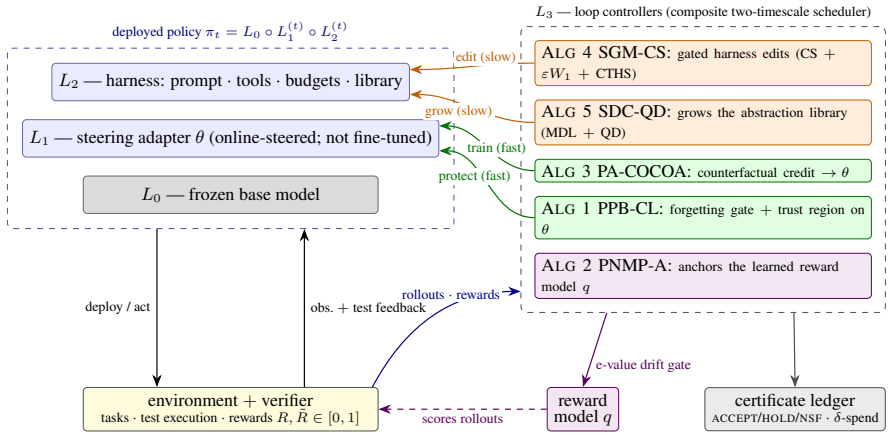
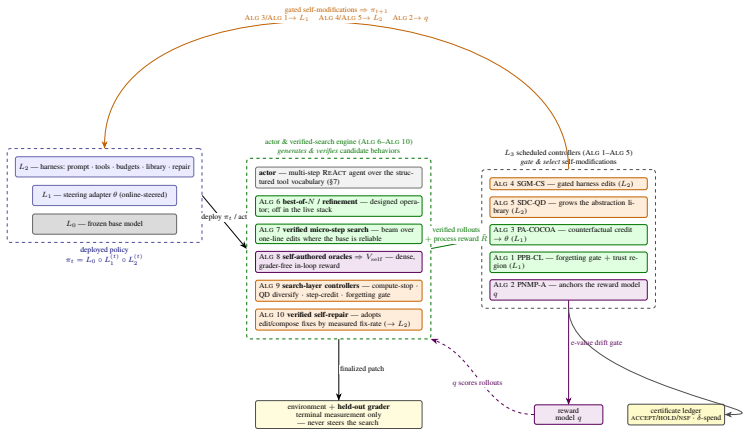
SEA is an architecture that confines self-modification to a small steering adapter and a versioned harness around a frozen base model. Modifications are admitted only through an anytime-valid gate emitting an auditable certificate against a fixed error budget. Five loop controllers compose published guarantees, and five verifier-in-the-loop mechanisms supply dense grader-free signals from the issue text alone. On a 52-instance SWE-bench Verified subset, the approach isolates gains of 4 and 5 points on two strong base models with mechanisms confirmed to fire and prevent regressions.
What carries the argument
Anytime-valid gate that selects among behaviors the frozen base already produces, supported by five verifier-in-the-loop mechanisms.
If this is right
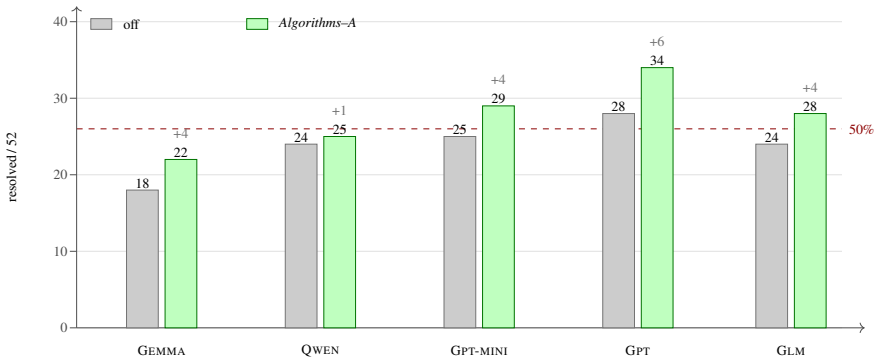
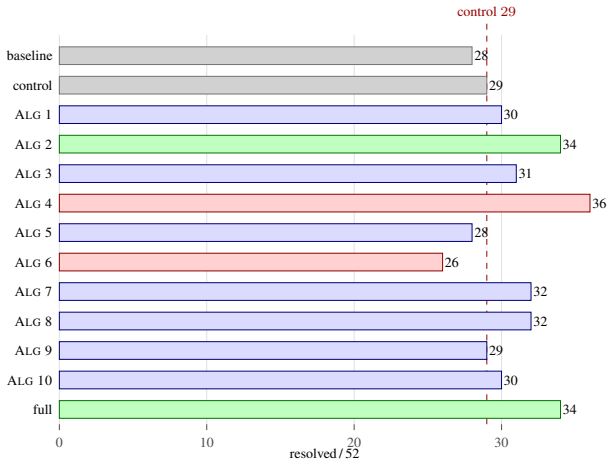
- The suite contributes an isolated +4 points on GLM 5.2 from 24 to 28.
- The suite contributes an isolated +5 points on GPT from 29 to 34.
- Event logs confirm the mechanisms fire and prevent regressions.
- Base capability remains the dominant effect across four base models.
Where Pith is reading between the lines
- This gated approach might reduce risks in deploying self-modifying systems in real-world applications beyond benchmarks.
- Similar anytime-valid controls could be applied to other self-improving AI systems where full retraining is undesirable.
- Future work on adapting the per-task algorithm mix could further optimize the performance gains observed.
Load-bearing premise
The five verifier-in-the-loop mechanisms supply the dense, grader-free signal the gates require, computed from the issue text alone.
What would settle it
A multi-run evaluation showing no consistent improvement over the no-op control on the SWE-bench subset would indicate the mechanisms do not provide the claimed signal.
Figures
read the original abstract
Self-evolving agents violate the assumption behind most learning-theoretic guarantees: the data, evaluator, components, and hypothesis space are produced by the policy being updated. We present \textbf{SEA}, an architecture that confines self-modification to a small steering adapter and a versioned harness around a \emph{frozen} base model and admits each modification only through an anytime-valid gate that emits an auditable certificate against a fixed error budget. Five loop controllers compose published guarantees; because such gates can only \emph{select} among behaviors the frozen base already produces, five verifier-in-the-loop mechanisms -- best-of-$N$, micro-step search, self-authored reproduction oracles, search-layer control, and self-repair -- supply the dense, grader-free signal the gates require, computed from the issue text alone. On a $52$-instance SWE-bench Verified subset across four base models, base capability is the dominant, confound-free effect, and on two strong base models a deliberate no-op-composite control isolates the suite's contribution at $+4$ and $+5$ (\textsc{Glm}~5.2 $24\to28$; \textsc{Gpt} $29\to34$, the $65\%$ best), with event logs confirming that its mechanisms fire and prevent regressions. Results are single-run on expensive evaluations; confirming run-to-run variance and adapting the per-task algorithm mix are future work.
Editorial analysis
A structured set of objections, weighed in public.
Referee Report
Summary. The manuscript presents SEA, an architecture for self-evolving agents that confines modifications to a steering adapter and versioned harness around a frozen base model. Each change is admitted only via an anytime-valid gate emitting an auditable certificate against a fixed error budget. Five verifier-in-the-loop mechanisms (best-of-N, micro-step search, self-authored reproduction oracles, search-layer control, self-repair) are claimed to supply dense grader-free signals computed from issue text alone, composing published guarantees. On a 52-instance SWE-bench Verified subset, base capability dominates; a no-op-composite control isolates the suite's contribution as +4 and +5 on two strong models (GLM 5.2: 24→28; GPT: 29→34), with event logs confirming mechanism activation and regression prevention. Results are single-run.
Significance. If the central guarantee holds—that the five mechanisms deliver grader-free signals strictly from issue text without external oracles, enabling the gates to select only among behaviors already produced by the frozen base—this would provide a concrete route to bounded-error self-modification with auditable certificates. The deliberate no-op control for isolating the suite's contribution is a methodological strength when properly specified. The composition of existing guarantees rather than new derivations is noted but does not diminish potential impact if the empirical isolation is reproducible.
major comments (2)
- [Abstract and §4] Abstract and §4 (mechanism definitions): the claim that self-authored reproduction oracles and self-repair produce signals 'computed from the issue text alone' and remain 'grader-free' is load-bearing for the 'select among behaviors the frozen base already produces' property. If either mechanism requires executing candidate patches against hidden tests or external oracles, the input to the anytime-valid gate is no longer internal, and the published guarantees being composed would rest on an unstated external source of truth.
- [§5 and Table 2] §5 (experimental setup) and Table 2: the no-op-composite control's construction is not visible, and results are reported as single-run without variance, detailed exclusion rules, or run-to-run statistics. This undermines the isolation claim of +4/+5 on the 65% best instances and the assertion that base capability is the dominant confound-free effect.
minor comments (2)
- [Abstract] Abstract: the parenthetical '(the 65% best)' is unclear without the corresponding table or selection criterion.
- [§3] Notation: 'anytime-valid gate' and 'versioned harness' are introduced without a forward reference to their formal definitions or the specific published guarantees they compose.
Simulated Author's Rebuttal
We thank the referee for the careful reading and for highlighting the load-bearing claims around grader-free signals and experimental controls. We respond to each major comment below.
read point-by-point responses
-
Referee: [Abstract and §4] Abstract and §4 (mechanism definitions): the claim that self-authored reproduction oracles and self-repair produce signals 'computed from the issue text alone' and remain 'grader-free' is load-bearing for the 'select among behaviors the frozen base already produces' property. If either mechanism requires executing candidate patches against hidden tests or external oracles, the input to the anytime-valid gate is no longer internal, and the published guarantees being composed would rest on an unstated external source of truth.
Authors: The manuscript states that the five mechanisms supply signals 'computed from the issue text alone.' Self-authored reproduction oracles are generated by deriving reproduction steps or candidate tests directly from the natural-language issue description; no hidden test suites or external oracles are consulted. Self-repair likewise uses only internal consistency and reproduction attempts derived from the same issue text. These definitions ensure the signals remain internal to the frozen base model's output distribution, so the gate selects among behaviors the base already produces. We will add explicit pseudocode and input-source examples to §4 to remove any ambiguity. revision: partial
-
Referee: [§5 and Table 2] §5 (experimental setup) and Table 2: the no-op-composite control's construction is not visible, and results are reported as single-run without variance, detailed exclusion rules, or run-to-run statistics. This undermines the isolation claim of +4/+5 on the 65% best instances and the assertion that base capability is the dominant confound-free effect.
Authors: We agree the no-op-composite control construction must be stated explicitly. In revision we will expand §5 with the precise definition of the control (which mechanisms are disabled and how the composite is formed). The manuscript already records that results are single-run owing to evaluation cost and flags run-to-run variance as future work. Event logs on the reported runs document mechanism activation and regression prevention; the +4/+5 deltas are measured against this explicit control on the two strongest bases. While additional runs would strengthen the claim, the current design isolates the suite contribution as described. revision: yes
Circularity Check
No circularity detected; claims rest on experimental isolation
full rationale
The paper's central results are empirical: a no-op-composite control on SWE-bench Verified isolates the suite's contribution (+4/+5 on two base models) with event logs. No equations, fitted parameters, or self-referential definitions appear in the abstract or described architecture. The five mechanisms are presented as supplying grader-free signals from issue text alone, and the gates are described as selecting among behaviors the frozen base already produces; these statements do not reduce by construction to the target claims. No self-citation load-bearing steps or uniqueness theorems imported from prior author work are invoked to force the result. The derivation chain is therefore self-contained against external benchmarks.
Axiom & Free-Parameter Ledger
axioms (2)
- domain assumption Gates can only select among behaviors the frozen base already produces
- domain assumption The five mechanisms supply dense grader-free signal computed from issue text alone
invented entities (1)
-
Anytime-valid gate
no independent evidence
Reference graph
Works this paper leans on
-
[1]
and Zrnic, Tijana and Mendler-D
Perdomo, Juan C. and Zrnic, Tijana and Mendler-D. Performative Prediction , booktitle =. 2020 , note =
2020
-
[2]
Journal of Machine Learning Research , volume =
Chugg, Ben and Wang, Hongjian and Ramdas, Aaditya , title =. Journal of Machine Learning Research , volume =. 2023 , note =
2023
-
[3]
Conference on Lifelong Learning Agents (CoLLAs) , year =
Friedman, Lior and Meir, Ron , title =. Conference on Lifelong Learning Agents (CoLLAs) , year =
-
[4]
Proceedings of the 23rd International Conference on Artificial Intelligence and Statistics (AISTATS) , series =
Farajtabar, Mehrdad and Azizan, Navid and Mott, Alex and Li, Ang , title =. Proceedings of the 23rd International Conference on Artificial Intelligence and Statistics (AISTATS) , series =. 2020 , note =
2020
-
[5]
2020 , note =
Generalisation Guarantees for Continual Learning with Orthogonal Gradient Descent , booktitle =. 2020 , note =
2020
-
[6]
International Conference on Learning Representations (ICLR) , year =
Fu, Shi and Wang, Yingjie and Chen, Yuzhu and Tian, Xinmei and Tao, Dacheng , title =. International Conference on Learning Representations (ICLR) , year =
-
[7]
Conference on Language Modeling (COLM) , year =
Gerstgrasser, Matthias and Schaeffer, Rylan and Dey, Apratim and Rafailov, Rafael and others , title =. Conference on Language Modeling (COLM) , year =
-
[8]
Nature , volume =
Shumailov, Ilia and Shumaylov, Zakhar and Zhao, Yiren and Papernot, Nicolas and Anderson, Ross and Gal, Yarin , title =. Nature , volume =
-
[9]
and Yang, Yaodong , title =
Wang, Mingzhi and Ma, Chengdong and Chen, Qizhi and Meng, Linjian and Han, Yang and Xiao, Jiancong and Zhang, Zhaowei and Huo, Jing and Su, Weijie J. and Yang, Yaodong , title =. International Conference on Learning Representations (ICLR) , year =
-
[10]
Proximal Point Nash Learning from Human Feedback , journal =
Tiapkin, Daniil and Calandriello, Daniele and Belomestny, Denis and Moulines, Eric and Naumov, Alexey and Rasul, Kashif and Valko, Michal and M. Proximal Point Nash Learning from Human Feedback , journal =. 2025 , note =
2025
-
[11]
, title =
Borkar, Vivek S. , title =
-
[12]
Game-Theoretic Statistics and Safe Anytime-Valid Inference , journal =
Ramdas, Aaditya and Gr. Game-Theoretic Statistics and Safe Anytime-Valid Inference , journal =. 2023 , note =
2023
-
[13]
Hindsight Credit Assignment , booktitle =
Harutyunyan, Anna and Dabney, Will and Mesnard, Thomas and Azar, Mohammad Gheshlaghi and Piot, Bilal and Heess, Nicolas and van Hasselt, Hado and Wayne, Greg and Singh, Satinder and Precup, Doina and Munos, R. Hindsight Credit Assignment , booktitle =
-
[14]
Advances in Neural Information Processing Systems (NeurIPS) , year =
Meulemans, Alexander and Schug, Simon and Kobayashi, Seijin and Daw, Nathaniel and Wayne, Greg , title =. Advances in Neural Information Processing Systems (NeurIPS) , year =
-
[15]
Proceedings of the 40th International Conference on Machine Learning (ICML) , series =
Mandal, Debmalya and Triantafyllou, Stelios and Radanovic, Goran , title =. Proceedings of the 40th International Conference on Machine Learning (ICML) , series =
-
[16]
Proceedings of the 37th International Conference on Machine Learning (ICML) , series =
Cutkosky, Ashok , title =. Proceedings of the 37th International Conference on Machine Learning (ICML) , series =
-
[17]
Proceedings of the 25th International Conference on Artificial Intelligence and Statistics (AISTATS) , series =
Baby, Dheeraj and Wang, Yu-Xiang , title =. Proceedings of the 25th International Conference on Artificial Intelligence and Statistics (AISTATS) , series =. 2022 , note =
2022
-
[18]
Coin Betting and Parameter-Free Online Learning , booktitle =
Orabona, Francesco and P. Coin Betting and Parameter-Free Online Learning , booktitle =
-
[19]
and Theocharous, Georgios and Ghavamzadeh, Mohammad , title =
Thomas, Philip S. and Theocharous, Georgios and Ghavamzadeh, Mohammad , title =. Proceedings of the 32nd International Conference on Machine Learning (ICML) , series =
-
[20]
and Castro da Silva, Bruno and Barto, Andrew G
Thomas, Philip S. and Castro da Silva, Bruno and Barto, Andrew G. and Giguere, Stephen and Brun, Yuriy and Brunskill, Emma , title =. Science , volume =
-
[21]
arXiv preprint arXiv:2510.10232 , year =
Wu, Xuening and Yin, Shenqin and Kang, Yanlan and Zhang, Xinhang and Xu, Qianya and Chen, Zeping and Zhang, Wenqiang , title =. arXiv preprint arXiv:2510.10232 , year =
-
[22]
and Ramdas, Aaditya and McAuliffe, Jon and Sekhon, Jasjeet , title =
Howard, Steven R. and Ramdas, Aaditya and McAuliffe, Jon and Sekhon, Jasjeet , title =. The Annals of Statistics , volume =
-
[23]
and Theocharous, Georgios and White, Martha and Thomas, Philip S
Chandak, Yash and Jordan, Scott M. and Theocharous, Georgios and White, Martha and Thomas, Philip S. , title =. Advances in Neural Information Processing Systems (NeurIPS) , year =
-
[24]
Ellis, Kevin and Wong, Catherine and Nye, Maxwell and Sabl. Dream. Proceedings of the 42nd ACM SIGPLAN Conference on Programming Language Design and Implementation (PLDI) , year =
-
[25]
and Wong, Lionel and Grand, Gabriel and Tenenbaum, Joshua B
Bowers, Matthew and Olausson, Theo X. and Wong, Lionel and Grand, Gabriel and Tenenbaum, Joshua B. and Ellis, Kevin and Solar-Lezama, Armando , title =. Proceedings of the ACM on Programming Languages , volume =. 2023 , note =
2023
-
[26]
, title =
Pentina, Anastasia and Lampert, Christoph H. , title =. Proceedings of the 31st International Conference on Machine Learning (ICML) , series =
-
[27]
and Yang, John and Liu, Kevin and Madry, Aleksander , title =
Chowdhury, Neil and Aung, James and Shern, Chan Jun and Jaffe, Oliver and Sherburn, Dane and Starace, Giulio and Mays, Evan and Dias, Rachel and Aljubeh, Marwan and Glaese, Mia and Jimenez, Carlos E. and Yang, John and Liu, Kevin and Madry, Aleksander , title =. 2024 , url =
2024
-
[28]
IEEE Transactions on Evolutionary Computation , volume =
Cully, Antoine and Demiris, Yiannis , title =. IEEE Transactions on Evolutionary Computation , volume =
-
[29]
Proceedings of the 40th International Conference on Machine Learning (ICML) , series =
Gao, Leo and Schulman, John and Hilton, Jacob , title =. Proceedings of the 40th International Conference on Machine Learning (ICML) , series =. 2023 , note =
2023
-
[30]
Illuminating search spaces by mapping elites
Mouret, Jean-Baptiste and Clune, Jeff , title =. arXiv preprint arXiv:1504.04909 , year =
work page internal anchor Pith review Pith/arXiv arXiv
-
[31]
and Shen, Yelong and Wallis, Phillip and Allen-Zhu, Zeyuan and Li, Yuanzhi and Wang, Shean and Wang, Lu and Chen, Weizhu , title =
Hu, Edward J. and Shen, Yelong and Wallis, Phillip and Allen-Zhu, Zeyuan and Li, Yuanzhi and Wang, Shean and Wang, Lu and Chen, Weizhu , title =. International Conference on Learning Representations (ICLR) , year =
-
[32]
Proceedings of the 59th Annual Meeting of the Association for Computational Linguistics (ACL) , year =
Li, Xiang Lisa and Liang, Percy , title =. Proceedings of the 59th Annual Meeting of the Association for Computational Linguistics (ACL) , year =
-
[33]
Proceedings of the 2021 Conference on Empirical Methods in Natural Language Processing (EMNLP) , year =
Lester, Brian and Al-Rfou, Rami and Constant, Noah , title =. Proceedings of the 2021 Conference on Empirical Methods in Natural Language Processing (EMNLP) , year =
2021
-
[34]
International Conference on Learning Representations (ICLR) , year =
Jim. International Conference on Learning Representations (ICLR) , year =
-
[35]
International Conference on Learning Representations (ICLR) , year =
Yao, Shunyu and Zhao, Jeffrey and Yu, Dian and Du, Nan and Shafran, Izhak and Narasimhan, Karthik and Cao, Yuan , title =. International Conference on Learning Representations (ICLR) , year =
-
[36]
Schmidhuber, J. G. arXiv preprint cs/0309048 , year =
work page internal anchor Pith review Pith/arXiv arXiv
-
[37]
Advances in Neural Information Processing Systems (NeurIPS) , year =
Madaan, Aman and Tandon, Niket and Gupta, Prakhar and Hallinan, Skyler and others , title =. Advances in Neural Information Processing Systems (NeurIPS) , year =
-
[38]
Advances in Neural Information Processing Systems (NeurIPS) , year =
Shinn, Noah and Cassano, Federico and Gopinath, Ashwin and Narasimhan, Karthik and Yao, Shunyu , title =. Advances in Neural Information Processing Systems (NeurIPS) , year =
-
[39]
International Conference on Learning Representations (ICLR) , year =
Chen, Bei and Zhang, Fengji and Nguyen, Anh and Zan, Daoguang and Lin, Zeqi and Lou, Jian-Guang and Chen, Weizhu , title =. International Conference on Learning Representations (ICLR) , year =
-
[40]
Teaching Large Language Models to Self-Debug , booktitle =
Chen, Xinyun and Lin, Maxwell and Sch. Teaching Large Language Models to Self-Debug , booktitle =. 2024 , note =
2024
-
[41]
, title =
Zelikman, Eric and Wu, Yuhuai and Mu, Jesse and Goodman, Noah D. , title =. Advances in Neural Information Processing Systems (NeurIPS) , year =
-
[42]
Reinforced Self-Training (ReST) for Language Modeling
Gulcehre, Caglar and Paine, Tom Le and Srinivasan, Srivatsan and others , title =. arXiv preprint arXiv:2308.08998 , year =
work page internal anchor Pith review Pith/arXiv arXiv
-
[43]
Brown, Bradley and Juravsky, Jordan and Ehrlich, Ryan and Clark, Ronald and Le, Quoc V. and R. Large Language Monkeys: Scaling Inference Compute with Repeated Sampling , journal =
-
[44]
Gauthier-Villars, Paris , year =
Ville, Jean , title =. Gauthier-Villars, Paris , year =
discussion (0)
Sign in with ORCID, Apple, or X to comment. Anyone can read and Pith papers without signing in.