REVIEW 4 major objections 4 minor 19 references
Adaptive Consensus with Exponential Decay
T0 review · 4 major / 4 minor · reviewed 2026-08-07 · deepseek-v4-flash
Pith's one-line read Concurrent learning makes adaptive consensus converge exponentially, and the same guarantee survives uniform quantization of the communication.
desk verdict The concurrent-learning update is written with the unknown parameter, so the exponential consensus claim is for an oracle controller; the fix is straightforward and the rest of the analysis is sound. read the letter →
The pith
A machine-rendered reading of the paper's core claim, the machinery that carries it, and where it could break.
The reading
What carries the argument
The carrying object is the Lyapunov function $V = x^T(L\otimes P)x + \frac12\sum_i \operatorname{tr}(\tilde{\theta}_i^T\tilde{\theta}_i)$. The new piece is the concurrent-learning term $\sum_k \Phi_i(x_{i,k})^T\Phi_i(x_{i,k})\tilde{\theta}_i$ added to the parameter update; Condition 1, full rank of the stored matrix $Z_i=[\Phi_i(x_{i,1}),\dots,\Phi_i(x_{i,p})]$, makes this sum at least $q_i I_m$, so the parameter error produces its own exponential decay. The graph Laplacian supplies the rate $\gamma = \lambda_2(L)/C$ through the algebraic connectivity. For the quantized result, the analysis switches to Krasovskii solutions, and the quantization disturbance, bounded by $\sigma$, is absorbed into an exponentially stable comparison system, yielding the $O(\sigma)$ steady-state bound.
What would settle it
Simulate the proposed closed loop with a single unknown scalar parameter per agent and store only the signals an agent actually measures (state, control, and past inputs). The update (2.8) requires $\tilde{\theta}_i=\hat{\theta}_i-\theta_i$, so the concurrent-learning sum $\sum_k \Phi_i(x_{i,k})^T\Phi_i(x_{i,k})\tilde{\theta}_i$ contains the unknown true $\theta_i$, and no rule in the paper tells the agent how to evaluate it. Alternatively, exhibit a history stack $Z_i=[\Phi_i(x_{i,1}),\dots,\Phi_i(x_{i,p})]$ of rank $m-1$; then $q=0$ in (3.4) and the claimed exponential parameter convergence fails.
Extended reading notes
Core claim
The central claim is Theorem 2.2: with the parameter update $\dot{\hat{\theta}}_i=\Phi_i^T B^T P \sum_j a_{ij}(x_i-x_j) - \sum_{k=1}^r \Phi_i(x_{i,k})^T \Phi_i(x_{i,k}) \tilde{\theta}_i$, where $\tilde{\theta}_i=\hat{\theta}_i-\theta_i$, the closed loop is exponentially stable. Both the consensus error $x^T(L\otimes P)x$ and the total parameter error $\sum_i \|\hat{\theta}_i-\theta_i\|^2$ decay at rate $\min\{\gamma,q\}$. The proof is a Lyapunov argument in which the concurrent-learning sum contributes a negative definite term proportional to the parameter error, provided the stored regressor matrix has full rank. Theorem 4.1 extends the same guarantee to communication through a uniform quantizer of level $\sigma$, giving exponential convergence to a neighborhood of consensus whose size is $O(\sigma)$.
Load-bearing premise
The load-bearing premise is that the concurrent-learning term in (2.8), built from $\tilde{\theta}_i=\hat{\theta}_i-\theta_i$, can be computed by an agent that does not know $\theta_i$; the paper never states the recorded measurement that would make this term available, and if no computable form exists the closed loop cannot be run as written. A second load-bearing premise is Condition 1, full rank of the stored regressor stack, because without it the parameter-decay rate $q$ is zero.
Editorial extensions
If this is right
- The controller from prior asymptotic consensus work, upgraded with concurrent learning, gives exponential consensus and exponential parameter convergence without persistent excitation.
- The convergence rate is explicit, so a designer can choose the graph and the stored-history stack to meet a required settling time.
- Uniform quantization does not destroy exponential stability; the consensus error scales linearly with the quantization step $\sigma$.
- Condition 1 replaces a persistent-excitation requirement with a finite-history rank condition, shifting the burden from online signal richness to offline data richness.
Reading between the lines
- There is an implementability gap in the stated update (2.8): it uses $\tilde{\theta}_i=\hat{\theta}_i-\theta_i$, and since $\theta_i$ is unknown, the paper would need to specify a recorded quantity, such as a stored model-error signal, that makes the concurrent-learning term computable; no such quantity is defined.
- If that gap is closed in the standard concurrent-learning way, the exponential rate $\min\{\gamma,q\}$ suggests that graph topology bounds speed independent of how much history is stored, while the history stack alone determines the parameter-decay contribution.
- The quantized result points toward a direct bit-rate versus steady-state-error trade-off, and the same Lyapunov machinery could likely handle logarithmic quantizers or event-triggered communication.
- Condition 1 can be checked offline and is weaker than persistent excitation, so it could be monitored online through the smallest singular value of the stored regressor stack.
Editorial analysis
A structured set of objections, weighed in public.
Referee Report
Summary. The paper studies leaderless consensus for a network of agents with identical linear dynamics and matched, state-dependent nonlinear uncertainties, building on the adaptive consensus controller of [3]. The authors add a concurrent-learning term to the parameter update law and claim, in Theorem 2.2, that the resulting closed-loop system achieves exponential consensus and exponential parameter convergence without persistent excitation, relying only on a rank condition on stored regressor data (Condition 1). Theorem 4.1 extends the claim to uniform quantized inter-agent communication, asserting exponential convergence of the consensus error up to an O(σ) bound. The proofs use a Lyapunov function combining a graph-weighted state term and parameter-error terms, with an algebraic Riccati equation cancellation; the quantized proof is an ISS-type argument with a Krasovskii solution. Numerical experiments for five agents with and without quantization are reported for σ = 5, 10, 15.
Significance. If the proposed update law were realizable, the result would be a useful and clean improvement: it replaces the asymptotic consensus of [3] with exponential rates that are explicit in terms of λ2(L), the ARE solution P, and the rank condition constant q, and it gives a transparent O(σ) quantized-error bound. The Lyapunov algebra in Section 3 is standard and the ARE cancellation in (3.2) checks out; the rate is not fitted, and the σ-scaling experiment is an appropriate falsifiable check. However, the central implementability gap described below means that, as written, the theorems are statements about an oracle system rather than a controller that an agent can actually execute, and the simulations do not exercise the proposed law. The contribution is therefore not yet established, but it is plausibly salvageable with a standard reformulation of the concurrent-learning term.
major comments (4)
- [§2.2, Eq. (2.8) and §4, Eq. (4.4)] The update law (2.8) and its quantized counterpart (4.4) are written with the term −Σ_k Φ_i^T(x_{i,k}) Φ_i(x_{i,k}) θ̃_i(t), where θ̃_i = θ̂_i − θ_i. Since θ_i is the unknown true parameter, this term is not computable from measurements available to agent i. The paper never defines a stored recorded output y_{i,k} such that the concurrent-learning term can be rewritten as −Σ_k Φ_i^T(x_{i,k})(Φ_i(x_{i,k})θ̂_i − y_{i,k}), which is the standard form used in concurrent learning [5]. Consequently, Theorems 2.2 and 4.1 currently prove exponential decay for an oracle differential equation whose right-hand side depends on the unknown θ_i, not for a realizable adaptive controller. This is load-bearing and must be fixed by explicitly defining the recorded data and rewriting the update law in a computable form.
- [§2.2, Condition 1] Condition 1 is stated as 'For each i ∈ {1,2,...,m}' although the agents are indexed by n, and the stored regressor matrix is written as Z_i = [Φ(x_{i,1}),...,Φ(x_{i,p})] without the agent subscript i on Φ; dimension compatibility of the stack (q p × m) is not stated. In addition, Eq. (2.7) sums over r stored points, while Condition 1 and the proof of Theorem 2.2 use p points, and the relation between r and p is never specified. Since the positivity of q in (3.4), and hence the exponential parameter-estimate decay in V̇, depends on exactly this condition, the theorem statement is not well posed as written. These details need to be corrected and reconciled.
- [§4, Eqs. (4.1)-(4.7)] The Krasovskii solution framework is introduced for the state x only, but for Theorem 4.1 the closed loop also includes the parameter update (4.4), which itself contains the discontinuous map x ↦ q_u(x_i). The proof asserts that 'this equation admits a Krasovskii solution' and then works with selections v_i(t) ∈ K[Δ_i](t) while θ̂ evolves simultaneously. A rigorous proof of Theorem 4.1 must define the augmented state (x, θ̂), verify local boundedness and measurability of the combined right-hand side, and establish existence of a Krasovskii solution of the augmented system before the Lyapunov differentiation is performed.
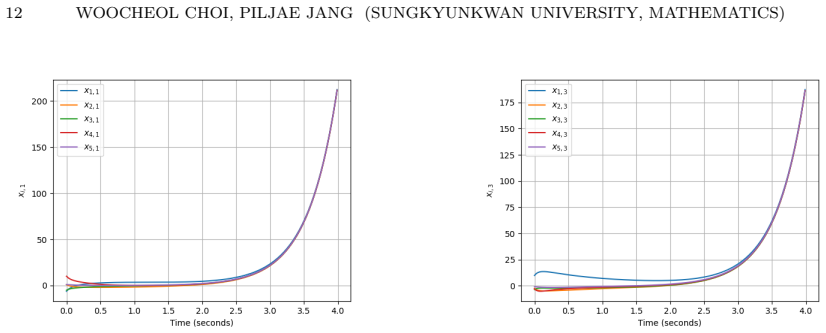
- [§5, Simulations] The non-quantized simulation is described as 'We simulate (2.2) involving the control given by (2.3)', i.e., the baseline adaptive controller from [3], not the proposed concurrent-learning update (2.8) that Theorem 2.2 concerns. The simulation therefore cannot validate Theorem 2.2 as stated. In addition, the paper gives no history stack: the number of stored points per agent, their locations, and any verification of Condition 1 are not reported, so the experiment is not reproducible. The quantized experiments similarly do not state which update law was actually implemented.
minor comments (4)
- [§4, Eq. (4.17)] Equation (4.17) claims a lower bound of the form x^T{(L⊗I) + [(2αL^2 − L)⊗PBB^T P]}x ≥ γ x^T(L^2⊗PBB^T P)x, but the subsequent estimate (4.20) uses a lower bound on x^T(L⊗I)x. As written, (4.17) is not justified in general and appears to be a typo; it should likely be x^T(L⊗I)x ≥ γ x^T(L⊗P)x, as in (3.6)-(3.7).
- [§2.2, Theorem 2.2 and §4, Theorem 4.1] The theorem statements say the 'dynamics (2.2) is exponentially stable,' but the Lyapunov function uses L⊗P and the state x does not converge to zero; the correct claim is exponential consensus, i.e., exponential convergence of the consensus error x − 1⊗x̄, together with exponential parameter error convergence.
- [§2 and §5] The symbol q is used both for the control input dimension in (2.2) and for the lower bound in (3.5), and in Section 5 q is initially set to 2 and later to 4; m is also reused for the parameter dimension and for the number of agents in Condition 1. These clashes should be resolved with distinct notation.
- [Throughout] There are many typographical and grammatical errors, including 'acheived', 'appled', 'Barbalet’s lemma', and the title 'DECA Y'; the reference list also has inconsistent formatting. These should be corrected in a revision.
Circularity Check
The proposed update law (2.8)/(4.4) contains the unknown true parameter theta_i through theta_tilde_i, so the 'adaptive' controller reduces by construction to an oracle controller and the exponential-consensus claim is not established for an implementable protocol.
-
self definitional
[Section 2.2, Eqs. (2.7) and (2.8); also Eq. (4.4) in Section 4.]
"Precisely, we propose the following update rule for the uncertain variable: dot(theta_hat_i)(t) = Phi_i^T B^T P sum_j a_ij(x_i(t) - x_j(t)) - sum_k Phi_i^T(x_i,k) Phi_i(x_i,k) theta_tilde_i(t), (2.7) where theta_tilde_i(t) = theta_hat_i(t) - theta_i."
The update rule for the estimate theta_hat_i is defined in terms of the unknown true parameter theta_i through theta_tilde_i = theta_hat_i - theta_i. Since theta_i is exactly the quantity the adaptive loop is supposed to learn, the right-hand side of (2.7)/(2.8) is not computable from measurements available to agent i. No recorded-data equivalent (e.g., the stored model prediction error used in standard concurrent learning [5]) is defined anywhere in the paper; Condition 1 constrains only the regressor stack, not a computable error signal.
full rationale
The exponential-stability analysis itself is a standard, self-contained Lyapunov argument: the decay rate gamma comes from the algebraic connectivity and the ARE solution P, and q comes from Condition 1's rank assumption; neither is fitted to the simulations. The sigma = {5, 10, 15} runs are an external, falsifiable check of the O(sigma) error bound, not an in-sample fit. There is no load-bearing self-citation: reference [3] supplies the baseline controller and [5] supplies concurrent learning, both external works. The single circular step is that the proposed update law (2.8) is written with theta_tilde_i = theta_hat_i - theta_i, so its right-hand side contains the unknown true parameter; no recorded-data error term is defined to make it computable. Hence the 'adaptive' controller reduces by construction to an oracle controller, and Theorems 2.2 and 4.1 prove convergence for that oracle system only. This is the load-bearing connection from 'proposed controller' to 'exponential consensus', so despite the otherwise independent mathematics, the central claim as stated is partially circular (self-definitional).
Assumptions & free parameters
free parameters (2)
- control gain alpha =
alpha = 0.8019 (simulation)
- history stack (stored points x_i,k; count r vs p) =
unspecified (r in (2.7), p in Condition 1 and (3.4))
assumptions (5)
- domain assumption Assumption 1: (A,B) is stabilizable
- domain assumption The interaction graph is undirected and connected
- domain assumption Phi_i is bounded and continuous, and the uncertainty enters matched as B Phi_i theta_i
- domain assumption Condition 1: rank[Phi(x_i,1), ..., Phi(x_i,p)] = m for the stored data of each agent
- standard math Existence and continuation of Krasovskii solutions for the quantized closed loop
Cite this review
Pith. "Pith review of Adaptive Consensus with Exponential Decay." pith.science (2026). https://pith.science/paper/QEO4KOUM
@misc{pith2026250607203,
  author       = {Pith},
  title        = {Pith review of: Adaptive Consensus with Exponential Decay},
  year         = {2026},
  howpublished = {\url{https://pith.science/paper/QEO4KOUM}},
  note         = {Machine review of arXiv:2506.07203}
}
read the original abstract
This paper addresses the adaptive consensus problem in uncertain multi-agent systems, particularly under challenges posed by quantized communication. We consider agents with general linear dynamics subject to nonlinear uncertainties and propose an adaptive consensus control framework that integrates concurrent learning. Unlike traditional methods relying solely on instantaneous data, concurrent learning leverages stored historical data to enhance parameter estimation without requiring persistent excitation. We establish that the proposed controller ensures exponential convergence of both consensus and parameter estimation. Furthermore, we extend the analysis to scenarios where inter-agent communication is quantized using a uniform quantizer. We prove that the system still achieves consensus up to an error proportional to the quantization level, with exponential convergence rate.
Figures


Figures from the paper (4 more)


Reference graph
Works this paper leans on
- [3]
-
[5]
Chowdhary, G. & Johnson, E. (2010, December). Concurrent learning for convergence in adaptive control without persistency of excitation. In 49th IEEE Conference on Decision and Control (CDC) (pp. 3674-3679). IEEE
work page 2010
-
[1]
Chung, S. J., & Slotine, J. J. E. (2009). Cooperative robot control and concurrent synchronization of Lagrangian systems. IEEE transactions on Robotics, 25(3), 686-700
work page 2009
- [2]
-
[4]
Yang, Y., Mei, J. & Ma, G. (2025). Adaptive leaderless consensus of MIMO multi-agent systems with unknown dynamics and nonlinear dynamic uncertainties. Systems and Control Letters, 196, 105983
work page 2025
-
[6]
Yue, D., Baldi, S., Cao, J. & De Schutter, B. (2023). Model reference adaptive stabilizing control with application to leaderless consensus. IEEE Transactions on Automatic Control, 69(3), 2052-2059
work page 2023
- [7]
- [8]
Show all 19 references
-
[9]
G., Cheng, L
Hou, Z. G., Cheng, L. & Tan, M. (2009). Decentralized robust adaptive control for the multiagent sys- tem consensus problem using neural networks. IEEE Transactions on Systems, Man, and Cybernetics, Part B (Cybernetics), 39(3), 636-647
2009
-
[10]
P., Wen, G
Chen, C. P., Wen, G. X., Liu, Y. J. & Wang, F. Y. (2014). Adaptive consensus control for a class of nonlinear multiagent time-delay systems using neural networks. IEEE Transactions on Neural Net- works and Learning Systems, 25(6), 1217-1226
2014
-
[11]
& Wei, Q
Ma, H., Wang, Z., Wang, D., Liu, D., Yan, P. & Wei, Q. (2015). Neural-network-based distributed adaptive robust control for a class of nonlinear multiagent systems with time delays and external noises. IEEE Transactions on Systems, Man, and Cybernetics: Systems, 46(6), 750-758
2015
-
[12]
Psillakis, H. E. (2019). PI consensus error transformation for adaptive cooperative control of nonlinear multi-agent systems. Journal of the Franklin Institute, 356(18), 11581-11604
2019
-
[13]
& Huang, J
Cai, H. & Huang, J. (2015). The leader-following consensus for multiple uncertain Euler-Lagrange systems with an adaptive distributed observer. IEEE Transactions on Automatic Control, 61(10), 3152-3157
2015
-
[14]
& Ahn, C
Zhu, Y., Wang, Z., Liang, H. & Ahn, C. K. (2023). Neural-network-based predefined-time adaptive consensus in nonlinear multi-agent systems with switching topologies. IEEE Transactions on Neural Networks and Learning Systems
2023
-
[15]
& Zhou, J
Zou, W. & Zhou, J. (2023). A novel neural-network-based consensus protocol of nonlinear multiagent systems. IEEE Transactions on Automatic Control, 69(3), 1713-1720
2023
-
[16]
& Tempo, R
Ishii, H. & Tempo, R. (2014). The PageRank problem, multiagent consensus, and web aggregation: A systems and control viewpoint. IEEE Control Systems Magazine, 34(3), 34-53
2014
-
[17]
& Murray, R
Lavaei, J. & Murray, R. M. (2011). Quantized consensus by means of gossip algorithm. IEEE Trans- actions on Automatic Control, 57(1), 19-32
2011
-
[18]
& Wang, L
Zhang, Z., Zhang, L., Hao, F. & Wang, L. (2016). Leader-following consensus for linear and Lipschitz nonlinear multiagent systems with quantized communication. IEEE transactions on cybernetics, 47(8), 1970-1982. 15
2016
-
[19]
W., Li, L., & Liu, M
Chen, S., Ho, D. W., Li, L., & Liu, M. (2014). Fault-tolerant consensus of multi-agent system with distributed adaptive protocol. IEEE transactions on cybernetics, 45(10), 2142-2155. Email address: choiwc@skku.edu
2014
Reviewed August 7, 2026 · model on record in the stance chip above.
Discussion (0). Sign in to comment.