REVIEW 3 major objections 6 minor 52 references
An encoding framework with brain inner state for natural image identification
T0 review · 3 major / 6 minor · reviewed 2026-08-14 · deepseek-v4-flash
Pith's one-line read Adding a brain 'inner state' term to fMRI encoding models lifts natural image identification to 100 percent.
desk verdict The ISF idea is a reasonable denoising heuristic, but the encoding evaluation leaks the target through other voxels' measured activity, and the zero-model control makes that plain. read the letter →
The pith
A machine-rendered reading of the paper's core claim, the machinery that carries it, and where it could break.
The reading
What carries the argument
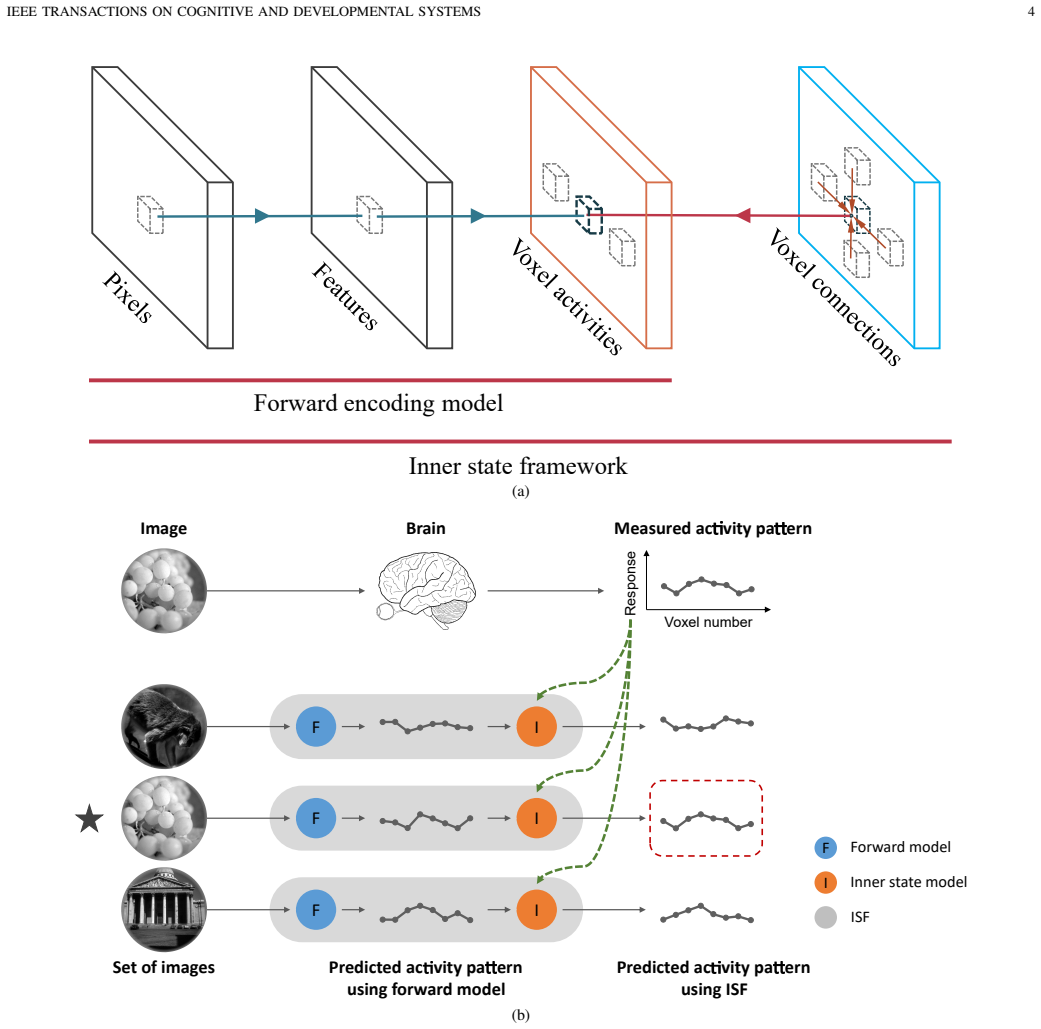
The load-bearing object is the inner-state model built from prediction residuals. After fitting a forward model on training data, the paper forms a residual matrix $E = [\epsilon_1, \dots, \epsilon_p]$ with $\epsilon_i = v_i - f_i(X)\tilde{\beta}_i$; for each voxel, it selects 'connected' voxels whose residual vectors have Pearson correlation above a threshold, and sets the inner state $\tilde{s}_i = E_i \alpha_i$, the first principal component of those connected voxels' residuals. A scalar weight $\tilde{\lambda}_i$ is then fitted by least squares, and the final ISF prediction is $v_i = f_i(X)\beta_i + \tilde{s}_i \tilde{\lambda}_i$. In decoding, the inner-state correction is applied to both the forward model's predicted pattern and the measured pattern, and identification picks the image whose corrected predicted pattern has the highest Pearson correlation with the measured pattern. This machinery is what carries the paper's claim that residual structure—rather than noise—contains recoverable information about intrinsic brain state.
What would settle it
Re-run ISF with the inner state for validation images estimated only from training-data residuals and the forward model's predictions (never from the validation image's measured pattern); if the encoding $R^2$ and identification gains over forward-only models largely vanish, the reported improvements depend on access to the measured response being predicted.
Extended reading notes
Core claim
Traditionally, a voxel-wise encoding model predicts each voxel's response as $v_i = f_i(X)\beta_i + e_i$, treating the brain as a stimulus-response mapper. The paper's central discovery is that adding an inner-state term $s_i\lambda_i$ to this equation—where $s_i$ is estimated as the first principal component of the prediction residuals of voxels whose residual time courses are highly correlated with voxel $i$—produces substantially higher encoding $R^2$ and identification accuracy than the forward model alone. Because the correction is built from residuals after the stimulus features have explained their portion, the paper argues it captures influence from intrinsic connections rather than from the image. The framework is deliberately agnostic to the forward model: Gabor wavelet pyramid, gross local orientation, retinotopy-only, and even a zero model can be plugged in. With effective forward models the corrected predictions also degrade less as the candidate image set grows from 100 to 1,000 images and remain accurate when pattern similarity is measured by Euclidean distance instead of Pearson correlation.
Load-bearing premise
The framework estimates a voxel's inner state in a validation image from the true measured activities of other voxels in that same image, so the prediction is not made from stimulus information alone.
Editorial extensions
If this is right
- Plugging any of the four tested forward models into ISF yields a statistically significant encoding $R^2$ increase over the forward-only version (t test, p < 0.01).
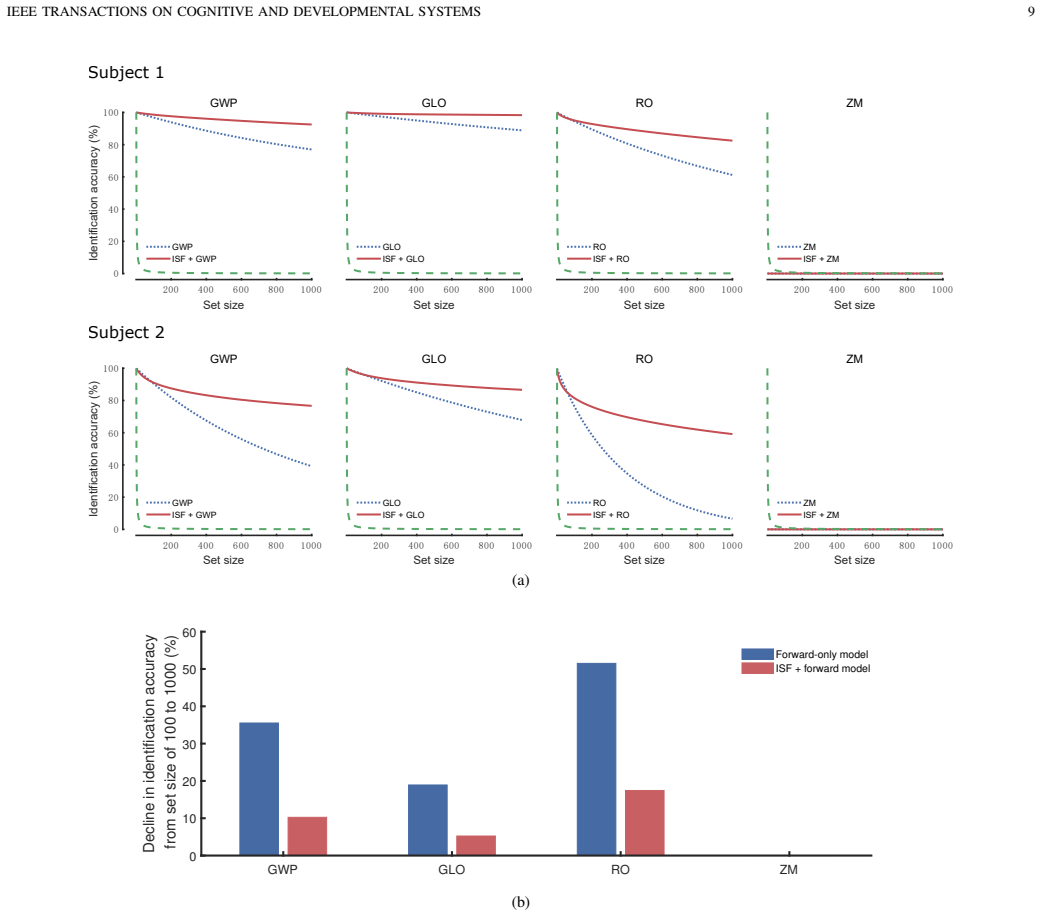
- ISF identification accuracy stays high as the candidate image set grows from 100 to 1,000 images, with a mean decline of 10.25%, 5.23%, and 17.44% for GWP, GLO, and RO versus 35.52%, 18.92%, and 51.51% for the forward-only versions.
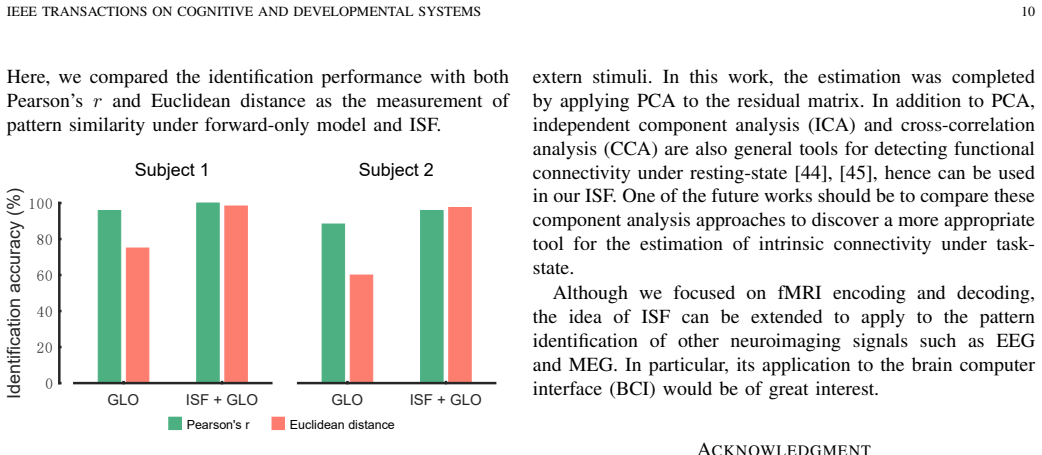
- ISF predictions remain close to measured patterns under Euclidean distance as well as Pearson correlation; for subject 1, ISF+GLO identification stays at 98.33% with Euclidean distance while forward-only GLO drops from 95.87% to 75%.
- The zero-model ISF reaches $R^2 = 0.35$ without any image features, but cannot identify images above chance, indicating the inner-state term alone carries non-stimulus structure but not image identity.
Reading between the lines
- Editorial inference: because the inner state for a validation image is computed from that image's measured voxel activities, part of the reported encoding $R^2$ gain likely reflects the model seeing the target pattern through other voxels; a test that estimates inner state from training data alone would reveal how much.
- Editorial inference: the zero-model result suggests the residual-based correction may also be absorbing shared noise or non-stimulus response components; applying ISF to image labels shuffled across the validation set would measure how much of the identification gain is specific to image content.
- Editorial inference: the framework's flexibility implies it could be combined with deep-network features or applied to EEG/MEG single-trial decoding, where a measured spatiotemporal pattern is available to seed the inner-state estimate.
Signed reviews
Editorial analysis
A structured set of objections, weighed in public.
Referee Report
Summary. The paper proposes an encoding framework (ISF) that augments a conventional forward stimulus-response encoding model with a data-driven "brain inner state" term. The inner state is estimated as the first principal component of the forward-model residuals of voxels that are highly correlated with the target voxel. The authors evaluate the framework on the Kay et al. natural-image fMRI dataset, reporting that ISF improves mean encoding R2 (e.g., GLO from 0.28 to 0.42) and image identification accuracy (e.g., ISF+GLO 100% for subject 1) relative to forward-only models, and that even a zero forward model combined with ISF reaches R2=0.35. The paper also studies identification accuracy as a function of image-set size and voxel count. The central claim is that adding the inner-state term to any forward encoding model yields substantial, robust gains in both encoding and decoding.
Significance. If the reported results were valid, the paper would present a conceptually interesting extension of voxel-wise encoding models, with a plausible neuroscientific motivation from intrinsic connectivity and a practical gain in decoding performance. The use of a public dataset, four forward models, and a zero-model control is a commendable design. However, the encoding evaluation is fundamentally compromised by target leakage: the inner state for a validation image is constructed from the true measured activities of other voxels for that same image, so the reported R2 gains do not reflect stimulus-driven prediction. The zero-model result of R2=0.35 without any image features is a direct demonstration of this leakage. The decoding procedure is also underspecified, leaving open the same leakage concern. As a result, the paper's main claims are not supported, and the contribution cannot be accepted in its current form.
major comments (3)
- [Section II-A, Eqs. (5)-(6); Section III-B.1] The encoding evaluation is circular. In Eqs. (5)-(6), the inner state s_i for a voxel is estimated as the first principal component of the residual vectors of its connected voxels, and the introduction explicitly states that 'to estimate the inner state of one voxel, one needs to know other voxels' true activities.' For the validation images, those true activities are the measured responses to the same image being predicted. Substituting this s_i into Eq. (2) means that each voxel's prediction uses the measured activity of other voxels from the same validation image. The reported encoding R2 values (e.g., ISF+GLO R2=0.42 vs. GLO R2=0.28, Fig. 3) therefore do not measure stimulus-driven predictive accuracy; they are inflated by information from the target image itself. This is a load-bearing flaw for the claim that ISF 'achieves much better performance' in encoding.
- [Fig. 3 and Section III-B.1] The zero-model control result is decisive evidence of target leakage. The zero model has no image features (Eq. 14), so ISF+ZM receives no stimulus information. Its reported mean R2 of 0.35 can only arise from correlations among the measured validation activities of connected voxels via Eqs. (5)-(6). This shows that the inner-state term, as implemented, is not extracting stimulus-independent brain dynamics; it is exploiting the measured response pattern of the same image. The paper itself notes that ISF+ZM 'still achieved a better predictive power of R2 = 0.35,' but the authors do not recognize that this invalidates rather than supports the framework's encoding claims.
- [Section II-C] The decoding procedure is underspecified in a way that matters for the identification results. The text says that the inner state model is 'applied to the predicted pattern and the measured pattern' to yield an updated prediction, but no equations are given for how the test-time inner state is computed. If the measured pattern (the one whose image identity is being sought) is used to estimate the inner state for each candidate image, then the updated prediction can be made artificially similar to the measured pattern for the correct image, inflating identification accuracy. The paper does not rule out this possibility, and hence the reported 100% and 95.83% identification accuracies for ISF+GLO are not interpretable without a precise statement of the test-time estimation procedure.
minor comments (6)
- [Section II-A] The choices of the correlation threshold for defining connected voxels and the number of principal components retained are not reported; these free parameters are central to the method and should be stated explicitly or provided in a supplementary table.
- [Eq. (7)] The notation is inconsistent: Eq. (6) defines \tilde{s}_i as the PCA-based estimate, Eq. (7) uses \tilde{s}_i to compute \tilde{\lambda}_i, but Eq. (2) uses s_i without tildes. Please clarify the relationship between the training-time estimate and the validation-time estimate.
- [Fig. 4] The scatter plots in the second column of Fig. 4 are very small and the axis labels overlap; larger panels or a density-color representation would make the voxel-level comparison readable.
- [Section IV-D] The phrase 'extern stimuli' should read 'external stimuli'.
- [References] Reference [15] and [16] lack complete bibliographic information (volume, pages, and publication year are missing); please complete these entries.
- [Section IV-B and Fig. 7] The paper claims state-of-the-art performance but does not compare with previously published identification accuracies on the same Kay et al. dataset; a comparison table would strengthen the decoding claim.
Circularity Check
Validation-time inner state is estimated from true measured responses of connected voxels (Sec. II-A), making the reported encoding R2 gains—and arguably decoding gains—reflect target leakage rather than predictive encoding.
-
fitted input called prediction
[Introduction; Section II-A (Eqs. 2, 3, 5, 6); Section III-B.1]
"To estimate the inner state of one voxel, one needs to know other voxels’ true activities, this feature makes the proposed encoding framework naturally suitable for brain decoding, where a measured activity pattern must be given at first. ... The zero model has as expected no predictive power (R2 = 0), but ISF with ZM still achieved a better predictive power of R2 = 0.35."
The ISF prediction for voxel i is v_i = f_i(X)β_i + s_i λ_i (Eq. 2). At validation time, s_i is the first principal component of the residual matrix E_i built from residuals ϵ_i = v_i − f_i(X)β_i (Eqs. 3, 5, 6) of connected voxels on the same 120 validation images. Therefore each voxel's 'prediction' is partly a linear combination of other voxels' true measured responses to the same image. The reported R2 gains (e.g., GLO from 0.28 to 0.42) are not a test of stimulus-driven encoding; they are inflated by target leakage. The zero-model control confirms this: with F=0, residuals equal measured activity, yet ISF+ZM attains R2=0.35, showing the gain comes from correlations among measured validation activities, not from external stimulus information.
full rationale
The paper's central encoding claim is that adding the inner-state term s_i λ_i improves prediction of held-out fMRI responses. But the method explicitly requires the true activities of connected voxels to estimate s_i (Eqs. 5–6), and the validation R2 is computed on the same 120 images. Thus the 'predicted' response for each voxel is, by construction, partly a function of the true measured responses of neighboring voxels in the same image. This is confirmed by the zero-model result: ISF+ZM, which receives no image features, still reaches R2=0.35. The decoding improvement is less clearly reducible because Section II-C does not give equations for how the inner-state model is applied to the measured pattern; that underspecification is a correctness risk but not a demonstrated circular step. There are no self-citation or uniqueness-theorem issues here. Overall, the encoding improvements are not independent evidence for the framework's predictive content, so the paper's strongest quantitative support is largely circular.
Assumptions & free parameters
free parameters (4)
- connectivity_threshold =
not reported
- number_of_principal_components =
1
- R2_survival_threshold =
0.1
- optimal_voxel_count =
800-1000
assumptions (5)
- domain assumption Forward-model residuals contain a stimulus-independent 'inner state' shared across voxels and linearly predictable from connected voxels.
- domain assumption Pearson correlation between residual vectors reflects intrinsic brain connectivity, not shared stimulus features.
- ad hoc to paper The first principal component of connected residual vectors adequately represents the inner state for each voxel.
- domain assumption The residual covariance structure learned on training images generalizes to validation images and across scan sessions.
- ad hoc to paper Test-time inner state can be estimated from measured true activities without leaking the stimulus label into the decision.
invented entities (1)
-
brain inner state (s_i)
Cite this review
Pith. "Pith review of An encoding framework with brain inner state for natural image identification." pith.science (2026). https://pith.science/paper/QEXJTXQA
@misc{pith2026190808807,
  author       = {Pith},
  title        = {Pith review of: An encoding framework with brain inner state for natural image identification},
  year         = {2026},
  howpublished = {\url{https://pith.science/paper/QEXJTXQA}},
  note         = {Machine review of arXiv:1908.08807}
}
read the original abstract
Neural encoding and decoding, which aim to characterize the relationship between stimuli and brain activities, have emerged as an important area in cognitive neuroscience. Traditional encoding models, which focus on feature extraction and mapping, consider the brain as an input-output mapper without inner states. In this work, inspired by the fact that human brain acts like a state machine, we proposed a novel encoding framework that combines information from both the external world and the inner state to predict brain activity. The framework comprises two parts: forward encoding model that deals with visual stimuli and inner state model that captures influence from intrinsic connections in the brain. The forward model can be any traditional encoding model, making the framework flexible. The inner state model is a linear model to utilize information in the prediction residuals of the forward model. The proposed encoding framework can achieve much better performance on natural image identification from fMRI response than forwardonly models. The identification accuracy will decrease slightly with the dataset size increasing, but remain relatively stable with different identification methods. The results confirm that the new encoding framework is effective and robust when used for brain decoding.
Figures


Figures from the paper (4 more)


Reference graph
Works this paper leans on
-
[1]
Encoding and decoding in fMRI,
T. Naselaris, K. N. Kay, S. Nishimoto, and J. L. Gallant, “Encoding and decoding in fMRI,” NeuroImage, vol. 56, no. 2, pp. 400–410, May 2011. [Online]. Available: http://linkinghub.elsevier.com/retrieve/ pii/S1053811910010657
work page 2011
-
[2]
Multivariate decoding and brain reading: Introduction to the special issue,
J.-D. Haynes, “Multivariate decoding and brain reading: Introduction to the special issue,” NeuroImage, vol. 56, no. 2, pp. 385–386, May
-
[3]
Finding the BOLD effect in brain images,
S. Ogawa, “Finding the BOLD effect in brain images,” NeuroImage, vol. 62, no. 2, pp. 608–609, Aug. 2012. [Online]. Available: http://www.sciencedirect.com/science/article/pii/S1053811912001085
work page 2012
-
[4]
Identifying natural images from human brain activity,
Kendrick N. Kay, T. Naselaris, R. J. Prenger, and J. L. Gallant, “Identifying natural images from human brain activity,” Nature, vol. 452, no. 7185, pp. 352–355, Mar. 2008. [Online]. Available: http://www.nature.com/doifinder/10.1038/nature06713
-
[5]
Encoding and decoding V1 fMRI responses to natural images with sparse nonparametric models,
V . Q. Vu, P. Ravikumar, T. Naselaris, K. N. Kay, J. L. Gallant, and B. Yu, “Encoding and decoding V1 fMRI responses to natural images with sparse nonparametric models,” The Annals of Applied Statistics, vol. 5, no. 2B, pp. 1159–1182, Jun. 2011. [Online]. Available: http://projecteuclid.org/euclid.aoas/1310562717
-
[6]
Reconstructing Visual Experiences from Brain Activity Evoked by Natural Movies,
S. Nishimoto, A. Vu, T. Naselaris, Y . Benjamini, B. Yu, and J. Gallant, “Reconstructing Visual Experiences from Brain Activity Evoked by Natural Movies,” Current Biology , vol. 21, no. 19, pp. 1641–1646, Oct. 2011. [Online]. Available: http://linkinghub.elsevier.com/retrieve/ pii/S0960982211009377
work page 2011
-
[7]
A voxel-wise encoding model for early visual areas decodes mental images of remembered scenes,
T. Naselaris, C. A. Olman, D. E. Stansbury, K. Ugurbil, and J. L. Gallant, “A voxel-wise encoding model for early visual areas decodes mental images of remembered scenes,” NeuroImage, vol. 105, pp. 215–228, Jan. 2015. [Online]. Available: http: //www.sciencedirect.com/science/article/pii/S1053811914008428
work page 2015
-
[8]
Natural speech reveals the semantic maps that tile human cerebral cortex,
A. G. Huth, W. A. de Heer, T. L. Griffiths, F. E. Theunissen, and J. L. Gallant, “Natural speech reveals the semantic maps that tile human cerebral cortex,” Nature, vol. 532, no. 7600, pp. 453–458, Apr. 2016. [Online]. Available: http://www.nature.com/doifinder/10. 1038/nature17637
work page 2016
Show all 52 references
-
[9]
Bayesian Reconstruction of Natural Images from Human Brain Activity,
T. Naselaris, R. J. Prenger, K. N. Kay, M. Oliver, and J. L. Gallant, “Bayesian Reconstruction of Natural Images from Human Brain Activity,” Neuron, vol. 63, no. 6, pp. 902–915, Sep. 2009. [Online]. Available: http://www.cell.com/article/S0896627309006850/abstract
2009
-
[10]
Unsupervised Feature Learning Improves Prediction of Human Brain Activity in Response to Natural Images,
U. Gl and M. A. J. v. Gerven, “Unsupervised Feature Learning Improves Prediction of Human Brain Activity in Response to Natural Images,” PLOS Computational Biology , vol. 10, no. 8, p. e1003724, Aug. 2014. [Online]. Available: https://journals.plos.org/ploscompbiol/ article?id...
2014 doi
-
[11]
Deep neural networks reveal a gradient in the complexity of neural representations across the ventral stream,
U. G ¨uc ¸l¨u and M. A. van Gerven, “Deep neural networks reveal a gradient in the complexity of neural representations across the ventral stream,” Journal of Neuroscience , vol. 35, no. 27, pp. 10 005–10 014, 2015. IEEE TRANSACTIONS ON COGNITIVE AND DEVELOPMENTAL SYSTEMS 11
2015
-
[12]
Decoding the visual and subjective contents of the human brain,
Y . Kamitani and F. Tong, “Decoding the visual and subjective contents of the human brain,” Nature Neuroscience, vol. 8, no. 5, pp. 679–685,
-
[13]
Neural Encoding and Decoding with Deep Learning for Dynamic Natural Vision,
H. Wen, J. Shi, Y . Zhang, K.-H. Lu, J. Cao, and Z. Liu, “Neural Encoding and Decoding with Deep Learning for Dynamic Natural Vision,” Cerebral Cortex , pp. 1–25. [Online]. Available: https://academic.oup. com/cercor/advance-article/doi/10.1093/cercor/bhx268/4560155
-
[14]
Decoding of visual activity patterns from fMRI responses using multivariate pattern analyses and convolutional neural network,
R. Zafar, N. Kamel, M. Naufal, A. S. Malik, S. C. Dass, R. F. Ahmad, J. M. Abdullah, and F. Reza, “Decoding of visual activity patterns from fMRI responses using multivariate pattern analyses and convolutional neural network,” Journal of Integrative Neuroscience , vol. 16, no....
2017
-
[15]
A Novel Brain Decoding Method: a Correlation Network Framework for Revealing Brain Connections,
S. Yu, N. Zheng, Y . Ma, H. Wu, and B. Chen, “A Novel Brain Decoding Method: a Correlation Network Framework for Revealing Brain Connections,”IEEE Transactions on Cognitive and Developmental Systems, pp. 1–1, 2018
2018
-
[16]
Reconstructing Perceived Images From Human Brain Activities With Bayesian Deep Multiview Learning,
C. Du, C. Du, L. Huang, and H. He, “Reconstructing Perceived Images From Human Brain Activities With Bayesian Deep Multiview Learning,” IEEE Transactions on Neural Networks and Learning Systems, pp. 1–14, 2018
2018
-
[17]
Resolving Ambiguities of MVPA Using Explicit Models of Representation,
T. Naselaris and K. N. Kay, “Resolving Ambiguities of MVPA Using Explicit Models of Representation,” Trends in Cognitive Sciences , vol. 19, no. 10, pp. 551–554, Oct. 2015. [Online]. Available: http://www.sciencedirect.com/science/article/pii/S1364661315001692
2015
-
[18]
Is the brain an effective turing machine or a finite-state machine?
F. van der Velde, “Is the brain an effective turing machine or a finite-state machine?” Psychological Research, vol. 55, no. 1, pp. 71–79, Mar 1993. [Online]. Available: https://doi.org/10.1007/BF00419895
1993 doi
-
[19]
Discovering dynamic brain networks from big data in rest and task,
D. Vidaurre, R. Abeysuriya, R. Becker, A. J. Quinn, F. Alfaro- Almagro, S. M. Smith, and M. W. Woolrich, “Discovering dynamic brain networks from big data in rest and task,” NeuroImage, Jun
-
[20]
Top-down influences on visual processing,
C. D. Gilbert and W. Li, “Top-down influences on visual processing,” Nature Reviews Neuroscience , vol. 14, no. 5, pp. 350–363, May
-
[21]
Feedback of visual object information to foveal retinotopic cortex,
M. A. Williams, C. I. Baker, H. P. Op de Beeck, W. Mok Shim, S. Dang, C. Triantafyllou, and N. Kanwisher, “Feedback of visual object information to foveal retinotopic cortex,” Nature Neuroscience, vol. 11, no. 12, pp. 1439–1445, 2008. [Online]. Available: http://www.nature.com...
2008
-
[22]
Perceptual Learning Incepted by Decoded fMRI Neurofeedback Without Stimulus Presentation,
K. Shibata, T. Watanabe, Y . Sasaki, and M. Kawato, “Perceptual Learning Incepted by Decoded fMRI Neurofeedback Without Stimulus Presentation,” Science, vol. 334, no. 6061, pp. 1413–1415, Dec
-
[23]
Functional connectivity in the resting brain: A network analysis of the default mode hypothesis,
M. D. Greicius, B. Krasnow, A. L. Reiss, and V . Menon, “Functional connectivity in the resting brain: A network analysis of the default mode hypothesis,” Proceedings of the National Academy of Sciences , vol. 100, no. 1, pp. 253–258, Jan. 2003. [Online]. Available: https://ww...
2003
-
[24]
Resting-State Functional Connectivity Reflects Structural Connectivity in the Default Mode Network,
M. D. Greicius, K. Supekar, V . Menon, and R. F. Dougherty, “Resting-State Functional Connectivity Reflects Structural Connectivity in the Default Mode Network,” Cerebral Cortex , vol. 19, no. 1, pp. 72–78, Jan. 2009. [Online]. Available: https://academic.oup.com/cercor/ articl...
2009
-
[25]
Natural Image Statistics and Neural Representation,
Bruno A. Olshausen, “Natural Image Statistics and Neural Representation,” Annual Review of Neuroscience , vol. 24, no. 1, pp. 1193–1216, 2001. [Online]. Available: http://dx.doi.org/10.1146/ annurev.neuro.24.1.1193
2001
-
[26]
The role of context in object recognition,
A. Oliva and A. Torralba, “The role of context in object recognition,” Trends in Cognitive Sciences , vol. 11, no. 12, pp. 520–527, Dec
-
[27]
Available: http://www.sciencemag.org/cgi/doi/10.1126/ science.1212003
[Online]. Available: http://www.sciencemag.org/cgi/doi/10.1126/ science.1212003
-
[28]
An evaluation of the two-dimensional Gabor filter model of simple receptive fields in cat striate cortex,
J. P. Jones and L. A. Palmer, “An evaluation of the two-dimensional Gabor filter model of simple receptive fields in cat striate cortex,” Journal of Neurophysiology , vol. 58, no. 6, pp. 1233–1258, Dec
-
[29]
Uncertainty relation for resolution in space, spatial frequency, and orientation optimized by two-dimensional visual cortical filters,
J. G. Daugman, “Uncertainty relation for resolution in space, spatial frequency, and orientation optimized by two-dimensional visual cortical filters,” JOSA A , vol. 2, no. 7, pp. 1160–1169, Jul. 1985. [Online]. Available: https://www.osapublishing.org/josaa/abstract.cfm? uri=j...
1985
-
[30]
Nonmonotonic noise tuning of BOLD fMRI signal to natural images in the visual cortex of the anesthetized monkey,
G. Rainer, M. Augath, T. Trinath, and N. K. Logothetis, “Nonmonotonic noise tuning of BOLD fMRI signal to natural images in the visual cortex of the anesthetized monkey,” Current Biology , vol. 11, no. 11, pp. 846–854, Jun. 2001. [Online]. Available: http://www.sciencedirect. ...
2001
-
[31]
Isolation of Relevant Visual Features from Random Stimuli for Cortical Complex Cells,
J. Touryan, B. Lau, and Y . Dan, “Isolation of Relevant Visual Features from Random Stimuli for Cortical Complex Cells,” Journal of Neuroscience, vol. 22, no. 24, pp. 10 811–10 818, Dec. 2002. [Online]. Available: http://www.jneurosci.org/content/22/24/10811
2002
-
[32]
On the importance of the static nonlinearity in estimating spatiotemporal neural filters with natural stimuli,
T. O. Sharpee, K. D. Miller, and M. P. Stryker, “On the importance of the static nonlinearity in estimating spatiotemporal neural filters with natural stimuli,” Journal of neurophysiology , vol. 99, no. 5, pp. 2496–2509, May 2008. [Online]. Available: https://www.ncbi.nlm.nih.g...
2008
-
[33]
Image representation using 2d Gabor wavelets,
Tai Sing Lee, “Image representation using 2d Gabor wavelets,” IEEE Transactions on Pattern Analysis and Machine Intelligence , vol. 18, no. 10, pp. 959–971, Oct. 1996
1996
-
[34]
Regression Shrinkage and Selection Via the Lasso,
R. Tibshirani, “Regression Shrinkage and Selection Via the Lasso,” Journal of the Royal Statistical Society: Series B (Methodological) , vol. 58, no. 1, pp. 267–288, 1996. [Online]. Available: https://rss. onlinelibrary.wiley.com/doi/abs/10.1111/j.2517-6161.1996.tb02080.x
1996
-
[35]
Sparse estimation automatically selects voxels relevant for the decoding of fMRI activity patterns,
O. Yamashita, M.-a. Sato, T. Yoshioka, F. Tong, and Y . Kamitani, “Sparse estimation automatically selects voxels relevant for the decoding of fMRI activity patterns,” NeuroImage, vol. 42, no. 4, pp. 1414–1429, Oct. 2008. [Online]. Available: http://www.sciencedirect. com/scie...
2008
-
[36]
Population receptive field estimates in human visual cortex,
S. O. Dumoulin and B. A. Wandell, “Population receptive field estimates in human visual cortex,” NeuroImage, vol. 39, no. 2, pp. 647–660, Jan. 2008. [Online]. Available: http://linkinghub.elsevier.com/ retrieve/pii/S1053811907008269
2008
-
[37]
Nonstimulated early visual areas carry information about surrounding context,
F. W. Smith and L. Muckli, “Nonstimulated early visual areas carry information about surrounding context,” Proceedings of the National Academy of Sciences , vol. 107, no. 46, pp. 20 099–20 103, Nov. 2010. [Online]. Available: http://www.pnas.org/content/107/46/20099
2010
-
[38]
Neuronal Circuits of the Neocortex,
R. J. Douglas and K. A. Martin, “Neuronal Circuits of the Neocortex,” Annual Review of Neuroscience , vol. 27, no. 1, pp. 419–451, 2004. [Online]. Available: https://doi.org/10.1146/annurev.neuro.27.070203. 144152
2004 doi
-
[39]
Exploring the brain net- work: a review on resting-state fmri functional connectivity,
M. P. Van Den Heuvel and H. E. H. Pol, “Exploring the brain net- work: a review on resting-state fmri functional connectivity,” European neuropsychopharmacology, vol. 20, no. 8, pp. 519–534, 2010
2010
-
[40]
Coding of image contrast in central visual pathways of the macaque monkey,
G. Sclar, J. H. R. Maunsell, and P. Lennie, “Coding of image contrast in central visual pathways of the macaque monkey,” Vision Research, vol. 30, no. 1, pp. 1–10, Jan. 1990. [Online]. Available: http://www.sciencedirect.com/science/article/pii/0042698990901233
1990
-
[41]
Circuits for Local and Global Signal Integration in Primary Visual Cortex,
A. Angelucci, J. B. Levitt, E. J. S. Walton, J.-M. Hup, J. Bullier, and J. S. Lund, “Circuits for Local and Global Signal Integration in Primary Visual Cortex,”Journal of Neuroscience, vol. 22, no. 19, pp. 8633–8646, Oct. 2002. [Online]. Available: http://jneurosci.org/content...
2002
-
[42]
Expectation (and attention) in visual cognition,
C. Summerfield and T. Egner, “Expectation (and attention) in visual cognition,” Trends in Cognitive Sciences , vol. 13, no. 9, pp. 403–409, Sep. 2009. [Online]. Available: http://www.sciencedirect.com/science/ article/pii/S1364661309001442
2009
-
[43]
Less Is More: Expectation Sharpens Representations in the Primary Visual Cortex,
P. Kok, J. M. Jehee, and F. deLange, “Less Is More: Expectation Sharpens Representations in the Primary Visual Cortex,” Neuron, vol. 75, no. 2, pp. 265–270, Jul. 2012. [Online]. Available: http://www.sciencedirect.com/science/article/pii/S0896627312004382
2012
-
[44]
Independent component analysis of functional MRI: what is signal and what is noise?
M. J. McKeown, L. K. Hansen, and T. J. Sejnowsk, “Independent component analysis of functional MRI: what is signal and what is noise?” Current Opinion in Neurobiology , vol. 13, no. 5, pp. 620–629, Oct. 2003. [Online]. Available: http://www.sciencedirect.com/science/ article/p...
2003
-
[45]
Detecting functional connec- tivity in the resting brain: a comparison between ica and cca,
L. Ma, B. Wang, X. Chen, and J. Xiong, “Detecting functional connec- tivity in the resting brain: a comparison between ica and cca,” Magnetic resonance imaging, vol. 25, no. 1, pp. 47–56, 2007
2007
-
[47]
The organization of the human cerebral cortex estimated by intrinsic functional connectivity,
B. Thomas Yeo, F. M. Krienen, J. Sepulcre, M. R. Sabuncu, D. Lashkari, M. Hollinshead, J. L. Roffman, J. W. Smoller, L. Z ¨ollei, J. R. Polimeni et al. , “The organization of the human cerebral cortex estimated by intrinsic functional connectivity,” Journal of neurophysiology,...
2011
-
[1987]
Available: https://www.physiology.org/doi/abs/10.1152/ jn.1987.58.6.1233
[Online]. Available: https://www.physiology.org/doi/abs/10.1152/ jn.1987.58.6.1233
1987
-
[2005]
Available: http://www.nature.com/neuro/journal/v8/n5/ abs/nn1444.html
[Online]. Available: http://www.nature.com/neuro/journal/v8/n5/ abs/nn1444.html
-
[2007]
Available: http://www.sciencedirect.com/science/article/ pii/S1364661307002550
[Online]. Available: http://www.sciencedirect.com/science/article/ pii/S1364661307002550
-
[2011]
Available: http://www.sciencedirect.com/science/article/ pii/S1053811911003363
[Online]. Available: http://www.sciencedirect.com/science/article/ pii/S1053811911003363
-
[2013]
Available: http://www.nature.com/nrn/journal/v14/n5/ full/nrn3476.html
[Online]. Available: http://www.nature.com/nrn/journal/v14/n5/ full/nrn3476.html
-
[2017]
Available: http://www.sciencedirect.com/science/article/ pii/S1053811917305487
[Online]. Available: http://www.sciencedirect.com/science/article/ pii/S1053811917305487
Reviewed August 14, 2026 · model on record in the stance chip above.
Discussion (0). Continue with ORCID to comment.