REVIEW 4 major objections 5 minor 13 references
Integrating Robotic Navigation with Blockchain: A Novel PoS-Based Approach for Heterogeneous Robotic Teams
T0 review · 4 major / 5 minor · reviewed 2026-08-07 · deepseek-v4-flash
Pith's one-line read This paper argues that a blockchain proof-of-stake mechanism can improve cooperative robot navigation in GPS-denied settings by weighting each robot's vote by its navigation reliability.
desk verdict A clear work-in-progress note that relabels reliability-weighted voting as PoS, but the central claim is unsupported because stake is never tied to actual navigation reliability. read the letter →
The pith
A machine-rendered reading of the paper's core claim, the machinery that carries it, and where it could break.
The reading
What carries the argument
The load-bearing mechanism is the stake-weighted consensus pipeline. Its three components are the stake weight function $W(r_i)=s_i/\sum_j s_j$, which normalizes each robot's stake into a share of the team's total stake; the consensus score $C_{\mathrm{PoS}}(r_i,r_j)$, which multiplies that weight by a sum over landmarks with an indicator $I(l_k,r_i,r_j)$ that is 1 exactly when both robots recognize landmark $l_k$; and the navigability function $N_{\mathrm{PoS}}(r_i)$, which sums consensus scores over teammates with trust weights $\alpha_{ij}$. The same navigability score is used in block generation, so the robot with the best navigability becomes the block generator. The paper reports $O(m\binom{n}{2})$ complexity for the consensus scores and $O(n^2m)$ for navigability, and highlights the tradeoff between frequent blockchain updates, which keep navigation data current, and the added computation and storage they demand.
What would settle it
Run the 10-robot, 20-landmark simulation with all stakes equal or with stakes deliberately reversed against each robot's true navigation accuracy. If the average-navigability curve still rises at the same rate, the reported improvement does not depend on stake-based prioritization, and the PoS weighting is not the active ingredient in the result.
Extended reading notes
Core claim
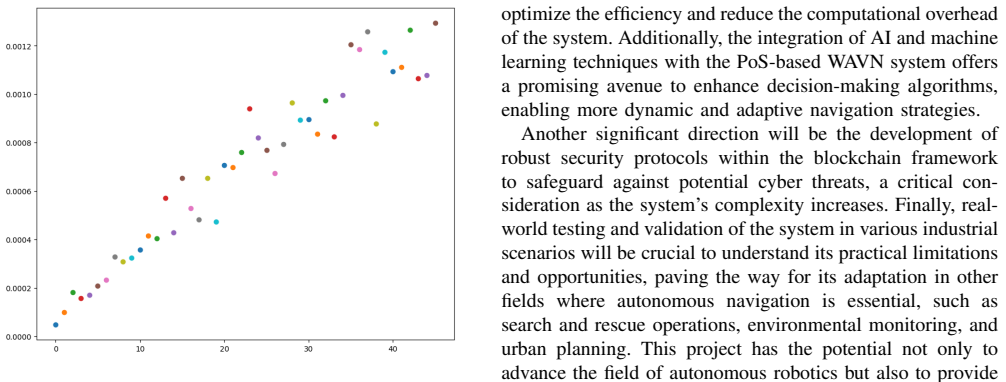
The paper's central claim is that transplanting Proof-of-Stake from blockchain consensus into WAVN improves team navigation by prioritizing robot contributions according to navigation reliability. Each robot $r_i$ is assigned a stake $s_i$, and the stake weight function $W(r_i)=s_i/\sum_{j} s_j$ turns stakes into voting weights; the consensus score $C_{\mathrm{PoS}}(r_i,r_j)$ then weights the number of landmarks that robots $r_i$ and $r_j$ both recognize, and the navigability function $N_{\mathrm{PoS}}(r_i)$ accumulates those weighted scores across teammates using trust coefficients $\alpha_{ij}$. In the preliminary experiment, average navigability grows over time, forms a valley when common-landmark match quality drops, and rises again when match quality is restored. The authors read this as evidence that a lightweight, WAVN-specialized PoS consensus can lighten overhead relative to heavier consensus mechanisms such as Proof of Work while keeping team navigation decisions decentralized.
Load-bearing premise
The stake $s_i$ assigned to each robot faithfully measures its navigation reliability; if stakes are arbitrary or stale, the PoS mechanism simply amplifies arbitrary priorities rather than accurate navigation.
Editorial extensions
If this is right
- If a robot's stake accurately reflects its navigation reliability, landmark-based team decisions will be dominated by the most reliable robots, reducing the influence of faulty or degraded sensors.
- Because the consensus is stake-based rather than work-based, the blockchain layer avoids expensive cryptographic hashing and may fit within the computational budgets of small mobile robots.
- The navigability score provides a concrete, computable criterion for choosing both the next block generator and the robot best suited to lead pathfinding.
- The stated $O(n^2m)$ complexity means the scheme is workable for small teams and landmark sets, but scaling to large deployments will require pruning, approximation, or hierarchical consensus.
Reading between the lines
- A natural extension the paper leaves implicit is a stake-update rule: after each mission, stakes could be revised from observed landmark-match accuracy or path outcomes, turning the mechanism into a self-reinforcing reliability estimate rather than a fixed priority list.
- The same stake-weighted landmark consensus transfers to any multi-agent perception task with shared observations, such as distributed mapping, search-and-rescue coordination, or environmental monitoring, where per-agent reliability can be scored.
- A clean control experiment would run the same simulation with all stakes equal; if the average-navigability curve rises at the same rate, the improvement is caused by random motion and increasing landmark overlap rather than by stake-based prioritization.
- Since the simulation assigns landmark quality randomly rather than from real panoramas, a field trial with actual visual homing data is the test that would show whether the valley-and-recovery pattern survives realistic landmark noise.
Editorial analysis
A structured set of objections, weighed in public.
Referee Report
Summary. The paper proposes integrating a Proof-of-Stake (PoS) blockchain mechanism into Wide Area Visual Navigation (WAVN) for heterogeneous robot teams. The methodology defines a stake weight function (Eq. 1), a consensus score (Eq. 2), and a navigability function (Eq. 3), where each robot's stake is interpreted as its navigation reliability. A preliminary simulation with 10 robots and 20 landmarks is reported, showing that average navigability between robots increases over time. The paper is explicitly a work-in-progress and lists stake management, scalability, and security as future challenges.
Significance. The cross-disciplinary idea of borrowing PoS concepts for robot navigation is interesting and could be relevant to decentralized cooperative navigation in GPS-denied environments. The paper also gives a clear complexity analysis of the scoring functions. However, as presented, there is no validation that the PoS mechanism improves navigation reliability: the stake is never tied to actual navigation performance, the simulation is self-referential, and no comparison to a baseline is provided. Thus the central claim is unsupported, and the current manuscript would not advance the state of the art beyond a proposal.
major comments (4)
- [Section III, Eq. (1)] The stake s_i in Eq. (1) is 'interpreted as its navigation reliability,' but no mechanism is given to set, calibrate, or update stakes from navigation outcomes. Section V explicitly leaves 'determining the appropriate methods and timing for adjusting the stakes' to future work. As written, Eqs. (1)-(3) define a weighted voting scheme that amplifies arbitrary inputs; if stakes are stale or incorrect, an unreliable robot with a high stake dominates the consensus score. The central claim that PoS prioritizes contributions by reliability therefore requires an external reliability signal that the paper does not provide.
- [Section IV] The simulation is self-referential: landmark qualities ω_k are randomly assigned, the importance coefficients α_ij are derived from transaction counts within the same simulation, and stakes are assumed to represent reliability without independent measurement. The reported rise in navigability over time follows from these internally generated inputs, not from any property of the PoS mechanism. Without a baseline—e.g., equal weighting, random weighting, or a PoW-like scheme—or a control with uninformative stakes, Figure 3 cannot support the claim that the PoS integration enhances cooperative navigation.
- [Section IV and V] The paper never defines or reports a navigation error metric. The abstract and introduction promise improved navigation accuracy, but the evaluation only tracks the internal navigability function N_PoS. A central claim about cooperative navigation needs task-level measurable outcomes, such as homing error, path length, success rate in GPS-denied conditions, or comparison with existing WAVN without blockchain. Without such metrics, the proposed method is not empirically distinguishable from a random process.
- [Section III, computational complexity] The complexity analysis is incomplete. The paper states that overall complexity is dominated by O(m * C(n,2)) and O(n^2 m) for the consensus and navigability functions, but it also acknowledges in the discussion that blockchain update frequency and data logging add computational overhead. The claim of scalability gains from PoS is not substantiated because the cost of reaching consensus, validating blocks, and maintaining the ledger is not incorporated into the analysis, nor are these costs compared with PoW or with a non-blockchain WAVN baseline.
minor comments (5)
- [Eq. (1)] The displayed equation for the stake weight function is garbled in the text; it should read W(r_i) = s_i / (Σ_j s_j). Please correct the typesetting.
- [Figure 3] Figure 3 lacks axis labels and a clear explanation of how the plotted 'average navigability' is computed across the matrix blocks; add both.
- [Section IV] The phrase 'randomness is employed throughout to simulate the process, ensuring maximum stress on the experiment when a parameter is absent' is vague; specify which parameters are stressed and what the randomness is intended to represent.
- [Section II, references] Reference [2] (optical memory in IoT devices) appears unrelated to the topic and seems to be a self-citation included without context; please remove or integrate it meaningfully.
- [Abstract and general text] The manuscript has several typographical issues, such as 'W A VN' spacing and 'other area' in the introduction; a careful proofread is needed.
Circularity Check
Stake is stipulated to be navigation reliability, so the PoS weighting is definitional and the simulated navigability trend is internally generated.
-
self definitional
[Abstract; Section III, Eq. (1)-(2)]
"This integration aims to enhance the cooperative navigation capabilities of robotic teams by prioritizing robot contributions based on their navigation reliability. ... where si represents the stake of robot ri (interpreted as its navigation reliability)"
The central benefit is guaranteed by stipulation: Eq. (1) defines W(ri)=si/Σsj, and Section III interprets si as 'navigation reliability.' Eq. (2) then weights the landmark consensus score by W(ri). No measurement or calibration connects si to observed navigation error; Section V says determining how to adjust stakes 'to reflect their navigation reliability accurately' is future work. So 'PoS prioritizes reliable robots' is not a derived finding; it is true by definition of the variable, making the claimed enhancement an input restated as an output.
-
other
[Section IV, Fig. 3, Eq. (3)]
"Given the absence of an actual panorama or point of view, we randomly assign the quality of common landmarks between a pair of robots, which serves as wk of navigability as defined in Equation 2."
The reported navigability increase (Fig. 3) is the value of Eq. (3) computed from inputs chosen inside the simulation: randomly assigned landmark qualities wk, transaction-derived αij, and the stakes of Eq. (1). None are compared with ground-truth navigation error or an external benchmark. The output therefore reduces to the simulation's own synthetic inputs and update rules, and cannot independently confirm that PoS weighting improves navigation reliability.
full rationale
The paper's core derivation is a definitional loop: the stake si is 'interpreted as its navigation reliability,' so using si to weight consensus scores (Eqs. 1-2) makes 'weighting by reliability' true by construction. The preliminary experiment then evaluates Eq. (3) using the same internal quantities—random landmark qualities and transaction-based importance—and presents the resulting navigability trend as evidence. Because no external calibration of stake to navigation performance exists (Section V explicitly defers it), the claimed benefit and the observed trend are generated from the paper's own assumptions rather than from independent data. The paper honestly labels itself work-in-progress and does not invoke a uniqueness theorem or machine-checked guarantee, so I score it 6 (partial circularity) rather than higher. Self-citations to prior WAVN work are present but are not the load-bearing circular step here.
Assumptions & free parameters
free parameters (4)
- Stake value s_i per robot =
not specified
- Landmark quality weights omega_k =
randomly assigned
- Importance coefficients alpha_ij =
derived from simulated transaction history
- Top transaction limit =
10
assumptions (4)
- domain assumption Each robot's stake s_i is a valid proxy for its navigation reliability
- domain assumption Common landmark recognition between two robots indicates useful navigational agreement
- domain assumption Blockchain consensus and data logging overhead are acceptable in real-time navigation
- ad hoc to paper Randomly assigned landmark qualities in Section IV approximate real perceptual conditions
Cite this review
Pith. "Pith review of Integrating Robotic Navigation with Blockchain: A Novel PoS-Based Approach for Heterogeneous Robotic Teams." pith.science (2026). https://pith.science/paper/QG7L67F6
@misc{pith2026250515954,
  author       = {Pith},
  title        = {Pith review of: Integrating Robotic Navigation with Blockchain: A Novel PoS-Based Approach for Heterogeneous Robotic Teams},
  year         = {2026},
  howpublished = {\url{https://pith.science/paper/QG7L67F6}},
  note         = {Machine review of arXiv:2505.15954}
}
read the original abstract
This work explores a novel integration of blockchain methodologies with Wide Area Visual Navigation (WAVN) to address challenges in visual navigation for a heterogeneous team of mobile robots deployed for unstructured applications in agriculture, forestry, etc. Focusing on overcoming challenges such as GPS independence, environmental changes, and computational limitations, the study introduces the Proof of Stake (PoS) mechanism, commonly used in blockchain systems, into the WAVN framework \cite{Lyons_2022}. This integration aims to enhance the cooperative navigation capabilities of robotic teams by prioritizing robot contributions based on their navigation reliability. The methodology involves a stake weight function, consensus score with PoS, and a navigability function, addressing the computational complexities of robotic cooperation and data validation. This innovative approach promises to optimize robotic teamwork by leveraging blockchain principles, offering insights into the scalability, efficiency, and overall system performance. The project anticipates significant advancements in autonomous navigation and the broader application of blockchain technology beyond its traditional financial context.
Figures


Reference graph
Works this paper leans on
-
[7]
A lightweight blockchain framework for visual homing and navigation robots,
M. Rahouti, D. M. Lyons, and L. Santana, “A lightweight blockchain framework for visual homing and navigation robots,” in International Conference on Robotics and Networks . Springer, 2022, pp. 91–104
work page 2022
-
[8]
A decentralized cooperative navigation approach for visual homing net- works,
M. Rahouti, D. Lyons, S. K. Jagatheesaperumal, and K. Xiong, “A decentralized cooperative navigation approach for visual homing net- works,” IT Professional, vol. 25, no. 6, pp. 71–81, 2023
work page 2023
-
[11]
Assessing blockchain con- sensus in robotics: A visual homing approach,
N. Paykari, D. Lyons, and M. Rahouti, “Assessing blockchain con- sensus in robotics: A visual homing approach,” in 2023 IEEE 14th Annual Ubiquitous Computing, Electronics & Mobile Communication Conference (UEMCON). IEEE, 2023, pp. 0577–0583
work page 2023
-
[13]
Wavn: Wide area visual navigation for large-scale, gps-denied environments,
D. M. Lyons and M. Rahouti, “Wavn: Wide area visual navigation for large-scale, gps-denied environments,” in 2023 IEEE International Conference on Robotics and Automation (ICRA) . IEEE, 2023, pp. 2039–2045
work page 2023
-
[1]
Visual homing for robot teams: Do you see what I see?
D. Lyons and N. Petzinger, “Visual homing for robot teams: Do you see what I see?” SPIE Conf. on Unmanned Sys. Tech. (UST) , April 2022
work page 2022
-
[2]
Optical memory in IoT devices: an energy-efficient approach using phase change materials,
B. Jahannia et al., “Optical memory in IoT devices: an energy-efficient approach using phase change materials,” in AI and Optical Data Sciences V , vol. 12903. SPIE, 2024, pp. 11–23
work page 2024
-
[3]
Blockchain in financial services: Current status, adoption challenges, and future vision,
A. Miah, M. Rahouti, S. K. Jagatheesaperumal, M. Ayyash, K. Xiong, F. Fernandez, and M. Lekena, “Blockchain in financial services: Current status, adoption challenges, and future vision,” International Journal of Innovation and Technology Management , vol. 20, no. 08, p. 2330004, 2023
work page 2023
-
[4]
From design to deployment: Decentralized coordi- nation of heterogeneous robotic teams,
D. St-Onge et al. , “From design to deployment: Decentralized coordi- nation of heterogeneous robotic teams,” Frontiers in Robotics and AI , vol. 7, p. 51, 2020
work page 2020
Show all 13 references
-
[5]
A survey on the autonomous exploration of confined subterranean spaces: Perspectives from real-word and industrial robotic deployments,
H. Azp ´urua et al., “A survey on the autonomous exploration of confined subterranean spaces: Perspectives from real-word and industrial robotic deployments,” Robotics and Autonomous Systems , vol. 160, p. 104304, 2023
2023
-
[6]
Robotic navigation in gps-denied environments using the strapdown navigation algorithm with zero-velocity updates,
S. Druen, “Robotic navigation in gps-denied environments using the strapdown navigation algorithm with zero-velocity updates,” M.S. The- sis, Naval Postgraduate School , 2020
2020
-
[9]
Blockchain and the future of the internet: A comprehen- sive review,
A. Ali et al., “Blockchain and the future of the internet: A comprehen- sive review,” arXiv preprint arXiv:1904.00733 , 2019
1904 arXiv
-
[10]
A survey on blockchain in robotics: Issues, opportunities, challenges and future directions,
U. S. Aditya, R. Singh, P. K. Singh, and A. Kalla, “A survey on blockchain in robotics: Issues, opportunities, challenges and future directions,” Journal of Network and Computer Applications , vol. 196, p. 103245, 2021
2021
-
[12]
Analysing the suitability of blockchain consensus algorithms in swarm robotics,
T. Krishnamohan, “Analysing the suitability of blockchain consensus algorithms in swarm robotics,” International Journal of Blockchains and Cryptocurrencies, vol. 3, no. 4, pp. 319–328, 2022
2022
Reviewed August 7, 2026 · model on record in the stance chip above.
Discussion (0). Continue with ORCID to comment.