REVIEW 3 major objections 6 minor 78 references
SUMI: Scalable Unified Model for 3D Point Cloud Inference
T0 review · 3 major / 6 minor · reviewed 2026-08-12 · deepseek-v4-flash
Pith's one-line read The paper claims that SUMI, a diffusion-enhanced refinement module that injects noisy geometric features into cross-attention with coarse structural features, can be attached to coarse-to-fine completion models to improve local detail…
desk verdict SUMI is a plausible incremental completion method with a genuinely new cross-attention twist, but the paper never defines its inference-time reverse diffusion step, so the central 'diffusion-enhanced' claim is not yet reproducible or attributable. read the letter →
The pith
A machine-rendered reading of the paper's core claim, the machinery that carries it, and where it could break.
The reading
What carries the argument
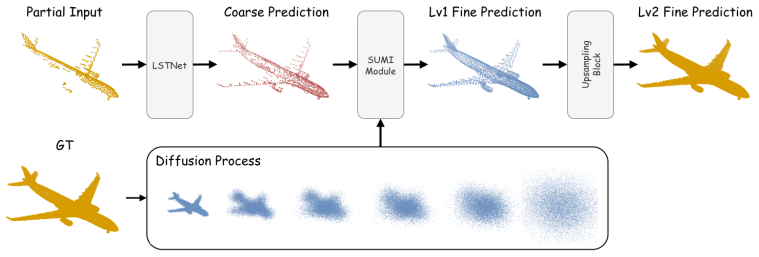
The load-bearing object is the noise-conditioned cross-attention fusion block inside the SUMI module. In each Fusion Block, the feature representation of the coarse prediction acts as the Query and the feature representation of the noisy point cloud acts as the Key and Value; a self-attention layer then enhances the fused features, and separate branches fuse in keypoint features and symmetry features before a final fusion block and a fully connected layer map to the upsampled point cloud. This mechanism lets stochastic perturbations influence how coarse structure and noisy geometry interact, which is what turns the diffusion process into a refinement signal rather than a coordinate generator. The second load-bearing piece is the three-layer coarse-to-fine pipeline that places SUMI at the first fine-generation stage and leaves a lightweight upsampler to reach the final density.
What would settle it
Run the same SUMI architecture on PCN with the mathematically correct DDPM posterior update (adding scheduled noise back at each reverse step) instead of the paper's clean-prediction substitution; if CD does not improve over the T=0 single-step baseline, the reported gains are not produced by a real reverse diffusion process.
Extended reading notes
Core claim
The central discovery is that diffusion does not need to be a standalone generator to help point cloud completion; it can serve as a fine-stage refinement signal inside feature interaction. SUMI encodes the coarse prediction and the noisy point cloud separately, then fuses them with cross-attention in which the coarse features are the query and the noisy features are the key and value, followed by self-attention and further fusion with keypoint and symmetry features. Because the key and value come from noise-perturbed geometry, the attention weights are implicitly conditioned on noise, and the network learns to predict the clean point cloud from the noisy observation. At inference, the predicted clean point cloud is used as the denoised estimate at each of T steps, with T=200 giving the best result. The paper claims this yields the best overall $\ell^1$ CD and F1-score on PCN, a CD reduction of up to 16.1% on ShapeNet-55, and the best CD across all four output densities on MVP, while also improving AdaPoinTr when integrated into it.
Load-bearing premise
The central claim depends on the assumption that iteratively replacing the noisy input with the network's predicted clean point cloud across T steps is a valid reverse diffusion process, an update rule the paper never states.
Editorial extensions
If this is right
- Existing coarse-to-fine completion models can adopt SUMI as a plug-in refinement stage and expect lower CD and higher F1 without retraining the whole architecture from scratch, as demonstrated with AdaPoinTr.
- Using diffusion at the fine stage rather than as a generator preserves global consistency and yields better local detail, with the gains attributed to iterative denoising because T=200 outperforms T=0 with the same architecture.
- Applying SUMI at the coarse stage degrades performance; the refinement belongs after coarse prediction, so future designs should target the fine-generation stage for diffusion-based refinement.
- Increasing inference timesteps improves quality up to T=200 and degrades at T=300, so there is a sweet spot balancing reconstruction quality and inference cost.
- The improved quality comes with extra inference cost from T steps of denoising, which the paper mitigates by applying SUMI only at the first fine stage and using a lightweight upsampler for the final density.
Reading between the lines
- The paper never writes the reverse update rule; it only states the forward process and the training loss. If the iterated clean-prediction substitution is not a proper DDPM posterior step, some of the reported gains could come from the fusion architecture or from timestep conditioning rather than from diffusion itself.
- The same noise-conditioned cross-attention design could transfer to other dense 3D tasks such as depth completion or scene completion, where a coarse prediction and a noisy observation must be fused in feature space; that would be a testable extension the paper does not explore.
- Because SUMI conditions on keypoint and symmetry features from the coarse model, its gains may depend on the coarse model's symmetry prior; on categories with weak or no symmetry, the refinement may add less.
Editorial analysis
A structured set of objections, weighed in public.
Referee Report
Summary. The manuscript proposes SUMI, a diffusion-enhanced refinement module for coarse-to-fine point cloud completion. The module takes a coarse prediction and a noisy point cloud, encodes them separately, and fuses them through cross-attention in which coarse features serve as queries and noisy features as keys/values; keypoint and symmetry features are then incorporated via additional fusion blocks. Training uses a Chamfer-distance loss to predict the clean fine point cloud from a noisy observation, jointly with coarse and upsampling losses. At inference the authors state that reverse denoising is performed for T steps, with the predicted clean point cloud used as the denoised estimate at each step. Experiments on PCN, ShapeNet-55/34, and MVP report improved CD/F1 over baselines, and ablations study output density, insertion stage, and diffusion timestep T.
Significance. If the reported results are reproducible, SUMI is a practically useful plug-in refinement stage: it improves a strong coarse-to-fine baseline (SymmCompletion) on three benchmarks and can be inserted into AdaPoinTr with minimal architectural changes. The paper also contributes a useful ablation study on the diffusion timestep and the insertion stage, and it evaluates on standardized benchmarks with broad category coverage. However, the lack of code, the absence of error bars, and the under-specification of the inference-time reverse process currently leave the central 'diffusion' attribution unsupported.
major comments (3)
- [§3.3.1 and Supplementary §2] The inference-time reverse process is never defined. The main text states that 'the predicted clean point cloud is used as the denoised estimate at each step, following the DDPM formulation summarized in the supplementary material,' but the supplementary only gives the forward kernel q(xt|xt−1), the marginal q(xt|x0), and the loss Ldiff; no reverse posterior q(xt−1|xt,x0), no sampling update, and no initialization for the reverse chain are provided. Consequently, the procedure used to obtain the T=200 results in Fig. 7 cannot be reproduced, and the gains cannot be attributed to a DDPM reverse transition rather than to repeated feed-forward application of the same network. Please provide the exact update rule and the initialization of the reverse chain, and either justify that it is a proper DDPM posterior or revise the diffusion-based claims.
- [§3.3.1–3.3.2] The network is not explicitly conditioned on the diffusion timestep t. In standard DDPMs, the model receives t (e.g., through a sinusoidal time embedding) so that one network can handle different noise levels; here the inputs are the noisy point cloud xt and the coarse/symmetry features, with no mention of any t embedding or t-dependent feature. Because the cross-attention is described only as Fc (query) against F_t^x (key/value), the noise level is available only implicitly through the statistics of xt. Without explicit time conditioning, iterative application of the same network for T steps is not a discretization of a known diffusion reverse process, and the meaning of 'timestep T' in Fig. 7 is unclear. Please specify the time-conditioning mechanism or clarify how the model distinguishes different noise levels.
- [Tables 1–3 and §4.2–4.4] The empirical claims are reported without error bars or significance tests, and the margins over the strongest baseline are small in several cases (PCN overall CD 6.27 vs 6.33 for SymmCompletion; MVP 2048 CD 4.85 vs 4.89 with F1 0.53 vs 0.54). The 'best' claims in the abstract and in §4.2–4.4 therefore rest on single-run numbers. Please report means and standard deviations over at least three training runs, or make the code and exact evaluation protocol available so that the results can be independently verified.
minor comments (6)
- [Eq. (5)] Equation (5) uses the symbol '·' for the operation that is afterwards defined as concatenation; as written, the expression resembles a product of two attention outputs. Please use a dedicated concatenation symbol (e.g., ⊕) or brackets.
- [Tables 2 and 3] Several numeric entries in Tables 2 and 3 lack spacing (e.g., '4.890.54', '2.140.85', '0.390.70'), which makes the tables difficult to read; please fix the formatting.
- [§3.4] Section 3.4 states that the SUMI input density is 2048 for PCN and is then 'further improved to the target resolution,' but it does not state the output density of the SUMI module itself or describe the lightweight upsampling module; please clarify this processing chain.
- [§2.3] In Section 2.3, references [58, 72, 65, 66] are grouped as prior diffusion methods operating on limited ShapeNet subsets, but [72] is a paper on semantic-collaborative diffusion for anomaly detection and does not appear to be a point cloud completion method; please re-check the citation.
- [§4.1] The F1-score threshold is not defined in Section 4.1; please specify it (e.g., 1% of the bounding box diameter) so that the reported F1 numbers can be compared with other papers.
- [Supplementary Table A2] In the supplementary Table A2, the evaluation time for MVP is 550 minutes per epoch, which seems disproportionately large relative to the other datasets; please clarify whether this includes the full test set and the T-step reverse process.
Circularity Check
No circularity: SUMI's CD/F1 gains are empirical benchmark results trained end-to-end on Chamfer Distance and evaluated on held-out data; the undefined reverse-sampling update is a reproducibility gap, not a circular reduction.
full rationale
The claimed derivation chain is an empirical coarse-to-fine completion system. The coarse module is imported from external work (SymmCompletion [8]), and the SUMI refinement module is trained end-to-end with the Chamfer Distance objective of Eq. 2 (Ldiff = LCD(xf, x0)) and the composite loss of Eq. 6. The headline numbers (PCN CD/F1, ShapeNet-55 CD reductions, MVP CD at all densities) are measured on standard held-out test splits against external baselines. No fitted constant, fitted scale, or tuned coefficient is relabeled as a prediction; the metric used for evaluation is also the training loss, but that is standard supervised learning, not a circularity. The Fig. 7 ablation compares T=0 and T>0 under the same refinement architecture, so the reported gain is an empirical result rather than a tautology. I also checked for self-citation load-bearing steps: the paper does not rely on the present authors' prior work; the backbone and fusion blocks are attributed to external papers [8, 68], and the DDPM forward process is standard [43]. No uniqueness theorem is imported from the authors. One genuine omission is flagged: Section 3.3.1 states that 'the predicted clean point cloud is used as the denoised estimate at each step, following the DDPM formulation summarized in the supplementary material,' but neither the main text nor Supplementary Section 2 gives the reverse transition xt-1 = f(xt, xf) or the posterior q(xt-1|xt, x0). This is a missing derivation and a reproducibility risk for the diffusion attribution, but it is not an equation reducible to its inputs by construction and therefore does not constitute circularity under the stated criteria.
Assumptions & free parameters
free parameters (5)
- Diffusion timesteps T =
T=200
- SUMI output density =
2048 points
- SUMI insertion stage =
Level-1 fine stage
- Number of fusion blocks =
4
- Training epochs =
350 (PCN/ShapeNet-55/34), 40 (MVP)
assumptions (5)
- standard math DDPM forward diffusion is a valid noise model for point clouds
- domain assumption The coarse module output Pc preserves sufficient global structure to condition fine refinement
- domain assumption Keypoint features Fk and symmetry features Fs are informative conditional signals
- ad hoc to paper Predicting clean x0 with CD loss yields a valid reverse-diffusion denoiser at inference
- domain assumption CD and F1 on PCN/ShapeNet-55/34/MVP are accepted measures of completion quality
Cite this review
Pith. "Pith review of SUMI: Scalable Unified Model for 3D Point Cloud Inference." pith.science (2026). https://pith.science/paper/QGLOXQVR
@misc{pith2026260808115,
  author       = {Pith},
  title        = {Pith review of: SUMI: Scalable Unified Model for 3D Point Cloud Inference},
  year         = {2026},
  howpublished = {\url{https://pith.science/paper/QGLOXQVR}},
  note         = {Machine review of arXiv:2608.08115}
}
read the original abstract
Point cloud completion commonly follows a coarse-to-fine paradigm, where a low-density coarse shape is first predicted and then upsampled to the target resolution. Although recent methods have improved global structure recovery, the fine stage often remains limited by simple upsampling and insufficient interaction with coarse structural features, making local detail reconstruction challenging. We propose SUMI, a diffusion-enhanced refinement module for coarse-to-fine point cloud completion. Unlike prior diffusion-based completion methods that use diffusion as a standalone point generator, SUMI injects noisy geometric features into cross-attention with coarse structural features, enabling reverse denoising to refine local geometry while preserving global consistency. SUMI can also be integrated into existing coarse-to-fine models as a flexible refinement module. Experiments on PCN, ShapeNet-55/34, and MVP demonstrate consistent improvements over strong baselines. SUMI achieves the best overall CD and F1-score on PCN, reduces CD by up to 16.1% on ShapeNet-55, and obtains the best CD across all output densities on MVP.
Figures


Figures from the paper (2 more)


Reference graph
Works this paper leans on
-
[1]
Poisson surface reconstruction
Michael Kazhdan, Matthew Bolitho, and Hugues Hoppe. Poisson surface reconstruction. In Proceedings of the fourth Eurographics symposium on Geometry processing, volume 7, 2006
2006
-
[2]
Database-assisted object retrieval for real-time 3d reconstruction
Yangyan Li, Angela Dai, Leonidas Guibas, and Matthias Nießner. Database-assisted object retrieval for real-time 3d reconstruction. InComputer graphics forum, volume 34, pages 435–446. Wiley Online Library, 2015
work page 2015
-
[3]
Example- based 3d scan completion
Mark Pauly, Niloy J Mitra, Joachim Giesen, Markus H Gross, and Leonidas J Guibas. Example- based 3d scan completion. InSymposium on geometry processing, volume 23, page 32. Vienna, 2005
work page 2005
-
[4]
Xiaoguang Han, Zhen Li, Haibin Huang, Evangelos Kalogerakis, and Yizhou Yu. High- resolution shape completion using deep neural networks for global structure and local geometry inference. InProceedings of the IEEE international conference on computer vision, pages 85–93, 2017
work page 2017
-
[5]
Pointr: Diverse point cloud completion with geometry-aware transformers
Xumin Yu, Yongming Rao, Ziyi Wang, Zuyan Liu, Jiwen Lu, and Jie Zhou. Pointr: Diverse point cloud completion with geometry-aware transformers. InProceedings of the IEEE/CVF international conference on computer vision, pages 12498–12507, 2021
work page 2021
-
[6]
V oxel-based network for shape completion by leveraging edge generation
Xiaogang Wang, Marcelo H Ang, and Gim Hee Lee. V oxel-based network for shape completion by leveraging edge generation. InProceedings of the IEEE/CVF international conference on computer vision, pages 13189–13198, 2021
work page 2021
-
[7]
Peng-Shuai Wang, Chun-Yu Sun, Yang Liu, and Xin Tong. Adaptive o-cnn: A patch-based deep representation of 3d shapes.ACM Transactions on Graphics (TOG), 37(6):1–11, 2018
work page 2018
-
[8]
Symmcompletion: High-fidelity and high-consistency point cloud completion with symmetry guidance
Hongyu Yan, Zijun Li, Kunming Luo, Li Lu, and Ping Tan. Symmcompletion: High-fidelity and high-consistency point cloud completion with symmetry guidance. InProceedings of the AAAI Conference on Artificial Intelligence, volume 39, pages 9094–9102, 2025
2025
Show all 78 references
-
[9]
Shape-controllable geometry completion for point cloud models.The Visual Computer, 33(3):385–398, 2017
Long Yang, Qingan Yan, and Chunxia Xiao. Shape-controllable geometry completion for point cloud models.The Visual Computer, 33(3):385–398, 2017
2017
-
[10]
Symmetry descriptors and 3d shape matching
Michael Kazhdan, Thomas Funkhouser, and Szymon Rusinkiewicz. Symmetry descriptors and 3d shape matching. InProceedings of the 2004 Eurographics/ACM SIGGRAPH symposium on Geometry processing, pages 115–123, 2004
2004
-
[11]
Partial and approximate symmetry detection for 3d geometry.ACM Transactions on Graphics (ToG), 25(3):560–568, 2006
Niloy J Mitra, Leonidas J Guibas, and Mark Pauly. Partial and approximate symmetry detection for 3d geometry.ACM Transactions on Graphics (ToG), 25(3):560–568, 2006
2006
-
[12]
Foldingnet: Point cloud auto-encoder via deep grid deformation
Yaoqing Yang, Chen Feng, Yiru Shen, and Dong Tian. Foldingnet: Point cloud auto-encoder via deep grid deformation. InProceedings of the IEEE conference on computer vision and pattern recognition, pages 206–215, 2018
2018
-
[13]
Vapcnet: viewpoint-aware 3d point cloud completion
Zhiheng Fu, Longguang Wang, Lian Xu, Zhiyong Wang, Hamid Laga, Yulan Guo, Farid Boussaid, and Mohammed Bennamoun. Vapcnet: viewpoint-aware 3d point cloud completion. InProceedings of the IEEE/CVF International Conference on Computer Vision, pages 12108– 12118, 2023
2023
-
[14]
Pointattn: You only need attention for point cloud completion
Jun Wang, Ying Cui, Dongyan Guo, Junxia Li, Qingshan Liu, and Chunhua Shen. Pointattn: You only need attention for point cloud completion. InProceedings of the AAAI Conference on artificial intelligence, volume 38, pages 5472–5480, 2024
2024
-
[15]
Seedformer: Patch seeds based point cloud completion with upsample transformer
Haoran Zhou, Yun Cao, Wenqing Chu, Junwei Zhu, Tong Lu, Ying Tai, and Chengjie Wang. Seedformer: Patch seeds based point cloud completion with upsample transformer. InEuropean conference on computer vision, pages 416–432. Springer, 2022
2022
-
[16]
Attention is all you need.Advances in neural information processing systems, 30, 2017
Ashish Vaswani, Noam Shazeer, Niki Parmar, Jakob Uszkoreit, Llion Jones, Aidan N Gomez, Łukasz Kaiser, and Illia Polosukhin. Attention is all you need.Advances in neural information processing systems, 30, 2017
2017
-
[17]
Bert: Pre-training of deep bidirectional transformers for language understanding, 2019
Jacob Devlin, Ming-Wei Chang, Kenton Lee, and Kristina Toutanova. Bert: Pre-training of deep bidirectional transformers for language understanding, 2019. URL https://arxiv.org/ abs/1810.04805. 10
2019 arXiv
-
[18]
Gpt-4 technical report, 2024
OpenAI. Gpt-4 technical report, 2024. URLhttps://arxiv.org/abs/2303.08774
2024 arXiv
-
[19]
An image is worth 16x16 words: Transformers for image recognition at scale.arXiv preprint arXiv:2010.11929, 2020
Alexey Dosovitskiy. An image is worth 16x16 words: Transformers for image recognition at scale.arXiv preprint arXiv:2010.11929, 2020
2010 arXiv
-
[20]
Training data-efficient image transformers and distillation through attention, 2021
Hugo Touvron, Matthieu Cord, Matthijs Douze, Francisco Massa, Alexandre Sablayrolles, and Hervé Jégou. Training data-efficient image transformers and distillation through attention, 2021. URLhttps://arxiv.org/abs/2012.12877
2021 arXiv
-
[21]
Masked autoencoders are scalable vision learners
Kaiming He, Xinlei Chen, Saining Xie, Yanghao Li, Piotr Dollár, and Ross Girshick. Masked autoencoders are scalable vision learners. InProceedings of the IEEE/CVF conference on computer vision and pattern recognition, pages 16000–16009, 2022
2022
-
[22]
Medvit: a robust vision transformer for generalized medical image classification
Omid Nejati Manzari, Hamid Ahmadabadi, Hossein Kashiani, Shahriar B Shokouhi, and Ahmad Ayatollahi. Medvit: a robust vision transformer for generalized medical image classification. Computers in biology and medicine, 157:106791, 2023
2023
-
[23]
Uniformer: Unifying convolution and self-attention for visual recognition.IEEE Transactions on Pattern Analysis and Machine Intelligence, 45(10):12581–12600, 2023
Kunchang Li, Yali Wang, Junhao Zhang, Peng Gao, Guanglu Song, Yu Liu, Hongsheng Li, and Yu Qiao. Uniformer: Unifying convolution and self-attention for visual recognition.IEEE Transactions on Pattern Analysis and Machine Intelligence, 45(10):12581–12600, 2023
2023
-
[24]
Detrs with collaborative hybrid assignments training
Zhuofan Zong, Guanglu Song, and Yu Liu. Detrs with collaborative hybrid assignments training. InProceedings of the IEEE/CVF international conference on computer vision, pages 6748–6758, 2023
2023
-
[25]
Detrs beat yolos on real-time object detection
Yian Zhao, Wenyu Lv, Shangliang Xu, Jinman Wei, Guanzhong Wang, Qingqing Dang, Yi Liu, and Jie Chen. Detrs beat yolos on real-time object detection. InProceedings of the IEEE/CVF conference on computer vision and pattern recognition, pages 16965–16974, 2024
2024
-
[26]
Rt-detrv2: Improved baseline with bag-of-freebies for real-time detection transformer, 2024
Wenyu Lv, Yian Zhao, Qinyao Chang, Kui Huang, Guanzhong Wang, and Yi Liu. Rt-detrv2: Improved baseline with bag-of-freebies for real-time detection transformer, 2024. URL https: //arxiv.org/abs/2407.17140
2024 arXiv
-
[27]
Tfnet: Transformer-based multi-scale feature fusion forest fire image detection network.Fire, 8 (2):59, 2025
Hongying Liu, Fuquan Zhang, Yiqing Xu, Junling Wang, Hong Lu, Wei Wei, and Jun Zhu. Tfnet: Transformer-based multi-scale feature fusion forest fire image detection network.Fire, 8 (2):59, 2025
2025
-
[28]
Grey wolf opti- mized swinunet based transformer framework for liver segmentation from ct images.Computers and Electrical Engineering, 117:109248, 2024
SS Kumar, RS Vinod Kumar, VG Ranjith, S Jeevakala, and S Sajithra Varun. Grey wolf opti- mized swinunet based transformer framework for liver segmentation from ct images.Computers and Electrical Engineering, 117:109248, 2024
2024
-
[29]
Patrans: Pixel-adaptive transformer for edge segmentation of cervical nuclei on small-scale datasets
Hexuan Hu, Jianyu Zhang, Tianjin Yang, Qiang Hu, Yufeng Yu, and Qian Huang. Patrans: Pixel-adaptive transformer for edge segmentation of cervical nuclei on small-scale datasets. Computers in Biology and Medicine, 168:107823, 2024
2024
-
[30]
Cswin-unet: Transformer unet with cross-shaped windows for medical image segmentation.Information Fusion, 113:102634, 2025
Xiao Liu, Peng Gao, Tao Yu, Fei Wang, and Ru-Yue Yuan. Cswin-unet: Transformer unet with cross-shaped windows for medical image segmentation.Information Fusion, 113:102634, 2025
2025
-
[31]
Pointclustering: Unsupervised point cloud pre-training using transformation invariance in clustering
Fuchen Long, Ting Yao, Zhaofan Qiu, Lusong Li, and Tao Mei. Pointclustering: Unsupervised point cloud pre-training using transformation invariance in clustering. InProceedings of the IEEE/CVF conference on computer vision and pattern recognition, pages 21824–21834, 2023
2023
-
[32]
Spiking point transformer for point cloud classification
Peixi Wu, Bosong Chai, Hebei Li, Menghua Zheng, Yansong Peng, Zeyu Wang, Xuan Nie, Yueyi Zhang, and Xiaoyan Sun. Spiking point transformer for point cloud classification. In Proceedings of the AAAI Conference on Artificial Intelligence, volume 39, pages 21563–21571, 2025
2025
-
[33]
Bwformer: Building wireframe reconstruction from airborne lidar point cloud with transformer
Yuzhou Liu, Lingjie Zhu, Hanqiao Ye, Shangfeng Huang, Xiang Gao, Xianwei Zheng, and Shuhan Shen. Bwformer: Building wireframe reconstruction from airborne lidar point cloud with transformer. InProceedings of the IEEE/CVF Conference on Computer Vision and Pattern Recognition (C...
2025
-
[34]
Oneformer3d: One transformer for unified point cloud segmentation
Maxim Kolodiazhnyi, Anna V orontsova, Anton Konushin, and Danila Rukhovich. Oneformer3d: One transformer for unified point cloud segmentation. InProceedings of the IEEE/CVF Conference on Computer Vision and Pattern Recognition, pages 20943–20953, 2024
2024
-
[35]
Position-guided point cloud panoptic segmentation transformer.International Journal of Computer Vision, 133(1):275–290, 2025
Zeqi Xiao, Wenwei Zhang, Tai Wang, Chen Change Loy, Dahua Lin, and Jiangmiao Pang. Position-guided point cloud panoptic segmentation transformer.International Journal of Computer Vision, 133(1):275–290, 2025. 11
2025
-
[36]
Point mask transformer for outdoor point cloud semantic segmentation.Computational Visual Media, 2025
Xiangqian Li, Xin Tan, Zhizhong Zhang, Yuan Xie, and Lizhuang Ma. Point mask transformer for outdoor point cloud semantic segmentation.Computational Visual Media, 2025
2025
-
[37]
3dlst: 3d learnable supertoken transformer for lidar point cloud scene segmentation.International Journal of Applied Earth Observation and Geoinformation, 140:104572, 2025
Dening Lu, Linlin Xu, Jun Zhou, Kyle Yilin Gao, and Jonathan Li. 3dlst: 3d learnable supertoken transformer for lidar point cloud scene segmentation.International Journal of Applied Earth Observation and Geoinformation, 140:104572, 2025
2025
-
[38]
Text2lidar: Text-guided lidar point cloud generation via equirectangular transformer
Yang Wu, Kaihua Zhang, Jianjun Qian, Jin Xie, and Jian Yang. Text2lidar: Text-guided lidar point cloud generation via equirectangular transformer. InEuropean Conference on Computer Vision, pages 291–310. Springer, 2024
2024
-
[39]
Sgformer: Semantic graph transformer for point cloud-based 3d scene graph generation
Changsheng Lv, Mengshi Qi, Xia Li, Zhengyuan Yang, and Huadong Ma. Sgformer: Semantic graph transformer for point cloud-based 3d scene graph generation. InProceedings of the AAAI Conference on Artificial Intelligence, volume 38, pages 4035–4043, 2024
2024
-
[40]
Pmp-net++: Point cloud completion by transformer-enhanced multi-step point moving paths.IEEE Transactions on Pattern Analysis and Machine Intelligence, 45(1):852–867, 2022
Xin Wen, Peng Xiang, Zhizhong Han, Yan-Pei Cao, Pengfei Wan, Wen Zheng, and Yu-Shen Liu. Pmp-net++: Point cloud completion by transformer-enhanced multi-step point moving paths.IEEE Transactions on Pattern Analysis and Machine Intelligence, 45(1):852–867, 2022
2022
-
[41]
Dapointr: Domain adaptive point transformer for point cloud completion
Yinghui Li, Qianyu Zhou, Jingyu Gong, Ye Zhu, Richard Dazeley, Xinkui Zhao, and Xuequan Lu. Dapointr: Domain adaptive point transformer for point cloud completion. InProceedings of the AAAI Conference on Artificial Intelligence, volume 39, pages 5066–5074, 2025
2025
-
[42]
Deep unsuper- vised learning using nonequilibrium thermodynamics
Jascha Sohl-Dickstein, Eric Weiss, Niru Maheswaranathan, and Surya Ganguli. Deep unsuper- vised learning using nonequilibrium thermodynamics. InInternational conference on machine learning, pages 2256–2265. pmlr, 2015
2015
-
[43]
Denoising diffusion probabilistic models.Advances in neural information processing systems, 33:6840–6851, 2020
Jonathan Ho, Ajay Jain, and Pieter Abbeel. Denoising diffusion probabilistic models.Advances in neural information processing systems, 33:6840–6851, 2020
2020
-
[44]
Diffusion models in vision: A survey.IEEE transactions on pattern analysis and machine intelligence, 45 (9):10850–10869, 2023
Florinel-Alin Croitoru, Vlad Hondru, Radu Tudor Ionescu, and Mubarak Shah. Diffusion models in vision: A survey.IEEE transactions on pattern analysis and machine intelligence, 45 (9):10850–10869, 2023
2023
-
[45]
Conditional image generation with score-based diffusion models.arXiv preprint arXiv:2111.13606, 2021
Georgios Batzolis, Jan Stanczuk, Carola-Bibiane Schönlieb, and Christian Etmann. Conditional image generation with score-based diffusion models.arXiv preprint arXiv:2111.13606, 2021
2021 arXiv
-
[46]
Freedom: Training- free energy-guided conditional diffusion model
Jiwen Yu, Yinhuai Wang, Chen Zhao, Bernard Ghanem, and Jian Zhang. Freedom: Training- free energy-guided conditional diffusion model. InProceedings of the IEEE/CVF International Conference on Computer Vision (ICCV), pages 23174–23184, October 2023
2023
-
[47]
Conditional text image generation with diffusion models
Yuanzhi Zhu, Zhaohai Li, Tianwei Wang, Mengchao He, and Cong Yao. Conditional text image generation with diffusion models. InProceedings of the IEEE/CVF Conference on Computer Vision and Pattern Recognition (CVPR), pages 14235–14245, June 2023
2023
-
[48]
Return of unconditional generation: A self- supervised representation generation method.Advances in Neural Information Processing Systems, 37:125441–125468, 2024
Tianhong Li, Dina Katabi, and Kaiming He. Return of unconditional generation: A self- supervised representation generation method.Advances in Neural Information Processing Systems, 37:125441–125468, 2024
2024
-
[49]
Implicit diffusion models for continuous super-resolution
Sicheng Gao, Xuhui Liu, Bohan Zeng, Sheng Xu, Yanjing Li, Xiaoyan Luo, Jianzhuang Liu, Xiantong Zhen, and Baochang Zhang. Implicit diffusion models for continuous super-resolution. InProceedings of the IEEE/CVF conference on computer vision and pattern recognition, pages 10021...
2023
-
[50]
Resdiff: Combining cnn and diffusion model for image super-resolution
Shuyao Shang, Zhengyang Shan, Guangxing Liu, LunQian Wang, XingHua Wang, Zekai Zhang, and Jinglin Zhang. Resdiff: Combining cnn and diffusion model for image super-resolution. In Proceedings of the AAAI Conference on Artificial Intelligence, volume 38, pages 8975–8983, 2024
2024
-
[51]
Ediffsr: An efficient diffusion probabilistic model for remote sensing image super-resolution.IEEE Transactions on Geoscience and Remote Sensing, 62:1–14, 2023
Yi Xiao, Qiangqiang Yuan, Kui Jiang, Jiang He, Xianyu Jin, and Liangpei Zhang. Ediffsr: An efficient diffusion probabilistic model for remote sensing image super-resolution.IEEE Transactions on Geoscience and Remote Sensing, 62:1–14, 2023
2023
-
[52]
Acdmsr: Accelerated conditional diffusion models for single image super-resolution.IEEE Transactions on Broadcasting, 70(2):492–504, 2024
Axi Niu, Trung X Pham, Kang Zhang, Jinqiu Sun, Yu Zhu, Qingsen Yan, In So Kweon, and Yanning Zhang. Acdmsr: Accelerated conditional diffusion models for single image super-resolution.IEEE Transactions on Broadcasting, 70(2):492–504, 2024
2024
-
[53]
Inpdiffusion: Image inpainting localization via conditional diffusion models
Kai Wang, Shaozhang Niu, Qixian Hao, and Jiwei Zhang. Inpdiffusion: Image inpainting localization via conditional diffusion models. InProceedings of the AAAI Conference on Artificial Intelligence, volume 39, pages 7771–7779, 2025. 12
2025
-
[54]
Rad: Region-aware diffusion models for image inpainting
Sora Kim, Sungho Suh, and Minsik Lee. Rad: Region-aware diffusion models for image inpainting. InProceedings of the Computer Vision and Pattern Recognition Conference, pages 2439–2448, 2025
2025
-
[55]
Efficient and scalable point cloud generation with sparse point- voxel diffusion models.IEEE Transactions on Neural Networks and Learning Systems, 2025
Ioannis Romanelis, Vlassis Fotis, Athanasios Kalogeras, Christos Alexakos, Adrian Munteanu, and Konstantinos Moustakas. Efficient and scalable point cloud generation with sparse point- voxel diffusion models.IEEE Transactions on Neural Networks and Learning Systems, 2025
2025
-
[56]
Diffusion probabilistic models for 3d point cloud generation
Shitong Luo and Wei Hu. Diffusion probabilistic models for 3d point cloud generation. In Proceedings of the IEEE/CVF conference on computer vision and pattern recognition, pages 2837–2845, 2021
2021
-
[57]
Sketch and text guided diffu- sion model for colored point cloud generation
Zijie Wu, Yaonan Wang, Mingtao Feng, He Xie, and Ajmal Mian. Sketch and text guided diffu- sion model for colored point cloud generation. InProceedings of the IEEE/CVF International Conference on Computer Vision, pages 8929–8939, 2023
2023
-
[58]
Lion: Latent point diffusion models for 3d shape generation.Advances in Neural Information Processing Systems, 35:10021–10039, 2022
Arash Vahdat, Francis Williams, Zan Gojcic, Or Litany, Sanja Fidler, Karsten Kreis, et al. Lion: Latent point diffusion models for 3d shape generation.Advances in Neural Information Processing Systems, 35:10021–10039, 2022
2022
-
[59]
Octfusion: Octree-based diffusion models for 3d shape generation
Bojun Xiong, Si-Tong Wei, Xin-Yang Zheng, Yan-Pei Cao, Zhouhui Lian, and Peng-Shuai Wang. Octfusion: Octree-based diffusion models for 3d shape generation. InComputer Graphics Forum, volume 44, page e70198. Wiley Online Library, 2025
2025
-
[60]
3dshape2vecset: A 3d shape representation for neural fields and generative diffusion models.ACM Transactions On Graphics (TOG), 42(4):1–16, 2023
Biao Zhang, Jiapeng Tang, Matthias Niessner, and Peter Wonka. 3dshape2vecset: A 3d shape representation for neural fields and generative diffusion models.ACM Transactions On Graphics (TOG), 42(4):1–16, 2023
2023
-
[61]
3d shape generation and completion through point-voxel diffusion
Linqi Zhou, Yilun Du, and Jiajun Wu. 3d shape generation and completion through point-voxel diffusion. InProceedings of the IEEE/CVF international conference on computer vision, pages 5826–5835, 2021
2021
-
[62]
Reconx: Reconstruct any scene from sparse views with video diffusion model
Fangfu Liu, Wenqiang Sun, Hanyang Wang, Yikai Wang, Haowen Sun, Junliang Ye, Jun Zhang, and Yueqi Duan. Reconx: Reconstruct any scene from sparse views with video diffusion model. arXiv preprint arXiv:2408.16767, 2024
2024 arXiv
-
[63]
Vis- tadream: Sampling multiview consistent images for single-view scene reconstruction
Haiping Wang, Yuan Liu, Ziwei Liu, Wenping Wang, Zhen Dong, and Bisheng Yang. Vis- tadream: Sampling multiview consistent images for single-view scene reconstruction. In Proceedings of the IEEE/CVF International Conference on Computer Vision, pages 26772– 26782, 2025
2025
-
[64]
Diffindscene: Diffusion-based high-quality 3d indoor scene generation
Xiaoliang Ju, Zhaoyang Huang, Yijin Li, Guofeng Zhang, Yu Qiao, and Hongsheng Li. Diffindscene: Diffusion-based high-quality 3d indoor scene generation. InProceedings of the IEEE/CVF Conference on Computer Vision and Pattern Recognition, pages 4526–4535, 2024
2024
-
[65]
Point cloud completion with pretrained text-to- image diffusion models.Advances in Neural Information Processing Systems, 36:12171–12191, 2023
Yoni Kasten, Ohad Rahamim, and Gal Chechik. Point cloud completion with pretrained text-to- image diffusion models.Advances in Neural Information Processing Systems, 36:12171–12191, 2023
2023
-
[66]
Superpc: a single diffusion model for point cloud completion, upsampling, denoising, and colorization
Yi Du, Zhipeng Zhao, Shaoshu Su, Sharath Golluri, Haoze Zheng, Runmao Yao, and Chen Wang. Superpc: a single diffusion model for point cloud completion, upsampling, denoising, and colorization. InProceedings of the Computer Vision and Pattern Recognition Conference, pages 16953...
2025
-
[67]
A conditional point diffusion-refinement paradigm for 3d point cloud completion.arXiv preprint arXiv:2112.03530, 2021
Zhaoyang Lyu, Zhifeng Kong, Xudong Xu, Liang Pan, and Dahua Lin. A conditional point diffusion-refinement paradigm for 3d point cloud completion.arXiv preprint arXiv:2112.03530, 2021
2021 arXiv
-
[68]
Lrm: Large reconstruction model for single image to 3d
Yicong Hong, Kai Zhang, Jiuxiang Gu, Sai Bi, Yang Zhou, Difan Liu, Feng Liu, Kalyan Sunkavalli, Trung Bui, and Hao Tan. Lrm: Large reconstruction model for single image to 3d. arXiv preprint arXiv:2311.04400, 2023
2023 arXiv
-
[69]
Pcn: Point completion network
Wentao Yuan, Tejas Khot, David Held, Christoph Mertz, and Martial Hebert. Pcn: Point completion network. In2018 international conference on 3D vision (3DV), pages 728–737. IEEE, 2018
2018
-
[70]
3d shapenets: A deep representation for volumetric shapes
Zhirong Wu, Shuran Song, Aditya Khosla, Fisher Yu, Linguang Zhang, Xiaoou Tang, and Jianxiong Xiao. 3d shapenets: A deep representation for volumetric shapes. InProceedings of the IEEE conference on computer vision and pattern recognition, pages 1912–1920, 2015. 13
1912
-
[71]
Multi-view partial (mvp) point cloud challenge 2021 on completion and registration: Methods and results.arXiv preprint arXiv:2112.12053, 2021
Liang Pan, Tong Wu, Zhongang Cai, Ziwei Liu, Xumin Yu, Yongming Rao, Jiwen Lu, Jie Zhou, Mingye Xu, Xiaoyuan Luo, Kexue Fu, Peng Gao, Manning Wang, Yali Wang, Yu Qiao, Junsheng Zhou, Xin Wen, Peng Xiang, Yu-Shen Liu, Zhizhong Han, Yuanjie Yan, Junyi An, Lifa Zhu, Changwei Lin,...
2021 arXiv
-
[72]
Sc-diff: Semantic-collaborative diffusion for multi- class anomaly detection
Haodong Wei, Qitao Hu, and Wenhe Liu. Sc-diff: Semantic-collaborative diffusion for multi- class anomaly detection. InProceedings of the 9th International Conference on Electronic Information Technology and Computer Engineering, pages 935–938, 2025
2025
-
[73]
Svdformer: Complementing point cloud via self-view augmentation and self-structure dual-generator
Zhe Zhu, Honghua Chen, Xing He, Weiming Wang, Jing Qin, and Mingqiang Wei. Svdformer: Complementing point cloud via self-view augmentation and self-structure dual-generator. In Proceedings of the IEEE/CVF International Conference on Computer Vision, pages 14508– 14518, 2023
2023
-
[74]
Cra-pcn: Point cloud completion with intra-and inter-level cross-resolution transformers
Yi Rong, Haoran Zhou, Lixin Yuan, Cheng Mei, Jiahao Wang, and Tong Lu. Cra-pcn: Point cloud completion with intra-and inter-level cross-resolution transformers. InProceedings of the AAAI Conference on Artificial Intelligence, volume 38, pages 4676–4685, 2024
2024
-
[75]
T-corresnet: Template guided 3d point cloud completion with correspondence pooling query generation strategy
Fan Duan, Jiahao Yu, and Li Chen. T-corresnet: Template guided 3d point cloud completion with correspondence pooling query generation strategy. InEuropean conference on computer vision, pages 90–106. Springer, 2024
2024
-
[76]
Dc-pcn: Point cloud completion network with dual-codebook guided quantization
Qiuxia Wu, Haiyang Huang, Kunming Su, Zhiyong Wang, and Kun Hu. Dc-pcn: Point cloud completion network with dual-codebook guided quantization. InProceedings of the AAAI Conference on Artificial Intelligence, volume 39, pages 8441–8449, 2025
2025
-
[77]
Snowflakenet: Point cloud completion by snowflake point deconvolution with skip-transformer
Peng Xiang, Xin Wen, Yu-Shen Liu, Yan-Pei Cao, Pengfei Wan, Wen Zheng, and Zhizhong Han. Snowflakenet: Point cloud completion by snowflake point deconvolution with skip-transformer. InProceedings of the IEEE/CVF international conference on computer vision, pages 5499–5509, 2021
2021
-
[78]
Aednet: adaptive embedding and multiview-aware disentanglement for point cloud completion
Zhiheng Fu, Longguang Wang, Lian Xu, Zhiyong Wang, Hamid Laga, Yulan Guo, Farid Boussaid, and Mohammed Bennamoun. Aednet: adaptive embedding and multiview-aware disentanglement for point cloud completion. InEuropean conference on computer vision, pages 127–143. Springer, 2024....
2024
Reviewed August 12, 2026 · model on record in the stance chip above.
Discussion (0). Continue with ORCID to comment.