REVIEW 3 major objections 5 minor 41 references
Confidence gating alone is not enough for reliable perception-to-action behavior; the fallback rule during holds is part of the decision problem, and a bounded-blend update removes severe stale-command error (3.2° to 0.5°).
Reviewed by Pith at T0; open to challenge. T0 means a machine referee read the full paper against a public rubric. the ladder, T0–T4 →
T0 review · deepseek-v4-flash
2026-08-01 14:33 UTC pith:QGMCWOBP
load-bearing objection A useful framing — fallback policy matters — but the headline numbers need full parameter disclosure and sensitivity analysis before they can be trusted. the 3 major comments →
Confidence-Gated Vision-Only Heading Alignment for UAV-UGV Cooperative Systems
The pith
A machine-rendered reading of the paper's core claim, the machinery that carries it, and where it could break.
Core claim
On its own terms, the paper establishes that the mapping from a fixed heading predictor to a safe command stream is a decision problem separable from prediction quality. Two cheap, interpretable proxies from the perception stream — bounding-box area and the rolling standard deviation of recent predicted headings — form a confidence gate (execute only when area is above a threshold and stability is below a threshold). Evaluating on a real UAV–UGV dataset with clean and perturbed perception, the paper finds that gating improves the quality of the executed subset but, with a freeze-HOLD fallback, severely degrades the issued command stream when execution becomes sparse. Under the same predictor
What carries the argument
The central object is the bounded-blend fallback update rule (Eq. 3): during a HOLD, the issued command is updated as a weighted average of the previous command and the current prediction, with a short-hold blending factor α for holds up to a maximum duration h-bar and a recovery blending factor ρ for longer holds; the baseline freeze-HOLD (Eq. 4) is the special case that repeats the previous command indefinitely. This rule, paired with the confidence gate (Eq. 7) that executes only when bounding-box area is above τ_area and rolling heading standard deviation σθ is below τ_σ, carries the argument by separating execution selectivity (which predictions get issued) from fallback behavior (how t
Load-bearing premise
The load-bearing premise is that the rolling standard deviation of recent heading predictions tracks true prediction reliability, so that low σθ means the prediction is trustworthy; a systematically biased but stable prediction would be executed by the gate, and the paper never validates σθ against actual heading error under perturbation.
What would settle it
A concrete test: perturb the predictor outputs to be a constant value offset by, say, 5 degrees from the true heading, with zero variance. The stability proxy σθ would be near zero and the area proxy unchanged, so the gate would execute every frame; the issued-stream MAE would jump to roughly 5 degrees even at low perturbation, demonstrating that the gate does not catch systematic bias. Conversely, if the gate's success under random perturbation is the claim, that test should fail to show degradation — but it would succeed, revealing the proxy's blindness to bias.
If this is right
- Confidence gating creates a real trade-off among execution rate, executed-frame accuracy, issued-command accuracy, and smoothness; no single gate dominates on all four under perturbation.
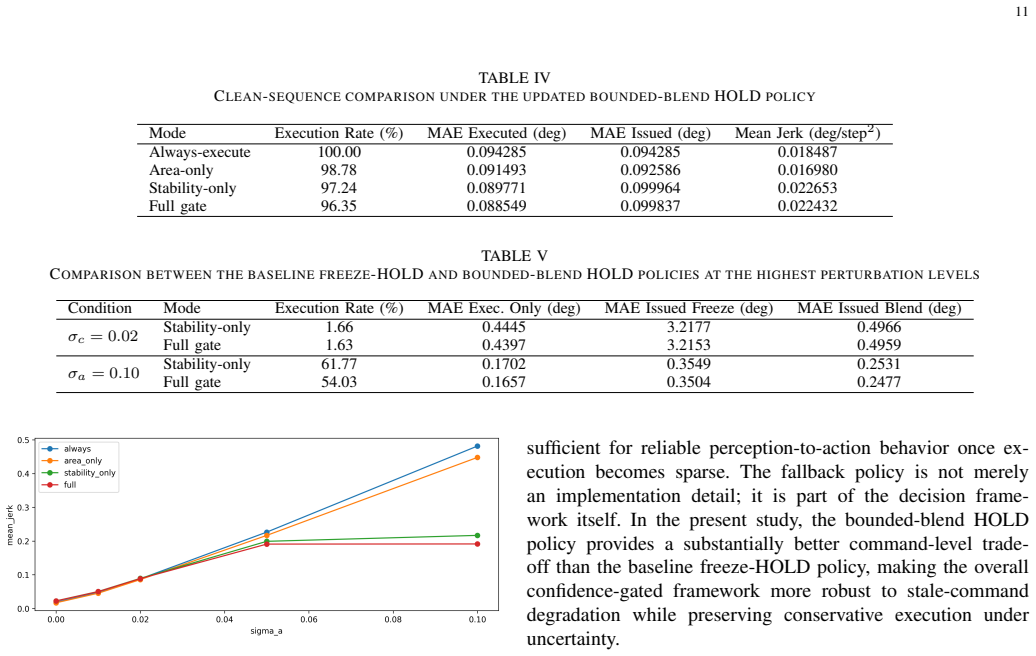
- Under strong centroid perturbation, stability-based gates become highly selective (execution fraction collapses to about 1.6 percent), preserving a clean executed subset (MAE ~0.44°) but, with freeze-HOLD, causing issued-stream MAE above 3.2° — worse than always executing.
- Switching to the bounded-blend fallback under identical gate decisions reduces issued-stream MAE to about 0.50° at σc = 0.02 and improves the command-level trade-off under area perturbation as well (0.3549° to 0.2531° for stability-only).
- The fallback is thus part of the decision framework: reliable perception-driven autonomy depends not only on when to execute but on how the command evolves when execution is withheld.
Where Pith is reading between the lines
- The robustness of the gating logic rests on an unvalidated proxy: the rolling standard deviation σθ is assumed to track true prediction reliability. A predictor that is consistently wrong but stable (e.g., a constant biased output) would pass the stability gate and be executed, so the reported gains may not hold under systematic bias rather than random perturbation.
- The bounded-blend fallback is formally a low-pass filter or momentum on the command stream, so a natural neighbouring question is whether a simple exponentially weighted moving average without any gate would achieve similar command-level error at lower complexity; the paper does not compare against such a baseline.
- The same decision-layer design could transfer to other perception-to-control interfaces — such as obstacle detection confidence or localization variance — where the cost of acting on a bad estimate is different from the cost of freezing, and where a bounded blend might need to be tuned per domain.
- The Pareto-grid threshold selection on a calibration subset suggests that thresholds could be adapted online as operating conditions shift; the paper lists this as future work, but the reported sensitivity to perturbation magnitude implies a frozen threshold will be suboptimal across a wider range of noise levels.
Editorial analysis
A structured set of objections, weighed in public.
Referee Report
Summary. The paper proposes a confidence-gated decision layer for a fixed vision-based heading predictor in a UAV–UGV cooperative setting. Two interpretable proxies are used to decide whether to issue the current predicted heading: bounding-box area (visibility) and short-window rolling standard deviation of predicted headings (stability). When the gate selects HOLD, the paper compares a baseline freeze-HOLD policy with a bounded-blend fallback update (Eq. 3) that lets the issued command evolve conservatively. Experiments on a real dataset under clean and perturbed conditions show that, under identical gate decisions, the bounded-blend policy substantially reduces issued-stream MAE at high centroid perturbation (from about 3.22° to 0.50°) and also improves the area-perturbation case. The authors conclude that fallback behavior during low-confidence intervals is a first-class decision problem, not an implementation detail.
Significance. The paper identifies and quantifies a real problem in perception-to-action pipelines: when confidence gating makes execution sparse, the choice of what to do during HOLD can dominate command-level error. The idea of separating the gate decision from the fallback update is sensible, and the experiments are structured to isolate the fallback effect by holding the predictor, thresholds, and gate decisions fixed. The use of decision-level metrics (executed fraction, executed-only MAE, issued-stream MAE, mean jerk) is a strength compared to evaluation that stops at predictor MAE. If the reported improvement is reproducible and robust, the paper would provide a useful design principle for UAV–UGV cooperation and similar perception-driven systems.
major comments (3)
- [§IV-C, Eq. (3) and Eq. (6); §VI-C, Tables IV–V] The central quantitative claim—that bounded-blend HOLD reduces issued-stream MAE from 3.2176° to 0.4966° at σc=0.02—depends on the fallback parameters α, h̄, ρ and on the stability window k. None of these values are reported, nor is the procedure by which they were chosen. Eq. (3) is a tunable filter: with large α and ρ it approaches always-execute behavior, and with small values it approaches freeze-HOLD. The reported improvement is therefore not a property of the bounded-blend rule alone but of specific parameter choices. Please report the exact values used, state whether they were fixed before the test evaluation or selected on the test data, and provide a sensitivity analysis over a plausible parameter range. Also report k, since it affects σθ(t) and hence the gate decisions themselves.
- [§IV-I, §VI-B/C, Tables II and V] The perturbation experiments are described as repeated Monte Carlo trials, but all reported numbers are point estimates without error bars, standard deviations, or confidence intervals. This is especially concerning at σc=0.02, where the executed fraction is only about 1.6%, so the executed-only MAE and issued-stream MAE are based on very few executed frames and may be noisy. To support the claim that the 3.22°→0.50° improvement is significant, report trial-to-trial variability and, if possible, confidence intervals for the key metrics.
- [§IV-C, Eq. (6); §VI-D] The stability proxy σθ(t) is used to gate execution, but it is never validated against the quantity it is meant to proxy: the actual heading error under perturbation. If a systematic bias or misdetection produces consistently wrong but stable predictions, the gate will execute them. The paper should at least report a correlation or scatter plot between σθ(t) and |θt − θ̂t| on the calibration subset, or otherwise justify why rolling standard deviation of the predictor output is a reliability signal. The freeze-vs-blend comparison is internally consistent, but this validation is load-bearing for the broader claim that the framework improves reliable command issuance.
minor comments (5)
- [§III-C, Eq. (3)] The hold counter h_t is used in Eq. (3) but its update is not formally defined. Specify that h_t resets on every EXECUTE and increments on each HOLD, or define it as a recursive quantity.
- [§IV-F] The threshold-calibration procedure is described only at a high level. Please specify the grid ranges and resolution for (τ_area, τ_σ), and clarify the exact criterion used to pick the operating point from the Pareto set.
- [Figures] The manuscript references many figures (Fig. 2–13), but the arXiv text contains no figure images. If the figures are missing in the submitted version, please ensure they are included in the camera-ready; the results are very hard to evaluate without them.
- [References] The inherited predictor and dataset come from reference [17], an arXiv preprint by the same group. Please state explicitly whether that code/data are publicly available, since the present paper's experiments depend on them.
- [General] The notation for the rolling mean in Eq. (5) uses the same symbol θ̄_t as later text; consider a distinct notation, e.g., μθ(t), to avoid confusion with the mean over another index.
Circularity Check
No significant circularity: the central claims are measured comparisons against a fixed predictor and ground truth, not derivations from the framework's own definitions.
full rationale
The paper's contribution is an empirical decision-layer evaluation, not a first-principles derivation. The predictor and dataset from [17] are fixed inputs; the decision thresholds are calibrated on a separate calibration subset and fixed before test (Sections IV-F, V-A, VI-A). The freeze-HOLD vs bounded-blend comparison is made under identical gate decisions, with only the update rule changing (Eq. 3 vs Eq. 4), so the difference in issued-stream MAE is a measured outcome rather than a constructed identity. The stability proxy sigma_theta is defined from prediction variation, not from prediction error, and the paper does not redefine the target metric in terms of the proxy. No uniqueness theorem or load-bearing self-citation is invoked; the self-citation to [17] supplies the frozen predictor and dataset, which are inputs to every compared policy equally. Omissions noted by a skeptical reader, such as the unreported values of alpha, h-bar, and rho and the lack of direct validation of sigma_theta against true error, are reproducibility and robustness limitations and do not make any stated result equivalent to its inputs by construction.
Axiom & Free-Parameter Ledger
free parameters (6)
- τ_area (visibility threshold) =
0.025583
- τ_σ (stability threshold) =
0.256323°
- α (short-hold blend factor) =
not reported
- h̄ (max bounded-hold duration) =
not reported
- ρ (recovery blend factor) =
not reported
- k (stability window size) =
not reported
axioms (4)
- domain assumption The frozen heading predictor f and its feature vector (Eq. 1) are reliable enough that gating on proxy thresholds improves command quality.
- ad hoc to paper Bounding-box area normalized by image area is a valid visibility/informativeness proxy.
- ad hoc to paper Rolling standard deviation of predicted heading (Eq. 6) is a valid stability/reliability proxy.
- domain assumption VICON ground-truth headings are effectively error-free and the single indoor sequence is representative.
read the original abstract
Vision-based heading prediction is useful for UAV--UGV cooperation, but accurate prediction alone does not guarantee that every predicted heading should be issued directly as a control command. This paper investigates the decision problem of when and how a fixed vision-based heading predictor should be trusted for command issuance. A lightweight confidence-gated framework is proposed in which execution decisions are made using two interpretable reliability proxies derived from the perception stream: bounding-box area as a visibility-related proxy and short-window variation in predicted heading as a stability-related proxy. During low-confidence intervals, the framework compares the baseline freeze-HOLD policy with a bounded-blend fallback that updates the issued command conservatively. The method is evaluated on a real UAV--UGV dataset under clean and perturbed conditions. The results show that confidence gating creates a clear trade-off among execution rate, executed-frame accuracy, issued-command accuracy, and smoothness. The results further show that sparse execution can cause severe stale-command error under the baseline freeze-HOLD policy, whereas the bounded-blend fallback substantially improves command-level behavior under the same gate decisions. These findings highlight that reliable perception-driven autonomy depends not only on prediction accuracy, but also on decision-aware command issuance during low-confidence
Figures


Reference graph
Works this paper leans on
-
[1]
A comprehensive review of uav-ugv collaboration: Advancements and challenges,
I. Munasinghe, A. Perera, and R. C. Deo, “A comprehensive review of uav-ugv collaboration: Advancements and challenges,”Journal of Sensor and Actuator Networks, vol. 13, no. 6, p. 81, 2024
2024
-
[2]
A review of collaborative air-ground robots research,
C. Liu, J. Zhao, and N. Sun, “A review of collaborative air-ground robots research,”Journal of Intelligent & Robotic Systems, vol. 106, no. 3, p. 60, 2022
2022
-
[3]
Integrating uav, ugv and uav-ugv collaboration in future industrialized agriculture: Analysis, opportunities and challenges,
Z. Ren, H. Zheng, J. Chen, T. Chen, P. Xie, Y . Xu, J. Deng, H. Wang, M. Sun, and W. Jiao, “Integrating uav, ugv and uav-ugv collaboration in future industrialized agriculture: Analysis, opportunities and challenges,” Computers and Electronics in Agriculture, vol. 227, p. 109631, 2024
2024
-
[4]
Ugv-uav integration advancements for coordinated missions: A review,
F. S. Shahar, M. T. H. Sultan, M. Nowakowski, and A. Łukaszewicz, “Ugv-uav integration advancements for coordinated missions: A review,” Journal of Intelligent & Robotic Systems, vol. 111, no. 2, p. 69, 2025
2025
-
[5]
A survey of autonomous robots and multi-robot navigation: Perception, planning and collaboration,
W. Chen, W. Chi, S. Ji, H. Ye, J. Liu, Y . Jia, J. Yu, and J. Cheng, “A survey of autonomous robots and multi-robot navigation: Perception, planning and collaboration,”Biomimetic Intelligence and Robotics, vol. 5, no. 2, p. 100203, 2025
2025
-
[6]
Dynamic path planning for unmanned aerial vehicles under deadline and sector capacity constraints,
S. Vaidhun, Z. Guo, J. Bian, H. Xiong, and S. K. Das, “Dynamic path planning for unmanned aerial vehicles under deadline and sector capacity constraints,”IEEE Transactions on Emerging Topics in Com- putational Intelligence, vol. 6, no. 4, pp. 839–851, 2021
2021
-
[7]
Evolutionary biparty multiobjective uav path planning: Problems and empirical comparisons,
K. Chen, W. Luo, X. Lin, Z. Song, and Y . Chang, “Evolutionary biparty multiobjective uav path planning: Problems and empirical comparisons,” IEEE Transactions on Emerging Topics in Computational Intelligence, vol. 8, no. 3, pp. 2433–2445, 2024
2024
-
[8]
A data-driven approach for uav-ugv integration,
R. Ahmari, V . Hemmati, A. Mohammadi, P. Kebria, M. Mahmoud, and A. Homaifar, “A data-driven approach for uav-ugv integration,” Automation, Robotics & Communications for Industry 4.0/5.0, p. 77, 2025
2025
-
[9]
Vision- based autonomous following of a moving platform and landing for an unmanned aerial vehicle,
J. Morales, I. Castelo, R. Serra, P. U. Lima, and M. Basiri, “Vision- based autonomous following of a moving platform and landing for an unmanned aerial vehicle,”Sensors, vol. 23, no. 2, p. 829, 2023
2023
-
[10]
Vision-based autonomous quadrotor landing on a moving platform,
D. Falanga, A. Zanchettin, A. Simovic, J. Delmerico, and D. Scara- muzza, “Vision-based autonomous quadrotor landing on a moving platform,” in2017 IEEE International Symposium on Safety, Security and Rescue Robotics (SSRR). IEEE, 2017, pp. 200–207
2017
-
[11]
Autonomous uav landing system based on visual navigation,
Z. Wu, P. Han, R. Yao, L. Qiao, W. Zhang, T. Shen, M. Sun, Y . Zhu, M. Lin, and R. Fan, “Autonomous uav landing system based on visual navigation,” in2019 IEEE International Conference on Imaging Systems and Techniques (IST). IEEE, 2019, pp. 1–6
2019
-
[12]
Vision based autonomous landing of multirotor uav on moving platform,
O. Araar, N. Aouf, and I. Vitanov, “Vision based autonomous landing of multirotor uav on moving platform,”Journal of Intelligent & Robotic Systems, vol. 85, no. 2, pp. 369–384, 2017
2017
-
[13]
Autonomous landing of a uav on a moving platform using model predictive control,
Y . Feng, C. Zhang, S. Baek, S. Rawashdeh, and A. Mohammadi, “Autonomous landing of a uav on a moving platform using model predictive control,”Drones, vol. 2, no. 4, p. 34, 2018
2018
-
[14]
Visual servoing approach to autonomous uav landing on a moving vehicle,
A. Keipour, G. A. Pereira, R. Bonatti, R. Garg, P. Rastogi, G. Dubey, and S. Scherer, “Visual servoing approach to autonomous uav landing on a moving vehicle,”Sensors, vol. 22, no. 17, p. 6549, 2022
2022
-
[15]
Coarse-to-fine visual au- tonomous unmanned aerial vehicle landing on a moving platform,
Q. Cui, M. Liu, X. Huang, and M. Gao, “Coarse-to-fine visual au- tonomous unmanned aerial vehicle landing on a moving platform,” Biomimetic Intelligence and Robotics, vol. 3, no. 1, p. 100088, 2023
2023
-
[16]
An integrated uwb-vision framework for autonomous approach and landing of uavs in gps-denied environments,
J. Liu and C. Yan, “An integrated uwb-vision framework for autonomous approach and landing of uavs in gps-denied environments,”Mathemat- ical Foundations of Computing, vol. 8, no. 5, pp. 710–724, 2025
2025
-
[17]
Visual heading prediction for autonomous aerial vehicles,
R. Ahmari, A. Mohammadi, V . Hemmati, M. Mynuddin, P. Kebria, M. N. Mahmoud, X. Yuan, and A. Homaifar, “Visual heading prediction for autonomous aerial vehicles,”arXiv preprint arXiv:2512.09898, 2025
arXiv 2025
-
[18]
Dropout as a bayesian approximation: Representing model uncertainty in deep learning,
Y . Gal and Z. Ghahramani, “Dropout as a bayesian approximation: Representing model uncertainty in deep learning,” ininternational conference on machine learning. PMLR, 2016, pp. 1050–1059
2016
-
[19]
What uncertainties do we need in bayesian deep learning for computer vision?
A. Kendall and Y . Gal, “What uncertainties do we need in bayesian deep learning for computer vision?”Advances in neural information processing systems, vol. 30, 2017
2017
-
[20]
Simple and scalable predictive uncertainty estimation using deep ensembles,
B. Lakshminarayanan, A. Pritzel, and C. Blundell, “Simple and scalable predictive uncertainty estimation using deep ensembles,”Advances in neural information processing systems, vol. 30, 2017
2017
-
[21]
On calibration of modern neural networks,
C. Guo, G. Pleiss, Y . Sun, and K. Q. Weinberger, “On calibration of modern neural networks,” inInternational conference on machine learning. PMLR, 2017, pp. 1321–1330
2017
-
[22]
A baseline for detecting misclassified and out-of-distribution examples in neural networks,
D. Hendrycks and K. Gimpel, “A baseline for detecting misclassified and out-of-distribution examples in neural networks,”arXiv preprint arXiv:1610.02136, 2016
Pith/arXiv arXiv 2016
-
[23]
Can you trust your model’s uncer- tainty? evaluating predictive uncertainty under dataset shift,
Y . Ovadia, E. Fertig, J. Ren, Z. Nado, D. Sculley, S. Nowozin, J. Dillon, B. Lakshminarayanan, and J. Snoek, “Can you trust your model’s uncer- tainty? evaluating predictive uncertainty under dataset shift,”Advances in neural information processing systems, vol. 32, 2019
2019
-
[24]
Is un- certainty quantification in deep learning sufficient for out-of-distribution detection?
A. Schwaiger, P. Sinhamahapatra, J. Gansloser, and K. Roscher, “Is un- certainty quantification in deep learning sufficient for out-of-distribution detection?”Aisafety@ ijcai, vol. 54, pp. 1–8, 2020
2020
-
[25]
The road to safety: A review of uncertainty and applications to autonomous driving perception,
B. Araujo, J. F. Teixeira, J. Fonseca, R. Cerqueira, and S. C. Beco, “The road to safety: A review of uncertainty and applications to autonomous driving perception,”Entropy, vol. 26, no. 8, p. 634, 2024
2024
-
[26]
Selective classification for deep neural networks,
Y . Geifman and R. El-Yaniv, “Selective classification for deep neural networks,”Advances in neural information processing systems, vol. 30, 2017
2017
-
[27]
Selectivenet: A deep neural network with an integrated reject option,
——, “Selectivenet: A deep neural network with an integrated reject option,” inInternational conference on machine learning. PMLR, 2019, pp. 2151–2159
2019
-
[28]
Leveraging uncer- tainty in deep learning for selective classification,
M. Y . Yildirim, M. Ozer, and H. Davulcu, “Leveraging uncer- tainty in deep learning for selective classification,”arXiv preprint arXiv:1905.09509, 2019
Pith/arXiv arXiv 1905
-
[29]
An experimental study of trojan vulnerabilities in uav autonomous landing,
R. Ahmari, A. Mohammadi, V . Hemmati, M. Mynuddin, M. N. Mah- moud, P. Kebria, A. Homaifar, and M. Saif, “An experimental study of trojan vulnerabilities in uav autonomous landing,” in2025 IEEE International Conference on Systems, Man, and Cybernetics (SMC), 2025, pp. 6253–6258
2025
-
[30]
Evaluating trojan attack vulnerabilities in autonomous landing systems for urban air mobility,
V . Hemmati, A. Mohammadi, M. Mynuddin, P. Kebria, and A. Homaifar, “Evaluating trojan attack vulnerabilities in autonomous landing systems for urban air mobility,”Automation, Robotics & Communications for Industry 4.0/5.0, vol. 80, 2025
2025
-
[31]
Evaluating uncertainty quantification in end-to-end autonomous driving control,
R. Michelmore, M. Kwiatkowska, and Y . Gal, “Evaluating uncertainty quantification in end-to-end autonomous driving control,”arXiv preprint arXiv:1811.06817, 2018
Pith/arXiv arXiv 2018
-
[32]
Predicting failures of vision systems,
P. Zhang, J. Wang, A. Farhadi, M. Hebert, and D. Parikh, “Predicting failures of vision systems,” inProceedings of the IEEE Conference on Computer Vision and Pattern Recognition, 2014, pp. 3566–3573
2014
-
[33]
Decentralized federated learning using the metropolis- hastings for highly dynamic uavs,
M. Mynuddin, Z. U. Chowdhury, R. Ahmari, M. Nabil, A. Alsharif, and A. Homaifar, “Decentralized federated learning using the metropolis- hastings for highly dynamic uavs,” in2024 IEEE 100th Vehicular Technology Conference (VTC2024-Fall), 2024, pp. 1–6
2024
-
[34]
Consensus-based fully decentralized and privacy- preserving federated learning in dynamic aav networks without key distribution center,
M. Mynuddin, Z. U. Chowdhury, R. Ahmari, A. Alsharif, A. Homaifar, and M. N. Mahmoud, “Consensus-based fully decentralized and privacy- preserving federated learning in dynamic aav networks without key distribution center,”IEEE Internet of Things Journal, pp. 1–1, 2026
2026
-
[35]
A validation strategy for deep learning models: Evaluating and enhancing robustness,
A.-R. Nuhu, P. M. Kebria, V . Hemmati, B. Lartey, M. N. Mahmoud, A. Homaifar, and E. Tunstel, “A validation strategy for deep learning models: Evaluating and enhancing robustness,”IEEE Open Journal of the Computer Society, vol. 7, pp. 276–289, 2026
2026
-
[36]
A unified uncertainty-informed approach for risk management of deep learning models in the open world,
L. Xue, S.-H. Chung, L. Yang, X.-L. Wang, and X. Zhang, “A unified uncertainty-informed approach for risk management of deep learning models in the open world,”IEEE Transactions on Emerging Topics in Computational Intelligence, 2026
2026
-
[37]
Multimodal perception-driven decision-making for human-robot interaction: a survey,
W. Zhao, K. Gangaraju, and F. Yuan, “Multimodal perception-driven decision-making for human-robot interaction: a survey,”Frontiers in Robotics and AI, vol. 12, p. 1604472, 2025
2025
-
[38]
Robotics perception and control: Key technologies and applications,
J. Luo, X. Zhou, C. Zeng, Y . Jiang, W. Qi, K. Xiang, M. Pang, and B. Tang, “Robotics perception and control: Key technologies and applications,”Micromachines, vol. 15, no. 4, p. 531, 2024
2024
-
[39]
Multi-objective optimisation using evolutionary algorithms: an introduction,
K. Deb, “Multi-objective optimisation using evolutionary algorithms: an introduction,” inMulti-objective evolutionary optimisation for product design and manufacturing. Springer, 2011, pp. 3–34
2011
-
[40]
Miettinen,Nonlinear multiobjective optimization
K. Miettinen,Nonlinear multiobjective optimization. Springer Science & Business Media, 1999, vol. 12
1999
-
[41]
A tutorial on multiobjective opti- mization: fundamentals and evolutionary methods,
M. T. Emmerich and A. H. Deutz, “A tutorial on multiobjective opti- mization: fundamentals and evolutionary methods,”Natural computing, vol. 17, no. 3, p. 585, 2018
2018
discussion (0)
Sign in with ORCID, Apple, or X to comment. Anyone can read and Pith papers without signing in.