REVIEW 4 major objections 2 minor 3 cited by
A driving VLA that predicts future images and uses its own prediction uncertainty as a safety-gated exploration reward reaches state-of-the-art NAVSIM scores.
Reviewed by Pith at T0; open to challenge. T0 means a machine referee read the full paper against a public rubric. the ladder, T0–T4 →
T0 review · grok-4.5
2026-07-13 13:45 UTC pith:QGOCE4Q3
load-bearing objection Abstract-only read of a coherent AV method paper: dense RGB+depth world modeling plus uncertainty-as-exploration under a safety gate; the linchpin claim is uncheckable here because the cached full text is the wrong paper. the 4 major comments →
ExploreVLA: Dense World Modeling and Exploration for End-to-End Autonomous Driving
The pith
A machine-rendered reading of the paper's core claim, the machinery that carries it, and where it could break.
Core claim
A single VLA backbone can be trained with joint trajectory prediction and future RGB/depth generation so that world-model image uncertainty becomes a usable intrinsic reward for safe policy exploration; optimized with GRPO under a safety gate, this yields state-of-the-art closed-loop driving scores on NAVSIM (PDMS 93.7, EPDMS 88.8).
What carries the argument
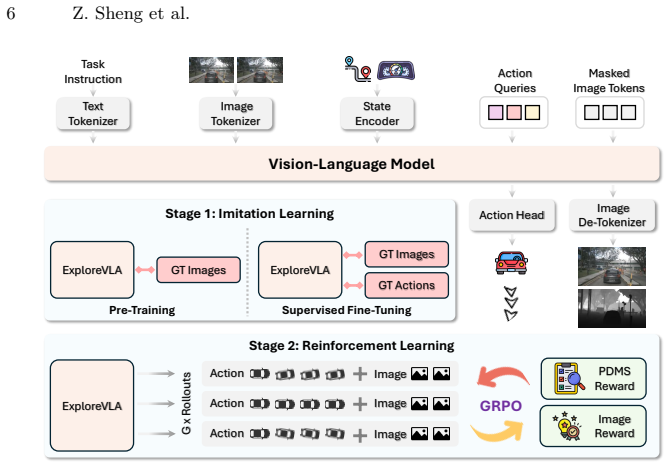
Dense world modeling: future RGB and depth generation attached to the planning backbone. It supplies dense supervision that enriches representations and, via image-prediction uncertainty, an intrinsic novelty signal that is safety-gated and optimized with Group Relative Policy Optimization (GRPO).
Load-bearing premise
The method assumes that when the world model is uncertain about future images, the planned trajectory is truly novel relative to training data and—if the safety gate passes—is a useful learning opportunity rather than noise, model failure, or an unsafe edge case the gate missed.
What would settle it
On a held-out NAVSIM or nuScenes split, measure whether trajectories with high world-model image uncertainty (after the safety gate) systematically improve closed-loop metrics more than equally diverse trajectories selected by a non-uncertainty baseline; if high-uncertainty safe trajectories do not outperform or correlate with worse outcomes, the exploration signal fails.
Editorial analysis
A structured set of objections, weighed in public.
Referee Report
Summary. ExploreVLA proposes a Vision-Language-Action framework for end-to-end autonomous driving that jointly trains trajectory prediction with future RGB and depth generation as dense world-modeling objectives, then uses the world model’s image-prediction uncertainty as a safety-gated intrinsic reward for policy exploration under Group Relative Policy Optimization (GRPO). The abstract claims this yields meaningful exploration beyond expert imitation and reports state-of-the-art NAVSIM scores (PDMS 93.7, EPDMS 88.8), with additional evaluation on nuScenes. Only the abstract of ExploreVLA is available for review; the full manuscript text supplied in the review package is an unrelated astronomy paper (Stellar Snake III), so methods, equations, ablations, safety-gate definition, uncertainty calibration, and result tables cannot be inspected.
Significance. If the full method is sound and the reported gains hold under proper ablations, the work would be a meaningful contribution: it targets a genuine limitation of pure behavior cloning in VLA driving (brittleness outside the expert distribution) by coupling dense generative world modeling with an uncertainty-based exploration signal and a safety gate. The dual use of the world model as both dense supervision and intrinsic reward is a coherent design idea. Those strengths cannot be credited as demonstrated until the actual methods, baselines, and ablations are available for audit.
major comments (4)
- Manuscript integrity: the full text provided for review is not ExploreVLA but an unrelated astronomy paper (Stellar Snake III / arXiv:2604.02717). No sections, equations, tables, or figures of ExploreVLA are available beyond the abstract. A load-bearing technical review of the central claim is therefore impossible; the reported PDMS/EPDMS numbers, GRPO formulation, safety gate, and uncertainty-to-reward mapping cannot be checked.
- Abstract (exploration mechanism): the claim that “image prediction uncertainty naturally measures a trajectory’s novelty relative to the training distribution” and that high-uncertainty, safety-gated trajectories are “valuable learning opportunities” is the linchpin of the paper. Image prediction error mixes epistemic OOD signal with aleatoric multi-modality of future RGB/depth and with generator capacity limits. Without a definition of uncertainty, calibration evidence, and ablations that separate these factors, it is unclear that GRPO is up-weighting useful novelty rather than hard-to-predict in-distribution futures, sensor noise, or model failure modes the safety gate misses.
- Abstract (safety-gated reward): the safety gate is free-parameter-heavy and load-bearing for the claim that exploration is safe. Thresholds, safety reward weights, and how the gate interacts with the uncertainty reward are not specified in the available text. Without that definition and failure analysis, the SOTA claim cannot be attributed to “meaningful exploration” rather than denser supervision alone or reward hacking around the gate.
- Abstract (results): PDMS 93.7 and EPDMS 88.8 on NAVSIM are asserted as SOTA, but no baseline table, ablation of world-model objectives vs. uncertainty reward vs. GRPO, or comparison protocol is available. The contribution of dense RGB/depth generation as supervision cannot be disentangled from the exploration reward without those experiments.
minor comments (2)
- Abstract: “Group Relative Policy Optimization (GRPO)” is named without citation or brief definition in the available text; once the full paper is supplied, a pointer to the original GRPO formulation and any driving-specific modifications should be explicit.
- Abstract: code URL is given; when the correct manuscript is provided, ensure the release includes the safety-gate config, uncertainty estimator, and training scripts needed to reproduce the NAVSIM numbers.
Circularity Check
No circular derivation found in available ExploreVLA text; uncertainty-as-novelty is an empirical assumption, not a by-construction reduction.
full rationale
Only the ExploreVLA abstract is available for the claimed paper; the cached full manuscript is an unrelated astronomy paper (Stellar Snake-III) and cannot be used to inspect equations, training objectives, or GRPO reward definitions. From the abstract alone, the claimed chain is: (1) behavior cloning is limited, so RL exploration is needed; (2) offline VLA lacks transitions, so a world model is learned via future RGB/depth generation as dense supervision; (3) that world model’s image-prediction uncertainty is used as a safety-gated intrinsic reward for GRPO. None of these steps reduces by definition to its inputs. Dense generation objectives and the policy reward are conceptually distinct roles of the same model; calling uncertainty a novelty measure is an interpretive/empirical claim, not a self-definitional identity or a fitted parameter renamed as a prediction. There are no uniqueness theorems, self-citation load-bearing premises, or ansatz-smuggling citations in the provided text. SOTA NAVSIM numbers are empirical claims, not circular constructions. Absent methods equations, circular reward hacking cannot be proven or disproven; under the hard rule that circularity requires a quotable reduction, the honest finding is no significant circularity.
Axiom & Free-Parameter Ledger
free parameters (2)
- Safety-gate thresholds / safety reward weights
- Uncertainty-to-reward mapping and GRPO hyperparameters
axioms (3)
- domain assumption A learned world model of future RGB and depth is a sufficient surrogate for state transitions when training VLA policies offline.
- ad hoc to paper Image prediction uncertainty measures a trajectory's novelty relative to the training distribution and, when high and safe, marks valuable learning opportunities.
- domain assumption Dense multi-task generation of future RGB and depth substantially enriches the planning backbone beyond trajectory-only supervision.
invented entities (1)
-
Safety-gated world-model uncertainty exploration reward for VLA driving
no independent evidence
read the original abstract
End-to-end autonomous driving models based on Vision-Language-Action (VLA) architectures have shown promising results by learning driving policies through behavior cloning on expert demonstrations. However, imitation learning inherently limits the model to replicating observed behaviors without exploring diverse driving strategies, leaving it brittle in novel or out-of-distribution scenarios. Reinforcement learning (RL) offers a natural remedy by enabling policy exploration beyond the expert distribution. Yet VLA models, typically trained on offline datasets, lack directly observable state transitions, necessitating a learned world model to anticipate action consequences. In this work, we propose a unified understanding-and-generation framework that leverages world modeling to simultaneously enable meaningful exploration and provide dense supervision. Specifically, we augment trajectory prediction with future RGB and depth image generation as dense world modeling objectives, requiring the model to learn fine-grained visual and geometric representations that substantially enrich the planning backbone. Beyond serving as a supervisory signal, the world model further acts as a source of intrinsic reward for policy exploration: its image prediction uncertainty naturally measures a trajectory's novelty relative to the training distribution, where high uncertainty indicates out-of-distribution scenarios that, if safe, represent valuable learning opportunities. We incorporate this exploration signal into a safety-gated reward and optimize the policy via Group Relative Policy Optimization (GRPO). Experiments on the NAVSIM and nuScenes benchmarks demonstrate the effectiveness of our approach, achieving a state-of-the-art PDMS score of 93.7 and an EPDMS of 88.8 on NAVSIM. The code is available at https://zihaosheng.github.io/ExploreVLA/.
Figures



Forward citations
Cited by 3 Pith papers
-
HyWorldVLA: A Vision-Language-Action Model with Hybrid World Modeling for Autonomous Driving
A hybrid world model that combines pixel-token prediction with latent prediction beats both pixel-only and latent-only world models on NAVSIM and is more robust to scene noise.
-
Distill to Think, Foresee to Act: Cognitive-Physical Reinforcement Learning for Autonomous Driving
CoPhy distills VLM knowledge into a BEV encoder and uses an action-conditioned auto-regressive BEV world model inside GRPO with dual physical-cognitive rewards to reach SOTA on NAVSIM v1/v2 while adding language-based...
-
Distill to Think, Foresee to Act: Cognitive-Physical Reinforcement Learning for Autonomous Driving
CoPhy is a new RL framework that distills VLM cognition into BEV encoders, adds an auto-regressive BEV world model for action-conditioned future prediction, and optimizes policies via GRPO with dual physical-cognitive...
Reference graph
Works this paper leans on
-
[1]
Barentsen, G., Vink, J. S., Drew, J. E., et al. 2011, MNRAS, 415, 103, doi: 10.1111/j.1365-2966.2011.18674.x Beaumont, C. N., & Williams, J. P. 2010, ApJ, 709, 791, doi: 10.1088/0004-637X/709/2/791 Behroozi, P. S., Wechsler, R. H., & Wu, H.-Y. 2013, ApJ, 762, 109, doi: 10.1088/0004-637X/762/2/109 Blondin, J. M., Wright, E. B., Borkowski, K. J., & Reynolds...
-
[2]
4 b degree The Galactic Latitude of the celestial object
The Columns of Snake III Catalog Column Unit Description 1 Cluster · · · Name of the open cluster to which the star belongs 2 source id · · · Source id from Gaia DR3 3 l degree The Galactic Longitude of the celestial object. 4 b degree The Galactic Latitude of the celestial object. 5 pml lsr mas yr −1 The proper motion in Galactic Longitude ( l) corrected...
2023
discussion (0)
Sign in with ORCID, Apple, or X to comment. Anyone can read and Pith papers without signing in.