REVIEW 3 major objections 4 minor 66 references
Machine-Learning-Guided Insights into Solid-Electrolyte Interphase Conductivity: Are Amorphous Lithium Fluorophosphates the Key?
T0 review · 3 major / 4 minor · reviewed 2026-08-04 · deepseek-v4-flash
Pith's one-line read Amorphous LiPO2F2 is a fast lithium-ion conductor, with projected room-temperature conductivity near 0.18 mS/cm.
desk verdict A well-executed computational case that amorphous LiPO2F2 is a much better Li-ion conductor than its crystalline form; the headline room-temperature conductivity is an honest but load-bearing Arrhenius extrapolation. read the letter →
The pith
A machine-rendered reading of the paper's core claim, the machinery that carries it, and where it could break.
The reading
What carries the argument
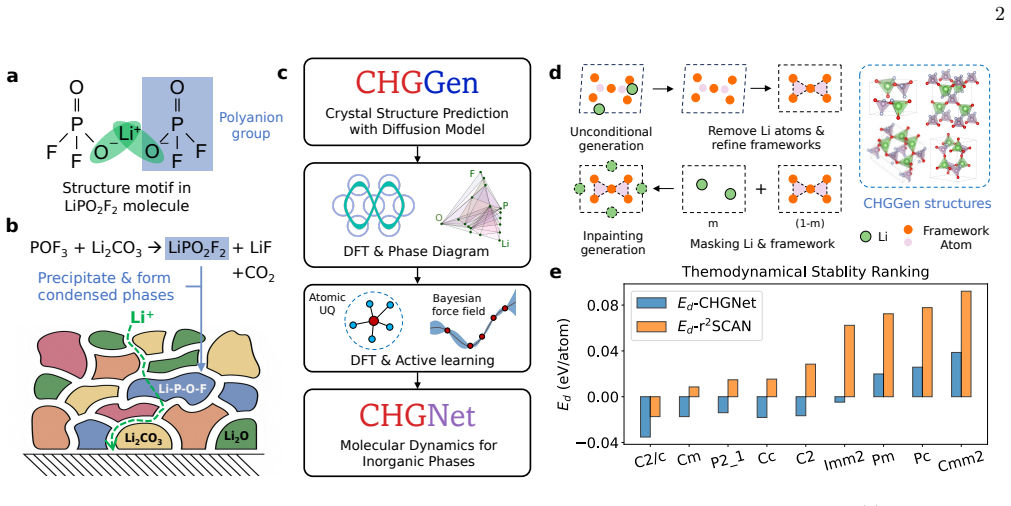
The key machinery is a two-stage generative structure-prediction pipeline (a diffusion model that first generates a plausible host framework, then inpaints lithium ions back in) paired with a fine-tuned machine-learning interatomic potential that enables large melt-quench and production molecular dynamics simulations at near-DFT accuracy. Supporting analyses—density of atomic states (DOAS) for the Li site-energy landscape and charged-defect formation-energy calculations—explain why amorphous LiPO2F2 conducts: disorder flattens the energy landscape, and interstitial Li defects form at low energy, supplying mobile carriers.
What would settle it
Measure the ionic conductivity of a phase-pure amorphous LiPO2F2 film or pellet at 300 K by impedance spectroscopy: a result orders of magnitude below roughly 0.2 mS/cm, or a nonlinear Arrhenius curve between 300 and 700 K in longer molecular dynamics runs, would refute the extrapolation.
Extended reading notes
Core claim
Using a diffusion-based generative model to propose crystal structures and a machine-learned interatomic potential for molecular dynamics, the authors predict a ground-state crystalline LiPO2F2 (space group C2/c, decomposition energy −0.017 eV/atom) built from corner-sharing LiO4 and PO2F2 tetrahedra. They then generate amorphous LiPO2F2 by melt-quench molecular dynamics and show that, in contrast to the crystalline phase, it has a broadened Li site-energy landscape, a low activation energy for diffusion (0.40 eV), and a low formation energy for Li interstitials. The combination of structural disorder and defect-enabling energy landscape yields a projected room-temperature conductivity of ro
Load-bearing premise
The load-bearing premise is that lithium hopping in amorphous LiPO2F2 keeps following the same Arrhenius behavior down to room temperature: the 300 K conductivity is extrapolated from simulations at higher temperatures, so a transport-mechanism change below the simulated range would make the headline number wrong by orders of magnitude.
Editorial extensions
If this is right
- If amorphous LiPO2F2 is the fast-ion phase, then fluorophosphate-rich interphases are not just passivating layers; they are the working ion highways of the battery.
- The low amorphization energy (30 meV/atom, about half that of Li2CO3) rationalizes the common observation of crystalline LiF/Li2O domains embedded in an amorphous SEI matrix.
- The predicted 0.40 eV activation energy, while higher than superionic conductors, is low enough to sustain transport across the 10–50 nm SEI, so amorphous fluorophosphate alone can account for observed rate capability.
- The authors expect conductivity to evolve smoothly with stoichiometry, rising with fluorine content within the same coordination chemistry, making LiPOxFy glasses a tunable family of SEI conductors.
Reading between the lines
- A testable corollary the paper leaves implicit: the practical conductivity depends on the percolation and connectivity of amorphous fluorophosphate domains in the SEI, not just on the phase's intrinsic conductivity; spatially resolved impedance or cryo-TEM mapping could test this.
- Because the room-temperature value is an Arrhenius extrapolation, an extended or enhanced-sampling molecular dynamics run at 300 K would be a sharper falsifier than new spectroscopy; a deviation from the high-temperature line would change the number but not necessarily the qualitative amorphous-versus-crystalline contrast.
- The design principle generalizes: any mixed-anion glass that combines anion disorder with low Li-interstitial formation energy—not only LiPO2F2—could serve as an SEI conductor, pointing to additive chemistries beyond the phosphorus/fluorine pair.
Editorial analysis
A structured set of objections, weighed in public.
Referee Report
Summary. The paper investigates LiPO2F2, a decomposition product in the SEI of Li-ion batteries, using a combination of diffusion-based generative crystal-structure prediction (CHGGen), DFT validation, and machine-learned interatomic potentials (CHGNet and a fine-tuned variant). It identifies a C2/c crystalline polymorph and, through melt-quench MD simulations, an amorphous phase. The authors report an Arrhenius activation energy of 1.13 ± 0.21 eV for crystalline LiPO2F2 and 0.40 ± 0.01 eV for the amorphous phase, and project a room-temperature ionic conductivity of σ ≈ 0.18 mS cm−1 for the latter. They attribute the enhancement to amorphization broadening the Li site-energy landscape (DOAS) and to a lower Li-interstitial formation energy. The paper proposes that amorphous mixed-anion Li–P–O–F phases may serve as the primary Li-ion conduction pathways in the SEI, providing a mechanism for the beneficial effect of fluorophosphate electrolyte additives.
Significance. If the quantitative result holds, the paper provides a concrete and atomistically resolved candidate for the ion-conducting medium in the inorganic SEI, which has been a long-standing puzzle. The workflow is genuinely state-of-the-art: generative structure prediction is validated against r2SCAN DFT, the MLIP is fine-tuned with an active-learning-style dataset, and the mechanistic explanations (DOAS, defect formation energies) are internally consistent. The comparison of amorphization energies across LiF, Li2O, Li2CO3, and LiPO2F2 is informative. The central qualitative claim—that amorphous LiPO2F2 is a much better Li-ion conductor than its crystalline counterpart—is supported by the MD and defect calculations. However, the headline conductivity and activation energy rest on an Arrhenius extrapolation over a ~400 K temperature range with no direct low-temperature data, and the Nernst–Einstein conversion is not fully reported. These issues do not invalidate the qualitative conclusion but make the quantitative '0.18 mS cm−1' claim vulnerable.
major comments (3)
- [Intrinsic Li-ion diffusivity (Fig. 2d)] The room-temperature conductivity σ ≈ 0.18 mS cm−1 and Ea = 0.40 eV are obtained by extrapolating high-temperature MD diffusivity to 300 K; the text states that statistically significant hopping events are rare at 300 K. This single-Arrhenius extrapolation over ~400 K is load-bearing for the abstract's quantitative headline. A 0.1 eV error in Ea changes σ(300 K) by ~50×, and a mechanism change below ~500 K (e.g., correlated hops, decoupling from matrix relaxation, or defect-limited transport) would invalidate the number. Please either provide direct low-temperature MD with enhanced sampling/longer trajectories, or reframe the claim as a high-temperature estimate with a confidence interval and remove the precise value from the abstract.
- [Nernst–Einstein conversion (conductivity value)] The paper reports σ ≈ 0.18 mS cm−1 but does not specify the carrier concentration used in the Nernst–Einstein relation. If the full Li concentration is used, the conversion assumes all Li are mobile, which is inconsistent with the defect-mediated picture emphasized later (where interstitial formation supplies carriers). If a reduced carrier concentration is used, it is an adjustable input. Please report the explicit formula, the carrier concentration, and the propagated uncertainty from D and Ea to σ.
- [Defect formation energetics (Fig. 3b)] The claim that amorphous LiPO2F2 shows 'excellent energetics' for Li+ defect formation is based on a mean interstitial formation energy of ~0.35 eV at 1 V vs. Li/Li+. The distribution is broad (shaded regions), and the relevance at the anode potential (0 V vs. Li/Li+) is not quantitatively connected to a carrier concentration. To support the 'Li-stuffing' mechanism, please report the formation-energy distribution at 0 V and the resulting carrier concentration estimate, or temper the claim accordingly.
minor comments (4)
- [Abstract] The value σ ≈ 0.18 mS cm−1 is given without an uncertainty estimate; at minimum include the Ea uncertainty and state that this is an Arrhenius extrapolation.
- [Figure 1] The schematic is dense; breaking panels (a)–(e) into a larger figure or adding a short workflow legend would improve readability.
- [References] Ref. [20] is a ChemRxiv preprint; please indicate its peer-review status or replace with a published version if available.
- [Discussion] The statement that amorphous LiPOxFy phases 'function as the primary Li-conducting channels' is stronger than the evidence directly supports; the paper studies one composition. Suggest softening to 'a plausible candidate' unless additional compositional evidence is provided.
Circularity Check
No significant circularity; the central conductivity result is emergent from MD with DFT validation, and the disclosed 300 K extrapolation is a modeling assumption, not a fitted input renamed as a prediction.
full rationale
The derivation chain is: (1) CHGGen proposes candidate LiPO2F2 polymorphs; candidates are screened with pretrained CHGNet, but the claimed ground state (C2/c, Ed = -0.017 eV/atom) is validated by r2SCAN DFT against the Materials Project phase diagram, so the structural result does not reduce to the generator's output. (2) Amorphous samples are produced by melt-quench MD using a CHGNet potential fine-tuned on DFT energies, forces, and stresses; Li diffusivities are computed from MSD trajectories, an emergent observable. No target sigma or Ea is used as a training label, so the conductivity claim is not an input-output loop. (3) Defect formation energies are computed by DFT with Freysoldt corrections and are used as a supporting trend, not fed back into the sigma calculation. The paper explicitly states its one notable limitation: 'statistically significant Li-ion hopping events were rare at room temperature, the diffusivity value for the amorphous phase at 300 K ... was determined by extrapolation from the high-temperature data.' That is an Arrhenius extrapolation with a stated model assumption, not a circular reduction: the 300 K value lies outside the fitted temperature window and is labeled 'projected.' The self-citations (CHGGen [31], CHGNet [37], Materials Project [40], CHGNet softening [41]) provide tools and context, but the load-bearing quantitative claims are either independently DFT-validated or emergent from MD, so no step reduces to its own inputs by construction.
Assumptions & free parameters
free parameters (4)
- Arrhenius activation energy for a-LiPO2F2 =
0.40 eV
- Arrhenius prefactor for a-LiPO2F2 =
not reported
- Mobile carrier concentration for Nernst-Einstein conversion =
not specified
- CSP stability screen threshold =
0.03 eV/atom
assumptions (4)
- domain assumption The fine-tuned CHGNet MLIP accurately reproduces DFT energies/forces for Li-P-O-F over the MD trajectories.
- domain assumption Melt-quench MD produces a representative amorphous phase of the SEI material.
- domain assumption Arrhenius behavior holds from simulation temperatures down to 300 K.
- domain assumption Random interstitial sites in the amorphous structures sample the operative defect ensemble.
Cite this review
Pith. "Pith review of Machine-Learning-Guided Insights into Solid-Electrolyte Interphase Conductivity: Are Amorphous Lithium Fluorophosphates the Key?." pith.science (2026). https://pith.science/paper/QH56L65X
@misc{pith2026251022912,
  author       = {Pith},
  title        = {Pith review of: Machine-Learning-Guided Insights into Solid-Electrolyte Interphase Conductivity: Are Amorphous Lithium Fluorophosphates the Key?},
  year         = {2026},
  howpublished = {\url{https://pith.science/paper/QH56L65X}},
  note         = {Machine review of arXiv:2510.22912}
}
abstract
Despite decades of study, the identity of the dominant \ce{Li+}-conducting phase within the inorganic SEI of Li-ion batteries remains unresolved. While the mosaic model describes LiF/\ce{Li2O}/\ce{Li2CO3} nanocrystallites within a disordered matrix, these crystalline phases inherently offer limited ionic conductivity. Growing evidence suggests that interfaces, grain boundaries, and amorphous phases may instead host the primary fast-ion pathways. Using diffusion-based generative structure prediction and machine-learning interatomic potentials (MLIPs), we investigate lithium difluorophosphate (\ce{LiPO2F2}), a key mixed-anion decomposition product of phosphorus- and fluorine-containing electrolytes. We identify a stable crystalline polymorph and demonstrate that the amorphous counterpart is conductive, with projected room-temperature $\sigma \approx 0.18$ mS cm$^{-1}$ and $E_\mathrm{a} \approx 0.40$ eV. This enhancement stems from structural disorder flattening the Li site-energy landscape and a low formation energy for Li-interstitial defects, which supplies additional mobile carriers. We propose amorphous mixed-anion Li--P--O--F phases as a promising conducting medium in the SEI, offering a specific target for engineering improved battery interfaces.
Figures


Reference graph
Works this paper leans on
-
[20]
Nguyen, V
D.-T. Nguyen, V. Prabhakaran, V. Shutthanandan, K. T. Mueller, and V. Murugesan, In situ cryogenic x-ray photoelectron spectroscopy unveils metastable compo- nents of sei layers in li-ion batteries, chemRxiv-2025-f7frl (2025)
2025
-
[1]
Peled and S
E. Peled and S. Menkin, Review—SEI: Past, Present and Future, Journal of The Electrochemical Society164, A1703 (2017)
2017
-
[2]
Zhang, X
X. Zhang, X. Cheng, X. Chen, C. Yan, and Q. Zhang, Fluoroethylene Carbonate Additives to Render Uniform Li Deposits in Lithium Metal Batteries, Advanced Func- tional Materials27, 1 (2017)
2017
-
[3]
S. T. Oyakhire, H. Gong, Y. Cui, Z. Bao, and S. F. Bent, An X-ray Photoelectron Spectroscopy Primer for Solid Electrolyte Interphase Characterization in Lithium Metal Anodes, ACS Energy Letters7, 2540 (2022)
2022
-
[4]
M. He, R. Guo, G. M. Hobold, H. Gao, and B. M. Gal- lant, The intrinsic behavior of lithium fluoride in solid electrolyte interphases on lithium, Proceedings of the Na- tional Academy of Sciences117, 73 (2020)
2020
-
[5]
Guo and B
R. Guo and B. M. Gallant, Li 2 O Solid Electrolyte In- terphase: Probing Transport Properties at the Chemical Potential of Lithium, Chemistry of Materials32, 5525 (2020)
2020
-
[6]
X. Liu, S. Li, C. Yuan, B. Zheng, G. Cheng, Y. Chen, X. Lu, D. Gu, B. Lv, H. Li, Z. Yan, H. Qian, Y. Zhu, D. Sun, Y. Song, and Y. Xiang, Probing the heteroge- neous nature of LiF in solid–electrolyte interphases, Na- ture646, 102 (2025)
2025
-
[7]
Yildirim, A
H. Yildirim, A. Kinaci, M. K. Y. Chan, and J. P. Gree- ley, First-Principles Analysis of Defect Thermodynamics and Ion Transport in Inorganic SEI Compounds: LiF and NaF, ACS Applied Materials & Interfaces7, 18985 (2015)
2015
Show all 66 references
-
[8]
X.-X. Ma, X. Shen, X. Chen, Z.-H. Fu, N. Yao, R. Zhang, and Q. Zhang, The Origin of Fast Lithium-Ion Transport in the Inorganic Solid Electrolyte Interphase on Lithium Metal Anodes, Small Structures3, 2200071 (2022)
2022
-
[9]
Christensen and J
J. Christensen and J. Newman, A Mathematical Model for the Lithium-Ion Negative Electrode Solid Electrolyte Interphase, Journal of The Electrochemical Society151, A1977 (2004)
2004
-
[10]
S. Shi, Y. Qi, H. Li, and L. G. Hector, Defect Ther- modynamics and Diffusion Mechanisms in Li 2 CO3 and Implications for the Solid Electrolyte Interphase in Li- Ion Batteries, The Journal of Physical Chemistry C117, 8579 (2013)
2013
-
[11]
J. Pan, Q. Zhang, X. Xiao, Y.-T. Cheng, and Y. Qi, De- sign of Nanostructured Heterogeneous Solid Ionic Coat- ings through a Multiscale Defect Model, ACS Applied Materials & Interfaces8, 5687 (2016)
2016
-
[12]
T. Hu, J. Tian, F. Dai, X. Wang, R. Wen, and S. Xu, Impact of the Local Environment on Li Ion Transport in Inorganic Components of Solid Electrolyte Interphases, Journal of the American Chemical Society145, 1327 (2023)
2023
-
[13]
Peled, D
E. Peled, D. Golodnitsky, and G. Ardel, Advanced Model for Solid Electrolyte Interphase Electrodes in Liquid and Polymer Electrolytes, Journal of The Electrochemical So- ciety144, L208 (1997)
1997
-
[14]
Q. Wang, C. Zhao, J. Wang, Z. Yao, S. Wang, S. G. H. Kumar, S. Ganapathy, S. Eustace, X. Bai, B. Li, and M. Wagemaker, High entropy liquid electrolytes for lithium batteries, Nature Communications14, 440 (2023)
2023
-
[15]
J. Chen, L. Xing, X. Yang, X. Liu, T. Li, and W. Li, Outstanding electrochemical performance of high-voltage LiNi1/3Co1/3Mn1/3O2 cathode achieved by application of LiPO2F2 electrolyte additive, Electrochimica Acta 290, 568 (2018)
2018
-
[16]
L. Li, W. Lv, J. Chen, C. Zhu, S. Dmytro, Q. Zhang, and S. Zhong, Lithium Difluorophosphate (LiPO2F2): An Electrolyte Additive to Help Boost Low-Temperature Behaviors for Lithium-Ion Batteries, ACS Applied En- ergy Materials5, 11900 (2022)
2022
-
[17]
S. Tan, Z. Shadike, J. Li, X. Wang, Y. Yang, R. Lin, A. Cresce, J. Hu, A. Hunt, I. Waluyo, L. Ma, F. Monaco, P. Cloetens, J. Xiao, Y. Liu, X.-Q. Yang, K. Xu, and E. Hu, Additive engineering for robust interphases to sta- bilize high-Ni layered structures at ultra-high voltage ...
2022
-
[18]
B. Han, X. Li, S. Bai, Y. Zou, B. Lu, M. Zhang, X. Ma, Z. Chang, Y. S. Meng, and M. Gu, Conformal three- dimensional interphase of Li metal anode revealed by low-dose cryoelectron microscopy, Matter4, 3741 (2021), 7 2106.08754
2021 arXiv
-
[19]
Y. Chen, M. Li, Y. Liu, Y. Jie, W. Li, F. Huang, X. Li, Z. He, X. Ren, Y. Chen, X. Meng, T. Cheng, M. Gu, S. Jiao, and R. Cao, Origin of dendrite-free lithium de- position in concentrated electrolytes, Nature Communi- cations14, 2655 (2023)
2023
-
[21]
S. B. Shuchi, G. D’Acunto, P. Sayavong, S. T. Oyakhire, K. M. Sanroman Gutierrez, J. Risner-Jamtgaard, I. R. Choi, Y. Cui, and S. F. Bent, Cryogenic X-ray photo- electron spectroscopy for battery interfaces, Nature646, 850 (2025)
2025
-
[22]
Zhang, F
S. Zhang, F. Zhao, J. Chen, J. Fu, J. Luo, S. H. Ala- hakoon, L.-Y. Chang, R. Feng, M. Shakouri, J. Liang, Y. Zhao, X. Li, L. He, Y. Huang, T.-K. Sham, and X. Sun, A family of oxychloride amorphous solid elec- trolytes for long-cycling all-solid-state lithium batteries, Nature...
2023
-
[23]
Hayashi, S
A. Hayashi, S. Hama, H. Morimoto, M. Tatsumisago, and T. Minami, Preparation of Li 2 S–P2 S5 Amorphous Solid Electrolytes by Mechanical Milling, Journal of the American Ceramic Society84, 477 (2001)
2001
-
[24]
C. L. Campion, W. Li, and B. L. Lucht, Thermal Decom- position of LiPF[sub 6]-Based Electrolytes for Lithium- Ion Batteries, Journal of The Electrochemical Society 152, A2327 (2005)
2005
-
[25]
Jayawardana, N
C. Jayawardana, N. Rodrigo, B. Parimalam, and B. L. Lucht, Role of Electrolyte Oxidation and Difluorophos- phoric Acid Generation in Crossover and Capacity Fade in Lithium Ion Batteries, ACS Energy Letters6, 3788 (2021)
2021
-
[26]
B. S. Parimalam, A. D. MacIntosh, R. Kadam, and B. L. Lucht, Decomposition Reactions of Anode Solid Elec- trolyte Interphase (SEI) Components with LiPF 6, The Journal of Physical Chemistry C121, 22733 (2017)
2017
-
[27]
E. W. C. Spotte-Smith, T. B. Petrocelli, H. D. Patel, S. M. Blau, and K. A. Persson, Elementary Decomposi- tion Mechanisms of Lithium Hexafluorophosphate in Bat- tery Electrolytes and Interphases, ACS Energy Letters8, 347 (2023)
2023
-
[28]
D. Zhou, I. Bier, B. Santra, L. D. Jacobson, C. Wu, A. Garaizar Suarez, B. R. Almaguer, H. Yu, R. Abel, R. A. Friesner, and L. Wang, A robust crystal structure prediction method to support small molecule drug de- velopment with large scale validation and blind study, Nature Co...
2025
-
[29]
Aykol, A
M. Aykol, A. Merchant, S. Batzner, J. N. Wei, and E. D. Cubuk, Predicting emergence of crystals from amorphous precursors with deep learning potentials, Nature Compu- tational Science5, 105 (2024)
2024
-
[30]
Gharakhanyan, Y
V. Gharakhanyan, Y. Yang, L. Barroso-Luque, M. Shuaibi, D. S. Levine, K. Michel, V. Bernat, M. Dzamba, X. Fu, M. Gao, X. Liu, K. Noori, L. J. Purvis, T. Rao, B. M. Wood, A. Rizvi, M. Uyttendaele, A. J. Ouderkirk, C. Daraio, C. L. Zitnick, A. Boromand, N. Marom, Z. W. Ulissi, a...
2025 arXiv
-
[31]
Zhong, X
P. Zhong, X. Dai, B. Deng, G. Ceder, and K. A. Persson, Crystal structure prediction with host-guided inpainting generation and foundation potentials, Materials Horizons , 10.1039.D5MH00774G (2025)
2025
-
[32]
Y. Song, J. Sohl-Dickstein, D. P. Kingma, A. Kumar, S. Ermon, and B. Poole, Score-based generative mod- eling through stochastic differential equations, Interna- tional Conference on Learning Representations (ICLR) (2020)
2020
-
[33]
T. Xie, X. Fu, O.-E. Ganea, R. Barzilay, and T. Jaakkola, Crystal diffusion variational autoencoder for periodic ma- terial generation, International Conference on Learning Representations (ICLR) (2021)
2021
-
[34]
C. Zeni, R. Pinsler, D. Z¨ ugner, A. Fowler, M. Horton, X. Fu, Z. Wang, A. Shysheya, J. Crabb´ e, S. Ueda, R. Sor- dillo, L. Sun, J. Smith, B. Nguyen, H. Schulz, S. Lewis, C.-W. Huang, Z. Lu, Y. Zhou, H. Yang, H. Hao, J. Li, C. Yang, W. Li, R. Tomioka, and T. Xie, A generative...
2025
-
[35]
T. Hsu, B. Sadigh, N. Bertin, C. W. Park, J. Chap- man, V. Bulatov, and F. Zhou, Score-based denoising for atomic structure identification, npj Computational Ma- terials10, 155 (2024)
2024
-
[36]
Lugmayr, M
A. Lugmayr, M. Danelljan, A. Romero, F. Yu, R. Tim- ofte, and L. Van Gool, RePaint: Inpainting using De- noising Diffusion Probabilistic Models, IEEE/CVF Con- ference on Computer Vision and Pattern Recognition (CVPR) (2022)
2022
-
[37]
B. Deng, P. Zhong, K. Jun, J. Riebesell, K. Han, C. J. Bartel, and G. Ceder, CHGNet as a pretrained universal neural network potential for charge-informed atomistic modelling, Nature Machine Intelligence5, 1031 (2023)
2023
-
[38]
A. Wang, R. Kingsbury, M. McDermott, M. Horton, A. Jain, S. P. Ong, S. Dwaraknath, and K. A. Persson, A framework for quantifying uncertainty in DFT energy corrections, Scientific Reports11, 15496 (2021)
2021
-
[39]
J. W. Furness, A. D. Kaplan, J. Ning, J. P. Perdew, and J. Sun, Accurate and Numerically Efficient r 2SCAN Meta-Generalized Gradient Approximation, The Journal of Physical Chemistry Letters11, 8208 (2020)
2020
-
[40]
M. K. Horton, P. Huck, R. X. Yang, J. M. Munro, S. Dwaraknath, A. M. Ganose, R. S. Kingsbury, M. Wen, J. X. Shen, T. S. Mathis, A. D. Kaplan, K. Berket, J. Riebesell, J. George, A. S. Rosen, E. W. C. Spotte- Smith, M. J. McDermott, O. A. Cohen, A. Dunn, M. C. Kuner, G.-M. Rign...
2025
-
[41]
B. Deng, Y. Choi, P. Zhong, J. Riebesell, S. Anand, Z. Li, K. Jun, K. A. Persson, and G. Ceder, Systematic soften- ing in universal machine learning interatomic potentials, npj Computational Materials11, 9 (2025)
2025
-
[42]
G. Han, Y. Wang, H. Li, Z. Yang, and S. Pan, The first lithium difluorophosphate LiPO2 F2 with a neutral poly- tetrahedral microporous architecture, Chemical Commu- nications55, 1817 (2019)
2019
-
[43]
Aykol, S
M. Aykol, S. S. Dwaraknath, W. Sun, and K. A. Persson, Thermodynamic limit for synthesis of metastable inor- ganic materials, Science Advances4, eaaq0148 (2018)
2018
-
[44]
Sivonxay and K
E. Sivonxay and K. A. Persson, Density functional theory assessment of the lithiation thermodynamics and phase 8 evolution in si-based amorphous binary alloys, Energy Storage Materials53, 42 (2022)
2022
-
[45]
J. Qi, S. Banerjee, Y. Zuo, C. Chen, Z. Zhu, M. H. Chandrappa, X. Li, and S. Ong, Bridging the gap be- tween simulated and experimental ionic conductivities in lithium superionic conductors, Materials Today Physics 21, 100463 (2021)
2021
-
[46]
Zhong, S
P. Zhong, S. Gupta, B. Deng, K. Jun, and G. Ceder, Ef- fect of Cation Disorder on Lithium Transport in Halide Superionic Conductors, ACS Energy Letters9, 2775 (2024)
2024
-
[47]
Vandermause, Y
J. Vandermause, Y. Xie, J. S. Lim, C. J. Owen, and B. Kozinsky, Active learning of reactive Bayesian force fields applied to heterogeneous catalysis dynamics of H/Pt, Nature Communications13, 5183 (2022)
2022
-
[48]
Y. Xie, J. Vandermause, S. Ramakers, N. H. Pro- tik, A. Johansson, and B. Kozinsky, Uncertainty-aware molecular dynamics from Bayesian active learning for phase transformations and thermal transport in SiC, npj Computational Materials9, 36 (2023)
2023
-
[49]
Y. Li, Y. Li, A. Pei, K. Yan, Y. Sun, C.-L. Wu, L.-M. Joubert, R. Chin, A. L. Koh, Y. Yu, J. Perrino, B. Butz, S. Chu, and Y. Cui, Atomic structure of sensitive bat- tery materials and interfaces revealed by cryo–electron microscopy, Science358, 506 (2017)
2017
-
[50]
X. He, Y. Zhu, A. Epstein, and Y. Mo, Statistical vari- ances of diffusional properties from ab initio molecular dynamics simulations, npj Computational Materials4, 18 (2018)
2018
-
[51]
S. Wang, Y. Liu, and Y. Mo, Frustration in Super- Ionic Conductors Unraveled by the Density of Atom- istic States, Angewandte Chemie International Edition 62, e202215544 (2023)
2023
-
[52]
Y. Zeng, B. Ouyang, J. Liu, Y.-W. Byeon, Z. Cai, L. J. Miara, Y. Wang, and G. Ceder, High-entropy mechanism to boost ionic conductivity, Science378, 1320 (2022)
2022
-
[53]
Zhang, D.-H
W. Zhang, D.-H. Seo, T. Chen, L. Wu, M. Topsakal, Y. Zhu, D. Lu, G. Ceder, and F. Wang, Kinetic path- ways of ionic transport in fast-charging lithium titanate, Science367, 1030 (2020)
2020
-
[54]
Y. Xiao, K. Jun, Y. Wang, L. J. Miara, Q. Tu, and G. Ceder, Lithium Oxide Superionic Conductors Inspired by Garnet and NASICON Structures, Advanced Energy Materials11(2021)
2021
-
[55]
Y. Chen, Z. Lun, X. Zhao, K. P. Koirala, L. Li, Y. Sun, C. A. O’Keefe, X. Yang, Z. Cai, C. Wang, H. Ji, C. P. Grey, B. Ouyang, and G. Ceder, Unlocking Li superionic conductivity in face-centred cubic oxides via face-sharing configurations, Nature Materials23, 535 (2024)
2024
-
[56]
J.-X. Shen, M. Horton, and K. A. Persson, A charge- density-based general cation insertion algorithm for gen- erating new Li-ion cathode materials, npj Computational Materials6, 161 (2020)
2020
-
[57]
Freysoldt, J
C. Freysoldt, J. Neugebauer, and C. G. Van De Walle, FullyAb InitioFinite-Size Corrections for Charged- Defect Supercell Calculations, Physical Review Letters 102, 016402 (2009)
2009
-
[58]
M. S. Farnell, J. Cheng, J.-X. Shen, and K. A. Pers- son, Ab Initio Insights to Metal Passivation: Diffu- sion and Defect Formation in Amorphous Zirconia and Alumina, Journal of The Electrochemical Society172, 071502 (2025)
2025
-
[59]
De Angelis, U
P. De Angelis, U. Raucci, F. Mambretti, M. Fasano, E. Chiavazzo, P. Asinari, and M. Parrinello, Exploring Lithium Diffusion in LiF with Machine Learning Poten- tials: From Point Defects to Collective Ring Diffusion, chemrxiv preprint chemrxiv-2025-fv0zl (2025)
2025
-
[60]
K. Jun, G. Wei, X. Yang, Y. Chen, and G. Ceder, Explor- ing the soft cradle effect and ionic transport mechanisms in the LiMXCl4 superionic conductor family, Matter8, 102001 (2025)
2025
-
[61]
Cheng, E
J. Cheng, E. Sivonxay, and K. A. Persson, Evaluation of Amorphous Oxide Coatings for High-Voltage Li-Ion Bat- tery Applications Using a First-Principles Framework, ACS Applied Materials & Interfaces12, 35748 (2020)
2020
-
[62]
Zhang, Z
W. Zhang, Z. Wang, H. Wan, A.-M. Li, Y. Liu, S.-C. Liou, K. Zhang, Y. Ren, C. Jayawardana, B. L. Lucht, and C. Wang, Revitalizing interphase in all-solid-state Li metal batteries by electrophile reduction, Nature Mate- rials24, 414 (2025)
2025
-
[63]
H. Ren, J. Hu, H. Ji, Y. Huang, W. Zhao, W. Huang, X. Wang, H. Yi, Y. Song, J. Liu, T. Liu, M. Liu, Q. Zhao, and F. Pan, Densification of Cathode/Electrolyte Inter- phase to Enhance Reversibility of LiCoO2 at 4.65 V, Ad- vanced Materials36, 2408875 (2024)
2024
-
[64]
Z. Yu, P. E. Rudnicki, Z. Zhang, Z. Huang, H. Celik, S. T. Oyakhire, Y. Chen, X. Kong, S. C. Kim, X. Xiao, H. Wang, Y. Zheng, G. A. Kamat, M. S. Kim, S. F. Bent, J. Qin, Y. Cui, and Z. Bao, Rational solvent molecule tuning for high-performance lithium metal battery elec- troly...
2022
-
[65]
Holoubek, M
J. Holoubek, M. Yu, S. Yu, M. Li, Z. Wu, D. Xia, P. Bhaladhare, M. S. Gonzalez, T. A. Pascal, P. Liu, and Z. Chen, An All-Fluorinated Ester Electrolyte for Stable High-Voltage Li Metal Batteries Capable of Ultra-Low- Temperature Operation, ACS Energy Letters5, 1438 (2020)
2020
-
[66]
B. Wang, H. A. Doan, S.-B. Son, D. P. Abraham, S. E. Trask, A. Jansen, K. Xu, and C. Liao, Data-driven design of electrolyte additives supporting high-performance 5 V LiNi0.5Mn1.5O4 positive electrodes, Nature Communi- cations16, 3413 (2025)
2025
Reviewed August 4, 2026 · model on record in the stance chip above.
Discussion (0). Continue with ORCID to comment.