LLM Semantic Signaling Game and Mechanism Design: Systematic Blindness, Awareness Shaping, and Mindset Dynamics
Pith reviewed 2026-06-30 07:56 UTC · model grok-4.3
The pith
Receiver awareness modeled as a type in a semantic signaling game captures systematic blindness and supports mechanism design for secure LLM interactions.
A machine-rendered reading of the paper's core claim, the machinery that carries it, and where it could break.
Core claim
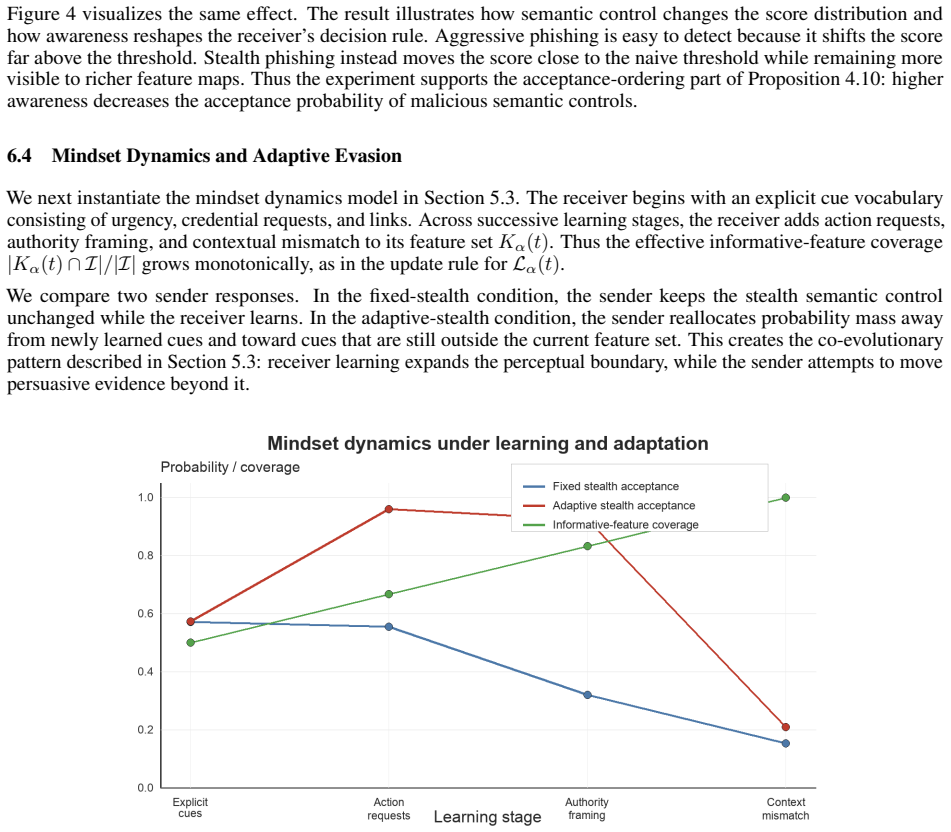
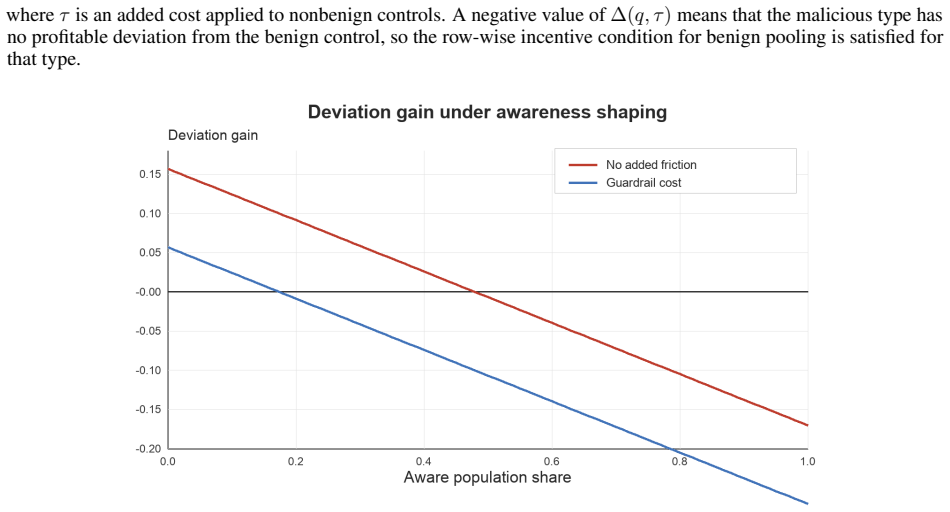
The central claim is that receiver awareness, treated as a type selecting which linguistic features enter the scoring mechanism, turns the semantic signaling game into an object that admits Perfect Bayesian Nash equilibria describing sender-receiver behavior; mechanism-design interventions that reshape awareness, impose costs on deceptive controls, or alter receiver populations can then induce benign pooling equilibria, with Gaussian approximations of aggregate scores enabling likelihood-ratio detection rules, all validated by numerical experiments on phishing reduction.
What carries the argument
The awareness type inside the semantic signaling game, which selects the subset of linguistic features used by the receiver's scoring rule.
If this is right
- Gaussian approximations of message scores yield likelihood-ratio decision rules for statistical detection.
- Perfect Bayesian Nash equilibria characterize strategic sender behavior under different awareness types.
- Mechanism design that penalizes deceptive semantic controls or modifies receiver populations induces benign pooling equilibria.
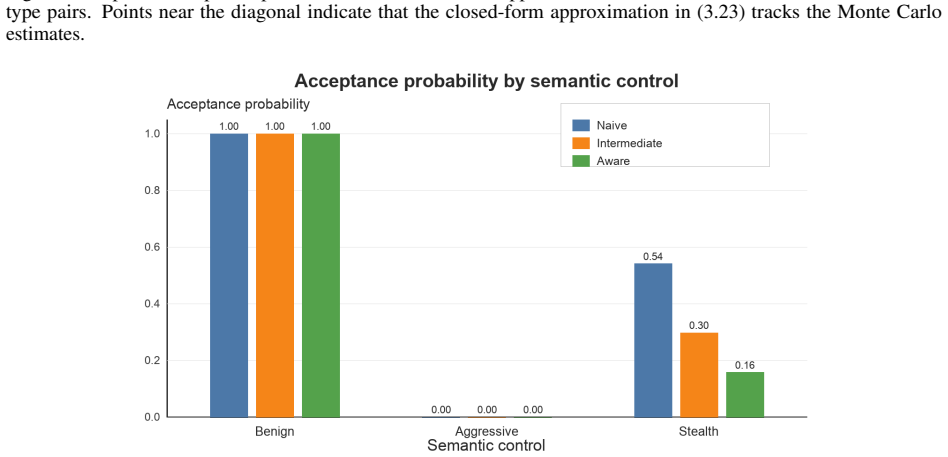
- Numerical experiments confirm that awareness shaping combined with guardrail costs reduces successful phishing attacks.
Where Pith is reading between the lines
- The same awareness-type construction could be tested in multi-turn conversations to see whether repeated interactions amplify or dampen mindset dynamics.
- Awareness-shaping mechanisms might be implemented directly as system prompts in deployed agents and measured for change in deception success rates.
- The framework suggests examining how heterogeneous awareness distributions across a population of receivers affect overall system security.
Load-bearing premise
Receiver awareness can be represented as a type that determines precisely which linguistic features are perceived and scored.
What would settle it
A controlled experiment in which measured human or LLM receiver evaluations fail to show the predicted dependence on awareness type, or observed deception rates in LLM interactions contradict the derived equilibria, would falsify the central modeling step.
Figures
read the original abstract
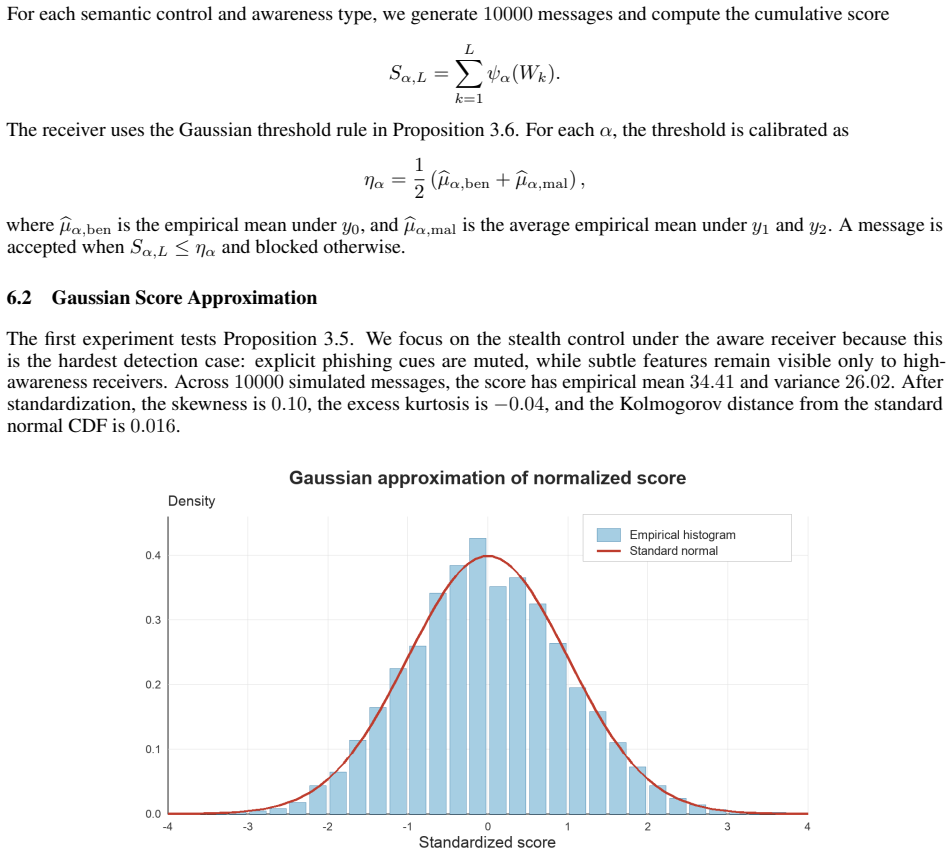
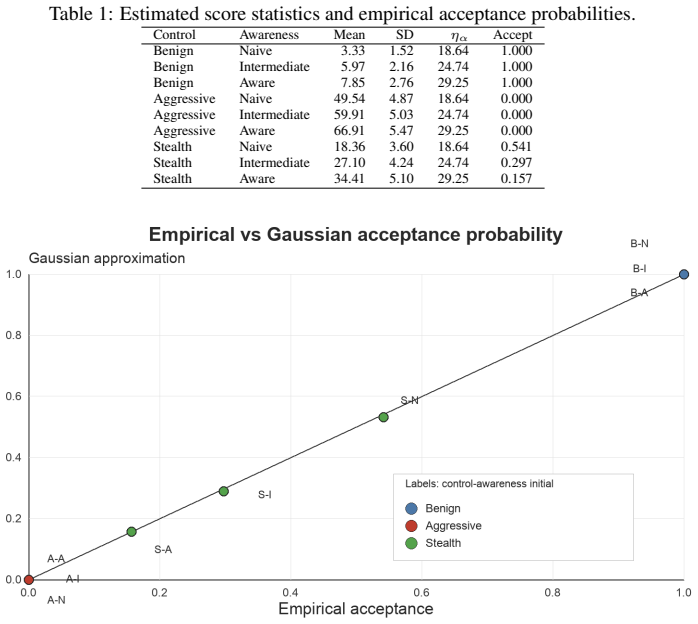
Large language models (LLMs) increasingly mediate strategic interactions through natural language, making semantic control a critical element of communication and deception. This paper develops a semantic signaling game in which a sender selects a semantic control, an LLM generates a stochastic message, and a receiver evaluates the message using an awareness-dependent scoring mechanism. Receiver awareness is modeled as a type that determines which linguistic features are perceived and used for inference, providing a formal model of systematic blindness. The framework connects prompt-based control, statistical detection, and game-theoretic equilibrium analysis. Gaussian approximations of aggregate message scores enable likelihood-ratio decision rules, while Perfect Bayesian Nash equilibria characterize strategic behavior. The paper further develops mechanism-design approaches that reshape receiver awareness, penalize deceptive semantic controls, and modify receiver populations to induce benign pooling equilibria. Numerical experiments validate the Gaussian approximation, quantify awareness-ordering effects, analyze mindset dynamics under adaptive adversaries, and demonstrate how awareness shaping and guardrail costs reduce successful phishing attacks. The proposed framework provides a principled foundation for analyzing strategic language-mediated interactions in agentic AI systems and offers new tools for the design of robust and secure human-AI communication.
Editorial analysis
A structured set of objections, weighed in public.
Referee Report
Summary. The paper develops a semantic signaling game in which a sender chooses a semantic control that influences an LLM-generated stochastic message. The receiver has an awareness type determining which linguistic features enter an aggregate score used for inference; this formalizes systematic blindness. Gaussian approximations of the score distribution yield likelihood-ratio decision rules. Perfect Bayesian Nash equilibria characterize strategic sender-receiver behavior. Mechanism-design tools are introduced to reshape awareness types, impose costs on deceptive controls, or alter receiver populations to induce benign pooling equilibria. Numerical experiments validate the Gaussian approximation, quantify awareness-ordering effects, examine mindset dynamics under adaptive adversaries, and demonstrate reductions in phishing success via awareness shaping and guardrail costs.
Significance. If the awareness-type construction produces equilibrium outcomes or mechanism-design leverage that cannot be replicated by relabeling payoffs in a standard signaling game, the framework supplies a principled link between prompt-based semantic control, statistical detection, and game-theoretic analysis of language-mediated deception. The reported experiments supply concrete numerical support for the approximation and for the claimed effects of awareness ordering and shaping on attack success rates.
major comments (2)
- [§3.2 and §4.1] §3.2 (Receiver Awareness Model) and §4.1 (Equilibrium Characterization): the claim that awareness types enable non-standard equilibria or mechanism-design leverage rests on the assertion that feature selection alters the induced distribution over aggregate scores in a sender-strategy-dependent manner. No derivation is supplied showing that the type changes the functional dependence of the score on the semantic control (rather than merely rescaling its mean or variance); without this, the model is equivalent to a classical signaling game with relabeled private information and the connection to new awareness-shaping mechanisms does not follow.
- [§5.3] §5.3 (Mechanism Design for Awareness Shaping): the proposed mechanisms that penalize deceptive semantic controls or modify receiver populations are presented as novel, yet the paper does not compare the resulting equilibrium selection or welfare gains against the same mechanisms applied to a standard signaling game without feature-perception types. This comparison is required to establish that the awareness modeling supplies additional leverage.
minor comments (2)
- Notation for the aggregate score and the awareness-dependent feature set is introduced without an explicit table mapping symbols to definitions; a compact notation table would improve readability.
- [§6] The description of the numerical experiments in §6 would benefit from an explicit statement of the LLM used for message generation and the precise prompt templates for each semantic control.
Simulated Author's Rebuttal
We thank the referee for the constructive and precise comments. We address each major point below and will incorporate revisions to strengthen the formal grounding of the awareness-type construction and its mechanism-design implications.
read point-by-point responses
-
Referee: [§3.2 and §4.1] §3.2 (Receiver Awareness Model) and §4.1 (Equilibrium Characterization): the claim that awareness types enable non-standard equilibria or mechanism-design leverage rests on the assertion that feature selection alters the induced distribution over aggregate scores in a sender-strategy-dependent manner. No derivation is supplied showing that the type changes the functional dependence of the score on the semantic control (rather than merely rescaling its mean or variance); without this, the model is equivalent to a classical signaling game with relabeled private information and the connection to new awareness-shaping mechanisms does not follow.
Authors: We acknowledge that the manuscript does not contain an explicit derivation establishing that awareness types alter the functional dependence of the aggregate-score distribution on the semantic control beyond mean or variance rescaling. In the revision we will add this derivation to §3.2. Because the score is formed from a type-specific subset of linguistic features whose conditional distributions are each modulated by the semantic control, the resulting family of likelihood functions is not in general equivalent to a simple location-scale transformation of a single reference distribution. Consequently the induced best-response correspondences and Perfect Bayesian Nash equilibria differ from those obtainable by relabeling payoffs or private information in a standard signaling game; the added derivation will make this distinction rigorous and thereby support the claimed mechanism-design leverage. revision: yes
-
Referee: [§5.3] §5.3 (Mechanism Design for Awareness Shaping): the proposed mechanisms that penalize deceptive semantic controls or modify receiver populations are presented as novel, yet the paper does not compare the resulting equilibrium selection or welfare gains against the same mechanisms applied to a standard signaling game without feature-perception types. This comparison is required to establish that the awareness modeling supplies additional leverage.
Authors: We agree that a side-by-side comparison is required to isolate the incremental value of the awareness-type formalism. The revised §5.3 will include this comparison, showing that (i) awareness-shaping instruments can induce pooling equilibria whose support depends on which feature subsets are perceived, an outcome not replicable by the same cost or population-shift instruments when all receivers observe the full feature vector, and (ii) the welfare ordering under awareness shaping is strictly finer than the ordering obtained in the corresponding standard signaling game. The added material will therefore demonstrate that the awareness construction supplies equilibrium-selection power beyond what is available from payoff relabeling alone. revision: yes
Circularity Check
No significant circularity; modeling extends standard signaling games without reduction.
full rationale
The paper defines a semantic signaling game with receiver awareness modeled explicitly as a type that selects perceived linguistic features, then applies standard Perfect Bayesian Nash equilibrium analysis and Gaussian approximations to scores. No equations or steps reduce by construction to fitted parameters renamed as predictions, self-citations that bear the central load, or ansatzes smuggled from prior author work. The mechanism-design components for awareness shaping follow directly from the defined payoffs and type structure rather than relabeling inputs. The framework remains self-contained against external benchmarks of signaling-game theory.
Axiom & Free-Parameter Ledger
axioms (2)
- domain assumption LLM generates a stochastic message based on sender-selected semantic control
- domain assumption Receiver awareness functions as a type selecting perceived linguistic features for inference
invented entities (1)
-
semantic control
no independent evidence
Reference graph
Works this paper leans on
-
[1]
Akata, L
E. Akata, L. Schulz, J. Coda-Forno, S. J. Oh, M. Bethge, and E. Schulz. Playing repeated games with large language models.Nature Human Behaviour, 9(7):1380–1390, Jul 2025. (Cited on p. 3)
2025
-
[2]
R. J. Aumann. Interactive epistemology i: knowledge.International Journal of Game Theory, 28(3):263–300,
-
[3]
J. S. Banks and J. Sobel. Equilibrium selection in signaling games.Econometrica: Journal of the Econometric Society, pages 647–661, 1987. (Cited on p. 3)
1987
-
[4]
Bergemann and S
D. Bergemann and S. Morris. Information design: A unified perspective.Journal of Economic Literature, 57(1):44–95, 2019. (Cited on p. 3)
2019
-
[5]
On the Opportunities and Risks of Foundation Models
R. Bommasani, D. A. Hudson, E. Adeli, R. Altman, S. Arora, S. von Arx, M. S. Bernstein, J. Bohg, A. Bosselut, E. Brunskill, E. Brynjolfsson, S. Buch, D. Card, R. Castellon, N. Chatterji, A. Chen, K. Creel, J. Q. Davis, D. Demszky, C. Donahue, M. Doumbouya, E. Durmus, S. Ermon, J. Etchemendy, K. Ethayarajh, L. Fei-Fei, C. Finn, T. Gale, L. Gillespie, K. Go...
work page internal anchor Pith review Pith/arXiv arXiv 2021
-
[6]
T. B. Brown, B. Mann, N. Ryder, M. Subbiah, J. Kaplan, P. Dhariwal, A. Neelakantan, P. Shyam, G. Sastry, A. Askell, S. Agarwal, A. Herbert-V oss, G. Krueger, T. Henighan, R. Child, A. Ramesh, D. M. Ziegler, J. Wu, C. Winter, C. Hesse, M. Chen, E. Sigler, M. Litwin, S. Gray, B. Chess, J. Clark, C. Berner, S. McCandlish, A. Radford, I. Sutskever, and D. Amo...
1901
-
[7]
Cho and D
I.-K. Cho and D. M. Kreps. Signaling games and stable equilibria.The Quarterly Journal of Economics, 102(2):179–221, 1987. (Cited on p. 3)
1987
-
[8]
T. M. Cover and J. A. Thomas.Elements of Information Theory. Wiley, New York, 2nd edition, 2006. (Cited on pp. 3, 17)
2006
-
[9]
V . P. Crawford and J. Sobel. Strategic information transmission.Econometrica, 50(6):1431–1451, 1982. (Cited on p. 3)
1982
-
[10]
Hunting-Lists: phishing-keywords.csv
cyb3rmik3. Hunting-Lists: phishing-keywords.csv. https://github.com/cyb3rmik3/ Hunting-Lists/commit/d1d36d7c7ee6c4e8bc491e8ae022e82c135e76da, 2023. GitHub commit d1d36d7c7ee6c4e8bc491e8ae022e82c135e76da, accessed June 16, 2026. (Cited on p. 18)
2023
-
[11]
Demichelis and J
S. Demichelis and J. W. Weibull. Language, meaning, and games: A model of communication, coordination, and evolution.American Economic Review, 98(4):1292–1311, 2008. (Cited on p. 3)
2008
-
[12]
Farrell and M
J. Farrell and M. Rabin. Cheap talk.Journal of Economic Perspectives, 10(3):103–118, 1996. (Cited on p. 3)
1996
-
[13]
Gallotta, G
R. Gallotta, G. Todd, M. Zammit, S. Earle, A. Liapis, J. Togelius, and G. N. Yannakakis. Large language models and games: A survey and roadmap.IEEE Transactions on Games, Sep 2024. Published online September 13,
2024
-
[14]
Hall and C
P. Hall and C. C. Heyde.Martingale limit theory and its application. Academic press, 2014. (Cited on pp. 3, 7)
2014
-
[15]
Y . Hu, J. Chen, and Q. Zhu. Game-theoretic neyman–pearson detection to combat strategic evasion.IEEE Transactions on Information Forensics and Security, 20:516–530, 2024. (Cited on p. 3) 24
2024
-
[16]
Huang, S
L. Huang, S. Jia, E. Balcetis, and Q. Zhu. Advert: an adaptive and data-driven attention enhancement mechanism for phishing prevention.IEEE Transactions on Information Forensics and Security, 17:2585–2597, 2022. (Cited on p. 3)
2022
-
[17]
Huang and Q
L. Huang and Q. Zhu.Cognitive Security: A System-Scientific Approach. Springer Nature, Jun 2023. (Cited on p. 3)
2023
-
[18]
T. N. Jagatic, N. A. Johnson, M. Jakobsson, and F. Menczer. Social phishing.Communications of the ACM, 50(10):94–100, 2007. (Cited on p. 3)
2007
-
[19]
Kamenica and M
E. Kamenica and M. Gentzkow. Bayesian persuasion.American Economic Review, 101(6):2590–2615, 2011. (Cited on p. 3)
2011
-
[20]
Lewis.Convention: A Philosophical Study
D. Lewis.Convention: A Philosophical Study. Harvard University Press, Cambridge, MA, 1969. (Cited on p. 3)
1969
-
[21]
Li and Q
T. Li and Q. Zhu. On the price of transparency: A comparison between overt persuasion and covert signaling. In Proceedings of the 62nd IEEE Conference on Decision and Control (CDC), pages 4267–4272. IEEE, 2023. (Cited on p. 3)
2023
-
[22]
Ouyang, J
L. Ouyang, J. Wu, X. Jiang, D. Almeida, C. L. Wainwright, P. Mishkin, C. Zhang, S. Agarwal, K. Slama, A. Ray, J. Schulman, J. Hilton, F. Kelton, L. Miller, M. Simens, A. Askell, P. Welinder, P. Christiano, J. Leike, and R. Lowe. Training language models to follow instructions with human feedback. InAdvances in Neural Information Processing Systems, volume...
2022
-
[23]
J. S. Park, J. C. O’Brien, C. J. Cai, M. R. Morris, P. Liang, and M. S. Bernstein. Generative agents: Interactive simulacra of human behavior. InProceedings of the 36th Annual ACM Symposium on User Interface Software and Technology, pages 1–22. ACM, 2023. (Cited on p. 3)
2023
-
[24]
Pawlick, E
J. Pawlick, E. Colbert, and Q. Zhu. Modeling and analysis of leaky deception using signaling games with evidence. IEEE Transactions on Information Forensics and Security, 14(7):1871–1886, 2019. (Cited on p. 3)
2019
-
[25]
J. Pawlick and Q. Zhu. Phishing for phools in the internet of things: Modeling one-to-many deception using poisson signaling games.arXiv preprint arXiv:1703.05234, 2017. (Cited on p. 3)
work page internal anchor Pith review Pith/arXiv arXiv 2017
-
[26]
H. A. Simon.Models of Man: Social and Rational; Mathematical Essays on Rational Human Behavior in a Social Setting. Wiley, New York, 1957. (Cited on pp. 3, 17)
1957
-
[27]
J. Sobel. Lying and deception in games.Journal of Political Economy, 128(3):907–947, 2020. (Cited on p. 3)
2020
-
[28]
M. Spence. Job market signaling.The Quarterly Journal of Economics, 87(3):355–374, 1973. (Cited on p. 3)
1973
-
[29]
Vaswani, N
A. Vaswani, N. Shazeer, N. Parmar, J. Uszkoreit, L. Jones, A. N. Gomez, L. Kaiser, and I. Polosukhin. Attention is all you need. InAdvances in Neural Information Processing Systems, volume 30, 2017. (Cited on p. 3)
2017
-
[30]
H. White. Maximum likelihood estimation of misspecified models.Econometrica, 50(1):1–25, 1982. (Cited on pp. 3, 17)
1982
-
[31]
Logisch-Philosophische Abhandlung
L. Wittgenstein.Tractatus Logico-Philosophicus. Routledge and Kegan Paul, London, 1922. Originally published in German as "Logisch-Philosophische Abhandlung". (Cited on p. 17)
1922
- [32]
-
[33]
Zhang and Q
T. Zhang and Q. Zhu. Hypothesis testing game for cyber deception. InProceedings of the International Conference on Decision and Game Theory for Security (GameSec), pages 540–555, Cham, 2018. Springer. (Cited on p. 3)
2018
- [34]
-
[35]
Q. Zhu. Generative-conjectural llm equilibrium for agentic ai deception with applications to spearphishing. In International Conference on Game Theory and AI for Security, pages 356–375. Springer, 2025. (Cited on p. 3)
2025
- [36]
- [37]
discussion (0)
Sign in with ORCID, Apple, or X to comment. Anyone can read and Pith papers without signing in.