REVIEW 4 major objections 5 minor 2 cited by
LVPNet: A Latent-variable-based Prediction-driven End-to-end Framework for Lossless Compression of Medical Images
T0 review · 4 major / 5 minor · reviewed 2026-08-06 · deepseek-v4-flash
Pith's one-line read LVPNet claims that global latent variables, extracted by a multi-scale sensing module and refined by quantization compensation, push lossless medical image compression to 2.65 bits per pixel on Chest X-ray, beating prior learned codecs…
desk verdict Solid incremental extension of ArIB-BPS with two sensible modules and plausible BPP gains, but missing a measured latent-bitrate term and a lossless round-trip check. read the letter →
The pith
A machine-rendered reading of the paper's core claim, the machinery that carries it, and where it could break.
The reading
What carries the argument
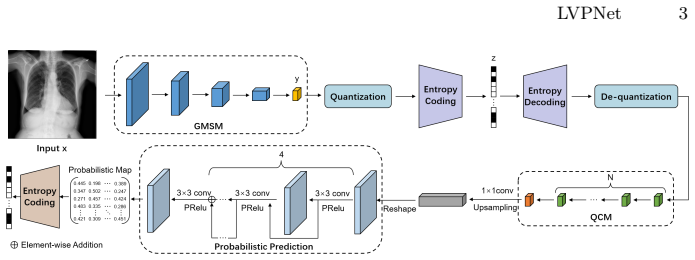
Global Multi-scale Sensing Module (GMSM): a CNN-based encoder that keeps a constant feature volume across hierarchical layers via skip connections $f^{t+1} = \mathrm{Conv}(f^t) + \mathrm{Pool}(f^t)$, then downsamples with $1\times1$ convolutions to a compressed coefficient map $y$ at a sampling ratio $r$. $y$ is floor-quantized to $z$ with a straight-through gradient approximation, Huffman-coded into the stored latent bitstream, and dequantized; the Quantization Compensation Module (QCM) adds non-negative residual corrections to the dequantized features so the final pixel-probability model sees features closer to the original coefficients. Together these modules increase the information content of the latent variables and reduce the cross-entropy term that dominates the total rate.
What would settle it
Compute the actual Huffman-coded length of $z$ per image at $r=0.15$ on a held-out set of Chest X-ray images with varying pathology and image size, and add it to the probability bitstream; if this latent length varies by more than about 0.05 BPP across the set, the fixed-sampling-ratio assumption fails to control total bitrate, and the reported BPP depends on the entropy of $z$ rather than on the trained cross-entropy loss.
Extended reading notes
Core claim
In the paper's own terms, LVPNet establishes that lossless compression of medical images can be improved by replacing sub-image autoregression with prediction conditioned on global latent variables. The quantized latent $z$ is entropy-coded once, and the bulk of the bitstream is the arithmetic-coded pixel probabilities $p_\theta(x|z)$ produced by a probability prediction module; a fixed sampling ratio $r$ makes the latent contribution to total bitrate approximately constant, so optimizing the pixel cross-entropy loss alone is claimed sufficient to lower total bits per pixel. On Chest X-ray the method reports 2.65 BPP dataset-level and 2.72 BPP single-image, below the previous best learned codecs, with encode/decode times at 143.63 and 184.06 ms/sample respectively.
Load-bearing premise
The method assumes the storage cost of the quantized latent variables stays roughly constant across images because the sampling ratio is fixed, so the training loss only needs to minimize pixel-prediction error.
Editorial extensions
If this is right
- If correct, LVPNet sets a new state of the art on Chest X-ray lossless compression, with dataset BPP 2.65 versus 2.74 for ArIB-BPS and 2.76 for LBB.
- The framework works for both whole-dataset and single-image compression, so an imaging site could use one codec for both archive-level and per-study storage.
- Because the pixel predictor is conditioned on global latents rather than a raster-scan autoregressive context, decoding is parallel across pixels, which keeps inference competitive with the fastest prior method.
- Quantization compensation is a drop-in ingredient: adding QCM to a plain CNN sampler reduces Chest X-ray BPP from 2.833 to 2.757 in the paper's ablation, suggesting similar gains for other entropy-coded latent codecs.
- The method extends beyond medical images: reported gains on CIFAR10, ImageNet32, and ImageNet64 are improvements over prior learned codecs, so the design appears to generalize beyond radiology.
Reading between the lines
- A testable extension is to measure the Huffman-coded length of $z$ across images and datasets; if the latent bitstream varies by more than a small fraction of a BPP at fixed $r$, the paper's assumption that total bitrate is controlled by the pixel-prediction loss is violated.
- The sampling ratio $r=0.15$ is chosen on Chest X-ray (Fig. 4) and may not transfer to higher-entropy images; adapting $r$ per image based on a latent-entropy estimate would be a natural follow-up.
- Because the loss is pure cross-entropy with no prior on $z$, coupling LVPNet with a learned entropy model on $z$ could push total BPP further; the paper does not report this.
- The single-image numbers for iVPF, LBB, and iFlow include large initial-bit overheads marked with $\Delta$ in Table 2, so a fair comparison of true single-image usefulness depends on whether model parameters are counted; LVPNet's own single-image numbers assume a shared trained model.
Editorial analysis
A structured set of objections, weighed in public.
Referee Report
Summary. The paper proposes LVPNet, a learned lossless compression framework for medical images. A global multi-scale sensing module (GMSM) extracts a downsampled latent from the full image, quantizes it, entropy-codes it, and a quantization compensation module (QCM) plus a pixel-prediction network produce pixel-wise probability estimates that are arithmetic-coded. The authors report BPP values on Chest X-ray, CIFAR10, ImageNet32, and ImageNet64 for both 'dataset' and 'single-image' settings, claiming state-of-the-art compression efficiency, e.g., 2.65 BPP on Chest X-ray versus 2.74 for ArIB-BPS, with competitive inference time. Ablations on Chest X-ray support the contributions of GMSM and QCM.
Significance. If the reported BPP numbers are reproducible and the pipeline truly encodes losslessly, LVPNet would be a meaningful new data point in learned lossless image compression: it combines a global latent with prediction-driven pixel coding and demonstrates a consistent margin over ArIB-BPS across four benchmarks. The manuscript ships a public code repository, which strengthens the potential for verification. However, the significance is tempered by the fact that the core evaluation is a set of BPP tables with no lossless bitstream verification, no reported latent-rate breakdown, and limited baseline variance information, so the strength of the empirical claim is currently uncertain.
major comments (4)
- [Sec. 2.5, Eq. (5)] The training loss minimizes only the negative log-likelihood of pixels under p_theta(x|z). It contains no term for the entropy of the quantized latent z, yet the total bitstream is rate(z) + rate(p_theta(x|z)). The paper assumes in Sec. 2.1 that the z bitstream 'remains relatively stable due to the fixed sampling ratio r', but the entropy of z is determined by the feature magnitudes produced by GMSM and by the Huffman coder, not by the sample count alone. Since no measured rate(z) is reported anywhere, the claimed total BPP values (e.g., 2.65 for Chest X-ray in Table 1) are not shown to be controlled by the optimized loss, and a varying latent rate could erase the margin over ArIB-BPS.
- [Sec. 3.3, Fig. 4] The sampling rate r is selected on the Chest X-ray test set. Figure 4 varies r and reports the resulting BPP on Chest X-ray, and the same r=0.15 is then used for the other datasets. This is a test-set-tuned hyperparameter, so the reported gains on Chest X-ray are optimistic, and the paper provides no evidence that r=0.15 transfers to CIFAR10, ImageNet32, or ImageNet64. A validation-set sweep or a sensitivity table on the other datasets is needed for the cross-dataset claim.
- [Sec. 2.3 and Sec. 3.3] There is no verification that the full pipeline is lossless or that the claimed bitstream sizes are achievable. The paper states that Huffman coding is used for z and arithmetic coding for predicted probabilities, but no bit-exact decode test, code output verification, or measured table of actual coded lengths is reported. Since 'lossless' is the central claim, at least a reported encode-decode round-trip check (ideally on all test images) should accompany the BPP tables.
- [Table 1] Baseline variance is absent: only LVPNet has error bars in Tables 1-3, and it is unclear how many runs or training seeds they cover. Given that the headline gain over ArIB-BPS is about 0.09 BPP on Chest X-ray (2.65 vs. 2.74), it is important to know the standard deviation of the baseline and whether the baselines were re-run in the same experimental protocol or taken from their original papers.
minor comments (5)
- [Sec. 1] Reference [4] appears as '?' in the text; this citation is missing or broken.
- [Sec. 2.5] The equations use both p_theta(x|z) and x-hat notation inconsistently: Eqs. (4)-(6) write p_theta(hat{x}_ij | Q(G(x))) but the text around them refers to true pixel values x_ij. Please clarify the notation for the target random variable.
- [Table 2] The definition of the delta-marked 'initial bit count' for iVPF, LBB, and iFlow is given only in the table caption. The meaning of 'summing the dataset's compression performance and the initial bit count' should be explained in the body text, since it affects the interpretability of those entries.
- [Sec. 2.3] The straight-through gradient in Eq. (3) uses the notation partial L/partial z but the loss in Eq. (5) is not actually a function of the latent rate; this should be made explicit so readers do not infer that the model optimizes rate(z).
- [Sec. 3.1] The training protocol omits details about dataset splits, number of training epochs, data augmentation, and how the 'single-image' models are trained. A few sentences on these details would help reproducibility.
Circularity Check
No circular derivation: the reported BPP is measured end-to-end, and the missing latent-rate term in Eq. (5) is a correctness risk, not a circular reduction.
full rationale
LVPNet's central claim (Tables 1-3: 2.65 BPP on Chest X-ray vs. 2.74 for ArIB-BPS) is an end-to-end measured bit rate, not a quantity derived from the model's own equations. Eq. (5) optimizes only the cross-entropy of p_theta(x|z), while the paper separately asserts that the z bitstream 'remains relatively stable due to the fixed sampling ratio r' (Sec. 2.1); that is an unverified modeling assumption and a correctness/robustness risk, but it does not make the reported total BPP equal to the training loss by construction. The only tuning-on-data element is the sampling ratio r=0.15, chosen via the Chest X-ray ablation in Fig. 4 and then used in the Chest X-ray results; this is mild benchmark-dependent hyperparameter selection, not a fitted parameter renamed as a prediction. Baselines such as ArIB-BPS are cited for comparison, not as load-bearing support for LVPNet's own derivation, and no uniqueness theorem or ansatz is imported from the authors' prior work. No circular step can be exhibited from the paper's equations or citations.
Assumptions & free parameters
free parameters (3)
- GMSM sampling rate r =
0.15
- Quantization step Q_step =
0.01
- QCM residual block count =
24 (dataset), 3 (single-image)
assumptions (3)
- standard math Arithmetic coding of predicted probabilities and Huffman coding of z achieve code lengths close to their entropies.
- domain assumption The straight-through gradient estimator in Eq. (3) gives a usable approximation to the true gradient through the quantization operation.
- domain assumption Baseline BPP values cited from other papers were measured under the same protocol and are directly comparable to LVPNet's.
Cite this review
Pith. "Pith review of LVPNet: A Latent-variable-based Prediction-driven End-to-end Framework for Lossless Compression of Medical Images." pith.science (2026). https://pith.science/paper/QHBE7NR5
@misc{pith2026250617983,
  author       = {Pith},
  title        = {Pith review of: LVPNet: A Latent-variable-based Prediction-driven End-to-end Framework for Lossless Compression of Medical Images},
  year         = {2026},
  howpublished = {\url{https://pith.science/paper/QHBE7NR5}},
  note         = {Machine review of arXiv:2506.17983}
}
read the original abstract
Autoregressive Initial Bits is a framework that integrates sub-image autoregression and latent variable modeling, demonstrating its advantages in lossless medical image compression. However, in existing methods, the image segmentation process leads to an even distribution of latent variable information across each sub-image, which in turn causes posterior collapse and inefficient utilization of latent variables. To deal with these issues, we propose a prediction-based end-to-end lossless medical image compression method named LVPNet, leveraging global latent variables to predict pixel values and encoding predicted probabilities for lossless compression. Specifically, we introduce the Global Multi-scale Sensing Module (GMSM), which extracts compact and informative latent representations from the entire image, effectively capturing spatial dependencies within the latent space. Furthermore, to mitigate the information loss introduced during quantization, we propose the Quantization Compensation Module (QCM), which learns the distribution of quantization errors and refines the quantized features to compensate for quantization loss. Extensive experiments on challenging benchmarks demonstrate that our method achieves superior compression efficiency compared to state-of-the-art lossless image compression approaches, while maintaining competitive inference speed. The code is at https://github.com/scy-Jackel/LVPNet.
Figures


Figures from the paper (1 more)

Forward citations
Cited by 2 Pith papers
-
CRISP-SAM2: SAM2 with Cross-Modal Interaction and Semantic Prompting for Multi-Organ Segmentation
A text-guided SAM2 variant with cross-modal attention, semantic prompt generation, and a similarity-sorted memory bank achieves top Dice and surface scores on seven public multi-organ CT datasets.
-
Hierarchical Characterization of Brain Dynamics via State Space-based Vector Quantization
A hierarchical state-space vector-quantization model, HST, quantizes fMRI brain states and transitions into discrete tokens and reports modest classification gains on ADHD and schizophrenia datasets.
Reference graph
Works this paper leans on
-
[1]
CA 2 CL: Cluster-Aware Adversarial Contrastive Learning for Pathological Image Analysis
Li, Junjian, et al. "CA 2 CL: Cluster-Aware Adversarial Contrastive Learning for Pathological Image Analysis." IEEE Journal of Biomedical and Health Informatics (2025)
work page 2025
-
[2]
Semantic-Orthogonal Multi-modal Attention Network for RGB-D Salient Object Detection
Xu, Jiawei, et al. "Semantic-Orthogonal Multi-modal Attention Network for RGB-D Salient Object Detection." The Visual Computer (2025): 1-13
work page 2025
-
[3]
DARC: Deep adaptive regularized clustering for histopathological image classification
Li, Junjian, et al. "DARC: Deep adaptive regularized clustering for histopathological image classification." Medical image analysis 80 (2022): 102521
work page 2022
-
[4]
Noise-Consistent Siamese-Diffusion for Medical Image Syn- thesis and Segmentation
Qiu, Kunpeng, et al. "Noise-Consistent Siamese-Diffusion for Medical Image Syn- thesis and Segmentation." Proceedings of the Computer Vision and Pattern Recog- nition Conference. 2025
work page 2025
-
[5]
Learn From Zoom: Decoupled Supervised Contrastive Learning For WCE Image Classification
Qiu, Kunpeng, Zhiying Zhou, and Yongxin Guo. "Learn From Zoom: Decoupled Supervised Contrastive Learning For WCE Image Classification." ICASSP 2024- 2024 IEEE International Conference on Acoustics, Speech and Signal Processing (ICASSP). IEEE, 2024
work page 2024
-
[6]
A mathematical theory of communication
Shannon, Claude Elwood. "A mathematical theory of communication." The Bell system technical journal 27.3 (1948): 379-423
work page 1948
-
[7]
Png (portable network graphics) specification version 1.0
Boutell, Thomas. Png (portable network graphics) specification version 1.0. No. rfc2083. 1997
work page 1997
-
[8]
A universal algorithm for sequential data com- pression
Ziv, Jacob, and Abraham Lempel. "A universal algorithm for sequential data com- pression." IEEE Transactions on information theory 23.3 (1977): 337-343
work page 1977
Show all 43 references
-
[10]
JPEG 2000 standard ISO/IEC 15444 ITU-T Recommendation T.800
"JPEG 2000 standard ISO/IEC 15444 ITU-T Recommendation T.800", Joint Photographic Experts Group (JPEG), 2004, [online] Available: http://www.jpeg.org/jpeg. 10 Chenyue Song et al
2000
-
[11]
Deep generative modelling: A comparative review of vaes, gans, normalizing flows, energy-based and autoregressive models
Bond-Taylor, Sam, et al. "Deep generative modelling: A comparative review of vaes, gans, normalizing flows, energy-based and autoregressive models." IEEE trans- actions on pattern analysis and machine intelligence 44.11 (2021): 7327-7347
2021
-
[12]
ICH-PRNet: a cross-modal intracerebral haemorrhage prognostic prediction method using joint-attention interaction mechanism
Yu, Xinlei, et al. "ICH-PRNet: a cross-modal intracerebral haemorrhage prognostic prediction method using joint-attention interaction mechanism." Neural Networks 184 (2025): 107096
2025
-
[13]
On the Interplay of Human-AI Alignment, Fairness, and Per- formance Trade-offs in Medical Imaging
Luo, Haozhe, et al. "On the Interplay of Human-AI Alignment, Fairness, and Per- formance Trade-offs in Medical Imaging." arXiv preprint arXiv:2505.10231 (2025)
2025 arXiv
-
[14]
Pixelcnn++: Improving the pixelcnn with discretized lo- gistic mixture likelihood and other modifications
Salimans, Tim, et al. "Pixelcnn++: Improving the pixelcnn with discretized lo- gistic mixture likelihood and other modifications." arXiv preprint arXiv:1701.05517 (2017)
2017 arXiv
-
[15]
Pixelrecurrent neural networks
VanDenOord,Aäron,NalKalchbrenner,andKorayKavukcuoglu."Pixelrecurrent neural networks." International conference on machine learning. PMLR, 2016
2016
-
[16]
Learned Lossless Image Compression based on Bit Plane Slic- ing
Zhang, Zhe, et al. "Learned Lossless Image Compression based on Bit Plane Slic- ing." CVPR. 2024
2024
-
[17]
Bit-swap: Recursive bits-back coding for lossless compression with hierarchical latent variables
Kingma, Friso, Pieter Abbeel, and Jonathan Ho. "Bit-swap: Recursive bits-back coding for lossless compression with hierarchical latent variables." International Conference on Machine Learning. PMLR, 2019
2019
-
[19]
Practical lossless compression with latent variables using bits back coding
Townsend, James, Tom Bird, and David Barber. "Practical lossless compression with latent variables using bits back coding." arXiv preprint arXiv:1901.04866 (2019)
2019 arXiv
-
[20]
Hilloc: Lossless image compression with hierarchical la- tent variable models
Townsend, James, et al. "Hilloc: Lossless image compression with hierarchical la- tent variable models." arXiv preprint arXiv:1912.09953 (2019)
2019 arXiv
-
[21]
Deep lossy plus residual coding for lossless and near-lossless image compression
Bai, Yuanchao, et al. "Deep lossy plus residual coding for lossless and near-lossless image compression." TPAMI 46.5 (2024): 3577-3594
2024
-
[22]
Hybrid-context-basedmulti-priorentropy modeling for learned lossless image compression
Fu,Chuan,BoDu,andLiangpeiZhang."Hybrid-context-basedmulti-priorentropy modeling for learned lossless image compression." Pattern Recognition 155 (2024): 110632
2024
-
[23]
Compression with flows via local bits-back coding
Ho, Jonathan, Evan Lohn, and Pieter Abbeel. "Compression with flows via local bits-back coding." Advances in Neural Information Processing Systems 32 (2019)
2019
-
[24]
Integer discrete flows and lossless compression
Hoogeboom, Emiel, et al. "Integer discrete flows and lossless compression." Ad- vances in Neural Information Processing Systems 32 (2019)
2019
-
[25]
iflow: Numerically invertible flows for efficient lossless com- pression via a uniform coder
Zhang, Shifeng, et al. "iflow: Numerically invertible flows for efficient lossless com- pression via a uniform coder." Advances in Neural Information Processing Systems 34 (2021): 5822-5833
2021
-
[26]
ivpf:Numericalinvertiblevolumepreservingflowforefficient lossless compression
Zhang,Shifeng,etal."ivpf:Numericalinvertiblevolumepreservingflowforefficient lossless compression." CVPR. 2021
2021
-
[27]
Lossless Image Compression Us- ing Context-Dependent Linear Prediction Based on Mean Absolute Error Minimiza- tion
Ulacha, Grzegorz, and Mirosław Łazoryszczak. "Lossless Image Compression Us- ing Context-Dependent Linear Prediction Based on Mean Absolute Error Minimiza- tion." Entropy 26.12 (2024): 1115
2024
-
[28]
Lossless image compression by joint prediction of pixel and context using duplex neural networks
Rhee, Hochang, et al. "Lossless image compression by joint prediction of pixel and context using duplex neural networks." IEEE Access 9 (2021): 86632-86645
2021
-
[29]
A prediction-based lossless image compression procedure using dimension reduction and Huffman coding
Rahman, Md Atiqur, and Mohamed Hamada. "A prediction-based lossless image compression procedure using dimension reduction and Huffman coding." Multime- dia Tools and Applications 82.3 (2023): 4081-4105
2023
-
[30]
Bilateral context modeling for residual coding in lossless 3D medical image compression
Liu, Xiangrui, et al. "Bilateral context modeling for residual coding in lossless 3D medical image compression." TIP (2024)
2024
-
[31]
Autoregressive diffusion models
Hoogeboom, Emiel, et al. "Autoregressive diffusion models." arXiv preprint arXiv:2110.02037 (2021). LVPNet 11
2021 arXiv
-
[32]
Variational diffusion models
Kingma, Diederik, et al. "Variational diffusion models." Advances in neural infor- mation processing systems 34 (2021): 21696-21707
2021
-
[33]
Practical full resolution learned lossless image compres- sion
Mentzer, Fabian, et al. "Practical full resolution learned lossless image compres- sion." CVPR. 2019
2019
-
[34]
Split hierarchical variational compression
Ryder, Tom, et al. "Split hierarchical variational compression." CVPR. 2022
2022
-
[35]
Creg-kd: Model refinement via confidence regularized knowl- edge distillation for brain imaging
Yang, Yanwu, et al. "Creg-kd: Model refinement via confidence regularized knowl- edge distillation for brain imaging." Medical Image Analysis 89 (2023): 102916
2023
-
[36]
Don’t Blame the ELBO! A Linear VAE Perspective on Pos- terior Collapse
Lucas, James et al. “Don’t Blame the ELBO! A Linear VAE Perspective on Pos- terior Collapse.” ArXiv abs/1911.02469 (2019): n. pag
2019 arXiv
-
[37]
Hybrid ladder transform- ers with efficient parallel-cross attention for medical image segmentation
Luo, Haozhe, Yu Changdong, and Raghavendra Selvan. "Hybrid ladder transform- ers with efficient parallel-cross attention for medical image segmentation." Interna- tional conference on medical imaging with deep learning. PMLR, 2022
2022
-
[38]
Advancing Brain Imaging Analysis Step-by-Step via Progres- sive Self-paced Learning
Yang, Yanwu, et al. "Advancing Brain Imaging Analysis Step-by-Step via Progres- sive Self-paced Learning." International Conference on Medical Image Computing and Computer-Assisted Intervention. Cham: Springer Nature Switzerland, 2024
2024
-
[39]
Deep residual learning for image recognition
He, Kaiming, et al. "Deep residual learning for image recognition." CVPR. 2016
2016
-
[40]
A method for the construction of minimum-redundancy codes
Huffman, David A. "A method for the construction of minimum-redundancy codes." Proceedings of the IRE 40.9 (1952): 1098-1101
1952
-
[41]
Synthesis of noiseless compression codes,
B. P. Tunstall, “Synthesis of noiseless compression codes,” in PhD diss., Georgia Institute of Technology, 1967
1967
-
[42]
FLIF: Free lossless image format based on MA- NIAC compression
Sneyers, Jon, and Pieter Wuille. "FLIF: Free lossless image format based on MA- NIAC compression." ICIP. IEEE, 2016
2016
-
[43]
JPEG XL next-generation image compression architecture and coding tools
Alakuijala, Jyrki, et al. "JPEG XL next-generation image compression architecture and coding tools." Applications of digital image processing XLII. Vol. 11137. SPIE, 2019
2019
-
[44]
Chestx-ray8: Hospital-scale chest x-ray database and benchmarks on weakly-supervised classification and localization of common thorax diseases
Wang, Xiaosong, et al. "Chestx-ray8: Hospital-scale chest x-ray database and benchmarks on weakly-supervised classification and localization of common thorax diseases." CVPR. 2017
2017
-
[45]
Adam: A Method for Stochastic Optimiza- tion
Kingma, Diederik P. and Jimmy Ba. “Adam: A Method for Stochastic Optimiza- tion.” CoRR abs/1412.6980 (2014): n. pag
2014 arXiv
Reviewed August 6, 2026 · model on record in the stance chip above.
Discussion (0). Sign in to comment.