REVIEW 2 major objections 4 minor 86 references
When few labeled target data suffice: a theory of semi-supervised domain adaptation via fine-tuning from multiple adaptive starts
T0 review · 2 major / 4 minor · reviewed 2026-08-06 · deepseek-v4-flash
Pith's one-line read Under anticausal linear causal models, low-dimensional distribution shifts let a few labeled target samples achieve the rate that would otherwise require d labeled samples.
desk verdict Solid SCM-based minimax theory for SSDA with a real gap: the upper bounds rely on oracle tuning constants, so the central r/n^0 claim is not yet certified for an implementable procedure. read the letter →
The pith
A machine-rendered reading of the paper's core claim, the machinery that carries it, and where it could break.
The reading
What carries the argument
The load-bearing object is the UDA-start plus low-dimensional correction decomposition: for each canonical intervention, the target-specific deviation $\beta^{\star} - \beta_{\mathrm{UDA}}$ is confined to a subspace (or a sparse support set) that is identifiable without target labels. FT-DIP estimates this subspace from the rank-$r_{\mathrm{ca}}$ covariance difference $\Sigma_X^{(0)} - \Sigma_X^{(1)}$ and fine-tunes subject to the constraint that the correction has no component in its orthogonal complement; FT-OLS-Src imposes an $\ell^1$ constraint around the source OLS estimator because $\beta^{\star} - \beta_{\mathrm{LS}}^{(1)}$ is supported on the $r_{\mathrm{sc}}$ intervened columns; FT-CIP builds the conditionally invariant subspace $V_{\mathrm{aw}}$ from heterogeneous source domains and uses the identity $Q_{\mathrm{aug}}^\top \Sigma_X^{(1)}(\beta^{\star} - \beta_{\mathrm{CIP}}) = 0$, removing the need for unlabeled target covariates. Gaussian-width and eigen-gap conditions control how many unlabeled samples are needed to learn these subspaces, and once the subspace is fixed the $r/n^{(0)}$ rate is the ordinary cost of $r$-dimensional constrained least squares.
What would settle it
Simulate an anticausal linear SCM with $d=100$ and true intervention rank $r=5$, but generate the target with a rank-$6$ perturbation; running FT-DIP with $r=5$ across increasing $n^{(0)}$ should show excess risk scaling as $6/n^{(0)}$ rather than the advertised $5/n^{(0)}$, which would falsify the rank condition's role. A cheaper check on real data is to estimate the rank of $\Sigma_X^{(0)} - \Sigma_X^{(1)}$ or of the conditional-mean differences from unlabeled data and compare it with the subspace dimension used by the fine-tuned method.
Extended reading notes
Core claim
Within the anticausal linear SCMs of Assumption 1, and for the three canonical intervention classes of Assumptions 3–5, the paper demonstrates that the oracle target coefficient $\beta^{\star}$ differs from the associated UDA estimator along a subspace of dimension $r$ that can be identified from source and unlabeled target data alone. Under confounded additive shifts, $\beta^{\star} - \beta^{(1)}_{\mathrm{DIP}}$ lies in $\operatorname{col}((\Sigma_X^{(0)})^{-1}V)$; under sparse connectivity shifts, $\beta^{\star} - \beta^{(1)}_{\mathrm{LS}}$ is $r_{\mathrm{sc}}$-sparse; and under anticausal weight shifts, the correction obeys $Q_{\mathrm{aug}}^\top \Sigma_X^{(1)}(\beta^{\star} - \beta_{\mathrm{CIP}}) = 0$, so no unlabeled target covariates are needed. Constrained least squares on the labeled target data within that subspace estimates only $r$ parameters, giving target excess risk of order $r/n^{(0)}$ up to logarithmic factors, while target-only estimators suffer $d/n^{(0)}$. Matching minimax lower bounds establish that this rate is optimal, and MASFT makes the choice among the three shift-specific strategies adaptive with only a $\log M$ validation penalty.
Load-bearing premise
The load-bearing premise is that the true source-to-target shift is exactly one of the three low-dimensional linear intervention classes, satisfying the exact rank, span, and support conditions of Assumptions 3, 4, and 5; if the shift is higher-dimensional, nonlinear, or fails the span condition, the identified fine-tuning subspace is misspecified and the $r/n^{(0)}$ guarantee collapses.
Editorial extensions
If this is right
- Under CA, SC, or AW shifts, a practitioner needs only $n^{(0)} \asymp r \log(1/\delta)$ labeled target samples, plus enough source and unlabeled data, to reach the target-only rate that would require $n^{(0)} \asymp d$.
- Unlabeled target data are not essential in every regime: FT-OLS-Src under SC shifts and FT-CIP under AW shifts achieve the minimax rate using only source data and a few target labels.
- When the shift type is unknown, MASFT makes model selection safe: a validation set of size about $\log M$ recovers the performance of the best candidate fine-tuning strategy.
- The covariance-matching DIP start identifies the CA shift subspace, so mean-matching-only alignments fail in centered confounded additive shifts; second-moment matching is the right alignment.
- In the covariate-only CA subcase ($w_Y = 0$), the paper notes the rate is not tight and the plug-in estimator can reach the oracle without any target labels.
Reading between the lines
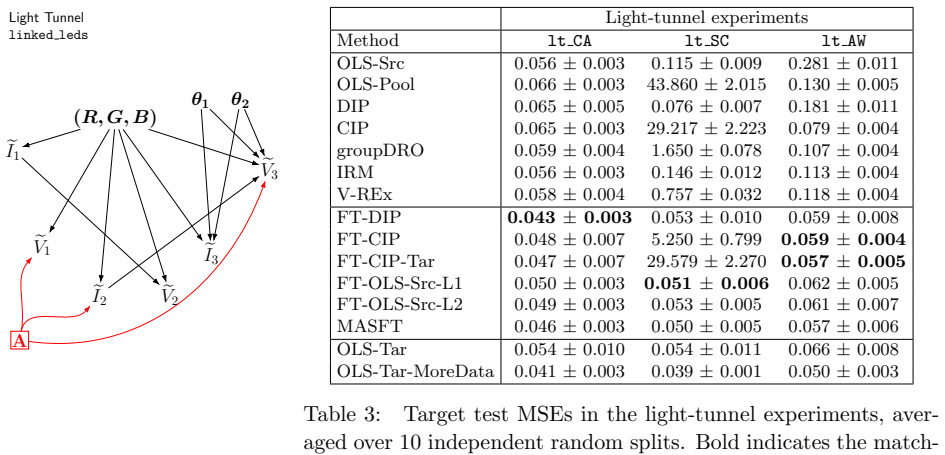
- If the true shift is only approximately low-dimensional, as in the NIR and Light Tunnel systems, the theory predicts the excess risk should degrade with the approximation error; a direct test is to measure how performance changes as the estimated rank of the covariance difference grows toward $d$.
- The same template suggests a cheap pre-screening diagnostic: estimate the rank of $\Sigma_X^{(0)} - \Sigma_X^{(1)}$ or the conditional-mean difference from unlabeled data before investing in labels; if the spectrum is flat, the $r/n^{(0)}$ guarantee should not be expected.
- The linear-SCM identities that carry the argument are specific to squared loss and linear predictors; extending the template to logistic or cross-entropy losses would require re-deriving the subspace decomposition, so the practical lesson for nonlinear models is architectural rather than rate-based.
Editorial analysis
A structured set of objections, weighed in public.
Referee Report
Summary. The paper develops a theory of semi-supervised domain adaptation (SSDA) under anticausal linear structural causal models, focusing on three low-dimensional intervention classes: confounded additive (CA) shifts, sparse connectivity (SC) shifts, and anticausal weight (AW) shifts. For each class it proposes a fine-tuning estimator (FT-DIP, FT-OLS-Src, FT-CIP) that starts from a corresponding UDA solution and uses the limited labeled target data only in the low-dimensional fine-tuning subspace. The main theoretical results are upper bounds of order r/n^(0) (up to logarithmic factors) on the target excess risk using n^(0) labeled target samples, complemented by minimax lower bounds of the same order. When the intervention type is unknown, the paper introduces MASFT, which selects among candidate fine-tuned estimators using a small target validation set. The theoretical findings are supported by synthetic experiments and by real-data experiments on light-tunnel and near-infrared spectroscopy datasets.
Significance. If the results hold, the paper provides a principled explanation of when few labeled target samples suffice: under low-dimensional interventions, source and unlabeled target data identify the high-dimensional shared structure, reducing the labeled-target sample complexity from the ambient dimension d to the intervention dimension r. A particular strength is the construction of the minimax lower bounds, where the source and unlabeled target data are kept identical across hypotheses, so the lower bounds correctly isolate the information carried by the labeled target samples. The paper also gives detailed finite-sample proofs, explicit conditions for each intervention class, and reproducible experiments with synthetic and physical-system data. The central caveat is that the upper-bound theorems are stated for oracle-tuned parameters, which is a load-bearing gap discussed below.
major comments (2)
- [§4.2, Eq. (20); §4.1, Eq. (16); Theorems 4.1 and 4.3] The tuning parameters in the proposed estimators depend on unknown population quantities. In Theorem 4.3, the constraint radius is set to gamma = ||beta* - hat_beta_LS^(1)||_1 and rho >= ||beta*||_2, where beta* is the unknown oracle target coefficient defined in Eq. (7). In Theorem 4.1, the bound requires choosing varrho >= c lambda_max(||beta*||_2 + ...), again involving the unknown beta*. The proofs therefore establish excess-risk bounds only for oracle-tuned members of the estimator family, and not for a procedure that selects these parameters from data. Since no data-driven tuning analysis is provided, the stated upper bounds do not certify an implementable algorithm that achieves the claimed r/n^(0) rate. The lower bounds remain valid, but the matching upper-bound claim is not yet supported for the practical versions of the methods.
- [§5, Corollary 1] The MASFT selection result inherits the oracle-tuning gap. Corollary 1 states that, under the conditions of Theorems 4.1, 4.3, and 4.5, validation-based selection among the candidates achieves the best candidate's rate up to a logarithmic overhead. However, each candidate's guarantee in those theorems assumes that its own tuning parameters (gamma, rho, varrho) are chosen using the unknown beta*. Thus the validation set selects among oracle-tuned members of the candidate families, not among implementable data-driven procedures. A complete result would require either a data-driven tuning procedure with a valid excess-risk bound or an explicit statement that the theory covers only oracle-tuned versions.
minor comments (4)
- [§3.2, Example (Additive mean shift)] The numerical values in the additive mean-shift example appear to be incorrect. For the stated noise means (source means all 1, target means -1, 0, 1), solving the constrained least-squares problem in (5) with the mean-matching penalty gives beta_DIP^(1) = (-1/11, 2/11, 5/11) and v_DIP = Sigma_X^(0)^{-1}(E[X^(1)] - E[X^(0)]) = (5/4, 1/4, -3/4), not the values (47,59,71)/272 and (7,3,-1)/12 reported in the text. The qualitative conclusion that beta* - beta_DIP is parallel to v_DIP still holds with the corrected values, but the displayed numbers should be fixed to avoid misleading readers.
- [§4.3.1] The variant FT-CIP-Tar, which uses unlabeled target covariates, is introduced and evaluated empirically but is not covered by a finite-sample theorem. The paper explicitly states that it focuses on the setting without unlabeled target covariates, so this is a clear scope limitation, but it would be helpful to add a sentence in Section 6 reminding readers that the theoretical guarantees for FT-CIP do not apply to FT-CIP-Tar.
- [Appendix G.1] The proof of Proposition 3.1 assumes d >= 32 and dismisses the small-dimensional case with a brief remark that a lower bound can be obtained by a one-parameter Fano construction. Since the small-d case is needed for a fully general statement, a few lines of detail would improve completeness, though this is not a barrier to the main claims.
- [§5, Corollary 1] The displayed bound in Corollary 1 writes "c'' eta_s sqrt(log(M/delta)/n_val^(0)) + epsilon_type" without explicitly showing that epsilon_type may also carry a log(1/delta) factor from applying the individual theorems at failure probability delta/M. The statement is acceptable if this is understood, but a short clarifying sentence would prevent misreading.
Circularity Check
No significant circularity: the r/n^(0) rates are derived from structural identities (Eqs. 15, 19, 25) and matched by independent minimax lower bounds; oracle-scale tuning constants are a flagged implementability gap, not a circular reduction.
full rationale
The central claim — that labeled-target sample complexity scales with the intervention dimension r rather than the ambient dimension d — is not reached by fitting or by definitional fiat. For each intervention model the low-dimensional correction is derived, not assumed: for CA shifts, Eq. (15) and Appendix C.1 prove β* − β_DIP lies in the r_ca-dimensional subspace col(Σ_X^(0)^{-1}V) via projection identities and covariance/cross-moment matching on the common subspace, instead of being imposed; for SC shifts, Eq. (19) and Appendix C.2 derive the r_sc-sparsity of β* − β_LS^(1) from the column-sparse difference B^(0) − B^(1) via the Sherman–Morrison formula; for AW shifts, Eqs. (25)–(27) and Appendix C.3 derive the (r_aw+1)-dimensional constraint from the span condition (22). The matching minimax lower bounds (Theorems 4.2, 4.4, 4.6; Appendices G.2–G.4) are genuine Fano constructions over the assumed classes in which source and unlabeled data are uninformative while the oracle varies in an r-dimensional family, proving that no method can beat r/n^(0) — so the class is shown to be genuinely r-hard rather than the conclusion being a tautology. The stated upper bounds do rely on oracle-scale tuning constants (Theorem 4.1: ϱ ≥ c_2 λ_max(||β*||_2 + κ^{3/2}||β_LS^(1)||_2 + κ^{3/2}σ_Y/σ_X); Theorem 4.3: ρ ≥ ||β*||_2 and γ = ||β* − \hat{β}_LS^(1)||_1; Theorem 4.5: ϱ ≥ c_3 λ_max(||β*||_2 + κ^{3/2}||β_Pool||_2 + κ^{3/2}σ_Y/σ_X)), so the theorems certify an infeasible parameter choice rather than a fully data-driven procedure; this implementability gap (inherited by Corollary 1's candidates) is a correctness risk, not a circular reduction, because the r-scaling in each bound follows from the structural dimension of the feasible set and not from the fitted constants. No load-bearing self-citation chain was found: the cited identifiability results [13, 76] contextualize but do not prove the new bounds, which are proved internally in Appendices C–F, and the overlap of FT-OLS-Src's ℓ1 constraint with [41] is explicitly acknowledged with a genuinely added source-estimation-uncertainty analysis. The empirical sections tune hyperparameters on separate validation sets and report held-out test MSE, so no fitted quantity is renamed as a prediction.
Assumptions & free parameters
free parameters (2)
- fine-tuning subspace dimension =
tuned on target validation set in experiments
- regularization or penalty parameters =
tuned on target validation set in experiments
assumptions (6)
- domain assumption Assumption 1: data follow anticausal linear SCMs with I-B invertible in every domain.
- domain assumption Assumption 2: noise terms are zero-mean sub-Gaussian and covariances are invertible.
- domain assumption Assumption 3: CA shift interventions with rank(W+bw_Y^T)=r_ca.
- domain assumption Assumption 4: SC shift interventions modify exactly r_sc columns of B.
- domain assumption Assumption 5: AW shift with b(0)-b(1) in the span of the source perturbation directions.
- standard math Standard concentration and Fano-type inequalities used in the proofs.
Cite this review
Pith. "Pith review of When few labeled target data suffice: a theory of semi-supervised domain adaptation via fine-tuning from multiple adaptive starts." pith.science (2026). https://pith.science/paper/QHBRV4UU
@misc{pith2026250714661,
  author       = {Pith},
  title        = {Pith review of: When few labeled target data suffice: a theory of semi-supervised domain adaptation via fine-tuning from multiple adaptive starts},
  year         = {2026},
  howpublished = {\url{https://pith.science/paper/QHBRV4UU}},
  note         = {Machine review of arXiv:2507.14661}
}
read the original abstract
Semi-supervised domain adaptation (SSDA) seeks to achieve accurate predictions in a target domain with limited labeled target data by exploiting abundant source and unlabeled target data. We study this problem under structural causal models (SCMs), which provide a statistical framework to describe distribution shifts between source and target domains as interventions in the data-generating process rather than ad hoc changes in model parameters. The central phenomenon is that, under low-dimensional interventions, source and unlabeled target data can help identify the high-dimensional shared structure, leaving only a low-dimensional target-specific correction to be learned from limited labeled target data. We formalize this principle for three canonical intervention models and propose the corresponding SSDA methods FT-DIP, FT-OLS-Src and FT-CIP. Under each intervention model, we demonstrate how extending an unsupervised domain adaptation (UDA) method to SSDA can achieve minimax-optimal target performance with limited target labels, with the labeled-target sample complexity scaling with the intervention dimension rather than the ambient dimension. When the distribution shift is underspecified, we propose the Multi-Adaptive-Start Fine-Tuning (MASFT) algorithm, which fine-tunes from multiple adaptive starts and selects among them using a small target validation set, incurring only logarithmic overhead in the number of starts. We validate the effectiveness of our proposed methods through simulated and real data experiments.
Figures


Figures from the paper (3 more)


Reference graph
Works this paper leans on
-
[1]
Achieving robustness across season, location and cultivar for a nirs model for intact mango fruit dry matter content.Postharvest Biology and Technology, 168:111202, 2020
NT Anderson, KB Walsh, PP Subedi, and CH Hayes. Achieving robustness across season, location and cultivar for a nirs model for intact mango fruit dry matter content.Postharvest Biology and Technology, 168:111202, 2020
2020
-
[2]
Invariant risk mini- mization.arXiv preprint arXiv:1907.02893, 2019
Martin Arjovsky, L´ eon Bottou, Ishaan Gulrajani, and David Lopez-Paz. Invariant risk mini- mization.arXiv preprint arXiv:1907.02893, 2019
arXiv 1907
-
[3]
MIT press, 2024
Francis Bach.Learning theory from first principles. MIT press, 2024
2024
-
[4]
Un- supervised domain adaptation by domain invariant projection
Mahsa Baktashmotlagh, Mehrtash T Harandi, Brian C Lovell, and Mathieu Salzmann. Un- supervised domain adaptation by domain invariant projection. InProceedings of the IEEE International Conference on Computer Vision, pages 769–776, 2013
2013
-
[5]
Predicting with proxies: Transfer learning in high dimension.Management Science, 67(5):2964–2984, 2021
Hamsa Bastani. Predicting with proxies: Transfer learning in high dimension.Management Science, 67(5):2964–2984, 2021
2021
-
[6]
A theory of learning from different domains.Machine learning, 79 (1-2):151–175, 2010
Shai Ben-David, John Blitzer, Koby Crammer, Alex Kulesza, Fernando Pereira, and Jen- nifer Wortman Vaughan. A theory of learning from different domains.Machine learning, 79 (1-2):151–175, 2010
2010
-
[7]
Springer Science & Business Media, 2013
Rajendra Bhatia.Matrix analysis, volume 169. Springer Science & Business Media, 2013
2013
-
[8]
Simultaneous analysis of lasso and dantzig selector.The Annals of Statistics, 37(4):1705, 2009
Peter J Bickel, Ya’acov Ritov, and Alexandre B Tsybakov. Simultaneous analysis of lasso and dantzig selector.The Annals of Statistics, 37(4):1705, 2009
work page 2009
Show all 86 references
-
[9]
Combining labeled and unlabeled data with co-training
Avrim Blum and Tom Mitchell. Combining labeled and unlabeled data with co-training. In Proceedings of the eleventh annual conference on Computational learning theory, pages 92–100, 1998
1998
-
[10]
Invariance, causality and robustness.Statistical Science, 35(3):404–426, 2020
Peter B¨ uhlmann. Invariance, causality and robustness.Statistical Science, 35(3):404–426, 2020
2020
-
[11]
Causality matters in medical imaging.Nature Communications, 11(1):3673, 2020
Daniel C Castro, Ian Walker, and Ben Glocker. Causality matters in medical imaging.Nature Communications, 11(1):3673, 2020
2020
-
[12]
An empirical study of training self-supervised vision transformers
Xinlei Chen, Saining Xie, and Kaiming He. An empirical study of training self-supervised vision transformers. InProceedings of the IEEE/CVF international conference on computer vision, pages 9640–9649, 2021
2021
-
[13]
Domain adaptation under structural causal models.Journal of Machine Learning Research, 22(261):1–80, 2021
Yuansi Chen and Peter B¨ uhlmann. Domain adaptation under structural causal models.Journal of Machine Learning Research, 22(261):1–80, 2021
2021
-
[14]
Spectral methods for data science: A statistical perspective.Foundations and Trends®in Machine Learning, 14(5):566–806, 2021
Yuxin Chen, Yuejie Chi, Jianqing Fan, Cong Ma, et al. Spectral methods for data science: A statistical perspective.Foundations and Trends®in Machine Learning, 14(5):566–806, 2021
2021
-
[15]
Optimal transport for domain adaptation.IEEE transactions on pattern analysis and machine intelligence, 39(9): 1853–1865, 2016
Nicolas Courty, R´ emi Flamary, Devis Tuia, and Alain Rakotomamonjy. Optimal transport for domain adaptation.IEEE transactions on pattern analysis and machine intelligence, 39(9): 1853–1865, 2016
2016
-
[16]
The bayesian approach to inverse problems.arXiv preprint arXiv:1302.6989, 2013
Masoumeh Dashti and Andrew M Stuart. The bayesian approach to inverse problems.arXiv preprint arXiv:1302.6989, 2013. 88
2013 arXiv
-
[17]
Semi-supervised domain adaptation with instance constraints
Jeff Donahue, Judy Hoffman, Erik Rodner, Kate Saenko, and Trevor Darrell. Semi-supervised domain adaptation with instance constraints. InProceedings of the IEEE conference on com- puter vision and pattern recognition, pages 668–675, 2013
2013
-
[18]
Statistics of robust optimization: A generalized empirical likelihood approach.Mathematics of Operations Research, 46(3):946–969, 2021
John C Duchi, Peter W Glynn, and Hongseok Namkoong. Statistics of robust optimization: A generalized empirical likelihood approach.Mathematics of Operations Research, 46(3):946–969, 2021
2021
-
[19]
Causal chambers as a real-world physical testbed for ai methodology.Nature Machine Intelligence, 7(1):107–118, 2025
Juan L Gamella, Jonas Peters, and Peter B¨ uhlmann. Causal chambers as a real-world physical testbed for ai methodology.Nature Machine Intelligence, 7(1):107–118, 2025
2025
-
[20]
Domain-adversarial training of neural networks.The Journal of Machine Learning Research, 17(1):2096–2030, 2016
Yaroslav Ganin, Evgeniya Ustinova, Hana Ajakan, Pascal Germain, Hugo Larochelle, Fran¸ cois Laviolette, Mario Marchand, and Victor Lempitsky. Domain-adversarial training of neural networks.The Journal of Machine Learning Research, 17(1):2096–2030, 2016
2016
-
[21]
Shortcut learning in deep neural networks.Nature Machine Intelligence, 2(11):665–673, 2020
Robert Geirhos, J¨ orn-Henrik Jacobsen, Claudio Michaelis, Richard Zemel, Wieland Brendel, Matthias Bethge, and Felix A Wichmann. Shortcut learning in deep neural networks.Nature Machine Intelligence, 2(11):665–673, 2020
2020
-
[22]
Domain adaptation with conditional transferable components
Mingming Gong, Kun Zhang, Tongliang Liu, Dacheng Tao, Clark Glymour, and Bernhard Sch¨ olkopf. Domain adaptation with conditional transferable components. InInternational conference on machine learning, pages 2839–2848. PMLR, 2016
2016
-
[23]
Improving neural network training in low dimensional random bases.Advances in Neural Information Processing Systems, 33: 12140–12150, 2020
Frithjof Gressmann, Zach Eaton-Rosen, and Carlo Luschi. Improving neural network training in low dimensional random bases.Advances in Neural Information Processing Systems, 33: 12140–12150, 2020
2020
-
[24]
A kernel two-sample test.The Journal of Machine Learning Research, 13(1):723–773, 2012
Arthur Gretton, Karsten M Borgwardt, Malte J Rasch, Bernhard Sch¨ olkopf, and Alexander Smola. A kernel two-sample test.The Journal of Machine Learning Research, 13(1):723–773, 2012
2012
-
[25]
Domain adaptation for medical image analysis: A survey.IEEE Transactions on Biomedical Engineering, 2022
Hao Guan and Mingxia Liu. Domain adaptation for medical image analysis: A survey.IEEE Transactions on Biomedical Engineering, 2022
2022
-
[26]
In search of lost domain generalization
Ishaan Gulrajani and David Lopez-Paz. In search of lost domain generalization. InInterna- tional Conference on Learning Representations (ICLR), 2020
2020
-
[27]
Adap- tive wavelet distillation from neural networks through interpretations.Advances in Neural Information Processing Systems, 34:20669–20682, 2021
Wooseok Ha, Chandan Singh, Francois Lanusse, Srigokul Upadhyayula, and Bin Yu. Adap- tive wavelet distillation from neural networks through interpretations.Advances in Neural Information Processing Systems, 34:20669–20682, 2021
2021
-
[28]
Delving deep into rectifiers: Surpassing human-level performance on imagenet classification
Kaiming He, Xiangyu Zhang, Shaoqing Ren, and Jian Sun. Delving deep into rectifiers: Surpassing human-level performance on imagenet classification. InProceedings of the IEEE international conference on computer vision, pages 1026–1034, 2015
2015
-
[29]
Conditional variance penalties and domain shift robustness.Machine Learning, 110(2):303–348, 2021
Christina Heinze-Deml and Nicolai Meinshausen. Conditional variance penalties and domain shift robustness.Machine Learning, 110(2):303–348, 2021
2021
-
[30]
Benchmarking neural network robustness to common corruptions and perturbations
Dan Hendrycks and Thomas Dietterich. Benchmarking neural network robustness to common corruptions and perturbations. InInternational Conference on Learning Representations, 2019
2019
-
[31]
Random design analysis of ridge regression
Daniel Hsu, Sham M Kakade, and Tong Zhang. Random design analysis of ridge regression. InConference on learning theory, pages 9–1. JMLR Workshop and Conference Proceedings, 2012. 89
2012
-
[32]
Lora: Low-rank adaptation of large language models.ICLR, 1 (2):3, 2022
Edward J Hu, Yelong Shen, Phillip Wallis, Zeyuan Allen-Zhu, Yuanzhi Li, Shean Wang, Lu Wang, Weizhu Chen, et al. Lora: Low-rank adaptation of large language models.ICLR, 1 (2):3, 2022
2022
-
[33]
Bidirectional adversarial training for semi-supervised domain adaptation
Pin Jiang, Aming Wu, Yahong Han, Yunfeng Shao, Meiyu Qi, and Bingshuai Li. Bidirectional adversarial training for semi-supervised domain adaptation. InIJCAI, pages 934–940, 2020
2020
-
[34]
Support and invertibility in domain-invariant representations
Fredrik D Johansson, David Sontag, and Rajesh Ranganath. Support and invertibility in domain-invariant representations. InThe 22nd International Conference on Artificial Intelli- gence and Statistics, pages 527–536. PMLR, 2019
2019
-
[35]
Do better imagenet models transfer better? InProceedings of the IEEE/CVF conference on computer vision and pattern recognition, pages 2661–2671, 2019
Simon Kornblith, Jonathon Shlens, and Quoc V Le. Do better imagenet models transfer better? InProceedings of the IEEE/CVF conference on computer vision and pattern recognition, pages 2661–2671, 2019
2019
-
[36]
Imagenet classification with deep convolutional neural networks.Advances in neural information processing systems, 25, 2012
Alex Krizhevsky, Ilya Sutskever, and Geoffrey E Hinton. Imagenet classification with deep convolutional neural networks.Advances in neural information processing systems, 25, 2012
2012
-
[37]
Out-of-distribution generalization via risk extrapolation (rex)
David Krueger, Ethan Caballero, Joern-Henrik Jacobsen, Amy Zhang, Jonathan Binas, Dinghuai Zhang, Remi Le Priol, and Aaron Courville. Out-of-distribution generalization via risk extrapolation (rex). InInternational Conference on Machine Learning, pages 5815–5826. PMLR, 2021
2021
-
[38]
How to fine-tune vision models with sgd
Ananya Kumar, Ruoqi Shen, Sebastien Bubeck, and Suriya Gunasekar. How to fine-tune vision models with sgd. InThe Twelfth International Conference on Learning Representations, 2022
2022
-
[39]
Distributional robustness and transfer learning through empirical bayes.arXiv preprint arXiv:2312.08485, 2023
Michael Law, Peter B¨ uhlmann, and Ya’acov Ritov. Distributional robustness and transfer learning through empirical bayes.arXiv preprint arXiv:2312.08485, 2023
2023 arXiv
-
[40]
Measuring the intrinsic dimension of objective landscapes
Chunyuan Li, Heerad Farkhoor, Rosanne Liu, and Jason Yosinski. Measuring the intrinsic dimension of objective landscapes. InInternational Conference on Learning Representations, 2018
2018
-
[41]
Sai Li, T Tony Cai, and Hongzhe Li. Transfer learning for high-dimensional linear regression: Prediction, estimation and minimax optimality.Journal of the Royal Statistical Society Series B: Statistical Methodology, 84(1):149–173, 2022
2022
-
[42]
Deep domain generalization via conditional invariant adversarial networks
Ya Li, Xinmei Tian, Mingming Gong, Yajing Liu, Tongliang Liu, Kun Zhang, and Dacheng Tao. Deep domain generalization via conditional invariant adversarial networks. InProceedings of the European Conference on Computer Vision (ECCV), pages 624–639, 2018
2018
-
[43]
A simple tool for bounding the deviation of random matrices on geometric sets
Christopher Liaw, Abbas Mehrabian, Yaniv Plan, and Roman Vershynin. A simple tool for bounding the deviation of random matrices on geometric sets. InGeometric Aspects of Func- tional Analysis: Israel Seminar (GAF A) 2014–2016, pages 277–299. Springer, 2017
2014
-
[44]
Semi-supervised domain adaptation for automatic quality control of flair mris in a clinical data warehouse
Sophie Loizillon, Olivier Colliot, Lydia Chougar, Sebastian Stroer, Yannick Jacob, Aur´ elien Maire, Didier Dormont, and Ninon Burgos. Semi-supervised domain adaptation for automatic quality control of flair mris in a clinical data warehouse. InMICCAI Workshop on Domain Adapta...
2023
-
[45]
Concentration inequalities under sub-gaussian and sub-exponential conditions.Advances in Neural Information Processing Systems, 34:7588– 7597, 2021
Andreas Maurer and Massimiliano Pontil. Concentration inequalities under sub-gaussian and sub-exponential conditions.Advances in Neural Information Processing Systems, 34:7588– 7597, 2021. 90
2021
-
[46]
Marginal likelihood for distance matrices.Statistica Sinica, pages 631–649, 2009
Peter McCullagh. Marginal likelihood for distance matrices.Statistica Sinica, pages 631–649, 2009
2009
-
[47]
A brief note on application of domain-invariant pls for adapting near-infrared spectroscopy calibrations between different physical forms of samples.Talanta, 232:122461, 2021
Puneet Mishra and Ramin Nikzad-Langerodi. A brief note on application of domain-invariant pls for adapting near-infrared spectroscopy calibrations between different physical forms of samples.Talanta, 232:122461, 2021
2021
-
[48]
Exact minimax risk for linear least squares, and the lower tail of sample covariance matrices.The Annals of Statistics, 50(4):2157–2178, 2022
Jaouad Mourtada. Exact minimax risk for linear least squares, and the lower tail of sample covariance matrices.The Annals of Statistics, 50(4):2157–2178, 2022
2022
-
[49]
Domain-invariant partial-least-squares regression.Analytical chemistry, 90(11):6693–6701, 2018
Ramin Nikzad-Langerodi, Werner Zellinger, Edwin Lughofer, and Susanne Saminger-Platz. Domain-invariant partial-least-squares regression.Analytical chemistry, 90(11):6693–6701, 2018
2018
-
[50]
Random perturbation of low rank matrices: Improving classical bounds.Linear Algebra and its Applications, 540:26–59, 2018
Sean O’Rourke, Van Vu, and Ke Wang. Random perturbation of low rank matrices: Improving classical bounds.Linear Algebra and its Applications, 540:26–59, 2018
2018
-
[51]
A quantitative formulation of sylvester’s law of inertia.Proceedings of the National Academy of Sciences, 45(5):740–744, 1959
Alexander M Ostrowski. A quantitative formulation of sylvester’s law of inertia.Proceedings of the National Academy of Sciences, 45(5):740–744, 1959
1959
-
[52]
Cambridge university press, 2009
Judea Pearl.Causality. Cambridge university press, 2009
2009
-
[53]
Moment matching for multi-source domain adaptation
Xingchao Peng, Qinxun Bai, Xide Xia, Zijun Huang, Kate Saenko, and Bo Wang. Moment matching for multi-source domain adaptation. InProceedings of the IEEE/CVF international conference on computer vision, pages 1406–1415, 2019
2019
-
[54]
Jonas Peters, Peter B¨ uhlmann, and Nicolai Meinshausen. Causal inference by using invariant prediction: identification and confidence intervals.Journal of the Royal Statistical Society: Series B (Statistical Methodology), 78(5):947–1012, 2016
2016
-
[55]
A survey on domain adaptation theory: learning bounds and theoretical guarantees.arXiv preprint arXiv:2004.11829, 2020
Ievgen Redko, Emilie Morvant, Amaury Habrard, Marc Sebban, and Youn` es Bennani. A survey on domain adaptation theory: learning bounds and theoretical guarantees.arXiv preprint arXiv:2004.11829, 2020
2004 arXiv
-
[56]
An improved cosmological parameter inference scheme motivated by deep learning.Nature Astronomy, 3(1):93–98, 2019
Dezs˝ o Ribli, B´ alint´Armin Pataki, and Istv´ an Csabai. An improved cosmological parameter inference scheme motivated by deep learning.Nature Astronomy, 3(1):93–98, 2019
2019
-
[57]
An empirical bayes approach to statistics
Herbert E Robbins. An empirical bayes approach to statistics. InBreakthroughs in Statistics: Foundations and basic theory, pages 388–394. Springer, 1992
1992
-
[58]
Cloning instru- ments, model maintenance and calibration transfer.TrAC Trends in Analytical Chemistry, 191:118319, 2025
Jean-Michel Roger, Valeria Fonseca Diaz, and Ramin Nikzad-Langerodi. Cloning instru- ments, model maintenance and calibration transfer.TrAC Trends in Analytical Chemistry, 191:118319, 2025
2025
-
[59]
The risks of invariant risk mini- mization.arXiv preprint arXiv:2010.05761, 2020
Elan Rosenfeld, Pradeep Ravikumar, and Andrej Risteski. The risks of invariant risk mini- mization.arXiv preprint arXiv:2010.05761, 2020
2010 arXiv
-
[60]
Causal dantzig.The Annals of Statistics, 47(3):1688–1722, 2019
Dominik Rothenh¨ ausler, Peter B¨ uhlmann, and Nicolai Meinshausen. Causal dantzig.The Annals of Statistics, 47(3):1688–1722, 2019
2019
-
[61]
Anchor regression: Heterogeneous data meet causality.Journal of the Royal Statistical Society Series B: Statistical Methodology, 83(2):215–246, 2021
Dominik Rothenh¨ ausler, Nicolai Meinshausen, Peter B¨ uhlmann, and Jonas Peters. Anchor regression: Heterogeneous data meet causality.Journal of the Royal Statistical Society Series B: Statistical Methodology, 83(2):215–246, 2021. 91
2021
-
[62]
Hanson-wright inequality and sub-gaussian concentra- tion.Electronic Communications in Probability, 18:1–9, 2013
Mark Rudelson and Roman Vershynin. Hanson-wright inequality and sub-gaussian concentra- tion.Electronic Communications in Probability, 18:1–9, 2013
2013
-
[63]
Distributionally robust neural networks for group shifts: On the importance of regularization for worst-case generalization
Shiori Sagawa, Pang Wei Koh, Tatsunori B Hashimoto, and Percy Liang. Distributionally robust neural networks for group shifts: On the importance of regularization for worst-case generalization. InInternational Conference on Learning Representations (ICLR), 2020
2020
-
[64]
Semi- supervised domain adaptation via minimax entropy
Kuniaki Saito, Donghyun Kim, Stan Sclaroff, Trevor Darrell, and Kate Saenko. Semi- supervised domain adaptation via minimax entropy. InProceedings of the IEEE/CVF in- ternational conference on computer vision, pages 8050–8058, 2019
2019
-
[65]
On causal and anticausal learning
Bernhard Sch¨ olkopf, Dominik Janzing, Jonas Peters, Eleni Sgouritsa, Kun Zhang, and Joris Mooij. On causal and anticausal learning. In29th International Conference on Machine Learning (ICML 2012). International Conference on Machine Learning, 2012
2012
-
[66]
Causality-oriented robustness: Exploiting general noise interventions.Journal of the American Statistical Association, 121(553):704–715, 2026
Xinwei Shen, Peter B¨ uhlmann, and Armeen Taeb. Causality-oriented robustness: Exploiting general noise interventions.Journal of the American Statistical Association, 121(553):704–715, 2026
2026
-
[67]
Deep coral: Correlation alignment for deep domain adaptation
Baochen Sun and Kate Saenko. Deep coral: Correlation alignment for deep domain adaptation. InEuropean conference on computer vision, pages 443–450. Springer, 2016
2016
-
[68]
Xudong Sun, Phul Subedi, Rachel Walker, and Kerry B Walsh. Nirs prediction of dry mat- ter content of single olive fruit with consideration of variable sorting for normalisation pre- treatment.Postharvest Biology and Technology, 163:111140, 2020
2020
-
[69]
Achieving robustness to temperature change of a nirs-plsr model for intact mango fruit dry matter content.Postharvest Biology and Tech- nology, 162:111117, 2020
Xudong Sun, Phul Subedi, and Kerry B Walsh. Achieving robustness to temperature change of a nirs-plsr model for intact mango fruit dry matter content.Postharvest Biology and Tech- nology, 162:111117, 2020
2020
-
[70]
Springer Series in Statistics, 2009
Alexandre B Tsybakov.Introduction to nonparametric estimation. Springer Series in Statistics, 2009
2009
-
[71]
Weak convergence and empirical processes with ap- plications to statistics.Journal of the Royal Statistical Society-Series A Statistics in Society, 160(3):596–608, 1997
A W van der Vaart and Jon A Wellner. Weak convergence and empirical processes with ap- plications to statistics.Journal of the Royal Statistical Society-Series A Statistics in Society, 160(3):596–608, 1997
1997
-
[72]
A survey on semi-supervised learning.Machine learning, 109(2):373–440, 2020
Jesper E Van Engelen and Holger H Hoos. A survey on semi-supervised learning.Machine learning, 109(2):373–440, 2020
2020
-
[73]
Cambridge university press, 2018
Roman Vershynin.High-dimensional probability: An introduction with applications in data science, volume 47. Cambridge university press, 2018
2018
-
[74]
Cambridge University Press, 2019
Martin J Wainwright.High-dimensional statistics: A non-asymptotic viewpoint, volume 48. Cambridge University Press, 2019
2019
-
[75]
A survey of unsupervised deep domain adaptation.ACM Transactions on Intelligent Systems and Technology (TIST), 11(5):1–46, 2020
Garrett Wilson and Diane J Cook. A survey of unsupervised deep domain adaptation.ACM Transactions on Intelligent Systems and Technology (TIST), 11(5):1–46, 2020
2020
-
[76]
Prominent roles of conditionally invariant components in domain adaptation: Theory and algorithms.Journal of Machine Learning Research, 26(110):1–92, 2025
Keru Wu, Yuansi Chen, Wooseok Ha, and Bin Yu. Prominent roles of conditionally invariant components in domain adaptation: Theory and algorithms.Journal of Machine Learning Research, 26(110):1–92, 2025. 92
2025
-
[77]
Distributionally robust transfer learning.arXiv preprint arXiv:2309.06534, 2023
Xin Xiong, Zijian Guo, and Tianxi Cai. Distributionally robust transfer learning.arXiv preprint arXiv:2309.06534, 2023
2023 arXiv
-
[78]
Multi-level consistency learning for semi-supervised domain adaptation.arXiv preprint arXiv:2205.04066, 2022
Zizheng Yan, Yushuang Wu, Guanbin Li, Yipeng Qin, Xiaoguang Han, and Shuguang Cui. Multi-level consistency learning for semi-supervised domain adaptation.arXiv preprint arXiv:2205.04066, 2022
2022 arXiv
-
[79]
Deep co-training with task decomposition for semi-supervised domain adaptation
Luyu Yang, Yan Wang, Mingfei Gao, Abhinav Shrivastava, Kilian Q Weinberger, Wei-Lun Chao, and Ser-Nam Lim. Deep co-training with task decomposition for semi-supervised domain adaptation. InProceedings of the IEEE/CVF international conference on computer vision, pages 8906–8916, 2021
2021
-
[80]
Im- proving domain generalization with domain relations
Huaxiu Yao, Xinyu Yang, Xinyi Pan, Shengchao Liu, Pang Wei Koh, and Chelsea Finn. Im- proving domain generalization with domain relations. InThe Twelfth International Conference on Learning Representations, 2024. URLhttps://openreview.net/forum?id=Dc4rXq3HIA
2024
-
[81]
A useful variant of the davis–kahan theorem for statisticians.Biometrika, 102(2):315–323, 2015
Yi Yu, Tengyao Wang, and Richard J Samworth. A useful variant of the davis–kahan theorem for statisticians.Biometrika, 102(2):315–323, 2015
2015
-
[82]
Semi-supervised domain adaptation with source label adapta- tion
Yu-Chu Yu and Hsuan-Tien Lin. Semi-supervised domain adaptation with source label adapta- tion. InProceedings of the IEEE/CVF conference on computer vision and pattern recognition, pages 24100–24109, 2023
2023
-
[83]
On learning invariant representations for domain adaptation
Han Zhao, Remi Tachet Des Combes, Kun Zhang, and Geoffrey Gordon. On learning invariant representations for domain adaptation. InInternational conference on machine learning, pages 7523–7532. PMLR, 2019
2019
-
[84]
Pls subspace- based calibration transfer for near-infrared spectroscopy quantitative analysis.Molecules, 24 (7):1289, 2019
Yuhui Zhao, Jinlong Yu, Peng Shan, Ziheng Zhao, Xueying Jiang, and Shuli Gao. Pls subspace- based calibration transfer for near-infrared spectroscopy quantitative analysis.Molecules, 24 (7):1289, 2019
2019
-
[85]
Calibration transfer based on affine invariance for nir without transfer standards.Molecules, 24(9):1802, 2019
Yuhui Zhao, Ziheng Zhao, Peng Shan, Silong Peng, Jinlong Yu, and Shuli Gao. Calibration transfer based on affine invariance for nir without transfer standards.Molecules, 24(9):1802, 2019
2019
-
[86]
Domain generalization: A survey.IEEE transactions on pattern analysis and machine intelligence, 45(4):4396–4415, 2022
Kaiyang Zhou, Ziwei Liu, Yu Qiao, Tao Xiang, and Chen Change Loy. Domain generalization: A survey.IEEE transactions on pattern analysis and machine intelligence, 45(4):4396–4415, 2022. 93
2022
Reviewed August 6, 2026 · model on record in the stance chip above.
Discussion (0). Continue with ORCID to comment.