REVIEW 3 major objections 7 minor 1 cited by
Driven shear flow in biological magneto-active fluids
T0 review · 3 major / 7 minor · reviewed 2026-08-06 · deepseek-v4-flash
Pith's one-line read A steady shear flow can be switched on and off in a bacterial suspension by tilting a magnetic field relative to an aerotactic band.
desk verdict A genuinely new tilted-field shear flow in a magnetotactic band, with a simple analytical model that gets the functional forms right; the quantitative claim leans on two fitted parameters and an asserted fixed density profile, but the paper deserves serious refereeing. read the letter →
The pith
A machine-rendered reading of the paper's core claim, the machinery that carries it, and where it could break.
The reading
What carries the argument
The carrying object is a one-dimensional magneto-active hydrodynamic model built from a Brinkman-type momentum equation, $(\Delta u - \beta^2 u) - \nabla p + \nabla\cdot\Sigma_p = 0$, with $\beta^2 = 12d^2/h^2$ encoding friction from the top and bottom walls. The particle stress $\Sigma_p$ contains the passive viscous term, a pusher-type active stress (the stress from swimmers that push fluid outward along their swimming axis) proportional to $n(\langle\hat{p}\hat{p}\rangle - I/3)$, and a magnetic torque term controlled by $\alpha_m = m_0B/\sigma_0$. Bacterial orientation evolves through flow vorticity, magnetic alignment, and rotational diffusion. The key step is the strong-field, dilute limit, where orientation becomes slaved to the field direction and the whole system reduces to the single equation whose right-hand side is the product $\sin(2\varphi)\,\partial_x n$; that product is what converts a positional density gradient plus orientational order into a shear flow with the observed symmetries.
What would settle it
Measure the bacterial density profile in situ during steady tilted-field actuation at the same time as the velocity profile, then insert the measured $n(x)$ into Eq. (4). If the band drifts, widens, or changes amplitude over the time scale of the flow measurement, or if the observed velocity departs from Eq. (5), the fixed-band premise and the predicted flow amplitude would need revision.
Extended reading notes
Core claim
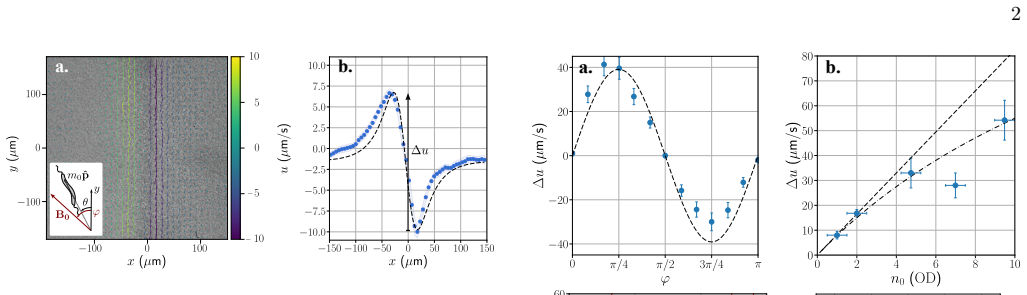
The central claim is that the density gradient created by aerotaxis and the orientational order imposed by a tilted magnetic field generate a non-vanishing active stress, which drives a predictable macroscopic shear flow. In the strong-field, dilute limit the model reduces to the linear equation $(\partial_x^2 - \beta^2)u = -\frac{1}{2}\sin(2\varphi)\,\partial_x n$, with the analytical solution $u(x) = -\sqrt{\pi/32}\,\Delta n\,\sin(2\varphi)\,F_\beta(x)$. The flow is a genuine fluid motion, not just swimming: passive fluorescent colloids are advected with the same velocity field. The same solution collapses the normalized velocity profiles for all tested densities, field strengths, and angles, and the fitted bacterial force dipole $\sigma_0 \approx 9 \times 10^{-19}\,\mathrm{J}$ agrees with typical values for such microorganisms. Finite-density and rotational-noise corrections, solved numerically, capture the sublinear density dependence and the saturation with magnetic field amplitude.
Load-bearing premise
The load-bearing premise is that the aerotactic band keeps its fixed Gaussian density profile, with unchanged width, height, and position, while the magnetic field and the flow it creates act on it; the paper states this assumption just before Eq. (1), and the analytical solution depends on it.
Editorial extensions
If this is right
- The shear-flow amplitude and full velocity profile can be predicted from the measured band width $d$, density contrast $\Delta n$, and field angle $\varphi$, with only one fitted parameter, the bacterial force dipole $\sigma_0$.
- Rotating the field should modulate the flow at twice the rotation frequency, with an additional spinner-type contribution $-\eta_p\omega$ predicted by the paper's linearized extension of Eq. (5).
- Because passive tracer colloids follow the same flow, the effect can transport particles or mix fluids in a sealed microfluidic chamber without any mechanical pump.
- For magnetotactic species with a polar magneto-aerotactic response, the nematic ordering that keeps the band stable is expected to break down, producing a richer family of collective states.
- Under rotating fields, the band destabilizes into a necklace of rotating bacterial patches with vortex flows, a pattern-formation route the authors distinguish from spinner edge currents.
Reading between the lines
- The $\sin(2\varphi)$ symmetry offers a clean experimental discriminator: any flow contribution with a different angular dependence, such as passive drift or thermal convection, can be separated by rotating the field and comparing amplitudes.
- The model's decoupling of density from flow implies that a pre-formed density gradient of orientable particles with field-imposed order would shear the fluid similarly; the same equation could be realized with magnetic colloids rather than living bacteria.
- Because the fitted effective temperature is about four times the bath temperature, the field-saturation curve could serve as a quantitative in vivo probe of active orientational noise in swimming bacteria.
- A direct test of the driving mechanism would vary the oxygen gradient to change $\Delta n$ independently of seeding density, checking whether the flow amplitude follows the density contrast rather than the mean concentration.
Editorial analysis
A structured set of objections, weighed in public.
Referee Report
Summary. The paper reports experiments on a suspension of magnetotactic bacteria (MSR-1) that first form an aerotactic band in a shallow chamber, after which a uniform magnetic field tilted at angle phi to the band generates a steady shear flow along the band. The flow amplitude is reported to scale as sin(2*phi), to increase linearly with bacterial density at low density, and to follow a single master profile across more than 30 configurations with different field angles, strengths, and densities. The authors propose a minimal magneto-active hydrodynamic model with a fixed Gaussian density profile, Brinkmann friction, and strong-field-aligned bacterial orientation, which reduces to Eq. (4) and yields the analytical solution Eq. (5). The model captures the profile shape and the sin(2*phi) and linear-density dependencies; the absolute amplitude is matched by choosing sigma0 = 9e-19 J, and the field-amplitude saturation is captured by fitting an effective temperature Teff = 4T0. Rotating-field experiments are also presented, showing a band destabilization into vortex-like patches, which the authors describe as more complex dynamics beyond the steady model.
Significance. If the central premise of a fixed density profile holds, this is a valuable demonstration of controllable flow generation in a biological active fluid by combining chemotaxis (positional cue) and magnetotaxis (orientational cue). The fluorescent-colloid control and the collapse of all velocity profiles onto a single master curve are strong evidence that a genuine fluid flow is measured, and the sin(2*phi) and low-density linear scaling are substantive predictions that do not depend on the fitted parameters. These are important strengths. However, the 'quantitative agreement' claim is partially anchored by two fitted parameters, and the fixed-density assumption is the load-bearing input to the model yet is not quantitatively tested in the steady experiments. The work is of clear interest to the active-matter and microfluidics communities, but the model validation needs to be tightened before the quantitative claim can be fully accepted.
major comments (3)
- [Eq. (4) and Eq. (5)] The fixed-Gaussian density assumption is load-bearing but not quantitatively tested. Just before Eq. (1) the density is assumed to remain n(x)/n0 = 1 + Δn exp(-x^2/(2d^2)) under magnetic forcing and flow, justified only by the qualitative sentence that the band 'does not show significant evolution.' Since Eq. (4) has ∂x n as its entire source term, even a modest change in d or Δn under actuation changes both the predicted amplitude (through U* and through Fβ) and the profile shape. The manuscript itself notes that 'a few data do not fully relax to the quiescent state at large x̃, possibly due to a non-fully stationary bacterial band,' and the rotating-field experiments show the same band destabilizing. The authors should provide time-resolved density statistics (e.g., d(t) and Δn(t)) during the static tilted-field measurements, comparing the band before, during, and after flow, to support the decoupling premise. Without this, Eq. (5) is not a closed dynamical prediction but an imposed-input calculation.
- [Model paragraph after Eq. (5)] There is an apparent sign inconsistency between Eq. (2) and Eq. (4). From Eq. (2), with p ≈ b = (sinφ, cosφ) in the strong-field limit, the off-diagonal active stress is Σp_xy = -n sinφ cosφ. Taking the y-component of Eq. (1) (with u = u(x) y and ∂y p = 0) gives (∂x^2 - β^2)u = + (sin 2φ)/2 ∂x n, opposite in sign to the equation as printed. This affects the sign of the predicted flow direction in Eq. (5). Please clarify the sign convention (e.g., the orientation of φ relative to the y-axis, the sign of the force dipole) and ensure the explicit form of Fβ is consistent; if a minus sign is already absorbed in Fβ or in the definition of φ, state this explicitly so the reader can verify the direction of the predicted flow against the experimental images.
- [Fig. 3c and text] The 'quantitative agreement' claim relies on two parameters fitted to the same data: σ0 = 9e-19 J sets the absolute velocity scale in Figs. 2b and 3a-b, and Teff ≈ 4T0 sets the B0 saturation in Fig. 3c. These are presented as plausible, but the paper should explicitly distinguish parameter-free predictions (the sin 2φ dependence, the low-density linear scaling, the master profile shape) from comparisons that are consistency checks after fitting. In addition, no error bars or confidence intervals are reported for the fitted parameters or the data points; a sensitivity analysis (e.g., how Δu varies when σ0 or Teff are varied within their physically plausible ranges) would help the reader judge the robustness of the quantitative match.
minor comments (7)
- [Fig. 3 caption and text] There are several typos in the text: 'broally' should be 'broadly', 'highlithing' should be 'highlighting', and 'robusteness' should be 'robustness'.
- [Fig. 1c and model paragraph] The text refers to the field-amplitude dependence as '(Fig. 3d)' in two places, but Fig. 3d shows the normalized profiles; the B0 dependence is in Fig. 3c. Please correct the cross-references.
- [Fig. 2b] The band width d is given as 13.3 µm from the Gaussian fit in Fig. 1c, then as 'd ≃ 15 µm' in the text and exactly d = 15 µm in the model and the master-curve comparison in Fig. 3d. Please clarify the value used, whether it is an average over conditions, and whether the results depend sensitively on this choice.
- [Eq. (2)] The sign of the flow direction in Fig. 2b is not specified relative to the coordinate frame. Once the sign convention in Eq. (4) is clarified, the figure should indicate which direction is positive y (e.g., up in the image) so the reader can check the predicted sign.
- [Text near Teff fit] In Eq. (2), the magnetic stress term αm (b⟨p⟩ - ⟨p⟩b)/2 vanishes identically in the strong-field limit p ≈ b. It may be helpful to state this explicitly when deriving Eq. (4), to avoid the impression that the magnetic stress contributes to the leading-order flow equation.
- [Abstract] The text says Teff ≈ 4T0, while footnote [27] uses 'T = 1 to 4 room temperature'. Please make the relation between Teff and the room-temperature T0 unambiguous.
- The abstract states that the steady regime is 'quantitatively captured' by the model; given the two fitted parameters, it would be more precise to say 'captured after adjusting two parameters' or to list which aspects are parameter-free. This would set more accurate expectations.
Circularity Check
Partial circularity: the absolute velocity scale and the B0-response curve are set by fitted parameters (σ0 and Teff), while the sin(2φ), linear-n0, and normalized-profile predictions are genuinely parameter-free.
-
fitted input called prediction
[Eq. (5) and following paragraph; Fig. 3a-b]
"More quantitatively, setting h = 100 µm and the typical density band characteristics as measured d = 15 µm, and ∆n = 1.5, we obtain a quantitative agreement for a swimming force dipole σ0 = 9 × 10⁻¹⁹ J, in line with typical values for such microorganisms [28], and with expectations based on the propelling velocity and the translational friction [21, 29]."
The dimensional velocity is U* = n0σ0d/η, so the amplitude of the predicted flow in Eq. (5) is proportional to σ0 by construction. The manuscript selects σ0 = 9×10⁻¹⁹ J to obtain agreement with the measured velocity amplitude rather than reporting an independent in-situ measurement; the literature comparisons cited afterward are order-of-magnitude consistency checks, not a measured value for this suspension. Thus the 'quantitative agreement' for the amplitude in Fig. 3a-b is a one-parameter fit, while the sin(2φ) dependence and linear n0 scaling remain genuine, parameter-free predictions.
-
fitted input called prediction
[Fig. 3c and paragraph after Eq. (5)]
"Finally, including the rotational noise effect, it is possible to fit the experimental response with respect to the field amplitude B0 (Fig. 3d), providing an effective temperature is accounted for, whose value is found of the order of Teff. ≃ 4T0."
The B0-dependence curve is obtained by fitting the effective temperature Teff to the same experimental data, and the figure caption labels the result 'Theoretical prediction including rotational noise with Teff. = 4T0.' Because Teff is adjusted to reproduce the measured amplitude-versus-field curve, the B0 response is not an independent prediction; its saturating shape is a consequence of the model form together with the fitted noise level. The external plausibility of Teff ≈ 4T0 mitigates, but does not eliminate, this circularity.
full rationale
The derivation of the normalized profile and of the sin(2φ) and linear-n0 scalings is self-contained: Eq. (4) is solved with the measured Gaussian density profile as input, and the profile prediction in Eq. (5) is compared with data without adjustable parameters. The fluorescent-colloid control independently establishes that the measured velocity is a genuine fluid flow rather than a bacterial swimming artifact. The circularity is partial and confined to the absolute amplitude and the B0 response. The amplitude scale U* = n0σ0d/η contains σ0, which is selected (9×10⁻¹⁹ J) to match the measured velocity magnitude rather than measured in situ; the field-amplitude curve is reproduced by fitting Teff ≈ 4T0 to the same data and then labeling it a 'theoretical prediction.' These are fitted inputs called predictions, but they do not undermine the parameter-free scaling and shape results. The fixed-Gaussian density assumption is a measured input rather than a fitted consequence of the flow, so it is a correctness risk (the paper itself notes non-stationary band behavior in some data and band destabilization under rotating fields) rather than a circular step. No load-bearing self-citation chain or uniqueness theorem is invoked; the stress and orientation equations rest on external references [15,26].
Assumptions & free parameters
free parameters (4)
- Force dipole strength σ0 =
9e-19 J
- Effective rotational temperature Teff =
≈4T0 ≈ 1172 K
- Band width d =
13.3 to 15 µm
- Band excess density Δn =
≈1.5
assumptions (7)
- domain assumption The aerotactic band density is fixed as n(x)/n0 = 1 + Δn exp(-x²/(2d²)) during magnetic actuation.
- domain assumption Bacteria are modeled as spherical pushers with force dipole -σ0 and magnetic moment m0 p along the swimming axis.
- domain assumption Strong-field and dilute limits hold: αm >> ηp, αm >> sqrt(ηp αT), and ηp << 1 for the analytical solution.
- domain assumption Wall confinement is represented by a Brinkman friction term β²u with β² = 12d²/h².
- domain assumption The system is 2D with weak z-dependence, so z-averaged equations are used.
- domain assumption North and South seeking bacteria coexist and behave as bidirectional pushers, giving nematic orientational order.
- domain assumption Orientational noise is Gaussian white noise described by an effective temperature Teff that may exceed the bath temperature.
Cite this review
Pith. "Pith review of Driven shear flow in biological magneto-active fluids." pith.science (2026). https://pith.science/paper/QI7ZPPIL
@misc{pith2026250713851,
  author       = {Pith},
  title        = {Pith review of: Driven shear flow in biological magneto-active fluids},
  year         = {2026},
  howpublished = {\url{https://pith.science/paper/QI7ZPPIL}},
  note         = {Machine review of arXiv:2507.13851}
}
read the original abstract
Active fluids made of powered suspended particles have unique abilities to self-generate flow and density structures. How such dynamics can be triggered and leveraged by external cues is a key question of both biological and applied relevance. Here we use magnetotactic bacteria to explore how chemotaxis and magnetotaxis -- leading, respectively, to positional and orientational responses -- combine to generate global scale flows. Such steady regime can be quantitatively captured by a magneto-active hydrodynamic model, while time-dependent magnetic driving unveils additional patterning complexity. Overall, our findings shed light on how active fluids respond to the ubiquitous situation of multiple external information, also suggesting routes for their manipulation.
Figures


Figures from the paper (1 more)

Forward citations
Cited by 1 Pith paper
-
Exact model of aerotactic band: From Fokker-Planck equation to band structure and fluid flow
A Fokker-Planck model yields exact Laplace-type band profiles for aerotactic bacteria and a parameter-free prediction for the magnetic-field-induced fluid flow.
Reference graph
Works this paper leans on
-
[1]
Saintillan, Rheology of active fluids, Annual Review of Fluid Mechanics 50, 563 (2018)
D. Saintillan, Rheology of active fluids, Annual Review of Fluid Mechanics 50, 563 (2018)
work page 2018
-
[2]
Ramaswamy, Active fluids, Nature Reviews Physics 1, 640 (2019)
S. Ramaswamy, Active fluids, Nature Reviews Physics 1, 640 (2019)
work page 2019
-
[3]
Lauga, Bacterial Hydrodynamics, Annual Review of Fluid Mechanics 48, 105 (2016)
E. Lauga, Bacterial Hydrodynamics, Annual Review of Fluid Mechanics 48, 105 (2016)
work page 2016
-
[4]
M. A. Bees, Annual review of fluid mechanics advances in bioconvection, Annu. Rev. Fluid Mech. 2020 52, 449 (2020)
work page 2020
-
[5]
J. Qiu, N. Mousavi, L. Zhao, and K. Gustavsson, Active gyrotactic stability of microswimmers using hydrome- chanical signals, Physical Review Fluids7, 10.1103/phys- revfluids.7.014311 (2022)
doi:10.1103/phys- 2022
- [6]
-
[7]
Marcos, H. C. Fu, T. R. Powers, and R. Stocker, Bacte- rial rheotaxis, Proceedings of the National Academy of Sciences 109, 4780–4785 (2012)
work page 2012
-
[8]
G. Jing, A. Z¨ ottl,´E. Cl´ ement, and A. Lindner, Chirality- induced bacterial rheotaxis in bulk shear flows, Science Advances 6, 10.1126/sciadv.abb2012 (2020)
Show all 34 references
-
[9]
Blums, A
E. Blums, A. Cebers, and M. M. Maiorov, Magnetic Flu- ids (De Gruyter, Berlin, New York, 1997)
1997
-
[10]
Jin and L
D. Jin and L. Zhang, Collective Behaviors of Mag- netic Active Matter: Recent Progress toward Recon- figurable, Adaptive, and Multifunctional Swarming Mi- cro/Nanorobots, Accounts of Chemical Research 55, 98 (2022)
2022
-
[11]
Junot, A
G. Junot, A. Cebers, and P. Tierno, Collective hydro- dynamic transport of magnetic microrollers, Soft Matter 17, 8605 (2021)
2021
-
[12]
Marmol, E
M. Marmol, E. Gachon, and D. Faivre, Colloquium: Magnetotactic bacteria: From flagellar motor to collec- tive effects, Rev. Mod. Phys. 96, 021001 (2024)
2024
-
[13]
Th´ ery, L
A. Th´ ery, L. L. Nagard, J. C. O. dit Biot, C. Fradin, K. Dalnoki-Veress, and E. Lauga, Self-organisation and convection of confined magnetotactic bacteria, Scientific Reports 10, 10.1038/s41598-020-70270-0 (2020)
2020 doi
-
[14]
Waisbord, C
N. Waisbord, C. T. Lef` evre, L. Bocquet, C. Ybert, and C. Cottin-Bizonne, Destabilization of a flow focused sus- pension of magnetotactic bacteria, Phys. Rev. Fluids 1, 053203 (2016)
2016
-
[15]
F. R. Koessel and S. Jabbari-Farouji, Emergent pattern formation of active magnetic suspensions in an external field, New Journal of Physics 22, 103007 (2020)
2020
-
[16]
F. Meng, D. Matsunaga, B. Mahault, and R. Golesta- nian, Magnetic microswimmers exhibit bose-einstein-like condensation, Phys. Rev. Lett. 126, 078001 (2021)
2021
-
[17]
Raina, B
J.-B. Raina, B. S. Lambert, D. H. Parks, C. Rinke, N. Si- boni, A. Bramucci, M. Ostrowski, B. Signal, A. Lutz, H. Mendis, F. Rubino, V. I. Fernandez, R. Stocker, P. Hugenholtz, G. W. Tyson, and J. R. Seymour, Chemo- taxis shapes the microscale organization of the ocean’s micro...
2022
-
[18]
Lef` evre, M
C. Lef` evre, M. Bennet, L. Landau, P. Vach, D. Pignol, D. Bazylinski, R. Frankel, S. Klumpp, and D. Faivre, Di- versity of magneto-aerotactic behaviors and oxygen sens- ing mechanisms in cultured magnetotactic bacteria, Bio- physical Journal 107, 527 (2014)
2014
-
[19]
F. Popp, J. P. Armitage, and D. Sch¨ uler, Polarity of bacterial magnetotaxis is controlled by aerotaxis through a common sensory pathway, Nature Communications 5, 5398 (2014)
2014
-
[20]
R. B. Frankel, D. A. Bazylinski, M. S. Johnson, and B. L. Taylor, Magneto-aerotaxis in marine coccoid bac- teria, Biophysical journal 73, 994 (1997)
1997
-
[21]
Bennet, A
M. Bennet, A. McCarthy, D. Fix, M. R. Edwards, F. Repp, P. Vach, J. W. Dunlop, M. Sitti, G. S. Buller, S. Klumpp, et al. , Influence of magnetic fields on magneto-aerotaxis, PLoS One 9, e101150 (2014)
2014
-
[22]
Codutti, K
A. Codutti, K. Bente, D. Faivre, and S. Klumpp, Chemo- taxis in external fields: Simulations for active mag- netic biological matter, Plos computational biology 15, e1007548 (2019)
2019
-
[23]
See Movies SM1 and SM2 in Supp. Mat
-
[24]
Vincenti, C
B. Vincenti, C. Douarche, and E. Clement, Actuated rhe- ology of magnetic micro-swimmers suspensions: Emer- gence of motor and brake states, Phys. Rev. Fluids 3, 033302 (2018)
2018
-
[25]
C. J. Pierce, H. Wijesinghe, E. Osborne, E. Mumper, B. Lower, S. Lower, and R. Sooryakumar, Tunable self-assembly of magnetotactic bacteria: Role of hydrodynamics and magnetism, AIP Advances 10, 015335 (2020), https://pubs.aip.org/aip/adv/article- pdf/doi/10.1063/1.5129925/130...
2020 doi
-
[26]
Alonso-Matilla and D
R. Alonso-Matilla and D. Saintillan, Microfluidic flow actuation using magnetoactive suspensions, EPL (Euro- physics Letters) 121, 24002 (2018)
2018
-
[27]
Indeed, with typical values (see text) ξr = 7 × 10⁻²⁰ N m s, σ0 = 9 × 10⁻¹⁹ J and T = 1 to 4 room tem- perature, we have for OD 1 and B0 = 5.6 mT: αm ≃ 0.6; ηp ≃ 6 × 10⁻² and √ηpαT = (1.6 to 3 .2) × 10−2
-
[28]
Drescher, J
K. Drescher, J. Dunkel, L. H. Cisneros, S. Ganguly, and R. E. Goldstein, Fluid dynamics and noise in bacterial cell–cell and cell–surface scattering, Proceedings of the National Academy of Sciences 108, 10940 (2011)
2011
-
[29]
Pichel, T
M. Pichel, T. Hageman, I. Khalil, A. Manz, and L. Abelmann, Magnetic response of magnetospirillum gryphiswaldense observed inside a microfluidic channel, Journal of Magnetism and Magnetic Materials 460, 340 (2018)
2018
-
[30]
Nadkarni, S
R. Nadkarni, S. Barkley, and C. Fradin, A Comparison of 6 Methods to Measure the Magnetic Moment of Magneto- tactic Bacteria through Analysis of Their Trajectories in External Magnetic Fields, PLoS ONE 8, e82064 (2013)
2013
-
[31]
P. J. Vach, D. Walker, P. Fischer, P. Fratzl, and D. Faivre, Pattern formation and collective effects in pop- ulations of magnetic microswimmers, Journal of Physics D: Applied Physics 50, 11LT03 (2017)
2017
-
[32]
V. Soni, E. S. Bililign, S. Magkiriadou, S. Sacanna, D. Bartolo, M. J. Shelley, and W. T. M. Irvine, The odd free surface flows of a colloidal chiral fluid, Nature Physics 15, 1188 (2019)
2019
-
[33]
reported a destabilization of the whole suspension into clusters while here only the band seems to break- down. More closely to our configuration, [32] predicts that edge currents characteristic of spinner chiral active matter induce y-traveling excitations at the band edge wh...
-
[34]
Massana-Cid, D
H. Massana-Cid, D. Levis, R. J. H. Hern´ andez, I. Pago- nabarraga, and P. Tierno, Arrested phase separation in chiral fluids of colloidal spinners, Physical Review Re- search 3, L042021 (2021)
2021
Reviewed August 6, 2026 · model on record in the stance chip above.
Discussion (0). Continue with ORCID to comment.