REVIEW 3 major objections 6 minor 54 references
X-Z Round Scheduling for the Surface Code with Defects under Biased Noise
T0 review · 3 major / 6 minor · reviewed 2026-08-08 · deepseek-v4-flash
Pith's one-line read Under biased noise, reallocating X- and Z-check rounds in defect-adapted surface codes lowers logical error rates by up to 8.46x.
desk verdict New and plausible scheduling knob for defect-adapted surface codes, but the p_Y=0 model makes the headline LER reductions unreliable. read the letter →
The pith
A machine-rendered reading of the paper's core claim, the machinery that carries it, and where it could break.
The reading
What carries the argument
The central object is the scheduling ratio $R = R_X:R_Z$, the relative number of consecutive syndrome-extraction rounds devoted to X-type versus Z-type gauge checks in a defect-adapted surface code. Defect adaptation converts affected stabilizers into lower-weight gauge checks that anti-commute across bases, so X and Z super-stabilizers must be measured in alternating rounds; the paper treats the relative frequency of those rounds as a free parameter. The mechanism has two effects: more frequent rounds in one basis sample the corresponding syndrome sooner, suppressing the logical error rate in that basis, and repeating the same gauge-check type across consecutive rounds makes individual gauge outcomes deterministic, letting the decoder discount measurement errors. The optimal ratio balances these effects and turns out to be governed by the noise bias $\eta$ rather than by code size or defect density.
What would settle it
Run the same scheduling sweep at $\eta=5$, $d=13$, and 1-2% defect rates with a biased Pauli channel that includes nonzero $p_Y$ (for example $p_Y = \sqrt{p_X p_Z}$), and check whether the optimal ratio $R_X:R_Z$ shifts from the $p_Y=0$ prediction and whether the logical error rate improvement over 1:1 shrinks.
Extended reading notes
Core claim
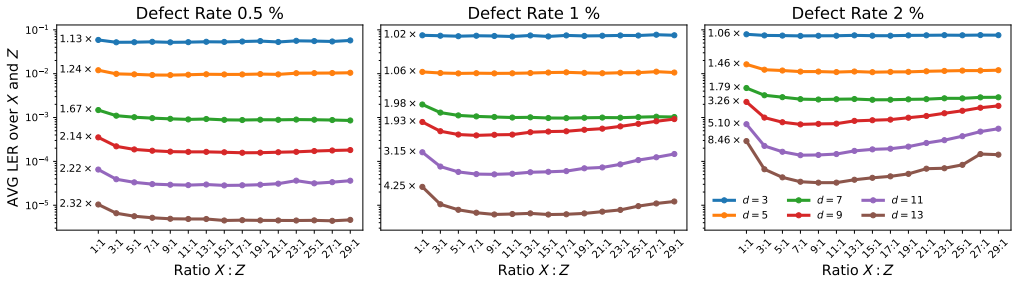
The paper's central claim is that under biased noise, the uniform $R=1:1$ round schedule used by defect-adapted surface codes is suboptimal, and reallocating rounds toward the basis that detects the dominant error type lowers the average logical error rate. Concretely, at $\eta=5$ and distance 13, the optimal schedule improves the logical error rate by 4.25x at a 1% defect rate and 8.46x at a 2% defect rate, relative to 1:1. The optimal ratio $R^*$ is, to a good approximation, determined only by the noise bias $\eta$: it stays constant across code distances $d=5$ through 13 and across defect rates 0.5% through 2%, up to sampling variation. This claim extends beyond defective hardware: in defect-free patches where parallel CNOTs suffer crosstalk, measuring X and Z stabilizers in separate rounds reduces the parallel-CNOT count per layer and yields up to a 4.5x logical error rate improvement at $d=13$, $\alpha=2$, and $\eta=5$.
Load-bearing premise
The simulation fixes $p_Y=0$ and assumes Y errors flip both X and Z syndromes, so including them would only rescale the logical error rate at fixed bias rather than change the optimal scheduling ratio; if Y errors interact differently with the alternating gauge-check schedule, the optimal ratio and the reported improvements could shift.
Editorial extensions
If this is right
- A manufacturer can measure the bias $\eta$ from calibration data and set the scheduling ratio once, reusing it across all code distances without running per-device simulation sweeps.
- Larger code distances amplify the benefit: at $\eta=5$, the improvement over 1:1 grows from 2.07x at $d=9$ to 4.46x at $d=13$.
- Higher defect rates increase the benefit: at $d=13$ and $\eta=5$, the gain rises from 4.25x at 1% defects to 8.46x at 2% defects, even though absolute logical error rates worsen.
- In defect-free architectures with CNOT crosstalk, scheduling X-only and Z-only rounds separately can reduce the logical error rate by up to 4.5x at $d=13$ with a 2x crosstalk penalty.
Reading between the lines
- The same round-rebalancing logic should apply to other defect-adaptation schemes that produce anti-commuting gauge checks, so the ratio could become a universal compilation knob rather than a setting specific to the defect-adaptation framework used here.
- The $p_Y=0$ assumption is the main point to test on hardware: because Y errors flip both X and Z syndromes, a realistic nonzero $p_Y$ may rescale the optimal ratio or dampen the reported improvements, so a sweep with nonzero Y error would bound the effect.
- Spatially heterogeneous bias, like the qubit-to-qubit variation shown in the calibration data, suggests a future extension: a position-dependent scheduling ratio that dedicates more rounds to locally dominant error regions rather than a single global optimum.
- The crosstalk extension implies a trade-off between parallelism and error sampling: separating X and Z rounds halves per-layer CNOT concurrency but doubles the number of rounds, so the 4.5x gain is tied to the simulated crosstalk penalty and could weaken for smaller $\alpha$.
Editorial analysis
A structured set of objections, weighed in public.
Referee Report
Summary. This paper studies the optimal ratio of X-type to Z-type syndrome-extraction rounds for a defect-adapted surface code (using the Snakes and Ladders framework) under biased noise. The authors simulate memory experiments with Stim and PyMatching, setting p_Y=0 and fixing p=p_X+p_Z, and sweep R_X:R_Z for various code distances, defect rates, and bias values eta=p_Z/p_X. They report that a non-uniform schedule reduces the average logical error rate by up to 4.25x at 1% defect rate and 8.46x at 2% defect rate for d=13 at eta=5, and that the optimal ratio R* is essentially independent of code distance and defect rate, depending mainly on eta. They also extend the idea to defect-free codes under a crosstalk model and report up to 4.5x improvement.
Significance. If the claims hold, the paper identifies a practical, calibration-driven tuning knob for surface codes with fabrication defects, complementing code-level bias tailoring. The use of standard tools (Stim, PyMatching) and the SnL framework is appropriate, and the empirical finding that R* depends primarily on noise bias is interesting and potentially useful. The paper is clearly written and the crosstalk section is presented as an illustrative extension. However, the two central claims rest on a restrictive p_Y=0 noise model and on simulation studies with no statistical uncertainty quantification, both of which need to be addressed before the quantitative results can be relied upon.
major comments (3)
- [Section III (Pauli channel setup)] The simulation model sets p_Y=0 and asserts that Y errors 'flip both syndromes, so including them rescales the LER by a constant factor at fixed bias, without changing the trends observed.' This assertion is not derived and is inconsistent with Section IV-B, where the calibration relation eta = T1/T2 - 1/2 comes from a Pauli-twirled T1/T2 channel in which p_Y = p_X. Under a non-uniform schedule R_X:R_Z != 1, a Y error is a correlated XZ event whose X- and Z-syndrome components are sampled in alternating rounds at different rates; changing p_Y therefore alters the relative weight of the X and Z decoding subgraphs rather than only the overall error rate. The optimal ratio R* could shift with p_Y, so the headline improvements (4.25x at 1% defects, 8.46x at 2% defects) and the claim that R* depends only on eta are conditional on this unverified assumption. Please repeat the key sweeps (at least Figures 4 and 6) with nonzero p_Y, e.g., p_Y = p_X as implied by T1/T2 twirling, and report whether R* and the improvement factors change.
- [Sections IV-A and IV-B (statistical reporting)] No shot counts, error bars, or confidence intervals are reported for any LER estimate, and each configuration uses only 10 to 30 stochastic defect patches (Figure 4 uses 10 patches; Figure 5 uses 30 patches). The definition of R* in Section IV-A as the smallest ratio whose average LER is within 1% of the observed minimum, and the 5% bars in Figure 6, therefore cannot be interpreted without knowing the sampling noise. The claim that R* is essentially independent of code distance and defect rate is a null result that needs uncertainty quantification; with a coarse ratio grid and small patch counts, the observed flatness of R* versus d could be an artifact of sampling variation. Please report the number of shots per patch, the number of patches per point, and standard errors or confidence intervals for the LER and for R*.
- [Section IV-B (calibration-based selection)] The paper advertises that the optimal ratio can be selected directly from measured calibration data, without running device-specific simulations. However, the only quantitative output is Figure 6, which shows R* for eta in {1,2,4,6,8,10} and for discrete ratios up to 49:1, with no fitted curve, interpolation rule, or statement of how sensitive the LER is to a small error in R*. Since the transferability claim relies on the relationship R*(eta) being robust, the manuscript should provide either a table of recommended ratios, a fit R*(eta), or an explicit error tolerance (e.g., the range of R where LER is within 1% of the minimum) as a function of eta.
minor comments (6)
- [Section III (simulation setup)] The text 'performing O(d) rounds of syndrome extraction' is underspecified; state the exact total number of rounds used for each d and confirm that the total number of rounds is held fixed across all schedules so that LER comparisons are not confounded by different memory times.
- [Figures 4 and 8] The improvement at d=13, dr=1%, eta=5 is reported as 4.46x in Figure 4 and 4.25x in Figure 8, while the abstract gives 4.25x; please reconcile these numbers and state which patch set and ratio grid each value refers to.
- [Section IV-A (optimality tolerance)] The 1% tolerance used to define R* is not justified; please report how the choice of tolerance affects the identified R* (e.g., a sensitivity sweep) or provide shot-noise-based error bars that motivate the tolerance.
- [Section IV-B (calibration relation)] The relation eta = T1/T2 - 1/2 is stated without derivation; consider adding the Pauli-twirling expressions for p_X, p_Y, p_Z or a citation with the explicit formula to make the connection to Section III's p_Y=0 model transparent.
- [Section V (crosstalk model)] The crosstalk model sets the simultaneous-to-isolated gate error ratio alpha in [1,2] but cites only general randomized-benchmarking references; state which measured values or specific experimental results motivate this range.
- [General] There are minor typographical issues: 'X-ZRound' appears in the title line, 'eta=p z/px' should use proper subscripts, and the notation R_X:R_Z should be defined explicitly in the abstract or introduction.
Circularity Check
No significant circularity: the optimal scheduling ratio is obtained by simulation sweeps, not by construction from the inputs, and the paper's claims are empirically self-contained.
full rationale
The paper's central claim — that under biased noise the optimal X-to-Z round scheduling ratio departs from 1:1 and is set primarily by the noise bias — is established by direct simulation: the LER is measured for a grid of ratios R_X:R_Z, the minimum is identified numerically, and the dependence on eta, distance, and defect rate is read off those sweeps. This is a posterior observation, not a quantity that is defined or fitted in terms of itself. The p_Y=0 noise-model choice is a stated input assumption, and while the assertion that Y errors merely rescale the LER is unproven, it is not a circular step: it does not define R*, and it is not used as a substitute for the simulation that produces the reported improvements. The only self-citation is reference [46] (Murali, McKay, Martonosi, Javadi-Abhari) used as background for the crosstalk model in Section V alongside external references [45] and [47]; that citation is not load-bearing for the main scheduling result, and the crosstalk model itself is explicitly adopted as a simple abstraction rather than derived from the cited work. The optimal-ratio-versus-bias relation is characterized empirically and could, in principle, have come out differently; therefore the derivation chain does not reduce to its inputs.
Assumptions & free parameters
free parameters (1)
- Optimality tolerance for defining R* =
1% of observed minimum average LER
assumptions (6)
- domain assumption Circuit-level Pauli noise with rate p on every gate, measurement, and idle location
- ad hoc to paper Y errors can be set to zero because they flip both X and Z syndromes and therefore only rescale the LER by a constant factor at fixed bias
- domain assumption Average LER over X- and Z-basis state preparations is the relevant figure of merit
- domain assumption Defects are independent per qubit and coupler at rate dr
- domain assumption SnL defect adaptation produces anti-commuting X/Z gauge checks requiring alternating rounds
- ad hoc to paper Crosstalk can be modeled by an error-rate multiplier alpha applied to CNOTs executed in parallel, with alpha in [1,2]
Cite this review
Pith. "Pith review of X-Z Round Scheduling for the Surface Code with Defects under Biased Noise." pith.science (2026). https://pith.science/paper/QIDSYTVN
@misc{pith2026260805518,
  author       = {Pith},
  title        = {Pith review of: X-Z Round Scheduling for the Surface Code with Defects under Biased Noise},
  year         = {2026},
  howpublished = {\url{https://pith.science/paper/QIDSYTVN}},
  note         = {Machine review of arXiv:2608.05518}
}
abstract
Fault-tolerant Quantum Computing (FTQC) relies on Quantum Error Correction (QEC) codes that encode logical qubits across many physical qubits to detect and correct errors. The surface code is among the most widely studied codes due to its high error threshold, the existence of efficient decoders, and hardware-friendly properties: a planar, two-dimensional layout with nearest-neighbor connectivity. In practice, however, the fabrication of solid-state quantum processors introduces hardware defects, resulting in defective qubits and couplers that must be discarded. Adapting the surface code to these defects often requires measuring the $X$- and $Z$-type checks in separate rounds rather than simultaneously. In this work, we investigate the optimal $X$-to-$Z$ checks round-scheduling ratio under biased noise systems. Our results characterize how key architectural parameters, such as noise bias, code distance, and defect rate, impact the logical error rate. We provide insights into how to determine the optimal scheduling ratio directly from device calibration data, enabling manufacturers to maximize performance without extensive simulations. Our approach reduces the logical error rate by up to $4.25\times$ at a $1\%$ defect rate and up to $8.46\times$ at a $2\%$ defect rate for a distance-$13$ surface code under moderately biased noise. Furthermore, we demonstrate that the benefits of round-scheduling extend beyond the defective-hardware setting. In biased-noise architectures subject to CNOT crosstalk, separating $X$ and $Z$ measurement rounds yields up to $4.5\times$ reduction in logical error rate.
Figures


Figures from the paper (8 more)




Reference graph
Works this paper leans on
-
[1]
Fault-tolerant quantum computation,
J. Preskill, “Fault-tolerant quantum computation,”Introduction to quan- tum computation and information, vol. 213, 1998
work page 1998
-
[2]
Surface codes: Towards practical large-scale quantum computation,
A. G. Fowler, M. Mariantoni, J. M. Martinis, and A. N. Cleland, “Surface codes: Towards practical large-scale quantum computation,”Physical Review A, vol. 86, no. 3, Sep. 2012
work page 2012
-
[3]
Sparse Blossom: correcting a million errors per core second with minimum-weight matching,
O. Higgott and C. Gidney, “Sparse Blossom: correcting a million errors per core second with minimum-weight matching,”Quantum, vol. 9, p. 1600, Jan. 2025
work page 2025
-
[4]
Mitigating cosmic- ray-like correlated events with a modular quantum processor,
X. Wu, Y . J. Joshi, H. Yan, G. Andersson, A. Anferov, C. R. Conner, B. Karimi, A. M. King, S. Li, H. L. Malc, J. M. Miller, H. Mishra, H. Qiao, M. Ryu, S. Xing, J. Shi, and A. N. Cleland, “Mitigating cosmic- ray-like correlated events with a modular quantum processor,”Physical Review Applied, vol. 24, no. 4, Oct. 2025
work page 2025
-
[5]
Quantum error correction below the surface code threshold,
R. Acharya, D. A. Abanin, L. Aghababaie-Beni, I. Aleiner, T. I. Andersen, M. Ansmann, F. Arute, K. Arya, A. Asfaw, N. Astrakhant- sev, J. Atalaya, R. Babbush, D. Bacon, B. Ballard, J. C. Bardin, J. Bausch, A. Bengtsson, A. Bilmes, S. Blackwell, S. Boixo, G. Bortoli, A. Bourassa, J. Bovaird, L. Brill, M. Broughton, D. A. Browne, B. Buchea, B. B. Buckley, D...
work page 2024
-
[6]
Resolving the positions of defects in super- conducting quantum bits,
A. Bilmes, A. Megrant, P. Klimov, G. Weiss, J. M. Martinis, A. V . Ustinov, and J. Lisenfeld, “Resolving the positions of defects in super- conducting quantum bits,”Scientific Reports, vol. 10, no. 1, Feb. 2020
work page 2020
-
[7]
Fluctuations of energy- relaxation times in superconducting qubits,
P. Klimov, J. Kelly, Z. Chen, M. Neeley, A. Megrant, B. Burkett, R. Barends, K. Arya, B. Chiaro, Y . Chen, A. Dunsworth, A. Fowler, B. Foxen, C. Gidney, M. Giustina, R. Graff, T. Huang, E. Jeffrey, E. Lucero, J. Mutus, O. Naaman, C. Neill, C. Quintana, P. Roushan, D. Sank, A. Vainsencher, J. Wenner, T. White, S. Boixo, R. Babbush, V . Smelyanskiy, H. Neve...
work page 2018
-
[8]
Towards understanding two- level-systems in amorphous solids: insights from quantum circuits,
C. M ¨uller, J. H. Cole, and J. Lisenfeld, “Towards understanding two- level-systems in amorphous solids: insights from quantum circuits,” Reports on Progress in Physics, vol. 82, no. 12, p. 124501, Oct. 2019
work page 2019
Show all 54 references
-
[9]
Snakes and ladders: Adapting the surface code to defects,
C. Leroux, S. F. Lin, P. Bienias, K. R. Sankar, A. Benhemou, A. Kubica, and J. K. Iverson, “Snakes and ladders: Adapting the surface code to defects,”PRX Quantum, vol. 6, no. 4, Oct. 2025
2025
-
[10]
Luci in the surface code with dropouts,
D. M. Debroy, M. McEwen, C. Gidney, N. Shutty, and A. Zalcman, “Luci in the surface code with dropouts,”Quantum, vol. 9, p. 1936, Dec. 2025
1936
-
[11]
Automated compilation including dropouts: Toler- ating defective components in stabiliser codes,
S. Wolanski, “Automated compilation including dropouts: Toler- ating defective components in stabiliser codes,”arXiv preprint arXiv:2512.01943, 2025
2025
-
[12]
Fault-tolerant quantum computation against biased noise,
P. Aliferis and J. Preskill, “Fault-tolerant quantum computation against biased noise,”Physical Review A, vol. 78, no. 5, Nov. 2008
2008
-
[13]
Quantum benchmarking of high-fidelity noise-biased operations on a detuned Kerr-cat qubit,
B. Qinget al., “Quantum benchmarking of high-fidelity noise-biased operations on a detuned Kerr-cat qubit,”Proc. Nat. Acad. Sci., vol. 123, no. 5, p. e2520479123, 2026
2026
-
[14]
The xzzx surface code,
J. P. Bonilla Ataides, D. K. Tuckett, S. D. Bartlett, S. T. Flammia, and B. J. Brown, “The xzzx surface code,”Nature Communications, vol. 12, no. 1, Apr. 2021
2021
-
[15]
Ultrahigh error threshold for surface codes with biased noise,
D. K. Tuckett, S. D. Bartlett, and S. T. Flammia, “Ultrahigh error threshold for surface codes with biased noise,”Physical Review Letters, vol. 120, no. 5, Jan. 2018
2018
-
[16]
Quantum computing in the nisq era and beyond,
J. Preskill, “Quantum computing in the nisq era and beyond,”Quantum, vol. 2, p. 79, Aug. 2018
2018
-
[17]
M. A. Nielsen and I. L. Chuang,Quantum Computation and Quantum Information: 10th Anniversary Edition. Cambridge University Press, 2010
2010
-
[18]
Coherent control of macroscopic quantum states in a single-cooper-pair box,
Y . Nakamura, Y . A. Pashkin, and J. S. Tsai, “Coherent control of macroscopic quantum states in a single-cooper-pair box,”Nature, vol. 398, no. 6730, p. 786–788, Apr. 1999
1999
-
[19]
Quantum supremacy using a programmable superconducting processor,
F. Arute, K. Arya, R. Babbush, D. Bacon, J. Bardin, R. Barends, R. Biswas, S. Boixo, F. Brandao, D. Buell, B. Burkett, Y . Chen, J. Chen, B. Chiaro, R. Collins, W. Courtney, A. Dunsworth, E. Farhi, B. Foxen, A. Fowler, C. M. Gidney, M. Giustina, R. Graff, K. Guerin, S. Habegge...
2019
-
[20]
Topological quantum memory,
E. Dennis, A. Kitaev, A. Landahl, and J. Preskill, “Topological quantum memory,”Journal of Mathematical Physics, vol. 43, no. 9, p. 4452–4505, Sep. 2002
2002
-
[21]
Quantum computing is scalable on a planar array of qubits with fabrication defects,
A. Strikis, S. C. Benjamin, and B. J. Brown, “Quantum computing is scalable on a planar array of qubits with fabrication defects,”Phys. Rev. Appl., vol. 19, p. 064081, Jun 2023
2023
-
[22]
Fault-tolerance thresholds for the surface code with fabrication errors,
J. M. Auger, H. Anwar, M. Gimeno-Segovia, T. M. Stace, and D. E. Browne, “Fault-tolerance thresholds for the surface code with fabrication errors,”Physical Review A, vol. 96, no. 4, Oct. 2017
2017
-
[23]
Improving trapped-ion-qubit memories via code-mediated error-channel balancing,
Y . Seis, B. J. Brown, A. S. Sørensen, and J. F. Goodwin, “Improving trapped-ion-qubit memories via code-mediated error-channel balancing,” Phys. Rev. A, vol. 107, p. 052417, May 2023
2023
-
[24]
Tailoring quantum error correction to spin qubits,
B. Het ´enyi and J. R. Wootton, “Tailoring quantum error correction to spin qubits,”Phys. Rev. A, vol. 109, p. 032433, Mar 2024
2024
-
[25]
Review of performance metrics of spin qubits in gated semiconducting nanostructures,
P. Stano and D. Loss, “Review of performance metrics of spin qubits in gated semiconducting nanostructures,”Nature Reviews Physics, vol. 4, no. 10, p. 672–688, Aug. 2022
2022
-
[26]
Long spin coherence and relaxation times in nanodiamonds milled from polycrystalline 12Cdiamond,
J. E. March, B. D. Wood, C. J. Stephen, L. D. Fervenza, B. G. Breeze, S. Mandal, A. M. Edmonds, D. J. Twitchen, M. L. Markham, O. A. Williams, and G. W. Morley, “Long spin coherence and relaxation times in nanodiamonds milled from polycrystalline 12Cdiamond,”Phys. Rev. Appl., ...
2023
-
[27]
One hundred second bit-flip time in a two-photon dissipative oscillator,
C. Berdou, A. Murani, U. R ´eglade, W. Smith, M. Villiers, J. Palomo, M. Rosticher, A. Denis, P. Morfin, M. Delbecq, T. Kontos, N. Pankra- tova, F. Rautschke, T. Peronnin, L.-A. Sellem, P. Rouchon, A. Sar- lette, M. Mirrahimi, P. Campagne-Ibarcq, S. Jezouin, R. Lescanne, and Z...
2023
-
[28]
Performance of surface codes in realistic quantum hardware,
A. d. iOlius, J. E. Martinez, P. Fuentes, P. M. Crespo, and J. Garcia- Frias, “Performance of surface codes in realistic quantum hardware,” Phys. Rev. A, vol. 106, p. 062428, Dec 2022
2022
-
[29]
Dynamically protected cat-qubits: a new paradigm for universal quantum computation,
M. Mirrahimi, Z. Leghtas, V . V . Albert, S. Touzard, R. J. Schoelkopf, L. Jiang, and M. H. Devoret, “Dynamically protected cat-qubits: a new paradigm for universal quantum computation,”New Journal of Physics, vol. 16, no. 4, p. 045014, 2014
2014
-
[30]
Confining the state of light to a quantum manifold by engineered two-photon loss,
Z. Leghtas, S. Touzard, I. M. Pop, A. Kou, B. Vlastakis, A. Petrenko, K. M. Sliwa, A. Narla, S. Shankar, M. J. Hatridgeet al., “Confining the state of light to a quantum manifold by engineered two-photon loss,” Science, vol. 347, no. 6224, pp. 853–857, 2015
2015
-
[31]
Exponential suppression of bit-flips in a qubit encoded in an oscillator,
R. Lescanne, M. Villiers, T. Peronnin, A. Sarlette, M. Delbecq, B. Huard, T. Kontos, M. Mirrahimi, and Z. Leghtas, “Exponential suppression of bit-flips in a qubit encoded in an oscillator,”Nature Physics, vol. 16, no. 5, pp. 509–513, 2020
2020
-
[32]
Hardware-efficient quantum error correction via concatenated bosonic qubits,
H. Putterman, K. Noh, C. T. Hann, G. S. MacCabe, S. Aghaeimeibodi, R. N. Patel, M. Lee, W. M. Jones, H. Moradinejad, R. Rodriguezet al., “Hardware-efficient quantum error correction via concatenated bosonic qubits,”Nature, vol. 638, no. 8052, pp. 927–934, 2025
2025
-
[33]
Stim: a fast stabilizer circuit simulator,
C. Gidney, “Stim: a fast stabilizer circuit simulator,”Quantum, vol. 5, p. 497, Jul. 2021
2021
-
[34]
Surface code with decoher- ence: An analysis of three superconducting architectures,
J. Ghosh, A. G. Fowler, and M. R. Geller, “Surface code with decoher- ence: An analysis of three superconducting architectures,”Phys. Rev. A, vol. 86, p. 062318, Dec 2012
2012
-
[35]
Efficient error models for fault-tolerant architectures and the pauli twirling approximation,
M. R. Geller and Z. Zhou, “Efficient error models for fault-tolerant architectures and the pauli twirling approximation,”Physical Review A, vol. 88, no. 1, 2013
2013
-
[36]
Decoherence benchmarking of superconducting qubits,
J. J. Burnett, A. Bengtsson, M. Scigliuzzo, D. Niepce, M. Kudra, P. Dels- ing, and J. Bylander, “Decoherence benchmarking of superconducting qubits,”npj Quantum Information, vol. 5, no. 1, 2019
2019
-
[37]
High-coherence fluxonium qubit,
L. B. Nguyen, Y .-H. Lin, A. Somoroff, R. Mencia, N. Grabon, and V . E. Manucharyan, “High-coherence fluxonium qubit,”Phys. Rev. X, vol. 9, p. 041041, Nov 2019
2019
-
[38]
Millisecond coherence in a superconducting qubit,
A. Somoroff, Q. Ficheux, R. A. Mencia, H. Xiong, R. Kuzmin, and V . E. Manucharyan, “Millisecond coherence in a superconducting qubit,” Phys. Rev. Lett., vol. 130, p. 267001, Jun 2023
2023
-
[39]
Decoherence of a tunable capacitively shunted flux qubit,
R. Trappen, X. Dai, M. A. Yurtalan, D. Melanson, D. M. Tennant, A. J. Martinez, Y . Tang, J. Gibson, J. A. Grover, S. M. Disseler, J. I. Basham, R. Das, D. K. Kim, A. J. Melville, B. M. Niedzielski, C. F. Hirjibehedin, K. Serniak, S. J. Weber, J. L. Yoder, W. D. Oliver, D. A. ...
2025
-
[40]
Gate fidelity and coherence of an electron spin in an si/sige quantum dot with micromagnet,
E. Kawakami, T. Jullien, P. Scarlino, D. R. Ward, D. E. Savage, M. G. Lagally, V . V . Dobrovitski, M. Friesen, S. N. Coppersmith, M. A. Eriksson, and L. M. K. Vandersypen, “Gate fidelity and coherence of an electron spin in an si/sige quantum dot with micromagnet,”Proceedings...
2016
-
[41]
Semiconductor spin qubits,
G. Burkard, T. D. Ladd, A. Pan, J. M. Nichol, and J. R. Petta, “Semiconductor spin qubits,”Rev. Mod. Phys., vol. 95, p. 025003, Jun 2023
2023
-
[42]
Tailored quantum device calibration with statistical model checking,
F. Mazurek, M. D’Onofrio, A. Van Horn, J. Yu, K. Ranawat, J. Kim, and K. R. Brown, “Tailored quantum device calibration with statistical model checking,” in2025 IEEE International Conference on Quantum Computing and Engineering (QCE), vol. 1. IEEE, 2025, pp. 394–404
2025
-
[43]
Randomized benchmarking of quantum gates,
E. Knill, D. Leibfried, R. Reichle, J. Britton, R. B. Blakestad, J. D. Jost, C. Langer, R. Ozeri, S. Seidelin, and D. J. Wineland, “Randomized benchmarking of quantum gates,”Physical Review A, vol. 77, no. 1, Jan. 2008
2008
-
[44]
Detecting crosstalk errors in quantum information processors,
M. Sarovar, T. Proctor, K. Rudinger, K. Young, E. Nielsen, and R. Blume-Kohout, “Detecting crosstalk errors in quantum information processors,”Quantum, vol. 4, p. 321, 2020
2020
-
[45]
Twiddle: Twirling and dynamical decoupling, and crosstalk noise modeling,
H. Safi, C. Niedermeier, and W. Mauerer, “Twiddle: Twirling and dynamical decoupling, and crosstalk noise modeling,” in2025 IEEE International Conference on Quantum Computing and Engineering (QCE), vol. 02, 2025, pp. 162–168
2025
-
[46]
Software mitigation of crosstalk on noisy intermediate-scale quantum computers,
P. Murali, D. C. Mckay, M. Martonosi, and A. Javadi-Abhari, “Software mitigation of crosstalk on noisy intermediate-scale quantum computers,” inProceedings of the Twenty-Fifth International Conference on Archi- tectural Support for Programming Languages and Operating Systems, ...
2020
-
[47]
Optimized noise suppression for quantum circuits,
F. Wagner, D. J. Egger, and F. Liers, “Optimized noise suppression for quantum circuits,”INFORMS Journal on Computing, vol. 37, no. 1, p. 22–41, Jan. 2025
2025
-
[48]
Analyzing crosstalk error in the nisq era,
S. Niu and A. Todri-Sanial, “Analyzing crosstalk error in the nisq era,” in2021 IEEE Computer Society Annual Symposium on VLSI (ISVLSI). IEEE, 2021, pp. 428–430
2021
-
[49]
Adaptive surface code for quantum error correction in the presence of temporary or permanent defects,
A. Siegel, A. Strikis, T. Flatters, and S. Benjamin, “Adaptive surface code for quantum error correction in the presence of temporary or permanent defects,”Quantum, vol. 7, p. 1065, Jul. 2023
2023
-
[50]
Relaxing hardware require- ments for surface code circuits using time-dynamics,
M. McEwen, D. Bacon, and C. Gidney, “Relaxing hardware require- ments for surface code circuits using time-dynamics,”Quantum, vol. 7, p. 1172, Nov. 2023
2023
-
[51]
Excising dead components in the surface code using minimally invasive alterations: A performance study,
R. V . Mishmash, V . Kliuchnikov, J. Bello-Rivas, A. Paetznick, D. Aasen, C. Knapp, Y . Wu, B. Bauer, M. P. da Silva, and P. Bonderson, “Excising dead components in the surface code using minimally invasive alterations: A performance study,”arXiv preprint arXiv:2508.04786, 2025
2025 arXiv
-
[52]
Improved pairwise measurement-based surface code,
L. Grans-Samuelsson, R. V . Mishmash, D. Aasen, C. Knapp, B. Bauer, B. Lackey, M. P. d. Silva, and P. Bonderson, “Improved pairwise measurement-based surface code,”Quantum, vol. 8, p. 1429, Aug. 2024
2024
-
[53]
Clifford- deformed surface codes,
A. Dua, A. Kubica, L. Jiang, S. T. Flammia, and M. J. Gullans, “Clifford- deformed surface codes,”PRX Quantum, vol. 5, no. 1, Mar. 2024
2024
-
[54]
IBM Quantum,
IBM Quantum, “IBM Quantum,” 2026. [Online]. Available: https://quantum.cloud.ibm.com/computers?processorType=Heron
2026
Reviewed August 8, 2026 · model on record in the stance chip above.
Discussion (0). Continue with ORCID to comment.