Attention mechanisms and transfer learning for robust peach leaf damage classification under domain shift
Pith reviewed 2026-06-28 15:34 UTC · model grok-4.3
The pith
Adding attention modules to EfficientNet models and applying transfer learning achieves over 93 percent accuracy in classifying peach leaf damage across different orchard conditions.
A machine-rendered reading of the paper's core claim, the machinery that carries it, and where it could break.
Core claim
The authors demonstrate that integrating the Convolutional Block Attention Module into EfficientNet architectures, combined with transfer learning on a local dataset, yields the highest classification accuracy and robustness under domain shift for peach leaf damage detection, outperforming other tested models on both benchmark and local data.
What carries the argument
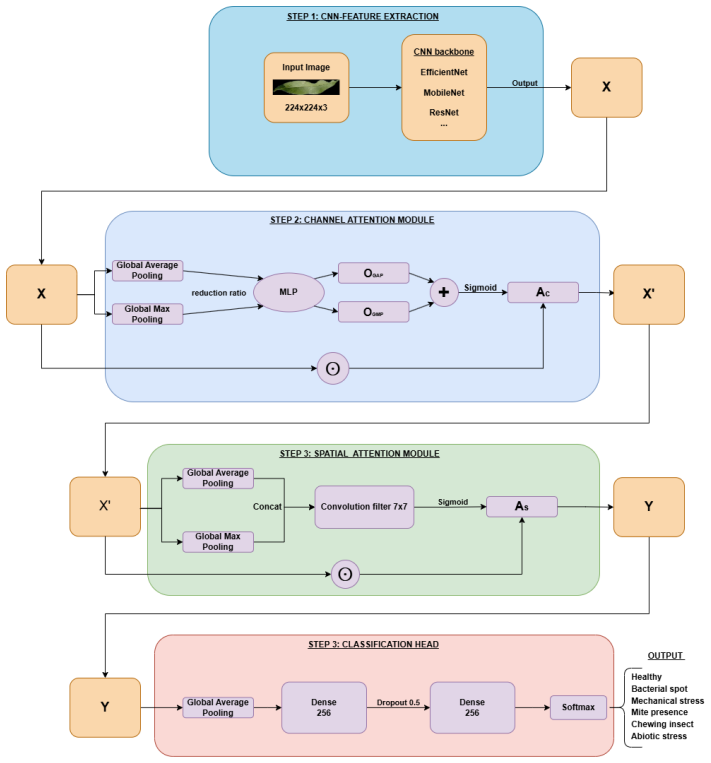
The Convolutional Block Attention Module (CBAM) that refines feature representations by focusing on important channels and spatial positions within EfficientNet backbones.
If this is right
- CBAM integration particularly improves handling of minority damage classes.
- Three fine-tuning strategies show that targeted transfer learning overcomes domain shift in local orchard images.
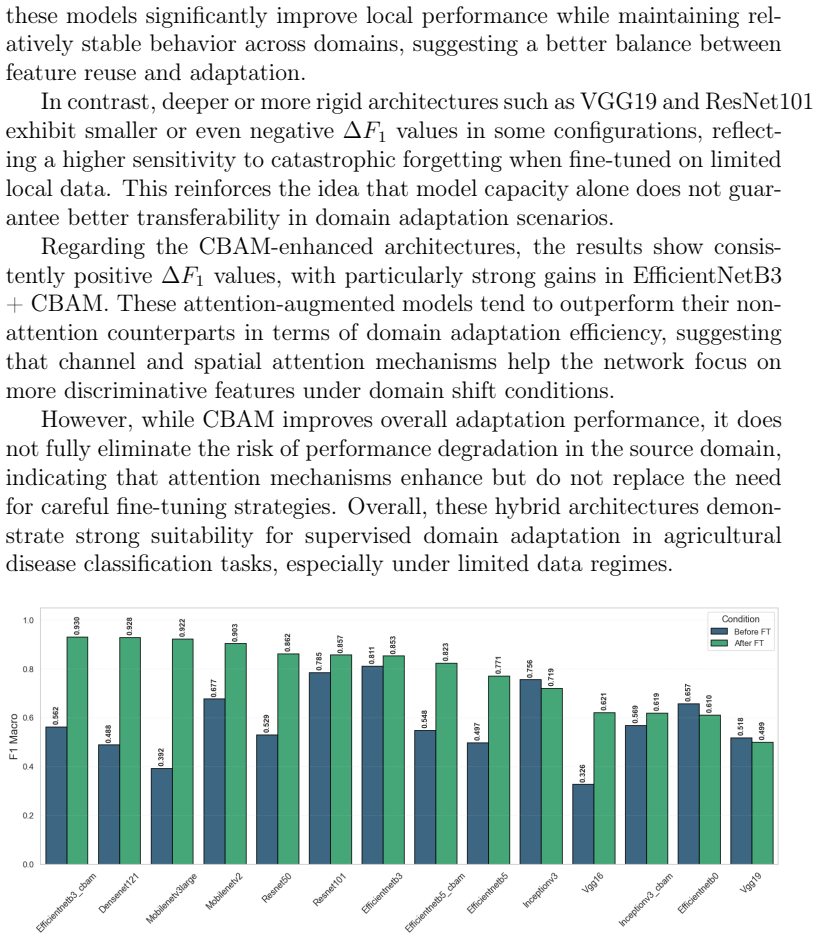
- EfficientNetB3 with CBAM achieves the top 93 percent macro F1-score on the local four-class set.
- Attention-enhanced models exhibit improved robustness to varying field conditions compared to baselines.
Where Pith is reading between the lines
- Similar attention and transfer techniques could extend to classifying damage in other fruit crops facing comparable symptom overlaps.
- Mobile deployment of these models might allow real-time orchard monitoring without extensive retraining per location.
- Expanding the local dataset size or diversity would test whether the reported performance generalizes further.
Load-bearing premise
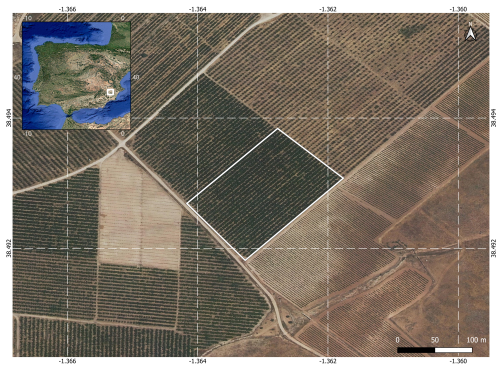
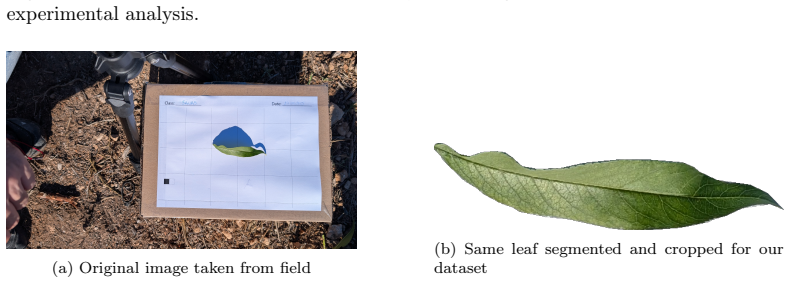
The 1,366-image benchmark and 180-image local collection capture the full visual variability and class distributions of damage in actual peach orchards under different conditions.
What would settle it
Evaluating the best model on additional peach leaf images from unseen orchards or seasons and finding accuracy substantially below 90 percent would indicate the generalization claims do not hold.
Figures
read the original abstract
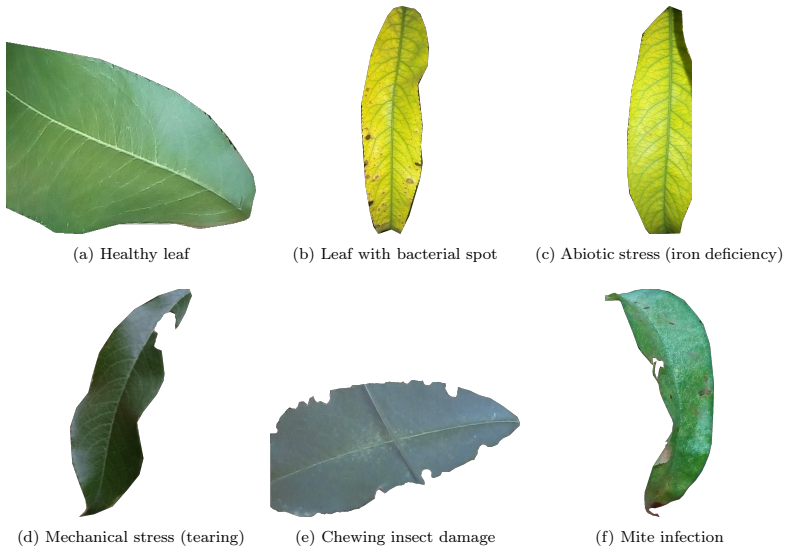
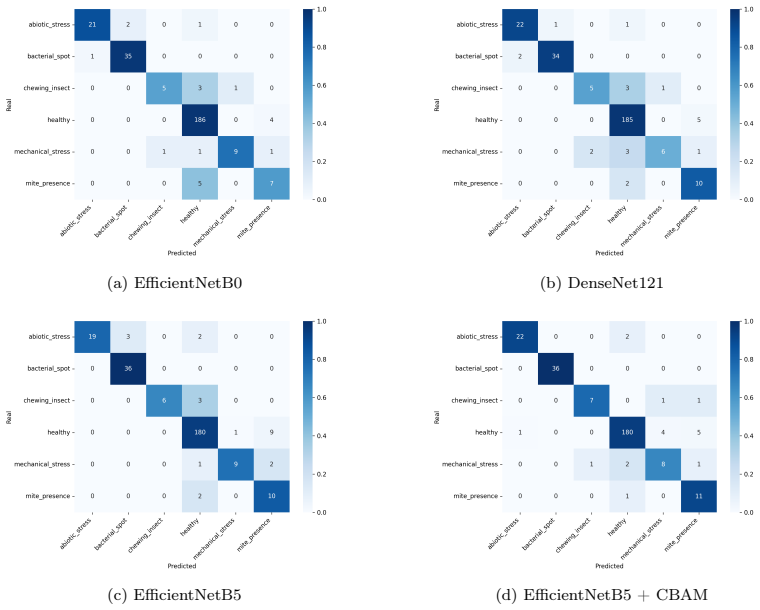
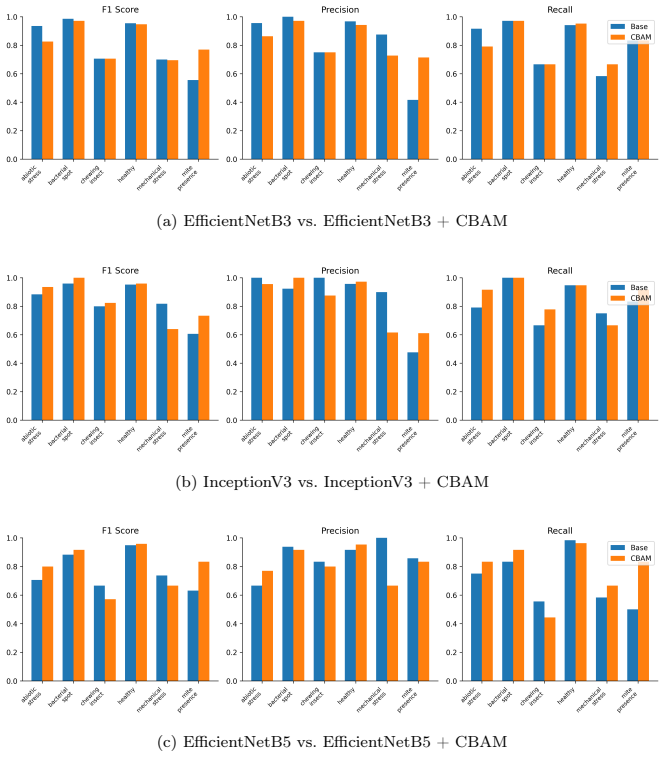
Artificial intelligence provides a practical framework for crop damage assessment from imagery data, supporting early decision-making in agricultural management. In peach orchards, climate change increases abiotic stress and biotic pressures, including pests and diseases, which often produce visually similar foliar symptoms. This overlap makes manual diagnosis difficult, especially across multiple fields with varying environmental conditions, highlighting the need for automated models with strong generalization ability. We propose an image-based classification approach for peach leaf damage detection. A benchmark dataset was created through manual annotation of publicly available images, consisting of 1,366 peach leaves across six damage categories. Several deep learning architectures were evaluated. EfficientNet models achieved the best results, with EfficientNetB0 reaching 92.9 percent accuracy, EfficientNetB3 achieving 91.5 percent, and EfficientNetB5 showing the strongest performance on minority classes. DenseNet121 reached 92.6 percent accuracy. The integration of the Convolutional Block Attention Module (CBAM) improved performance in several backbones, particularly EfficientNetB5 and InceptionV3, while showing limited or negative impact in others. The CBAM-enhanced EfficientNetB5 achieved the best overall accuracy of 93.3 percent. To evaluate robustness under realistic conditions, a local dataset of 180 images across four classes was collected, and transfer learning strategies were applied to address domain shift. Three fine-tuning strategies were tested. EfficientNetB3 combined with CBAM achieved the best performance in the local domain, reaching a 93 percent macro F1-score after transfer. Overall, attention-based models showed improved robustness for minority classes and better generalization across different field conditions.
Editorial analysis
A structured set of objections, weighed in public.
Referee Report
Summary. The paper creates a manually annotated benchmark of 1,366 peach leaf images in six damage classes and evaluates multiple CNN backbones with and without the Convolutional Block Attention Module (CBAM). EfficientNetB5+CBAM reaches 93.3% accuracy on the benchmark; on a separate local collection of 180 images in four classes, transfer learning with EfficientNetB3+CBAM yields 93% macro F1, which the authors interpret as evidence of improved robustness to domain shift.
Significance. If the local-domain numbers prove reliable, the work supplies concrete empirical support that attention modules can aid minority-class performance and cross-domain transfer in agricultural image classification, a practically relevant setting. The dual evaluation on a public-scale benchmark plus a field-collected set is a positive feature.
major comments (1)
- [Local dataset and transfer-learning experiments] The central claim of improved generalization under domain shift rests entirely on transfer results from the local 180-image, four-class collection. No train/validation/test split sizes, no standard deviations across repeated splits, no statistical comparison to non-CBAM baselines, and no quantification of how representative the 180 images are of orchard variability (lighting, cultivar, severity) are reported. This makes the 93% macro F1 indistinguishable from an optimistic draw and directly weakens the robustness conclusion.
minor comments (1)
- [Abstract] The abstract states that three fine-tuning strategies were tested but does not enumerate them or indicate which produced the reported best result.
Simulated Author's Rebuttal
We thank the referee for the constructive feedback on our work. We address the major comment point-by-point below and commit to revisions that strengthen the reporting of the local-domain experiments.
read point-by-point responses
-
Referee: The central claim of improved generalization under domain shift rests entirely on transfer results from the local 180-image, four-class collection. No train/validation/test split sizes, no standard deviations across repeated splits, no statistical comparison to non-CBAM baselines, and no quantification of how representative the 180 images are of orchard variability (lighting, cultivar, severity) are reported. This makes the 93% macro F1 indistinguishable from an optimistic draw and directly weakens the robustness conclusion.
Authors: We agree that the current manuscript lacks sufficient experimental detail on the local dataset, which is necessary to fully support the domain-shift claims. In the revised version we will add: (i) the precise train/validation/test split ratios and sizes used for the 180 images, (ii) standard deviations obtained from repeated random splits or multiple runs, (iii) statistical significance tests (e.g., McNemar or paired t-tests) comparing CBAM-enhanced models against the corresponding non-CBAM baselines, and (iv) an expanded description of the local collection protocol that addresses variability in lighting, cultivars, and damage severity. These additions will allow readers to evaluate whether the reported 93 % macro F1 is robust or potentially optimistic. revision: yes
Circularity Check
No circularity; purely empirical results on held-out image sets
full rationale
The paper evaluates standard deep learning architectures (EfficientNet variants, DenseNet, InceptionV3) with optional CBAM attention on two image datasets: a 1,366-image benchmark and a 180-image local collection. All reported figures (92.9% accuracy, 93.3% accuracy, 93% macro F1) are direct measurements of model performance on held-out test images after training or fine-tuning. No equations, derivations, or parameter-fitting steps appear; no quantity is defined in terms of itself, no fitted hyper-parameter is relabeled as a prediction, and no uniqueness theorems or self-citations are invoked to justify model choices. The work is self-contained empirical ML evaluation with no load-bearing self-referential structure.
Axiom & Free-Parameter Ledger
axioms (1)
- domain assumption Convolutional neural networks trained on labeled leaf images can learn features that distinguish damage categories even when imaging conditions change between datasets.
Reference graph
Works this paper leans on
-
[3]
James Daniel Omaye and Emeka Ogbuju and Grace Ataguba and Oluwayemisi Jaiyeoba and Joseph Aneke and Francisca Oladipo , keywords =. Cross-comparative review of Machine learning for plant disease detection: apple, cassava, cotton and potato plants , journal =. 2024 , issn =. doi:https://doi.org/10.1016/j.aiia.2024.04.002 , url =
-
[7]
Tiantian Jiang and Liang Li and Zhen Zhang and Xun Yu and Yanqin Zhu and Liming Li and Yadong Liu and Yali Bai and Ziqian Tang and Shuaibing Liu and Yan Zhang and Zheng Duan and Dameng Yin and Xiuliang Jin , keywords =. YOLO-light-pruned: A lightweight model for monitoring maize seedling count and leaf age using near-ground and UAV RGB images , journal =....
-
[8]
Boyi Tang and Jingping Zhou and Chunjiang Zhao and Yuchun Pan and Yao Lu and Chang Liu and Kai Ma and Xuguang Sun and Ruifang Zhang and Xiaohe Gu , keywords =. Using UAV-based multispectral images and CGS-YOLO algorithm to distinguish maize seeding from weed , journal =. 2025 , issn =. doi:https://doi.org/10.1016/j.aiia.2025.02.007 , url =
-
[9]
Faisal Dharma Adhinata and Wahyono and Raden Sumiharto , keywords =. A comprehensive survey on weed and crop classification using machine learning and deep learning , journal =. 2024 , issn =. doi:https://doi.org/10.1016/j.aiia.2024.06.005 , url =
-
[11]
2015 , howpublished=
Keras , author=. 2015 , howpublished=
2015
-
[12]
EfficientNet-Based Robust Recognition of Peach Plant Diseases in Field Images , volume =
Farman, Haleem and Ahmad, Jamil and Jan, Bilal and Shahzad, Yasir and Abdullah, Muhammad and Ullah, Atta , year =. EfficientNet-Based Robust Recognition of Peach Plant Diseases in Field Images , volume =. Computers, Materials & Continua , doi =
-
[14]
Overcoming Catastrophic Forgetting During Domain Adaptation of Seq2seq Language Generation
Li, Dingcheng and Chen, Zheng and Cho, Eunah and Hao, Jie and Liu, Xiaohu and Xing, Fan and Guo, Chenlei and Liu, Yang. Overcoming Catastrophic Forgetting During Domain Adaptation of Seq2seq Language Generation. Proceedings of the 2022 Conference of the North American Chapter of the Association for Computational Linguistics: Human Language Technologies. 2...
-
[16]
2017 , eprint=
MobileNets: Efficient Convolutional Neural Networks for Mobile Vision Applications , author=. 2017 , eprint=
2017
-
[17]
Deep Learning for Plant Diseases: Detection and Saliency Map Visualisation
Brahimi, Mohammed and Arsenovic, Marko and Laraba, Sohaib and Sladojevic, Srdjan and Boukhalfa, Kamel and Moussaoui, Abdelouhab. Deep Learning for Plant Diseases: Detection and Saliency Map Visualisation. Human and Machine Learning: Visible, Explainable, Trustworthy and Transparent. 2018
2018
-
[18]
2019 , eprint=
MobileNetV2: Inverted Residuals and Linear Bottlenecks , author=. 2019 , eprint=
2019
-
[19]
2019 , eprint=
Searching for MobileNetV3 , author=. 2019 , eprint=
2019
-
[20]
2020 , eprint=
EfficientNet: Rethinking Model Scaling for Convolutional Neural Networks , author=. 2020 , eprint=
2020
-
[21]
2015 , eprint=
Deep Residual Learning for Image Recognition , author=. 2015 , eprint=
2015
-
[22]
2015 , eprint=
Very Deep Convolutional Networks for Large-Scale Image Recognition , author=. 2015 , eprint=
2015
-
[23]
2015 , eprint=
Rethinking the Inception Architecture for Computer Vision , author=. 2015 , eprint=
2015
-
[24]
2019 , eprint=
Squeeze-and-Excitation Networks , author=. 2019 , eprint=
2019
-
[25]
2018 , eprint=
CBAM: Convolutional Block Attention Module , author=. 2018 , eprint=
2018
-
[26]
2017 , eprint=
Adam: A Method for Stochastic Optimization , author=. 2017 , eprint=
2017
-
[27]
ImageNet: A large-scale hierarchical image database , year=
Deng, Jia and Dong, Wei and Socher, Richard and Li, Li-Jia and Kai Li and Li Fei-Fei , booktitle=. ImageNet: A large-scale hierarchical image database , year=
-
[29]
Jocher, Glenn and Qiu, Jing and Chaurasia, Ayush , title =
-
[30]
Plant Disease Detection Using Machine Learning , year=
Ramesh, Shima and Hebbar, Ramachandra and M., Niveditha and R., Pooja and N., Prasad Bhat and N., Shashank and P.V., Vinod , booktitle=. Plant Disease Detection Using Machine Learning , year=
-
[31]
A survey of detecting leaf diseases using machine learning and deep learning in various crops , volume =
T, Thilagraj and Kareem, Abdul and Kumara, Varun and Naik, Utkrishna and Poojary, Sanjana and R, Bharath , year =. A survey of detecting leaf diseases using machine learning and deep learning in various crops , volume =. IAES International Journal of Artificial Intelligence (IJ-AI) , doi =
-
[32]
Tomato leaves diseases detection approach based on Support Vector Machines , booktitle =
Ali, Mona and Mokhtar, Usama and Hassanien, Aboul Ella and Hefny, Hesham , year =. Tomato leaves diseases detection approach based on Support Vector Machines , booktitle =
-
[33]
Asif and Talukder, Kamrul Hasan , booktitle=
Iqbal, Md. Asif and Talukder, Kamrul Hasan , booktitle=. Detection of Potato Disease Using Image Segmentation and Machine Learning , year=
-
[34]
K. J. Mohan and M. Balasubramanian and S. Palanivel , title =. International Journal of Computer Applications , volume =. 2016 , doi =
2016
-
[35]
Plant Leaf Disease Prediction , volume =
Monigari, Vaishnavi , year =. Plant Leaf Disease Prediction , volume =. International Journal for Research in Applied Science and Engineering Technology , doi =
-
[37]
Rama , booktitle=
M, Teenu Sahasra and S, Sai Kumari and S, Sai Meghana and Devi, P. Rama , booktitle=. Leaf Disease Detection Using Deep Learning , year=
-
[39]
International Conference on Electronic Governance with Emerging Technologies , pages=
Leaf Diseases Detection in Peach Using EfficientNet , author=. International Conference on Electronic Governance with Emerging Technologies , pages=. 2024 , organization=
2024
-
[40]
Stefani , journal =
E. Stefani , journal =. ECONOMIC SIGNIFICANCE AND CONTROL OF BACTERIAL SPOT/CANKER OF STONE FRUITS CAUSED BY XANTHOMONAS ARBORICOLA pv. PRUNI , urldate =
-
[41]
Bacteria , VOLUME =
Sakata, Nanami and Ishiga, Yasuhiro , TITLE =. Bacteria , VOLUME =. 2025 , NUMBER =
2025
-
[44]
International Journal of Molecular Sciences , VOLUME =
Kopecká, Romana and Kameniarová, Michaela and Černý, Martin and Brzobohatý, Břetislav and Novák, Jan , TITLE =. International Journal of Molecular Sciences , VOLUME =. 2023 , NUMBER =
2023
-
[46]
Plant growth regulation , volume=
The effects of mechanically-induced stress in plants—a review , author=. Plant growth regulation , volume=. 1986 , publisher=
1986
-
[47]
Experimental and Applied Acarology , volume=
Do plant mites commonly prefer the underside of leaves? , author=. Experimental and Applied Acarology , volume=. 2011 , publisher=
2011
-
[48]
, TITLE =
Situngu, Sivuyisiwe and Barker, Nigel P. , TITLE =. Forests , VOLUME =. 2024 , NUMBER =
2024
-
[49]
Insects , VOLUME =
Möth, Stefan and Walzer, Andreas and Redl, Markus and Petrović, Božana and Hoffmann, Christoph and Winter, Silvia , TITLE =. Insects , VOLUME =. 2021 , NUMBER =
2021
-
[53]
Enhanced Anomaly Detection in Pandemic Surveillance Videos: An Attention Approach With EfficientNet-B0 and CBAM Integration , year=
Ul Amin, Sareer and Sibtain Abbas, Muhammad and Kim, Bumsoo and Jung, Yonghoon and Seo, Sanghyun , journal=. Enhanced Anomaly Detection in Pandemic Surveillance Videos: An Attention Approach With EfficientNet-B0 and CBAM Integration , year=
-
[54]
ICTAR , month =
Gök, Ali and Yurdakul, Mustafa and Tasdemir, Sakir , year =. ICTAR , month =
-
[55]
2018 , eprint=
Densely Connected Convolutional Networks , author=. 2018 , eprint=
2018
-
[56]
2016 , eprint=
You Only Look Once: Unified, Real-Time Object Detection , author=. 2016 , eprint=
2016
-
[57]
2025 , eprint=
YOLO Evolution: A Comprehensive Benchmark and Architectural Review of YOLOv12, YOLO11, and Their Previous Versions , author=. 2025 , eprint=
2025
-
[58]
2024 , eprint=
YOLOv11: An Overview of the Key Architectural Enhancements , author=. 2024 , eprint=
2024
-
[60]
2019 , eprint=
PyTorch: An Imperative Style, High-Performance Deep Learning Library , author=. 2019 , eprint=
2019
-
[61]
2019 , eprint=
An introduction to domain adaptation and transfer learning , author=. 2019 , eprint=
2019
-
[62]
2020 , eprint=
A Comprehensive Survey on Transfer Learning , author=. 2020 , eprint=
2020
-
[63]
Learning and Domain Adaptation , booktitle=
Mansour, Yishay , year =. Learning and Domain Adaptation , booktitle=
-
[65]
Horticulturae , volume=
Influence of climate change on metabolism and biological characteristics in perennial woody fruit crops in the Mediterranean environment , author=. Horticulturae , volume=. 2022 , publisher=
2022
-
[66]
Regional environmental change , volume=
Climate change impacts on winter chill in Mediterranean temperate fruit orchards , author=. Regional environmental change , volume=. 2023 , publisher=
2023
-
[67]
Horticulturae , volume=
Effects of Elevated Temperature on the Phenology and Fruit Shape of the Early-Maturing Peach Cultivar ‘Mihong’ , author=. Horticulturae , volume=. 2025 , publisher=
2025
-
[68]
Agricultural and Forest Meteorology , volume=
Shifts in the thermal niche of fruit trees under climate change: The case of peach cultivation in France , author=. Agricultural and Forest Meteorology , volume=. 2021 , publisher=
2021
-
[69]
International Journal of Environment and Climate Change , volume=
Effects of Climate Change on Fruit Growing: Risks and Solutions for the Future , author=. International Journal of Environment and Climate Change , volume=. 2025 , doi=
2025
-
[70]
Insects , volume=
Impact of Climate Change on Peach Fruit Moth Phenology: A Regional Perspective from China , author=. Insects , volume=. 2024 , publisher=
2024
-
[71]
leaves in two agroecosystems , author=
Diversity of the organisms in the Prunus persicae L. leaves in two agroecosystems , author=. I+ D Revista de Investigaciones , volume=. 2024 , url=
2024
-
[72]
The impact of global warming on fruit crops and mitigation strategies: A comprehensive review , author=. Agronom. 2025 , publisher=
2025
-
[73]
Agricultural Systems , volume=
Phenological and epidemiological impacts of climate change on peach production , author=. Agricultural Systems , volume=. 2024 , publisher=
2024
-
[74]
International Journal of Molecular Sciences , volume=
Enhancing abiotic stress resilience in Mediterranean woody perennial fruit crops: Genetic, epigenetic, and microbial molecular perspectives in the face of climate change , author=. International Journal of Molecular Sciences , volume=. 2025 , publisher=
2025
-
[75]
The Horticulture Journal , pages=
Meteorological Responses of Fruit Trees, Impact of Climate Change on Fruit Production, and Adaptation Strategies , author=. The Horticulture Journal , pages=. 2025 , publisher=
2025
-
[76]
Scientific Reports , volume=
Plant leaf disease detection using vision transformers for precision agriculture , author=. Scientific Reports , volume=. 2025 , url=
2025
-
[77]
Proceedings of the Entomological Society of Washington , volume=
Population Dynamics of Peach Silver Mite Aculus fockeui (Nalepa and Trouessart)(Acari: Eriophyidae) on Plum, Prunus domestica, and Peach, Prunus persica,(Rosaceae) in Yalova-Turkey , author=. Proceedings of the Entomological Society of Washington , volume=. 2023 , publisher=
2023
-
[78]
Abiotic Stress Management in Fruit Crops , isbn =
Manju and Agrawal, Sarita and Alam, Md and Mir, Muzafar and Singh, Kh and Sharma, Aman , year =. Abiotic Stress Management in Fruit Crops , isbn =
-
[79]
Artificial Intelligence Review , volume=
Deep learning and computer vision in plant disease detection: a comprehensive review of techniques, models, and trends in precision agriculture , author=. Artificial Intelligence Review , volume=. 2025 , publisher=
2025
-
[80]
Frontiers in Plant Science , volume=
A review of plant leaf disease identification by deep learning algorithms , author=. Frontiers in Plant Science , volume=. 2025 , publisher=
2025
-
[81]
J , volume=
Plant Leaf Disease Detection Using Deep Learning: A Multi-Dataset Approach , author=. J , volume=. 2025 , publisher=
2025
-
[82]
, author=
PeachNet: Peach Diseases Detection for Automatic Harvesting. , author=. Computers, Materials & Continua , volume=. 2021 , url=
2021
-
[84]
BMC Plant Biology , volume=
Deep learning technique for plant disease classification and pest detection and model explainability elevating agricultural sustainability , author=. BMC Plant Biology , volume=. 2025 , publisher=
2025
-
[85]
Plants , volume=
Plant and disease recognition based on PMF pipeline domain adaptation method: Using bark images as meta-dataset , author=. Plants , volume=. 2023 , publisher=
2023
-
[86]
Computers and Electronics in Agriculture , volume=
Advancing plant disease classification: A robust and generalized approach with transformer-fused convolution and Wasserstein domain adaptation , author=. Computers and Electronics in Agriculture , volume=. 2024 , publisher=
2024
-
[87]
pruni in China , author=
Identification, genetic diversity, and chemical control of Xanthomonas arboricola pv. pruni in China , author=. Plant Disease , volume=. 2022 , publisher=
2022
-
[88]
pruni, causal agent of bacterial spot of stone fruits and almond: its genomic and phenotypic characteristics in the X
Xanthomonas arboricola pv. pruni, causal agent of bacterial spot of stone fruits and almond: its genomic and phenotypic characteristics in the X. arboricola species context , author=. Molecular plant pathology , volume=. 2018 , publisher=
2018
-
[89]
Insects , volume=
Management of Panonychus ulmi with various miticides and insecticides and their toxicity to predatory mites conserved for biological mite control in eastern US Apple Orchards , author=. Insects , volume=. 2023 , publisher=
2023
-
[91]
PLoS One , volume=
Comparison of absorption and excretion of test compounds in sucking versus chewing pests , author=. PLoS One , volume=. 2025 , publisher=
2025
-
[92]
, author Agarwal, A
author Abadi, M. , author Agarwal, A. , author Barham, P. , author Brevdo, E. , author Chen, Z. , author Citro, C. , author Corrado, G.S. , author Davis, A. , author Dean, J. , author Devin, M. , author Ghemawat, S. , author Goodfellow, I. , author Harp, A. , author Irving, G. , author Isard, M. , author Jia, Y. , author Jozefowicz, R. , author Kaiser, L....
2015
-
[93]
author Ahmad, J. , author Farman, H. , year 2024 . title Dataset: Efficientnet-based robust recognition of peach plant diseases in field images . howpublished Mendeley Data, V1 . https://data.mendeley.com/datasets/3pmj85snvw/1, :10.17632/3pmj85snvw.1
-
[94]
author Alosaimi, W. , author Alyami, H. , author Uddin, M.I. , year 2021 . title Peachnet: Peach diseases detection for automatic harvesting. journal Computers, Materials & Continua volume 67 . https://doi.org/10.32604/cmc.2021.014950
-
[95]
author Bedi, P. , author Gole, P. , year 2021 . title Plant disease detection using hybrid model based on convolutional autoencoder and convolutional neural network . journal Artificial Intelligence in Agriculture volume 5 , pages 90--101 . https://www.sciencedirect.com/science/article/pii/S2589721721000180, :https://doi.org/10.1016/j.aiia.2021.05.002
-
[96]
, year 1986
author Biddington, N.L. , year 1986 . title The effects of mechanically-induced stress in plants—a review . journal Plant growth regulation volume 4 , pages 103--123
1986
-
[97]
author Body, M.J.A. , author Neer, W.C. , author Vore, C. , author Lin, C.H. , author Vu, D.C. , author Schultz, J.C. , author Cocroft, R.B. , author Appel, H.M. , year 2019 . title Caterpillar chewing vibrations cause changes in plant hormones and volatile emissions in arabidopsis thaliana . journal Frontiers in Plant Science volume Volume 10 - 2019 . ht...
-
[98]
author Brahimi, M. , author Arsenovic, M. , author Laraba, S. , author Sladojevic, S. , author Boukhalfa, K. , author Moussaoui, A. , year 2018 . title Deep Learning for Plant Diseases: Detection and Saliency Map Visualisation . publisher Springer International Publishing , address Cham . chapter chapter 8 . pp. pages 93--117 . https://doi.org/10.1007/978...
-
[99]
author Buslaev, A. , author Iglovikov, V.I. , author Khvedchenya, E. , author Parinov, A. , author Druzhinin, M. , author Kalinin, A.A. , year 2020 . title Albumentations: Fast and flexible image augmentations . journal Information volume 11 , pages 125 . http://dx.doi.org/10.3390/info11020125, :10.3390/info11020125
-
[100]
, et al., year 2015
author Chollet, F. , et al., year 2015 . title Keras . howpublished https://keras.io
2015
-
[101]
author Cui, Z. , author Li, K. , author Kang, C. , author Wu, Y. , author Li, T. , author Li, M. , year 2023 . title Plant and disease recognition based on pmf pipeline domain adaptation method: Using bark images as meta-dataset . journal Plants volume 12 , pages 3280 . https://doi.org/10.3390/plants12183280
discussion (0)
Sign in with ORCID, Apple, or X to comment. Anyone can read and Pith papers without signing in.