REVIEW 4 major objections 5 minor 88 references
Uncertainty Propagation in a Multiscale CALPHAD-Reinforced Elastochemical Phase-field Model
T0 review · 4 major / 5 minor · reviewed 2026-08-14 · deepseek-v4-flash
Pith's one-line read Thermodynamic parameter uncertainty can be propagated end-to-end through a CALPHAD and phase-field chain to yield probability distributions for microstructural descriptors in Mg2(SixSn1-x).
desk verdict A genuinely integrated UQ/UP pipeline for CALPHAD–phase-field modeling, but the uncertainty bands are conditional on a computed reference phase diagram, so treat the application numbers as a demonstration rather than predictive intervals. read the letter →
The pith
A machine-rendered reading of the paper's core claim, the machinery that carries it, and where it could break.
The reading
What carries the argument
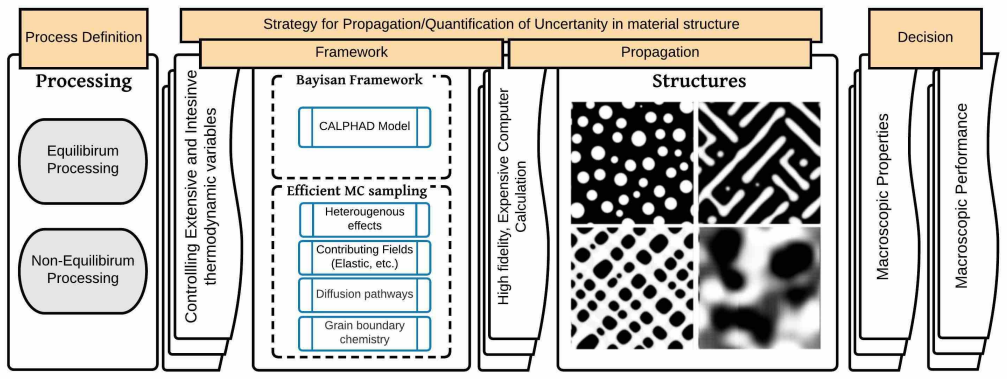
The load-bearing object is the total free energy functional $F_{\mathrm{tot}} = f_{\mathrm{bulk}} + f_{\mathrm{interfacial}} + f_{\mathrm{elas}}$, in which the bulk chemical free energy is a sub-regular solution model with CALPHAD interaction parameters of the form $L^\nu_{\alpha\beta} = {}^\nu a_{\alpha\beta} + {}^\nu b_{\alpha\beta} T$, and the microstructure evolution is governed by the Cahn-Hilliard equation $\partial c/\partial t = \nabla \cdot M\nabla(\delta F_{\mathrm{tot}}/\delta c)$ with microelasticity solved through the mechanical equilibrium and constitutive laws. This functional is the meeting point of the two uncertainty streams: the MCMC posterior on thermodynamic parameters enters through $f_{\mathrm{bulk}}$, while the microelastic and kinetic priors enter through $f_{\mathrm{elas}}$ and the mobility $M$. The argument is carried by treating this functional as a stochastic simulator: sample parameters, run the chain, collect microstructures, and summarize the output distribution through quantities of interest.
What would settle it
Re-run the MCMC calibration using direct experimental composition-temperature data for the miscibility gap rather than the reference computed phase diagram, then compare the resulting 95% credible intervals on the phase boundary and on the microstructure QoIs with the intervals shown here; substantial non-overlap would show the propagated bands are conditional on the choice of calibration data.
Extended reading notes
Core claim
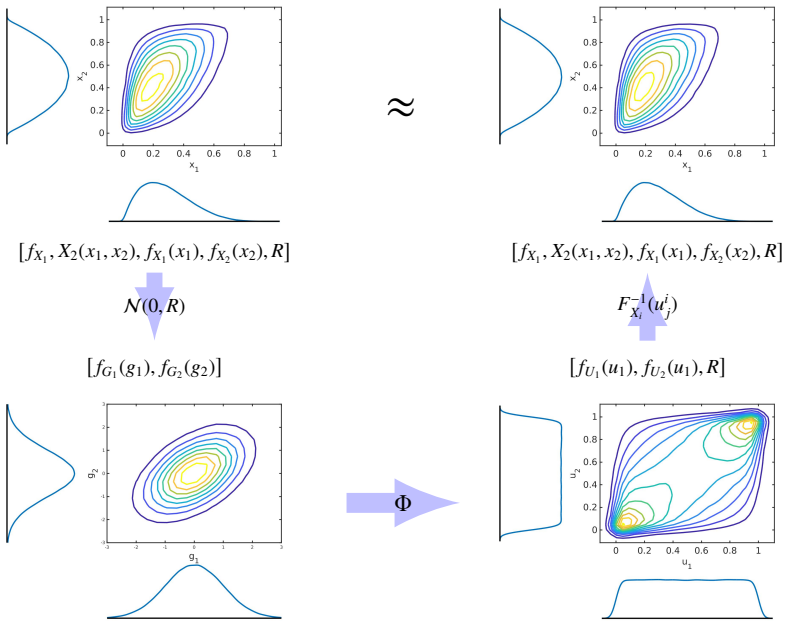
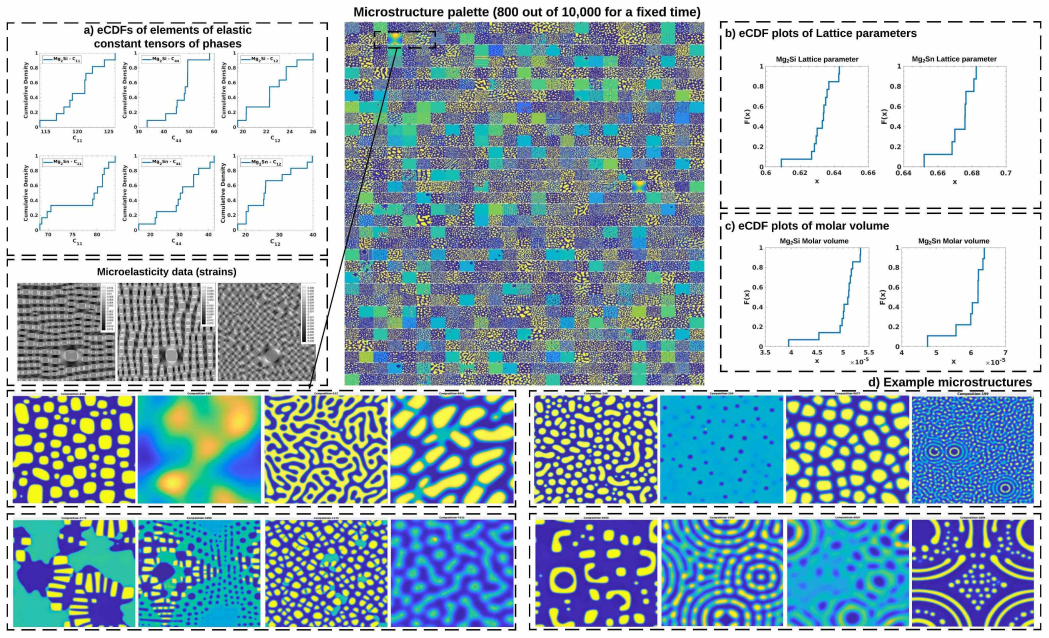
The central claim is that statistically quantified uncertainty in thermodynamic parameters can be propagated through the Gibbs free energy, the equilibrium phase diagram, and then through a phase-field model that couples chemical and elastic driving forces, producing probability distributions for microstructural descriptors in the pseudobinary thermoelectric alloy $\mathrm{Mg}_2(\mathrm{Si}_x\mathrm{Sn}_{1-x})$. The propagation is done in two stages: an MCMC calibration converts a prior on six CALPHAD interaction parameters into a posterior, and a Gaussian copula sampler draws parameter vectors from that posterior together with priors on elastic constants, stress-free transformation strain, molar volumes, mobility, gradient energy coefficient, and alloy composition. These samples drive 10,000 phase-field runs; the resulting synthetic microstructures are reduced to eight quantities of interest, and clustering separates them into decomposed versus not-decomposed classes. The paper's contribution is the end-to-end demonstration that meaningful uncertainty bands survive the chain and that the output space is not a single regime but a landscape with multiple modes.
Load-bearing premise
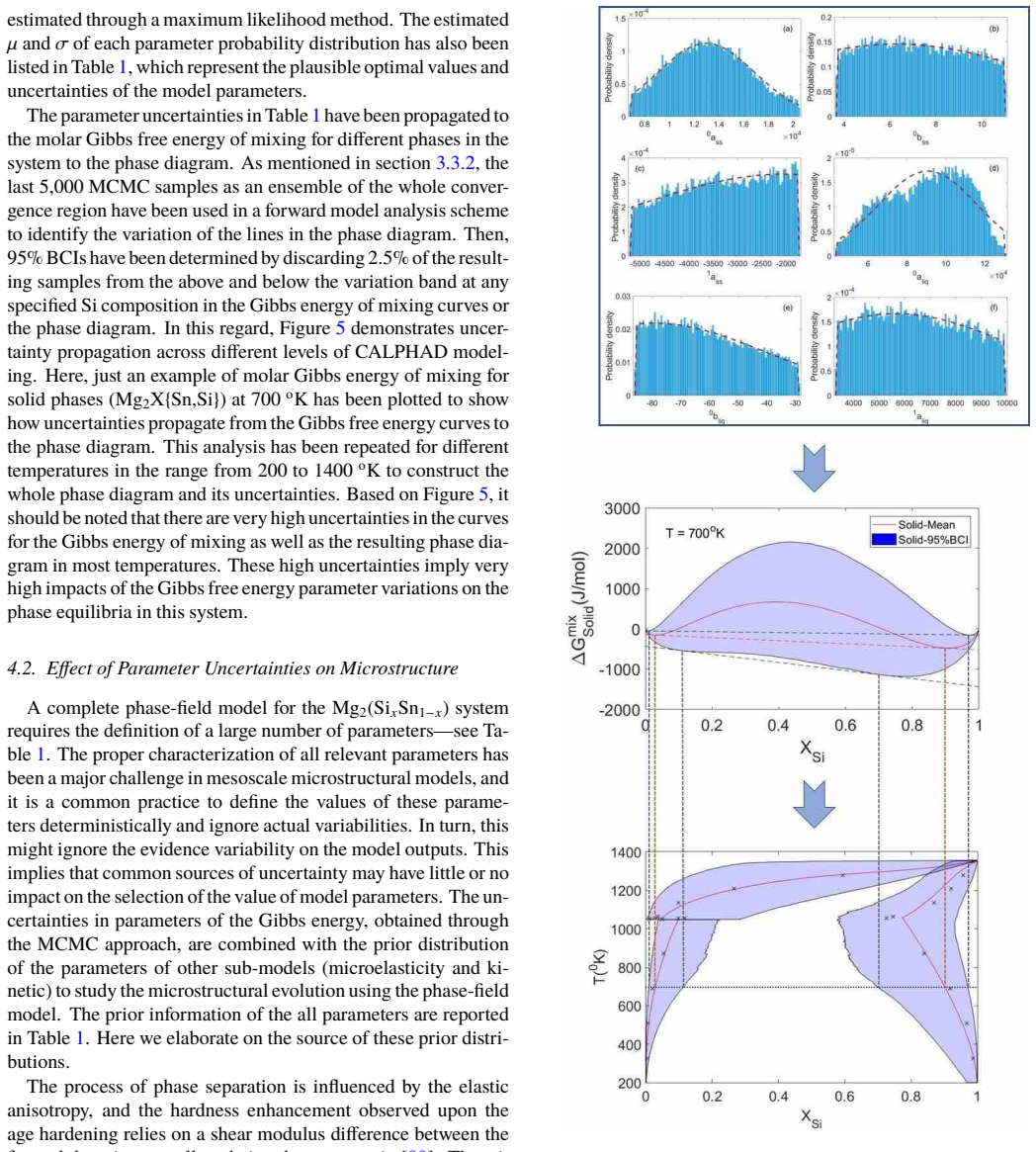
The chain is anchored by calibrating the CALPHAD parameters to one computed phase diagram, even though experimental phase boundary estimates for this system disagree by tens of atomic percent; if that reference diagram is biased, every downstream credible interval shifts with it.
Editorial extensions
If this is right
- If the framework is right, microstructure predictions from CALPHAD-based phase-field simulations can be reported as posterior distributions rather than point forecasts, with 95% credible intervals attached to phase boundary locations, phase compositions, characteristic lengths, and area fractions.
- The high uncertainty seen in the Gibbs energy curves and phase diagram means that thermodynamic parameter uncertainty is not washed out by the subsequent simulation; downstream microstructure predictions inherit it and can change qualitatively, not just quantitatively.
- The trimodal distributions of equilibrium phase compositions imply that deterministic min/mean/max sampling of inputs would miss whole microstructure regimes; sampling schemes that preserve correlations and marginal distributions are necessary.
- Microstructure data can be organized into two broad classes, decomposed and not-decomposed, and classifiers can draw decision boundaries in input-parameter space that identify processing conditions favoring one or the other, connecting to different phonon-scattering regimes.
Reading between the lines
- Editorial inference: the same two-stage sampling scheme could be extended past microstructure to transport properties, turning the QoI distributions into confidence intervals for lattice thermal conductivity or the thermoelectric figure of merit; the paper stops at microstructure and lists phonon scattering as motivation.
- Editorial inference: the strongest test of the calibration is to replace the reference phase diagram used in the MCMC likelihood with direct experimental phase boundary measurements of the same pseudobinary system; if the propagated credible intervals do not overlap the experimental boundaries, the posterior needs reweighting.
- Editorial inference: because the output QoIs are multimodal, scalar summaries like variance-to-mean ratio may hide the regimes; a natural extension is to use the classifier decision boundaries as inverse maps that return the processing-parameter region for a target microstructure class.
Signed reviews
Editorial analysis
A structured set of objections, weighed in public.
Referee Report
Summary. The paper presents a framework for uncertainty quantification and propagation through a multiscale model chain consisting of a CALPHAD thermodynamic description, a microelasticity model, and a Cahn-Hilliard phase-field model, applied to the Mg2(SixSn1-x) thermoelectric system. The CALPHAD interaction parameters are calibrated with an adaptive Metropolis-Hastings MCMC against the computed phase diagram of Kozlov et al., yielding posterior distributions that are propagated to Gibbs free energy curves and phase diagram credible intervals. These posteriors are then combined, via a Gaussian copula, with priors on microelastic and kinetic parameters to sample a high-dimensional input space for 10,000 phase-field simulations. The resulting microstructure ensemble is characterized through several quantities of interest, and machine-learning classifiers and clustering are used to identify decomposed versus not-decomposed microstructures. The authors also curate the generated dataset in the Open Phase-field Microstructure Database.
Significance. If the approach is sound, this is one of the few complete demonstrations of end-to-end uncertainty propagation through a CALPHAD-to-phase-field chain, and it adds a publicly available large microstructure dataset. The combination of Bayesian calibration, copula-based sampling, high-throughput phase-field simulation, and ML-based analysis is methodologically ambitious and could serve as a template for ICME uncertainty workflows. The main strength is the explicit treatment of correlated thermodynamic parameters and the transparent release of data. However, the external anchoring of the uncertainty is a central concern, because the MCMC posterior is conditioned on a single computational phase diagram rather than on experimental data, and the paper does not fully acknowledge the conditionality of its uncertainty bands.
major comments (4)
- [Section 4.1, Figure 5, Table 2] The MCMC calibration in Section 4.1 fits the six CALPHAD parameters to 'calculated composition-temperature data sampled from the phase diagram proposed by Kozlov et al. [62]', which is a computational reference, not experimental data. The introduction (Section 2) itself notes that experimental phase boundary estimates for Mg2(SixSn1-x) disagree by several tens of atomic percent [39]. Since the posterior distributions drive the Gibbs energy BCIs in Figure 5, the Gaussian copula samples in Section 3.3.3, and the microstructure QoI distributions in Table 2, the reported credible intervals are conditional on the Kozlov diagram's bias. An unknown likelihood variance hyper-parameter can widen the intervals but cannot recenter a biased mean. Please either re-frame the central claim as propagation of uncertainty conditional on a chosen reference diagram, or anchor the posterior with experimental phase boundary data or multiple independent CALPHAD assessments.
- [Section 3.3.3] The Gaussian copula is used to sample the 18-dimensional input space for phase-field simulations, but the paper does not specify how the correlation matrix R is constructed for the full input set, nor does it validate that the copula reproduces the actual joint posterior of the CALPHAD parameters. The joint frequency plot in Figure 4 suggests non-elliptical dependence for at least one parameter pair, and a Gaussian copula with pairwise correlations may not preserve higher-order or tail dependencies. Because the microstructure QoI distributions depend on the joint sampling, please add a quantitative validation step (for example, energy distance or scatter/QQ comparisons) between copula-generated CALPHAD parameter vectors and the MCMC posterior, and state explicitly how R is assembled from the MCMC covariance and the assumed independent priors.
- [Table 2] The 'Dispersion (sigma^2 mu)' column in Table 2 contains negative entries (e.g., -1012.1 for mu_chem = -156.06 and -6.01e-6 for mu_int = 1.59e-9), which are impossible if this column reports a variance or variance-to-mean ratio with positive variance. The header is also not defined consistently with Table 1, where the analogous column appears to report variances. These values undermine the quantitative QoI statistics that are central to the propagation claim. Please correct the definition and the values, or clearly relabel the column as the index of dispersion if that is the intent.
- [Section 3.3.1 and Section 4.1] Convergence of the MCMC sampler is supported only by a qualitative joint-frequency plot and a statement that 100,000 samples were generated. Since the posterior is the foundation for all downstream uncertainty propagation, quantitative convergence diagnostics (e.g., effective sample size, trace plots, or multiple-chain Gelman-Rubin statistics) should be reported to justify the use of the last 5,000 samples as representative of the stationary distribution.
minor comments (5)
- [Abstract and Section 4.2] The abstract mentions '200,000 time series of synthetic microstructures', while Section 4.2 reports 10,000 parameter combinations run through the phase-field solver; please clarify whether the 200,000 figure corresponds to 10,000 simulations at multiple time frames and state this explicitly.
- [Table 1, SFTS row] The SFTS parameter row in Table 1 lists a negative dispersion value (-4.28), which is inconsistent with the variance interpretation used for other rows; this appears to be a sign or formatting error and should be corrected.
- [References [61] and [70]] References [61] and [70] are the same paper by Vives et al.; please consolidate the duplicate citation.
- [Section 4.3, paragraph on VMR] The text states 'VMR = 0 is associated to a random data-set', which is incorrect: a variance-to-mean ratio of zero implies zero variance, not randomness; the intended statement is likely that VMR near 1 corresponds to a Poisson-like random distribution.
- [Section 3.3.3 and Figure 3] The sampling methodology is explained clearly with the two-dimensional example, but the extension to the actual 18-dimensional case should state how the marginal distributions for microelastic and kinetic parameters are specified (e.g., truncated normal fits, uniform bounds) and how the zero-correlation assumption for those parameters is reflected in R.
Circularity Check
No significant circularity: the forward uncertainty-propagation chain is self-contained; the phase-diagram output is an explicit posterior-predictive consistency check, not an independent prediction.
full rationale
After walking the derivation chain, no circular step is present. The MCMC calibration in Sec. 4.1 fits six CALPHAD interaction parameters to 'calculated composition-temperature data sampled from the phase diagram proposed by Kozlov et al. [62]'; the subsequent propagation of the posterior to Gibbs-energy curves and to a phase diagram is a standard Bayesian posterior-predictive consistency check, and the paper does not present that output as an independent measurement or first-principles prediction. The central forward chain—posterior CALPHAD parameters plus priors on microelastic/kinetic parameters, fed into 10,000 elastochemical phase-field simulations, and then to microstructure QoI distributions in Table 2—uses no QoI feedback into parameter fitting, so those QoI distributions are genuine forward propagation. Self-citations to the authors' earlier Mg2Si-Mg2Sn phase-field work [39] and Bayesian CALPHAD work [21] provide background, parameter priors, and motivation, but they are not invoked as a uniqueness theorem or as the sole evidence for the framework's validity. The concern that the Kozlov reference diagram may be biased is a data-fidelity and correctness limitation—the introduction itself notes that experimental phase-boundary estimates disagree by tens of atomic percent—but it does not make the derivation circular.
Assumptions & free parameters
free parameters (4)
- CALPHAD interaction parameters (0a_ss, 0b_ss, 1a_ss, 0a_liq, 0b_liq, 1a_liq) =
mean values in Table 1, e.g., 0a_ss = 12840.4 J/mol
- likelihood variance hyper-parameter =
not reported
- Phase-field parameter prior bounds (mobility, gradient energy, SFTS, elastic constants, molar volumes) =
ranges in Table 1, e.g., SFTS uniform in [-0.02, 0.02]
- Gaussian copula correlation matrix =
pairwise Pearson correlations from MCMC posterior
assumptions (5)
- domain assumption Sub-regular solution model for the bulk free energy (Eq. 5) accurately describes Mg2(SixSn1-x) thermodynamics.
- domain assumption The phase diagram calculated by Kozlov et al. [62] is a reliable calibration target.
- standard math Cahn-Hilliard and linear microelasticity equations (Eqs. 8-12) capture the essential microstructure evolution physics.
- domain assumption Gaussian copula with pairwise correlations preserves the joint distribution sufficiently for propagation.
- domain assumption The hierarchical clustering labels (decomposed vs not-decomposed) correspond to distinct phonon scattering regimes.
Cite this review
Pith. "Pith review of Uncertainty Propagation in a Multiscale CALPHAD-Reinforced Elastochemical Phase-field Model." pith.science (2026). https://pith.science/paper/QJ44MGJD
@misc{pith2026190800638,
  author       = {Pith},
  title        = {Pith review of: Uncertainty Propagation in a Multiscale CALPHAD-Reinforced Elastochemical Phase-field Model},
  year         = {2026},
  howpublished = {\url{https://pith.science/paper/QJ44MGJD}},
  note         = {Machine review of arXiv:1908.00638}
}
abstract
ICME approaches provide decision support for materials design by establishing quantitative process-structure-property relations. Confidence in the decision support, however, must be achieved by establishing uncertainty bounds in ICME model chains. The quantification and propagation of uncertainty in computational materials science, however, remains a rather unexplored aspect of computational materials science approaches. Moreover, traditional uncertainty propagation frameworks tend to be limited in cases with computationally expensive simulations. A rather common and important model chain is that of CALPHAD-based thermodynamic models of phase stability coupled to phase field models for microstructure evolution. Propagation of uncertainty in these cases is challenging not only due to the sheer computational cost of the simulations but also because of the high dimensionality of the input space. In this work, we present a framework for the quantification and propagation of uncertainty in a CALPHAD-based elasto-chemical phase field model. We motivate our work by investigating the microstructure evolution in Mg$_2$(Si$_x$Sn$_{1-x}$) thermoelectric materials. We first carry out a Markov Chain Monte Carlo-based inference of the CALPHAD model parameters for this pseudobinary system and then use advanced sampling schemes to propagate uncertainties across a high-dimensional simulation input space. Through high-throughput phase field simulations we generate 200,000 time series of synthetic microstructures and use machine learning approaches to understand the effects of propagated uncertainties on the microstructure landscape of the system under study. The microstructure dataset has been curated in the Open Phase-field Microstructure Database (OPMD), available at \href{http://microstructures.net}{http://microstructures.net}.
Figures

Figures from the paper (6 more)



Reference graph
Works this paper leans on
- [62]
-
[39]
S. Yi, V. Attari, M. Jeong, J. Jian, S. Xue, H. Wang, R. Ar- royave, C. Yu, Strain-induced suppression of the miscibility gap in nanostructured mg2si–mg2sn solid solutions, Journal of Materials Chemistry A 6 (36) (2018) 17559–17570
work page 2018
-
[1]
Y. Qian, C. Jackson, F. Giorgi, B. Booth, Q. Duan, C. For- est, D. Higdon, Z. J. Hou, G. Huerta, Uncertainty quantifi- cation in climate modeling and projection, Bulletin of the American Meteorological Society 97 (5) (2016) 821–824
2016
-
[2]
Gupta, D
S. Gupta, D. Ghosh, Uncertainty quantification in structural engineering: Current status and computational challenges, in: Uncertainty Quantification in Computational Science: Theory and Application in Fluids and Structural Mechanics, World Scientific, 2017, pp. 119–149
2017
-
[3]
Ghoreishi, D
S. Ghoreishi, D. Allaire, Adaptive uncertainty propaga- tion for coupled multidisciplinary systems, AIAA Journal (2017) 3940–3950
2017
-
[4]
Begoli, T
E. Begoli, T. Bhattacharya, D. Kusnezov, The need for un- certainty quantification in machine-assisted medical deci- sion making, Nature Machine Intelligence 1 (1) (2019) 20
2019
-
[5]
J. H. Panchal, S. R. Kalidindi, D. L. McDowell, Key com- putational modeling issues in integrated computational ma- terials engineering, Computer-Aided Design 45 (1) (2013) 4–25
2013
-
[6]
D. L. McDowell, S. R. Kalidindi, The materials innovation ecosystem: a key enabler for the materials genome initia- tive, Mrs Bulletin 41 (4) (2016) 326–337
2016
Show all 88 references
-
[7]
Arroyave, S
R. Arroyave, S. Shields, C.-N. Chang, D. Fowler, R. Malak, D. Allaire, Interdisciplinary research on designing engi- neering material systems: Results from a national science foundation workshop, Journal of Mechanical Design
-
[8]
Arr ´oyave, D
R. Arr ´oyave, D. L. McDowell, Systems approaches to ma- terials design: Past, present, and future, Annual Review of Materials Research 49
-
[9]
Allison, Integrated computational materials engineering: A perspective on progress and future steps, Jom 63 (4) (2011) 15–18
J. Allison, Integrated computational materials engineering: A perspective on progress and future steps, Jom 63 (4) (2011) 15–18
2011
-
[10]
X. Liu, D. Furrer, J. Kosters, J. Holmes, Vision 2040: A roadmap for integrated, multiscale modeling and simulation of materials and systems (2018)
2018
-
[11]
Weinan, Principles of multiscale modeling, Cambridge University Press, 2011
E. Weinan, Principles of multiscale modeling, Cambridge University Press, 2011. 14
2011
-
[12]
Sanghvi, P
M. Sanghvi, P. Honarmandi, V. Attari, T. Duong, R. Arroy- ave, D. L. Allaire, Uncertainty propagation via probability measure optimized importance weights with application to parametric materials models, in: AIAA Scitech 2019 Fo- rum, 2019, p. 0967
2019
-
[13]
W. K. Liu, L. Siad, R. Tian, S. Lee, D. Lee, X. Yin, W. Chen, S. Chan, G. B. Olson, L.-E. Lindgen, et al., Complexity sci- ence of multiscale materials via stochastic computations, International Journal for Numerical Methods in Engineer- ing 80 (6-7) (2009) 932–978
2009
-
[14]
Kouchmeshky, N
B. Kouchmeshky, N. Zabaras, Microstructure model re- duction and uncertainty quantification in multiscale defor- mation processes, Computational Materials Science 48 (2) (2010) 213–227
2010
-
[15]
Koslowski, A
M. Koslowski, A. Strachan, Uncertainty propagation in a multiscale model of nanocrystalline plasticity, Reliability Engineering & System Safety 96 (9) (2011) 1161–1170
2011
-
[16]
Salehghaffari, M
S. Salehghaffari, M. Rais-Rohani, E. Marin, D. Bammann, A new approach for determination of material constants of internal state variable based plasticity models and their un- certainty quantification, Computational Materials Science 55 (2012) 237–244
2012
-
[17]
Honarmandi, A
P. Honarmandi, A. Solomou, R. Arroyave, D. C. Lagoudas, Uncertainty quantification of the parameters and predic- tions of a phenomenological constitutive model for ther- mally induced phase transformation in ni-ti shape memory alloys, Modelling and Simulation in Materials Scien...
-
[18]
Saunders, A
N. Saunders, A. P. Miodownik, CALPHAD (calculation of phase diagrams): a comprehensive guide, Vol. 1, Elsevier, 1998
1998
-
[19]
Steinbach, B
I. Steinbach, B. B¨ottger, J. Eiken, N. Warnken, S. Fries, Cal- phad and phase-field modeling: a successful liaison, Jour- nal of phase equilibria and diffusion 28 (1) (2007) 101–106
2007
-
[20]
M. Stan, B. J. Reardon, A Bayesian approach to evaluating the uncertainty of thermodynamic data and phase diagrams, Calphad 27 (3) (2003) 319–323
2003
-
[21]
Honarmandi, T
P. Honarmandi, T. C. Duong, S. F. Ghoreishi, D. Allaire, R. Arroyave, Bayesian uncertainty quantification and infor- mation fusion in calphad-based thermodynamic modeling, Acta Materialia 164 (2019) 636–647
2019
-
[22]
W. D. Thomison, D. L. Allaire, A model reification ap- proach to fusing information from multifidelity information sources, in: 19th AIAA non-deterministic approaches con- ference, 2017, p. 1949
2017
-
[23]
Honarmandi, N
P. Honarmandi, N. Paulson, R. Arroyave, M. Stan, Uncer- tainty quantification and propagation in calphad modelling, Modelling and Simulation in Materials Science and Engi- neering
-
[24]
R. A. Otis, Z.-K. Liu, High-throughput thermodynamic modeling and uncertainty quantification for icme, JOM 69 (5) (2017) 886–892
2017
-
[25]
Bocklund, R
B. Bocklund, R. Otis, A. Egorov, A. Obaied, I. Roslyakova, Z.-K. Liu, Espei for efficient thermodynamic database de- velopment, modification, and uncertainty quantification: application to cu-mg, arXiv preprint arXiv:1902.01269
1902 arXiv
-
[26]
S. G. Kim, W. T. Kim, T. Suzuki, Phase-field model for bi- nary alloys, Physical review e 60 (6) (1999) 7186
1999
-
[27]
Steinbach, L
I. Steinbach, L. Zhang, M. Plapp, Phase-field model with finite interface dissipation, Acta Materialia 60 (6-7) (2012) 2689–2701
2012
-
[28]
Attari, S
V. Attari, S. Ghosh, T. Duong, R. Arroyave, On the inter- facial phase growth and vacancy evolution during acceler- ated electromigration in cu/sn/cu microjoints, Acta Materi- alia 160 (2018) 185–198
2018
-
[29]
Attari, A
V. Attari, A. Cruzado, R. Arroyave, Exploration of the mi- crostructure space in tialzrn ultra-hard nanostructured coat- ings, Acta Materialia 174 (2019) 459 – 476
2019
-
[30]
Karayagiz, L
K. Karayagiz, L. Johnson, R. Seede, V. Attari, B. Zhang, X. Huang, S. Ghosh, T. Duong, I. Karaman, A. Elwany, et al., Finite interface dissipation phase field modeling of ni- nb under additive manufacturing conditions, arXiv preprint arXiv:1906.10200
1906 arXiv
-
[31]
Duong, R
T. Duong, R. E. Hackenberg, V. Attari, A. Landa, P. E. Turchi, R. Arroyave, Probing discontinuous precipitation in u-nb, arXiv preprint arXiv:1907.00918
1907 arXiv
-
[32]
N. Wang, S. Rokkam, T. Hochrainer, M. Pernice, A. El- Azab, Asymptotic and uncertainty analyses of a phase field model for void formation under irradiation, Computational materials science 89 (2014) 165–175
2014
-
[33]
L. S. Leon, R. C. Smith, W. S. Oates, P. Miles, Identifia- bility and active subspace analysis for a polydomain ferro- electric phase field model, in: ASME 2017 Conference on Smart Materials, Adaptive Structures and Intelligent Sys- tems, American Society of Mechanical Engineers...
2017
-
[34]
B ¨ottger, R
B. B ¨ottger, R. Altenfeld, G. Laschet, G. Schmitz, B. St¨ohr, B. Burbaum, An icme process chain for diffusion brazing of alloy 247, Integrating Materials and Manufacturing In- novation 7 (2) (2018) 70–85
2018
-
[35]
S. H. Lee, W. Chen, A comparative study of uncertainty propagation methods for black-box-type problems, Struc- tural and Multidisciplinary Optimization 37 (3) (2009) 239
2009
-
[36]
Honarmandi, A
P. Honarmandi, A. Solomou, R. Arroyave, D. Lagoudas, Parametric analysis of a phenomenological constitutive model for thermally induced phase transformation in ni-ti shape memory alloys, arXiv preprint arXiv:1808.07377
-
[37]
Tapia, L
G. Tapia, L. Johnson, B. Franco, K. Karayagiz, J. Ma, R. Ar- royave, I. Karaman, A. Elwany, Bayesian calibration and uncertainty quantification for a physics-based precipitation model of nickel–titanium shape-memory alloys, Journal of Manufacturing Science and Engineering 139 (...
2017
-
[38]
S. Wang, N. Mingo, Improved thermoelectric properties of mg2sixgeysn1−x−y nanoparticle-in-alloy materials, Applied Physics Letters 94 (20) (2009) 203109
2009
-
[40]
Aizawa, R
T. Aizawa, R. Song, Mechanically induced reaction for solid-state synthesis of mg 2si and mg 2sn, Intermetallics 14 (4) (2006) 382–391
2006
-
[41]
Y. Noda, H. Kon, Y. Furukawa, N. Otsuka, I. A. Nishida, K. Masumoto, Preparation and thermoelectric properties of mg2si1−xgex (x= 0.0∼0.4) solid solution semiconductors, Materials Transactions, JIM 33 (9) (1992) 845–850
1992
-
[42]
N. A. Heinz, T. Ikeda, Y. Pei, G. J. Snyder, Applying quantitative microstructure control in advanced functional composites, Advanced Functional Materials 24 (15) (2014) 2135–2153
2014
-
[43]
Balout, P
H. Balout, P. Boulet, M.-C. Record, Thermoelectric prop- erties of sn-containing mg2si nanostructures, The Journal of Physical Chemistry C 119 (31) (2015) 17515–17521
2015
-
[44]
Gorsse, S
S. Gorsse, S. Viv `es, P. Bellanger, D. Riou, L. Laversenne, S. Miraglia, D. R. Clarke, Multi-scale architectured ther- moelectric materials in the mg2 (si, sn) system, Materials Letters 166 (2016) 140–144
2016
-
[45]
Gorsse, P
S. Gorsse, P. Bauer Pereira, R. Decourt, E. Sellier, Mi- crostructure engineering design for thermoelectric materi- als: an approach to minimize thermal diffusivity, Chemistry of Materials 22 (3) (2009) 988–993
2009
-
[46]
W. Wang, L. Yang, N. Wang, H. Zhang, Y. Jia, Design of a thermoelectric material using the calphad technique: Ther- modynamic reassessment of the al-sb-zn system, Journal of Electronic Materials 47 (1) (2018) 261–271
2018
-
[47]
D. U. Furrer, Application of phase-field modeling to indus- trial materials and manufacturing processes, Current Opin- ion in Solid State and Materials Science 15 (3) (2011) 134– 140
2011
-
[48]
G. J. Schmitz, U. Prahl, Toward a virtual platform for mate- rials processing, JOM 61 (5) (2009) 19–23
2009
-
[49]
Y. C. Yabansu, P. Steinmetz, J. H ¨otzer, S. R. Kalidindi, B. Nestler, Extraction of reduced-order process-structure linkages from phase-field simulations, Acta Materialia 124 (2017) 182–194
2017
-
[50]
D. Wang, R. Shi, Y. Zheng, R. Banerjee, H. L. Fraser, Y. Wang, Integrated computational materials engineering (icme) approach to design of novel microstructures for ti- alloys, Jom 66 (7) (2014) 1287–1298
2014
-
[51]
G. J. Schmitz, B. B ¨ottger, M. Apel, Microstructure mod- eling in icme settings, in: Proceedings of the 3rd World Congress on Integrated Computational Materials Engineer- ing (ICME 2015), Springer, 2015, pp. 165–172
2015
-
[52]
G. J. Snyder, E. S. Toberer, Complex thermoelectric mate- rials, in: Materials For Sustainable Energy: A Collection of Peer-Reviewed Research and Review Articles from Nature Publishing Group, World Scientific, 2011, pp. 101–110
2011
-
[53]
Yang, H.-L
J. Yang, H.-L. Yip, A. K.-Y. Jen, Rational design of ad- vanced thermoelectric materials, Advanced Energy Mate- rials 3 (5) (2013) 549–565
2013
-
[54]
Tan, L.-D
G. Tan, L.-D. Zhao, M. G. Kanatzidis, Rationally designing high-performance bulk thermoelectric materials, Chemical reviews 116 (19) (2016) 12123–12149
2016
-
[55]
Gorai, D
P. Gorai, D. Gao, B. Ortiz, S. Miller, S. A. Barnett, T. Ma- son, Q. Lv, V. Stevanovi´c, E. S. Toberer, Te design lab: A virtual laboratory for thermoelectric material design, Com- putational Materials Science 112 (2016) 368–376
2016
-
[56]
A. S. Tazebay, S.-I. Yi, J. K. Lee, H. Kim, J.-H. Bahk, S. L. Kim, S.-D. Park, H. S. Lee, A. Shakouri, C. Yu, Thermal transport driven by extraneous nanoparticles and phase seg- regation in nanostructured mg2 (si, sn) and estimation of optimum thermoelectric performance, ACS a...
2016
-
[57]
W. Liu, X. Tan, K. Yin, H. Liu, X. Tang, J. Shi, Q. Zhang, C. Uher, Convergence of conduction bands as a means of en- hancing thermoelectric performance of n-type mg2si1−xsnx solid solutions, Physical Review Letters 108 (16) (2012) 166601
2012
-
[58]
Zhang, J
Q. Zhang, J. He, T. Zhu, S. Zhang, X. Zhao, T. Tritt, High figures of merit and natural nanostructures in mg 2 si 0.4 sn 0.6 based thermoelectric materials, Applied Physics Letters 93 (10) (2008) 102109
2008
-
[59]
Zaitsev, M
V. Zaitsev, M. Fedorov, E. Gurieva, I. Eremin, P. Kon- stantinov, A. Y. Samunin, M. Vedernikov, Highly effec- tive mg2si1−xsnx thermoelectrics, Physical Review B 74 (4) (2006) 045207
2006
-
[60]
Nolas, D
G. Nolas, D. Wang, M. Beekman, Transport properties of polycrystalline mg2si1−ysby (0≤ y< 0.4), Physical Review B 76 (23) (2007) 235204
2007
-
[61]
Vives, P
S. Vives, P. Bellanger, S. Gorsse, C. Wei, Q. Zhang, J.-C. Zhao, Combinatorial approach based on interdiffusion ex- periments for the design of thermoelectrics: Application to the mg2 (si, sn) alloys, Chemistry of Materials 26 (15) (2014) 4334–4337
2014
-
[63]
Viennois, C
R. Viennois, C. Colinet, P. Jund, J.-C. T´edenac, Phase sta- bility of ternary antifluorite type compounds in the quasi- binary systems mg2x–mg2y (x, y= si, ge, sn) via ab-initio calculations, Intermetallics 31 (2012) 145–151
2012
-
[64]
Nikitin, V
E. Nikitin, V. Bazanov, V. Tarasov, Thermoelectric proper- ties of mg2si-mg2sn solid solutions, Sov. Phys. Solid State 3 (1961) 2648–2652. 16
1961
-
[65]
Polymeris, N
G. Polymeris, N. Vlachos, A. Khan, E. Hatzikraniotis, C. B. Lioutas, A. Delimitis, E. Pavlidou, K. Paraskevopoulos, T. Kyratsi, Nanostructure and doping stimulated phase sep- aration in high-zt mg2si0. 55sn0. 4ge0. 05 compounds, Acta Materialia 83 (2015) 285–293
2015
-
[66]
D. Rowe, V. Shukla, N. Savvides, Phonon scattering at grain boundaries in heavily doped fine-grained silicon– germanium alloys, Nature 290 (5809) (1981) 765
1981
-
[67]
Medlin, G
D. Medlin, G. Snyder, Interfaces in bulk thermoelectric ma- terials: a review for current opinion in colloid and interface science, Current Opinion in Colloid & Interface Science 14 (4) (2009) 226–235
2009
-
[68]
Ikeda, L
T. Ikeda, L. A. Collins, V. A. Ravi, F. S. Gascoin, S. M. Haile, G. J. Snyder, Self-assembled nanometer lamellae of thermoelectric pbte and sb2te3 with epitaxy-like interfaces, Chemistry of Materials 19 (4) (2007) 763–767
2007
-
[69]
Y. Pei, N. A. Heinz, A. LaLonde, G. J. Snyder, Combina- tion of large nanostructures and complex band structure for high performance thermoelectric lead telluride, Energy & Environmental Science 4 (9) (2011) 3640–3645
2011
-
[70]
Viv ´es, P
S. Viv ´es, P. Bellanger, S. Gorsse, C. Wei, Q. Zhang, J.-C. Zhao, Combinatorial approach based on interdiffusion ex- periments for the design of thermoelectrics: Application to the mg2 (si, sn) alloys, Chemistry of Materials 26 (15) (2014) 4334–4337
2014
-
[71]
Gorai, V
P. Gorai, V. Stevanovi ´c, E. S. Toberer, Computationally guided discovery of thermoelectric materials, Nature Re- views Materials 2 (9) (2017) 17053
2017
-
[72]
L. Q. Chen, J. Shen, Applications of semi-implicit fourier- spectral method to phase field equations, Computer Physics Communications 108 (2-3) (1998) 147–158
1998
-
[73]
Gelman, H
A. Gelman, H. S. Stern, J. B. Carlin, D. B. Dunson, A. Ve- htari, D. B. Rubin, Bayesian data analysis, Chapman and Hall/CRC, 2013
2013
-
[74]
Foreman-Mackey, D
D. Foreman-Mackey, D. W. Hogg, D. Lang, J. Goodman, emcee: the mcmc hammer, Publications of the Astronomi- cal Society of the Pacific 125 (925) (2013) 306
2013
-
[75]
G. J. McRae, J. W. Tilden, J. H. Seinfeld, Global sensitiv- ity analysis-a computational implementation of the fourier amplitude sensitivity test (fast), Computers & Chemical En- gineering 6 (1) (1982) 15–25
1982
-
[76]
Huntington, C
D. Huntington, C. Lyrintzis, Improvements to and limita- tions of latin hypercube sampling, Probabilistic engineering mechanics 13 (4) (1998) 245–253
1998
-
[77]
Haario, E
H. Haario, E. Saksman, J. Tamminen, et al., An adaptive metropolis algorithm, Bernoulli 7 (2) (2001) 223–242
2001
-
[78]
K. Choi, Y. Noh, I. Lee, Reliability-based design optimiza- tion with confidence level for problems with correlated in- put distributions, in: 6th China-Japan-Korea Joint Sympo- sium on Optimization of Structural and Mechanical Sys- tems, 2010
2010
-
[79]
D. J. Battle, P. Gerstoft, W. S. Hodgkiss, W. Kuperman, P. L. Nielsen, Bayesian model selection applied to self-noise geoacoustic inversion, J. Acoust. Soc. Am. 116 (4) (2004) 2043–2056
2004
-
[80]
Fried, M
E. Fried, M. E. Gurtin, Coherent solid-state phase transi- tions with atomic diffusion: a thermomechanical treatment, Journal of Statistical Physics 95 (5-6) (1999) 1361–1427
1999
-
[81]
M. V. Karsanina, K. M. Gerke, E. B. Skvortsova, D. Mal- lants, Universal spatial correlation functions for describ- ing and reconstructing soil microstructure, PloS one 10 (5) (2015) e0126515
2015
-
[82]
D. T. Fullwood, S. R. Niezgoda, S. R. Kalidindi, Mi- crostructure reconstructions from 2-point statistics using phase-recovery algorithms, Acta Materialia 56 (5) (2008) 942–948
2008
-
[83]
Shotton, M
J. Shotton, M. Johnson, R. Cipolla, Semantic texton forests for image categorization and segmentation, in: 2008 IEEE Conference on Computer Vision and Pattern Recognition, IEEE, 2008, pp. 1–8
2008
-
[84]
Csurka, C
G. Csurka, C. Dance, L. Fan, J. Willamowski, C. Bray, Vi- sual categorization with bags of keypoints, in: Workshop on statistical learning in computer vision, ECCV, Vol. 1, Prague, 2004, pp. 1–2
2004
-
[85]
D. G. Lowe, Distinctive image features from scale-invariant keypoints, International journal of computer vision 60 (2) (2004) 91–110
2004
-
[86]
Y. Ham, M. Kamari, Automated content-based filtering for enhanced vision-based documentation in construction to- ward exploiting big visual data from drones, Automation in Construction 105 (2019) 102831
2019
-
[87]
Rajan, Informatics for materials science and engineer- ing: data-driven discovery for accelerated experimentation and application, Butterworth-Heinemann, 2013
K. Rajan, Informatics for materials science and engineer- ing: data-driven discovery for accelerated experimentation and application, Butterworth-Heinemann, 2013
2013
-
[88]
C. K. Williams, C. E. Rasmussen, Gaussian processes for machine learning, Vol. 2, MIT Press Cambridge, MA, 2006. 17
2006
Reviewed August 14, 2026 · model on record in the stance chip above.
Discussion (0). Continue with ORCID to comment.