REVIEW 3 major objections 5 minor 1 cited by
Avoiding Resentment Via Monotonic Fairness
T0 review · 3 major / 5 minor · reviewed 2026-08-14 · deepseek-v4-flash
Pith's one-line read A score function can avoid both class resentment and score resentment by ignoring the protected attribute and being monotone in every declared 'better' non-protected attribute, and monotonically constrained neural networks realize this…
desk verdict Defines a clean, useful fairness criterion, but the zero-resentment guarantee rides on user-specified orderings that the experiments never validate. read the letter →
The pith
A machine-rendered reading of the paper's core claim, the machinery that carries it, and where it could break.
The reading
What carries the argument
The central object is the monotonic fairness condition together with the sign-constrained neural network that realizes it. The condition is that $f$ must ignore the protected attribute and be non-decreasing in each declared 'better' non-protected attribute. The mechanism is a feedforward network with a weight transformation $\tau$ applied to first-layer weights of monotone inputs, positive for non-decreasing directions and negative for non-increasing directions, and to all weights in later layers, so the composed function is monotone in those inputs. The paper uses an offset exponential linear unit for $\tau$ and notes that any continuously differentiable function with strictly positive range would work. This mechanism carries the argument by turning an abstract fairness guarantee into a parameter space that gradient methods can optimize, while the demographic-parity term in the compound loss supplies the group-balance objective.
What would settle it
Take held-out individuals who are nearly identical on all non-monotone attributes but differ on one declared monotone attribute and check whether outcomes are higher for the higher-valued attribute. If outcomes fall as the declared 'better' attribute rises, the ordering is wrong, and the monotone model will systematically punish genuinely better candidates, directly contradicting the zero-score-resentment guarantee.
Extended reading notes
Core claim
Formally, the paper defines a score function as monotonically fair if no individual experiences class resentment or score resentment. It then shows that if the function does not take the protected attribute as input, class resentment is zero, and if it is non-decreasing in every non-protected attribute in $X^+$ (and non-increasing where the practitioner declares the direction reversed), score resentment is zero. The constructive result is that these conditions are implementable: a feedforward network whose first-layer weights are sign-constrained for the monotone inputs, and whose later-layer weights are all positive, is guaranteed monotone in those dimensions. Adding the differentiable demographic-parity penalty, the absolute difference in mean prediction between groups, to the training loss lets the same network target group balance while preserving zero resentment by construction. On the three datasets, the method reaches the same range of demographic discrimination as unconstrained fair networks while exhibiting no resentment, at a small accuracy cost.
Load-bearing premise
The declaration of which non-protected attributes are 'better' must match the true relationship between those attributes and the outcome, and the method itself never verifies those orderings.
Editorial extensions
If this is right
- Any classifier trained with this architecture has zero individual resentment by construction, independently of how strongly demographic balance is enforced.
- Demographic parity can be traded against accuracy with a single weight $\alpha$, and that trade-off does not reintroduce score resentment.
- On law school admissions, COMPAS, and German credit data, the accuracy loss from monotonicity is small relative to unconstrained fair networks at the same discrimination level.
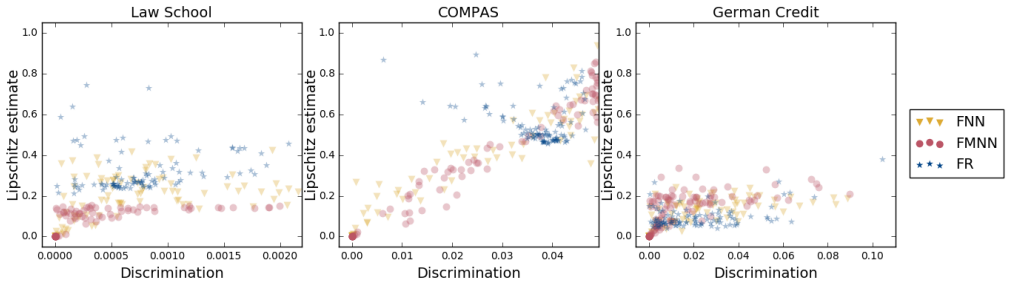
- Monotonicity acts as a regularizer, and in settings where the true outcome is monotone the fitted functions also have smaller estimated Lipschitz constants.
- The same construction handles monotone non-increasing attributes by negating the constrained first-layer weights, so attributes such as loan amount or repayment duration can be declared undesirable and still produce a monotonically fair classifier.
Reading between the lines
- Because the zero-resentment guarantee is relative to declared orderings, the practical guarantee only holds if the analyst's 'better' directions match the true outcome relationship; a wrong direction enforces the opposite of score fairness, so deployments should validate orderings against data before trusting the guarantee.
- A clean testable extension would audit resentment non-parametrically: on a held-out set, count pairs where one candidate dominates another on all declared monotone attributes but receives a lower score; the monotone model should yield zero such inversions, while unconstrained fair models will often yield many.
- The same monotone-architecture idea could be combined with outcome-based monotonicity, ranking by expected outcome rather than declared inputs, which might satisfy both score-resentment and meritocratic-fairness intuitions when input orderings are disputed.
- The paper's test-set-based resentment measure underestimates true score resentment in high-dimensional spaces because few observed individuals are comparable on all attributes; a full audit needs constructed counterfactual pairs, not only observed peers.
Signed reviews
Editorial analysis
A structured set of objections, weighed in public.
Referee Report
Summary. The paper proposes a notion of 'monotonic fairness' for classification, defining two forms of individual resentment: class (protected attribute) resentment and score (non-protected attribute) resentment. It observes that a score function has zero individual resentment if it does not take the protected attribute as input and is monotone non-decreasing with respect to all non-protected attributes designated as ordered by value. The authors implement this via a feedforward neural network with positive-weight constraints on monotonic dimensions and a compound loss combining cross-entropy with a demographic-parity penalty. They compare this monotone network against a non-monotone fair network and Fair Representations on law school admissions, COMPAS, and German credit data, reporting accuracy-discrimination trade-offs, resentment levels, and Lipschitz constant estimates.
Significance. If taken as a design principle, the paper's core observation is sound and clean: monotonicity with respect to declared ordered attributes plus independence from protected attributes guarantees the two defined forms of resentment are zero by construction, and the demographic-parity penalty allows a trade-off with group fairness. The synthetic example in Figure 1 clearly illustrates the failure mode the authors target, and the paper provides a reproducible implementation. However, the theoretical content is largely definitional rather than a substantive theorem, and the empirical support is weakened by the absence of uncertainty quantification and by the circularity of measuring zero resentment in a model that has zero resentment by design. The unvalidated assumption about the correctness of user-specified monotone orderings is a further load-bearing limitation.
major comments (3)
- [Section 4, Section 5.1] The zero-resentment guarantee is conditional on the practitioner-specified monotone orderings of the non-protected attributes in X+. Section 5.1 sets the German credit directions 'intuitively' (for example, credit amount and loan length as non-increasing) with no data-driven or external validation. If a declared direction does not match the true relationship, or if the true relationship is non-monotonic, the constrained model is misspecified: it has zero resentment with respect to the declared ordering, but score resentment with respect to the value ordering that actually matters can persist. This concern is acknowledged in the Discussion ('Estimation of monotonic relationships'), but the experiments do not address it, so the empirical claims rest on an untested input assumption.
- [Section 5.3, Figure 4] The resentment metric for the monotone network is guaranteed to be zero by construction, as the authors state: 'the resentment of the monotonic neural network will always be zero by design.' Reporting zero resentment for FMNN is therefore circular validation, not empirical evidence. The paper should instead quantify the score resentment experienced by the non-monotone methods and report uncertainty (error bars, confidence intervals, or significance tests) across the 100 runs per model. Without such uncertainty quantification, the accuracy-discrimination trade-off plots in Figure 4 cannot support quantitative comparisons among the three methods.
- [Section 3, Section 5.3] The claim that the proposed method avoids both forms of resentment is definitional rather than an empirical finding. The paper should phrase this as a construction result and clarify that, since none of the compared models takes the protected attribute as an input, class resentment is zero for all three baselines by design; the only meaningful difference between the methods lies in score resentment. This framing would avoid overstating the empirical contribution while making the actual comparison sharper.
minor comments (5)
- [References] References [16] and [17] are duplicate entries for the same Dwork et al. paper; the duplicate should be removed and the citation numbering corrected.
- [Section 5.3, Figure 4] Although 100 runs per model are reported, no error bars, confidence intervals, or significance tests are shown; at minimum, the text should report the spread of the accuracy and discrimination values across runs.
- [Equation (2)] The index convention for the weights w_{\ell,k,i} should be defined explicitly before use (input unit i, hidden unit k, layer \ell), since the current notation is not introduced in the text.
- [Section 5.3.1] The sample-based Lipschitz estimator is acknowledged to be a downward-biased lower bound, but the paper should note that the degree of bias may vary across models and datasets, especially in high-dimensional settings such as German credit.
- [Section 5.2] The description of the Fair Representations baseline says 'actual data given a mixed membership vector to these prototypes,' but it is not stated whether the protected attribute is used as an input to the final prediction; this should be clarified since it affects the interpretation of class resentment.
Circularity Check
Zero-resentment claim is definitional: score resentment is defined as a monotonicity violation, so the monotone network's zero resentment is by construction; the accuracy/fairness trade-off remains an independent empirical result.
-
self definitional
[Section 3 (Definitions 1-3) and Section 5.3 (Results, Resentment metric)]
"We can ensure a score function has zero individual resentment by requiring that the function does not take the protected attribute as an input (guaranteeing zero protected attribute resentment) and is monotone non-decreasing w.r.t. all non-protected attributes in X+ (guaranteeing zero non-protected attribute resentment). ... However, the resentment of the monotonic neural network will always be zero by design."
Score resentment (Def. 2) is defined as a better-qualified individual receiving a lower score, and monotonic fairness (Def. 3) is defined as the absence of class and score resentment. The paper then asserts that ignoring A and being non-decreasing in X+ guarantees zero resentment, and the FMNN architecture enforces exactly that monotonicity via non-negative weight transformations. The Resentment metric in Section 5.3 counts individuals with a peer who has worse attributes but a higher prediction, so FMNN's zero value is entailed by the constraint before any data are seen. Reporting this zero as an experimental outcome is therefore a re-statement of the model's definition, not an empirical validation.
full rationale
Most of the paper is not circular: the fairness definitions are new, the architecture for monotone networks follows standard positive-weight constructions, and the experiments compare accuracy versus discrimination and Lipschitz smoothness against non-monotone baselines. There are no self-citations, no imported uniqueness theorems, and no fitted parameters renamed as predictions. The circular element is confined to the paper's core resentment guarantee: because score resentment is defined as a violation of monotonicity, any monotone function has zero score resentment by definition. The paper itself acknowledges this ('always be zero by design'). The German-credit monotone orderings being set 'intuitively' is an unvalidated assumption and a correctness risk, but it is not a circularity; the formal guarantee is conditional on that ordering. Overall, the central 'no resentment' result is a tautological consequence of the definitions, while the accuracy/fairness trade-off is independently demonstrated, so a score of 6 reflects partial circularity rather than complete reduction.
Assumptions & free parameters
free parameters (3)
- trade-off weight alpha =
sampled per run from Beta(0.5,0.5) across 100 runs
- monotonic weight transform tau =
offset exponential linear unit (elumod)
- network architecture =
4 hidden layers, 10 nodes, tanh activation
assumptions (3)
- standard math A feedforward neural network with nonnegative weights on all paths from X+ inputs to the output is monotone non-decreasing in those inputs.
- domain assumption The practitioner knows the correct direction of monotonicity for each attribute in X+.
- domain assumption The two resentment definitions capture the ethically relevant individual unfairness.
Cite this review
Pith. "Pith review of Avoiding Resentment Via Monotonic Fairness." pith.science (2026). https://pith.science/paper/QJ4A3XGH
@misc{pith2026190901251,
  author       = {Pith},
  title        = {Pith review of: Avoiding Resentment Via Monotonic Fairness},
  year         = {2026},
  howpublished = {\url{https://pith.science/paper/QJ4A3XGH}},
  note         = {Machine review of arXiv:1909.01251}
}
read the original abstract
Classifiers that achieve demographic balance by explicitly using protected attributes such as race or gender are often politically or culturally controversial due to their lack of individual fairness, i.e. individuals with similar qualifications will receive different outcomes. Individually and group fair decision criteria can produce counter-intuitive results, e.g. that the optimal constrained boundary may reject intuitively better candidates due to demographic imbalance in similar candidates. Both approaches can be seen as introducing individual resentment, where some individuals would have received a better outcome if they either belonged to a different demographic class and had the same qualifications, or if they remained in the same class but had objectively worse qualifications (e.g. lower test scores). We show that both forms of resentment can be avoided by using monotonically constrained machine learning models to create individually fair, demographically balanced classifiers.
Figures


Figures from the paper (6 more)




Forward citations
Cited by 1 Pith paper
-
MERIT: A Merchant Incentive Ranking Model for Hotel Search & Ranking
MERIT adds a monotonic merchant-quality tower and a stratified pairwise loss to a hotel ranking model, improving merchant quality scores by 3.02% in an online A/B test.
Reference graph
Works this paper leans on
-
[1]
A reductions approach to fair classification
Alekh Agarwal, Alina Beygelzimer, Miroslav Dud´ ık, John Langford, and Hanna Wallach. A reductions approach to fair classification. In International Conference on Machine Learning, 2018
work page 2018
-
[2]
Julia Angwin, Jeff Larson, Surya Mattu, and Lau- ren Kirchner. Machine bias: There’s software used across the country to predict future criminals, and it’s biased against blacks. ProPublica, 2016
work page 2016
-
[3]
Lipschitz properties for deep convolutional net- works
Radu Balan, Maneesh Singh, and Dongmian Zou. Lipschitz properties for deep convolutional net- works. Contemporary Mathematics , 706:129–151, 2018
work page 2018
-
[4]
Maria-Florina Balcan, Travis Dick, Ritesh Nooth- igattu, and Ariel D Procaccia. Envy-free classifica- tion. arXiv:1809.08700, 2018
work page Pith review arXiv 2018
-
[5]
A convex frame- work for fair regression
Richard Berk, Hoda Heidari, Shahin Jabbari, Matthew Joseph, Michael Kearns, Jamie Morgen- stern, Seth Neel, and Aaron Roth. A convex frame- work for fair regression. arXiv:1706.02409, 2017
arXiv 2017
-
[6]
Data decisions and theoretical implications when adversarially learning fair representations
Alex Beutel, Jilin Chen, Zhe Zhao, and Ed H Chi. Data decisions and theoretical implications when adversarially learning fair representations. arXiv:1707.00075, 2017
arXiv 2017
-
[7]
Antidiscriminatory algo- rithms
Stephanie Bornstein. Antidiscriminatory algo- rithms. Ala. L. Rev., 70:519, 2018
work page 2018
-
[8]
Semantics derived automatically from language corpora contain human-like biases
Aylin Caliskan, Joanna J Bryson, and Arvind Narayanan. Semantics derived automatically from language corpora contain human-like biases. Sci- ence, 356(6334):183–186, 2017
work page 2017
Show all 46 references
-
[9]
Monotonic classification: an overview on algorithms, performance measures and data sets
Jos´ e-Ram´ on Cano, Pedro Antonio Guti´ errez, Bar- tosz Krawczyk, Micha l Wo´ zniak, and Salvador Garc´ ıa. Monotonic classification: an overview on algorithms, performance measures and data sets. Neurocomputing, 2019
2019
-
[10]
Fast and accurate deep net- work learning by exponential linear units (elus)
Djork-Arn´ e Clevert, Thomas Unterthiner, and Sepp Hochreiter. Fast and accurate deep net- work learning by exponential linear units (elus). arXiv:1511.07289, 2015
2015 arXiv
-
[11]
Students for Fair Ad- missions, Inc
Massachusetts District Court. Students for Fair Ad- missions, Inc. v. President and Fellows of Harvard College et al. 28(1:2014cv14176):1331, 2014
2014
-
[12]
Regents of the University of Cali- fornia v
Supreme Court. Regents of the University of Cali- fornia v. Bakke. 438(No. 76-811):265, 1978
1978
-
[13]
Fisher v
Supreme Court. Fisher v. University of Texas at Austin. 133(No. 11-345):2411, 2013
2013
-
[14]
Fisher v
Supreme Court. Fisher v. University of Texas at Austin. 136(No. 14-981):2198, 2016
2016
-
[15]
Fairness through awareness
Cynthia Dwork, Moritz Hardt, Toniann Pitassi, Omer Reingold, and Richard Zemel. Fairness through awareness. In Innovations in Theoreti- cal Computer Science Conference , pages 214–226. ACM, 2012
2012
-
[17]
Decoupled classifiers for group-fair and efficient machine learning
Cynthia Dwork, Nicole Immorlica, Adam Tauman Kalai, and Max Leiserson. Decoupled classifiers for group-fair and efficient machine learning. In Conference on Fairness, Accountability and Trans- parency, pages 119–133, 2018
2018
-
[18]
Runaway feedback loops in predictive polic- ing
Danielle Ensign, Sorelle A Friedler, Scott Neville, Carlos Scheidegger, and Suresh Venkatasubrama- nian. Runaway feedback loops in predictive polic- ing. In Conference on Fairness, Accountability and Transparency, pages 160–171, 2018
2018
-
[19]
The nation’s report card: Trends in academic progress
National Center for Education Statistics (Ed). The nation’s report card: Trends in academic progress
-
[20]
Regularisation of neural networks by enforcing Lipschitz continuity
Henry Gouk, Eibe Frank, Bernhard Pfahringer, and Michael Cree. Regularisation of neural networks by enforcing Lipschitz continuity. arXiv:1804.04368, 2018
2018 arXiv
-
[21]
Equal- ity of opportunity in supervised learning
Moritz Hardt, Eric Price, and Nati Srebro. Equal- ity of opportunity in supervised learning. In Ad- vances in Neural Information Processing Systems , pages 3315–3323, 2016
2016
-
[22]
Fairness behind a veil of ig- norance: A welfare analysis for automated decision making
Hoda Heidari, Claudio Ferrari, Krishna Gummadi, and Andreas Krause. Fairness behind a veil of ig- norance: A welfare analysis for automated decision making. In Advances in Neural Information Pro- cessing Systems, pages 1265–1276, 2018
2018
-
[23]
Metric learning for individual fairness
Christina Ilvento. Metric learning for individual fairness. arXiv:1906.00250, 2019
1906 arXiv
-
[24]
Fair algorithms for infinite and contextual bandits
Matthew Joseph, Michael Kearns, Jamie Mor- genstern, Seth Neel, and Aaron Roth. Fair algorithms for infinite and contextual bandits. arXiv:1610.09559, 2016
2016 arXiv
-
[25]
Eliciting and enforcing subjective individual fairness
Christopher Jung, Michael Kearns, Seth Neel, Aaron Roth, Logan Stapleton, and Zhiwei Steven Wu. Eliciting and enforcing subjective individual fairness. arXiv:1905.10660, 2019. 12
1905 arXiv
-
[26]
Fairness-aware classifier with prejudice remover regularizer
Toshihiro Kamishima, Shotaro Akaho, Hideki Asoh, and Jun Sakuma. Fairness-aware classifier with prejudice remover regularizer. In Joint European Conference on Machine Learning and Knowledge Discovery in Databases , pages 35–50. Springer, 2012
2012
-
[27]
Fairness-aware learning through regu- larization approach
Toshihiro Kamishima, Shotaro Akaho, and Jun Sakuma. Fairness-aware learning through regu- larization approach. In International Conference on Data Mining Workshops , pages 643–650. IEEE, 2011
2011
-
[28]
Meritocratic fairness for cross-population se- lection
Michael Kearns, Aaron Roth, and Zhiwei Steven Wu. Meritocratic fairness for cross-population se- lection. In International Conference on Machine Learning-Volume 70, pages 1828–1836, 2017
2017
-
[29]
How we analyzed the COMPAS recidi- vism algorithm
Jeff Larson, Surya Mattu, Lauren Kirchner, and Ju- lia Angwin. How we analyzed the COMPAS recidi- vism algorithm. ProPublica (5 2016), 9, 2016
2016
-
[30]
UCI machine learning repository, 2013
M Lichman. UCI machine learning repository, 2013
2013
-
[31]
Does mitigating ml’s impact dis- parity require treatment disparity? In S
Zachary Lipton, Julian McAuley, and Alexandra Chouldechova. Does mitigating ml’s impact dis- parity require treatment disparity? In S. Bengio, H. Wallach, H. Larochelle, K. Grauman, N. Cesa- Bianchi, and R. Garnett, editors, Advances in Neu- ral Information Processing Systems ...
-
[32]
Bias mitigation post- processing for individual and group fairness
Pranay K Lohia, Karthikeyan Natesan Rama- murthy, Manish Bhide, Diptikalyan Saha, Kush R Varshney, and Ruchir Puri. Bias mitigation post- processing for individual and group fairness. In ICASSP 2019-2019 IEEE International Confer- ence on Acoustics, Speech and Signal Processin...
2019
-
[33]
The variational fair autoencoder
Christos Louizos, Kevin Swersky, Yujia Li, Max Welling, and Richard Zemel. The variational fair autoencoder. In International Conference on Learn- ing Representations, 2016
2016
-
[34]
To predict and serve? Significance, 13(5):14–19, 2016
Kristian Lum and William Isaac. To predict and serve? Significance, 13(5):14–19, 2016
2016
-
[35]
Learning adversarially fair and transferable representations
David Madras, Elliot Creager, Toniann Pitassi, and Richard Zemel. Learning adversarially fair and transferable representations. In International Con- ference on Machine Learning, 2018
2018
-
[36]
Commission on Civil Rights
U.S. Commission on Civil Rights. Public education funding equity: In an era of increasing concentra- tion of poverty and resegregation, 2018
2018
-
[37]
Monotonic networks
Joseph Sill. Monotonic networks. In Advances in Neural Information Processing Systems, pages 661– 667, 1998
1998
-
[38]
Intriguing properties of neural networks
Christian Szegedy, Wojciech Zaremba, Ilya Sutskever, Joan Bruna, Dumitru Erhan, Ian Goodfellow, and Rob Fergus. Intriguing properties of neural networks. In International Conference on Learning Representations, 2014
2014
-
[39]
The role of the A* grade at A level as a predictor of univer- sity performance in the United Kingdom
Carmen Vidal Rodeiro and Nadir Zanini. The role of the A* grade at A level as a predictor of univer- sity performance in the United Kingdom. Oxford Review of Education, 41(5):647–670, 2015
2015
-
[40]
LSAC na- tional longitudinal bar passage study
Linda F Wightman and Henry Ramsey. LSAC na- tional longitudinal bar passage study . Law School Admission Council, 1998
1998
-
[41]
Estimation of the lips- chitz constant of a function
GR Wood and BP Zhang. Estimation of the lips- chitz constant of a function. Journal of Global Op- timization, 8(1):91–103, 1996
1996
-
[42]
Fairgan: Fairness-aware generative adversarial networks
Depeng Xu, Shuhan Yuan, Lu Zhang, and Xintao Wu. Fairgan: Fairness-aware generative adversarial networks. In IEEE International Conference on Big Data (Big Data) , pages 570–575. IEEE, 2018
2018
-
[43]
From parity to preference-based notions of fairness in classification
Muhammad Bilal Zafar, Isabel Valera, Manuel Ro- driguez, Krishna Gummadi, and Adrian Weller. From parity to preference-based notions of fairness in classification. In Advances in Neural Information Processing Systems, pages 229–239, 2017
2017
-
[44]
Fairness constraints: Mechanisms for fair classification
Muhammad Bilal Zafar, Isabel Valera, Manuel Gomez Rodriguez, and Krishna P Gummadi. Fairness constraints: Mechanisms for fair classification. In Artificial Intelligence and Statistics, 2017
2017
-
[45]
Learning fair representations
Rich Zemel, Yu Wu, Kevin Swersky, Toni Pitassi, and Cynthia Dwork. Learning fair representations. In International Conference on Machine Learning , pages 325–333, 2013
2013
-
[46]
Recurjac: An efficient recursive algorithm for bounding jacobian matrix of neural networks and its applications
Huan Zhang, Pengchuan Zhang, and Cho-Jui Hsieh. Recurjac: An efficient recursive algorithm for bounding jacobian matrix of neural networks and its applications. In Proceedings of the AAAI Con- ference on Artificial Intelligence , volume 33, pages 5757–5764, 2019. 13 Supplement In...
2019
-
[8135]
Curran Associates, Inc., 2018
2018
Reviewed August 14, 2026 · model on record in the stance chip above.
Discussion (0). Continue with ORCID to comment.