REVIEW 2 major objections 5 minor 42 references
Full- and low-rank exponential midpoint schemes for forward and adjoint Lindblad equations
T0 review · 2 major / 5 minor · reviewed 2026-08-07 · deepseek-v4-flash
Pith's one-line read Full- and low-rank exponential midpoint schemes solve forward and adjoint Lindblad equations to second-order accuracy in trace norm while preserving positivity and, after normalization, unit trace.
desk verdict A clean, useful numerical analysis paper with solid full-rank results and a low-rank analysis that hinges on an unverified exponential approximation bound. read the letter →
The pith
A machine-rendered reading of the paper's core claim, the machinery that carries it, and where it could break.
The reading
What carries the argument
The schemes rest on a reformulation of the Lindblad equation as $\dot\rho = A(t)\rho+\rho A^\dagger(t)+\sum_k\gamma_k L_k\rho L_k^\dagger$, where $A$ is non-Hermitian; the variation-of-constants formula turns one step into matrix exponentials applied from both sides, with quadrature of the dissipative integral. The low-rank machinery replaces $\rho_n$ with $X_nX_n^\dagger$ and compresses columns by truncated SVD $T_{\epsilon_1}$, while the matrix exponentials acting on vectors are approximated with tolerance $\epsilon_2$; this is what makes the low-rank error bound depend on both tolerances.
What would settle it
Compute, for a dissipative example with non-normal $A$ and for a specific approximate exponential (e.g. truncated Taylor series or Krylov subspace), the quotient $\sup_{\sigma\ne0}\|\tilde e^{\mu\tau A}\sigma\tilde e^{\mu\tau A^\dagger}-e^{\mu\tau A}\sigma e^{\mu\tau A^\dagger}\|_1/\|\sigma\|_1$. If this quotient is not bounded by $C_e\epsilon_2$, or if the LREM global error in trace norm fails to follow $c_1\tau^2+c_2\delta+c_3\epsilon_1+c_4\epsilon_2$ when $\epsilon_1,\epsilon_2$ are scaled proportionally to $\tau^2$, the low-rank convergence theorem's premise is violated.
Extended reading notes
Core claim
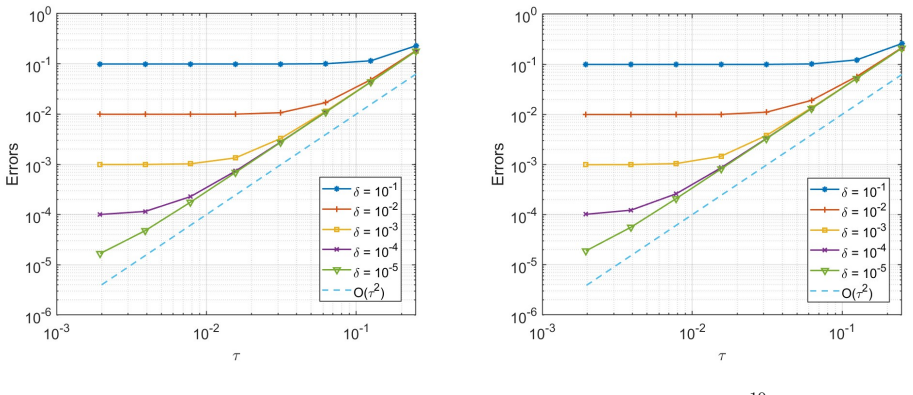
The central claim is that the FREM schemes (3.7) and (3.11), obtained by exponentiating $A=-iH-\frac12\sum_k\gamma_k L_k^\dagger L_k$ and evaluating the dissipative terms at midpoint quadrature, are second-order accurate in trace norm for both forward and backward Lindblad dynamics, and that the normalized versions (3.12) preserve positivity and unit trace unconditionally. For the low-rank schemes (3.15) and (3.18), which propagate Cholesky-like factors and apply truncated SVD, the paper proves error bounds of the form $c_1\tau^2+c_2\delta+c_3\epsilon_1+c_4\epsilon_2$, where $\delta$ is the initial low-rank error and $\epsilon_1,\epsilon_2$ are the compression and matrix-exponential tolerances, provided the matrix-exponential approximation obeys a uniform trace-norm error bound. Numerical experiments with the X–X Ising-chain model confirm these convergence rates and the positivity/trace preservation in practice.
Load-bearing premise
The low-rank error bounds rely on the assumption that the approximate matrix exponential used in the scheme always has an error proportional to its tolerance, for every density-matrix-like input, and the paper does not verify this property for any particular exponential routine.
Editorial extensions
If this is right
- FREM can serve as a structure-preserving forward-backward pair in optimize-then-discretize optimal control loops; the adjoint solve has the same order and stability.
- The normalized schemes guarantee trace-correct density matrices at every step, removing the need for post-hoc correction.
- For low-rank schemes, the error bound tells a user how to set tolerances: choosing $\epsilon_1,\epsilon_2=O(\tau^2)$ keeps full second order, while larger tolerances introduce controlled additive errors.
- The LREM scheme reduces storage from $m\times m$ to $m\times r$ with $r\ll m$, making high-dimensional open-system simulations feasible at controlled accuracy.
Reading between the lines
- The uniform trace-norm assumption on the matrix exponential is likely satisfied by scaling-and-squaring algorithms whose error is controlled in norm, but for Krylov subspace methods the bound may not hold for arbitrary Hermitian $\sigma$; a practical implementation should verify it or adapt the tolerance.
- The same midpoint-in-time construction could be extended to non-uniform grids or to time-dependent Lindblad operators, since the proof only uses local Lipschitz and quadrature consistency.
- In an optimal-control setting, the ability to solve forward and adjoint equations with the same code and the same structural guarantees should translate into reliable gradient computations; testing GRAPE or Krotov with FREM/LREM is a natural next step that the paper leaves for the future.
- The low-rank error bound suggests a tuning strategy: choose $\epsilon_1,\epsilon_2$ proportional to $\tau^2$ to balance the three terms, matching the paper's experimental choice $\epsilon_1=\tau^3$.
Editorial analysis
A structured set of objections, weighed in public.
Referee Report
Summary. The paper develops full-rank (FREM) and low-rank (LREM) exponential midpoint integrators for the forward and adjoint Lindblad equations with time-dependent Hamiltonian and jump operators. The FREM schemes (3.7), (3.11) preserve positivity unconditionally, and after normalization (3.12) also preserve unit trace. The LREM schemes (3.15), (3.18) preserve both positivity and trace by construction. The paper proves second-order trace-norm convergence for the FREM schemes (Theorems 4.5 and 5.6) and, under assumptions on column compression and approximate matrix exponentials, for the LREM schemes (Theorems 4.7 and 5.8). Numerical experiments on an Ising-type model validate the orders and compare efficiency with a QuTiP solver.
Significance. The FREM analysis is solid and genuinely useful: it provides the first second-order, structure-preserving exponential integrators for both forward and adjoint Lindblad equations with time-dependent coefficients, and the proofs are self-contained up to two norm inequalities imported from the authors' previous work. The LREM scheme addresses a real scalability bottleneck for open-quantum optimal control, and the convergence analysis is a worthwhile first step. However, the LREM convergence theorems depend on a uniform trace-norm error bound for approximate matrix exponentials that is neither proved nor shown to hold for any concrete algorithm, and the numerical experiments never exercise the approximate-exponential regime because they use machine-precision expm. This gap is load-bearing for the claimed efficiency of the low-rank method, so the manuscript needs revision before its central low-rank claim is fully supported.
major comments (2)
- [§4.2, Lemma 4.6 (and §5.2, Lemma 5.7)] The proofs of Theorems 4.7 and 5.8 assume a uniform trace-norm bound of the form ∥e^{μτA}σe^{μτA†} − \tilde e^{μτA}σ\tilde e^{μτA†}∥₁ ≤ C_e ε₂ ∥σ∥₁ for all Hermitian σ, all μ ∈ {0.5,1}, and all time steps. This is a state-independent, uniform-in-time bound on the full superoperator sandwich, which is much stronger than the column-wise or initial-vector-dependent error estimates typically available for Krylov subspace or exponential-action algorithms. The paper does not identify any concrete matrix-exponential algorithm that provably satisfies this bound, nor does it give a numerical verification of the bound for a practical approximate solver. Since this assumption is the sole carrier of the ε₂ term in the LREM error estimate, the second-order convergence claim for LREM with approximate exponentials is conditional and lacks support for cheap algorithms.
- [§6, numerical experiments] The numerical experiments do not validate the approximate-exponential regime of the LREM schemes. The text states that the matrix exponential codes from scipy are used with default machine-precision tolerance, so ε₂ is effectively on the order of 10⁻¹⁶ and the ε₂ terms in Theorems 4.7 and 5.8 are never exercised. Figure 6.5 reports results for varying ε₂, but the manuscript never explains how an approximate exponential with a controlled ε₂ is generated, so the reader cannot check whether the assumed uniform bound holds in those tests. The central efficiency motivation for LREM—avoiding costly full matrix exponentials—therefore rests on an assumption that is neither proven nor numerically tested.
minor comments (5)
- [§4.2, Theorem 4.7 proof] The proof text refers to the error-split components as being 'in (3.11)' twice; the correct reference is to equation (4.11). This cross-reference typo should be fixed.
- [§4.2, Lemma 4.6 and §5.2, Lemma 5.7] In the statement of the assumed matrix-exponential bound, the tilde over the second exponential is missing in the typeset formula, so the inequality as written compares the exact exponential with itself and is trivially zero. Add the tilde to the approximate exponentials in both lemmas.
- [§5.2, Theorem 5.8 proof] The expression 'ˇc3ϵ1 ˇ+c4ϵ2' near the end of the proof contains a misplaced plus sign; it should read 'ˇc3ϵ1 + ˇc4ϵ2'.
- [§5.2, after (5.17)] The word 'yeilds' should be spelled 'yields'.
- [§6, LREM experiments] The experiments do not report the evolution of the column ranks r_n during the LREM runs; reporting the actual ranks would strengthen the efficiency claim and help the reader assess the practical performance of the truncation strategy.
Circularity Check
No significant circularity; the FREM and LREM derivations are self-contained or explicitly conditional on stated approximation tolerances, and the only self-citations are standard, non-load-bearing norm inequalities.
full rationale
The derivation chain is self-contained and non-circular. The FREM schemes are obtained directly from variation-of-constants representations (3.5)-(3.6) with quadrature approximations, and their error bounds (Theorems 4.4-4.5 and 5.5-5.6) follow from standard consistency/stability arguments using exact exponentials; no fitted parameter is later called a prediction. The LREM analysis is conditional in a transparent way: Lemma 4.6 and Lemma 5.7 explicitly assume a uniform trace-norm error bound for the approximate matrix exponential, and Theorems 4.7 and 5.8 propagate that assumed tolerance epsilon_2 together with the SVD tolerance epsilon_1 and initial-rank error delta into the final bound. This is a perturbation estimate, not a circular derivation, because the assumption does not contain the convergence conclusion and the tolerances are inputs, not outputs. The only self-citations, Lemmas 4.1 and 5.1 from the authors' prior preprint [10], are standard contractivity inequalities for Lindblad-type evolutions; they are parameter-free, do not assume the target convergence results, and could be derived from the dissipative structure of A(s), so under the review rules they are independent support and do not raise the circularity score. The numerical experiments run the matrix exponential at machine precision, so the practical regime of a cheap approximate exponential for LREM is not exercised; this is a validation gap, not circularity.
Assumptions & free parameters
assumptions (6)
- domain assumption The Lindblad generator has the standard GKSL form with H = H†, arbitrary jump operators L_k, and γ_k ≥ 0 (Section 2, eq. (2.1)).
- domain assumption Initial and terminal states ρ0 and Q are Hermitian, positive semidefinite, with unit trace (stated after Lemma 2.1).
- domain assumption Sufficient smoothness of H, γ_k, L_k, ρ, q and their first and second derivatives (used in consistency bounds, eqs. (4.3) and (5.6)).
- standard math Norm bound of Lemma 4.1, imported from prior work [10].
- standard math Trace-norm inequality of Lemma 5.1, imported from prior work [10].
- ad hoc to paper Matrix exponential approximation bound assumed in Lemmas 4.6 and 5.7.
Cite this review
Pith. "Pith review of Full- and low-rank exponential midpoint schemes for forward and adjoint Lindblad equations." pith.science (2026). https://pith.science/paper/QJAMH7OR
@misc{pith2026250600346,
  author       = {Pith},
  title        = {Pith review of: Full- and low-rank exponential midpoint schemes for forward and adjoint Lindblad equations},
  year         = {2026},
  howpublished = {\url{https://pith.science/paper/QJAMH7OR}},
  note         = {Machine review of arXiv:2506.00346}
}
read the original abstract
The Lindblad equation is a widely used quantum master equation to model the dynamical evolution of open quantum systems whose states are described by density matrices. This equation is also a fundamental building block to design optimal control functions. In this paper we develop full- and low-rank exponential midpoint integrators for solving both the forward and adjoint Lindblad equations. These schemes are applicable to optimize-then-discretize approaches for optimal control of open quantum systems. We show that the proposed schemes preserve positivity and trace unconditionally. Furthermore, convergence of these numerical schemes is proved theoretically and verified numerically.
Figures


Figures from the paper (5 more)


Reference graph
Works this paper leans on
-
[1]
M. Abdelhafez, D. I. Schuster, and J. Koch. Gradient-based optimal control of open quantum systems using quantum trajectories and automatic differentiation.Phys. Rev. A, 99:052327, May 2019
work page 2019
-
[2]
D. Appel¨ o and Y. Cheng. Kraus is king: High-order completely positive and trace preserving (CPTP) low rank method for the Lindblad master equation.Journal of Computational Physics, 534:114036, 2025
work page 2025
-
[3]
B. Bid´ egaray, A. Bourgeade, and D. Reignier. Introducing physical relaxation terms in Bloch equations.Journal of Computational Physics, 170(2):603–613, 2001
work page 2001
-
[4]
A. Borz ` ı, G. Ciaramella, and M. Sprengel.Formulation and Numerical Solution of Quantum Control Problems. Society for Industrial and Applied Mathematics, Philadelphia, PA, 2017
work page 2017
-
[5]
A. Bourgeade and O. Saut. Numerical methods for the bidimensional Maxwell-Bloch equations in nonlinear crystals.Journal of Computational Physics, 213(2):823–843, 2006
work page 2006
- [6]
-
[7]
H.-P. Breuer and F. Petruccione.The Theory of Open Quantum Systems. Oxford University Press, 2007
work page 2007
- [8]
Show all 42 references
-
[9]
Cao and J
Y. Cao and J. Lu. Structure-preserving numerical schemes for Lindblad equations.Journal of Scientific Computing, 102:27, 2025
2025
-
[10]
H. Chen, A. Borz ` ı, D. Jankovi´ c, J.-G. Hartmann, and P.-A. Hervieux. Full- and low-rank expo- nential euler integrators for the lindblad equation, 2024
2024
-
[11]
D’ Alessandro.Introduction to Quantum Control and Dynamics
D. D’ Alessandro.Introduction to Quantum Control and Dynamics. Chapman and Hall/CRC, 2008
2008
-
[12]
Davies.Quantum Theory of Open Systems
E. Davies.Quantum Theory of Open Systems. Academic Press, 1976. 30
1976
-
[13]
de Fouquieres, S
P. de Fouquieres, S. Schirmer, S. Glaser, and I. Kuprov. Second order gradient ascent pulse engineering.Journal of Magnetic Resonance, 212(2):412–417, 2011
2011
-
[14]
Doria, T
P. Doria, T. Calarco, and S. Montangero. Optimal control technique for many-body quantum dynamics.Phys. Rev. Lett., 106:190501, May 2011
2011
-
[15]
D. J. Egger and F. K. Wilhelm. Optimal control of a quantum measurement.Phys. Rev. A, 90:052331, Nov 2014
2014
-
[16]
Goerz, D
M. Goerz, D. Reich, and C. Koch. Optimal control theory for a unitary operation under dissipative evolution.New Journal of Physics, 16(5):055012, may 2014
2014
-
[17]
Gollub, M
C. Gollub, M. Kowalewski, and R. de Vivie-Riedle. Monotonic convergent optimal control theory with strict limitations on the spectrum of optimized laser fields.Phys. Rev. Lett., 101:073002, Aug 2008
2008
-
[18]
Gorini, A
V. Gorini, A. Kossakowski, and E. Sudarshan. Completely positive dynamical semigroups of N-level systems.Journal of Mathematical Physics, 17(5):821–825, 05 1976
1976
-
[19]
Johansson, P
J. Johansson, P. Nation, and F. Nori. Qutip 2: A Python framework for the dynamics of open quantum systems.Computer Physics Communications, 184(4):1234–1240, 2013
2013
-
[20]
Khaneja, R
N. Khaneja, R. Brockett, and S. J. Glaser. Time optimal control in spin systems.Phys. Rev. A, 63:032308, Feb 2001
2001
-
[21]
Khaneja, T
N. Khaneja, T. Reiss, C. Kehlet, T. Schulte-Herbr¨ uggen, and S. J. Glaser. Optimal control of coupled spin dynamics: design of nmr pulse sequences by gradient ascent algorithms.Journal of Magnetic Resonance, 172(2):296–305, 2005
2005
-
[22]
Krotov.Global Methods in Optimal Control Theory
V. Krotov.Global Methods in Optimal Control Theory. CRC Press, 1995
1995
-
[23]
Le Bris and P
C. Le Bris and P. Rouchon. Low-rank numerical approximations for high-dimensional Lindblad equations.Phys. Rev. A, 87:022125, Feb 2013
2013
-
[24]
Le Bris, P
C. Le Bris, P. Rouchon, and J. Roussel. Adaptive low-rank approximation and denoised Monte Carlo approach for high-dimensional Lindblad equations.Phys. Rev. A, 92:062126, Dec 2015
2015
-
[25]
Lindblad
G. Lindblad. On the generators of quantum dynamical semigroups.Communications in Mathe- matical Physics, 48(2):119–130, 1976
1976
-
[26]
Machnes, U
S. Machnes, U. Sander, S. J. Glaser, P. de Fouqui` eres, A. Gruslys, S. Schirmer, and T. Schulte- Herbr¨ uggen. Comparing, optimizing, and benchmarking quantum-control algorithms in a unifying programming framework.Phys. Rev. A, 84:022305, Aug 2011
2011
-
[27]
Maday and G
Y. Maday and G. Turinici. New formulations of monotonically convergent quantum control algorithms.The Journal of Chemical Physics, 118(18):8191–8196, 05 2003
2003
-
[28]
Ohtsuki, G
Y. Ohtsuki, G. Turinici, and H. Rabitz. Generalized monotonically convergent algorithms for solving quantum optimal control problems.The Journal of Chemical Physics, 120(12):5509–5517, 03 2004. 31
2004
-
[29]
Palao and R
J. Palao and R. Kosloff. Quantum computing by an optimal control algorithm for unitary trans- formations.Phys. Rev. Lett., 89:188301, Oct 2002
2002
-
[30]
Pechen and H
A. Pechen and H. Rabitz. Teaching the environment to control quantum systems.Phys. Rev. A, 73:062102, Jun 2006
2006
-
[31]
N. Rach, M. M. M¨ uller, T. Calarco, and S. Montangero. Dressing the chopped-random-basis optimization: A bandwidth-limited access to the trap-free landscape.Phys. Rev. A, 92:062343, Dec 2015
2015
-
[32]
D. M. Reich, M. Ndong, and C. P. Koch. Monotonically convergent optimization in quantum control using krotov’s method.The Journal of Chemical Physics, 136(10):104103, 03 2012
2012
-
[33]
Riesch and C
M. Riesch and C. Jirauschek. Analyzing the positivity preservation of numerical methods for the Liouville-von Neumann equation.Journal of Computational Physics, 390:290–296, 2019
2019
-
[34]
Riesch, A
M. Riesch, A. Pikl, and C. Jirauschek. Completely positive trace preserving methods for the Lindblad equation. In2020 International Conference on Numerical Simulation of Optoelectronic Devices (NUSOD), pages 109–110, 2020
2020
-
[35]
Schlimgen, K
A. Schlimgen, K. Head-Marsden, L. Sager, P. Narang, and D. Mazziotti. Quantum simulation of the Lindblad equation using a unitary decomposition of operators.Phys. Rev. Res., 4:023216, Jun 2022
2022
-
[36]
Schulte-Herbr¨ uggen, A
T. Schulte-Herbr¨ uggen, A. Sp¨ orl, N. Khaneja, and S. J. Glaser. Optimal control-based efficient synthesis of building blocks of quantum algorithms: A perspective from network complexity towards time complexity.Phys. Rev. A, 72:042331, Oct 2005
2005
-
[37]
Schulte-Herbr¨ uggen, A
T. Schulte-Herbr¨ uggen, A. Sporl, N. Khaneja, and S. Glaser. Optimal control for generating quantum gates in open dissipative systems.Journal of Physics B: Atomic, Molecular and Optical Physics, 44(15):154013, jul 2011
2011
-
[38]
Tˇ osner, T
Z. Tˇ osner, T. Vosegaard, C. Kehlet, N. Khaneja, S. J. Glaser, and N. Nielsen. Optimal control in nmr spectroscopy: Numerical implementation in simpson.Journal of Magnetic Resonance, 197(2):120–134, 2009
2009
-
[39]
Wenin and W
M. Wenin and W. P¨ otz. State-independent control theory for weakly dissipative quantum systems. Phys. Rev. A, 78:012358, Jul 2008
2008
-
[40]
Wiseman and G
H. Wiseman and G. Milburn.Quantum Measurement and Control. Cambridge University Press, 2009
2009
-
[41]
W. Zhu, J. Botina, and H. Rabitz. Rapidly convergent iteration methods for quantum optimal control of population.The Journal of Chemical Physics, 108(5):1953–1963, 02 1998
1953
-
[42]
Ziolkowski, J
R. Ziolkowski, J. Arnold, and D. Gogny. Ultrafast pulse interactions with two-level atoms.Phys. Rev. A, 52:3082–3094, Oct 1995. 32
1995
Reviewed August 7, 2026 · model on record in the stance chip above.
Discussion (0). Sign in to comment.