REVIEW 4 major objections 6 minor 47 references
Structured Pruning for Diverse Best-of-N Reasoning Optimization
T0 review · 4 major / 6 minor · reviewed 2026-08-07 · deepseek-v4-flash
Pith's one-line read Selectively pruning attention heads in a transformer can improve, not just shrink, a language model's mathematical reasoning, and the paper proposes a contrastive method to choose which head to prune for each question.
desk verdict A new contrastive head-selection mechanism with a solid motivating study, but the main Pass@N claim is not yet supported because the evaluation never isolates the learned selector. read the letter →
The pith
A machine-rendered reading of the paper's core claim, the machinery that carries it, and where it could break.
The reading
What carries the argument
The carrying object is the set of learnable head embeddings $v_j$ for every head-layer pair, aligned with question embeddings $q_i = \theta(\varphi(x_i))$ through a contrastive loss with a diversity regularizer. The first loss term is a softmax over negative squared Euclidean distances $\lVert q_i - v_j\rVert_2^2$, which pulls each question toward heads whose pruning solves it; the second term $\lambda \sum_{j<k} s_{jk} \lVert v_j - v_k\rVert_2^2$, weighted by the training-set agreement score $s_{jk}$, pushes similar heads apart. At inference, the selector simply takes the head (or top-N heads) closest to the question embedding and prunes them before greedy decoding. This makes pruning choices cheap and input-dependent.
What would settle it
Give a held-out set of math questions and record, for each question, the accuracy of the single best pruned head. Then compare the Pass@1 of SPRINT's selected head against the distribution of randomly chosen heads on those questions; if the selected head is not reliably better than a random head, or if a fixed head chosen once on the training set matches its performance, the alignment is doing no work.
Extended reading notes
Core claim
The paper's central claim is that a single-head pruning choice is a per-question decision, not a global one, and that a contrastive embedding can learn to make it. For each training question, the method records which heads, when pruned, yield a correct answer; it then optimizes head embeddings and a linear projection of a sentence embedding so that the question embedding sits close to those beneficial heads, while a diversity term spreads apart heads with similar correctness patterns. At test time, pruning the top-N nearest heads produces several answers from structurally different model variants. The paper asserts that this approach consistently outperforms multinomial sampling at temperatures 0.1, 0.6, and 0.9 and beats random head selection across both datasets.
Load-bearing premise
The load-bearing premise is that the contrastive embeddings learned from 1,500 training questions generalize, so a new question's embedding lands near heads whose pruning will actually help that question; if that alignment fails, the selector is no better than random head choice.
Editorial extensions
If this is right
- A single base model yields a diverse pool of candidate generators by pruning different heads, so best-of-N diversity does not require sampling temperature or multiple models.
- The gains concentrate at $N \in \{1,2,3,4\}$, where ordinary multinomial sampling supplies the least diversity, indicating pruning adds a kind of diversity temperature cannot.
- Because the selector is a lookup over learned embeddings, applying it at inference adds negligible overhead relative to generating the candidates.
- If the alignment generalizes, the same recipe applies to any reasoning dataset where head-level correctness can be measured on training questions.
Reading between the lines
- Editorial inference: an extension the paper does not pursue is combining pruned candidates with a verifier or reward model, since the pruned variants are cheaply generated and a second-stage scorer could select among them without extra forward passes.
- Editorial inference: a testable extension is pruning sets of heads instead of one head at a time; single-head gains are small per question, and multiple simultaneous removals might create larger, more useful diversity.
- Editorial inference: the unspecified sentence encoder is a variable worth isolating, because the method's transfer on out-of-domain questions would reveal whether the learned alignment is about question content or only about dataset-specific patterns.
Editorial analysis
A structured set of objections, weighed in public.
Referee Report
Summary. This paper investigates whether selectively pruning individual attention heads in a transformer LM can improve mathematical reasoning. It reports that for several Qwen and Llama models, pruning certain heads raises per-category accuracy on MATH500. It then proposes SPRINT, a contrastive framework that learns embeddings for head-layer pairs and, at test time, selects the top-N nearest heads to a question embedding to generate N pruned-model candidates. Experiments on MATH500 and GSM8K with Qwen2.5-Math-1.5B-Instruct report Pass@N curves comparing SPRINT with multinomial sampling at three temperatures and a random head selection baseline. The authors claim SPRINT significantly outperforms these baselines at low N.
Significance. The core idea—using pruning to create diverse reasoning candidates and selecting the head per question via contrastive embeddings—is interesting and, if validated, could offer a lightweight way to improve best-of-N reasoning without model retraining. The paper also documents a potentially surprising phenomenon that head pruning can improve accuracy. However, the current evidence is not strong enough: the main experimental claim lacks statistical support, the baselines do not isolate the contribution of the learned selector, and the motivating phenomenon is vulnerable to post hoc selection artifacts. The method itself is described at a high level but lacks implementation details needed for reproduction.
major comments (4)
- [Section 5.1, Figure 4] The claim that SPRINT 'significantly outperforms' multinomial sampling and random head selection is not supported by any statistical analysis. The Pass@N curves in Figure 4 are single-point estimates with no error bars, confidence intervals, or significance tests. With 500 and 1,319 test questions, differences of a few percentage points are within the range of sampling noise; the authors should report bootstrap confidence intervals or repeated-seed results and apply a paired test (e.g., McNemar's test on question-level correctness) to support the headline claim.
- [Section 5 (Baselines) and Section 4] The experimental design does not isolate the contribution of the learned per-question head selection. The only pruning-aware baseline is described as 'we use a greedy approach to identify the heads that solve the most samples in the training set. During testing, we randomly select N heads.' This is ambiguous: if the greedy step selects a small set of training-accurate heads and random selection is within that set, the baseline is a fixed-best-heads-plus-random-diversity method; if selection is over all heads, it may include catastrophic heads. Neither variant controls for the diversity effect of using N different pruned heads. The paper should add a fixed-best-heads baseline (e.g., the N heads with the highest training-set accuracy, used for all test questions) and an oracle per-question upper bound, and should directly report the top-1/top-N head retrieval accuracy of the learned embeddings on held-out questions. Without these, the Pass@N gains cannot be attributed to the contrastive alignment.
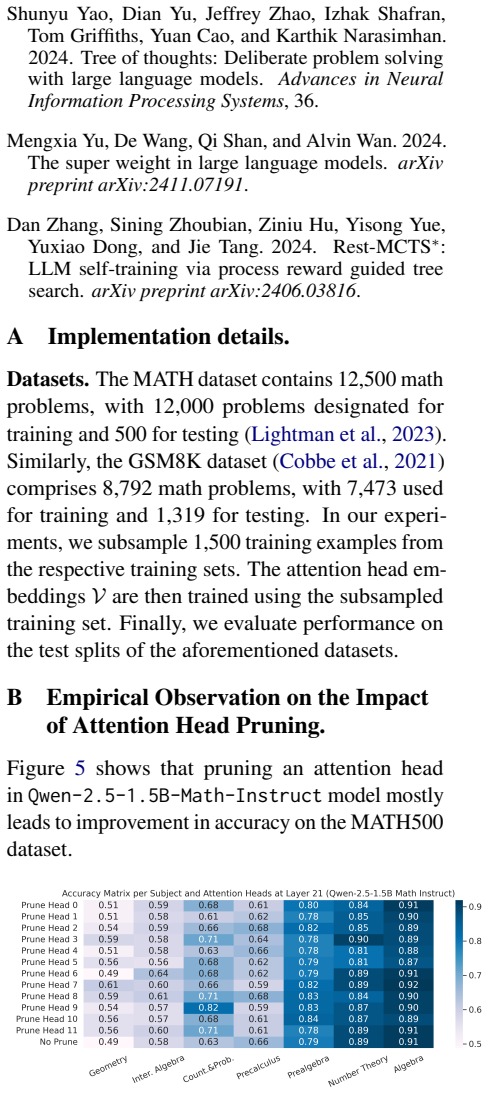
- [Section 3.2] The motivating observation that 'pruning certain heads leads to improvements' is based on the best pruned head per category (violin plots of additive gains in Figure 2 and Tables 1–4). Because the maximum is taken over many head-layer pairs (e.g., 48 for Qwen2.5-Math-1.5B in Table 2) and category sample sizes in MATH500 are small (often 30–100 questions per category), positive maximum gains are expected under pure noise even if no head truly improves accuracy. A multiple-comparison correction or a permutation test against the no-prune baseline is needed before the phenomenon is treated as established.
- [Section 4, Eq. (1) and Appendix A] The description of SPRINT is not reproducible. The sentence embedding model φ is never identified (Figure 3 hints at Sentence-BERT, but no model name or dimension p is given), the dimension and initialization of head embeddings V are not specified, and the training procedure (optimizer, learning rate, number of epochs, batch size, and the value of λ) is entirely absent. Without these details, the joint optimization in Eq. (1) cannot be reimplemented or compared with future work.
minor comments (6)
- [Section 3.1 vs. Section 5] Section 3.1 states that L=4 layers are selected (first layer, layers 5 and 15, and the last layer), while Section 5 uses five layers {5, 10, 15, 20, 25}; the paper should clarify which configuration applies to the main experiments and why the motivating analysis uses different layers.
- [References] The reference list contains a suspicious placeholder-style entry (John Doe, Jane Smith, and Alan Turing, 2023) and a duplicate entry for Li et al. 2024a/2023; the authors should verify and clean the bibliography.
- [Abstract] The abstract uses 'best-of-$N$' with math mode while the rest of the paper uses 'best-of-N'; please make the notation consistent.
- [Tables 1–4] The per-category tables do not report category sample sizes, which makes it hard to judge the reliability of the reported differences; adding the number of questions per category would improve interpretability.
- [Section 4, Figure 2] The sentence 'In this experiment 1, we study...' contains a stray footnote marker, and the y-axis label of Figure 2 repeats the subtitle; both should be cleaned up.
- [Section 5] The statement that SPRINT works 'without introducing inference-time overhead' should be made precise: generating N candidates from N pruned models still requires N forward passes, just like multinomial best-of-N, so the intended meaning is presumably that no additional reward model or retraining is needed.
Circularity Check
No significant circularity: SPRINT is a standard supervised selector trained on a separate split and evaluated on held-out benchmarks.
full rationale
SPRINT's contrastive selector is trained on 1,500 subsampled training questions with per-head correctness labels (Appendix A), and its Pass@N is measured on the held-out MATH500/GSM8K test splits. The loss in Eq. (1) is a standard supervised alignment objective, not an identity or a fitted parameter renamed as a prediction; the nearest-head choice at inference is the trained predictor's output. The claim of outperforming multinomial sampling and random head selection is an empirical comparison, not a consequence of how the method is defined. The Section 3 phenomenon is identified by maximizing per-category gains on MATH500, and the base model and pruning layers are selected using those gains; this is a test-set-selection concern rather than a circular step, because the final numbers still require the learned embeddings to transfer to unseen questions. Self-citations (Nguyen et al. 2025a-c, Jiang et al. 2025) appear only in related work and are not load-bearing. No step in the derivation reduces to its own inputs.
Assumptions & free parameters
free parameters (4)
- Diversity weight lambda =
not reported
- Layer set for pruning =
layers {5, 10, 15, 20, 25} in Section 5
- Sentence embedding model and dimension p =
not reported (Figure 3 suggests Sentence-BERT)
- Number of training examples subsampled =
1500
assumptions (4)
- domain assumption Zeroing a head's output before oproj is a valid pruning operation that preserves model functionality for generation.
- ad hoc to paper The sentence embedding model phi captures question features that correlate with which heads are beneficial to prune.
- domain assumption Binary exact-match correctness on the training questions is a sufficient label for learning beneficial prune configurations.
- ad hoc to paper The selected layers {5, 10, 15, 20, 25} contain all or most heads whose pruning improves answers to the test questions.
Cite this review
Pith. "Pith review of Structured Pruning for Diverse Best-of-N Reasoning Optimization." pith.science (2026). https://pith.science/paper/QJS4RCYK
@misc{pith2026250603978,
  author       = {Pith},
  title        = {Pith review of: Structured Pruning for Diverse Best-of-N Reasoning Optimization},
  year         = {2026},
  howpublished = {\url{https://pith.science/paper/QJS4RCYK}},
  note         = {Machine review of arXiv:2506.03978}
}
abstract
Model pruning in transformer-based language models, traditionally viewed as a means of achieving computational savings, can enhance the model's reasoning capabilities. In this work, we uncover a surprising phenomenon: the selective pruning of certain attention heads leads to improvements in reasoning performance, particularly on challenging tasks. Motivated by this observation, we propose SPRINT, a novel contrastive learning framework that dynamically selects the optimal head and layer to prune during inference. By aligning question embeddings with head embeddings, SPRINT identifies those pruned-head configurations that result in more accurate reasoning. Extensive experiments demonstrate that our method significantly outperforms traditional best-of-$N$ and random head selection strategies on the MATH500 and GSM8K datasets.
Figures


Figures from the paper (2 more)

Reference graph
Works this paper leans on
-
[1]
online" 'onlinestring :=
ENTRY address archivePrefix author booktitle chapter edition editor eid eprint eprinttype howpublished institution journal key month note number organization pages publisher school series title type volume year doi pubmed url lastchecked label extra.label sort.label short.list INTEGERS output.state before.all mid.sentence after.sentence after.block STRING...
-
[2]
write newline
" write newline "" before.all 'output.state := FUNCTION n.dashify 't := "" t empty not t #1 #1 substring "-" = t #1 #2 substring "--" = not "--" * t #2 global.max substring 't := t #1 #1 substring "-" = "-" * t #2 global.max substring 't := while if t #1 #1 substring * t #2 global.max substring 't := if while FUNCTION word.in bbl.in capitalize " " * FUNCT...
-
[3]
Josh Achiam, Steven Adler, Sandhini Agarwal, Lama Ahmad, Ilge Akkaya, Florencia Leoni Aleman, Diogo Almeida, Janko Altenschmidt, Sam Altman, Shyamal Anadkat, and 1 others. 2023. Gpt-4 technical report. arXiv preprint arXiv:2303.08774
arXiv 2023
-
[4]
Janice Ahn, Rishu Verma, Renze Lou, Di Liu, Rui Zhang, and Wenpeng Yin. 2024. Large language models for mathematical reasoning: Progresses and challenges. arXiv preprint arXiv:2402.00157
arXiv 2024
-
[5]
AI@Meta. 2024. https://github.com/meta-llama/llama3/blob/main/MODEL_CARD.md Llama 3 model card
2024
-
[6]
Edward Beeching, Lewis Tunstall, and Sasha Rush. 2024. https://huggingface.co/spaces/HuggingFaceH4/blogpost-scaling-test-time-compute Scaling test-time compute with open models
work page 2024
-
[7]
Zhenni Bi, Kai Han, Chuanjian Liu, Yehui Tang, and Yunhe Wang. 2024. Forest-of-thought: Scaling test-time compute for enhancing LLM reasoning. arXiv preprint arXiv:2412.09078
arXiv 2024
-
[8]
Brown, Benjamin Mann, Nick Ryder, Melanie Subbiah, Jared D
Tom B. Brown, Benjamin Mann, Nick Ryder, Melanie Subbiah, Jared D. Kaplan, Prafulla Dhariwal, Arvind Neelakantan, Pranav Shyam, Girish Sastry, Amanda Askell, and 1 others. 2020. Language models are few-shot learners. Advances in Neural Information Processing Systems, 33:1877--1901
work page 2020
Show all 47 references
-
[9]
Ngoc Bui, Hieu Trung Nguyen, Shantanu Kumar, Julian Theodore, Weikang Qiu, Viet Anh Nguyen, and Rex Ying. 2025. Mixture-of-personas language models for population simulation. arXiv preprint arXiv:2504.05019
2025 arXiv
-
[10]
Aakanksha Chowdhery, Sharan Narang, Jacob Devlin, Maarten Bosma, Gaurav Mishra, Adam Roberts, Paul Barham, Hyung Won Chung, Charles Sutton, Sebastian Gehrmann, and 1 others. 2022. Palm: Scaling language modeling with pathways. arXiv preprint arXiv:2204.02311
2022 arXiv
-
[11]
Karl Cobbe, Vineet Kosaraju, Mohammad Bavarian, Mark Chen, Heewoo Jun, Lukasz Kaiser, Matthias Plappert, Jerry Tworek, Jacob Hilton, Reiichiro Nakano, Christopher Hesse, and John Schulman. 2021. Training verifiers to solve math word problems. arXiv preprint arXiv:2110.14168
2021 arXiv
-
[12]
Mehul Damani, Idan Shenfeld, Andi Peng, Andreea Bobu, and Jacob Andreas. 2024. Learning how hard to think: Input-adaptive allocation of LM computation. arXiv preprint arXiv:2410.04707
2024 arXiv
-
[13]
John Doe, Jane Smith, and Alan Turing. 2023. https://doi.org/10.1109/AICONF.2023.10560644 Natural language processing in virtual assistants: Current approaches and challenges . In Proceedings of the IEEE Conference on Artificial Intelligence, pages 122--128. IEEE
2023
-
[14]
Xidong Feng, Ziyu Wan, Muning Wen, Stephen Marcus McAleer, Ying Wen, Weinan Zhang, and Jun Wang. 2023. Alphazero-like tree-search can guide large language model decoding and training. arXiv preprint arXiv:2309.17179
2023 arXiv
-
[15]
Maria Garcia, Li Wei, and Ahmed El-Sayed. 2023. https://doi.org/10.3390/electronics12143170 Ethical challenges in the development of virtual assistants powered by large language models . Electronics, 12(14):3170
2023 doi
-
[16]
Xinyu Guan, Li Lyna Zhang, Yifei Liu, Ning Shang, Youran Sun, Yi Zhu, Fan Yang, and Mao Yang. 2025. rStar-Math : Small LLMs can master math reasoning with self-evolved deep thinking. arXiv preprint arXiv:2501.04519
2025 arXiv
-
[17]
Dan Hendrycks, Collin Burns, Saurav Kadavath, Akul Arora, Steven Basart, Eric Tang, Dawn Song, and Jacob Steinhardt. 2021. Measuring mathematical problem solving with the math dataset. Advances in Neural Information Processing Systems
2021
-
[18]
Jordan Hoffmann, Sebastian Borgeaud, Arthur Mensch, Elena Buchatskaya, Trevor Cai, Eliza Rutherford, Diego de Las Casas, Lisa Anne Hendricks, Johannes Welbl, Aidan Clark, and 1 others. 2022. Training compute-optimal large language models. arXiv preprint arXiv:2203.15556
2022 arXiv
-
[19]
Shima Imani, Liang Du, and Harsh Shrivastava. 2023. Mathprompter: Mathematical reasoning using large language models. arXiv preprint arXiv:2303.05398
2023 arXiv
-
[20]
Ziwei Ji, Nayeon Lee, Rita Frieske, Tiezheng Yu, Dan Su, Yan Xu, Etsuko Ishii, Ye Jin Bang, Andrea Madotto, and Pascale Fung. 2023. Survey of hallucination in natural language generation. ACM Computing Surveys, 55(12):1--38
2023
-
[21]
Chonghe Jiang, Bao Nguyen, Anthony Man-Cho So, and Viet Anh Nguyen. 2025. Probe-free low-rank activation intervention. arXiv preprint arXiv:2502.04043
2025 arXiv
-
[22]
Aitor Lewkowycz, Anders Andreassen, David Dohan, Ethan Dyer, Henryk Michalewski, Vinay Ramasesh, Ambrose Slone, Cem Anil, Imanol Schlag, Theo Gutman-Solo, and 1 others. 2022. Solving quantitative reasoning problems with language models. Advances in Neural Information Processin...
2022
-
[23]
Junyi Li, Tianyi Tang, Wayne Xin Zhao, Jian-Yun Nie, and Ji-Rong Wen. 2024 a . Pre-trained language models for text generation: A survey. ACM Computing Surveys, 56(9):1--39
2024
-
[24]
Kenneth Li, Oam Patel, Fernanda Vi \'e gas, Hanspeter Pfister, and Martin Wattenberg. 2023. Inference-time intervention: Eliciting truthful answers from a language model. Advances in Neural Information Processing Systems, 36:41451--41530
2023
-
[25]
Kenneth Li, Oam Patel, Fernanda Vi \'e gas, Hanspeter Pfister, and Martin Wattenberg. 2024 b . Inference-time intervention: Eliciting truthful answers from a language model. Advances in Neural Information Processing Systems, 36
2024
-
[26]
Hunter Lightman, Vineet Kosaraju, Yura Burda, Harri Edwards, Bowen Baker, Teddy Lee, Jan Leike, John Schulman, Ilya Sutskever, and Karl Cobbe. 2023. Let's verify step by step. arXiv preprint arXiv:2305.20050
2023 arXiv
-
[27]
Sheng Liu, Haotian Ye, Lei Xing, and James Zou. 2023 a . In-context vectors: Making in context learning more effective and controllable through latent space steering. arXiv preprint arXiv:2311.06668
2023 arXiv
-
[28]
Yiheng Liu, Tianle Han, Siyuan Ma, Jiayue Zhang, Yuanyuan Yang, Jiaming Tian, Hao He, Antong Li, Mengshen He, Zhengliang Liu, and 1 others. 2023 b . Summary of chatgpt-related research and perspective towards the future of large language models. Meta-Radiology, page 100017
2023
-
[29]
Xinyin Ma, Gongfan Fang, and Xinchao Wang. 2023. Llm-pruner: On the structural pruning of large language models. Advances in neural information processing systems, 36:21702--21720
2023
-
[30]
Bao Nguyen, Binh Nguyen, Duy Nguyen, and Viet Anh Nguyen. 2025 a . Risk-aware distributional intervention policies for language models. arXiv preprint arXiv:2501.15758
2025
-
[31]
Duy Nguyen, Archiki Prasad, Elias Stengel-Eskin, and Mohit Bansal. 2025 b . Multi-attribute steering of language models via targeted intervention. arXiv preprint arXiv:2502.12446
2025 arXiv
-
[32]
Hieu Trung Nguyen, Bao Nguyen, Binh Nguyen, and Viet Anh Nguyen. 2025 c . https://aclanthology.org/2025.naacl-short.43/ Task-driven layerwise additive activation intervention . In Proceedings of the 2025 Conference of the Nations of the Americas Chapter of the Association for ...
2025
-
[33]
Rae, Sebastian Borgeaud, Trevor Cai, Katie Millican, Jordan Hoffmann, Francis Song, John Aslanides, Sarah Henderson, Roman Ring, Susannah Young, and 1 others
Jack W. Rae, Sebastian Borgeaud, Trevor Cai, Katie Millican, Jordan Hoffmann, Francis Song, John Aslanides, Sarah Henderson, Roman Ring, Susannah Young, and 1 others. 2021. Scaling language models: Methods, analysis & insights from training gopher. arXiv preprint arXiv:2112.11446
2021 arXiv
-
[34]
Colin Raffel, Noam Shazeer, Adam Roberts, Katherine Lee, Sharan Narang, Michael Matena, Yanqi Zhou, Wei Li, and Peter J. Liu. 2019. Exploring the limits of transfer learning with a unified text-to-text transformer. arXiv preprint arXiv:1910.10683
2019 arXiv
-
[35]
Bernardino Romera-Paredes, Mohammadamin Barekatain, Alexander Novikov, Matej Balog, M Pawan Kumar, Emilien Dupont, Francisco JR Ruiz, Jordan S Ellenberg, Pengming Wang, Omar Fawzi, and 1 others. 2024. Mathematical discoveries from program search with large language models. Nat...
2024
-
[36]
Emre Sezgin. 2024. https://doi.org/10.2196/53225 Redefining virtual assistants in health care: The future with large language models . Journal of Medical Internet Research, 26:e53225
2024 doi
-
[37]
Nisan Stiennon, Long Ouyang, Jeffrey Wu, Daniel Ziegler, Ryan Lowe, Chelsea Voss, Alec Radford, Dario Amodei, and Paul F Christiano. 2020. Learning to summarize with human feedback. Advances in Neural Information Processing Systems, 33:3008--3021
2020
-
[38]
Trieu H Trinh, Yuhuai Wu, Quoc V Le, He He, and Thang Luong. 2024. Solving olympiad geometry without human demonstrations. Nature, 625(7995):476--482
2024
-
[39]
Xuezhi Wang, Jason Wei, Dale Schuurmans, Quoc Le, Ed Chi, Sharan Narang, Aakanksha Chowdhery, and Denny Zhou. 2022. Self-consistency improves chain of thought reasoning in language models. arXiv preprint arXiv:2203.11171
2022 arXiv
-
[40]
Ziheng Wang, Jeremy Wohlwend, and Tao Lei. 2019. Structured pruning of large language models. arXiv preprint arXiv:1910.04732
2019 arXiv
-
[41]
Yuhuai Wu, Albert Qiaochu Jiang, Wenda Li, Markus Rabe, Charles Staats, Mateja Jamnik, and Christian Szegedy. 2022. Autoformalization with large language models. Advances in Neural Information Processing Systems, 35:32353--32368
2022
-
[42]
Zhengxuan Wu, Atticus Geiger, Aryaman Arora, Jing Huang, Zheng Wang, Noah D Goodman, Christopher D Manning, and Christopher Potts. 2024. pyvene: A library for understanding and improving pytorch models via interventions. arXiv preprint arXiv:2403.07809
2024 arXiv
-
[43]
Yuxi Xie, Anirudh Goyal, Wenyue Zheng, Min-Yen Kan, Timothy P Lillicrap, Kenji Kawaguchi, and Michael Shieh. 2024. Monte C arlo tree search boosts reasoning via iterative preference learning. In The First Workshop on System-2 Reasoning at Scale, NeurIPS'24
2024
-
[44]
Ziwei Xu, Sanjay Jain, and Mohan Kankanhalli. 2024. Hallucination is inevitable: An innate limitation of large language models. arXiv preprint arXiv:2401.11817
2024 arXiv
-
[45]
Shunyu Yao, Dian Yu, Jeffrey Zhao, Izhak Shafran, Tom Griffiths, Yuan Cao, and Karthik Narasimhan. 2024. Tree of thoughts: Deliberate problem solving with large language models. Advances in Neural Information Processing Systems, 36
2024
-
[46]
Mengxia Yu, De Wang, Qi Shan, and Alvin Wan. 2024. The super weight in large language models. arXiv preprint arXiv:2411.07191
2024 arXiv
-
[47]
Dan Zhang, Sining Zhoubian, Ziniu Hu, Yisong Yue, Yuxiao Dong, and Jie Tang. 2024. Rest- MCTS ^* : LLM self-training via process reward guided tree search. arXiv preprint arXiv:2406.03816
2024 arXiv
Reviewed August 7, 2026 · model on record in the stance chip above.
Discussion (0). Sign in to comment.