Domain Adaptation Under Wireless Network Constraints: When Does It Become Green?
Pith reviewed 2026-06-26 06:38 UTC · model grok-4.3
The pith
Unsupervised domain adaptation becomes more energy-efficient than retraining after a minimum number of target domains once labeling costs are included.
A machine-rendered reading of the paper's core claim, the machinery that carries it, and where it could break.
Core claim
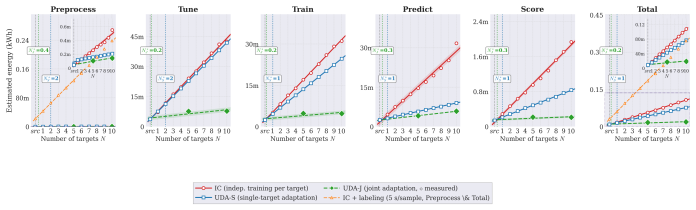
By modeling the energy consumption of UDA pipelines against single-task training while factoring in labeling costs, one can compute the smallest number of target domains for which UDA is the lower-energy choice under wireless network constraints.
What carries the argument
A break-even calculation that weighs the energy overhead of UDA modules against the labeling energy avoided across multiple shifted domains.
If this is right
- For any fixed labeling cost and wireless setting, the method gives a numerical cutoff beyond which adaptation is preferred.
- Added UDA modules can still yield net energy savings once labeling effort across several domains is counted.
- Wireless constraints on transmission and computation must be folded into the comparison to obtain the correct threshold.
Where Pith is reading between the lines
- The same threshold logic could be applied to other constrained environments such as edge devices where labeling is costly.
- Hardware-specific power traces would allow tighter bounds on the minimum domain count than analytic models alone.
- The approach invites similar break-even studies for semi-supervised or federated variants of adaptation.
Load-bearing premise
Energy consumption of UDA pipelines and retraining including labeling can be accurately modeled and directly compared under wireless network constraints.
What would settle it
A real-world wireless deployment measurement showing that actual energy use deviates enough from the model to change which strategy is cheaper at the predicted domain count.
Figures

read the original abstract
The deployment of data-driven models in 6G wireless networks is increasingly challenged by frequent distribution shifts that degrade performance over time. Unsupervised Domain Adaptation (UDA) offers an alternative approach by adapting the trained model to a shifted domain without requiring labels. However, UDA pipelines are often more complex than single-task training due to additional modules and optimization procedures, raising a practical question: do the benefits of adaptation come at a higher energy cost, and how does this trade-off compare to retraining when labeling effort is also considered? In this work, we investigate the energy consumption of UDA and compare it to single task. We further propose a way to determine the minimum number of target domains for which UDA becomes more energy-efficient than retraining, taking into account the labeling cost. Our results aim to clarify when UDA should be preferred over classical train-from-scratch approaches from an energy and labeling-aware perspective.
Editorial analysis
A structured set of objections, weighed in public.
Referee Report
Summary. The paper investigates energy consumption of Unsupervised Domain Adaptation (UDA) pipelines versus single-task retraining in 6G wireless networks subject to distribution shifts. It proposes a method to compute the minimum number of target domains at which UDA becomes more energy-efficient than retraining, incorporating labeling costs under wireless constraints.
Significance. If a sound, non-circular derivation of the threshold were provided, the work could supply a practical, quantitative criterion for energy-aware deployment decisions in wireless networks, potentially guiding when adaptation is preferable to retraining on combined energy-plus-labeling grounds.
major comments (1)
- [Abstract] Abstract: The manuscript states the intent to 'investigate the energy consumption of UDA and compare it to single task' and to 'propose a way to determine the minimum number of target domains' but supplies no equations, modeling assumptions, derivation steps, or results. This absence makes the central claim unevaluable and load-bearing for any recommendation.
Simulated Author's Rebuttal
We thank the referee for the review and the opportunity to respond. The concern raised focuses on the abstract's lack of technical detail. We address this below and propose a targeted revision to the abstract while clarifying that the full manuscript contains the requested elements.
read point-by-point responses
-
Referee: [Abstract] Abstract: The manuscript states the intent to 'investigate the energy consumption of UDA and compare it to single task' and to 'propose a way to determine the minimum number of target domains' but supplies no equations, modeling assumptions, derivation steps, or results. This absence makes the central claim unevaluable and load-bearing for any recommendation.
Authors: We agree that the abstract, by design, is a concise overview and does not contain equations or derivations. The full manuscript supplies these in Section 3 (energy models under wireless constraints), Section 4 (derivation of the threshold number of target domains incorporating labeling costs), and Section 5 (results). The derivation is non-circular, relying on explicit energy functions for UDA pipelines versus retraining plus labeling. To improve evaluability from the abstract alone, we will revise it to include a brief statement of the key threshold formula and main modeling assumptions (e.g., distribution shift frequency and wireless transmission costs). revision: yes
Circularity Check
No significant circularity detected
full rationale
The paper's central contribution is a proposal for computing the minimum number of target domains at which UDA becomes preferable to retraining on combined energy and labeling grounds under wireless constraints. The abstract and available description contain no equations, fitted parameters, self-citations, or derivation steps that reduce any claimed result to its own inputs by construction. No load-bearing assumptions or uniqueness claims are visible that would trigger the enumerated circularity patterns. The work is therefore self-contained as a modeling proposal without identifiable internal circularity.
Axiom & Free-Parameter Ledger
Reference graph
Works this paper leans on
-
[1]
Pattern Recognition , volume=
Comparative study on classifying human activities with miniature inertial and magnetic sensors , author=. Pattern Recognition , volume=. 2010 , publisher=
2010
-
[2]
, author=
A public domain dataset for human activity recognition using smartphones. , author=. ESANN , volume=
-
[3]
Proceedings of the 13th ACM conference on embedded networked sensor systems , pages=
Smart devices are different: Assessing and mitigatingmobile sensing heterogeneities for activity recognition , author=. Proceedings of the 13th ACM conference on embedded networked sensor systems , pages=
-
[4]
PHM Society European Conference , volume=
Condition monitoring of bearing damage in electromechanical drive systems by using motor current signals of electric motors: A benchmark data set for data-driven classification , author=. PHM Society European Conference , volume=
-
[5]
ACM SigKDD Explorations Newsletter , volume=
Activity recognition using cell phone accelerometers , author=. ACM SigKDD Explorations Newsletter , volume=. 2011 , publisher=
2011
-
[6]
Machine Learning , volume=
A theory of learning from different domains , author=. Machine Learning , volume=. 2010 , publisher=
2010
-
[7]
Benoit Courty and Victor Schmidt and Sasha Luccioni and Goyal-Kamal and Marion Coutarel and Boris Feld and Jérémy Lecourt and Liam Connell and Amine Saboni and Inimaz and supatomic and Mathilde Léval and Luis Blanche and Alexis Cruveiller and ouminasara and Franklin Zhao and Aditya Joshi and Alexis Bogroff and Hugues de Lavoreille and Niko Laskaris and Ed...
-
[8]
2014 14th UK Workshop on Computational Intelligence (UKCI) , pages=
Adaptive learning with covariate shift-detection for non-stationary environments , author=. 2014 14th UK Workshop on Computational Intelligence (UKCI) , pages=. 2014 , organization=
2014
-
[9]
2025 , month = nov, url =
Ericsson Mobility Report , institution =. 2025 , month = nov, url =
2025
-
[10]
Ericsson Technology Review , year =
When. Ericsson Technology Review , year =
-
[11]
2020 , url =
Towards 6G: Evolving mobile networks for new services and capabilities , institution =. 2020 , url =
2020
-
[12]
IEEE Transactions on Cognitive Communications and Networking , volume=
An introduction to deep learning for the physical layer , author=. IEEE Transactions on Cognitive Communications and Networking , volume=. 2017 , publisher=
2017
-
[13]
IEEE Transactions on Signal Processing , volume=
Learning to optimize: Training deep neural networks for interference management , author=. IEEE Transactions on Signal Processing , volume=. 2018 , publisher=
2018
-
[14]
IEEE Wireless Communications Letters , volume=
Semi-supervised ML-based joint channel estimation and decoding for m-MIMO with Gaussian inference learning , author=. IEEE Wireless Communications Letters , volume=. 2023 , publisher=
2023
-
[15]
ICC 2019-2019 IEEE International Conference on Communications (ICC) , pages=
Semi-supervised deep learning-based methods for indoor outdoor detection , author=. ICC 2019-2019 IEEE International Conference on Communications (ICC) , pages=. 2019 , organization=
2019
-
[16]
arXiv preprint arXiv:2108.00874 , year=
Few-shot domain adaptation for end-to-end communication , author=. arXiv preprint arXiv:2108.00874 , year=
-
[17]
arXiv preprint arXiv:2511.21668 , year=
Through the telecom lens: Are all training samples important? , author=. arXiv preprint arXiv:2511.21668 , year=
-
[18]
Proceedings of the Eighteenth ACM International Symposium on Mobile Ad Hoc Networking and Computing , pages=
Optimizing information freshness in wireless networks under general interference constraints , author=. Proceedings of the Eighteenth ACM International Symposium on Mobile Ad Hoc Networking and Computing , pages=
-
[19]
2025 , month = feb, type =
Sustainable AI in Telecom: Promises and Challenges in 6G , institution =. 2025 , month = feb, type =
2025
-
[20]
Advances in Neural Information Processing Systems , volume=
On-device training under 256kb memory , author=. Advances in Neural Information Processing Systems , volume=
-
[21]
Discover Computing , volume=
A comprehensive review of lightweight deep learning models for edge computing with future directions , author=. Discover Computing , volume=. 2026 , publisher=
2026
-
[22]
IEEE Journal on selected areas in communications , volume=
A survey of energy-efficient techniques for 5G networks and challenges ahead , author=. IEEE Journal on selected areas in communications , volume=. 2016 , publisher=
2016
-
[23]
Telecommunications Policy , volume=
ICT sector electricity consumption and greenhouse gas emissions--2020 outcome , author=. Telecommunications Policy , volume=. 2024 , publisher=
2020
-
[24]
2023 , url =
Ericsson Sustainability and Corporate Responsibility Report , institution =. 2023 , url =
2023
-
[25]
IEEE Communications Magazine , volume=
Large language models for telecom: Forthcoming impact on the industry , author=. IEEE Communications Magazine , volume=. 2024 , publisher=
2024
-
[26]
, author=
Deep unsupervised domain adaptation for time series classification: a benchmark: HI Fawaz et al. , author=. Data Mining and Knowledge Discovery , volume=. 2025 , publisher=
2025
-
[27]
arXiv preprint arXiv:2007.03051 , year=
Carbontracker: Tracking and predicting the carbon footprint of training deep learning models , author=. arXiv preprint arXiv:2007.03051 , year=
-
[28]
Doklady mathematics , volume=
Eco2ai: carbon emissions tracking of machine learning models as the first step towards sustainable ai , author=. Doklady mathematics , volume=. 2022 , organization=
2022
-
[29]
Carbon Emissions and Large Neural Network Training
Carbon emissions and large neural network training , author=. arXiv preprint arXiv:2104.10350 , year=
work page internal anchor Pith review Pith/arXiv arXiv
-
[30]
Proceedings of the 57th annual meeting of the association for computational linguistics , pages=
Energy and policy considerations for deep learning in NLP , author=. Proceedings of the 57th annual meeting of the association for computational linguistics , pages=
-
[31]
Quantifying the Carbon Emissions of Machine Learning
Quantifying the carbon emissions of machine learning , author=. arXiv preprint arXiv:1910.09700 , year=
work page internal anchor Pith review Pith/arXiv arXiv 1910
-
[32]
Sustainable Computing: Informatics and Systems , volume=
Trends in AI inference energy consumption: Beyond the performance-vs-parameter laws of deep learning , author=. Sustainable Computing: Informatics and Systems , volume=. 2023 , publisher=
2023
-
[33]
Proceedings of machine learning and systems , volume=
Sustainable ai: Environmental implications, challenges and opportunities , author=. Proceedings of machine learning and systems , volume=
-
[34]
IEEE Communications Surveys & Tutorials , volume=
AI models for green communications towards 6G , author=. IEEE Communications Surveys & Tutorials , volume=. 2021 , publisher=
2021
discussion (0)
Sign in with ORCID, Apple, or X to comment. Anyone can read and Pith papers without signing in.