REVIEW 3 major objections 5 minor 1 cited by
Sparse multi-view reasoning is still near chance for current VLMs; grounding each thought step in visible boxes lifts performance and transfers to real data.
Reviewed by Pith at T0; open to challenge. T0 means a machine referee read the full paper against a public rubric. the ladder, T0–T4 →
T0 review · grok-4.5
2026-07-13 23:41 UTC pith:QLDFN4D7
load-bearing objection Solid systems paper: sparse multi-view is still near chance, grounded CoT helps and transfers on MCQ, but multi-hop still does not scale and MindCube is a soft real-world check. the 3 major comments →
VIEW2SPACE: Studying Multi-View Visual Reasoning from Sparse Observations
The pith
A machine-rendered reading of the paper's core claim, the machinery that carries it, and where it could break.
Core claim
Current vision-language models largely fail at sparse multi-view spatial reasoning on VIEW2SPACE, yet training with Grounded Chain-of-Thought with Visual Evidence produces large gains under moderate difficulty and transfers to real multi-view data, while high-hop compositional reasoning remains a structural limit even as data and model size grow.
What carries the argument
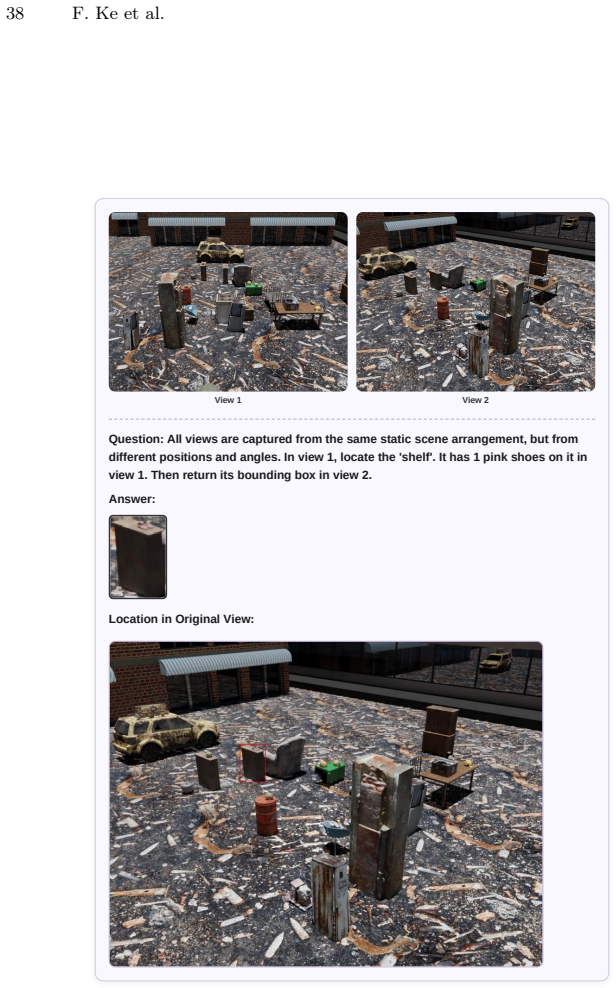
Grounded Chain-of-Thought with Visual Evidence: a training regime in which each intermediate reasoning step must cite the 2D bounding box of the relevant object in the relevant view, tying the language chain to engine-verified geometry instead of free-form text.
Load-bearing premise
That success on the simulated scenes and the reported transfer to real images measure genuine sparse multi-view reasoning rather than regularities specific to the physics engine and its curated assets.
What would settle it
Train the same Grounded CoT recipe on VIEW2SPACE, then evaluate on a real multi-view set that requires explicit localization of occluded or multi-hop targets (not only multiple-choice); if accuracy collapses to near chance while synthetic scores stay high, the transfer claim fails.
Editorial analysis
A structured set of objections, weighed in public.
Referee Report
Summary. The paper argues that sparse multi-view visual reasoning—integrating partial RGB observations across discrete, heterogeneous viewpoints—is largely unsolved for current VLMs, and that it can be studied at scale via a physically grounded Blender data engine. From this engine the authors release VIEW2SPACE (evaluation split VIEW2SPACE-v1 with MCQ/counting/detection under graded hop-based difficulty and visibility constraints) plus a disjoint 300K training split with deterministic geometry-derived supervision. Comprehensive evaluation (open MLLMs, spatial specialists, GPT family, random/frequency baselines, human upper bounds) shows most models near chance, especially under grounding. Supervised fine-tuning of Qwen3-VL-4B with Grounded Chain-of-Thought with Visual Evidence yields large gains on VIEW2SPACE (e.g., detection mIoU 69.34 vs 47.58 instruction-tuning) and zero-shot transfer to MindCube-Tiny (+9.24% absolute over official MindCube checkpoints). Difficulty-aware scaling (2B/4B, 1K–300K) indicates perceptual gains under sufficient visibility but poor scaling for deep multi-hop compositional reasoning.
Significance. If the results hold, this is a substantial systems and empirical contribution for multi-view spatial intelligence: a controllable PE-annotated multi-view engine, a multi-task sparse-view benchmark with stricter evidence constraints than prior MCQ-only multi-view sets, a clean geometry-derived grounded-CoT training recipe, and a difficulty-stratified scaling study that separates visibility-limited perception from compositional multi-hop failure. Strengths include deterministic non-LLM answer generation, held-out scenes, human upper bounds (Table 5), thinking vs direct ablations (Table 4), three SFT variants on the same 300K set (Table 1), and external MindCube evaluation (Table 2). These make the negative result (near-chance SOTA) and the moderate-difficulty training gains falsifiable and useful to the community, even if deep multi-view reasoning remains open.
major comments (3)
- [§5.2 / Table 2] The abstract, contributions list, and §5.2 frame MindCube zero-shot gains as evidence that VIEW2SPACE training teaches sparse multi-view spatial reasoning that transfers to real data. Table 2 reports +9.24% absolute over MindCube-Plain, but the paper itself states MindCube often encodes inter-view relations in language, uses limited human-centric viewpoints, simpler relations, and only MCQ (no grounding). VIEW2SPACE supervision is dense geometry-derived CoT with explicit 2D boxes (§3 Stage 4, Appendix G). Success on MindCube is therefore consistent with improved multi-image MCQ / language-mediated spatial priors rather than the harder capability the benchmark targets (cross-view geometric alignment under sparse heterogeneous RGB views with strict grounding). Either add a real multi-view grounding transfer evaluation, or substantially qualify the transfer claim so it does not underwrite t
- [§5.3 / Fig. 4 / Appendix D] Scaling conclusions in §5.3 and Fig. 4 rest on a hop-count + log2(N) difficulty proxy (§4.1, Appendix D) and isolation cuts (visibility <0.5 for reasoning curves; reasoning difficulty <6 for visibility curves). The paper acknowledges the metric is noisy (e.g., one-hop rotation vs one-hop relation). Because the central claim that “deep compositional reasoning … remains a fundamental challenge” while “geometric perception can benefit from scaling” is drawn from these stratified curves, the manuscript needs either (i) sensitivity analysis under alternative difficulty definitions, or (ii) clearer separation of metric-dependent vs metric-robust findings. Without that, the structural-limitation interpretation risks over-reading an approximate difficulty axis.
- [§4.1–4.2 / Table 1] VIEW2SPACE-v1 is deliberately skewed toward lower difficulty (§4.1–4.2: “relatively higher proportion of lower-difficulty cases”; 3,591 questions). Aggregate Table 1 numbers (including the large Grounded-CoT gains) therefore mix perceptual/low-hop success with multi-hop failure. The paper’s own scaling analysis shows diminishing returns as hop complexity rises. For the claim that training “substantially improves performance under moderate difficulty” while deep reasoning remains unsolved, report primary metrics stratified by reasoning and visibility difficulty for the SFT models in the main text (not only appendix dense plots), so readers cannot over-read overall mIoU/ACC as solving sparse multi-view reasoning.
minor comments (5)
- [Table 1] Table 1 “Ours (Grounded CoT, Direct Answer at Test)” shows a large drop vs full Grounded CoT; a short discussion of whether test-time visual-evidence emission is required for the gains would clarify deployment implications.
- [§3 / §4.1] Relation discretization uses |cos θ|<0.1 (ε=0.1) and F1 uses IoU>50%; state these thresholds once in the main evaluation section for reproducibility.
- [Appendix A / Table 3] Appendix Table 3 comparison is helpful; ensure venue/year labels and “Sparse/FFR/R-scale” columns are defined consistently with the main text claims about prior multi-view work (InternSpatial, MindCube).
- [Fig. 4] Several figure captions (e.g., Fig. 4, Fig. 11–12) refer to dense empirical dots “in the appendix”; if space allows, one main-text panel with raw points would aid inspection of fit quality.
- [Throughout] Minor wording/typos: “RoBobrain” vs “RoboBrain” inconsistency; “ho” labels in Fig. 3; occasional missing spaces in compound words in the compiled text.
Circularity Check
No circular derivation: engine-grounded supervision and held-out/external evaluation are independent of model outputs
full rationale
VIEW2SPACE is an empirical benchmark-and-training paper, not a first-principles derivation. QA answers, CoT traces, and visual-evidence boxes are produced deterministically from Blender geometry and ray-cast visibility (Stage 4 / §B.4 / §G), not fitted to any model’s predictions; the training signal is therefore not circular by construction. Evaluation uses a scene-disjoint VIEW2SPACE-v1 split and the external real-world MindCube benchmark without MindCube fine-tuning (Table 2). Difficulty labels (hop count + log N, visibility via ray casting) are diagnostic axes for scaling plots, not quantities that the model is claimed to “predict” after being fitted to them. There is no self-definitional loop, no fitted parameter re-labeled as a prediction, no load-bearing uniqueness theorem imported from the authors, and no ansatz smuggled via self-citation. Standard self-citations of prior VLMs/benchmarks are ordinary related-work references and do not force the central empirical claims. Concerns about synthetic shortcuts or whether MindCube MCQ transfer fully validates sparse multi-view grounding are validity/generalization issues, not circularity of the derivation chain.
Axiom & Free-Parameter Ledger
free parameters (4)
- SFT hyperparameters (LR 3e-5, 2 epochs, batch 2, grad accum 32, warmup 0.05)
- Visibility difficulty threshold ~0.7 and reasoning-difficulty isolation cutoffs (<0.5 visibility; <6 reasoning)
- Relation discretization epsilon |cos θ|<0.1 and IoU>0.5 F1 threshold
- VIEW2SPACE-v1 sampling (3,591 Qs balanced toward lower difficulty)
axioms (5)
- domain assumption Physically based Blender rendering with curated real-scale assets yields multi-view RGB+metadata that transfers to real sparse-view reasoning.
- ad hoc to paper Minimal hop count on per-view object–relation graphs plus log2(N) combinatorial term is a useful difficulty proxy.
- domain assumption Deterministic geometric rules produce correct QA and grounded CoT without generative label noise.
- domain assumption Full-parameter SFT of Qwen3-VL with explicit box evidence is a fair test of whether training can close the multi-view gap.
- standard math Standard accuracy/MAE/mIoU/F1 and random/frequency baselines are appropriate for MCQ/count/detection.
invented entities (2)
-
VIEW2SPACE data engine and benchmark (incl. OSD-Tag pipeline)
no independent evidence
-
Grounded Chain-of-Thought with Visual Evidence
no independent evidence
read the original abstract
Multi-view visual reasoning is essential for intelligent systems that must understand complex environments from sparse and discrete viewpoints, yet existing research has largely focused on single-image or temporally dense video settings. In real-world scenarios, reasoning across views requires integrating partial observations without explicit guidance, while collecting large-scale multi-view data with accurate geometric and semantic annotations remains challenging. To address this gap, we leverage physically grounded simulation to construct diverse, high-fidelity 3D scenes with precise per-view metadata, enabling scalable data generation that remains transferable to real-world settings. Based on this engine, we introduce VIEW2SPACE, a multi-dimensional benchmark for sparse multi-view reasoning, together with a scalable, disjoint training split supporting millions of grounded question-answer pairs. Using this benchmark, a comprehensive evaluation of state-of-the-art vision-language and spatial models reveals that multi-view reasoning remains largely unsolved, with most models performing only marginally above random guessing. We further investigate whether training can bridge this gap. Our proposed Grounded Chain-of-Thought with Visual Evidence substantially improves performance under moderate difficulty, and generalizes to real-world data, outperforming existing approaches in cross-dataset evaluation. We further conduct difficulty-aware scaling analyses across model size, data scale, reasoning depth, and visibility constraints, indicating that while geometric perception can benefit from scaling under sufficient visibility, deep compositional reasoning across sparse views remains a fundamental challenge.
Figures



Forward citations
Cited by 1 Pith paper
-
GlowGS: Generative Semantic Feature Learning for 3D Gaussian Splatting in Nighttime Glow Scenes
GlowGS improves 3D Gaussian Splatting in nighttime glow scenes via semantic feature generation from diffusion models and novel-view semantic learning with vision foundation models.
Reference graph
Works this paper leans on
-
[1]
arXiv preprint arXiv:2511.21631 (2025)
Bai, S., Cai, Y., Chen, R., Chen, K., Chen, X., Cheng, Z., Deng, L., Ding, W., Gao, C., Ge, C., Ge, W., Guo, Z., Huang, Q., Huang, J., Huang, F., Hui, B., Jiang, S., Li, Z., Li, M., Li, M., Li, K., Lin, Z., Lin, J., Liu, X., Liu, J., Liu, C., Liu, Y., Liu, D., Liu, S., Lu, D., Luo, R., Lv, C., Men, R., Meng, L., Ren, X., Ren, X., Song, S., Sun, Y., Tang, ...
Pith/arXiv arXiv 2025
-
[2]
Bai, S., Chen, K., Liu, X., Wang, J., Ge, W., Song, S., Dang, K., Wang, P., Wang, S., Tang, J., et al.: Qwen2. 5-vl technical report. arXiv preprint arXiv:2502.13923 (2025)
Pith/arXiv arXiv 2025
-
[3]
arXiv preprint arXiv:2511.07403 (2025)
Batra, H., Tu, H., Chen, H., Lin, Y., Xie, C., Clark, R.: Spatialthinker: Re- inforcing 3d reasoning in multimodal llms via spatial rewards. arXiv preprint arXiv:2511.07403 (2025)
Pith/arXiv arXiv 2025
-
[4]
In: Proceedings oftheIEEE/CVFConferenceonComputerVisionandPatternRecog- nition
Chen, B., Xu, Z., Kirmani, S., Ichter, B., Sadigh, D., Guibas, L., Xia, F.: Spa- tialvlm: Endowing vision-language models with spatial reasoning capabilities. In: Proceedings oftheIEEE/CVFConferenceonComputerVisionandPatternRecog- nition. pp. 14455–14465 (2024)
2024
-
[5]
arXiv preprint arXiv:2512.18563 (2025)
Chen, Q., Zhang, C., Fu, C.W., Ye, J., Cai, J.: Openview: Empowering mllms with out-of-view vqa. arXiv preprint arXiv:2512.18563 (2025)
arXiv 2025
-
[6]
arXiv preprint arXiv:2503.01773 (2025)
Chen, S., Zhu, T., Zhou, R., Zhang, J., Gao, S., Niebles, J.C., Geva, M., He, J., Wu, J., Li, M.: Why is spatial reasoning hard for vlms? an attention mechanism perspective on focus areas. arXiv preprint arXiv:2503.01773 (2025)
arXiv 2025
-
[7]
In: Proceedings of the IEEE/CVF conference on computer vision and pattern recognition
Chen, S., Chen, X., Zhang, C., Li, M., Yu, G., Fei, H., Zhu, H., Fan, J., Chen, T.: Ll3da: Visual interactive instruction tuning for omni-3d understanding reasoning and planning. In: Proceedings of the IEEE/CVF conference on computer vision and pattern recognition. pp. 26428–26438 (2024)
2024
-
[8]
arXiv preprint arXiv:2412.05271 (2024)
Chen, Z., Wang, W., Cao, Y., Liu, Y., Gao, Z., Cui, E., Zhu, J., Ye, S., Tian, H., Liu, Z., et al.: Expanding performance boundaries of open-source multimodal models with model, data, and test-time scaling. arXiv preprint arXiv:2412.05271 (2024)
Pith/arXiv arXiv 2024
-
[9]
In: Proceedings of the IEEE/CVF conference on computer vision and pattern recognition
Chen, Z., Wu, J., Wang, W., Su, W., Chen, G., Xing, S., Zhong, M., Zhang, Q., Zhu, X., Lu, L., et al.: Internvl: Scaling up vision foundation models and aligning for generic visual-linguistic tasks. In: Proceedings of the IEEE/CVF conference on computer vision and pattern recognition. pp. 24185–24198 (2024)
2024
-
[10]
Advances in Neural Information Processing Systems37, 135062–135093 (2024)
Cheng, A.C., Yin, H., Fu, Y., Guo, Q., Yang, R., Kautz, J., Wang, X., Liu, S.: Spatialrgpt: Grounded spatial reasoning in vision-language models. Advances in Neural Information Processing Systems37, 135062–135093 (2024)
2024
-
[11]
arXiv preprint arXiv:2601.10611 (2026)
Clark, C., Zhang, J., Ma, Z., Park, J.S., Salehi, M., Tripathi, R., Lee, S., Ren, Z., Kim, C.D., Yang, Y., et al.: Molmo2: Open weights and data for vision-language models with video understanding and grounding. arXiv preprint arXiv:2601.10611 (2026)
Pith/arXiv arXiv 2026
-
[12]
Blender Foun- dation, Blender Institute, Amsterdam (2018)
Community, B.O.: Blender-a 3D modelling and rendering package. Blender Foun- dation, Blender Institute, Amsterdam (2018)
2018
-
[13]
In: Proceedings of the Computer Vision and Pattern Recognition Conference
Deitke, M., Clark, C., Lee, S., Tripathi, R., Yang, Y., Park, J.S., Salehi, M., Muen- nighoff, N., Lo, K., Soldaini, L., et al.: Molmo and pixmo: Open weights and open data for state-of-the-art vision-language models. In: Proceedings of the Computer Vision and Pattern Recognition Conference. pp. 91–104 (2025) VIEW2SPACE 41
2025
-
[14]
arXiv preprint arXiv:2506.18385 (2025)
Deng, N., Gu, L., Ye, S., He, Y., Chen, Z., Li, S., Wang, H., Wei, X., Yang, T., Dou, M., et al.: Internspatial: A comprehensive dataset for spatial reasoning in vision-language models. arXiv preprint arXiv:2506.18385 (2025)
Pith/arXiv arXiv 2025
-
[15]
In: European Conference on Computer Vision
Fu, X., Hu, Y., Li, B., Feng, Y., Wang, H., Lin, X., Roth, D., Smith, N.A., Ma, W.C., Krishna, R.: Blink: Multimodal large language models can see but not per- ceive. In: European Conference on Computer Vision. pp. 148–166. Springer (2024)
2024
-
[16]
MIT press (2004)
Gardenfors, P.: Conceptual spaces: The geometry of thought. MIT press (2004)
2004
-
[17]
IEEE Robotics and Automation Letters3(3), 1687–1694 (2018)
Gawel, A., Del Don, C., Siegwart, R., Nieto, J., Cadena, C.: X-view: Graph-based semantic multi-view localization. IEEE Robotics and Automation Letters3(3), 1687–1694 (2018)
2018
-
[18]
IEEE Transactions on Intelligent Transportation Systems23(8), 12572–12587 (2021)
Ge, H., Gao, D., Sun, L., Hou, Y., Yu, C., Wang, Y., Tan, G.: Multi-agent trans- fer reinforcement learning with multi-view encoder for adaptive traffic signal con- trol. IEEE Transactions on Intelligent Transportation Systems23(8), 12572–12587 (2021)
2021
-
[19]
arXiv preprint arXiv:2509.06266 (2025)
Gholami, M., Rezaei, A., Weimin, Z., Mao, S., Zhou, S., Zhang, Y., Akbari, M.: Spatial reasoning with vision-language models in ego-centric multi-view scenes. arXiv preprint arXiv:2509.06266 (2025)
arXiv 2025
-
[20]
In: Proceedings of the IEEE/CVF Confer- ence on Computer Vision and Pattern Recognition
Hong, Y., Lin, C., Du, Y., Chen, Z., Tenenbaum, J.B., Gan, C.: 3d concept learning and reasoning from multi-view images. In: Proceedings of the IEEE/CVF Confer- ence on Computer Vision and Pattern Recognition. pp. 9202–9212 (2023)
2023
-
[21]
arXiv preprint arXiv:2311.12871 (2023)
Huang, J., Yong, S., Ma, X., Linghu, X., Li, P., Wang, Y., Li, Q., Zhu, S.C., Jia, B., Huang, S.: An embodied generalist agent in 3d world. arXiv preprint arXiv:2311.12871 (2023)
Pith/arXiv arXiv 2023
-
[22]
arXiv preprint arXiv:2507.23478 (2025)
Huang, T., Zhang, Z., Tang, H.: 3d-r1: Enhancing reasoning in 3d vlms for unified scene understanding. arXiv preprint arXiv:2507.23478 (2025)
Pith/arXiv arXiv 2025
-
[23]
arXiv preprint arXiv:2410.21276 (2024)
Hurst, A., Lerer, A., Goucher, A.P., Perelman, A., Ramesh, A., Clark, A., Os- trow, A., Welihinda, A., Hayes, A., Radford, A., et al.: Gpt-4o system card. arXiv preprint arXiv:2410.21276 (2024)
Pith/arXiv arXiv 2024
-
[24]
In: Proceedings of the Computer Vision and Pattern Recognition Conference
Ji, Y., Tan, H., Shi, J., Hao, X., Zhang, Y., Zhang, H., Wang, P., Zhao, M., Mu, Y., An, P., et al.: Robobrain: A unified brain model for robotic manipulation from abstract to concrete. In: Proceedings of the Computer Vision and Pattern Recognition Conference. pp. 1724–1734 (2025)
2025
-
[25]
In: The Fourteenth International Conference on Learning Representations (2026), https://openreview.net/forum?id=6nZKT2rL0H
Jia, M., Qi, Z., Zhang, S., Zhang, W., Yu, X., He, J., Wang, H., Yi, L.: Omnispatial: Towards comprehensive spatial reasoning benchmark for vision language models. In: The Fourteenth International Conference on Learning Representations (2026), https://openreview.net/forum?id=6nZKT2rL0H
2026
-
[26]
Transactions on Machine Learning Research(2024)
Jiang, D., He, X., Zeng, H., Wei, C., Ku, M., Liu, Q., Chen, W.: Mantis: Interleaved multi-image instruction tuning. Transactions on Machine Learning Research(2024)
2024
-
[27]
In: Findings of the Association for Computational Linguistics: ACL 2025
Kim, Y., Abdulle, Y., Wu, H.: Biohopr: A benchmark for multi-hop, multi-answer reasoning in biomedical domain. In: Findings of the Association for Computational Linguistics: ACL 2025. pp. 12894–12908 (2025)
2025
-
[28]
In: Inter- national Semantic Web Conference
Koner, R., Li, H., Hildebrandt, M., Das, D., Tresp, V., Günnemann, S.: Graph- hopper: Multi-hop scene graph reasoning for visual question answering. In: Inter- national Semantic Web Conference. pp. 111–127. Springer (2021)
2021
-
[29]
Laurençon, H., Tronchon, L., Cord, M., Sanh, V.: What matters when building vision-language models? Advances in Neural Information Processing Systems37, 87874–87907 (2024)
2024
-
[30]
arXiv preprint arXiv:2504.17207 (2025) 42 F
Lee, P.Y., Je, J., Park, C., Uy, M.A., Guibas, L., Sung, M.: Perspective-aware reasoning in vision-language models via mental imagery simulation. arXiv preprint arXiv:2504.17207 (2025) 42 F. Ke et al
Pith/arXiv arXiv 2025
-
[32]
Transactions of the Association for Computational Linguistics11, 635–651 (2023)
Liu, F., Emerson, G., Collier, N.: Visual spatial reasoning. Transactions of the Association for Computational Linguistics11, 635–651 (2023)
2023
-
[33]
arXiv preprint arXiv:2403.05525 (2024)
Lu, H., Liu, W., Zhang, B., Wang, B., Dong, K., Liu, B., Sun, J., Ren, T., Li, Z., Yang, H., et al.: Deepseek-vl: towards real-world vision-language understanding. arXiv preprint arXiv:2403.05525 (2024)
Pith/arXiv arXiv 2024
-
[34]
In: Proceedings of the IEEE/CVF International Conference on Computer Vision
Ma, W., Chen, H., Zhang, G., Chou, Y.C., Chen, J., de Melo, C., Yuille, A.: 3dsr- bench: A comprehensive 3d spatial reasoning benchmark. In: Proceedings of the IEEE/CVF International Conference on Computer Vision. pp. 6924–6934 (2025)
2025
-
[35]
In: Proceedings of the Winter Conference on Applications of Computer Vision
Ma, Y., Ye, W., Cui, C., Zhang, H., Xing, S., Ke, F., Wang, J., Miao, C., Chen, J., Rezatofighi, H., et al.: Position: Prospective of autonomous driving-multimodal llms world models embodied intelligence ai alignment and mamba. In: Proceedings of the Winter Conference on Applications of Computer Vision. pp. 1010–1026 (2025)
2025
-
[36]
OpenAI: Introducing gpt-5.2.https://openai.com/index/introducing-gpt-5- 2/(Dec 2025), accessed: 2025-12-30
2025
-
[37]
arXiv preprint arXiv:2504.15485 (2025)
Pothiraj, A., Stengel-Eskin, E., Cho, J., Bansal, M.: Capture: Evaluating spatial reasoning in vision language models via occluded object counting. arXiv preprint arXiv:2504.15485 (2025)
Pith/arXiv arXiv 2025
-
[38]
arXiv preprint arXiv:2503.17349 (2025)
Qi, J., Liu, J., Tang, H., Zhu, Z.: Beyond semantics: Rediscovering spatial aware- ness in vision-language models. arXiv preprint arXiv:2503.17349 (2025)
arXiv 2025
-
[39]
Ramakrishnan, S.K., Wijmans, E., Kraehenbuehl, P., Koltun, V.: Does spatial cognition emerge in frontier models? arXiv preprint arXiv:2410.06468 (2024)
Pith/arXiv arXiv 2024
-
[40]
arXiv preprint arXiv:2601.03267 (2025)
Singh, A., Fry, A., Perelman, A., Tart, A., Ganesh, A., El-Kishky, A., McLaughlin, A., Low, A., Ostrow, A., Ananthram, A., et al.: Openai gpt-5 system card. arXiv preprint arXiv:2601.03267 (2025)
Pith/arXiv arXiv 2025
-
[41]
In: The First Workshop on Mul- timodal Knowledge and Language Modeling (2025)
Tang, Y., Qu, A., Wang, Z., Zhuang, D., Wu, Z., Ma, W., Wang, S., Zheng, Y., Zhao, Z., Zhao, J.: Sparkle: Mastering basic spatial capabilities in vision language models elicits generalization to spatial reasoning. In: The First Workshop on Mul- timodal Knowledge and Language Modeling (2025)
2025
-
[42]
arXiv preprint arXiv:2507.02029 (2025)
Team, B.R., Cao, M., Tan, H., Ji, Y., Chen, X., Lin, M., Li, Z., Cao, Z., Wang, P., Zhou, E., et al.: Robobrain 2.0 technical report. arXiv preprint arXiv:2507.02029 (2025)
Pith/arXiv arXiv 2025
-
[43]
arXiv preprint arXiv:2503.19786 (2025)
Team, G., Kamath, A., Ferret, J., Pathak, S., Vieillard, N., Merhej, R., Perrin, S., Matejovicova, T., Ramé, A., Rivière, M., et al.: Gemma 3 technical report. arXiv preprint arXiv:2503.19786 (2025)
Pith/arXiv arXiv 2025
-
[44]
arXiv preprint arXiv:2505.23747 (2025)
Wu, D., Liu, F., Hung, Y.H., Duan, Y.: Spatial-mllm: Boosting mllm capabilities in visual-based spatial intelligence. arXiv preprint arXiv:2505.23747 (2025)
Pith/arXiv arXiv 2025
-
[46]
In: Pro- ceedings of the Computer Vision and Pattern Recognition Conference
Yang, J., Yang, S., Gupta, A.W., Han, R., Fei-Fei, L., Xie, S.: Thinking in space: How multimodal large language models see, remember, and recall spaces. In: Pro- ceedings of the Computer Vision and Pattern Recognition Conference. pp. 10632– 10643 (2025)
2025
-
[47]
In: Pro- ceedings of the Computer Vision and Pattern Recognition Conference
Yang, J., Yang, S., Gupta, A.W., Han, R., Fei-Fei, L., Xie, S.: Thinking in space: How multimodal large language models see, remember, and recall spaces. In: Pro- ceedings of the Computer Vision and Pattern Recognition Conference. pp. 10632– 10643 (2025) VIEW2SPACE 43
2025
-
[48]
In: Proceedings of the IEEE/CVF conference on computer vision and pattern recognition
Yang, S., Li, G., Yu, Y.: Graph-structured referring expression reasoning in the wild. In: Proceedings of the IEEE/CVF conference on computer vision and pattern recognition. pp. 9952–9961 (2020)
2020
-
[49]
Advances in neural information processing systems36, 11809–11822 (2023)
Yao, S., Yu, D., Zhao, J., Shafran, I., Griffiths, T., Cao, Y., Narasimhan, K.: Tree of thoughts: Deliberate problem solving with large language models. Advances in neural information processing systems36, 11809–11822 (2023)
2023
-
[50]
In: Structural Priors for Vision Workshop at ICCV’25 (2025)
Yin, B., Wang, Q., Zhang, P., Zhang, J., Wang, K., Wang, Z., Zhang, J., Chan- drasegaran, K., Liu, H., Krishna, R., et al.: Spatial mental modeling from limited views. In: Structural Priors for Vision Workshop at ICCV’25 (2025)
2025
-
[51]
arXiv preprint arXiv:2511.20022 (2025)
Yu, S., Lee, S., Kim, N., Shin, J., Park, J., Ryu, W., Jung, R., Shim, H.: Way- moqa: A multi-view visual question answering dataset for safety-critical reasoning in autonomous driving. arXiv preprint arXiv:2511.20022 (2025)
arXiv 2025
-
[52]
arXiv preprint arXiv:2503.11094 (2025)
Zhang, W., Zhou, Z., Zheng, Z., Gao, C., Cui, J., Li, Y., Chen, X., Zhang, X.P.: Open3dvqa: A benchmark for comprehensive spatial reasoning with multimodal large language model in open space. arXiv preprint arXiv:2503.11094 (2025)
arXiv 2025
-
[53]
arXiv preprint arXiv:2409.18125 (2024)
Zhu, C., Wang, T., Zhang, W., Pang, J., Liu, X.: Llava-3d: A simple yet effective pathway to empowering lmms with 3d-awareness. arXiv preprint arXiv:2409.18125 (2024)
Pith/arXiv arXiv 2024
discussion (0)
Sign in with ORCID, Apple, or X to comment. Anyone can read and Pith papers without signing in.